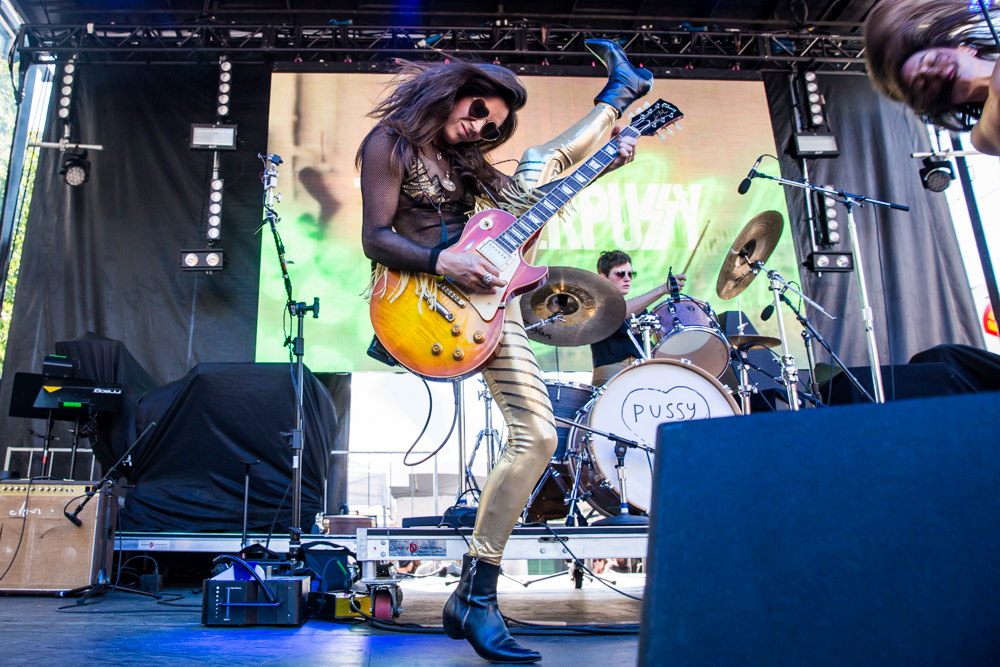
Whitney Petty. guitarists for the band Thunderpussy is one of the most accomplished guitarists in the Pacific Northwest. Her energetic and powerful licks have most likely entered your ears via her band Thunderpussy or one of the many other projects she’s been a part of.
Thunderpussy have had a busy 2018. After a couple years filled with a steady stream of increasingly well-attended local performances and local festival billings, the group (Petty on guitar; MollySides, vocals; Leah Julius on bass; and Ruby Dunphy, drums) released their self-titled debut album and hit the road for a tour of the U.S. and UK, giving other parts of the world a taste of their theatrical and high-energy live show.
Clearly, Petty has good reasons to feel accomplished and excited for the future, but she’s quick to credit her bandmate’s talents and strength of character as the biggest contributors to the group’s success.
“On stage is really important,” she says. “Having great material is really important. And there’s this other thing, which is being present, kind, gracious, and just a good person.” She says this with confidence and a sense of relief comes off of her voice, her gratefulness radiating.
Not surprisingly, the band’s name has helped draw attention to their music as well. In fact, Thunderpussy is part of a large trademark case that has reached the Supreme Court. The case revolves around whether groups can claim trademarks on names or words that are considered to be “scandalous” by the United States Patent and Trademark Office. Oral arguments will be made in mid-April in Washington D.C.
After all the trouble Thunderpussy has gone through on this issue, I certainly hope that they are granted the ability to trademark their band name.
Legal issues haven’t slowed the band down, musically. They are at work on a new album and, today, we’re excited to share their brand new single, a cover of Jefferson Airplane’s “Somebody to Love,” a staple and fan favorite from their highly entertaining live show.
Thunderpussy performing Somebody To Love (Audio). under exclusive license to Stardog Records/Republic Records, a division of UMG Recordings, Inc
On Ramonda Hammer’s searing debut LP “I Never Wanted Company”, front-woman Devin Davis takes a hard look at her struggle between despairing loneliness and embracing independence. The Los Angeles quartet’s blistering guitars and Davis’s paint-peeling vocals – recalling past greats like Hole and likeminded contemporaries like Mannequin Pussy – form the support for lyrics that grapple with two years of emotional upheaval for Davis.
Since the band released their 2017 EPDestroyers, a release that cemented Ramonda Hammer as a tentpole act in LA’s surging community of woman- and queer-fronted bands, Davis struggled to come to terms with her codependency, fought against her own overwhelming over-analysis, and got into her first queer relationship.
The result is an album that’s bruising, cathartic, searching, and ultimately therapeutic. Featuring production by Alex Newport ( At The Drive In, Bloc Party), I Never Wanted Companyis a powerful and triumphant return for the quartet – including Justin Geter on guitar, Andy Hengl on bass, and Mark Edwards on drums.
“No one is coming! No one!” Davis wails at the end of lead single “Hoax”. On its face, it’s a bleak and almost nihilistic statement – but for her, it’s a call to independence. Davis hopes the album will help people who want to take better control over their own lives and emotions. “I’m an anxious person,” she says. “It helps me to play loud rock music with gritty sounds and brash lyrics. Sometimes you to scream to wake people up.”
“Bridges To Bremen” is a full-length show performed by the Rolling Stones on the fifth and final leg of the Bridges To Babylon Tour. Filmed at the German city’s Weserstadion on September 2nd, 1998, the band had by then completed four legs in the stadiums and arenas of North America (twice), Asia and South America before finally landing in Europe early that summer. Ever the innovators, Bridges To Babylon was a tour of firsts – the first time the band went on the road with a permanent B-stage, and also the first time where fans could vote on the band’s website for a track they wanted to hear at the show – “Memory Motel” in the case of the Bremen fans. This concert film has been meticulously restored from the original masters, and the audio remixed and remastered from the live multitrack recordings. Four tracks from their Soldier Field performances in Chicago are included as bonus features. Eagle Vision’s SD Blu-ray range presents upscaled standard definition original material with uncompressed stereo and DTS-HD Master Audio surround sound for the best possible quality.
1998 concert film • Remixed audio • Restored visuals • Surround sound • 2CD+Blu-ray, 3LP vinyl + more formats
In terms of audio and picture quality, it sounds promising, since Eagle Vision state that the film has been “meticulously restored from the original masters” while the audio has been remixed and remastered from the live multitrack recordings. Remember, even though this is offered on blu-ray, this isn’t full HD but ‘upscaled standard definition’. In terms of sound, we get uncompressed stereo and DTS-HD Master Audio surround sound.
Bridges to Bremen will be released on 21st June 2019.
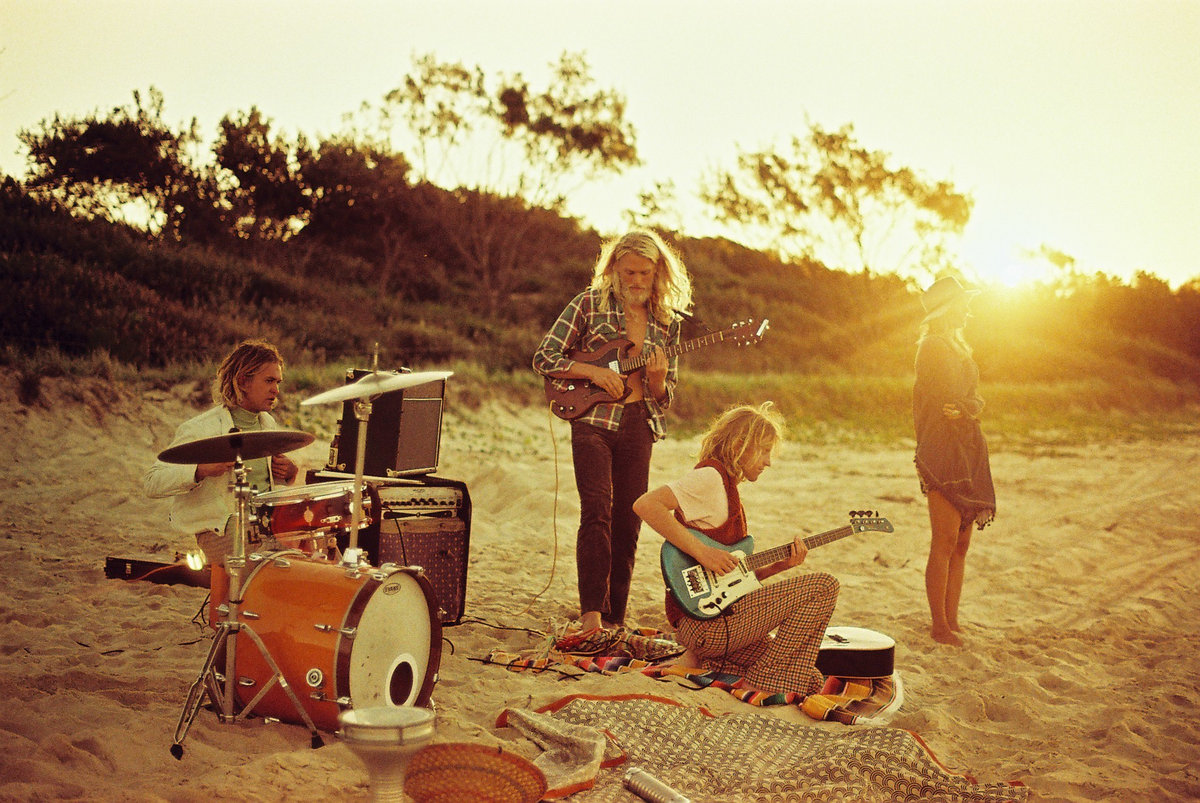
The Babe Rainbow was formed in the summer of 2014 by Angus Dowling and Jack Laughlan Crowther in the coastal surf town of Rainbow Bay, Australia. Students of English, lovers of permaculture, riders of waves – the pair also found common ground in the 60’s music like The Incredible String Band and Swing Mademoiselles. Their early singles attracted the attenion of Flightless Records who went on to release their breakout single Secret Enchanted Broccoli Forest. The band, which now includes Lucas Mariani and Jessi Dunbar, caught the attenion of US record producer, artist and now label owner Danger Mouse who signed them to his 30th Century Records. The album was produced by Stu Mackenzie (King Gizzard and the Lizard Wizard).
They come loosely from the same staple as King Gizzard and the Lizard Wizard, and are similarly enamoured of the less murky side of 60’s psychedelia. Their album, Double Rainbow epitomises the summer vibe with its mellifluous harmonies, second-gear beat architecture and bright acoustics. Double Rainbow has some influences from the 60’s such as The Beatles and Grateful Dead, as you’ll read elsewhere, but what it really reminded me of was J.J Cale’sNaturally. Listen to ‘Darby and Joan’ and tell me you don’t hear ‘Call Me the Breeze’. Not only the song structure but J.J Cale’s easy swagger and insouciance. Front porch therapy. Replete with tropical aromas, gentle breezes and cool temperament.
‘Eureka’ clamours successfully for that vibe as well, but ventures more into sunset party territory with accentuated wah-wah and a drummer riding the cymbals with free abandon. The album starts out with a song, ‘The Magician’, so assured, so beautifully written, it’s hard to believe these guys have been only hanging together for a year and a half. Probably longer as surfing mates if the truth be known.
The Beths are an Auckland quartet who pen stylish guitar pop with a keen lyrical bite. All four members studied jazz at University giving them the technical proficiency to contort simple pop structures and perfect, lush vocal harmonies. Check out a super rad performance by the Beths“Live at Lincoln Hall”. Recorded on March 6th, 2019 in Chicago, IL.
Tracklist:
1. Whatever
2. Happy Unhappy
3. Little Death
Band Members
Elizabeth Stokes – Vocals and Guitar
Jonathan Pearce – Guitar and Vocals
Benjamin Sinclair – Bass and Vocals
Ivan Luketina-Johnston – Drums and Vocals
The Pixies‘ “Doolittle” is to be thirty years old this month, it was the second studio album by American alternative rock band Pixies, released in April 1989 on 4AD Records. The album’s offbeat and dark subject material, featuring references to surrealism, Biblical violence, torture and death, contrasts with the clean production sound achieved by the newly hired producer Gil Norton. Doolittle was the Pixies‘ first international release.
Pixies released two singles from “Doolittle”, “Here Comes Your Man” and “Monkey Gone to Heaven”, both of which were chart successes. “Debaser” the opener from that classic album, “Debaser” is a lot of people’s favourite Pixies song. When they play it live, it’s a guaranteed catalyst for chaos on the floor. Played live or on record, it’s a song that illustrates the alchemy that the Pixies are capable of at their peak. If you strip it down to its base elements, there’s really nothing to it , Black Francis’ nonsense lyrics – nominally inspired by the Buñuel/Dali surrealist film Un Chien Andalou, but essentially meaningless, though well-suited to being barked out by the frontman, Along with Joey Santiago’s four-chord riff and simple finger-picked accents and Kim Deal’s characteristic bassline for beginners.
Doolittle, Pixies’ second album proper, contained so many great tracks it’s inevitable that a few would fail to get their day in the sun. With its weird reggae introduction and Francis sounding more deranged than ever – suddenly transforming into something new and unexpected a good three or four times in the space of a couple of minutes – ‘Mr Grieves’ is not a song you often see cited, yet it remains a prime example of the band at their most schizoid and hyperactive. Definitely worthy of rediscovery.
Of course when it all comes together, driven by one of David Lovering’s best performances on drums and executed with passion and panache and more enthusiasm than a band that’s starting to fall apart should be able to muster, it’s a majestic, superlative, enduring, adrenalized, alt-rock classic. augmented by Kim’s backing vocals. Joey doesn’t have to shred when he’s making such an uplifting, joyous noise and that bassline – well, that’s trademark Pixies.
This album “Doolittle” still sounds sensational three decades on – from Debaser through to Gouge Away. The Pixies, at their best, aren’t so much a band as a group of alchemists.
Despite being issued on hi-res SACD in the past this is the Doolittle‘s debut in 5.1. Kevin Vanbergen has created the new surround mix from the original analogue multi-tracks.
This new edition will also feature an HD transfer of the original stereo mix by Mobile Fidelity Sound Lab. The album was reissued back in 2014 for its 25th anniversary. The album has been cited as inspirational by many alternative artists, while numerous music publications have ranked it as one of the most influential albums ever. A 2003 poll of NME writers ranked Doolittle as the second-greatest album of all time.
This blu-ray audio of Doolittle was released on 9th December and is on Amazon in the USA and is available to pre-order from the 4AD Records store.
Pixies
Black Francis – vocals, rhythm guitar, acoustic guitar
Kim Deal – bass guitar, vocals, acoustic slide guitar on “Silver”
Joey Santiago – lead guitar, backing vocals
David Lovering – drums, lead vocals on “La La Love You”, bass guitar on “Silver”
Conceived over a bucks fizz binge in Birmingham, UK early 2018, Cherry Pickles comes at you like the basement band you always wanted to start. Priscila B brings from Brazil her love of early Tropicalia and the kind of ‘let’s be bad’ attitude that can only come from a land chock full of Catholic guilt. Mimi B brings her love of stripped down, bare essential rhythm. If two drums are good enough for Peggy O’Neill then they should definitely be good enough for you. Together they bonded over a mutual love of 50s malt-shop-pop, 60s minimalist garage, no wave, fuzz and all forms of outsider art. ‘Art damaged’ isn’t a slur, it’s a compliment. Anything lost in translation with this transatlantic duo only doubles the charm.
As a duo, they work perfectly together. Each song is driven by Mimi’s backbeat of tomtom and snare. It’s simple but man it works. Priscilla B has it all. She flirts between english and Portuguese while her simple but effective guitar playing leads the charge.
They may play simplified, striped down, lo-fi garage rock, but believe me there is some magic to be heard here. The musicianship is primitive (apparently Cherry Pickles even play second hand cheap instruments) but it all sounds so natural. Just listen to a song like ‘It Will End in Tears‘ for proof that Cherry Pickles can write a decent tune.
Their debut has the cheeky title ‘Cherry Pickles…Will Harden Your Nipples‘ and depending on your mood, it will quite possibly do just that. This is music for playing spin the bottle, or drinking cans of cherry coke in a treehouse, or go-go dancing with the flash of swirling lights. Hooky, reverb-tremolo pop with Link Wray riffs and stomping beats. This is garage rock done right.
Paul Raymond, the keyboardist and guitarist from UFO who also did stints in Savoy Brown and the Michael Schenker Group, has died only a few days after the band concluded a tour. He was 73 years old.
Born November 16th, 1945 in St. Albans, England, Raymond started out playing jazz in early 1964, and formed a psychedelic prog band, Plastic Penny, in 1967. The group, which included future Elton John drummer Nigel Olsson, had a Top 10 U.K. hit with its debut, a cover of the Box Tops’ “Everything I Am,” but broke up towards the end of 1968.
From there, he joined the British blues band Chicken Shack, replacing Christine McVie when she became a member of Fleetwood Mac. But after they were dropped by their label following the commercial failure of 1970’s Accept,Raymond and two of his bandmates left Savoy Brown, which itself had seen three of its members depart for Foghat.
Raymond had spent five years in Savoy Brown, but during a 1976 show in Saginaw, Mich., where they were on the same bill as UFO, he got into a conversation with bassist Pete Way, who said that UFO were planning to fire keyboardist Danny Peyronel because they wanted someone who could also play rhythm guitar. Upon their return to England, Raymond passed the audition, and UFO entered what’s considered by many to be their classic period.
However, in 1981, tensions in the band were running high and Schenker, who had jumped ship to form his self-named group a year earlier, offered him a job. But soon after the release of MSG, Raymond had what his website’s bio described as a “non-music-related altercation” with Schenker and was let go.
He then worked with Way in Waysted and returned to a new lineup of UFO in 1984. But he left after two years, midway through a U.S. tour, due to numerous problems within the band. In 1993, he, Schenker and Way reunited with Phil Mogg. But when Schenker walked out mid-gig in Japan, Raymond decided it was time to leave the road. He eventually took a much different gig, playing jazz piano at a hotel and several casinos in London.
UFO came calling again, in 2003, and Raymond stayed with the band until his death. It is unknown as of press time how Raymond’s death will affect the upcoming U.S. dates on their farewell tour that begin in October.
The news was broken this morning (April 13th) on his Facebook page. “Hi to all the fans and people who knew Paul! This is Sandra, Paul’s life partner speaking,” she wrote. “With a desperate and broken heart, fully in tears and pains that feel like they will kill me I have to tell you that my most beautiful and beloved darling Paul Raymond has passed away today. The doctors were trying to reanimate him and with success at first but then his system shot down again and there was nothing more they could do for him, he died of a heart attack. He absolutely enjoyed the last couple of weeks touring with UFO in the U.K. & Ireland and he was looking forward to the rest of this year’s tour.”
UFO wrote that they were “too shell-shocked” by the news and shared Sandra’s update. They included a photo of Raymond from that last concert and added, “Thank you to everyone for your very kind and supportive messages.”
Paul Raymond first joined UFO in 1976, and played on the classic albums Lights Out, Obsession, and No Place to Run,and on the legendary live album Strangers In The Night. With four different stints in the band, he had been a regular fixture in the lineup since 2003.
If you’re any kind of cinephile, you’ve probaly seen Bette Davis as an aging Broadway diva in the 1950 classic “All About Eve”. But for all you lucky theater goers , there’s now a modern stage adaptation of the Academy Award–winning film, starring our favorite redhead Gillian Anderson (The X-Files) and Lily James (Mamma Mia!). It’s currently playing at the Noël Coward Theatre in London’s famed West End.
Later this month, the production’s original soundtrack comes out—including twelve tracks and ten original pieces of instrumental music, plus two eerie songs written by PJ Harvey and sung by Anderson and James. Singer-songwriter Harvey has long since supplemented her daring albums with compositions for film, TV, and theater.
Of the score and her collaboration with theater director Ivo van Hove, P.J.Harvey said in a press statement: “I have always loved stories, and so to compose music to support and enhance a story being told is a challenge I enjoy. I also love the freedom that working instrumentally can give me without the constraints of song form.”
Listen to “The Moth,” which features vocals from Lily James, as well as the instrumental track “Descending” below.
Taken from the PJ Harvey Original Score to the West End theatrical production of ‘All About Eve.’
‘The Moth’ Written and Composed by PJ Harvey Vocals by Lily James
Performed by PJ Harvey, Lily James, James Johnston, and Kenrick Rowe
Released April 12th 2019 via Invada Records and Lakeshore Records.
taken from the Original Score to the West End theatrical production of ‘All About Eve.’ ‘Descending’
Composed by PJ Harvey Performed by PJ Harvey, James Johnston, and Kenrick Rowe
Released April 12th 2019 via Invada Records and Lakeshore Records.
The All About Eve soundtrack is out April 12th via Lakeshore/Invada. ‘All About Eve,’ directed by Ivo Van Hove, stars Gillian Anderson and Lily James, and is produced by Sonia Freedman Productions.
Steven Van Zandt – known widely in music circles as Little Steven and Bruce fans as Miami Steve, among other sobriquets – is something of a New Jersey renaissance man, yet he’s never been one to really seek the spotlight.
Whether it’s his long-standing role as Bruce Springsteen’s right-hand man in The E Street Band – it was Van Zandt himself who gifted him the nickname “The Boss” – or in his lauded TV role as Silvio Dante in The Sopranos, he’s usually happy playing sideman to bigger names, a role he carries off with a humble aplomb.
There are, of course, exceptions to every rule – he had the lead role in short-lived Norwegian-American gangster series Lilyhammer, and he hosts his own beloved Underground Garage radio show which is syndicated all over the world – but mainly Van Zandt is happy to eschew the limelight and leave the grandstanding to others.
Little Steven & The Disciples Of Soul covering The Southside Johnny and Asbury Jukes classic, “I Don’t Wanna Go Home”, performed by Little Steven & The Disciples of Soul at BluesFest 2016.
But with The Boss a couple of years ago deciding to make a lengthy one-man stand on Broadway and his acting commitments having temporarily dried up, Van Zandt found himself reviving the ‘80s outfit he’d formed during another hiatus from The E Street Band – this time when Springsteen was assembling his 1982 solo masterpiece Nebraska – namely Little Steven & The Disciples Of Soul.
His solo project had found him returning to the Jersey Shore sound that Van Zandt had helped formulate back in the ‘70s, first with his early group Southside Johnny & The Asbury Jukes and then on the early Springsteen records (which he largely arranged), and then over the course of a number of staggered albums taking that sound into new and routinely fascinating places.
Yet he’d barely even considered that body of work for 20 years when in mid-2016 he was randomly invited by a London promoter to appear at a UK blues festival, after which he pulled a new version of the band together and hasn’t looked back. Since then the band has two new albums to their name – Soulfire (2017) and Summer Of Sorcery (2019) – and has been touring ever since to global acclaim, something Van Zandt had never envisaged happening again.
“Yeah, it’s been quite an experience and I’m very, very happy I did it,” he chuckles. “It was fortunate, Bruce decided to spend some time on Broadway and I didn’t have a new TV show going, so just through those random circumstances I ended up revisiting my own work, and I found it to be really quite rewarding.
“I hadn’t realised the value of the stuff and how well it all held up and how it had kinda become its own genre through the years, that ‘50s rock-meets-soul thing which at this point is quite unique.
“So it’s just been fun to revisit your stuff and try and reconnect with an audience again and see how the stuff holds up. It’s been quite a year-and-a-half of exploration and discovery and it’s been a very, very satisfying response from the audience – the audiences have been going crazy!”
The Disciples Of Soul are a 15-piece powerhouse, but Van Zandt is like a pig in mud back putting their massive sound together.
“The arranging is the fun part,” he smiles. “I’ve been using five horns ever since we put together Southside Johnny & The Asbury Jukes really which was mid-‘70s, and then I carried that same sound into my first solo album in ’82. Then the rest of my solo albums are all very different from each other, so I just went back to it recently.
“Plus I recently produced an album for the great Darlene Love and she had these great background singers so I fell in love with background vocals, so that’s the one thing I’ve added to my sound now. I just thoroughly enjoy the horn parts and the string parts and the background vocal parts all being woven together and complementing each other, and making sure that they all work together and don’t step on each other and don’t cancel each other out and they all work dynamically: that’s the fun part for me.”
And being in the spotlight again? Little Steven is fine with it, but you can tell that he’s still taking on such prominence reluctantly.
“I’ve never really needed it, my inclination is to be behind the scenes,” he reflects. “I’m really a producer at heart – that’s how I describe myself. I really am a producer first, but I am a performer and I do enjoy being a sideman.
“Even as a frontman I got really quite good at it in the ’80s – you get used to it and you get good at it – and I’m almost halfway back to being a frontman, I’m not all the way there yet. I’m working my way back because it’s a big mountain to climb, man, it’s a whole different job and you actually have to work for a living as opposed to being ‘the guitar player’ where you can just muck around.”
Van Zandt is famously well versed in many different types of music – as well as the Jersey Shore sound he helped found, he’s a noted rock’n’roll aficionado and curates satellite radio stations covering both garage-rock and outlaw country – and he puts these disparate passions in part down to the timing of his earliest musical forays.
“I think growing up when we did, it was an extraordinary period of time,” he marvels. “It was an absolute renaissance in the sense that the greatest music being made was also the most commercial, which we’ll never see again or not for hundreds of years, I think.
“More than that, we were, in a funny way, pretty much a monoculture back then and the trends would come and go year by year: in ’64 everyone’s into the British Invasion, in ’65 everybody is into folk-rock and that’s when The Byrds and Bob Dylan started, in ’66 it might have been country-rock so everybody gets into country music and then it was jazz-rock so everybody gets into jazz, and then in ’67 it’s psychedelic-rock so everyone gets into that – and I mean everybody! – and then in ’68 blues-rock came in and everybody got into blues, and then the final trend of the ‘60s in ’69 was southern-rock, which is more rootsy and Americana and The Band and Delaney & Bonnie and Taj Mahal and The Youngbloods and people like that.
“And believe it or not most musicians would follow from one trend to the other and you’d pick up some pieces of it – you’d take some of it for your own identity – and then some would stay in it: some would get to country-rock and they’d stay there, some would get to blues and they would stay there for the rest of their career. But a lot of us would go from one to the next, and you’d learn that genre and pick up what you want from it for your own identity and then you’d move on to the next one.
“So I think partially it was a result of growing up in that time, when things went from one trend to another and we were all going to school without knowing we were going to school. Parts of each genre stick with you and in the end you tend to just appreciate greatness whenever you hear it, it doesn’t matter what genre it is really. Even if it’s not a genre that you’re particularly fond of or use for your own identity, greatness is greatness and you recognise it and you appreciate it. I think that’s what’s stuck with me all these years.”