There was the shoegaze phase some years back so at some point, after working my way through the staple bands (My Bloody Valentine, Ride, Slowdive, The Jesus and Mary Chain, etc.), I stumbled upon Hum possibly through fellow ’90s Chicago bands Pinebender or Lovesliescrushing. Hum were more aggressive than many of the other shoegaze bands I was listening to, thanks to their post-hardcore and metal roots, and their 1998 album, Downward Is Heavenward, left a big impression on me with its scorching riffs and heavy use of phasers. Two years after that album came out, they got dropped by their label and called it quits, but this week, 22 years after the release of that record, they surprise-released a new LP called Inlet. As expected, there are plenty of thick, driving and flat-out thundering guitar passages (“Waves” and “The Summoning” will blow your head off), and their sensitive, mystical sides come out too (“Desert Rambler,” “Shapeshifter”). It’ll take a while to explore all the nuances of their smouldering soundscapes, but this album is an instant listening winner.
Hum is happy to announce the release of our new album, Inlet. Vinyl (180g double LP), CD, pre-order via Polyvinyl Records “Waves” the first single from Hum’s new album “Inlet” – Earth Analog Records Released on: 24th June 2020. The Band:
Matt Talbott,
Tim Lash,
Jeff Dimpsey,
Bryan St. Pere,
The record is also available for consumption at http://humband.bandcamp.com and will ripple out to all digital platforms within the week.
Despite being only 22, Samia has a self-awareness beyond her years. The indie singer-songwriter is masterful in her sharp lyrics, which capture common anxieties and frustrations with a poet’s charm. She finds painful moments and leans into their messy, ugly details, transforming them into defiant common touchstones speckled throughout life. One breakup song ends mid-sentence, evoking the discomfort and anticipation of separation, while another is inspired by a high-school memory of boys groping her breasts, using the experience to inspect the politics and power of women’s desirability.
But, the New York singer offers more than poignant confessional lyrics. She also crafts striking compositions, which range from dramatic, wailing folk ballads backed by simple piano or acoustic guitar accompaniments to gritty and grungy rock anthems. Always at the forefront is her crystalline voice, carrying each number with its deft transitions between ranges and its emotional power.
Using this idea of two distinct selves as framework, the indie rocker teamed with director Nick D’agostino to craft a music video that illustrates the disparity. My first album is called “The Baby” and it’s coming out via Grand Jury on 28th August. made it with my friends caleb hinz, jake luppen, nathan stocker and lars stalfors kramer
2nd single off the record is called Fit n Full and i wrote it with Tom D’Agustino and it’s out now!!
Official music video for Samia’s “Is The Something in the Movies?,” from her debut album The Baby, coming August 28th.
Haim new album Women in Music Pt III” is available now. Haim are really about to drop one of the best albums of the year with ”Women in Music Pt. III”, huh?! Following on from the release of the Stones-esque “The Steps,” the sibling trio are leaning in a more electronic direction on “I Know Alone” – a shifty, percussive dance piece about loneliness that hits different in our weird new quarantine world: “Been a couple days since I’ve been out/Calling all my friends but they won’t pick up/Found another room in a different place/Sleeping through the day and I dream the same.” This is the American rock/pop trio’s third studio album and it will feature 16 songs, although the full track listing is still to be revealed. You can listen to ‘The Steps’ below. Because of the length of the album, this will be a 2LP vinyl pressing.
Danielle begins the third HAIM LP by bemoaning the city that built them. “Los Angeles, give me a miracle,” she sings after a flurry of saxophone starts the song. “I just want out from this.” She continues into the chorus as her sisters Alana and Este join in on backup, singing “These days I can’t win.” The City of Angels is also the city of sweaty, broken dreams, as any struggling actor, screenwriter or regular-person-stuck-in-traffic can tell you. Even Danielle—primary songwriter for the trio—who was born, raised and primed for rock stardom in the sprawling city clearly can’t stand it some days. Danielle’s depression, which she has attributed to the struggles she and her partner/producer Ariel Rechtshaid faced upon his testicular cancer diagnosis in 2016, informs some of Women in Music Pt III most specific and heartfelt lyrics. But her sisters’ struggles are just as important. Alana remembers her best friend who passed away at 20, while Este’s life has been full of ups and downs since her Type 1 diabetes diagnosis during her freshman year of high school. They all lean on each other, and that love is perhaps loudest in stirring folk number “Hallelujah.” Though outwardly carefree, Women in Music Pt III finds HAIM exploring darker and more serious matters than ever before, which is one reason why it’s their most complete and forward-thinking release yet. Many of these songs find Danielle, Alana and Este flat on their backs, but it’s never long before they’ve returned to their default position: upright, strutting confidently through the streets of L.A. and life itself.
Women in Music Pt III was originally due to be issued in April but will now be released on 21st August 2020.
Capturing the messy upheaval of the ’70s just as rock was re-inventing itself, the film explores CREEM Magazine’s humble beginnings in post-riot Detroit, follows its upward trajectory from underground paper to national powerhouse, then bears witness to its imminent demise following the tragic and untimely deaths of its visionary publisher, Barry Kramer, and its most famous alum and genius clown prince, Lester Bangs, a year later. Fifty years after publishing its first issue, “America’s Only Rock ‘n’ Roll Magazine” remains a seditious spirit in music and culture. Director: Scott Crawford
If Rolling Stone aspired (after somewhat “underground” beginnings) to be the Rolls Royce of rock magazines, CREEM was by contrast the Volkwagen band-van: pungent with reefer, speed sweat, and last night’s groupie action. The hubris that had it self-dubbed “America’s Only Rock ’n’ Roll Magazine” was strictly of a working-class, sex-drugs-and-you-know-what variety that ridiculed all upscaling pretensions, musical or otherwise. Scott Crawford’s “Boy Howdy! The Story of CREEM Magazine” is a brief, careening survey through the publication’s two-decade life and times, filled with colorful personalities and commentary. Vintage rock fans will be in (cough) high heaven.
The director’s prior feature was 2014’s “Salad Days,” a history of the influential Washington, D.C., hardcore punk scene. While this sophomore effort numbers late CREEM publisher Barry Kramer’s surviving ex-wife and son among its producers, it provides a similarly critical overview of another enterprise whose creativity largely sprang from the volatility of the personalities involved.
Starting as a regional publication, and forever kicking against the coastal biases of the music industry and entertainment media, CREEM launched in a 1969 Detroit already shaken by racial strife and “white flight.” Kramer’s co-founder Tony Reay hoped for an erudite blues-rock forum (hence the monicker nod to then-supergroup Cream). Within a few issues he was out, and in hiring new editor Dave Marsh, Kramer found a sparring partner more in tune with his own goals. Which were to create a mag both populist and subversive, something whose possession was what locally-raised actor Jeff Daniels calls akin to “buying Playboy — you didn’t want your parents to see either one of them.”
Working in a space over a record store-cum-headshop in a “decrepit” inner-city neighbourhood before a disastrous two-year move to their own rural “commune,” the staff were “all a little crazy,” with Kramer (whom one person here muses may have been bipolar) hardly a stabilizing influence. His clashes with Marsh finally drove the latter to greener pastures, i.e. Rolling Stone. A longer, in many ways defining resident was Lester Bangs, whose gonzo writings pushed even this mag’s envelope in terms of brilliant insight mixed with juvenile impudence often tipping into straight-up insult. While their vehicle often poked fun at hedonistic rock-star excesses, both Kramer and Bangs would burn their candles at both ends to premature demises by the early 1980s.
CREEM’s outrageousness had a sort of permanently-adolescent-male tenor, and was largely aimed at that audience, with no end of sexist japery clinching the deal. (“It was the ’70s, so sue me,” shrugs one female ex-contributor here.) But it also provided foot-in-door opportunity to a lot of women journalists, who in turn mentored others. In addition, its shameless testosterone-driven character meant it was an early embracer of metal and punk music — two realms that stodgy Rolling Stone shunned until its grudging acceptance itself seemed old-fogeyish. The Detroit acts it stubbornly championed, like MC5 and The Stooges, in many ways anticipated those genres, which were themselves as anti-aspirational as the magazine itself.
When Kramer died in 1981, Connie Kramer wanted it to keep it going as a “legacy” for their son JJ, but CREEM ran out of steam at decade’s end. Still, it’s fondly remembered by many here, from critics and contributors to stars of its heyday (Alice Cooper, Ted Nugent), as well as future members of R.E.M., Red Hot Chili Peppers, Pearl Jam and more, whose rock dreams were fueled by its non-parentally-approved pages.
In addition to the plethora of latter-day talking-head interviews, Crawford’s very lively package incorporates crude old office videotapes, musical performance snippets, and some simple animation. If anything, “Boy Howdy!” (named after CREEM’s R. Crumb-designed “mascot” figure) is too brisk, not even reaching the 70-minute mark before its final credits. While “Salad Days” mined its subject a little too exhaustively, one gets the sense here that Crawford has barely scratched the surface in terms of outlandish vintage “I’m with the band” (or with Lester Bangs) stories, for starters.
Still, it’s always good to leave ‘em wanting more, and this compact, well-crafted documentary will no doubt make viewers comb eBay and garage sale print stacks for all the old CREEM issues they can find.
‘Boy Howdy! The Story of CREEM Magazine Running time: 73 MIN.
Production: (Documentary) A New Rose Films production. (Int’l sales: Sunshine Entertainment, New York City.) Producers: JJ Kramer, Jaan Uhelszki. Executive producers: Connie Kramer, Margaret Saadie Kramer, Todd Edinger.
Crew: Director: Scott Crawford. Screenplay: Crawford, Jaan Uhelszki. Camera (color, HD): Jim Saah. Editor: Patrick Wright. Music: Wayne Kramer.
With: Wayne Kramer, Cameron Crowe, Jeff Ament, Chad Smith, Niagra Detroit, Ted Nugent, Peter Wolf, Jeff Daniels, Ann Powers, Michael Stipe, Lamar Sorrento, Michael N. Marks, Roberta “Robbie” Cruger, Resa Jannett, Bob Stark, Dave DiMartino, Connie Kramer, JJ Kramer, Robert Duncan, Lenny Kaye, Alice Cooper, Suzi Quatro, Mitch Ryder, Susan Whitall, Greil Marcus, Robert Christgau, Bebe Buell, Thurston Moore, Chris Stein, Kirk Hammett, Joan Jett, Gene Simmons, Paul Stanley, Legs McNeil.
Bloomington, Minnesota. indie duo Remo Drive have unveiled their third LP A Portrait of An Ugly Man. the first single “Ode to Joy 2,” taken from the album, is an edgy ballad inspired by alcohol, and the accompanying video is the visual representation of that fun drunken Friday night in the backseat of your friend’s car. “The lyrics were inspired by the excess I perceived around me as I transitioned from being a college student into touring full time,” says vocalist Erik Paulson. “Most people who’ve done either can confirm that many social interactions are built around having a drink or smoking weed. Once the honeymoon period of exploration was over for me, I became frustrated with the omnipresence of drugs and alcohol and wanted to write about it.”
The song has the same jaded sound as their last record Natural, Everyday Degradation, which was heavily imbued with nihilism. It seems like the hedonistic days of their debut, Greatest Hits, are already over.
Pottery’s debut EP, No. 1, made our mid-year best post-punk list last year thanks to its bluesy, funky take on post-punk. This coming Friday , the Montreal five-piece are unleashing their first full-length, and it’s even more eccentric than we were expecting (or hoping). It’s full of psych-punk jams so surreal and danceable that falling down their wormhole and grooving to the beat are not optional. Make sure you polish off your dancing shoes before diving into its off-the-wall percussion and snappy guitars. Their sky-high dance-punk and witty psychedelia can hardly pack more tightly-coiled zip.
Here’s a jagged new single from Montreal band Pottery’s upcoming debut album, “Welcome to Bobby’s Motel”, which is out in June. It goes from a rigid start into something decidedly more funky. “While there are hints of environmental themes on this one, we mainly wanted to make a disco song with a robotic feeling, something that could be easily chanted,” say Pottery. “Austin was originally really interested in heat as a musical concept/feeling – some of the early album titles we threw around were ‘Hot Hot Hot’ and ‘Sun Fever’ – and there are a bunch of other heat references on the album [see previous single ‘Hot Like Jungle’. In the studio he’d be joking around and yelling stuff at us like ‘let’s make it hot!’ right before a take. A lot of that didn’t end up totally sinking in, but some did…like on this song.”
“Hot Heater” from ‘Welcome to Bobby’s Motel’ out June 26th on Partisan Records and Royal Mountain Records.
North Carolinian folk-fusion artist Ryan Gustafson (who performs under the alias The Dead Tongues) today releases his latest album Transmigration Blues via the Durham-based label Psychic Hotline. The news arrived last month with the lead single, “Peaceful Ambassador.” Gustafson is thoroughly rooted in the North Carolina music scene, having previously served as guitarist for both Phil Cook and Hiss Golden Messenger. He also counts Mandolin Orange and Mountain Man as friends.
He recorded Transmigration Blues, his fourth album, during summer 2019 in the midst of a bout of depression. But the record doesn’t only promise gloom. ”’Transmigration Blues’ belongs to the moments weaving between uncertainty and discovery,” he says of the release.
From The Dead Tongues album “Transmigration Blues”, out now via Psychic Hotline
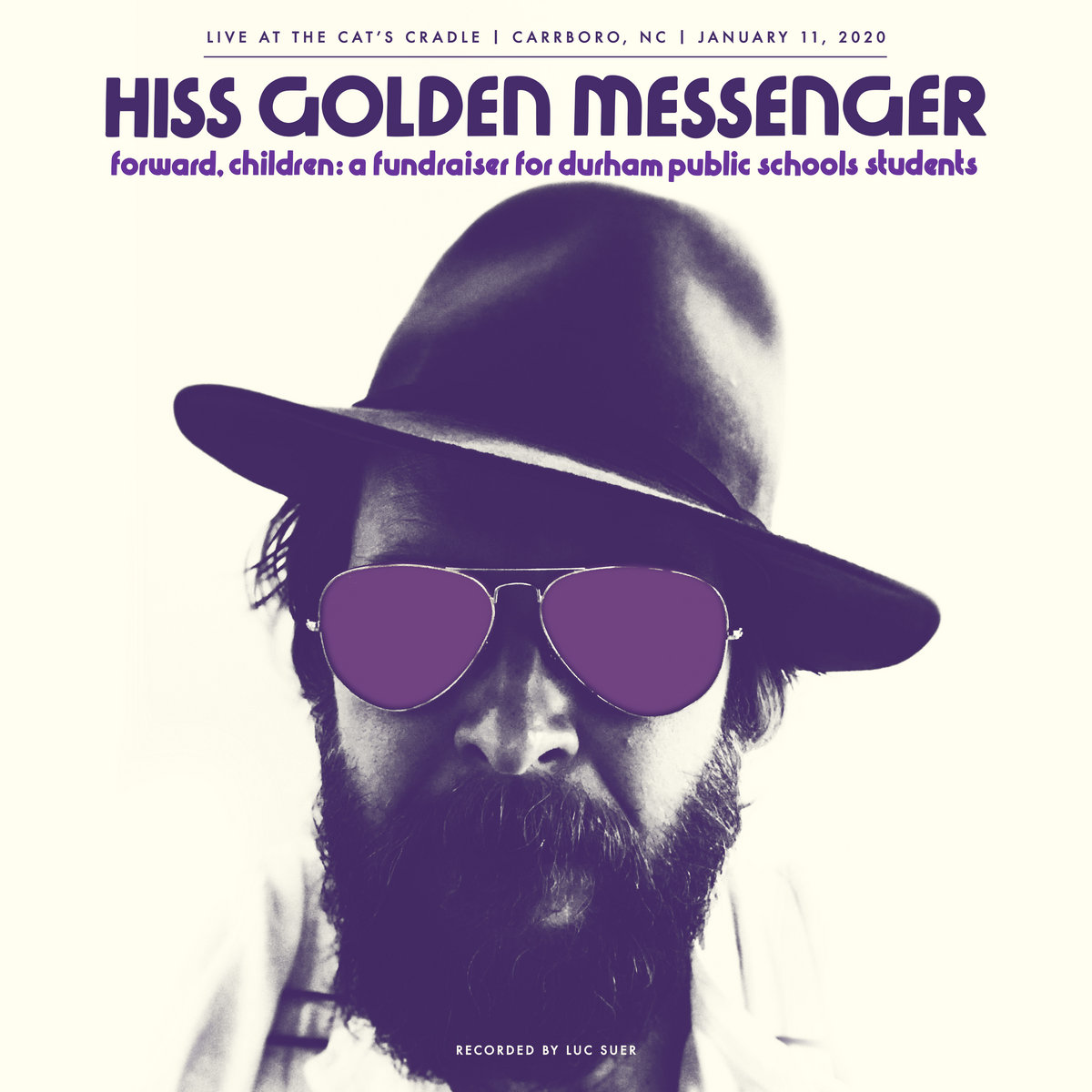
When M.C. Taylor moved to North Carolina more than a dozen years ago now, Hiss Golden Messenger was his private enterprise, an outlet for the curious songs he composed quietly at his kitchen table in the country. But soon after Taylor and his budding family moved to a modest home nestled back from busy roads in the gentle Durham hills, he began building a network of local aces, all sympathetic to songs that documented his quest to be a better human being. Hiss Golden Messenger became and remain a community endeavor, an indelible part of North Carolina’s historic and contemporary musical fabric. The 15 songs of Forward, Children: A fundraiser for Durham Public Schools students are an instant illustration of that decade-long arc, a one-night snapshot of Hiss Golden Messenger’s metamorphosis from solitary songwriter fare to full-band jubilee.
Just days into 2020, the quintet—well-rested from a holiday respite after a busy 2019 that included some 60 shows across the United States and the release of the gripping Terms of Surrender—loaded into their home region’s legendary hub, Cat’s Cradle, for a two-night stand. For nearly 90 minutes, they smoke, sorting through the greatest hits of the Hiss Golden Messenger songbook with the intuition of a band that accepts these tunes as gospel but plays them with the verve of five folks delighted to be back on the same stage.
Lifted by trombone and organ, “Highland Grace” sounds here like a prayer for the salvation of love. Buttressed by bounding piano, “Saturday’s Song” feels like a relief anthem for these fraught times, a beaming reminder of celebration and communion. Drifting and then roaring, “When the Wall Comes Down” is an urgent reminder that catastrophe and humanity know no arbitrary borders, that we are all forever bound to one another. During “Jesus Shot Me in the Head,” they unravel into a cleansing 12-minute upheaval, the sound of self-doubt looking for the relief of resolution—and finding it, at last.
The son of two teachers, Taylor taught for a spell at the University of North Carolina-Chapel Hill, arguably the nation’s first public university, after finishing his graduate degree there, joining one of the country’s proudest educational lineages. His wife, Abby, is now an ESL instructor in Durham, and his children, Elijah and Ione, are in the fifth and first grades there, respectively. In mid-March, due to the COVID-19 pandemic, Durham Public Schools closed like most others nationwide, at least through mid-May. The necessary move means that many children throughout the school system don’t know where they’ll get their next meal, a profound failure of our social safety network but a profound opportunity for our collective help. All profits from Forward, Children will benefit the Durham Public Schools Foundation. “It’s my duty as a dad of students and the spouse of a teacher,” Taylor says, “to give what I can.”
Forward, Children is not just the sound of a great band at work, which it surely is. And it is not just the sound of the community that helped create Hiss Golden Messenger coming together to hear what it’s made in a homecoming of hundreds. It is, all told, the sound of communion, blessedly preserved to tape for times like these, when we need any communion we can get. One of the best American bands out there right now.
Released March 27th, 2020 The Band:
M.C. TAYLOR — Guitars & Singing
PHIL COOK — Keys, Guitars & Singing
CHRIS BOERNER — Guitar
ALEX BINGHAM — Bass Guitar & Singing
AL SMITH — Drums & Percussion
EVAN RINGEL — Trombone
BILLIE FEATHER — TambourineMany thanks to all who generously helped in the creation of this album, including Luc Suer, Chris Boerner, Brent Lambert at The Kitchen, Merge Records, the venerable Cat’s Cradle, Grayson Haver Currin, and Darryl Norsen. Love to the amazing Hiss crew for keeping the literal and figurative wheels on the bus: Jocelyn Romo, Ellowyn Kane, Carly Bingham and Billie Feather. Thanks to Brian Schwartz, Rachel Miller, and the whole 7S family, and to Adam Voith. Hiss Golden Messenger is proud to support the Durham Public Schools Foundation.
All proceeds from this album support students in the Durham Public Schools system.
The kings of country-rock and outspoken wisdom, Drive-By Truckers, returned this year with their 12th studio album, following 2016’s American Band and the 2018 release of the long-lost Adam’s House Cat album Town Burned Down, which featured Patterson Hood and Mike Cooley recorded before their Truckers days. “The Unraveling” arrives after a prolonged period of writer’s block for Hood and Cooley, easily one of the most impressive song-writing pairs in music’s recent history . On The Unraveling, they pick up right where American Band left off, with searing political commentary and a sharp look at the harsh realities of modern American life. “The past three-and-a-half years were among the most tumultuous our country has ever seen,” Hood said in a press statement, “and the duality between the generally positive state of affairs within our band while watching so many things we care about being decimated and destroyed all around us informed the writing of this album to the core.” And there you have it. It’s a new decade, but the Truckers remain dedicated to the same cause: relaying the truth—no matter how difficult it is to speak—by way of deep-rooted, multifaceted and, perhaps most importantly, southern rock ‘n’ roll.
The longest gap between new Drive by Truckers albums – The Unraveling was recorded at the legendary Sam Phillips Recording Service in Memphis, TN by Grammy Award-winning engineer Matt Ross-Spang (Jason Isbell, Margo Price) and longtime DBT producer David Barbe. Co-founding singer / songwriter / guitarists Mike Cooley and Patterson Hood both spent much of the time prior doing battle with deep pools of writer’s block.
The songs that eventually emerged are among Drive-By Truckers’ most direct and pointedly provocative, tackling the myriad horrors of our new normal through sincere emotion and unbridled heart. Indeed, Armageddon’s Back in Town takes a whirlwind joyride through the whiplash of events we collectively deal with each day while the concluding Awaiting Resurrection dives headfirst into the despair and pain roiled up by these troubled times.
The remarkable songcraft found on The Unraveling receives much of its musical muscle from the sheer strength of the current Drive-By Truckers line-up, with Hood and Cooley joined by bassist Matt Patton, keyboardist / multi-instrumentalist Jay Gonzalez, and drummer Brad Morgan – together, the longest-lasting iteration in the band’s almost 25-year history. The LP also features a number of special guests, including The Shins’ Patti King, violinist/string arranger Kyleen King (Brandi Carlile), and North Mississippi All-Stars’ Cody Dickinson, who contributes electric washboard to the strikingly direct Babies In Cages.
Like 2016’s ‘American Band,’ ‘The Unraveling’ features a scaled-back Drive-By Truckers surveying the America around them. And for the most part they don’t like what they see. There’s anger (“Thoughts and Prayers”) and reflection (“Armageddon’s Back in Town”) here, but mostly there’s a renewed sense of focus and purpose after a few years of excess and bloat. Singers and songwriters Patterson Hood and Mike Cooley once again share the songs, lining up for a portrait of a country in serious need of healing – and this was before the coronavirus and George Floyd.
The Unraveling Drive By Truckers released thru ATO Records.
Katie Ellen’s debut album, 2017’s Cowgirl Blues, saw frontwoman Anika Pyle kicking against the traditions and norms that come with adulthood—namely, love, major life changes, cohabitation, and domesticity. She penned the anti-marriage anthem with “Sad Girls Club,” a standout track that featured the defiant heartbreaker of a chorus: “Sad girls don’t make good wives.” On the Philly band’s new, five-song EP, Still Life, Pyle is still trying to wrap her head around these things.
Was SO excited at the news of this EP, considering that Cowgirl Blues was among my favourite albums of 2017. “Still Life” is particularly resonant for me. It feels so different as Anika showcases her vocal skills even more, with a fuller band sound and even backup vocals, but the emotional quality and content of the song still feels 100% like Katie Ellen. On opener “Lighthouse,” Pyle reckons with warring thoughts—wanting to be brave enough to swim into life’s uncharted deep end, but feeling tied down by the anchor of fear and anxiety. Later, on the EP’s title track, she surrenders to the idea that love is more powerful and wild than our capacity to tame it: “You can’t make love stay / Do your best to hold it in place.”
Musically, Pyle flexes a few new tricks she’s trying out, like on “Still Life,” where her voice spirals into borderline operatic delivery, a far jump from the quick and dirty style she cut her teeth on in her former pop punk project Chumped.
Still Life from Lauren Records. originally released July 20th, 2018