Archive for the ‘CLASSIC ALBUMS’ Category

At the very beginning of their career, the North London Fairport Convention were often mistaken for an American band. This was largely due to their penchant for cover versions of songs by US singer-songwriters, primarily Bob Dylan. A good reason for a 2018 compilation is that it marks the 50th Anniversary since the original 12-track ‘Basement Tapes’ acetate of Dylan arrived in London. It was from this white label that Fairport Convention got “Million Dollar Bash” and Fairport splinter group, Fotheringay, took “Too Much of Nothing”. Manfred Mann scored a hit with “The Mighty Quinn”, Julie Driscoll & Brian Auger, “This Wheel’s On Fire” and, lest we forget, The Tremelos “I Shall Be Released”.

This new compilation of vintage covers of Bob Dylan’s work by Fairport Convention and their friends, “A Tree With Roots — Fairport Convention And The Songs Of Bob Dylan“, will be released on Island on 3rd August. It comes just ahead of the 2018 edition of the band’s celebrated Cropredy Festival, which takes place this year from 9th-11th August with Fairport themselves in the traditional headlining slot.

In their early days, before they developed their own song writing, Fairport were much given to covering the work of Dylan, one of their prime influences. 2018 marks the 50th anniversary of the arrival of the American bard’s Basement Tapes acetate in London, from which the nascent English folk group took ‘Million Dollar Bash.’ It also offered up ‘Too Much Of Nothing’ to the Fairport splinter group Fotheringay.

Dylan was also responsible for Fairport’s one UK hit single, ‘Si Tu Dois Partir,’ their version of his ‘If You Gotta Go, Go Now’,’ written in 1964. It prompted an appearance by the band on Top Of The Pops and featured on their third album Unhalfbrickingspending two weeks at No. 21 on the UK singles chart.

That version is on A Tree With Roots along with such Dylan copyrights as ‘Lay Down Your Weary Tune,’ ‘I’ll Keep It With Mine’ and the more widely-celebrated ‘All Along The Watchtower’ and ‘Knockin’ On Heaven’s Door.’ Tracks by Fotheringay and Fairport’s former lead singer Sandy Denny are also included.

No photo description available.

Melbourne lo-fi rock duo Good Morning have built quite an impressive resume for themselves despite flying largely under the radar for much of their career. Melbourne’s slacker jangle pop outfit Good Morning join the Dinked series with their latest landing on exclusive wax with a poster insert.

The two high school friends have been making bright and breezy tunes together for almost a decade now, and ‘Barnyard’ hears them at their most melodic and attentive to the outside world. The pair recorded the album at Wilco’s Loft studio following a US tour, and is set for release in October.

They’ve had a consistent output of short albums, EPs and singles over the years, their song “Warned You” has become a veritable indie hit, and A$AP Rocky even sampled their song “Don’t Come Home Today” on his last album Testing. The duo’s new album “The Option” is largely devoid of the hazy psych trappings of their past, but it’s also their most sprawling and fully realized record to date.

http://

‘Barnyard’ sees Australian lo-fi slacker-indie duo Good Morning firmly settling into the laidback sound they brought us on 2019’s ‘Basketball Breakups’. This is an LP of off-kilter, gently strummed melodies and jangling lead guitar lines. Their influences come from the likes of SmogSebadohPavement and the Flying Nun roster.
“The Option” includes 8 new rock songs by the band Good Morning.
Good Morning are played this time by Stefan Blair, John Considine, James Macleod & Liam Parsons.
released April 5th, 2019

based off the short film ‘cornerstone’ (2009) by Richard Ayoade taken from the album ‘The Option’ out now

May be an image of 1 person and text that says 'DONOVAN SURSHIE UNSHI Season of the Witch The Trip Celeste Guinevere Three King Fishers Sunshine Superman Angel Ferris Wheel G Girl Child Linda egendo Bert's Blues PERMAI ह0'

“Sunshine Superman”, by Donovan The first single and title track from the album “Sunshine Superman“, released on this day in 1966. This was the first song that saw Donovan combine efforts with producer Mickie Most and arranger John Cameron. The trio kept working together through Donovan’s streak of hit albums in the late 1960s. Cameron plays the harpsichord on this track, and he came up with the idea of using both acoustic and electric bass, enlisting jazz bass player Spike Heatley and John Paul Jones.

Cameron: “The combination of double bass and bass guitar gave us, pre-synthesizers, a lot of depth and different textures at the bottom end.” John Paul Jones was at the time an in-demand musician and arranger, working with Most on recordings by Herman’s Hermits. The session also included one guitar player named Jimmy Page. A few years later Page and Paul Jones would form a band called Led Zeppelin.

Donovan wrote the song about his relationship with Linda Lawrence: “My tempestuous affair had started in the spring, had gone all the way through the summer, with me falling deeper and deeper in love with this girl who I realized – slowly – had a child and who had been with Brian Jones of the Rolling Stones for two years and no marriage.

Lawrence left England for the sunny southern California, but the two reunited in 1970.

Donovan is multi-talented. This song is about how he was tripping while hanging out w/Bob Dylan and Joan Baez. The guitar player here is Jimmy Page. The bass player is John Paul Jones. Donovan also played w/The Jeff Beck Group. He is the other voice on Alice Cooper’s “Million Dollar Babies.” He did great folk, folk-rock, rock, blues, jazz, and even classical. He also had a great literature background, and his lyrics were very poetic.

Pinegrove have shared the studio version of their new song “Orange,” which centers around governmental inaction with regard to climate change. The song’s release follows an acoustic live performance of the song which the band shared a week prior.

Frontman Evan Stephens Hall explains in a press release: “‘Orange,’ a waltz about the climate crisis, was written on the day in 2020 that the photos of Oregon’s eerie, bloodshot sky circulated the internet. The song tries to balance outrage at those preventing progress politicians elected in good faith to protect us who instead believe themselves celebrities with the ethereal, almost dissociative feeling of being alive at the end of history.

The mirage on offer by today’s political theatre does nothing to assuage our concerns as we watch where the money actually goes: the American military, one of the single greatest global sources of fossil fuel emissions. So for all who have on one hand heard the desperate scientific prognosis, and on the other seen the already-weak promises on the campaign trail traded in for endless wars—it’s tough not to lose heart.

“This isn’t a song trying to convince anyone that climate change is real. It’s for people horrified at the government’s inaction to what we can all see with our own eyes. As this summer progresses, breaking all sorts of records across the northern hemisphere, and the conclusion sinks further into our collective gut, it’s essential for people with a microphone to start shouting, and in whatever way we can to affirm community, to step in and help one another cope in the absence of our government, and take seriously the need to organize for a better world.”

Pinegrove’s most recent studio album, “Marigold”, was released last year via Rough Trade Records.

Evan and the Gang come through with a wonderfully poignant song about our impending doom, wrapped in some of their most tasteful production, enchanting harmonies, and dynamic instrumentation yet

Released August 25th, 2021
2021, Pinegrove under exclusive license to Rough Trade Records Ltd

See the source image

“Spread The Feeling” is the sixth or seventh studio LP by The Pernice Brothers. I’m honestly not sure. I don’t keep track. All I know is that if I play one song off each album at a gig, it’s a long show. Joe Pernice formed Pernice Brothers in Massachusetts with his brother Bob in 1997 when Joe was playing with his band the Scud Mountain Boys. The Scuds disbanded later that year, and Pernice Brothers became Joe’s main musical focus. Their debut release was the ’97 Monkey Suit 7” on Sub Pop Records, followed by the LP “Overcome by Happiness” in ’98.
Pernice & Linehan launched their Ashmont Records in ’99

I recorded a full length Pernice Brothers record a few years back, but ditched it after it was mixed. Scrapping it had everything to do with me not liking the songs. The playing, the recording and mixing were fantastic to my ears. After letting the mixes sit for a while . But there were a couple songs that were really good and deserved to be saved, unlike my soul. I holed up with engineer/musician extraordinaire Liam Jaeger in Toronto, and we reworked/mixed the songs worth the time. Then we kept recording new songs until “Spread The Feeling” was done. (I am toying with releasing all my rejected recording on a double CD called SHITTY SONGS.

Eric Menck came up with the title. I think it was a peanut butter ad campaign slogan.

I don’t know if “Spread The Feeling” is a return to some kind of form. That’s for other people to decide. To be honest, I write all kinds of songs all the time. It might come down to my mood at the time as to which songs make a record. This record definitely has the most “muscle” of all my records. (That’s not saying much if you compare it to say, PINE BOX by the Scud Mountain Boys.) The playing is pretty nuts. Liam Jaeger and James Walbourne are two of the finest guitarists out there. Peyton Pinkerton is a true genius. It should be no surprise to learn that he’s an exceptional painter. All three players wowed me at every turn. Both Patrick Berkery and Ric Menck played drums. They are as good as it gets in my opinion. Neko Case and Pete Yorn were extremely generous with their voices. I’m grateful to both for elevating the songs. Oh, and my brother Bob is on there too, as always.

http://

The record was recorded and mixed in Boston, Toronto and Washington State.

What’s the single? Probably “The Devil And The Jinn” or “Mint Condition” or “Lullaby.” I have my favourite songs, but they are almost never the ones most people like. For instance, this song didn’t make the cut, but the chorus is pretty badass:

The cover photo was snapped in the early 1970s by late great BMX team owner Rick Twomey. Team member Mel Stoutsenberger launches out of the concrete flood channel into the Simi Valley heat. Rick’s Bike Shop team members and local talent look on in with admiration, chomping at the bit for their turn. Just a bunch of kids hanging out, getting rad, spreading the feeling. Joe Pernice

All songs by Joe Pernice,

Harmonizer

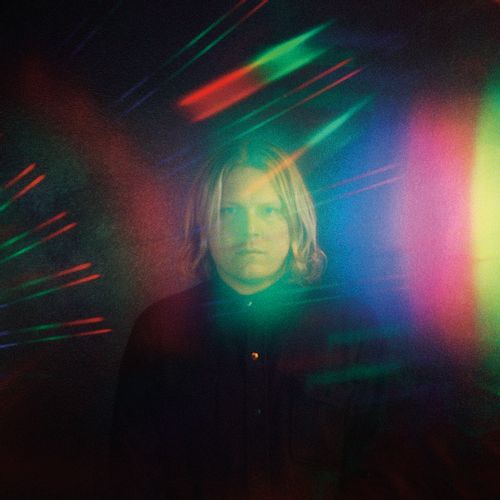
Ty Segall has a new album titled “Harmonizer” that he has just foisted upon the world. The album, his first since 2019’s great “First Taste”, was made at Ty’s new Haronizer studios and co-produced by Cooper Crain. Members of Ty’s Freedom Band — Ben Boye, Mikal Cronin, Emmett Kelly, and Charles Moothart — all appear on the album, as does Ty’s wife, Denée Segall, who co-wrote two of the songs and sings lead on “Feel Good.” She also shot the album’s cover

The surprise new album Harmonizer which he has also released via Drag City Records. The album sees Segall’s sound continue to evolve into a new and unexpected territory. The album sees him lean further into synth production as well as bets, keyboard textures as well as of course guitars. It’s the first recording of Ty’s to be released from Ty’s newly-completed Harmonizer Studios . It’s his first album in forever (two years)! ty glides smoothly into a wild area with a synthtasm of production redesign, dialling up a wealth of new guitar and keyboard settings.

Again, Segall does what HE likes to do. This unexpected album just came out of the blue without any marketing promo. It’s a characteristic Segall record. Some Black Sabbath styled drones, some fuzzing and buzzing stompers, some hazy psycherazza and his partner Denée singing a track called ‘Feel Good’ (she also wrote the lyrics). Yep, it’s Ty by numbers, but his numbers are as usual pretty good.

A seething statement of emotional austerity, harmonizer enraptures the ear, while enabling ty to cut through dense undergrowth, making groove moves for the body, mind and soul. ty glides smoothly into unexpected territory, right where he likes to find himself! responding to the challenge his new songs gave him: a synthtastic production redesign, Ty kicks back with bottom-heavy creativity, dialling up a wealth of guitar and keyboard settings to do the deed. “Harmonizer” is a glossy, barely-precedented sound for him, and truth, it enraptures the ear — but in Ty’s hands, the sound is also a tool that allows him to cut through dense undergrowth, making for some of his cleanest songs and starkest ideas to date. Harmonizer’s production model couches tightly-controlled beats in thick keyboard textures, with direct-input guitar signal whining and buzzing purposefully from left to right. the Freedom band appear all over the record, but often one at a time, their contributions leaving a distinctive footprint on the proceedings wherever they appear.

Operating in this airtight environment with an eye towards precision, feel, and explosive mass, Ty’s crafted a formidable listening encounter — and once you get between the lines, the need to know more grows more compelling with every song. the thing about closed doors is they need opening again, no matter what happens. you open them and then you can pass through them. and there’s light on the other side. that’s what this album is about. the first recording to be released from Ty’s just-completed Harmonizer studios, Harmonizer benefits from a collaboration with Cooper Crain, who co-produced the album with Ty. the venn diagram of these guys unites them in diy/punk dyed-in-the-wooldom; Ty’s propers you know, but cooper’s own unique journey in rhythm, minimalism and diy (as heard on his productions with cave, bitchin bajas and jackie lynn) mines the depths around Ty’s peerless vocal attack and aid in the latest chapter of his never-ending search for unfathomably corrosive guitar sounds. spoiler alert: they found some more! bursting with transcendent energy, harmonizer is an extension of the classic style of emotional mugger and sleeper, revisiting the lonely days and loathsome nights of the alienated, grown-up-wrong soul, to make it all right in the end.

Ty Segall will take The Freedom Band on a USA West Coast tour, and has dates with his proto-metal-inspired trio Fuzz in 2022. 

See the source image

Pentangle are to have three of their first four albums, along with a 1970s compilation, reissued on deluxe heavyweight vinyl.

As a result of new deal with US specialist label Renaissance Records, the band’s 1968 debut album “The Pentangle”, 1969’s ‘breakthrough’ third album “Basket Of Light” and 1970’s fourth album “Cruel Sister”, are all to be reissued, along with the 1973 compilation album “Pentangling“.

The third full length studio album, “Basket Of Light” was released in 1969 and was their most commercially successful. The song Light Flight became a popular hit single after it was placed as the theme song for the television series “Take Three Girls“. The album reached No. 5 on the UK album charts. the peak of The Pentangle’s long career.

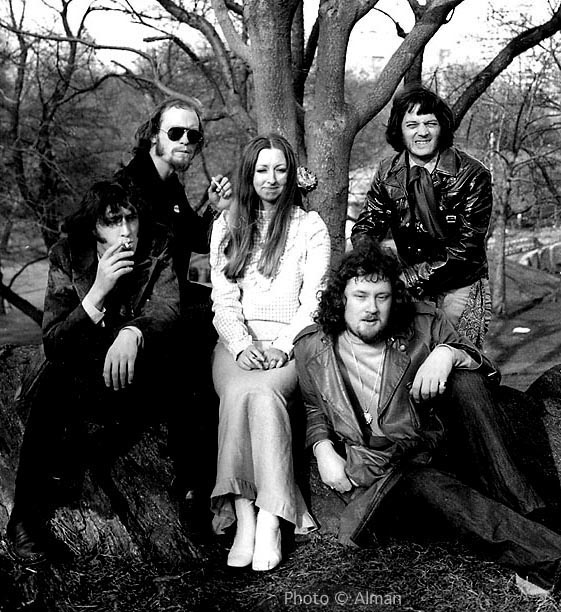
The Pentangle” was the 1968 debut album of the band featuring John Renbourn, Bert Jansch, Jacqui McShee, Danny Thompson and Terry Cox. It brought together their separate influences of folk, jazz, blues, early music and contemporary song writing. Renbourn and Jansch were already popular musicians on the British Folk scene, with several solo albums each and a duet release “Bert And John”. Their use of complex inter-dependent guitar parts, referred to as Folk Baroque, had become a distinctive characteristic of their music. The two also shared a house in St John’s Wood London.

Jacqui McShee had begun as an (unpaid) “floor singer” in several of the London Folk Clubs, and then, by 1965, ran a folk club at the Red Lion in Surrey, establishing a friendship with Jansch and Renbourn when they played there. Thompson and Cox were well known as jazz musicians and had played together in Alexis Korner’s band Although nominally a ‘folk’ group, the members shared catholic tastes and influences. McShee had a grounding in traditional music, Cox and Thompson a love of jazz, Renbourn a growing interest in early music, and Jansch a taste for the blues and contemporaries such as Bob Dylan.

The Pentangle by British folk-jazz band The Pentangle available on 180 gram vinyl

Pentangle started out in 1967 with the original line-up of Jacqui McShee (vocals), John Renbourn (vocals and guitar), Bert Jansch (vocals and guitar), Danny Thompson (double bass), and Terry Cox (drums). The band’s unique sound was an eclectic mix of folk, jazz, blues, and rock influences. “They did bring together these elements, rather like a rock supergroup, like Cream, except they came from folk and jazz backgrounds rather than blues and rock”

Pentangle signed up with Transatlantic Records and their eponymous debut album was released in May 1968. This all-acoustic album was produced by Shel Talmy, who has claimed to have employed an innovative approach to recording acoustic guitars to deliver a very bright “bell-like” sound.

June of that year they performed at Royal Festival Hall in London. Recordings from that concert formed part of their second album, “Sweet Child” (released in November 1968), a double LP comprising live and studio recordings.

“They didn’t have a long time together, but particularly with their first album, They weren’t big on the loud and more rhythmic sense of it, but they did bring together these elements, rather like a rock supergroup, like Cream, except they came from folk and jazz backgrounds rather than blues and rock.

“I think they were important and they were much respected, particularly in America.”

Renaissance Records will start with the release of their debut album, “The Pentangle”, “Basket Of Light” and “Cruel Sister” onto deluxe 180g gram vinyl in late August of 2021. The remaining greatest hits album, “Pentangling” will be released in September of 2021. These albums will include extra incentives such as trading cards of the original band members, lyric sheets, lost photos, and more when you purchase them exclusively with Renaissance Records.

Basket Of Light by British folk-jazz band The Pentangle available on 180 gram vinyl

“Basket of Light” is a 1969 album by the folk rock group Pentangle. It reached no. 5 on the UK Albums chart. A single from the album, “Light Flight”, the theme from BBC1’s first colour drama series Take Three Girls, reached no. 43 on the UK Singles chart. Another single from the album, “Once I Had a Sweetheart”, reached no. 46 in the charts. 180 gram deluxe package features gatefold, trading cards, photos, lyric sheets and more. “Basket of Light”, which followed in mid-1969, was their greatest commercial success. By 1970, they were at the peak of their popularity, recording a soundtrack for the film “Tam Lin” making at least 12 television appearances, and undertaking tours of the UK (including the Isle of Wight Festival) and America (including a concert at the Carnegie Hall).

“They had the tag of being folk jazz at the time but in fact their influences were very broad. In a way they were the first super group of unlikely musicians that came from backgrounds not conventionally allied.

Cruel Sister by British folk-jazz band The Pentangle available on 180 gram vinyl

Cruel Sister” was an album recorded in 1970 by folk-rock band The Pentangle. It was the most folk-based of the albums recorded by the band, with all the tracks being versions of traditional songs. Whereas their previous album had been produced by Shel Talmy and featured quite a heavily produced, commercial sound, “Cruel Sister” was produced by Bill Leader, noted for his recordings of folk musicians. 180 gram deluxe gatefold vinyl.

Package features trading cards, lost photos and lyric sheets. Each of the five LPs released during Pentangle’s first and best period is a different shade of brilliant, deceptively showcasing the talents of its instrumentalists (guitarists Bert Jansch and John Renbourn, bassist Danny Thompson and drummer Terry Cox), who gave the perfect framework for vocalist Jacqui McShee to gently break hearts and warm souls. As all good boxed sets do, this new Cherry Red Records collection graciously expands the original albums within. Tacked on to the end of each disc is a smattering of studio outtakes, alternate versions and live material, much of it unreleased until now. The CD of Pentangle’s 1971 LP “Reflection” also includes a few tracks from Renbourn’s solo album “Faro Annie”, which featured Cox and Thompson. All of it provides an essential glimpse for anyone interested in the history of the U.K. folk scene.

See the source image

How prolific of a songwriter was Stevie Nicks in the ’70s and early ’80s? Not only did she pen multiple Fleetwood Mac hits – “Rhiannon,” “Dreams,” “Sara” and “Gypsy,” to name a few – but she also found time to write and record a hit solo album, 1981’s “Bella Donna”.

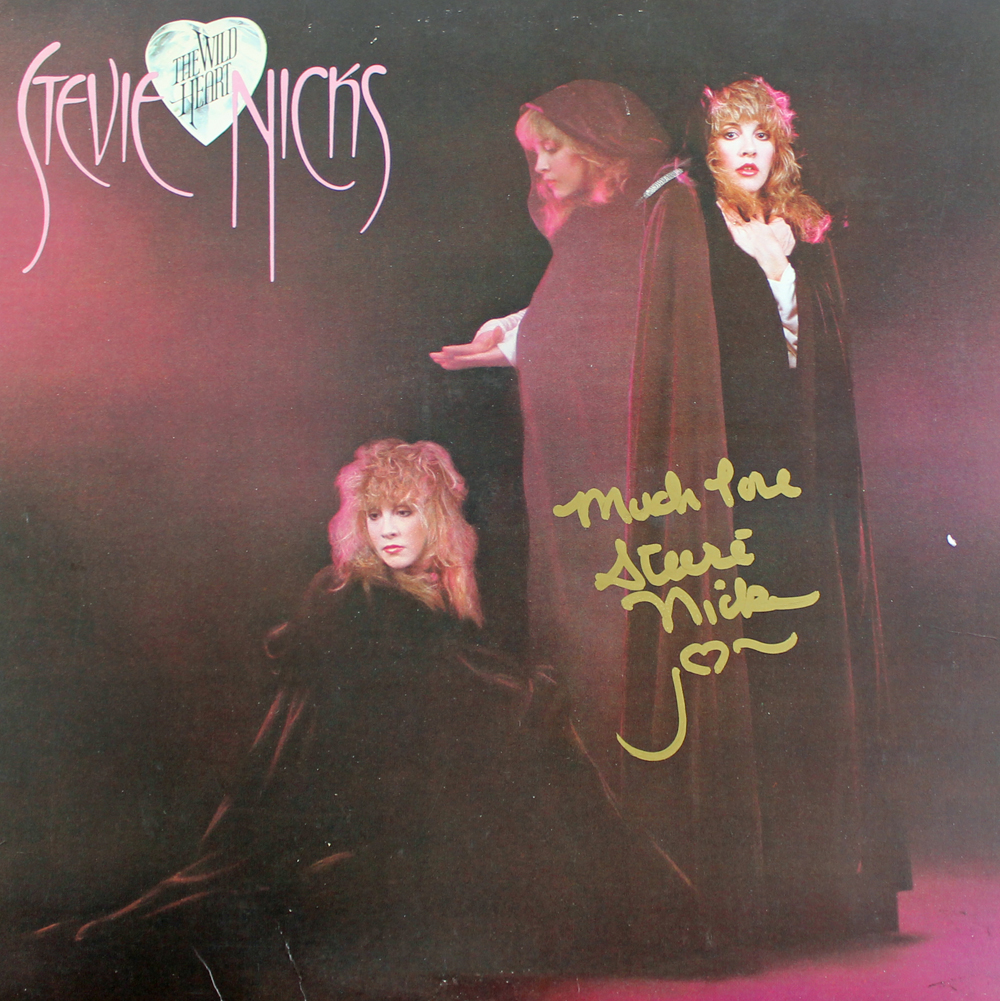
Stevie Nicks’ first two solo albums  “Bella Donna” and “The Wild Heart” reissued via Rhino Records. Each deluxe release will feature not only the original LP but rarities and bonus tracks, like the previously unreleased demo of her solo debut’s title track, streaming below. Stripped of its backing vocals as well as the raucous live band and synthesizers featured on the original album version, Nicks’ demo is a tender, intimate take on the song. She sings softly above just the piano track, nearly whispering “Bella donna, my soul” and barely reaching the full-throated belt she unleashes on the 1981 recording.

The Legendary Fleetwood Mac singer-songwriter Stevie Nicks joined producer Jimmy Iovine to begin recording her solo debut, “Bella Donna”, following the release of the Mac’s TUSK and its subsequent tour. Nicks’ 1981 collection was quickly certified platinum thanks to singles like “Stop Draggin’ My Heart Around” (with Tom Petty and the Heartbreakers), “Leather And Lace” (with Don Henley) and “Edge Of Seventeen.” Rhino’s triple-disc deluxe edition of the collection uncovers unreleased versions of the latter two classics as well as soundtrack rarities and a concert from 1981 that features performances of songs from the album along with several Fleetwood Mac favourites.

Ahead of Best Of “24 Karat Gold” solo tour, singer-songwriter talks set lists, “sex, rock & roll and drugs” songs, and more
Later this month and just before releasing the reissues, Nicks will embark on a solo tour with opening act the Pretenders. Nicks‘ tour is in support of her 2014 album 24K Gold, a collection of songs she had cut from her prior solo releases for various reasons. “These are the glory songs,” she told of her reason to follow a multi-year world tour with Fleetwood Mac with the solo dates. “These are the sex, rock & roll and drugs songs that I’m actually not really writing right now, and these are the songs I could never write again.”

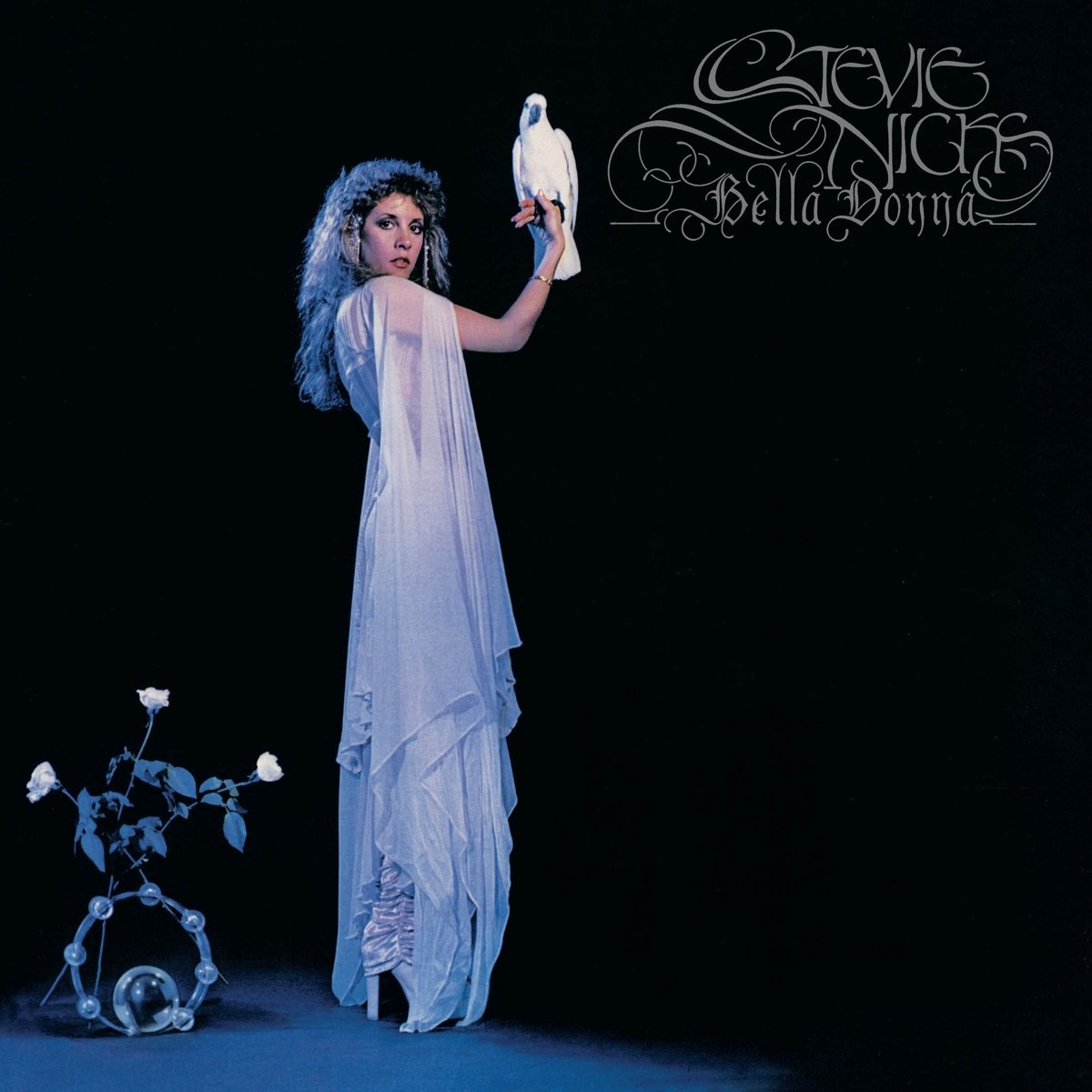
The cover of “Bella Donna,” Stevie Nicks’s first solo album, shows the artist looking slender and wide-eyed, wearing a white gown, a gold bracelet, and a pair of ruched, knee-high platform boots. One arm is bent at an improbable angle; a sizable cockatoo sits on her hand. Behind her, next to a small crystal ball, is a tambourine threaded with three long-stemmed white roses. Nicks did not invent this storefront-psychic aesthetic—it is indebted, in varying degrees, to Hans Christian Andersen’s Thumbelina, de Troyes’s Guinevere, and Cher—but, beginning in the mid-nineteen-seventies, she came to embody it. The image was girlish and delicate, yet inscrutable, as if Nicks were suggesting that the world might not know everything she’s capable of.

While Nicks’s sartorial choices have been widely mimicked, it’s rare to hear echoes of her magnanimity in modern pop songs, which are frequently defensive and embattled, preaching self-sufficiency at any cost.  “Bella Donna,” from 1981, and Nicks’s second solo album, “The Wild Heart,” from 1983, are being reissued. Nicks was thirty-three when “Bella Donna” was released. Though its cover might not suggest an excess of reason, in its songs she is a sagacious and measured presence. Her acknowledgment of the heart’s capriciousness is gentle, if not grandmotherly. There’s surely no kinder summation of love’s petulance than the chorus of “Think About It,” a jangling folk song about taking a breath before hurling yourself off a metaphorical cliff. “And the heart says, ‘Danger!’ Nicks sings. She pauses briefly. “And the heart says, ‘Whatever.’ ” For anyone busy self-flagellating over an error in judgment, this can feel like a rope ladder thrown from above—an invitation to scramble up and out of despair. It is generous and knowing, and offers a clear-eyed conclusion: some things can’t be helped.

What does it mean to be Stevie Nicks? To understand loss and longing as being merely the cost of doing business? To acknowledge the bottomless nature of certain aches, yet to know, in some instinctive way, that you’ll keep going? Nicks evokes Byron, in spirit and in certitude: “The heart will break, but broken live on.”

Nicks was born in 1948, in Phoenix. Her paternal grandfather, A. J. Nicks, Sr., was a struggling country musician, and he taught Nicks how to sing when she was four years old. She was given an acoustic guitar for her sixteenth birthday, and immediately wrote a song called “I’ve Loved and I’ve Lost and I’m Sad but Not Blue.” The title is a surprisingly succinct encapsulation of Nicks’s lyrical alchemy: a combination of acceptance (I am hurting) and perspective (I will not hurt forever).

In 1966, when Nicks was in her senior year of high school and living in Atherton, California—her father, an executive at a meatpacking company, had been relocated there—she met the guitarist Lindsey Buckingham at a party. He was sitting cross-legged on the floor—bearded, curly-haired, and strumming the Mamas and the Papas’ “California Dreamin’.” Uninvited, she joined him in harmony. (“How brazen!” she later said.) Buckingham asked Nicks to join his band, Fritz. By 1971, the two were romantically involved. They eventually took off for Los Angeles, where they tried to make it as a duo, called Buckingham Nicks, releasing one album, in 1973, to very little acclaim. Not long afterward, Buckingham was asked to join Fleetwood Mac, a British blues band featuring the singer and keyboard player Christine McVie, the bassist John McVie, and the drummer Mick Fleetwood; the group was being rebooted as an American soft-rock act. Buckingham insisted that Nicks be invited, too. She ended up writing two of the band’s biggest early hits, “Landslide” and “Rhiannon.”

Extraordinary success often leads to spiritual dissolution, and Fleetwood Mac had its share of psychic turmoil. In 1975, Fleetwood divorced his wife, the model Jenny Boyd, after she had an affair with one of his former bandmates. Nicks and Buckingham broke up the following year. Around the same time, John and Christine McVie’s marriage collapsed. There was an ungodly amount of brandy and cocaine on hand to help nullify the despair. Still, in 1977, Fleetwood Mac now five wild-eyed, newly single people—released “Rumours,” a collection of yearning songs about love and devotion. The record spent thirty-one weeks at the top of the charts, and is one of the best-selling albums in American history.

Nicks’s debt is to Laurel Canyon, and to the sentimental, silky-voiced artists who emerged from L.A. in the late sixties and early seventies. Some of those acts—James Taylor, the Eagles—are now considered, fairly or not, irrelevant to the Zeitgeist: too mellow, too affluent, too sexless, too white. Candles and incense and macramé plant hangers; wistful thoughts about weather. Nicks’s lyrics often worry over domestic or earthly concerns—gardens, mountains, flowers, the seasons—and how they might affect the whims of her heart. “It makes no difference at all / ’Cause I wear boots all summer long,” she sings in “Nightbird.” When compared with the dissonant and provocative music coming out of downtown New York, the California sound could seem limp. But the scene in Laurel Canyon was tumultuous. Many of its artists—including, at various times, Nicks—were wrecked by drug addiction. Nicks’s voice, a strange, quivering contralto, gives her songs unexpected weight.

“Bella Donna” was produced by Jimmy Iovine, a Brooklyn-born audio engineer who worked on Bruce Springsteen’s “Born to Run” and produced the Patti Smith Group’s “Easter” and Tom Petty and the Heartbreakers’ “Damn the Torpedoes.” Iovine spent time in California, but his sensibility was tougher and more plainly that of the East Coast. He later became a co-founder of Interscope Records, where he helped to establish the career of the rapper Tupac Shakur, and, for a period, he oversaw the hip-hop label Death Row Records.

“Bella Donna” reached No. 1 on the Billboard chart, and produced four hit singles: “Stop Draggin’ My Heart Around,” a duet with Petty; “Leather and Lace,” with Don Henley; “Edge of Seventeen”; and “After the Glitter Fades.” The last, a country song about the travails of stardom—Nicks wrote it just after she and Buckingham moved to Los Angeles, long before she had a record deal, showing either hubris or prescience—contains organ, pedal steel, and reassurances. “The dream keeps coming even when you forget to feel,” she sings.

Nicks, like most artists, culls inspiration from disparate sources. She is prone to saying things like “ ‘Edge of Seventeen’ was about Tom Petty and his wife, Jane, my uncle dying, and the assassination of John Lennon.” But her personal life—a tangle of love affairs, often with her collaborators—informs her work in explicit ways. “Heartbreak of the moment isn’t endless,” she sings, in “Think About It.” This might seem like a billowy platitude, but if you are someone who does not think that every flubbed decision is fodder for personal growth, it is comforting to hear someone assert that nearly all mistakes can be neutralized, if not conquered. If “Bella Donna” contains a single directive, it’s to love freely, love fully, and hang on. The songs Stevie Nicks left off her debut solo LP “Bella Donna”, You can hear why “Blue Lamp” didn’t end up on “Bella Donna” The song has a darker, rock-oriented vibe that’s quite different from the rest of the album. However, it’s one of Nicks’ finest solo songs, based on a “dark blue Tiffany lamp” from her mom that “symbolized to me the light that shines through the night,” as she told The Source in 1981.

“When Fleetwood Mac  we found them or they found us or whatever you know – it was a definite light at the end of the tunnel for both Lindsey Buckingham and I.” However, Nicks also saw the song represent new beginnings in her solo career. “It was very important that it found a place for itself,”.”I love that song. It was really the beginning of Bella Donna, because it was the first thing I’d ever recorded with other musicians, and it was the first time I’d ever recorded by standing in a room singing at the same time that five guys were playing. Fleetwood Mac doesn’t record that way. They record from a more technical standpoint.”
It seemed inevitable Nicks would have had a song on the “Fast Times At Ridgemont High” soundtrack – after all, her manager, Irving Azoff, co-produced the movie. However, “Sleeping Angel” was certainly no tossed-off leftover; in fact, it’s one of Nicks’ most gorgeous and emotional songs from the era.

Driven by elegiac piano from E.Streeter Roy Bittan and lush backing vocals from Lori Perry and Sharon Celani, Nicks defines the respect she needs in and from a relationship: “I need you because you let me breathe / Well, you’ve taken me away / But never take me lightly / Or I could never stay.”

Incredibly enough, Nicks never actually recorded “Gold and Braid” in the studio, although she played it live on early ’80s solo tours. In concert, it’s a barn-burning rocker that serves as a perfect contrast to Bella Donna’s folkier songs and hints at what it might have sounded like had Nicks followed through on her desire to join Tom Petty and the Heartbreakers.

Nicks’ original demo for “24 Karat Gold” is piano-heavy and meditative, with almost stream-of-conscious vocals. The version that surfaced later on “24 Karat Gold” maintains the bones of her demo, the piano especially, but turns into a compact cautionary tale about ill-fated fame and love.

“‘Belle Fleur’ was about not being able to have a relationship because you were a rock ‘n’ roll star,” she said in 2015. Fittingly, one demo for the song is just piano and voice, featuring Nicks and her backing singers – a sisterhood of support that’s always been a through-line in Nicks’ work. “The [lyric] ‘When you come to the door of the long black car’ ,that’s the limousine that’s coming to take you away. Then your boyfriend is standing on the porch waving at you, like, ‘When are you going to be back?’ And you’re like, ‘I don’t know, maybe three months?’ But then we would add shows to a tour, and I could end up not being back for six months. It was difficult for the men in my life. I lived that song so many times.”

See the source imageIn 1981, Iovine flew with Nicks to the Château d’Hérouville, in northern France, where Fleetwood Mac was recording its next album, “Mirage.” Iovine left almost immediately, to escape the interpersonal conflicts that roiled the band. Iovine and Nicks’s relationship foundered. The following fall, while Fleetwood Mac was on tour, Nicks’s childhood friend Robin Anderson died, of leukemia, at the age of thirty-three. “What was left over was just a big, horrible, empty world,” Nicks has said. Days before her death, Anderson had prematurely given birth to a son. Nicks, operating under the savage logic of grief, married her friend’s widower, Kim Anderson, thinking that she would help raise the child. They divorced three months later.

By 1983, Nicks was ready to make another record. Her relationship with Iovine was strained, but Nicks asked him to produce the record anyway. “The Wild Heart” is inspired in part by the unravelling of that relationship, and in part by her mourning for Anderson. Nicks frequently cites as a guiding influence for the recording sessions the 1939 film adaptation of Emily Brontë’s “Wuthering Heights,” which depicts an undying, almost fiendish love. Mostly, the songs are about bucking against the circumstances that separate us from the people we need.

The artist Justin Vernon, of the band Bon Iver, uses a brief sample of “Wild Heart” (a track from “The Wild Heart”) on the group’s new album, “22, A Million.” Nicks’s voice is sped up, pitch-altered, and barely discernible as human—just a high, grousing “wah-wah,” deployed intermittently. Vernon pinched it from a popular YouTube video of Nicks, in which she sits on a stool having her makeup done, wearing a white dress with spaghetti straps. She begins to sing. Soon, someone is messing with a piano; one of her backup singers joins in with a harmony. The makeup artist gamely tries to continue with her work, before giving up. While the studio recording of “Wild Heart” is saturated, almost wet, this version is all air, all joy.

What affects me most about the video is how profoundly Nicks appears to love singing. Her voice has an undulating, galloping quality. It is as if, once it’s started up, there’s no slowing down, no stopping; the car is careering down a mountain, with no brakes. You can see on her face how good it feels just to let go.

“Stand Back,” the first single from “The Wild Heart,” was inspired by Prince’s “Little Red Corvette,” which Nicks heard on the radio while driving with Kim Anderson to San Ysidro Ranch, in Santa Barbara, for their honeymoon. (Prince played keyboards on the track, though he’s not credited in the album’s liner notes.) The song was produced in accordance with the style of the era, with lots of synthesizer and rubbery, overdubbed percussion. The lyrics describe a deliberate seduction followed by an acute betrayal. “First he took my heart, then he ran,” Nicks sings. The chorus is appropriately punchy: “Stand back, stand back,” she warns. Nicks is capable of going fully feral before a microphone, perhaps most famously at the end of “Silver Springs,” a song intended for “Rumours” and one of several that she wrote about Buckingham. (It ends with Nicks hollering, “Was I just a fool?”) On “Stand Back,” she erupts briefly, on the middle verses, but for the rest of the song she is more characteristically sanguine. “It’s all right, it’s all right,” she concedes. “I did not hear from you, it’s all right.”

Nicks has gone on to make six more solo albums, and three more with Fleetwood Mac. Following her divorce from Kim Anderson, she never married again, or had any children, though a rich maternal instinct runs through all her songs. This, more than anything else, may be the reason that Nicks’s work has endured.

After making a triumphant return courtesy of his concert at London’s Rainbow Theatre, an event organized by Pete Townshend and featuring any number of famous friends, Clapton’s confidence was restored and he returned to Miami’s Criteria Studios to begin work on a record that would stand as another milestone in Clapton’s career. “461 Ocean Boulevard” is the second studio solo album by the English musician. The album was released in late July 1974 for RSO Records, shortly after the record company released the hit single “I Shot The Sheriff” in early July the same year. The album topped various international charts and sold more than two million copies.

Eric Clapton was getting his life back together after a crippling heroin addiction, and his second solo album throws in a bunch of different styles to keep him occupied. It’s not all about guitar fireworks, either. There were blues covers, some heartfelt originals and a version of Bob Marley’s “I Shot the Sheriff” that went to No. 1. Eric Clapton had already undergone several transitions in his ever-evolving career by the time his album “461 Ocean Boulevard” was released in late July 1974. Having gained fame as a member of the Yardbirds and, later, John Mayall’s Bluesbreakers.

Perhaps the best way to describe guitar legend Eric Clapton’s in July 1974, as he prepared to unveil his watershed solo LP, “461 Ocean Boulevard”, was as a “wanted man.”

After laying low for the better part of three years while struggling with substance abuse, Clapton was sought after by his fellow musicians, by the countless fans of his prior exploits (the Yardbirds, Mayall’s Bluesbreakers, Blind Faith and Cream plus the short lived period Derek and the Dominoes and by the savvy music industry suits, who knew they were dealing with a golden goose – sure to fill their coffers regardless of what music he put his name to. The impetus for the album was born from the guitarist’s fascination with the blues recordings that had inspired him early on. During his recovery, he found himself renewing his familiarity with those older records and listening to more recent offerings as well. So too, a demo tape given him by Dominos bassist Carl Radle shared songs Radle had written with drummer Jamie Oldaker. As a result, the two musicians became the core of Clapton’s new outfit, which also came to include guitarist George Terry and singer Yvonne Elliman. The album took its title from the house where Clapton and company ensconced, located at “461 Ocean Boulevard” in Golden Beach, Florida,

461 Ocean Boulevard was bookended by an urgently paced re-working of the traditional “Motherless Children” and the renewed vigour of “Mainline Florida.” In between, however, the ensuing laid-back fare ranged from the hymn-like “Give Me Strength” to the easy-grooving “Willie and the Hand Jive” to a slippery slide across Elmore James’ “I Can’t Hold Out” and an acoustic “Please Be with Me.”

Sprinkled among these were three key tracks in “Get Ready” (a cowrite and duet with Yvonne Elliman); Clapton’s own, earnestly hopeful “Let it Grow” (an emotional reflection of his recent rebirth from the shadows of heroin addiction); and, most striking of all, a relatively straight cover of Bob Marley’s “I Shot the Sheriff” that went to No. 1, pulling the rest of the album right along with it.

Other covers are of similar significance. “Willie and the Hand Jive” tapped into the familiarity factor, a slow-rolling mesh of blues and funk written by singer and composer Johnny Otis. Elmore James’ “I Can’t Hold Out” and Robert Johnson’s “Steady Rollin’ Man” found Clapton going back to the basics of blues.

Throughout the sessions, Clapton was aided and abetted by bassist Carl Radle (late of the Dominos), drummer Jamie Oldaker, keyboardist Dick Sims, guitarist George Terry – and, perhaps most crucial of all, Tom Dowd. Most importantly, 461 Ocean Boulevardis the album that found Clapton renewing his confidence and shoring up his strengths as a bandleader who was no longer in need of simply sharing his efforts with others. In that regard, “461 Ocean Boulevard” can be considered a destination that seemed to serve him best. The album finishes with George Terry’s “Mainline Florida”, which “breaks away from the established tone of the record” and features Clapton’s using talk box during his outgoing solo.

The dean of record producers, he’d worked with Clapton since his Dominos and Cream days, and contributed much to shoring up his shaky confidence.

Together, these players helped Eric Clapton fulfill most of the tall expectations harboured by his previous groups alluded to earlier, once his incomparable talents and this inspired song set were finally captured in the grooves of 461 Ocean Boulevard.

A tribute album featuring Steve Earle, Lucinda Williams and Beachwood Sparks among others was announced yesterday along with details of a new Neal Casal Music Foundation (NCMF) which has been created “to honour the memory of the late great, multi-dimensional artist through an ongoing series of charitable endeavors.” The initial focus of the foundation is to provide instruments and lessons to students in New Jersey and New York state schools where Casal was born and raised, as well as to make donations to mental health organizations that support musicians in need. NCMF is being spearheaded by Neal’s longtime manager Gary Waldman along with a team of Casal’s friends.

A first round of funding for the foundation is being raised through a Kickstarter campaign comprised of two primary packages: a 30-plus song tribute album, ‘Highway Butterfly: The Songs of Neal Casal’ and a coffee table photography book, ‘Tomorrow’s Sky: Photographs by Neal Casal.’

“In a note left behind, Neal told the story of how he got his first guitar when he was 13,” explains Waldman. “As he explained it, ‘I remember the day on one of those drives where dad asked what I wanted for Christmas and I said an Atari, and he said ‘c’mon Neal, you can do better than that. I always see you with your radio playing music, do you want more records? Do you want to play an instrument? Anything but Atari y’know? It’s just going to collect dust after a few months, I want to get you something useful.’ I sheepishly said I like guitar, and his eyes lit up and he said, ‘sure i’ll get you a guitar, at least you’ll be learning something.’ So that was it, my life was set right there. I remember the exact place where we were when he said it. We were passing that reservoir that’s in between Oak Ridge, NJ and route 23 into NY state.’ So with that in mind, the concept for the foundation was born. We will also donate a large portion of proceeds to MusiCares, Backline and other mental health organizations for musicians. This was also a specific wish of Neal’s and we have already donated over $25,000 to MusiCares from our preliminary fundraiser at the Capitol Theatre tribute concert for Neal on September 25, 2019.”

‘Highway Butterfly: The Songs of Neal Casal’ will be a double CD/triple vinyl album celebrating the prolific body of work Casal left behind over the course of 14 studio albums. Recording sessions for the project began in February led by co-producers Dave Schools of Widespread Panic and recording engineer/producer Jim Scott at PLYRZ Studios in Valencia, CA. Over 30 artists have been confirmed to appear, including Lucinda Williams, Jonathan Wilson, Phil Lesh and The Terrapin Family Band, Cass McCombs, Steve Earle, Warren Haynes, Jaime Wyatt, Shooter Jennings and Robert Randolph & The Family Band among numerous others. The first single and video from the recording was captured during those initial sessions in February. It features Billy Strings with Circles Around the Sun performing ‘All The Luck In The World’ which you can watch below.

“It’s been overwhelming to record these talented artists as they put their own spin on Neal’s songs,” says Schools. “It speaks volumes to the high quality of his song writing and to the depth of love and appreciation that his peers had for him.”

The upcoming tribute Highway Butterfly: The Songs of Neal Casala 5-LP box set featuring Neal’s friends, colleagues, and admirers paying tribute to the prolific musician’s immense body of work.

Today the “second” single is out – Neal’s dear friends Beachwood Sparks (whom Neal played, toured, and recorded with) and GospelbeacH (of which Neal was a founding member) release their version of “You Don’t See Me Crying,” with Neal’s photographs brought to life by the brilliant Pooley at Woom Studio.

The 41-song box set is available for pre-order now and will be released on November 12th.

One of Neal’s other last wishes left behind was that a book be made of the photographs he had taken while travelling the world over the last 20 years. ‘Tomorrow’s Sky: Photographs by Neal Casal’ is a 240-page, hard cover, coffee table book that presents over 250 of his photos. The book is broken up into six sections entitled Surf, Road, Rooms, Humans, Travel and Music—all subjects near and dear to Casal. Each section is described as “a deep reflection of where Neal was in his life, whether backstage with his band, in a recording studio with Willie Nelson, an empty stretch of highway through a tour bus windshield, or on the beach with a surfboard.” The photographs were carefully curated by Ricki Blakesberg using Neal’s Instagram, Tumblr and photo albums as a guide, while the book’s producer is Neal’s close friend and legendary photographer, Jay Blakesberg.

“‘Tomorrow’s Sky’ is a look at the world seen through the eyes of Neal Casal. Neal was a stealth photographer who always carried his camera and documented the people, places and scenes as they passed before him,” says Jay Blakesberg. “The photos are intimate, beautiful and from the hip. Nothing is set up, it is real life in real time.”

Highway Butterfly: The Songs Of Neal Casal
Confirmed Artists & Track Listing

Aaron Lee Tasjan – “Traveling After Dark”
Beachwood Sparks – “You Don’t See Me Crying”
Billy Strings w/ Circles Around the Sun – “All The Luck In The World”
Britton Buchanan – “Willow Jane”
Cass McCombs – “Miss It When It’s Gone”
Courtney Jaye – “Grand Island”
Dori Freeman & Teddy Thompson – “Sweeten The Distance”
Hannah Cohen & Sam Evian – “Junkyard In The Sun”
Hazeldine – “Today I’m Gonna Bleed”
Hiss Golden Messenger – TBD
Jaime Wyatt – “Need Shelter”
Jason Crosby – “Pray Me Home”
Jesse Aycock – “The Losing End Again”
Jimmy Herring w/ Circles Around the Sun – “Bird With No Name”
Johnathan Rice – “Me & Queen Sylvia”
Jonathan Wilson – TBD
Kenny Roby – “Too Much To Ask”
Lauren Barth – “Lost Satellite”
Leslie Mendelson – “Feel No Pain”
Lucinda Williams – TBD
Mapache – “The Wisest of the Wise”
Marcus King & Eric Krasno – “No One Above You”
Phil Lesh & The Terrapin Family Band – TBD
Robbi Robb – “I Will Weep No More”
Robert Randolph & The Family Band – TBD
Shooter Jennings – “Maybe California”
Steve Earle – “Highway Butterfly”
Todd Sheaffer – “December”
Vetiver – “White Fence, Round House”
Victoria Reed – “Angel & You’re Mine”
Warren Haynes – “Free To Go”
Zephaniah OHora – TBD