The Demo have perfectly captured the sunshine of Britpop, multi-part harmonies and all, in new single ‘Apart’. They pile on the summertime vibes elsewhere in their discography, drawing from the most melodic guitar licks of the 00s garage revival to create an altogether good vibe. ‘’Apart’ is arguably the band’s strongest release to date. Four minutes of soaring, shimmering guitars and suitably optimistic vocals, it’s a far cry from the grit and swagger of ‘How’ve We Ended Up (Here Again)’, and feels like The Demo taking a step in a more mature direction.’
It’s become increasingly clearer that Manchester needs a new breed of bands to look to. Thankfully, it being the city it is, there’s a plethora of acts vying for attention, and with acts like The Lathums shining a light onto Manchester’s grassroots, showing younger bands that is possible to make it, there couldn’t be a better time to be part of the city’s ever-burgeoning scene.
That’s where The Demo come in. A five-piece hailing from Middleton, The Demo peddle in an upbeat and ramshackle brand of indie-pop that feels equally as timely as it does timeless. Interestingly enough however, latest single ‘Apart’ is something of a departure from the rough and ready delivery of their earlier cuts, eschewing the colloquial indie-pop in favour of something that feels grander, more polished, and more transatlantic.
Indeed, sharing more in common with bands like REM than The Courteeners or The Pigeon Detectives, ‘Apart’ is arguably the band’s strongest release to date. More mature it may be, but ‘Apart’ still manages to harbour the youthful energy and exuberance that made their early recordings so appealing. And though it’s still early days for the five-piece, ‘Apart’ is very much another step closer to cracking it. A band you need to keep an eye on.
Upcoming single, ‘Apart’ out on Friday 27th November 2020.
Liverpool post-punkers Gen and the Degenerates have wasted no time in announcing live dates for 2021 and their audience will be as eager as them to share in the eccentric energy of their live shows. This, they say is only the beginning of their plans for the year – and we’ll be waiting to hear what else they have in store. Gen and the Degenerates have been causing a stir across Merseyside so far in 2019. Playfully aggressive and a message worth listening to, people are learning what the Degenerates knew all along: They’re destined for big things.
“If Gen and The Degenerates keep releasing music like ‘Cocaine’ and ‘Jesus Green’ then they will almost certainly be headlining big venues in the next year.”
Gen and The Degenerates are Infamous for their high energy, larger than life, live performances. Making a hobby of gate crashing the UK music scene, bringing with them their unique breed of blood and thunder rock n roll, they have appeared alongside Strange Bones , WSTR , Bang Bang Romeo , The Ninth Wave and many more.
A track about diving head first into a toxic relationship, despite knowing it’ll only end badly. Gen Degenerate throws caution to the wind as she sings, “you’re the kind of girl that I’d like to ruin my life…”.Littered with fluttering hooks to match the feelings of attraction, the song builds and builds towards a tense release. The melody is infectious as it wraps around Gen’s words. It’s fun, in your face and loud. Speaking about the song, Gen Degenerate said: “I wrote this song about an ex-girlfriend who I knew was going to be terrible for me but pursued anyway. “Even though she did ruin my life, I still love this song because it celebrates a flawed queer woman.
I don’t think the media and music industry uses its platform to celebrate them enough. As a flawed queer woman myself, I can verify that we’re fucking fantastic.” If Gen and the Degenerates keep producing songs like ‘Very Fast, Very Dangerous’, ‘Cocaine’ and ‘Jesus Green’, then it won’t be long before the media and the rest of the music industry celebrate the flawed queer woman and her degenerates.
Much like the ebbing away of these unprecedented times, 50 years ago, the music world was coming to terms with the end of an endemic fever that had changed the face of society. As the Fab Four scrambled to studios to release their break-up albums, the Kinks seized that large Beatle-sized hole to mock the very system that had taken them to those dizzying, and ultimately suffocating heights, in their 1970 album “Lola Versus Powerman and the Moneygoround, Pt.1”, which has been re-released and remastered in a glossy deluxe format.
The Kinks were the contrarian’s choice in the 60s music scene, the swagger of Mick Jagger and the Jesus-like appeal of John Lennon meant that Ray Davies and co. found themselves dwarfed in the zeitgeist of their era. Far from nobodies nonetheless – such tracks as ‘You Really Got Me’, ‘Waterloo Sunset’ and ‘Sunny Afternoon’ belong in in the same pantheon as the ‘Hey Jude’s and ‘Angie’s of this world, but alas their popularity found itself dwarfed by the canonisation of their British Invasion counterparts.
“Lola” gave the Kinks an unexpected hit, and its crisp, muscular sound, pitched halfway between acoustic folk and hard rock, provided a new style for the band. However, the song only hinted at what its accompanying album, “Lola Versus Powerman and the Moneygoround, Part One”, was all about. It didn’t matter that Ray Davies just had his first hit in years — he had suffered greatly at the hands of the music industry and he wanted to tell the story in song. Hence, Lola — a loose concept album about Ray Davies’ own psychosis and bitter feelings toward the music industry.
He never really delivers a cohesive story, but the record holds together because it’s one of his strongest sets of songs. Dave Davies contributes the lovely “Strangers” and the appropriately paranoid “Rats,” but this is truly Ray’s show, as he lashes out at ex-managers (the boisterous vaudevillian “The Moneygoround”), publishers (“Denmark Street”), TV and music journalists (the hard-hitting “Top of the Pops”), label executives (“Powerman”), and, hell, just society in general (“Apeman,” “Got to Be Free”). If his wit wasn’t sharp, the entire project would be insufferable, but the album is as funny as it is angry. Furthermore, he balances his bile with three of his best melancholy ballads: “This Time Tomorrow,” “A Long Way from Home,” and the anti-welfare and union “Get Back in Line,” which captures working-class angst better than any other rock song.
These tracks provide the spine for a wildly unfocused but nonetheless dazzling tour de force that reveals Ray’s artistic strengths and endearing character flaws in equal measure. [The 50th anniversary edition of Lola Vs Powerman is expanded by three discs filled with rarities that span the decades. The Kinks needed to cast a wide net for this 2020 reissue since Lola received a healthy double-disc expansion in 2014, one that unearthed the outtakes “Anytime” and “The Good Life,” which are both here in new mixes. “Anytime” also seeds the newly created “The Follower — Any Time 2020,” where new spoken word elements are interwoven with the original track. There’s a lot of this kind of thing on this 50th Anniversary Edition, including several “Ray’sKitchen Sink” tracks, which contain Ray Davies and his brother Dave discussing the album’s songs while music plays in the background.
A bunch of mono mixes and alternate takes, most previously reissued, are here along with an “Apeman” from Unplugged, selections from the Ray-starring production The Long Distance Piano Player, Ray singing “Lola” with the Danish National Chamber Orchestra, and a version of “A Long Way from Home” from Ray’s 2006 Austin City Limits.
Some of this is strange, much of it is good, and all the worthwhile cuts were on the 2014 set, so this is for the hardcore Kinks fan, the one who appreciates the oddities of the bonus material instead of cursing the absence of unheard music (which likely does not exist).] What makes this album one of the Kinks’ most peculiar is its scattergun genre usage: the opening track, ‘the Contenders’ exhibits this vision, with a slow percussion and jaunty acoustic guitar transitioning, without warning, into a hard-rock crescendo. Initially this breathes freshness an invigorating freshness, but as the album progresses, this indecisiveness and laid-back approach towards genre makes this album difficult to fall in love with. For example, a song like ‘Apeman’, which is such a strong single, falls flat because it is surrounded by a weak music-hall tribute in ‘the Moneygoround’ or weird George Formby pastiche “Denmark Street”. With Christmas approaching, see this album as a box of Celebrations songs like ‘Get Back in Line’ and ‘A Long Way from Home’ sit like a Bounty amongst the fantastic ‘Lola’ and ‘Rats’.
Thematically, Lola Versus Powerman, can be lumped together with Pink Floyd’s Wish You Were Here or Pulp’s This is Hardcore as it is an album with the clear, age-old message – the music business is called a business for a reason – to cripple and pornographise the artistic expression and freedom of musical creation for profit and growth. On ‘Powerman’, the band channel their disgust for the abusive relationship between executives, artists and their music while ‘Top of the Pops’ is a brilliant slapstick satire about the process of making a hit, with Davies evoking the forced enthusiasm of the industry in his vocal performance. In fact, it is a crippling indictment (and brilliant foresight) of the band that the quip “I might even end up a rock’n’roll god / It might just turn into a steady job” rings true today, with bona fide legends such as David Crosby having to sell their publishing rights for money. No industry revolution will never be started by this album however – Davies misses the mark by not making his message cohesive enough. It is no surprise that ‘Lola’ was the first song written off the album, as every song feels like an attempt to make an LP to surround the big hit. The exotic nature of the iconic steel guitar on that track spreads its tentacles through the album and eventually looms large over them, stifling the listener to enjoy them only moderately.
Ray Davies described his oeuvre as “a celebration of artistic freedom (including my own) and the right for anyone to be gender-free if one wishes” and the bonus tracks offer an insight not only to how the album was created, but how the band transported their complex product to the stage with some roaring live tracks. What is clear is that despite its somewhat disjointed nature, LolaVersus Powerman is still a vibrant expression of what the Kinks became so famous for: variety, innovation and joy.
Following their hugely successful second album ‘The Age Of Immunology’ (roundly raved over by The Line Of Best Fit, PopMatters, Pitchfork, Q, MOJO, The Quietus and Uncut) and one of Rough Trade, MOJO and Uncut’s albums of 2019. Fire Films announces the first in our ‘Baptism Of Fire’ series of live streams for 2021, beginning with the transcendent psychedelic pop of Vanishing Twin and brought to you via Noonchorus on 20th January.
Vanishing Twin present ‘Pensiero Magico’ (Magical Thinking), a surreal document of their live show, augmented for 2D in a one-hour live performance special. Vanishing Twin will explore all sides of its schizophrenic self, from hypnagogic jazz to quixotic squidge pop to peeling electronic thunder, all set in multiple monochromatic worlds. Viewers will have access to exclusive merchandise designed by the band for the event including screen-printed hoodies and t-shirts and will also be entered into a raffle to win one of two dubplates created for the performance.
Check out Vanishing Twin’s newly released show trailer, a production by Tentacle and recorded by Gareth Finnegan, for a taster of their arresting live show later this month. Our ‘Baptism Of Fire’ live series will bring special performances from Fire Records artists direct to your living room throughout the year
Cocktail umbrellas and chlorinated fantasies! It’s time to get cool in the pool with Vanishing Twin. “Fantastical soundscapes that are as welcoming as they are unusual.” All Music
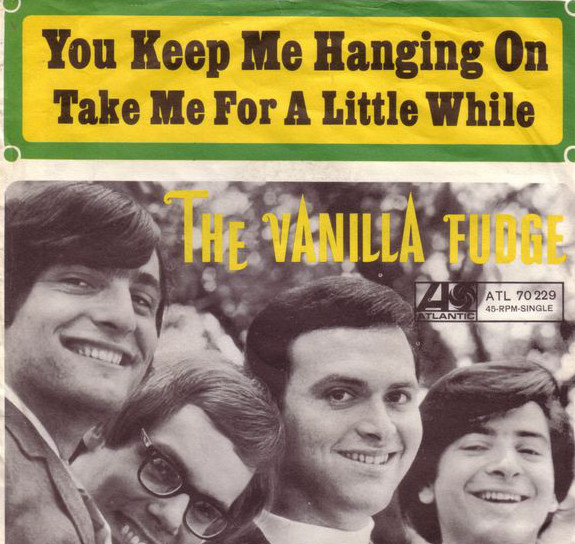
At the emerging period of psychedelia, Vanilla Fudge started with an exemplary debut set that produced the classic track, “You Keep Me Hanging On”. This song was a claim to fame and legitimized the band going forward. Unfortunately, Vanilla Fudge never surpassed their debut in sales or hit singles, although a great cover of Donovan’s “Season of the Witch” was on the band’s second album. By 1970, Vanilla Fudge was finished after five albums.
The Vanilla Fudge story begins in 1967 when the producer and songwriter George “Shadow” Morton heard the band–then composed of vocalist-keyboardist Mark Stein, drummer Carmine Appice, guitarist Vinny Martell and bassist TimBogert performed the song that would become their signature tune, a slow and heavy cover of the 1966 Supremes hit “You Keep Me Hangin’ On,” at The Action House in Long Island, New York. Morton quickly arranged for the group to record the song, which led to the band signing with Atlantic Records’ Atco imprint.
This time Vanilla Fudge scored a No#6 pop hit, Their self-titled debut album followed shortly thereafter and, virtually overnight, the band found itself headlining major bills on both coasts as the album reached No#6 on the sales chart. “You Keep Me Hangin’ On” was released as a single in July ’67 one year after the Supremes had took it to top spot, One year later, though a follow-up album was selling, the song was re-released as a single, and rose quickly up the chart.
Morton went on to produce the second and third Fudge albums, 1968’s The Beat Goes On and Renaissance, both of which continue their rise into the rock stratosphere. Soon, the band was touring with every major rock act, from Jimi Hendrix to Cream to Led Zeppelin, who remarkably had opened for Vanilla Fudge on their very first U.S. tour back in 1968 and early ’69.
After an exhaustive non-stop schedule between 1967 and 1970, the band went on hiatus as Bogert and Appice formed another classic rock band, Cactus. By 1972, the pair joined superstar guitarist Jeff Beck to form the power trio Beck, Bogert & Appice. Their 1973 self-titled album included their cover of Stevie Wonder’s “Superstition,” with Bogert singing lead.
Vanilla Fudge had numerous reunion albums and tours. A 2015 album, Spirit of ’67, featured original members Appice, Martell and Mark Stein, as well as bassist Pete Bremy replacing Bogert, who retired from touring in 2008.
Tim Bogert, who died of cancer. (January 13, 2021) Bogert was 76, he was the bass guitarist for the hard rock bands the Vanilla Fudge and Cactus, and later as part of a trio with Jeff Beck and Carmine Appice, The news was shared by Appice, his frequent bandmate and friend for over 50 years, on his Facebook page, calling Bogert “a one of a kind bass player.” Appice’s tribute continued. “He was as masterful at shredding as he was holding down a groove, and Tim introduced a new level of virtuosity into rock bass playing. No one played like Tim. He created bass solos that drove audiences to a frenzy every time he played one. And he played a different solo every night. He was the last of the legendary 60’s bass players.
“I loved Tim like a brother. He will be missed very much in my life. I will miss calling him, cracking jokes together, talking music and remembering the great times we had together, and how we created kick-ass music together.” reports that at the time of his death Bogert had been working with Beck and Appice on a live album project.
Audio specialists at Mobile Fidelity will do the classic Vanilla Fudge debut proud by reissuing the title on a limited edition 180g-weight 2LP package, newly remastered and pressed at 45RPM. Even better, MoFi will release a limited edition SACD of the album (with a CD layer allowing play in most CD players). The 2LP set is limited to 3000 copies, while the SACD edition is limited to 2000 copies. The sound is in Mono.
Despite being miles ahead of their time and writing one of the greatest rock songs ever (“For What It’s Worth”), Buffalo Springfield fell into the margins of rock history after making three albums between 1966 and 1968 and splitting up. That’s probably because a few of the members namely Stephen Stills, Neil Young and Jim Messina would go on to even bigger things. Another core member, Richie Furay, took Messina (plus recruits Rusty Young, George Grantham and future Eagle Randy Meisner) and started Poco as a vehicle for the blend of rock and country that he’d brought to Buffalo Springfield. Poco’s debut 1969 album, Pickin’ Up the Pieces, along with the first Flying Burrito Brothers album, are now considered two of the most influential albums of the country-rock movement. On Poco’s self-titled sophomore album, another future Eagle, Timothy B. Schmit, replaced Meisner on bass. Both records were well-regarded, but neither got much radio play.
Messina departed in 1971 but, interestingly, secured the services of his replacement, guitarist and songwriter Paul Cotton, and actually oversaw a transition of power during a three-night run at Fillmore West on Oct. 30th, 31st and November. 1st, 1970, when Poco opened for Procol Harum. On the first two nights, Messina played while Cotton studied. On the final night, Cotton took over, with Messina observing. It wasn’t the band’s first personnel shake-up, and it would be far from the last, but Rusty Young kept Poco kept chugging along into the 21st century.
Initially naming themselves after Walt Kelly’s iconic comic strip character Pogo, the band made its live debut three months after the release of the Byrds’ seminal Sweetheart of the Rodeo and three months before the Burritos’ debut, The Gilded Palace of Sin.“If any one event can be said to have ignited L.A.’s country-rock scene it would have to be the debut show by Pogo at the Troubadour in November 1968,” writes Barney Hoskyns in Hotel California, his definitive history of Southern California’s folk-rock scene in the ’60s and ’70s. Playing in full view of Linda Ronstadt, Rick Nelson and other luminaries that would share country influences, they played “a tight, ebullient set as good as any performance the Buffalo Springfield had given,”
During sessions for that band’s final album, Buffalo Springfield co-founder Richie Furay and Jim Messina, the Springfield short timer who produced the set, recruited steel guitarist Rusty Young to play on Furay’s “Kind Woman,” the album’s most country-influenced piece. With the band’s demise, the trio formed the core of the new band, adding bassist Randy Meisner and drummer George Grantham and gaining not only a rhythm section but two more singers, thus laying the foundation for the choral muscle that would become an earmark.
Poco (as they would rename themselves following legal threats from Kelly) gelled quickly. With Furay on rhythm guitar, Messina’s wiry Telecaster leads answered Young’s virtuosic pedal steel and Dobro. If the Byrds and Burritos gave country-rock substance, Poco helped fine-tune its style with a tight live sound that moved the fulcrum of the genre away from Nashville and straight into Bakersfield—country and western, emphasizing California’s leaner accent.
Behind the scenes, they were less cheerful: Tension over Furay’s dominance as songwriter and Messina’s guiding hand as producer fractured the nascent group before it could complete the album, with Meisner rebelling when he was excluded from final mixing sessions. Meisner quit prior to its release, his bass parts and backing vocals retained and lead vocals erased and replaced by new leads by George Grantham. Poco’s formation occurred at an inflection point in country’s influence on rock. Apart from the Byrds and the Burrito Brothers, former Byrds lead singer Gene Clark, Bob Dylan, the Beau Brummels and the Everly Brothers all tapped into country elements between ’67 and ’68, with the pace of country-rock releases quickening in 1969 with the Burritos’ debut, the Byrds’ Dr. Byrds & Mr. Hyde and Dylan’s Nashville Skyline preceding Poco’s first studio album in May. Manager David Geffen landed them a contract with Epic Records, freeing Furay from his ties to Atlantic Records in a swap enabling Graham Nash to depart his obligations to the label, via the Hollies, and join David Crosby and Stephen Stills on Atlantic.
Furay and Messina wasted little time in replacing Meisner with Timothy B. Schmit, whose fleet, melodic bass guitar and high tenor vocals brought a seamless fit onstage and on their self-titled second studio album a year later. It was this line-up that was recorded at back-to-back concerts at the Boston Music Hall and New York’s Felt Forum on September 22nd and 23rd, respectively
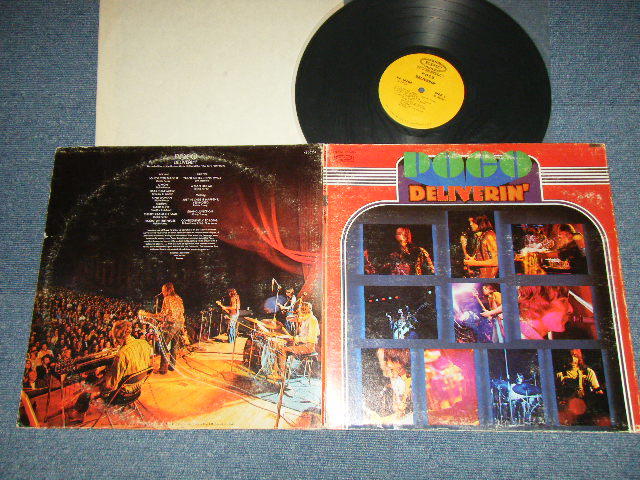
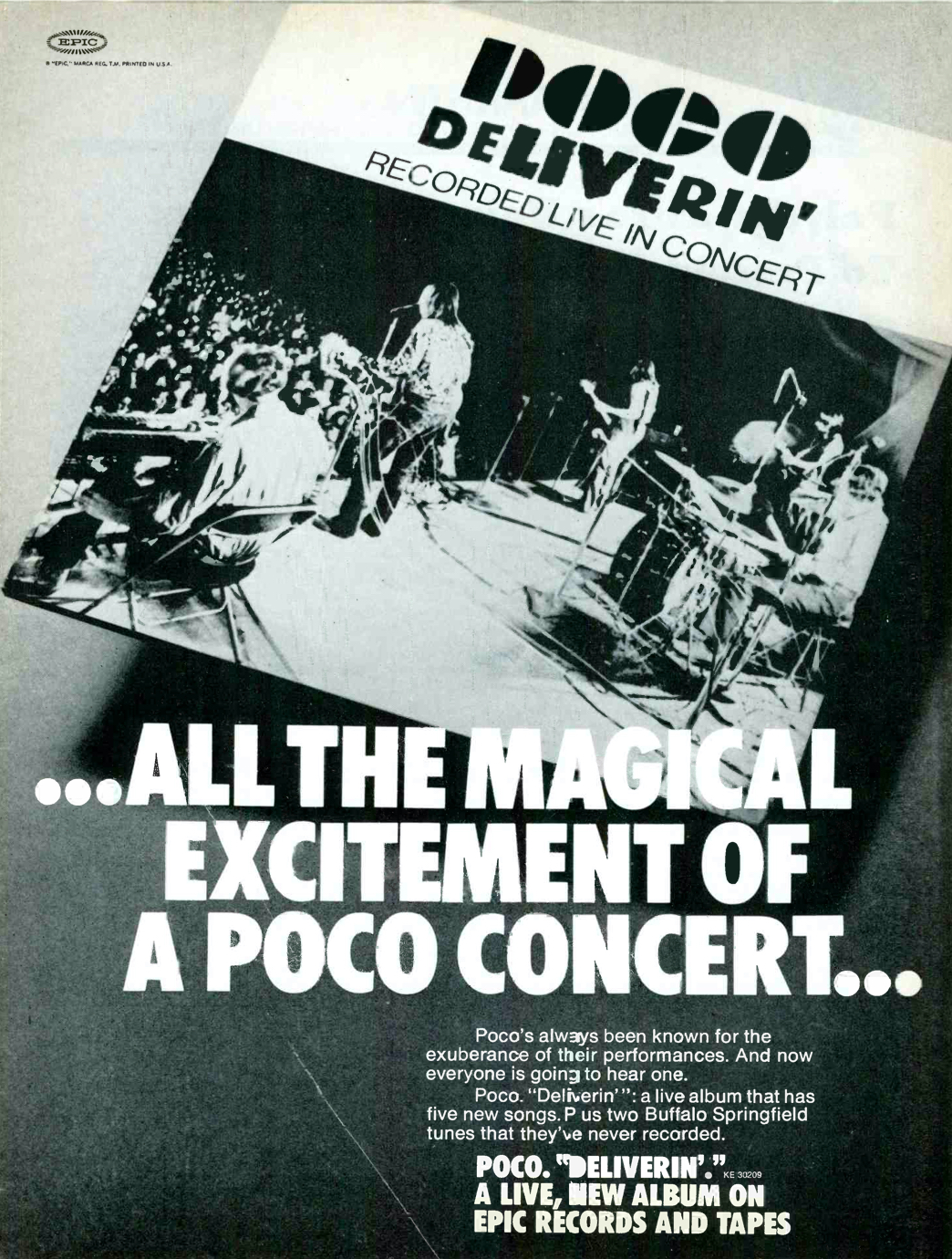
The quintet’s early records met with modest sales, but onstage they were a force from inception, as captured by their third album and first live recording, “Deliverin’”, released on January 13th, 1971.
Deliverin’ opens at a gallop with “I Guess You Made It,” showcasing Young’s shapeshifting pedal steel, here routed through a Leslie speaker cabinet to emulate a Hammond B-3 organ. Like the Burritos’ steel player “Sneaky Pete” Kleinow, Young shrewdly mixes classic steel technique with rock effects. Both the brisk tempo and the band’s vocal zeal are signatures that recur throughout the set, with Poco noteworthy for spontaneous shouts closer to the days of the British Invasion than typical for the era.
Reflecting both Furay’s prolific song writing output and the band’s confidence in breaking in material on the road, the album includes three more previously unreleased songs, while devoting the other four tracks to more familiar works, starting with a leisurely performance of “Kind Woman,” the Springfield track that first brought Furay, Messina and Young together. A warm ballad in waltz time, the song offers a breather between the uptempo songs and medleys that dominate their set.
The album’s first medley welds a new Schmit song, “Hard Luck,” with Furay’s “A Child’s Claim to Fame,” introduced on Buffalo Springfield Again, and his title track for the Poco debut full-length. A testament to Young’s technical command, his Dobro work here gives no ground to James Burton’s studio take on the Springfield perennial. With tracks from their second studio album still percolating on FM playlists, the band refreshes one of Poco’s best-received songs, Messina’s “You Better Think Twice” (here listed as “You’d Better Think Twice”) by shifting from the razor-edged electric lead figures Messina played in the studio to an acoustic setting their spoken intro flags as “down home,” with Young moving to Dobro rather than steel.
For the album’s closing track, the band revisits three of the debut album’s songs in a medley framing Rusty Young’s lively pedal steel instrumental, “Grand Junction,” with two more Furay originals, “Just in Case it Happens, Yes Indeed” and “Consequently, So Long.”
Across its brisk 39 minutes, Deliverin’ maintains a lighter touch than harder blues-leaning rockers of that era, consistently pushing vocal harmonies higher thanks to Schmit’s and Furay’s ease at slipping into falsetto head tones. Coupled with the band’s instrumental dexterity, that style was what galvanized that first audience at the Troubadour and would continue to be a hallmark of the band and an influence on peers and successors such as Pure Prairie League, Firefall and the Eagles.
That Deliverin’ conveyed their potency as a live band was borne out by sales handily outstripping their two studio albums, reaching #26 on the album chart and yielding a minor hit in “C’mon” that validated their confidence in emphasizing new material rather than familiar album tracks. But internal squabbles would again interrupt Poco’s forward momentum, this time between Furay and Messina, who chafed at Furay’s control, leaving the band less than a month after those live shows to partner with a more compliant Kenny Loggins and bequeathing his perch in Poco to Illinois Speed Press alumnus Paul Cotton.
Young’s steady commitment to the band would provide the constant that enabled Poco to become one of the longest-running country-rock outfits, based in Colorado where the native Californian was raised. Furay would remain with the band for three more albums, quitting in 1973 to join J.D. Souther and Chris Hillman in the ill-fated Southern Hillman Furay Band, while Schmit would leave four years later to join the Eagles, replacing Meisner for a second time.
Poco’s most successful album came a year later, with 1978’s Legacy reaping the hit profile for which Furay and Messina had hungered. Its breakout hit was “Crazy Love,” written and sung by Young, the last man standing from the original band. Young’s persistence would enable Poco to survive subsequent label and line-up changes, securing the band’s induction into the Colorado Music Hall of Fame in 2015, two years after Young’s formal retirement.
Manchester’s teenage pals of the Goa Express have recently been swept up by Rough Trade for their fresh psych-infused garage rock. Although influences varying from 60s psychedelia to post-punk are obvious, their sound is distinct and compelling, with a sound that perfectly complements their fun-loving attitude and charm of the city of Manchester.
Hailing from Manchester, the group have been pals since they were teenagers, steadily making their name around the scene with their garage-rock sizzlers. Ludicrously-catchy garage rock from these NME 100 graduates.
On recently released track ‘Be My Friend’, the group describe it as being about “taking a step away from those who’re always trying to get close to you and as both a shout out to individuality and an acceptance of rejection. It’s a dismissal of the modern world’s hyper-connectivity and a return to privacy, rather than the involvement of everyone knowing everyone’s business all of the time.”
With tons more exciting things on the horizon, based out of Todmorden/Burnley, UK, if you like : Spacemen 3, Ty Segall, Ending the who-knows-how-long Yorkshire vs. Lancashire feud with short and snappy Ramones-style hits. While their early influences ranged from Spacemen 3 to Brain Jonestown Massacre, James tells us the band now tries to “find influences in everything we see and in everywhere we go”. You’re going to love them: A precedent was set by The Goa Express when they formed in the wake of a wild, substance-heavy night seeing The Brian Jonestown Massacre – one that left them newly single and sleeping rough outside a Tesco. All about having a good time, the lads have already caught the eye of producer Ross Orton (Arctic Monkeys, Amyl & The Sniffers) and Fat White Family’s Nathan Saoudi (a fellow lover of chaos) with their jangly, loud-mouthed garage-psych.
The Goa Express are a band you need on your radar. Enjoying life under the wings of Rough Trade Management (Shame, black midi), the Manchester-based five-piece have wowed with singles The Day and Be My Friend. Their first single proper, The Day, saw them enlist the talents of Fat White Family’s Nathan Sauodi for production duties at their own Champ Zone studio in Sheffield, culminating in a 2-minute explosion of guitars, synths, and youthful energy.
The band’s tight-knit camaraderie – formed during their teenage years at school and playing intimate live shows above vintage shops – is captured in their self-produced video for Be My Friend; a lockdown-created clip pieced together using footage taken on nights out and day-to-day laughs filmed on a phone with no intention they’d ever be used in a music promo.
BBC 6 Music legend Steve Lamacq is an early champion, having invited the quintet to play their first radio session at London’s iconic Abbey Road Studios.
The Goa Express are riding the tracks to the top and rightfully find their place among the exciting charge of UK and Irish outfits tearing up the rule book. The Goa Express are very, very good. They’re five mates from the north who are more of a brotherhood than a band. Their effortless gung-ho garage rock is causing a buzz, with singles The Day and Be My Friend prime examples of a band ready to smash down barriers and shake up the establishment.
The Goa Express are James Douglas Clarke, Joey Stein, Naham Muzaffar, Joe Clarke and Sam Launder
Philadelphia rock quartet Soraia are giving fans new music for the start of the New Year: The single Tight-Lipped, with a B-side cover of Aerosmith’s Angel, featuring a cameo by Jessie Wagner. Frontwoman ZouZou Mansour says, “Tight-Lipped is about a woman who politely refuses to challenge the status quo and direction of her life. It’s a final recognition of the part she has played in her own oppressive censoring — a soulful rebuke of her former beliefs on how to live. But by the end of the song, it becomes a triumphant declaration of who she now is: Meet Ophelia — no more promises. I refuse to be so tight-lipped.”
Side A: Tight-Lipped (Soraia Mansour/Travis Smith) Green Eyed Lady Publishing (BMI)/Real Bad Music Publishing (BMI) Side B: Angel (ft. Jessie Wagner) (Steven Tyler/Desmond Child) Primary Wave Steven Tyler/Universal Polygram International Publishing
ZouZou Mansour: Lead Vocals, Backing Vocals, Organ Nick Seditious: Lead Guitar, Rhythm Guitar Travis Smith: Bass Guitar Brianna Sig: Drums, Percussion, Backing Vocals John Hildenbrand: Organ Geoff Sanoff: Backing Vocals, Organ Jessie Wagner: Featured Artist singing on “Angel” Soraia Released January 8th, 2021
Paper Birch are an experimental noise-rock duo, consisting of Fergus Lawrie, of Urusei Yatsura, and Dee Sada of Steve Albini-produced An Experiment On A Bird In An Air Pump. The band started working together under the enforced distance of 2020, and created their debut album, “Morninghairwater”, which received a minimal digital download release through Cafe Oto imprint TakuRoku. Now one of eight new signings to the excellent Reckless Yes label, alongside the likes of Breakup Haircut, Piney Gir and th’sheridans, Morninghairwater is set to receive a much more expansive release later this year.
Listening to Morninghairwater, Paper Birch’s sound seems to exist between an array of genres, one moment engulfing the listener in a flurry of angular shoegazing noise, before the next slipping into richly melodic moments of indie-pop. The result is a record that seems to ebb and flow, one that is far more than the sum of its songs; they seem to have almost created a sonic landscape, full of moments of real beauty, and others where the brutality of the natural world is laid bare. Particularly wonderful is Fallen, reminiscent of early-Liars or even Joy Division’s Atmosphere, as it combines dissonant guitars with easy, half-spoken vocals and a steady rhythmic pulse. While the album is already out in the world, with the backing of one of the UK’s most exciting new indie-labels, Paper Birch’s music should reach a whole new array of ears in the year ahead.
Official music video for Paper Birch’s ‘Summer Daze’ directed by Grant McPhee, written and recorded by Dee Sada and Fergus Lawrie, produced by Fergus Lawrie and mastered by Steven Ward. Taken from the album, Morninghairwater released August 5th 2020 on TAKUROKU records.
The Weather Station (the project of Toronto-based singer/songwriter Tamara Linderman) is releasing a new album, “Ignorance”, on February 5th via Fat Possum Records. This week she shared another song from it, “Atlantic,” via a self-directed video for the track.
Linderman had this to say about the song in a press release: “Trying to capture something of the slipping feeling I think we all feel, the feeling of dread, even in beautiful moments, even when you’re a little drunk on a sea cliff watching the sun go down while seabirds fly around you; that slipping feeling is still there, that feeling of dread, of knowing that everything you see is in peril. I feel like I spend half my life working on trying to stay positive. My whole generation does. But if you spend any time at all reading about the climate situation circa now, positivity and lightness are not fully available to you anymore; you have to find new ways to exist and to see, even just to watch the sunset. I tried to make the band just go crazy on this one, and they did. This is one where the music really makes me see the place in my mind; the flute and the guitar chasing each other, wheeling around like birds, the drums cliff like in their straightness; I love the band on this one.”
“Ignorance” includes “Robber,” a new song The Weather Station shared in October via a self-directed video for it in her directorial debut. “Robber,” an atmospheric horn- and string-backed track, When the album was announced in November, Linderman shared its second single, “Tried to Tell You,” via another self-directed video for the track. Ignorance is the follow-up to The Weather Station’s acclaimed self-titled and self-produced fourth album, released in 2017 by Paradise of Bachelors.
In a previous press release, Linderman said the album was built on rhythm. “I saw how the less emotion there was in the rhythm, the more room there was for emotion in the rest of the music, the more freedom I had vocally,” she says. Linderman, who plays guitar and piano on the album, was aided in this cause by drummer Kieran Adams (DIANA), bassist Ben Whiteley, percussionist Philippe Melanson (Bernice), saxophonist Brodie West (The Ex), flutist Ryan Driver (Eric Chenaux), keyboardist Johnny Spence (Tegan and Sara), and guitarist Christine Bougie (Bahamas). Linderman co-produced Ignorance with Marcus Paquin, who also mixed the album.
“Atlantic” from The Weather Station’s new album ‘Ignorance’ out February 5th, 2021


:format(jpeg):mode_rgb():quality(90)/discogs-images/R-1947317-1475924973-7369.jpeg.jpg)


 The Fat Angel Sings