Archive for the ‘CLASSIC ALBUMS’ Category

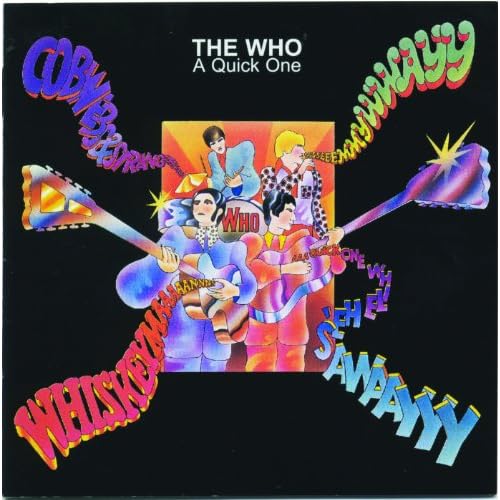
A Quick One (Remastered)

Not long after The Who’s debut album was released, Pete Townshend was already moving on. “My Generation”, which had arrived at the tail end of 1965, was mostly made up of R&B covers, garage-rock rave-ups and guitar-powered pop that pretty much sounded like every other above-average British rock LP of the period, but louder. Their second record, “A Quick One”, showed a glimpse of Pete Townshend’s ambition, wit and skewed sense of what rock music should sound like in the mid-’60s when it was released on December 9th, 1966.

So when the group assembled in IBC Studios and Pye Studios in London late in the year to lay down tracks for its second album, Townshend  with the other band members dutifully along for the ride by contributing their own material . A Quick One is the Who’s most delightfully unfocused album,  weaving through the band’s most democratic period. Bassist John Entwistle contributed two songs (including “Boris the Spider,” probably his most well known composition); drummer Keith Moon did (the instrumental “Cobwebs and Strange” encapsulates his boozy, woozy charm in two and a half minutes). Vocalist Roger Daltrey wrote one song, plus there’s a cover of the Martha & the Vandellas hit “Heat Wave.”

That left the remaining four tracks to Townshend, who, by comparison to most of his bandmates’ contributions, sounds rather conventional on three songs, although “So Sad About Us” is one of his most underrated. But it’s his final number, and the album’s closer and de facto title track, that dominates the LP and sets up the Who’s future and legacy. Clocking in at more than nine minutes, “A Quick One, While He’s Away” distills six separate songs into one cohesive track. It was Townshend’s first attempt at a rock opera, prefiguring future classic Who albums like Tommy and Quadrophenia. And it’s a masterpiece of tension and release, the story of a woman who has an affair after her boyfriend goes missing, told through various song movements that shift through moods and tempos.

Today, the album is viewed as the link between the band’s more traditional early years and the start of the ambitious period that followed with 1967’s The Who Sell Out .

Recorded at IBC Studios, Pye Studios and Regent Sound, London in the autumn of 1966. Pete’s first rock opera contains six separate songs, ‘Her Man’s Gone’, ‘Crying Town’, ‘We Have A Remedy’, ‘Ivor The Engine Driver’, ‘Soon Be Home’, and ‘You Are Forgiven’. Along the way the unnamed heroine pines for her absent lover, selects Ivor as a substitute, regrets her folly when her man returns, confesses her indiscretion and is ultimately forgiven. John:”We wanted to put ‘cellos on the track but Kit Lambert said we couldn’t afford it. That’s why we sing ‘cello, cello, cello, cello,’…where we thought they should be.”

Antlers frontman Peter Silberman recently released the solo single “Slips Away” after revealing that he would release his first proper solo album at some point. The album details are finally here, and it turns out that “Slips Away” is not on the album, but the new nearly-nine-minute single “Karuna” is. If you like The Antlers’ atmospheric, melancholic pop, you’re probably gonna like this too. The album is called Impermanence. Here’s what Peter says about it:
Much of what distinguishes Impermanence from its forebears can be attributed to an unexpected injury, which forced me to consider the finite. A few years ago, I developed a hearing impairment that resulted in a temporary total hearing loss in one ear and an excruciating sensitivity to everyday sounds, including my own voice. In order to find rest and quiet, I left my Brooklyn apartment for a secluded setting in upstate New York.
It would be some time before I experienced silence again, thanks to a constant blizzard of tinnitus. Once silence ceased to be available to me, I came to think of it as the luxury of well-calibrated perception. We mistakenly perceive it as nothing, but it’s precious, a profound entity. It became obvious to me why many prayers are silent, performed in immaculately quiet spaces.
As the sensitivity and static began to subside, I gradually re-introduced sound into my world, gently playing my nylon-string acoustic guitar and whisper-singing. Eventually songs emerged— ”Karuna”, “New York”, “Gone Beyond”, “Maya”, “Ahimsa”, and “Impermanence”— each sparse and minimal. I was conscious to only say what needed to be said. The six songs have an economy of expression, the spaces between the words as important as the words themselves. I often thought of the Miles Davis quote: “It’s not the notes you play, it’s the notes you don’t play.”
As writing neared completion, I linked up with my friend and collaborator, Nicholas Principe, to record at his People Teeth studio in Saugerties, NY. Together, we carved out a sacred sonic space, elongating the distance between notes, between chords, utilizing minimal arrangements to allow breathing room. With the help of mix engineer Andrew Dunn, we repeatedly ran tracks through aged tape until the songs themselves decayed.
But the album goes beyond experiments in ambience. It traces the stages of healing, as I experienced them. The sequence mimics the challenges in facing unexpected obstacles, charting a circular course between pain and peace, in which both are passing phases.
Impermanence illustrates our uncertain world, where everything and everyone is a temporary participant. It provides no remedy for the unpredictable, but instead offers another way to think about changing circumstances. I hope it can provide some comfort to those of us grappling with transition, which is, undoubtedly, all of us.

Julien Baker is only 20 years old, but the songs on “Sprained Ankle” sound like the stories of someone who has lived hundreds of lives before this one, which is to say: It’s an impossibly sad album. Fortunately, Baker’s heartache runs as deep as her faith, and that dichotomy is parsed over the course of these nine songs, all of which stand alone in their beauty but offer a sense of relief when bundled together. “Sprained Ankle” might make you melancholic, but it will also remind you of the lasting, saving power of music. It’s one that you will return to when you find yourself in crisis. It’s impossible to worry about the future when a 20-year-old college student effortlessly produced one of the best albums of the year. Well, even if it wasn’t effortless the stark effervescence of Sprained Ankle is as gripping as a single candle burning in the dark. Each song flickers, frisson and fear dance in shadows, but Baker herself never wavers. As perfect a debut as I’ve ever heard.

http://

Recorded at Spacebomb Studios in Richmond, VA
Mastered at Bonati Mastering in Brooklyn, NY, these guitar notes that enter here just blew my mind. incredible vocal performance, and the restraint in the instrumentals / production is just perfect for this. amazing track.

Nirvana Incesticide

Back on Record Store Day 2012, Nirvana put out a 20th anniversary double-vinyl reissue of their essential 1992 rarities compilation Incesticide. It was just a limited release, but now, for its 25th anniversary, it’ll get a proper release on January 13TH 2017. It was remastered from the original analog master tapes and recording sources by Bernie Grundman.
It’s a little less exciting than the 20th anniversary reissues of Nevermind and In Utero, which came with tons of awesome bonus content, but still cool news for Nirvana completists.

Incesticide was a Geffen cash-grab, a collection of cobbled-together recordings released in 1992 at the height of Nirvana’s popularity.

While the motivation behind the collection may not have been too pure, it remains a brilliant and fascinating record, and a vital element in understanding just how great the band were.

The album contains quirky covers of the likes of Devo and The Vaselines which hint at Cobain’s new wave and pop influences, outsider art such as ‘Beeswax’ and ‘Mexican Seafood’, and some of their finest material ever recorded (‘Dive’, ‘Aneurysm’ and the irrepressible ‘Sliver’). And now you can buy it on double-vinyl, to celebrate the record’s 25th anniversary.

Image result

Virginia singer-songwriter Lucy Dacus’s No Burden is astounding for two reasons. First off, this is the young artist’s debut album, but it is surprisingly genuine and mature. Second, she reimagines the indie folk and rock scene because she does not fall victim to the one-dimensional melancholic trope and rather opts for a frank and beautiful style. With her warm, dreamy voice, Dacus has an artful swagger and constructs wry and acute observations about her experiences. Accompanied by her mesmerizing guitar, Lucy Dacus bravely traverses and articulates the inner workings of her self in songs like “I Don’t Wanna Be Funny Anymore” and “Map on a Wall.”

http://

A self-described restless soul, Dacus is on a quest of endurance, “how to survive the bendin’ and breakin’.” With a breezy attitude, Dacus’ drops the “g’s” from “-ing” verbs in a charming manner, but she still maintains a modern elegance. All the while, No Burden has a tinge of optimism and hope, making it a gorgeous and insightful work.

Such a great voice, great songs. The album starts with more upbeat numbers but what makes the album so great are the ballads and lower-key songs


To be clear, Lucy Dacus’ No Burden was originally released by the small Richmond, Virginia-based label Egghunt earlier this year, and was just reissued by venerable indie Matador following much critical acclaim and a few successful cross-country tours. The extra push is nice, but Lucy Dacus’ songs possess enough timeless vigor that it’s tough to imagine them having been kept a secret for long. You will appreciate the quality of Lucy Dacus’ confessional songwriting, culled from acute observation and sleek homage to a universal truth on this sleek debut.

Jet Plane and Oxbow

Okkervil River members Jonathan Meiburg and Will Sheff began Shearwater as a channel for some more subdued songs they were working on together. Meiburg, whose master’s thesis at the UT geography department was on a subspecies of falcons common to the Falkland Islands, took the name from a class of migratory seabirds. Beyond his interest in ornithology, Meiberg’s prolific creative output includes writing (he’s a contributor to the literary magazine The Believer), and releasing Shearwater’s ninth(!) studio album.

Jet Plane and Oxbow, which was released on Sub Pop last month, has a particularly early 80s sound to it. Think Scary Monsters era David Bowie meets early Peter Gabriel. The new album receives an extra boon from film composer and percussionist Brian Reitzell, whose work includes the soundtracks for several Sofia Copolla films like The Virgin Suicides and Lost in Translation. Jonathan Meiburg with Emily Lee on keys, Sadie Powers on bass, Josh Halpern on drums, and Lucas Oswald on guitar came into Studio 1A today..

Shearwater’s eighth record, will be one of 2016’s most slept-on, and that’s a shame, because this is far and away the strongest thing the band has released since 2008’s Rook, and one of their best records to date. Masterful drummer Thor Harris has departed, which is perhaps one of the reasons there are a few more electronics and programmed beats here, but the band still hits hard, with some shimmering, towering songs like “Quiet Americans” and “Filaments,” with the thundering “A Long Time Away” being quite a high watermark for the band. As usual, Jonathan Meiburg and co. know when to tone it down, as on the beautiful “Only Child” and the closing track. Meiburg’s voice is, as ever, able to be forceful and gentle, often within the same song, going from rough to tender and back again. I hope people find this record while catching up on 2016’s music output, because it would be a small tragedy for a surprisingly good record, from a band who some have sort of turned away from, went unnoticed.

Shearwater 2.3.16

In addition to a couple different nifty t-shirts, some leftover copies of Missing Islands, and of course the new album in various formats, we have TWO exclusive tour releases. You’ve heard about the Complete Island Arc digital box set before (more details and pictures at the link), but we will also have something brand new: Safe Houses, an instrumental “deconstruction and reimagination” of Jet Plane and Oxbow by our producer Danny Reisch (buy the code now, download available February. 15th). Both releases are digital, but both come with physical art objects hand-manufactured by us.

Tonight we get to see you from the stage! And vice-versa, I suppose. Let me introduce you to the band, and the band to you. At left, on keys, is Emily Lee, also of Snake Oil fame. Besides running our Instagram account, she does a mean Ozzy Osbourne. Long-time guitarist, vocalist, multi-instrumentalist, and heartthrob Lucas Harrison Oswald and our leader Jonathan Meiburg surely needs no introduction.
To the right of JM is bassist Sadie Powers, also of Dead Fame and her own doom ambient duo project Discipline, whose secret Bowie tribute “Dolphins” is really worth hearing.
This selfie’s auteur, front and center, is our drummer Josh Halpern, whom you might have met before – he’s also a member our Austin friends Marmalakes (who are opening for us at the two Texas shows).
Not onstage but a very powerful presence: our long-time friend, sound man Jay Demko.
If you’ve seen us before, you may notice that our stage design is a little more impressive than usual – we’re doing our best to live up to the cover of Jet Plane and Oxbow.

The first album recorded by someone other than the band themselves, Modern Baseball enlisted Joe Reinhart (Hop Along, Joyce Manor) at Headroom Studios in Philadelphia to help refine their sound on Holy Ghost.

In a tight 28 minutes, Holy Ghost covers an impressive emotional range, with co-songwriters Jacob Ewald and Brendan Lukens literally splitting the record in half. The record kicks off with six songs from Ewald and ends with five from Lukens. What they ended up with was a complete record of the past two years– the highs alongside the lows, tales from the road and glorious days at home alongside songs of heartbreak and personal struggle.

http://

Modern Baseball co-frontman Brendan Lukens had a pretty intense year leading up to the release of Holy Ghost, having gone to treatment for depression and addiction, which was captured on the Tripping in the Dark a short documentary film. They’re not a band that’s quick to hide their scars or laugh away their wounds—you don’t get to be heroes of the so-called “emo revival” by putting on a happy face. The thing of it, though, is that their music is so damn fun that it’s hard not to come away from Modern Baseball’s most intensely emotional and personal moments without a feeling of satisfaction, catharsis or hell, even just feeling good. Holy Ghost is split into two halves, the first comprising songs written and sung by Jake Ewald and the second by Lukens. The distinction is notable; Ewald’s spacious compositional style on “Hiding” and Lukens’ immediacy in “Apple Cider, I Don’t Mind” provide a strong contrast, though the flow and sequence still works simply because this is a band that comes together most strongly as a whole, grasping those worst personal moments and turning them into two-minute celebrations

This band is so honest and down-to-earth, it’s amazing. Love the vibe of the whole album.

Taste artwork

Generally written off as a Jesus and Mary Chain and Spacemen 3 rip The Telescopes earlier records are a lot more diverse than tag lines may describe. The Telescopes are to shoegaze what The Cro-Mags are to Hardcore. The Cro-Mags started late and therefore benefited from the influence of every major and influential hardcore punk bands of that era. They fused everything that they where influenced by and injected their own new york attitude into it. The Telescopes do a very similar move on their first LP ‘Taste’, and the title itself gives an air of pretension more overt and obvious than the Mary Chain or Spacemen 3 (see also the lyric in There Is No Floor, ‘there is no 13th floor’). The record was released in 1989 and its sound is equally influenced by records like Psychocandy or the Perfect Prescription but these dudes where obviously waaaay stoked on garage punk. Like they are definately down with the Stooges and Iggy Pop but they where probably waaay more excited about The Iguanas or Them. They also have much more of a Rolling Stones influence with a bit of the Buzzcocks

http://

The band has tread between shoegaze, psychedelic noise, and shimmering pop since they formed in Burton upon Trent, England, in the late ’80s, and they’ve remained opaque throughout; the founding singer/guitarist Stephen Lawrie is either charming or maddeningly cryptic in interviews, depending on who’s telling the story. 

Luckily, the Telescopes’ debut album, “Taste”, is a sumptuous example of how music can communicate what language can’t. It was released in 1989, when shoegaze was still fledgling, and it’s a varied sampler of the eventual staples of shoegaze: zonked-out space rock, drone-laced rhythms, gossamer guitars. The divergence from the eventual genre lies in Lawrie’s vocals, which don’t so much swoon as sock you in the stomach, especially on the lysergic “Threadbare.” On “Taste”, that shock to the senses proves enlightening. 

Our first album “Taste”. Originally released on What Goes On Records, almost 30 years ago, later re issued on; Cheree Records, RevOla Records/ Cherry Red Records and Bomp Records. Now available to download from our Bandcamp site..

12494911_1011315852288699_8456905394648066026_n

Most Tom Petty fans thought they would never see one Mudcrutch album, let alone two. Tom Petty has reconvened his early band Mudcrutch – Petty, Benmont Tench, Mike Campbell, Tom Leadon and Randall Marsh – for a second set of rootsy country-rockers.  The album includes seven originals written by Tom Petty, with his bandmates each composing one track.

To catch everyone up on Heartbreakers’ trivia, the backstory goes that in 1974, a scraggly Florida outfit with the unwieldy name of Mudcrutch —bassist/singer/songwriter Petty along with keyboardist Benmont Tench, Tom Leadon and Mike Campbell on guitars and drummer Randall Marsh — headed to L.A. to find fame and fortune. They recorded a few tunes and soon disbanded. But since Petty was signed to the Shelter label, he kept Tench and Campbell added new members and the Heartbreakers was born.

In 2008, Petty unexpectedly revived the name, brought back Leadon and Marsh from obscurity and released what became Mudcrutch’s belated debut. That disc’s loose-limbed yet winning mix of covers and originals was a little looser and more rootsy than Petty’s typical fare and even though he was clearly the frontman, Tench and Leaden took a few lead vocals.

Eight years and two Heartbreakers albums later, Petty gives the venture another go-round, now booking a tour to support it. This one ups the energy a few notches, especially on the pounding garage pulsing “Hope” which, with its cheesy Farfisa organ sounds like a pretty good Standells B-side. Tench takes another vocal turn on the dryly humorous boogie-woogie “Welcome to Hell” and guitarist Campbell gets a rare chance to sing on his lone writing contribution, the chugging “Victim of Circumstance,” finding ground somewhere between Petty and Creedence Clearwater Revival. Even drummer Marsh takes a frontman status on his perfectly acceptable “Beautiful World,” proving himself both a respectable singer and capable of churning out at least one solid pop-rocker.

Not surprisingly Petty contributes the bulk of the material — this disc is all originals — with seven new tunes (out of 11), all of them up to the high standards he has set for himself throughout his stellar 40-and-counting year career. Even Tom Petty experts would have trouble telling the first three tracks aren’t new Tom Petty & the Heartbreakers tunes since they ride that well established sweet spot between chiming Byrds-influenced rocking and impossible to resist choruses. That’s particularly true of “Dreams of Flying,” a mid-tempo nugget every bit as good as his best work.

The closing six minute “Hungry No More” is this album’s epic answer to the debut’s sprawling 9 minute “Crystal River,” giving Campbell and Leadon room to weave their guitars around a strummy, emotionally laced Petty ballad that incorporates a bit of a psychedelic vibe, not something you’d likely hear in a set from his full time ensemble.

As usual, Petty makes it seem easy. And with help from his fellow Mudcrutchers, the unassumingly titled 2 is proof that even Tom Petty’s modest side projects are better and more compelling than many acts at their best.

Mudcrutch.