Archive for the ‘CLASSIC ALBUMS’ Category

A1093100952 16

Whitney  –  Light Upon The Lake: Demo Recordings

Light Upon The Lake’, the debut from Whitney, was born from early-morning songwriting sessions during one of the most brutal winters in Chicago’s history. Vocalist / drummer Julien Ehrlich and guitarist Max Kakacek began writing unflinching, honest songs about everything from breakups to the passing of Ehrlich’s grandfather. The pair leaned on one another for both honest critique and a sounding board for working through their newly-discovered truths.

The brief, intense period of creativity for the band yielded ‘Light Upon The Lake’s exceptional, unfussy combination of soul, breezy Sixties / Seventies rock and sombre heartbreak woven together by hopeful, golden threads. After critical acclaim and nearly nonstop touring since the album’s 2016 release, Ehrlich and Kakacek are going back to their roots – for the first time, the full demos from ‘Light Upon The Lake’ will be made available. After a whirlwind year following the debut, the demos offer a way for listeners to get a glimpse into the very beginning of Whitney’s sound.

“After almost two years of non-stop touring, we decided we wanted to close the chapter on ‘Light Upon The Lake’ by releasing the songs in their earliest incarnations alongside a cover of a band favorite by Alan Toussaint, and an unreleased track called ‘You and Me’. We’re looking towards LP2 as we finish out the year on the road.”

Num200

Husker Du – Savage Young Du

Experience the punishing sonic origins of a punk icon. Collected here for the first time, and skillfully remastered from original board tapes, demos, and session masters, this collection is an authoritative chronicling of the wellspring and maturation of Grant Hart, Greg Norton and Bob Mould – three St. Paul teenagers who’d go on to become the most heralded trio of the American punk underground. Follow the Hüskers to their earliest gigs in 1979, through extensive road dog touring, and to the start of their partnership with West Coast tastemaker SST Records in 1983 via a massive hardbound book crammed full of photos, flyers, and a sprawling essay with participation from the band. 47 of the 69 songs compiled here are previously unissued, and includes In A Free Land, Everything Falls Apart , and an alternate version Land Speed Record.

3CD – Three CD Remastered Set housed in Die Cut Sleeves. Comes with 144 Page Booklet with 40 previously unpublished photographs and 12,000 word essay by Erin Osmon.

4LP – Four LP Remastered Set housed in Tip on Sleeves. Comes with 108 Page Booklet with 40 previously unpublished photographs and 12,000 word essay by Erin Osmon.

Rog stooges hftfhs lp jacket cover 1500px

The Stooges  – Highlights From The Fun House Sessions

1970: The Complete Fun House Sessions was recorded at Elektra Sound Recorders in Los Angeles and compiled from all thirteen reels of multi-track tape that held every note and snippet of studio dialogue. Twelve reels of tape were used during the original sessions, with the thirteenth reel having the takes that would be used on the studio album. This sprawling set which was originally aimed at the collector market would be challenging and cost prohibitive to reissue as a multi-disc vinyl box set. What is presented here is an attempt to assemble some of the best highlights from the Fun House Sessions on an officially-released 2LP set in high quality packaging with a sequence that hopefully proves to be an easier, and more casual listen. Included are some terrific alternate versions of Down on the Street, Loose, Dirt, Funhouse ,1970 and others, pulled from session reels 1, 4,6, 7, 9 & 11 and originally recorded on May 11,12, 15, 18, 21 & 25 of 1970. Also notable is the inclusion of the 17+ minute-version of L.A. Blues, titled as “Freak,” which encompasses the entire fourth side of this set and is the prime example of what makes the Funhouse Sessions both loved and feared simultaneously.

Jag314.ao.bsides.fc.1600

Angel Olsen –  Phases

Angel Olsen releases Phases, a collection of B-sides, rarities, and demos from the past several years, including a number of never-before released tracks, via Jagjaguwar. Balancing tenacity and tenderness, Phases acts as a deep-dive for longtime fans, as well as a fitting introduction to Olsen’s sprawling sonics for the uninitiated. Fly On Your Wall, previously contributed to the online-only, anti-Trump fundraiser Our First 100 Days, opens Phases, before seamlessly slipping into Special, a brand new song from the My Woman recording sessions. Both How Many Disasters and Sans are first-time listens: home-recorded demos that have never been released, leaning heavily on Olsen’s arresting croon and lonesome guitar. The B-sides compilation is both a testament to Olsen’s enormous musical range and a tidy compilation of tracks that have previously been elusive in one way or another.

LP – Black Vinyl with Download.

Jane weaver

Jane Weaver  –  Modern Kosmology

Modern Kosmology sees Jane Weaver’s melodic-protagonist channeling new depths of creative cosmic energy within. After the huge critical acclaim of 2012’s Fallen By Watchbird, followed by 2015’s exploratory Silver Globe LP winning her unanimous “record of the year accolades” and hefty measures of radio play-listing Jane Weaver’s conceptual trajectory has sent her neo-kosmische penchants to the point of no-return. Jane Weaver’s unwaning yearning for psychoactive pop energy has just reached a new level of magnetism. As snowclones go, Modern Kosmology is the new Silver. Another Spectrum to add to the tension.

CD – Digipack.

LP – Standard LP is standard weight vinyl, black inner and A6 download card.

LP+ – Deluxe LP – 1000 Copies only. Black 180 Gram vinyl, Deluxe metallic foil print sleeve, black inner, 24”x12” fold out poster, A6 download card.

6891232d567c333bca07239c7733c806

Vagabon – Infinite Worlds

Reissue on Marathon of the album that came out earlier this year on Father/Daughter records and was a Pitchfork favourite. Within the songs of Laetitia Tamko there are infinite worlds: emotional spaces that grow wider with time, songs within songs that reveal themselves on each listen. Tamko is a multi-instrumentalist and a producer, recording since 2014 as Vagabon. Her forthcoming debut, Infinite Worlds, builds upon Tamko’s stripped-down demos that have been circulating online and throughout the independent music community for the past two years. Tamko’s songs are embedded with her own story and personal history: growing up in Cameroon, her family’s move to New York and adjusting to culture shock. She grew up around music and loved it, but finishing engineering school was a priority before music could start to feel like a real possibility. To date, Tamko mostly listens to East and West African music nostalgic of her childhood, styles of music that influence her own in subtle ways.

Raincoats 500x500

The Raincoats  –  Fairytale In The Supermarket EP

Limited copies are signed by Ana Da Silva. We ThRee reissue The Raincoats’ legendary first 7” E.P. originally released on Rough Trade Records in April 1979, and has been commercially unavailable since its first release. Fairytale in the Supermarket currently features in Mike Mill’s widely acclaimed and Golden Globes nominated new film 20th Century. Digitally re-mastered from original masters. Original monoprint sleeve design by Ana da Silva.

Rem double cd 1200x1200 04dfea90 f66b 4d15 a5d9 f33b4ec306d4 1024x1024

R.E.M  – Automatic For The People (25th Anniversary Edition)

Widely considered to be one of the best albums of the 90s, 1992’s Automatic For The People features R.E.M.’s iconic hit singles Nightswimming, Man on the Moon and Everybody Hurts.

2CD – Remastered album plus Live At The 40 Watt Club in a rigid clamshell box with booklet. 4CD – Remastered Deluxe edition boxset features previously unreleased material, including 20 never-before-heard demos, and the previously unreleased tracks Mike’s Pop Song and Devil Rides Backwards. A Blu-ray disc offers the full album (with bonus track Photograph featuring Natalie Merchant) mixed in Dolby Atmos, plus a high-resolution master of the album, music videos, and the original 1992 EPK. Also included is Live At The 40 Watt Club 11/19/92 – a live set performed in R.E.M.’s hometown of Athens, GA.

LP – 180 Gram Heavyweight black vinyl, cut from original analogue tapes at Capitol Studios and download card.

100000x100000 999 1

Ed Tullett and Novo Amor  –  Heiress

After meeting in November 2013, Ed Tullett and Novo Amor (Ali Lacey) quickly began writing to form the basis of what is now “Heiress”, their full-length collaborative record.
Recorded around the release of their two widely lauded collaborative singles (“Faux”, 2014 and “Alps”, 2016), the pair worked sporadically in intense week-long sessions in Cardiff spilling over Lacey’s old and new home-studios, tearing songs down and building them back up again. “Heiress” is noticeably the product of nearly 4 years work – sprawling, ambitious and strikingly deep, it’s a collection of songs both meticulously calculated and deeply felt.

R.E.M. named their eighth studio album, 1992’s Automatic for the People, after a slogan employed by Weaver D’s, a joint in their hometown of Athens, Ga., that specialized in soul food. But the musicians didn’t just enjoy soul food, they were fans of soul music – an influence that got obscured by the music press’ constant references to the Byrds and New York punks.

But R.E.M. loved R&B records. They goofily covered Archie Bell and the Drells’ “Tighten Up” in the ’80s and some soul aficionados compared Bill Berry’s drumming to that of Booker T. and the MG’s member Al Jackson Jr.

It was Berry who came up with the rough idea for R.E.M.’s most soulful original song, “Everybody Hurts.” In mid-1991, Berry, guitarist Peter Buck and bassist/keyboardist Mike Mills met up to begin working on music for the band’s follow-up to Out of Time. (Singer Michael Stipe would enter the creative process later, which was standard operating procedure for R.E.M.) One day, the drummer, who also played other instruments, brought in a new idea. “Bill wrote most of it,” Mills has said. “He came in with the chords on guitar. We were actually playing with Bill on guitar, Peter on bass and me on drums. It sounded terrible. We thought, ‘This sucks. Let’s demo it playing our own instruments, play it right.’”

Buck described the initial version of the song, which had no chorus or bridge, as a country-ish ballad. As R.E.M.’s instrumental trio kept at it, the song began to develop a more soulful feeling.

“We went through about four different ideas and how to approach it and eventually came to that Stax, Otis Redding, ‘Pain in My Heart’ kind of vibe,” Buck recalled, “I’m not sure if Michael would have copped that reference, but to a lot of our fans it was a Staxxy-type thing,”

With Mills playing Booker T. Jones to Buck’s Steve Cropper, “Everybody Hurts” became something of a soul ballad. It had the some of the trademarks of a Stax ballad, including an arpeggiated guitar part, electric piano and 12/8 time signature.

“But then it’s shuffled through us. Like the bridge is in a way-weird different key,” Buck said in 1992. “We’re not Otis Redding. But given that, we took some of the influence, that music we loved for years.”

Berry, Buck and Mills didn’t think that Stipe would respond to their slow and simple approach, and that this track would be consigned to the b-sides and rarities bin. But the singer ended up taking to “Everybody Hurts,” which displayed a much different approach – both in lyrics and performance – to early R.E.M. While Stipe would play fast and loose with enunciation on songs such as “Gardening at Night” and “9-9,” that habit had slowly faded with R.E.M.’s rise to rock prominence. “Everybody Hurts” took one more step forward in being clear and direct. “There’s a time for obfuscation,”said Mills . “But this wasn’t it.”

Many times since the release of Automatic, R.E.M.’s members have discussed the lyrical ideas of “Everybody Hurts,” explaining that the anti-suicide sentiments of the song were directed at teenagers – or anyone, really – who might need to be reminded that so many people share pain, sadness and dark thoughts. The band had written political songs before (and elsewhere on this album), but this was R.E.M.’s first “message song.” And the message was, “You’re not alone.”

In an ironic twist, the man who was most responsible for the song ended up barely playing on it. Instead of Berry’s drumming, the majority of the track features a metronome-like beat created by a $20 Univox drum machine, although Bill was the one who programmed it.

Stipe “and I cut it live with this dumb drum machine which is just as wooden as you can get,” said the drummer  in 1992. “We wanted to get this flow around that: Human and non-human at the same time.”

Berry’s normal drums show up for the song’s bridge, and again at the end, when his crisp pounding helps bring “Everybody Hurts” to a soaring conclusion – aided in no small part by full complement of strings. The orchestration was the work members of the Atlanta Symphony Orchestra, supervised by John Paul Jones. Via producer Scott Litt, R.E.M. had asked the Led Zeppelin bassist about arranging strings for “Everybody Hurts” and three other Automatic songs. He agreed and collaborated on the overdubs in the spring of ’92.

“John Paul Jones was great to work with,” Buck said in Reveal: The Story of R.E.M. “He knows his way backwards and forwards on just about every instrument. He’s a great arranger and a super sweet guy.”

“Everybody Hurts” became the fourth track on Automatic for the People, which came out in October 1992, as well as the fourth single R.E.M. released from the album. The song became a smash overseas, hitting No. 7 in the U.K., No. 4 in the Netherlands and No. 6 in Australia, where it remains the highest-charting hit of the band’s career. “Everybody Hurts” also went over well in R.E.M.’s home country, going to No. 29 on the charts, The commercial success was helped, maybe even overshadowed, by the song’s music video.

In one of R.E.M.’s most iconic clips, the band finds themselves in the middle of a traffic jam (shot by Jake Scott on a freeway in San Antonio). Subtitles flutter between song lyrics and – in a Fellini-esque touch – the unheard thoughts of R.E.M.’s fellow motorists, in snippets that are funny, strange and devastating. The band gets out of their car, Stipe starts to sing and everyone is moved to just get out and walk.

“Michael is probably the best artist I’ve worked with in terms of understanding his performance, even though he’s so insecure all the time,” Scott, who is the son of big-time film director Ridley Scott said in 1995. “In ‘Everybody Hurts,’ he felt exposed and agoraphobic and I think that worked for the video. It’s rare that somebody has the confidence and awareness to look awkward and quite afraid in front of the camera.”

MTV agreed, playing the video early and often and awarding it multiple Moonmen at 1993’s Video Music Awards, at which R.E.M. performed the song for only the second time in public. (As with Out of Time, the band had again chosen to forgo a tour to promote Automatic.) But in the following years, “Everybody Hurts” became a frequent part of R.E.M.’s set and was featured at the band’s final full performance in 2008 in Mexico City. It’s been part of each best-of collection that includes the group’s Warner Bros. years.

“Everybody Hurts” also became bigger than just one of R.E.M.’s hits. In Nevada, a state that has a high rate of teen suicide, the legislature celebrated the song for its message. A U.K. counselling service based an ad campaign around the hit, hoping to help more young people who were contemplating suicide. And, in 2010, R.E.M. gave their permission for the song’s use (sans royalties) for an all-star charity single that sought to raise money for the people of Haiti after that year’s earthquake.

If the song has been perceived as too square, maudlin or basic by some music fans, Mills thinks that’s due to the song’s overexposure on the airwaves. But it’s clear that the members of R.E.M. take pride in it, especially Stipe.

“I don’t remember singing it, but I still kind of can’t believe my voice is on this recording,” he wrote in Part Lies, Part Heart, Part Truth, Part Garbage 1982-2011. “It’s very pure. This song instantly belonged to everyone except us, and that honestly means the world to me.”

Tennis we can die happy

Every album represents something foundational to our lives during the time of its creation. Yours Conditionally was about extricating ourselves from an industry that made us feel joyless and restrained. After a successful campaign that involved starting our own label and learning how to record on our own, We Can Die Happy finds us on the other side of that leap of faith, reveling in the sense of freedom and control we’ve found in our work. While making the track list for Yours Conditionally, a couple of songs didn’t seem to fit.

One song, I Miss That Feeling, had been giving me trouble for months. The concept came to me after I noticed the way that certain physiological aspects of anxiety could be read as feelings of pleasure when presented as a list, without context. We had gone as far as recording and mixing it, but when I listened back, I knew I had gotten it wrong. I scrapped everything except the chorus lyrics which detailed my own experiences with panic attacks and started over. I hoped I Miss That Feeling would be an easy fix and the rest of the EP would take shape around it. Instead each song resolved itself while I Miss That Feeling remained stubbornly incomplete. In the final days of our deadline, feeling the pressure, I had a panic attack. Even in the middle of hyperventilating, I thought spiraling into anxiety over a song about anxiety was oddly fitting. Very me. In the end I settled on a kinder approach. I made the minor chords major; I softened things. I made the song a love letter to my constant companion rather than a denunciation of it.

“‘Cause what I want with you is none of your business,” Alicia Bognanno sings in a soft bedroom voice, layered above a repeating and driven guitar riff in the opening verse of “Kills to Be Resistant.”

This release off of Bully’s sophomore album, Losing, is not hard to identify with. The drums in this song lay down a foundation, perfectly mirroring Bognanno as she ebbs between gentle verses tip-toeing around the topic, and choruses riddled with gravel, grit and the pain that comes with accepting circumstances as they are. With just drums and bass to hold the words, Bognanno confesses, “When I’m alone, I stare at your picture,” a habit with which most of us are all too familiar. When the guitar riff comes back in for the bridge, it’s an embodiment of that cyclical, anxious thought process that’s attached to facing an end to or a shift in a relationship.

“It won’t stop / Do you feel nothing?” she asks in the chorus leading into an outro that matches the built-up frustration in the lyrics with dissonant chords and skillfully-played drum fills.

This is all anyone could have hoped for when anticipating new music from Bully. The sound is full, but nowhere near overly-complicated. Every necessary element is there, coming together to sound so effortless and raw. The only thing more to ask for is a ticket to a live performance.

No automatic alt text available.

Overcoats is a Brooklyn-based duo that mixes traditional folk, soul, and gospel with the forward-thinking electronic production of Sylvan Esso and Little Dragon. Their debut album “YOUNG” is built on the themes of family, love, and concepts of womanhood. Produced by Nicolas Vernhes (Daughter, Dirty Projectors) and experimental R&B artist Autre Ne Veut, the deluxe edition of their debut album YOUNG featuring the new track “I Don’t Believe In Us” is out now!

If you needed yet another reason to love Overcoats, bless them because they just gave it to you. At the end of April, Hana Elion and JJ Mitchell, uber-talented vocalists/musicians/all-around stargrlz, released their highly anticipated debut album, Young, and it’s a game changer.

The 12-song album, co-written by the duo, builds upon their self-titled EP (which featured “Smaller Than My Mother”, “The Fog”, “Walk On”, and “Little Memory”), and brings several new songs into the fold, each imbued with its own personality. The more familiar tracks have also been revamped, creating a fuller, more mature soundscape that personifies where Overcoats have been, where they are, and where they’re going. And boy, are they going places.

Overcoats have an incredible ability to create honest stories that allow us to heal openly.  A subtle, but ever-present concept throughout the album is learning who we are in the world and coming to terms with the ways in which we have changed

As R.E.M. were completing work on their eighth studio album, Automatic for the People, in the late spring of 1992, the quartet’s members grew concerned about the final track listing. For the most part, this was a batch of dark songs about difficult subjects. Perhaps a bit of levity, in the form of the buoyant “The Sidewinder Sleeps Tonite,” would be welcome in the running order.

“We included this song on Automatic in order to break the prevailing mood of the album,” guitarist Peter Buck wrote in the liner notes for In Time: The Best of R.E.M. 1988-2003. “Given that the record dealt with mortality, the passage of time, suicide and family, we felt that a light spot was needed. In retrospect, the consensus amongst the band is that this might be a little too lightweight.”

Like the majority of the songs on this album, “Sidewinder” first came to life in rehearsal/demo sessions conducted by the instrumentalists in the band: Buck, bassist/keyboardist Mike Mills and drummer Bill Berry. Following a couple months of promotion for 1991’s Out of Time, the trio holed up in R.E.M.’s hometown of Athens, Ga., and began working on what they had planned to be a big rock record. But the tracks that most intrigued them – and singer Michael Stipe – turned out to be the quieter, acoustic-driven ones, and the melancholy music that would symbolize Automatic for the People started to coalesce.

But amid some of the softer, slower, minor-key stuff was an upbeat boogie, created the same day that the men came up with the music for “Man on the Moon.” Both were melody-forward, but the former seemed to recall R.E.M.’s sunniest moments, such as “Shiny Happy People” and “Stand.” It only became bolder with John Paul Jones’ string arrangement, added after the bulk of the album sessions in Atlanta.

“The other guys gave me this new song that is so beyond ‘Stand’ that it makes ‘Stand’ sound like a dirge,” Stipe has said in 1992, perhaps referring to what would become “The Sidewinder Sleeps Tonite.” “I mentioned it and they all started laughing. But it sounds like that song ‘The Sound of Philadelphia’ by MFSB. It’s really out there.”

R.E.M’s singer went “really out there” in penning the lyrics to “Sidewinder,” writing lines that list food (“A can of beans or black-eyed peas / Nescafe and ice”) or could be snippets of overheard conversation (“Uou can’t lay a patch by computer design / It’s just a lot of stupid, stupid signs”) or obsess over the tiny details (“There are scratches around the coin slot”).

But that’s not to say that this song isn’t sub-sub-sub-substantial. “Sidewinder” seems to be offering glimpses of a transient lifestyle with the hallmarks of a roadside motel – instant food, strange characters and pay phones. Although Stipe wrote the lyrics, the details may have mirrored aspects of guitarist Buck’s life, seeing as his first marriage was in trouble during the Automatic era.

“I didn’t even have a house,” he revealed in the documentary R.E.M. by MTV. “I was driving around listening to cassettes and staying in $19-a-night motels.”

The “Sidewinder” mentioned in the song’s title is a snake, perhaps a metaphor for the drifting narrator, or maybe it refers to the public phone that is so central to the lyrics. Some old-timey telephones were called sidewinders, because of the coil of cord that wound on the side of the machine.

It’s also possible that in the chorus (where Stipe squeezes nine syllables into the space of four, “callmewhenyoutrytowakeherup”), the “her” that he’s singing about could refer to the phone. If cars, boats and spaceships can be “shes,” why can’t a pay phone be a “her”?

Despite wearing a lighter pallor, “Sidewinder” still ties into one of Automatic’s main themes: youth, or rather, memories of youth. You can hear Stipe laugh as he sings, following the namecheck of Dr. Seuss (because he’s incapable of saying the children’s author’s name as Dr. Zeus). He goes on to sing about the Cat in the Hat and cartoons, in a lyric of which the singer is particular fond.

“Sidewinder” “holds on of my favorite lines ever, in ‘their world has flat backgrounds and little need to sleep but to dream’,” he wrote in the liner notes to Part Lies, Part Heart, Part Truth, Part Garbage 1982-2011. “Cartoon characters never just get sleepy, they always have to have a dream of some floaty kind.”

R.E.M. Automatic For the People reissue

In the recording stage, the song’s working title was “Wake Her Up,” before it was changed to “The Sidewinder Sleeps Tonite” – a reference to the old Tokens’ doo-wop hit “The Lion Sleeps Tonight.” Stipe even cops that song’s “eee-dee-dee-dee” intro in the R.E.M. song’s opening moments. The guys had a genuine love for the song, which they had been covering since R.E.M.’s earliest shows, and decided to clear their nod to the pop classic with its songwriters.

“We actually paid them for that,” Buck revealed in 1992. “We didn’t want some guy, down the road, going, ‘You owe me two million dollars.’ So we called them up and said, ‘We’re calling it “The Sidewinder Sleeps Tonite” and the singer kind of paraphrases the line.’ In any court of law, we couldn’t have been nailed. Because the song doesn’t have anything to do with it. But you don’t want someone to feel that you’re stealing from them.”

R.E.M. also promised to cover “The Lion Sleeps Tonight,” allowing Stipe to squeal with joy on the B-side of the “Sidewinder” single, thus ensuring the songwriters some royalties. Which is what happened when the band put out the song as Automatic’s third single in the winter of 1993, a few months after the album’s release. It kind of flopped in the U.S. (“Sidewinder” fared well on rock radio, but didn’t match the reaction to “Drive” or “Man on the Moon”), but went to No. 17 in the U.K.

Although “The Sidewinder Sleeps Tonite” has featured on multiple best-of compilations – including 2003’s In Time and 2011’s career-spanning Part Lies, Part Heart, Part Truth, Part Garbage – R.E.M. never played the song in concert. It is one of only two tracks from Automatic for the People to never make it into a concert (the other being “New Orleans Instrumental No. 1”).

“That’s a song that to this day I’m not really sure what it’s about, but it’s a lot of fun,” Mills said in 2007. “We never do it live, but it’s a good record. It’s just one of those songs that never seemed like it need to be done live. We might’ve messed around with it at sound check a couple of times, but it never felt like something we should really try.”

“Try Not to Breathe” is a pretty bleak command. And, indeed, the second track from R.E.M.’s Automatic for the People is about death. But the song’s title originated with a much more innocuous statement.

During the demo stages for the album, which would come out in October 1992, guitarist Peter Buck was recording the groundwork for a possible new tune on acoustic guitar.

“We were doing the demo, and I had the mic for my guitar right up against my mouth. I was kind of huffing,” Buck said in 1992. “So John [Keane], the engineer, said, ‘You’re making too much noise.’ So I said, ‘OK, take two. I’ll try not to breathe.’ I just meant that I wouldn’t breathe during the take. But Michael [Stipe] heard it and said, ‘Oh, that’s a nice title.’”

Stipe took the idea away and returned with a completed lyric, a scene of someone on their deathbed, told from the perspective of person who is about to shuffle off this mortal coil. The singer came up with a poetic depiction of what this ailing figure would be feeling and thinking. There’s discomfort (“I can hold my head still with my hands at my knees”), but also strength (“The decision is mine”) and acceptance of the end (“I have lived a full life”).

In interviews at the time of Automatic’s release, Buck and bassist/keyboardist Mike Mills talked about the subject of “Try Not to Breathe” as a man (probably because Stipe is male). But the frontman later revealed his deeply personal connection to the song. He was writing about his grandmother. He was reflecting his feelings by imagining hers in what appears to be an internal monologue. She conveys love to her family silently, as thoughts run through her head: “I will try not to burden you / I can hold these inside / I will hold my breath until all these shivers subside / Just look in my eyes.”

Some rock critics and fans marveled at the capacity of a rock singer in his early 30s to write so movingly about an elderly woman. But in this, Stipe might have not only been inspired by his grandmother, but by another songwriter who had a gift for embodying people beyond his years in compositions: John Prine. For a couple years, Stipe had been singing Prine’s “Hello in There” at performances with Natalie Merchant and/or Billy Bragg, bringing an earnest empathy to the song’s portrayal of sad and lonely, elderly folks.

Long before it had lyrics, or a title, “Try Not to Breathe” was one of the first tracks conceived for Automatic for the People. During the final days of making Out of Time in 1990, Buck offered it to be the counterpart to Stipe’s “Nightswimming” lyrics. When the singer opted for Mills’s circular piano idea instead, the guitarist got his idea on tape at Prince’s Paisley Park Studios (where R.E.M. were mixing Out of Time).

The waltzing instrumental returned for the 1992 demo and recording sessions for Automatic, some of which took place at Woodstock, N.Y.’s Bearsville Sound Studios. At that point, the song was nicknamed “6/8 Sailor” for its time signature, then was marked “Passion” when the final touches were added at Bad Animals in Seattle.

“Chord structure-wise, it could be some kind of a mountain ballad,” was how Buck described the track that would appear as “Try Not to Breathe” on the final album. “But then it has electronically altered background vocals and feedback in the bridge, to give it an unsettling feel.”

Like “Drive” before it, this recording crackles in its mix of elements. There’s the roughed-up components (which Buck describes above) and the rattle that seems to be counting down the last moments. But there’s also those long, twangy guitar strains that seem to bend into eternity, drummer Bill Berry’s tasteful tom hits that give just enough to push the song forward, and Mills’ organ overdub, which adds grace to such finality.

If his keyboard playing brings grace to “Try Not to Breathe,” Mills’ backing vocals carry deliverance. Near the middle of the song, R.E.M.’s not-so-secret weapon swoops in to do his best Smokey Robinson. He’s a resplendent echo of the dying woman’s last thoughts: “Something to flyyyyy.” He’s nothing short of an angel, not coming to save the day, but to help make it better. Mills’ vocal performance is what stayed with him, long after he finished work on Automatic.

“A beautiful song, personally one of my favorite backing vocals that I ever did,” he said in 2007. “I felt like John Lennon when I came up with it. It’s very nice to feel like John Lennon even if it’s just for five seconds.”

As the album’s second track, “Try Not to Breathe” establishes the theme of mortality found on half of the 12 songs on Automatic for the People, but it was the first song on the album to deal with death. Musically, it carries over the acoustic foundation and dark sonic aesthetic from “Drive.” It helped define the album as more subdued and pensive, certainly less guitar-forward than much of Green or Document.

“On quiet little songs like ‘Try Not to Breathe’ … the guitar is always there, but it’s a discordant guitar bubbling under the surface,” comments Buck. “Automatic for the People isn’t a real rockin’ album, but I think that’s fine, because there are enough of those around this year as it is!”

Of course, R.E.M. had initially indicated that their follow-up to the blockbuster, but gentle, Out of Time would be a big, rock record. Instead, in the burgeoning era of Nirvana and Pearl Jam, they were offering a death rattle.

“My feeling was – not in a negative way – is that it was kind of a down record with a lot of minor keys,”said Buck in 2017, “and we were at the age when Michael was thinking a lot about mortality, so I didn’t expect it to be a huge hit.”

Yet, Automatic for the People, with the death-focused “Try Not to Breathe” in a prominent position, became a multi-platinum and critical success, displaying R.E.M. at the height of their cultural importance.

Before R.E.M. was finished making Out of Time, they had begun crafting Automatic for the People. They just didn’t know it yet.

In December 1990, they traveled to Prince’s famous Paisley Park Studios outside of Minneapolis to put the finishing touches and create the final mixes for Out of Time, which would come out a few months later. The band recorded a demo version of “Drive” on the final day of mixing for their soon-to-be blockbuster release.

“It wasn’t actually in the running for that album,” guitarist Peter Buck said in 1992. “When we’re mixing or doing overdubs, we all sit around with guitars and just play. I put this thing down on tape and then [bassist/keyboardist] Mike [Mills] added some stuff. We thought it might be a good B-side for that album.”

But “Drive” turned into much more than a B-side. Along with two other tracks that can trace their origins to Paisley Park (“Nightswimming” and “Try Not to Breathe”), the sparse acoustic guitar-propelled song eventually would set the tone for the Automatic for the People sessions. Although Buck, Mills and drummer Bill Berry initially tried to fashion a follow-up out of up-tempo rockers – sort of counter-programming after the delicate, pastoral Out of Time – the faster, harder songs had less appeal, both to the instrumental trio of R.E.M. and the band’s frontman Michael Stipe.

The way the group usually recorded was that Buck, Mills and Berry would first create a slate of instrumental demos, and then Stipe would write lyrics to the ones that most intrigued him. Buck credits the R.E.M. singer for plucking the minor-key “Drive” off the scrap heap.

“I had it on a cassette of demos and I always fast-forwarded through it,” Buck recalled. “I thought it was the most boring thing I’d ever heard. Then, all of a sudden, Michael had these lyrics, which defined the song for me.”

It’s ironic that, on the song that would become Automatic’s first track (and lead single), Stipe helps introduce this ballad-heavy record with the line, “Hey, kids, rock and roll.” The rest of the band loved the idea of having rock and roll in the lyrics, but not necessarily in the music, although Stipe maintained he wasn’t being snarky, but paying tribute to David Essex’s “Rock On” (a similarly spare recording featuring the same phrase).

“There were, before punk, a few songs that resonated with me,” said Stipe  in 2009. “One was David Essex’s ‘Rock On.’ ‘Drive’ is a homage to that.”

But “Drive” was more about telling kids to rock – even “around the clock” in a nod to the dawn of the genre. The lyrics appear to be about control, with “elder statesman” Stipe (he was barely over 30 at the time), reminding a younger generation to think for themselves. Certain lines also suggest a political angle. “Bush-whacked” gives you an idea of what Stipe thought then-President George H.W. Bush was doing to the country. “Ollie, Ollie in come free” might reference disgraced military man Oliver North, while also recalling a childhood game. Lost youth would be a running theme throughout Automatic.

“It’s a subtle, political thing. Michael specifically mentions the term ‘Bush-whacked,’” Buck said. “But if you want to take it like ‘Stand,’ that’s cool too. You like to think that you can appreciate these songs on any level you want to. I have a lot of records I listen to when I’m just doing the dishes.”

With the lyrics mostly in place, in early 1992, R.E.M. recorded a more complete demo version of “Drive” at John Keane Studios, a favorite establishment for the band to work in their hometown of Athens, Ga. Before the bulk of the Automatic sessions were to take place in March and April, the group spent a little more than a week in the Big Easy, playing and recording in Daniel Lanois’ Kingsway Studio.

“We did demos in New Orleans at Daniel Lanois’ studio, which is an old, haunted mansion – supposedly haunted – and filled with kind of neat, old antiques, neat instruments,” Buck said in a promotional video. “And [we] did demos there, some of which ended up on the record. ‘Drive’ is a live take from there. Bass, drums, guitar and vocals – all live.”

The demo recording was so alluring – with spindly acoustic guitar, deep bass, thunder-crack drums and Stipe’s rich vocals, set against a mass of empty space – that it became the foundation for the final track. Again, “Drive” was setting the tone for Automatic and the work that was yet to take place in Woodstock, N.Y.; Miami, Atlanta and Seattle in the spring of ’92.

R.E.M. would add to “Drive” during some of those sessions. An overdubbed melodica  appears at the 45-second mark, bringing some sweet to round out the stark, but also serving as the sort of piercing ring you’d hear in the aftermath of an explosion. But in this case, the explosion happens secondary to the aftermath, when Buck’s overdubbed fuzz guitar (plucked with a nickel for blunt force) crashes in like a fire bomb, setting the emptiness alight.

The emotion is not just carried in Stipe’s cavernous voice, but also in the symphonic strings that pair with the melodica about a minute-and-a-half into the song. According to Berry, the band were in Miami when they decided that strings might benefit some of the Automatic material, including “Drive.” As fans of John Paul Jones’ orchestrations as a member of Led Zeppelin, they contacted the multi-instrumentalist, who agreed to arrange and oversee the additions.

“Doing the string arrangements for that album was a great experience, actually,” said Jones  in 2010. “They sent me the demos of their songs, and we went into a studio in Atlanta, with members of the Atlanta Symphony Orchestra. They were great songs, something you can really get your teeth into as an arranger.”

The strings lift “Drive,” but also swirl around its primary instruments, sometimes tangling with Buck’s fuzzed-up slashes. What began as a relatively subdued, haunting acoustic number turned into something much more vigorous: a track that built and built and built over the course of four-plus minutes, only to set down gently once more. Scott Litt (who had co-produced R.E.M.’s previous three LPs and would work on this one and the next two) thought that the sort of dynamism on display on “Drive” was a result of the band’s love of Queen.

“The arrangement of ‘Drive’ was, in part, inspired by Queen,” Litt said in 1995. “Pete and Mike are big Queen fans. Queen records, for all their bombast, sounded like each player had a personality.”

In the final stages of work, “Drive” was chosen to be the track that would lead off the album. It would also be the first single to be released from the album, on October. 1st, 1992, just a few days before Automatic for the People hit stores. Once more, “Drive” was setting the tone.

As a song without a chorus, “Drive” was a curious choice for the lead single. Perhaps, R.E.M. thought that that after “Losing My Religion” – a tune with a mandolin riff – had become a pop smash, anything was possible. “Drive” didn’t quite reach those heights, although this dark gem went to No. 28  (and did even better in Canada and Europe), became plastered on rock radio and served as the gateway for fans to Automatic.

The song’s video, featured prominently on MTV, also served as a signpost. Directed by frequent collaborator Peter Care (from Stipe’s concept), the black-and-white clip appeared to take its cues from Anton Corbijn’s crisp band photos found in the Automatic CD booklet, but added an element of danger. Strobe lights flash, a crowd of outstretched arms swells like a stormy sea and R.E.M.’s frontman appears to be taking part in one unpleasant crowd-surf or the victim of an angry mob. Cutaways are made to Buck, Mills and Berry, each blasted with a fire hose, in a strange appropriation of civil rights era images.

Automatic’s music videos became more important for the band’s image following R.E.M.’s decision not to promote the album with a tour (which had also happened the year earlier with Out of Time). However, the band did knock out one show in Athens for a Greenpeace benefit. At the concert, R.E.M. played a handful of tunes from the new record, including “Drive,” which featured a dramatically different approach. Instead of beginning with the haunting acoustic intro like on the record, the performance took the song’s name literally, launching with a pile driver of electric guitar and organ. The live version of “Drive” metastasized into herky-jerky funk-rock workout.

Although the live reimagining was recorded and released on 1994’s Alternative NRG (also to benefit Greenpeace) and became a B-side, most fans were introduced to the high-energy “Drive” during R.E.M.’s performance at the 1993 MTV Video Music Awards. It’s continued to be the way the band played the song on their massive Monster tour in ’95.

“We’ve played it a lot, it’s been in virtually every show that we’ve done since we’ve put it out, and after a while, you know, you want to give things a little bit of a different treatment,” said Mills in 2007. “The MTV Awards we did, it was fun to do, that was a chance to surprise a whole lot of people at one time. Music is not immutable, it’s organic, and while there are some songs we never change live, that was one that could do with a little moving around.”

The live version of “Drive” was released on the bonus disc of rarities and B-sides that came with special editions of In Time: The Best of R.E.M. 1988-2003. Despite “Drive’s” status as a hit single, the original recording was left off the main edition, as well as the career-spanning compilation, Part Lies, Part Heart, Part Truth, Part Garbage 1982-2011 – out-shouldered by Automatic for the People’s other notable singles.

But it remained a live favorite through to the end of R.E.M.’s performing days, and the band eventually reverted to playing “Drive” in a rendition that more closely resembled the original recording. It was one of five Automatic selections the group performed at their final full concert in 2008 in Mexico City. “Drive” was played early in the show, again helping to set the tone.

Based in Austin, Texas, Hovvdy (pronounced “howdy”) is the writing and recording project of Charlie Martin and Will Taylor. The duo, both primarily drummers, first met in the fall of 2014 and quickly bonded over a love for quiet music. Within a few weeks, they had combined songs and began recording their first EP in bedrooms and family homes across Texas.

By 2016 the two had committed to each others growth in songwriting and recording, resulting in their debut album “Taster”, originally released on Sports Day Records and reissued in 2017 by Double Double Whammy. Hovvdy has found a unique identity in rhythmic, down-tempo pop songs that are hopeful, yet melancholy; relatable, yet distinguishable.

Hovvdy’s sophomore album, “Cranberry”, expands on a familiar texture, building off Taster’s minimal complexity and covering new ground. Hovvdy – “Petal” Off their new album, “Cranberry” Out February 9th, 2018 on Double Double Whammy Records.

summerteeth-cover1

Despite a memorable handful of upbeat, borderline joyous songs—including a title track that literally features chirping birds—”Summerteeth” is pretty damn dark. Songs like “We’re Just Friends,” “How to Fight Loneliness” and the murder-dream classic “Via Chicago” are heartbreaking, and even tracks with a cheery sheen are low-key depressing when you get into the lyrics. Still, a thread of hope runs through even the most downtrodden passages, lending Summerteeth an emotional depth that pairs nicely with a newfound sonic complexity.

It’s the first album where Wilco really explores what’s possible in the studio. Organs and guitars are held on equal measure. There are birdsounds, there are horns, there are pops and bells and clanks and other textural flourishes. It’s a dazzling departure for a band whose sound had been predicated on alt-country twang. Plus, the songwriting is uniformly excellent, as evidenced by the fact that “Via Chicago” and “A Shot in the Arm” are still live favorites today. On Summerteeth, Wilco was becoming something else.

Can’t Stand It (From Summerteeth, 1999)
I couldn’t have been the only one who first heard the opening song on Summerteeth and immediately thought, “What the hell???” It didn’t take long (less than 4 minutes, I’m sure) for me to get over it. It was probably about the time I first heard, “No love’s as random as God’s love…I can’t stand it….I can’t stand it.”
Great stuff.

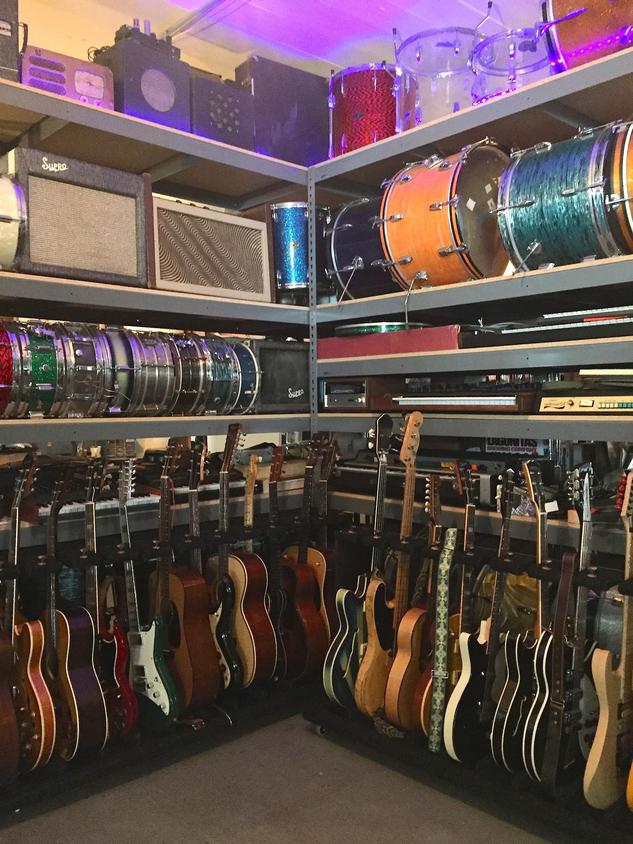
You’ll have the chance to buy some of Wilco’s gear. Jeff Tweedy and company will be opening up a shop on Reverb.com called “The Wilco Loft Shop,” named after their Chicago studio/”safe haven for making music” where much of the gear currently resides, and selling off various items from their collections.

The instruments range from insanely valuable, including a 1958 Gretsch 6021 and two 1940’s Gibson flattop acoustics, all owned by Tweedy, to more collector-focused, like an assortment of guest passes from past Wilco tours. Tweedy discusses the decision to open up the online shop, stating, “Every once in a while we look around the loft and say ‘Geez, there’s just too much stuff up here,’” adding, “We hate to see it go, but we’re sure you’ll put it to good use!”.

Wilco Will Be Selling Off Some of Their Gear On Reverb.com Starting Next Week

All of the items for sale have been played by members of Wilco either on tour, in the studio or both, and will be shipped with a signed certificate of authenticity. You can head here to preview the shop before it opens next week to see a preview of some of the items that will be for sale, and below you’ll find a few pictures of  Wilco’s actual loft, along with video of a 1996 Wilco

WilcoLoft_3.jpg