The Manic Street Preachers remember Hillsborough in moving new single ‘Liverpool Revisited’
paying tribute to the victims of the Hillsborough disaster in their touching new single. A highlight of their upcoming album ‘Resistance Is Futile’, the soulful cut is drenched in melody in the vein of their ‘Everything Must Go’ anthemic side – as the band deliver a moving ode to the people of Liverpool as they remember the 96.
“Again, another lyric that Nick has written about events that really inspired him,” said frontman James Dean Bradfield of the track. “It’s about the ‘Justice For The Victims Of Hillsborough’ campaign. That campaign fought the entire British establishment to get to the truth, and they finally got there with their ruling.
“When the ruling came out of the High Court, we were just about to do a gig at the Liverpool Echo Arena, and Nick had a day down on the waterfront where he just took loads of Polaroids and wrote loads of poetry, as he does. Nick wrote this song in its entirety. I think I’d gone home for tea with the family and by the time I got back, he’d done a guitar solo – which is a bit cheeky. When he gets into the flow of doing a song on his own, it does just flow.
As well as teasing plans to celebrate the 20th anniversary of their classic album ‘This Is My Truth Tell Me Yours‘, Nicky Wire recently spoke about what to expect from ‘Resistance Is Futile‘.
“On the single and the whole album, there are a lot of mini tributes to things that make your life feel a little bit better,” said Wire’. “Rather than my internalised misery, I tried to put a sense of optimism into the lyrics by writing about things that we find really inspiring.” He continued: “I wouldn’t go as far as to call it ‘escapist’, but it does feel like we’re building our own world. It goes back to the idea of when we started the band with us four insulating ourselves and germinating ideas. It’s not about purposefully switching yourself off from the world around you, but just trying to find inspiration. Otherwise you just get swamped in a sea of total negativity – which is fine. It’s not like we haven’t done that before.”.
Taken from the new album, ‘Resistance Is Futile,’ available
The Eels’ twelfth studio album and first in four years, The Deconstruction, was performed by E (Mark OliverEverett) and his longtime collaborators Koool G Murder and P-Boo alongside The Deconstruction Orchestra & Choir. It was produced by E, with some songs produced by Mickey Petralia for the first time since 1998’s Electro-Shock Blues. Eels mastermind E says of the new album, “Here are 15 new Eels tracks that may or may not inspire, rock or not rock you. The world is going nuts. But if you look for it, there is still great beauty to be found. Sometimes you don’t even have to look for it. Other times you have to try to make it yourself. And then there are times you have to tear something apart to find something beautiful inside.”
It has been more than two decades since Eels first burst onto the scene with their gloriously offbeat debut album Beautiful Freak. Since then, the band’s chief creative force Mark Oliver Everett – better known simply as E – has delivered a dozen albums, written an autobiography, penned music for films an television shows and even fronted a BAFTA-winning documentary on the subject his father Hugh Everett, the physicist responsible for the ‘many-worlds’ theory which posits the existence of infinite universes.
After recording and touring relentlessly for much of the last couple of decades he decided to take a well-earned break, but this week Eels return with their first new album since 2014 and ahead of its release we sat down with the man himself to talk about the new album, his forays into acting, and hanging out with the cast ofMad Men…
Official video for “Today is the Day” from THE DECONSTRUCTION, out now!
Jimi Hendrix released only three studio albums and one live LP before he died on September. 18th, 1970, at the age of 27. His legacy is built on that classic trio of records, but it’s grown over the past four decades thanks to dozens of album releases that have been released since his death.
Jimi Hendrix was despite being so enigmatic and galvanizing in front of a live audience, he actually hated being out on the road. In his defense, “the road” in the 1960s was an unforgiving and punishing place to be, especially when plotted out in advance by Hendrix’s manager, Michael Jeffery. One night he and his band, The Experience, would be playing a gym in Santa Barbara, California, and the next night they’d find themselves in an arena in Seattle, Washington. Patently brutal. Then there was the added anxiety of being far away from the recording studio — the place where he felt most at home. To Hendrix, touring was more stress than it was worth. It was just something he had to do to keep the black lights at Electric Lady Studios on.
Jimi Hendrix was only on the scene for about four years of his life, but he absolutely made the most of that time. Amid a vast number of classic, immortal live recordings, he toured incessantly and performed an incredible number of live shows that still have the ability to shock and surprise nearly 50 years on. From the Fillmore East to the Fillmore West, from Woodstock and Monterey to Paris, and London, and everywhere else that he and whatever group was backing him went, the possibility that real magic might present itself .
THE OLYMPIA THEATRE Paris– OCTOBER 18th, 1966
Some concerts on this list are bound to get a little more shine due to their historic nature, like this gig at the Olympia Theatre in Paris from 1966. This was the first time that The Jimi Hendrix Experience, with Mitch Mitchell on drums and Noel Redding on bass, played together as a group in front of a paying audience — opening for the “French Elvis Presley”, Johnny Hallyday, no less. I suppose we could have put Hendrix’s last known gig at the Isle of Fehmarn on September 6, 1970, or maybe his performance at the Isle of Wight a few weeks earlier, but both of those are kind of shambolic and more than a little morbid. Even though this show was only 15 minutes long, you get a real sense of the kind of fire Hendrix was playing with around the time he first hit the scene. The band’s first single, “Hey Joe”, sounds great, but it’s the Howlin’ Wolf cover “Killing Floor” that will leave your jaw on the floor. (The above video shows Hendrix at the venue one year later.
THE CAFÉ AU GO-GO – MARCH 17th, 1968
One of the great things about going to a live show is the feeling that anything can happen. The patrons of the small Café Au Go-Go Club in New York City couldn’t have known when they ordered their drinks that they were about to witness one of the great, public rock and roll jam sessions of all time that spring night. To be sure, Hendrix was known to play around town while in New York City, but this gig with Elvin Bishop on rhythm guitar, Paul Butterfield on harmonica and vocals, and Buddy Miles on the drums is some next-level stuff. It’s clear from the recording that the guys were just interested in messing around, but there are some real spine-tingling moments to be gleaned here like the pickup group’s all-instrumental rendition of “Little Wing” or the cover of T-Bone Walker’s “Stormy Monday.”
THE ATLANTA INTERNATIONAL POP FESTIVAL – JULY 4th, 1970
Many of Hendrix’s greatest live shows came in outdoor spaces, like this one at the Atlanta Pop Festival on Independence Day in 1970. In many ways, this Georgia gathering was the spiritual sequel to Woodstock that the fiasco in Altamont failed to be. Like Woodstock, it was billed as “three days of peace, love and music,” and you needed a ticket to enter. And just like in upstate New York, the deluge of 300,000-500,000 people crying out slogans like “music belongs to the people” forced the organizers to open the gates and let everyone in completely free of charge. For his part, Hendrix actually delivered a set that was far more cohesive and tight than he had given the summer before, albeit without any of the iconic highlights. A rare performance of “Room Full of Mirrors” is a real gem from this show as is the extended “Red House” jam.
BERKELEY COMMUNITY THEATRE – MAY 30th, 1970
Loose is the operative word when it comes to describing this concert, which took place just outside the confines of the University of California. In the context in which it was performed, it’s actually an interesting contrast to the mania of the anti-Vietnam War demonstrations that were taking place right outside the venue. In his own way, Hendrix addresses the tension permeating the atmosphere in his intro to “The Star-Spangled Banner” when he asks the crowd to get on their feet and stand for the national anthem, reminding them that “we’re all Americans.” For their troubles, he then proceeds to knock them down back on their asses with seismic versions of “Purple Haze” and “Voodoo Chile (Slight Return)”. For real music nerds, it should be noted that this show was one of the very few instances in his career when Hendrix didn’t tune his guitar down a half step and instead played this entire gig in standard tuning.
THE FILLMORE EAST – JANUARY 1st, 1970
The one and only performance of the short-lived Band of Gypsys came at Bill Graham’s Fillmore East. The only reason this project came to fruition in the first place was due to a legal settlement between Hendrix and Ed Chalpin of PPX Recordings, whereby the latter would receive total rights to one release by the former. It was a messy situation all around and one that Hendrix wasn’t about to resolve by giving Chalpin the tapes that would make up Electric Ladyland, so instead he enlisted his old Army buddy Billy Cox to play bass and Buddy Miles of Electric Flag to play drums for a special live album project. It’s hard to say that Band of Gypsys was superior to the Experience, but this show isn’t without its merits. “Them Changes” with Miles on lead vocals is funky and fun in a way that Hendrix rarely was while performing live, but it’s the song “Machine Gun” that takes the cake. At a runtime of 12:40, it’s by no means succinct, but with that signature, simulated-gunfire riff and wandering, adventurous solos, it’s one of the most thrilling tracks in Hendrix’s canon.
THE L.A. FORUM – APRIL 25th, 1970
There’s something about the sunny confines of the Forum in Inglewood, California, that brought out the best in a myriad of ‘60s and ‘70s rock bands, and Hendrix was no exception. This was the first live show that Hendrix played after his foray with the Band of Gypsys and the first in seven months with Mitch Mitchell back on the skins. Hendrix sounds completely re-energized and hits the SoCal crowd with a number of heavy-hitting tracks, including one of the first performances of “Ezy Rider” and “Freedom”, which both sound incredible. The cherry of this gig, however, is the sultry and bombastic “Foxey Lady”, which, per usual, was dedicated to one of the finer specimens of the opposite sex that the guitarist spotted in the crowd.
WOODSTOCK – AUGUST 18th, 1969
You probably assumed that this show would top this list or maybe place second, but one transcendent moment does not a complete concert make. Hendrix’s performance of “The Star-Spangled Banner” at Woodstock will forever stand as one of the defining moments of the ‘60s, but the rest of the show around that singular – and notably solo – rendition of the American national anthem is somewhat shambolic. For this gig, Hendrix brought together his regular drummer, Mitch Mitchell, and his Army buddy and Band of Gypsys bassist, Buddy Cox, but also an overstuffed array of world musicians who clearly weren’t ready to tackle this material. That this was also the longest performance of Hendrix’s career actually doesn’t help its case as one might assume either. It’s not a complete disaster, however, as both “Woodstock Improvisation” and “Hey Joe” are undeniably fantastic.
THE ROYAL ALBERT HALL – FEBRUARY 24th, 1969
It was one of Hendrix manager Michael Jeffrey’s more canny moves that this gig was even booked in the first place. Originally, he and the Experience were only supposed to perform at the Royal Albert Hall for one night on February 18th, which was due to be recorded for a potential live album, but Jeffrey was worried that the band wouldn’t make the grade. His concern proved correct as both Redding and Mitchell sounded utterly lethargic at that show. The band only had one more shot to make up for their lackluster performance, thus this gig a week later where they absolutely killed. Hendrix clearly knew that he and the band were on fire and actually went back on at the end of the night for a positively rare encore of the exceedingly rarely played “Room Full of Mirrors”. This ended up being the last show that the Experience would ever play together in Europe.
THE MONTEREY POP FESTIVAL – JUNE 18th, 1967
When Jimi Hendrix left New York City for the UK in 1966, hardly anyone in his home country even noticed. When he came back on June 18, 1967, for the Monterey Pop Festival in northern California, they could hardly tear their eyes away. As opposed to Woodstock where one song transcended the rest of the Hendrix’s set, at Monterey, the guitarist’s violent, sexually charged rendition of The Troggs’ “Wild Thing” was a culmination. Seemingly intent on topping The Who’s explosive performance of “My Generation” that preceded him, when it came to ending his own showing, Hendrix pulled out all the stops. Even watching now, the display of him grinding his custom-painted Stratocaster against the stack of Marshall amps before throwing it down to the ground and riding it like a familiar love is shocking to behold. Then comes the lighter fluid; and then the match and then the flames. At Monterey, Hendrix threw down the gauntlet to his generation of fellow artists: Either become daring, or remain irrelevant.
THE WINTERLAND BALLROOM – OCTOBER 11th, 1968
Burning guitars and rockets red-glaring aside, this show, the second in a run of three dates in San Francisco, was the absolute peak of Jimi Hendrix’s live performance career. Throughout its history, the Winterland Ballroom was a venue that brought the best out of those who performed there, whether it was Led Zeppelin in 1969, The Band in 1976, or Bruce Springsteen and the Sex Pistols in 1978. Hendrix, already one of the best live acts on the scene at the time, with a tremendously loyal and dedicated following in the Bay Area, brought his pure A-game to the BillGraham-promoted concert hall.
It’s actually a pretty tall order to pick from which of the three nights from the 10th through the 12th was the best of the bunch. On the first evening, you have a tremendous, electrified version of “Hear My Train a Comin’” to go along with a twisted, psychedelic rendition of “Tax Free”. On the last night, there’s that great cover of Cream’s “Sunshine of Your Love” and an explosive “Spanish Castle Magic”. But then you have the second night, and Hendrix gives you perhaps the best version of “Purple Haze” that he ever performed live to go along with a mind-blowing cover of Bob Dylan’s “Like a Rolling Stone”. You can’t go wrong with any of these gigs to be perfectly honest, and taken together, they really are the iconic guitarist at the very top of his game.
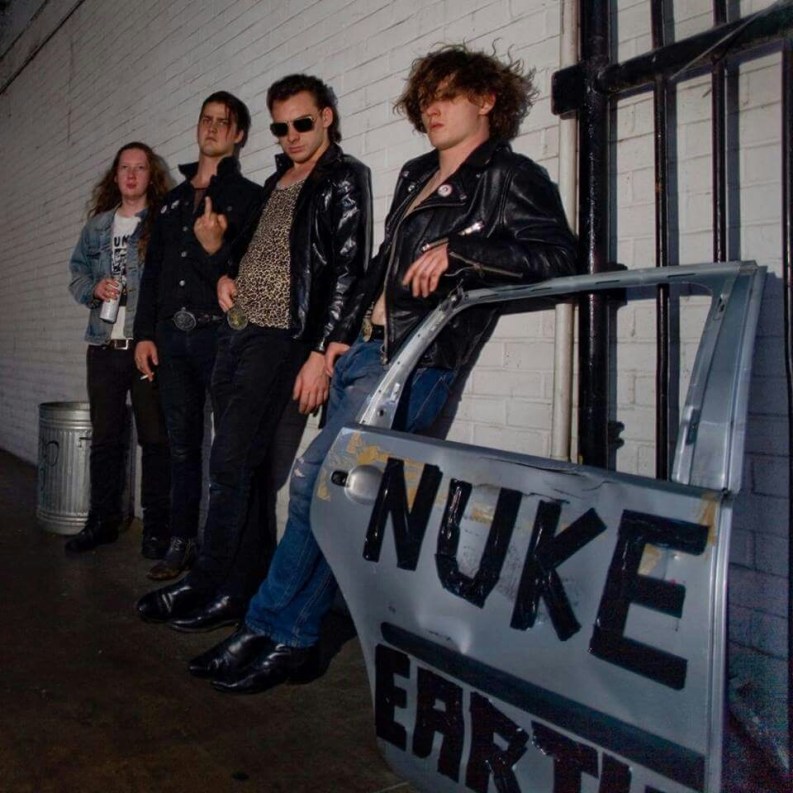
You want something loud, raw and frantic with a crescendo of decibels and urgency? Then look no further than The Cavemen’s new full-length ‘Frantic Earth’.
It’s not surprising perhaps that these New Zealanders have found favour beyond their Auckland home. After we featured their debut album recently, we were ready for more. Out today (April 6th) through Slovenly Recordings, the 13 tracks are a rampaging onslaught of bit-size nuggets of ballsy punk.
And this third album release is, aptly, as they themselves describe it: “pure, primitive motherfuckin’ Garage Punk like you lust after every night when you’re licking your sexiest leather record jackets, or ‘77 punk steeped in a moldy stack of bootleg Motörhead outtake LPs. The Cavemen have gone batshit crazy, and they’re in full-on attack mode here with 13 tracks of panty dropping chaos guaranteed to land you in jail faster than you can crack one off in a grindhouse showing an “Ilsa” film. Rock’n’roll is here to stay, and it’ll always be for the crazy kids… like it or lump it!”
Philly indie folk act Kississipi have announced the release of their upcoming debut album, ‘Sunset Blush’.
The Philadelphia-based project have announced that their debut full-length will come out in just a little over two weeks. The album’s called Sunset Blush, The opening track starts off pillowy and warm, the synths making space for Zoe Reynolds’ voice the same way she’s trying to be more accommodating for the person she’s singing about. “Up to now I’ve given all I’ve got/ You could always keep it if you want/ I’ll make myself easier to love,” she sings. The song operates in a grey area — its final hook of “I didn’t think it would be you” suggests that maybe all that change was worth it, but some of the verses seem to lean towards the other end of the spectrum, giving up too much of your independence in order to be there for someone else. That’s true of the constant push-and-pull of an adult relationship, though, balancing autonomy with partnership.
It will be released in April next year via SideOneDummy Records
Performed by Kississippi, Kyle Pulley.
Drums by Michael Tashjian.
Backup vocals on Cut Yr Teeth by Mary Allen.
Backup vocals on Easier to Love and Shamer by Kaylen Alan.
Backup vocals on Lash to Lash by Sofia Verbilla of Harmony Woods.
Guitar Feature on Cut Yr Teeth by Katie Capri of Fern Mayo.
Cello on Shamer by Luke Shefski.
ISLAND are an Alternative guitar band from London. Their music is arena ready, both explosive and atmospheric with gigantic hooks emotionally build with ambient blues and immersive catchy song-writing
Recorded all in one room in just two weeks with sparing use of overdubs and no click track, London-based Island’s debut album is a sonic document that’s all about feel, all about capturing four musicians at their most unprocessed and uninhibited. A combination of influences ranging from trad-folk to high-octane punk rock and encompassing everything in-between, “Feels Like Air”, with its hook-filled anthemic choruses and inventive drumming simultaneously deploys Island’s rolling melancholy and bottles the lightening of the group’s imperious live shows.
Forming as teenagers when frontman Rollo Doherty’s acoustic bedroom project was treated to the boisterous backing of guitarist Jack Raeder, bassist James Wolfe and drummer Toby Richards in a dingy windowless practice room where they began to painstakingly shape a sound which combined darkly twisting instrumental with a sweetly melodic song-writing nous that belied their age.
Now signed to New York tastemaker label Frenchkiss Records, the band are gearing up to release their hotly anticipated debut album, due April 6th 2018 and entitled ‘Feels Like Air’.
In keeping to their DIY approach to making music, ‘Feels Like Air’ was written and produced entirely by the band and includes all new music. Drawing on influences from their shared love of artists like Fleetwood Mac, Kings of Leon, War On Drugs and Grizzly Bear,
their debut offering, with its hook-filled anthemic choruses and inventive drumming, is a body of work two years in the making.
The eleven-track album progresses through a range of emotions, experimenting with the down-tempo and cinematic and includes their singles ‘Try’, ‘The Day I Die’, ‘Ride’ and ‘Horizon’.
The band’s live show is fearsomely tight and effervescently energetic through years of playing together week in, week out since their youth. Be sure to catch ISLAND touring Europe and North America in 2018.
“They are very very special, this band” – Huw Stephens BBC Radio 1
“One of the most exciting bands at the moment.” – Wonderland
Tamara Lindeman aka The Weather Station made a big impression at Austin’s SXSW with the New York Times selecting her as one the 17 Acts that Stood Out. Hot on the heels of such well-deserved praise she has revealed her new video for “Impossible”. The cleverly choreographed video finds Linderman assisted in daily routine tasks by several assistants.
Shot and edited by Lindeman herself and Colin Medley she described it as “one of these late night, half asleep ideas. A sort of child-like play on free will. On the idea of habit, or how much one is controlled by unconscious ideas. On the idea of moving against–or moving with–these forces.”
The act of watching others assist (or hinder) her in simple tasks such as brushing her hair and eating breakfast is strange but the act of resistance she introduces, especially with her mobile phone which she is forced to interact with creates an uncomfortable friction that translates well through the lens and really drives home how over-complicated our lives have become.
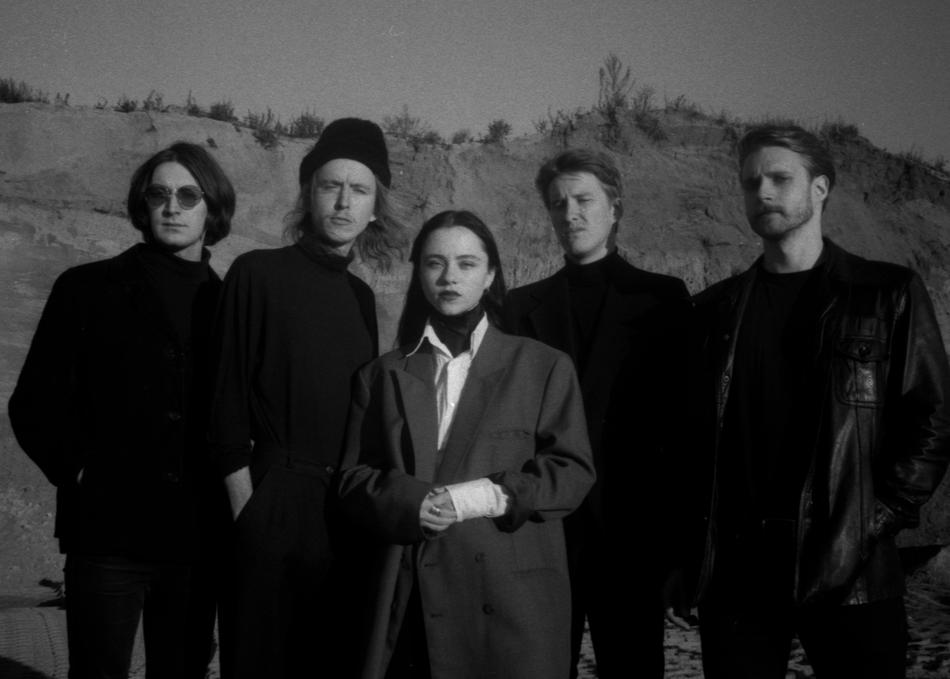
HOLY MOTORS is a Tallinn, Estonia based on dark twang & reverb sound like a band from a nonexistent movie. It bows to engines and echos andfilm-directors. Cinematic suspension is often more than not what drives the band towards a melody and meaning. It’s “psychedelic rock that hits like a dream despite undoubtedly seeking to soundtrack nightmares”. Thankfully, Slow Sundown, Holy Motors’ debut full length release, finds the Estonian dream catchers utilizing a similar sonic palette ranging from dark psychedelic pop to shoegaze-inflected western music. But much like 2015’s Heavenly Creatures 7”vinyl, provided only a fleeting glimpse into the sounds that their music evokes.
Slow Sundown’s eight tracks offer a more immersive experience for those brave enough to take the ride. While the guitar lines from lonely cowboy ballads like “Honeymooning” could easily serve as the central themes for unwritten Morriccone scores, dystopian anthems like the rhythmically propelled Signs break new ground for the band and demonstrate that Holy Motors are not bound by their influences. Thematically the album is comprised primarily of sad love songs centered around the idea of motion – the motion of a satellite orbiting a planet, the motion of a passenger riding shotgun in a car – as it relates to stellar-scale and existential isolation. Produced by Merchandise’s Carson Cox and recorded at Brooklyn’s Kutch1 Studios when the band was visiting the US on tourist visas, Slow Sundown is a beautiful alien artifact that definitively delivers on everything we have been promised by Holy Motors’ work to date.
Released 50 years ago, it surely is one of his most controversial albums.. “Embracing” classic Country music & kicking off the “Country Rock” genre. I’ve always liked this album… It’s not a masterpiece, but a solid Dylan album.
Recorded February 12th–21th, 1969 Nashville Skyline was the ninth studio album by American singer-songwriter Bob Dylan, released in April 1969 by Columbia Records.
Dylan looks inscrutable, or at least aloof, on many of his album covers. So it’s disarming to see him with a big grin, mid-tip of the hat, on the front of Nashville Skyline. As much as we’re looking at him, he seems to be looking back at us, and there’s a warmth to his gaze that feels all the more affecting coming from the trailblazer who once sneered, “How does it feeeel?”
He’s worn many hats throughout his career—rock star, folk crooner, musical intellectual and political troubadour—and 50 years ago, he unexpectedly added country singer to that list. Dylan released Nashville Skyline, one of the most noteworthy style deviations in his discography, it ranks high among the best albums of that year. It features the suggestive hit “Lay, Lady, Lay,” Bob Dylan’s finest drawl and a reworked version of his 1963 tune “Girl From The North Country” featuring the country king himself, Johnny Cash.
Building on the rustic style he experimented with on John Wesley Harding, “Nashville Skyline” displayed a complete immersion into country music. Along with the more basic lyrical themes, simple songwriting structures, and charming domestic feel, it introduced audiences to a radically new singing voice from Dylan—a soft, affected country croon. At the time, the album was viewed as yet another new direction for Dylan, whose previous album had been the spare, rustic, lyrically opaque, acoustic guitar-based John Wesley Harding(1967); itself a departure from the mostly electric sound of Highway 61 Revisited (1965) and Blonde on Blonde (1966). Both Blonde on BlondeandJohn Wesley Harding were recorded in Nashville, the latter using three local musicians exclusively, but when he returned to Nashville in February 1969 to record Nashville Skyline(released in April ’69), he embraced country music more than he ever had before—penning simpler, more straightforward lyrics, doing a deeper dive into country instrumentation as accompaniment, and also singing with a much warmer, sweeter tone than he had shown before,
The first track on the album was a retooling of a tune Dylan originally wrote and recorded in 1963 for The Freewheelin’ Bob Dylan (his second album), called “Girl from the North Country.” On Nashville Skyline it was sung as a duet with Johnny Cash, which might sound like an unusual pairing, but the two had actually been friends dating back a few years when both lived in Woodstock, New York. Cash even wrote an evocative liner notes poem for the Nashville Skyline.
When Johnny Cash began his three-year run as host of a popular—and excellent!—summer TV series, The Johnny Cash Show, which was shot at Nashville’s famed Ryman Auditorium and each week featured various country and country-leaning artists. Dylan, who had barely been seen in public since early 1966, agreed to appear on the June 7th episode of Cash’s show, and they sang this version of “Girl from the North Country,” no doubt baffling some of his old fans, while introducing himself to many, many new ones.
Watch Dylan perform the song “Girl From The North Country” live in Oakland, Calif., in 1988
Kris Kristofferson played an important (albeit uncredited) role in the recording of “Lay Lady Lay.” The song’s distinctive percussion features a pair of bongos and a cowbell during the verses, and Kristofferson — then working as a janitor at Columbia Recording Studios — was asked to hold these instruments for percussionist Kenny Buttrey, allowing him to play the drum parts during the chorus. Buttrey moved the drum microphone directly over Kristofferson so it could pick up these sounds more clearly, which had the added effect of making his drumming sound fainter. The first take wound up becoming the master take, and Buttrey would later call it one of his favourite performances.
The result received a generally positive reaction from critics, and was a commercial success. Reaching number 3 in the US, the album also scored BobDylan his fourth UK number 1 album.
“Lay Lady Lay” turned out to be one of Dylan’s biggest pop hits, reaching #7 in the US, and giving him his biggest single in three years. “Lay Lady Lay” was originally written for the film Midnight Cowboy, but Dylan did not deliver it in time for it to be included in the score. He was initially reluctant to authorize the single’s release, but eventually approved at the insistence of Columbia president Clive Davis.
In the end, Nashville Skyline is a lovely album but not a heavyweight contender, though its effects were major ones. Country music was despised, hick music when Dylan took it up. People were divided into the hip and the non-hip. The counterculture was in full swing and riddled with its own self-importance and snobbery. Nashville Skyline was a hard pill to swallow: but it did ’em good. Nashville Skyline was a full-fledged country album, complete with steel guitars and brief, direct songs. It’s a warm, friendly album, particularly since Bob Dylan is singing in a previously unheard gentle croon — the sound of his voice is so different it may be disarming upon first listen, but it suits the songs.
So here he is, folks, Homebody Bob, singin’ ten songs for your listenin’ pleasure — well, nine, actually one is a hoedown sort o’ thing. Everyone knows by now, I hope, how intense that pleasure is. But hasn’t anyone noticed something odd? ….. but no one mentioned that by the mere trick of changing his entire vocal style, Dylan had crossed us up again, that “Nashville Skyline” was a bigger switcheroo than “John Wesley Harding.” It is touching that everyone wants to believe Bobby has settled down, but don’t bet on it. All those protestations of easy innocence may be just one more shuck.
Transplanted Kiwi London garage punk miscreants reissue debut LP. For fans of The Stooges, The Gun Club, Eddie Cochran (on speed) and The Cramps. Two weeks before they left the shores of their native New Zealand for the grimy cobblestones of London, garage-punk miscreants The Cavemen attempted a tour in support of their first album.
What went down was equally chaotic as the 19 minutes of puerile degeneracy found distilled on their debut release. Youth halls were desecrated, now-defunct venues were soiled and an ill-fated final show in a graveyard was cancelled when the tour vans engine exploded and a passing motorist collided with bassist Nick Caveman. This first record is a funny, tuneful rampage of hedonistic juvenile delinquency, grave robbing fantasies and substance / self abuse-themed anarchy, from the opening blast of Mentally Ill to the climactic kiss-off Trash Talkin’ Paint Huffin’ Girl. The stand-out tunes include unconventional my girlfriend dumped for the leader of a Nazi biker gang anthem Rides With The Reich (“Gee I, don’t wanna kiss ya, I’m in love with Adolf Hitler”), the shouty Motorhead-name checking alcoholic celebration of At The Pub (“I was born (at the pub), went to school (at the pub), fell in love (at the pub), had my kids (at the pub), had a beer (at the pub), had a fight (at the pub)”) and manic mid-term meltdown School Sucks (“kill the teachers, burn the homework, smash the classroom”).
There’s pretty much a racket to suit every form of deviancy, from the sex, drugs and punk rock self-abasement of Rock N Roll Retard and Glass Breakfast – frontman Paul Caveman giving good Lemmy on the latter – to the necrophilia-based antics of chucklesome, worryingly catchy shock-rocker Fuck For Hate and Stand By Your Ghoul’s ode to cadaver-based love. The whole record clocks in at under 30 minutes, making it the perfect rude ‘n’ crude warm-up music for any imminent crime spree.