Archive for the ‘CLASSIC ALBUMS’ Category

Albumism_TheWho_AlbumMosaic.jpg

While not exactly the most prolific of bands, The Who have released some of the most enduring and genuinely influential albums singles and in the history of rock

Pete Townshend, Roger Daltrey, John Entwistle and Keith Moon first began touting their maximum r’n’b wares to West London’s pill-blocked mod community in 1964, hammering out James Brown and Slim Harpo covers as The High Numbers. Their original manager, publicist and self-styled ace face, Pete Meaden was more intent on getting his own name on the songwriting credits of their first single (I’m The Face/Zoot Suit) than looking after the band’s best interests, but when they were picked up by film-makers Chris Stamp and Kit Lambert (lured by Townshend’s penchant for destroying guitars) the latter encouraged the troubled guitarist to compose some original material. Which he did. In abundance. And the rest is history.

The Who are among my my favorite band’s.  Lets have a look at their albums. Live At Leeds is no ordinary live album. Also included are the compilation Odds and Sods an album of outtakes and rarities because of so few studio albums and it was released while they were still going strong. and the compliation Meaty Big and Bouncy.

Endlesswirecover.jpg

Endless Wire – 2006 

This album was released in 2006. Obviously, I’m not as close to this album as The Who’s other albums..but I’ve listened to it more recently than the other albums.  It’s a good album but the best way I can describe it is it’s not as defined as other albums and the mini-opera Wire and Glass can get tedious. There are some good songs such as Black Widow’s Eyes (the only song featuring Zac Starkey), A Man in a Purple Dress and the different but good  God Speaks of Marty Robbins… I will say that time has affected Roger’s voice more than Pete’s. Pete’s voice sounds really good on this album. Roger does fine but age has treated Pete’s voice well.

Following their ludicrously extensive two decade-plus studio lay-off, Roger Daltrey weighs in with muscular vocals that occasionally overshoot the runway while Townshend remains largely introspective. Everything here is fine, but the overwhelming feeling is that none of these songs should ever trouble The Who’s live set. Performances are accomplished, but where’s the desire ?.

Regular live drummer Zak Starkey, a ten-year veteran unavailable due to touring commitments with Oasis is much missed, but the most keenly felt absence however is that of the late John Entwistle. Respected bass journeyman Pino Paladino work is solid, dependable, but the venerable Ox was always going to be utterly irreplaceable. A Man In A Purple Dress rails against religion, yet there’s no lyrical maturity, and you can’t escape the feeling that Townshend’s better than this. The Wire & Glass mini opera that lies at the heart of the project is as uneven as it’s technically faultless, and you cannot help but long for Endless Wire’s dependable surgical slickness to be shattered by a spell-breaking fart-at-a-funeral Moony drum fill.

its hard.jpg

It’s Hard – 1982

One thing I will say about this album. It has aged better than I thought it would, never a big fan of this album. I liked some songs like Eminence Front, Athena and some of the tracks like Cry if you Want. This was the last studio Who album until 2006 Endless Wire. The band was not happy at this time and the end was coming…at least until they reunited at the end of the 80s for a reunion tour.

While lead singleAthena is insipid, with Pete Townshend at his most inconsequentially self-regarding, the guitar solo-led, groove-driven highlight Eminence Front remains in their live set to this day. Elsewhere the stylish muscle of Roger Daltrey powerhouse I’ve Known No War and epic dynamics of John Entwistle’s Dangerous work in the album’s favour, but Kenney Jones continues to wilfully behave himself. It’s Hard (their last studio set prior to a 24-year hiatus) is further hobbled by the always debilitating eighties factor. Its contemporary Glyn Johns production sheen lacks teeth and its Tommy-referencing cover documents a midlife style crisis that’s probably best forgotten.

The_who_face_dances_album.jpg

Face Dances – 1981

The first post-Moon album finds The Who on surprisingly good form. Occupying the Loon’s position at the rear ex-Faces drummer Kenney Jones faces an impossible task, but his tighter, more concise style focusses Townshend’s songwriting. Daltrey gives a little too much beef to some of the more sensitive material, but Entwistle’s The Quiet One is a highlight that, for a couple of years, replaced My Wife as his live party piece. Accompanying hit single You Better You Bet might not be Pete’s best work, but it boasts a similarly effective hook to Who Are You. Elsewhere modestly performing second single Don’t Let Go The Coat(again somewhat overcooked by Daltrey) further confirms Towshend’s continuing commitment to both the teachings of Meher Baba and, for the time being at least, sobriety.

This album has been slammed by critics and fans alike. I bought the album when it was released.  Face Dances was The first album without their engine, Keith Moon. Kenney Jones was a great drummer for the Small Faces and Faces but there is only one drummer for the Who and that was Keith. There are some good songs. “You Better You Bet”  (what I call “Who Are You’s” weak sister) Don’t Let Go the Coat, Another Tricky Day, and The Quiet One.

odds and sods.jpg

Odds and Sods – 1974

This album was released in 1974 of outtakes and rarities that The Who had in the Vaults. The highlights are Long Live Rock, Naked Eye, Pure and Easy, and Postcard by John Entwistle. This album full of outtakes were as good as other bands A-songs. Just as its title suggests Odds And Sods is a collection of studio floor sweepings but, in this case at least, unreleased need not mean unworthy. Who’s Next era Long Live Rock — previously sung by a Keith Moon-backed Billy Fury in the David Essex vehicle That’ll Be The Day movie — is absolutely classic ‘orrible ‘Oo in excelsis. The original Pete Meaden-penned single version of the pre-Who High Numbers’ rework of Slim Harpo’s Got Love If You Want It, I’m The Face (recorded in ‘64 as the b-side to Zoot Suit) is an essential mod artefact and irrefutable album highlight. Essentially compiled to confound bootleggers by a clearly spoiled-for-choice John Entwistle, Odds And Sods is a surprising highlight of the Who’s all too slight seventies output, and a release only deemed more essential by a CD-age doubling of its contents.

Who_Are_You_album_cover.JPG

Who Are You – 1978

The Who were in the worst shape of their 15-year career when they began work on Who Are You in late 1977. Pete Townshend and Roger Daltrey had taken nasty swipes at each other in the press in recent years, and Keith Moon was a severe drug addict. He was just 32, but he looked a good decade older. The punk revolution was also sweeping England, threatening to make bands like the Who seem like dinosaurs.

Pete Townshend was determined to see his band survive, though the Who Are You opening track “New Song” acknowledges his tough task: “I write the same old song with a few new lines/ And everybody wants to hear it.” The title track reflects on a drunken night with members of the Sex Pistols where he did actually pass out in a Soho doorway, while “Music Must Change” also acknowledges the changing musical landscape. “But is this song so different?” Townshend wonders. “Am I doing it all again?” Despite his doubts, the album was a huge success – but less than two weeks after it hit shelves, Keith Moon was dead. Ironically, he’s posed on the cover sitting in a chair that reads “Not To Be Taken Away.”

Keith Moon was not well during recordings of this album. Still, I’ll take a 70 percent Keith Moon over a 100 percent anyone else for the Who. It contained the Who classic title track, Sister Disco, 905, and Music Must Change. Pete continued what he started with the Who By Numbers album by writing from the perspective of an aging rocker. This album sold faster than any other Who album. Within the month of its release, Keith Moon was gone for good.

Intoxicated and depressed into ill health and undeniable disinterest, Keith Moon’s lack of form left the band operating at little more than 75% of their potential. Quite literally in the case of Music Must Change from which, uninspired, the debilitated drummer remained entirely absent, save for a handful of cymbal crashes. Overshadowed by Moon’s death just three weeks after its release, this out of time album remains one of Townshend’s most underrated works.

The_who_by_numbers_cover.jpg

Who by Numbers – 1975

Pete wrote songs so personal that Roger didn’t feel right about singing some of the songs. Pete was wondering at this point if The Who were still relevant anymore. He felt old by rock standards and wondered if the band should just pack it in.

This album had to grow on me but now I do appreciate the personal songs that Pete wrote. “How Many Friends” is the single saddest song in the Who’s catalog, while “Dreaming from the Waist” deals with the sexual frustration of aging. The best-known song is Squeeze Box but the album is full of good songs. Slip Kid, However Much I Booze, Dreaming from the Waist and Blue Red Grey. With Punk music starting to happen Pete wrote in “They Are All In Love”

Hey, goodbye all you punks, Stay young and stay high
Hand me my checkbook, And I’ll crawl out to die

After the high concepts that dominated the band’s output for the previous trilogy of albums, The Who By Numbers’ unpretentious straightforwardness arrived into the directionless pre-punk doldrums as something of a relief. Kicking off in impressive style with Slip Kid, things rapidly freewheel downhill as Townshend takes his Dr Marten-ed foot way too far off the gas. However Much I Booze swathes the guitarist’s ongoing descent into alcoholism in an inappropriately jolly arrangement, while the seemingly inescapable contemporary jukebox staple Squeeze Box is little more than throwaway, end-of-the-pier fluff. Where is the Pete Townshend of Lifehouse? Where the architect of Quadrophenia? In 1975 it was a baffling disappointment. And The Who, as they entered their thirties, seemed unbelievably old.

If Pete had only known the future…they were only in their twenties at that time…that is just the beginning now.

A_quick_one.jpg

A Quick One – 1966

Following on from the time-marking surf-heavy Ready Steady Who EP, The Who’s second album represented almost implausibly rapid progression, and exhibited a far higher level of sophistication to My Generation. If there’s a slight return to their mod-era dance floor traditionalism in Townshend’s So Sad About Us, his closing mini opera A Quick One While He’s Away is almost preposterously ambitious. A multi-part expansion of the kind of linear narratives that were to provide the band with their next brace of singles (Happy Jack, Pictures Of Lily) it hasn’t aged particularly well and sounds significantly more sixth form than La Scala.

The mini-opera starts here. A Quick One, While He’s Away is a classic song made of fragments weaved with each other to make a whole. Everyone writes at least one song for this album. John Entwistle with his signature tune Boris the Spider, Keith Moon turns out the crazy and strange “Cobwebs and Strange,” and a bit of power pop with I Need You. They also covered Heatwave with the familiar Who flair.

The Kids Are Alright

The Kids Are Alright (1979) 

Released to accompany Jeff Stein’s documentary of archive clips, The Kids Are Alright captures some of the band’s greatest performances, not least a titanic final assault on Won’t Get Fooled Again captured during the soon-to-be-late Keith Moon’s swansong appearance at Shepperton Film Studios on May 25th, 1978. Here also is the band’s show-stealing rendition of A Quick One While He’s Away from The Rolling Stones ill-fated Rock ‘N’ Roll Circus TV Special of ‘68 and the, quite literally, explosive My Generation detonated during The Smothers Brothers’ Comedy Hour in ‘67 where soon-to-be long-term tinnitus sufferer Townshend is effectively deafened (and has his hair set on fire) when Moon exceeds the prescribed dose of pyro when blowing up his drum kit.

Meaty Beaty Big & Bouncy [VINYL]

Meaty Beaty Big And Bouncy (1971)

The overwhelming success of Tommy and Who’s Next brought the Who a huge new army of fans, and many of them weren’t around during their initial hit-making period in the 1960s. Also, many of their early classics (“I Can’t Explain,” “The Seeker,” “Substitute”) weren’t available on any album. It was common practice in the 1960s for bands to churn out regular singles, leaving many of them off their albums.

A cornerstone of any early seventies record collection, ‘60s hit compilation Meaty Beaty Big And Bouncy provided irrefutable proof that throughout the previous decade The Who were not just a singles band but one of the world’s best. Prior to Townshend’s obsession with lengthier operatic works he was the master of the short sharp perfectly formed linear narrative, and the best (Happy Jack, Pictures Of Lily, I’m A Boy) are here, along with mod’s ultimate anthems; I Can’t Explain, Anyway Anyhow Anywhere, Substitute and the totemic My Generation.

The BBC Sessions

BBC Sessions (2000)

For pure mod-era distilled adrenalin you’d have to go a long way to find a better example than the guitar solo captured here on Anyway Anyhow Anywhere. Eye-opening insights into the early Who’s live set come courtesy of spirited frugs through James Brown’s Just You And Me Darling and The Olympics’ Good Lovin’. Elsewhere, rare Roger Daltrey composition See My Way is significantly perkier in session than in its A Quick One incarnation and, somewhat implausibly, disaffected teen anthem My Generation is rewritten as a perky Radio 1-promoting jingle. With plentiful chart hits reimagined, some of the Odds on here are significantly better than the higher profile Sods corralled elsewhere.

live_at_leeds.jpg

Live at Leeds – 1970

Tommy was a bigger hit than the Who could have possibly imagined. They were suddenly headlining major festivals and playing to sold-out opera houses in major cities. They played the entire album every night, along with earlier songs and covers like “Young Man Blues” and “Summertime Blues.” They were on fire every single night, playing some of the greatest concerts in the history of rock.

In late 1969, they began taping shows for a possible live album, though Townshend was unhappy with the results.  Tapes were rolling again when they played Hull and Leeds University, in February 1970, but Entwistle’s bass parts weren’t captured during the opening songs at Hull, so they released the Leeds show. The original record of Live at Leeds just had six songs (three of which were covers) to showcase their pre-Tommy live repertoire but, over the years, they’ve slowly released the complete show.

There are live albums and then there is this… This album along with At Fillmore East rise above other live albums. Bands would release them when they were in between studio albums. On Live at Leeds, I have never heard a rock band so tight. This is the Who clicking on all cylinders.

The Who were always a very different band in the live arena and Live At Leeds captures them at their best. Rather than the tightly-disciplined studio entity, they’re a loose-limbed, tirelessly extemporising rock machine. Rather than simply duplicating three-minute hits, the vinyl album’s entire second side is split between an elongated improvisation upon My Generation and a similarly expanded version of Magic Bus. Considered for at least the first five years of its existence to be the ultimate example of the live rock record, Live At Leeds (now vastly expanded for CD) still boasts a rare, feral potency.

Moon, Entwistle, Townshend, and Daltrey are all in their prime on this.

My-Generation--2.jpg

My Generation – 1965

A little over a year after he helped the Kinks become superstars by producing “You Really Got Me,” producer Shel Talmy brought the Who into his recording studio. They made the heavily Kinks-inspired “I Can’t Explain” and “Anyway, Anyhow, Anywhere” together and those singles were successful enough to get the young band a deal for an entire album.

Scattered among a handful of perky, maximum r’n’b covers designed to keep Goldhawk Road modernists leaping, a batch of Townshend originals entirely define their time. None more than the pair recorded in a single session on October 13th, ‘65. The Kids Are Alright and My Generation. The Who’s intensified, electrified, surf-splashed, pop art-infused over-cranked bludgeoning not only provides a raw template for garage rock, but created a musical landscape within which Jimi Hendrix, Heavy Metal, punk, and therefore, modern rock itself could exist. Due to a long period of unavailability, My Generation attained mythic status in the mid-seventies as it was widely assumed that every track delivered equal parent-quaking wallop to its ubiquitous title track. Of course, they don’t, but if they did the album would be good enough to actually kill you

The title song is still an anthem of the sixties generation. This may be the hardest power pop album released, The Kids Are Alright, A Legal Matter, and Out In The Street.

They experimented in the studio and found new sounds and used feedback as an instrument. You start hearing the power chords on this album and the great hooks that Pete came up with on guitar…Roger still hasn’t grown into his later voice and the band is raw but electric.

The Ox is just a musical explosion. What a great debut album this was in 1965.

The_who_sell_out_album_front.jpg

Who Sell Out – 1967

The Who’s take on Pirate radio of the sixties complete with commercials. The standout hit was I Can See For Miles but this album is a collection of good songs strung together with fake commercials. The Who Sell Out wraps up with “Rael,” which contains the musical seeds of a story about a blind, deaf and dumb boy that would transform the Who into one of the biggest bands on Earth.

I like to listen to this album in sequence. Pete was maturing into the Pete we would know soon. The Who didn’t repeat themselves and kept reaching and experimenting.

The Who’s third album — recorded soon after their pivotal appearance at the Monterey Festival — was even more ambitious in scope than A Quick One, yet while lauded as a pop art masterpiece on its initial release it hasn’t aged well. That said stone-cold classic I Can See For Miles balances out overly contrived one-joke ditties like Odorono and Heinz Baked Beans, Speedy Keen’s Armenia City In The Sky injects psych-era menace (even if it is more Satanic Majesty than Sgt Pepper) while Rael (1 And 2) sounds like a premonitory collage of sketchy snippets from Townshend’s notebooks, even to the extent of offering an early glimpse of Tommy’s Sparks. A tentative Daltrey is yet to find his voice, there’s way too much growing up in public on display, and for all its courageous intentions it often sounds contrived, hurried and half-formed.

Strong tracks are Armenia City In The Sky, Tatto, Our Love Was, Relax. and Rael and of course the masterpiece I Can See For Miles.

Tommyalbumcover.jpg

Tommy – 1969

This Rock Opera left a huge dent in pop culture and left its imprint on rock history. I like the album but the production leaves a lot to be desired. This album made the Who rock gods. There are some great songs on this album like Pinball Wizard, We’re Not Going To Take It, I’m Free, and The Acid Queen.

Always more ‘important’ than satisfying, Tommy talks a better game than it delivers. Again produced under enormous pressure, while the band teetered on the brink of onstage auto-destruction hastened bankruptcy (all that smashed gear, much of it hired, racked up king’s ransoms of debt) the creative hothouse of the late sixties demanded back-to-back releases and full-tilt progression as standard. The band’s instrumental interplay is nothing short of electrifying and Michael McInnerney’s game-changing cover art stunning. Pinball Wizard swiftly captured the public’s imagination and Townshend’s grand, Kit Lambert-encouraged operatic vision gradually came to full fruition in the live arena, saved The Who financially and broadened rock’s scope with an ambitious high concept that brought sixties pop to adulthood and presaged seventies prog.

I personally like Sally Simpson and Christmas. Pete Townshend and Kit Lambert worked together on this album and Kit helped Pete shape it into a concept album. I wished Kit would have let someone else engineer and mix it. I’m mostly a studio album guy but I think this album works better live than the record. Listening to the live version of this album around that time for me beats the album.

There is no denying that it is a landmark album in Rock.

Quadrophenia_(album).jpg

Quadrophenia – 1973

Touching on real-life incidents – like the Brighton Beach brawl between mods and rockers – the double album Quadrophenia was a worthy follow-up to Tommy, though this time, kids all around the world related to Jimmy and his intense feelings of isolation. It proved too difficult to play onstage in 1973, but they revived it in 1996 and 2012 to much acclaim.

This kick-started the Mod revival of the 70s. The concept album is about a teenager mod (Jimmy) coming of age in the 60s…It is also about the band itself and it’s four different personalities and also their fans. It is much more cohesive than Tommy and Pete’s use of synthesizers on this is incredible.

The band are on fire. The ensemble interplay that accompanies Roger Daltrey’s bullish. career-topping vocal performance is only ever stunning. Quadrophenia is Townshend’s masterpiece, his most convincing and engaging rock opera by some distance. Based in mod though eternally relevant, it’s bolstered by a vast, cinematic production and is utterly huge in every given sense of the word: in vision, scope, concept and enduring influence.

The Real Me, Doctor Jimmy, Love Reign O’er Me, Bell Boy, 5.15; compositions that don’t just represent The Who at their best, but rock at its best. Townshend’s writing has matured almost beyond recognition – even since Tommy – and considering that he’s progressed from I Can’t Explain’s surly proto-punk inarticulacy to a work of such depth, sophistication, magnitude and brilliance in under a decade is astonishing. Quadrophenia then, a standout album from a standout year, an undiminished juggernaut of epic proportions. Rock really doesn’t get any more classic than this.

The high spot for me is hearing Entwistle and Moon play “The Real Me.”

Some of the many great songs are Love, Reign O’er Me, The Real Me, The Punk and The Godfather, Drowned, 5:15.

Whosnext.jpg

Who’s Next -1971

There was really no suspense to this album being number one Who album. This arguably could be the best rock album of the 70s. Instead of Kit Lambert The Who hired Glyn Johns to help produce and it showed. The sound quality difference between this and Tommy is day and night. This album has a sonic quality like no other.

Having ultimately abandoned his long-promised Meher Baba-inspired Lifehouse project, Townshend asset-stripped its constituent parts for Who’s Next, and while it’s tempting to harbour a romantic notion of what could have been, the relative simplicity of a traditional nine-track album setting seems to suit the proposed Lifehouse material perfectly well. Baba O’Riley and Won’t Get Fooled Again (the latter released in a chart-troubling single edit) stand strong on their own merits and, bookending the album, have come to define the band in their prime. Roger Daltrey’s vocal performance is astonishing. Behind Blue Eyes seems to serve as signature piece for both Daltrey and Townshend, while Entwistle’s My Wife blazes with cannily deployed brass. A vast evolutionary leap forward that set the band’s reputation in stone as one of rock’s very best.

The album came out of a failed attempt at a rock concept album by Pete called Lifehouse that apparently no one but Pete understood. Classic radio stations use this album as their foundation. An incredible album with no weak songs.

These songs live work so well. Won’t Get Fooled Again maybe has the best line in Rock… “Meet the new boss, Same as the Old boss” . Pete Townshend released Lifehouse under his own name in 2000 as The Lifehouse Chronicles. It wasn’t nearly as good as Who’s Next. Not even close.

thanks in part to powerpop.blog, Rolling Stone and others.

The Albums
My Generation (1965)
A Quick One (1966)
The Who Sell Out (1967)
Tommy (1969)
Who’s Next (1971)
Quadrophenia (1973)
The Who by Numbers (1975)
Who Are You (1978)
Face Dances (1981)
It’s Hard (1982)
Endless Wire (2006)

Albumism_FirstAidKit_Ruins_MainImage.jpg

It’s been almost four years since Stay Gold, the critically acclaimed album full of Cosmic American Music-tinged folk, put Swedish sisters Johanna and Klara Söderberg on the map. As fans eagerly awaited a follow-up, the sisters slowly broke down. Subjected to the draining tedium of a never-ending tour, they found themselves going through the motions as the ground beneath their feet never stopped moving. Written largely in Joshua Tree, where they hunkered down after the dissolution of Klara’s engagement, Ruins is a mature record.

Compared to their previous work, Ruins feels subtle, a little more grown up. While it is missing some of the energy of earlier singles like “Stay Gold” and “Silver Lining,” this album expands upon their mastery of the American songbook. Never feeling like outsiders, the Söderbergs are consistent and confident in their execution. Working with producer Tucker Martine and Peter Buck or R.E.M. fame, Ruins has the requisite twang that has charmed listeners since their debut EP Drunken Trees (2008). The perfect combination of the sisters’ voices remains the heart of their music. Their harmonizing is organically crystal clear in a time of over-synthesized production; the purity is shocking.

Ruins may not recapture the intensity of Stay Gold, but its strength lays in the duo’s swooning vocals and lyrical romance. Where it misses the loud, creative production of past albums, folk vocals with a little extra (those harmonies!) pick up the slack. Ruins is a charismatic, concise send-up of a style unclaimed by many young American musicians in 2018, but exquisitely executed by these special Swedish talents.”

Not that it’s darker, per se; their gorgeous, blood-close harmonies and the sunny streaks of pedal steel guitar keep it from ever feeling too morose. Instead, there’s a gentle weight of experience that permeates the album’s lyrics, a freshly sharpened edge of cynicism explored across several different sounds. There’s the classic country of the easy-riding “Postcard,” the ‘50s doo-wop vibe of “Fireworks” and a return to their folk roots with “To Live a Life.” 

Albumism_Lightfoils_Chambers_MainImage.jpg

There’s probably a reason why shoegaze never achieved widespread musical acceptance. The swirling, trippy waves of sound over the distant vocals and drums that were often more faint pulse than propulsive pop beat created a genre that would be beloved by few, but never embraced by many. As one of the blessed few who love the shoegaze sound, I was incredibly excited by Lightfoils’ new EP, Chambers, which perfectly captures classic shoegaze sound.

Shoegaze came out of England but Lightfoils comes out of Chicago, but you wouldn’t detect anything particularly American about the band. Singer Jane Zabeth Nicholson’s dreamy vocals are the sonic equivalent of Vasoline over a camera lens, taking an image just slightly out of focus. Her voice is similarly, and beautifully, out of focus, preventing her voice from being tethered to a particular geography.

Instrumentation is also an important part of shoegaze, and Lightfoils deliver there, too. Guitarists Neil Yodnane and Zeeshan Abbasi deploy the feedback, distortion, and tremolo characterizing the ethereal sound, although Lightfoils does play with cleaner guitar sounds in interesting ways.

The clean tones are in play on “Duende,” which has folk-influenced, almost-Spanish melody emerging from a chorus-laden guitar. Nicholson’s voice hangs over the track like a mist while dueling guitars chime and John Rungger’s drums ever-so-gently push the track along.

“Summer Nights” also has clean tones, built upon a low-key tremolo-y riff that almost phases in and out of time. But not time as in beat, but rather time as in chronology. The song, with its beautiful melodies and crystal-clear drums, gets stronger and more focused over an epic eight minutes, and while it never becomes a straight-ahead rock song, it does become more of a rock song.

Great shoegaze, like My Bloody Valentine or The Jesus and Mary Chain, can be liberating. Instead of focusing on notes and beats, the listener becomes wrapped up in sonic textures. It’s not so much about a song, so much as it’s about creating an almost-secret-yet-complete world.

Lightfoils have built a beautiful, sonically gauze-hazed environment in just five songs (and just over half an hour). Listeners who missed the first wave of shoegaze in the 1990s, or simply miss the sound today, should give Lightfoils a chance.

david byrne 1989

If mere mortals were as capable and accomplished as David Byrne then we would most definitely be having this conversation in this galaxy so far, far away!

David Byrne first introduced himself to the world in 1975 as the frontman of the American new wave pioneers, Talking Heads. Since their disbandment in 1991, he has released a prolific collection of solo albums and works across a broad range of media including film, photography, opera, fiction, non-fiction and theatre.

Here are some of the great moments in the career of an artist boasting limitless creativity, and an overwhelming passion to transform the world around him for all.

TRUE STORIES,

David Byrne made his debut on the big screen in 1986 when he wrote, directed and starred in True Stories. He described the film as ‘… an ode to the extraordinariness of ordinary American life …’, reviewers described it as ‘60 minutes on acid’ – proving that with David Byrne at the helm, even an exploration of the mundane is a potentially mind-bending experience!

To celebrate the anniversary of the film’s release,True Stories, A Film by David Byrne: The Complete Soundtrack will be released on vinyl LP, CD, and digital formats on November 23rd

AMERICAN UTOPIA

Released earlier this year, American Utopia is a celebration of euphoria designed to remind us of all that’s good in the world. The first single, “Everybody’s Coming to My House” was co-written with longtime collaborator and all-round musical superhero, Brian Eno.

“The chicken imagines a heaven, full of roosters and plenty of corn,” sang David Byrne on Everyday Is A Miracle, an avian highlight from this, his first solo album since 2004. Though it isn’t quite the accessible treat some were anticipating, for others, American Utopia is one of Byrne’s best; heavily electronic, the record boasts production by Thomas Bartlett, Daniel Lopatin and Rodaidh McDonald, among others, and there are pleasing touches of the global, electronic funk Byrne has regularly released on his Luaka Bop label. The likes of Gasoline And Dirty Sheets might bounce along on a sturdy dancehall beat, but much of American Utopia is a wry reflection of the times we live in: Bullet is a joyous song about a brutal shooting, for example, while I Dance Like This moves suddenly between pretty piano verses and industrial choruses. More than poultry thrills here, it turns out.

“These songs attempt to describe the world we live in now—and that world, when we look at it, as we live in it, as it impacts on us – immediately commands us to ask ourselves – is there another way? A better way? A different way?

ABORETUM

Since the 1990’s, David Byrne’s visual art has been shown in contemporary art galleries and museums around the world.  In 2006, his sketchbook of tree drawings titled, Arboretum was published, featuring a decade’s worth of “mental maps of imaginary territory” earning him the title of ‘visual philosopher’ in the art community.

LOVE THIS GIANT

David Byrne has released an extensive range of experimental collaborations with cutting-edge female artists. One shining example is the brazen album, Love This Giant(2012), written and recorded with St. Vincent. The formidable pair of alt-art-rockers combine dissonant textures and eclectic, juxtaposing, melodic hooks to create an immersive but challenging work unlike anything else in either musician’s prior solo efforts.

TALKING HEADS 

In 1974 Byrne moved to New York City with a dream of starting a band. He was joined by friend, Chris Frantz and his girlfriend Tina Weymouth who would become the band Talking Heads by 1975.

The group found themselves at the forefront of the new wave movement that was bubbling up in New York’s underground music scene, setting themselves apart and defining an era with their refined, minimalist sound, slick suits and intellectual overtones.

MY LIFE IN THE BUSH OF GHOSTS 

During his time in Talking Heads, Byrne also took on a number of outside projects. In 1979 he collaborated with Brian Eno on an album titled, My Life in the Bush of Ghosts which attracted considerable critical acclaim due to its early use of analogue sampling and found sounds that would form the basis of modern-day electronica.

CYCLING 

Motivated by the freedom and exhilaration, David Byrne is an avid cycling enthusiast. In 2008 he designed a series of bicycle parking racks that were later sold as artworks, featuring images corresponding with their locations. He has also written widely on the subject in his 2009 non-fiction book, Bicycle Diaries.

THE SIMPSONS 

In 2003, Byrne set a benchmark for cameos when he guest starred as himself on The Simpsons in an episode titled, ‘Dude, Where’s My Ranch?’ for which he penned and performed the classic number, ‘Everybody Hates Ned Flanders’.

HERE LIES LOVE 

In late 2005, Byrne teamed up with electronic artist, Fatboy Slim to produce, Here Lies Love, a disco opera about the life of Imelda Marcos, the controversial former First Lady of the Philippines. Some music from this piece was debuted at Adelaide Festival of Arts in Australia in February 2006.

REASONS TO BE CHEERFUL

Obama was on his way out, Trump was on his way up, and Byrne wanted to alleviate the gloom by collating stories of positive change from around the world. Playing the part of a dapper academic with his sharp grey suit and shock of white hair, David Byrne presenting a slide show of uplifting human stories designed to remind audiences of all the Reasons to be Cheerful.

With a dedication to making the world a better place at the heart of all of his projects, David Byrne is a rare and true example of the highly evolved. The artist has dedicated his life’s work to looking on the bright side and asking if things can be done differently – for the better of all.

American Utopia

“The chicken imagines a heaven, full of roosters and plenty of corn,” sang David Byrne on Everyday Is A Miracle, an avian highlight from this, his first solo album since 2004. Though it isn’t quite the accessible treat some were anticipating, for others, American Utopia is one of Byrne’s best; heavily electronic, the record boasts production by Thomas Bartlett, Daniel Lopatin and Rodaidh McDonald, among others, and there are pleasing touches of the global, electronic funk Byrne has regularly released on his Luaka Bop label. The likes of Gasoline And Dirty Sheets might bounce along on a sturdy dancehall beat, but much of American Utopia is a wry reflection of the times we live in: Bullet is a joyous song about a brutal shooting, for example, while I Dance Like This moves suddenly between pretty piano verses and industrial choruses. More than poultry thrills here, it turns out.

Four-piece Teleman are something of a strange proposition in 2018: an English art-pop band, formed in their early thirties, who have built up a keen fanbase and substantial critical acclaim across their last two albums without any gimmicks, just great songs and excellent live gigs.

After rising from the ashes of Reading’s underrated Pete & The Pirates in 2012, the quartet of vocalist Thomas Sanders, bassist Pete Cattermoul, synth/keys player Jonny Sanders and drummer Hiro Amamiya added metronomic Krautrock rhythms and cosmic synths to the indie-garage of their former work. Bernard Butler produced their debut, Breakfast, so it was naturally a glossy, sleek thing – yet Family Of Aliens, this their third album, produced by Boxed In’s Oli Bayston, is, if anything, even more electronic. Submarine Life is driven by aquatic Vocodered vocals, while the synth-pop of Cactus sounds like prime Ladytron or Hot Chip at their most relaxed. Starlight, conversely, is a loping six-minute ballad driven by woozy synths, like something from Gorillaz’s debut album, while Sea Of Wine springs from rippling piano and a vocal melody that recalls Gorky’s Zygotic Mynci or Robert Wyatt.

The band’s musical progression works throughout, though, highlighting Thomas Sanders’ wry, subdued vocals and enigmatic lyrics. “Use your imagination,” he mutters in the opening title track, and it’s almost a key to understanding his bookish lyrics. Family Of Aliens itself is a propulsive delight with an almost motorik beat, but this isn’t the Autobahn – instead Sanders is “driving along the M1… I saw the lights calling me onwards…”

Somebody’s Island looks at love and support: “I could have just left you dancing on your own/I could have just run but I didn’t know where to go…” Teleman clearly have no such problem – for those who haven’t heard them yet, it may be time to turn on and tune in.

Armed with a freer, more collaborative approach to both writing and recording, Teleman’s new 11-track album “Family of Aliens”, is a fluid collection of glorious pop-songs fluent with new electronic textures and united by the sharp lyricism, buoyant guitars and instantaneous melodies that are synonymous with Teleman.

“We want to keep evolving and keep discovering. This band is one long journey for us, and we never want to stop developing and finding new ways of creating music. I’m always wanting to better what we’ve done before. To go deeper, to find something more beautiful, more catchy, more challenging, more interesting … just more.”

http://

It’s evident the much-loved quartet have evolved, cultivating and honing their sound as a very-welcome and anticipated proposition for 2018.

Released September 7th, 2018

Image may contain: 1 person

Two albums in, Erin Costelo seems destined to establish herself alongside the top tier of today’s most expressive soulful singers. It’s a quick ascent to be sure, especially since her debut album Down Below, The Status Quo was released only two years ago. Nevertheless, given its flood of rave reviews and the anticipation for what would follow, this Canadian chanteuse clearly has the craft and charisma needed to sustain her momentum. For the most part, Sweet Marie maintains a more nocturnal ambiance, a sound that’s well in keeping with a jazzier inclination. Smooth and supple, her voice manages to create an emphatic impression simply by manipulating the mood, veering from sensual and suggestive one minute to playful the next.

The upbeat appeal of “All In Your Head,” with its bouncy rhythm, Stax-style organ and soaring brass, adds a decidedly dazzling appeal, while the bluesy inflection of “Hands on Fire” asserts Costelo’s confidence as a torch singer of creedence and conviction. Likewise, the pulsating piano framing “Epilogue” adds an emphatic energy to the proceedings. then there’s “My Love,” a song which emerges from a slow build to a triumphant refrain to become one of the standouts of the set overall.

Musicians: Erin Costelo – vocals/keyboard/Producer Clive MacNutt – guitar Leith Fleming-Smith – organ Anna Ruddick – bass Glenn Milchem – drums Andrew MacKelvie – saxophone Andrew Jackson – trombone Leanne Hoffman – background vocals Kwento – background vocals

Taken from the documentary film based on the making of Erin Costelo’s 5th album, “Sweet Marie”.


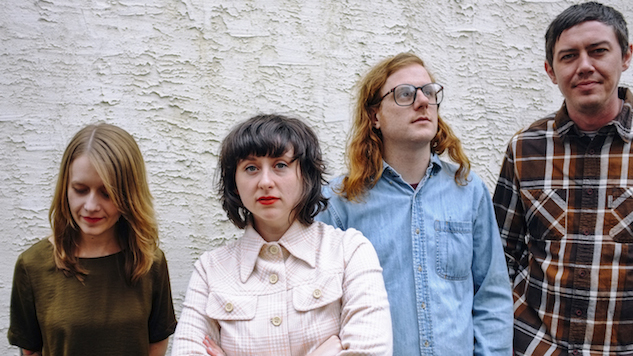
Swearin' to Release New Album This Year, Share North American Tour Dates

Philadelphia-based indie-rock band Swearin’, featuring Allison Crutchfield, Kyle Gilbride, Jeff Bolt and Amanda Bartley, will release their first new music since 2013’s Surfing Strange this year.

The band recently played their first live shows in three years, opening for Superchunk on tour in the northeast U.S. Swearin’ have now signed a record deal with Merge Records and are set to release a new album later this year.

Gilbride said of the band’s reunion, forthcoming album and recent record deal:

If time were real, it would have healed our wounds, but it’s not, so we decided to make a rock record. And to make one the way we always have! Quickly, at home, and for no one in particular. Fortunately for us, Merge hadn’t dismissed us as an oddity from earlier in the decade and said, “sup with that record?”And with their help, we’ve been reintroduced to polite society. Sometimes a band takes on a life of its own, and it seems this one came back to us when it was ready, and in its new form, to stay for the foreseeable future.

The band also announced a new joint tour with Mike Krol in August on the West Coast, Swearin’ will play a pair of U.S. shows with Ought in as well.

Their record label, Merge, hinted that fans should stay tuned for upcoming Swearin’ news by following the band on Facebook and by following Allison Crutchfield on Instagram, too. after releasing two beloved full-lengths, 2012’s Swearin’ and 2013’s Surfing Strange, the Philadelphian band quietly put things on hold.

It was due, at least in part, to the band’s main songwriters, Allison Crutchfield and Kyle Gilbride, ending their romantic relationship. but when the band found themselves in a room again years later, the conversation turned back to Swearin’. “without any hesitation or inhibitions,” said Crutchfield, “we asked, ‘what would it take from each of us? what would we want to accomplish if we decided to be a band again?’” they realized that what they all wanted was to not just play shows, but to make a new record. they wanted to do something that reflected the people they’d become during those intervening years. before long, Crutchfield and Gilbride had a new batch of Swearin’ songs, ones that meshed with the sound they’d originally developed together but boldly pushed things forward. Fall Into the Sun is a Swearin’ record that doesn’t try to obscure the passage of time but instead embraces it. “getting older, your tastes change, and what you want to do changes,” said Bolt. that can be seen in songs like “big change,” where Crutchfield says goodbye to Philly and the scene that she came up in, or in “dogpile,” where Gilbride offers the line any aging punk can relate to: “by pure dumb luck i’ve gotten where i’m going.” “there was a lot on our minds, and it was a super fertile time to put a bunch of songs together,” said Gilbride. it’s true of the material found on Fall Into the Sun, but it’s noticeable in the album’s production, too. much like the band’s previous albums, Gilbride anchored the recording and producing of the record, but this time around, the band worked to make the process feel more collaborative than ever before. “i feel like this was the first time i could look at a Swearin’ record and say that i co-produced it, and that felt really good,” said Crutchfield. Listening to Fall Into the Sun, Swearin’ is a more confident, collaborative version than the one people first came to know.

http://

Released October 5th, 2018
Swearin’ is
Jeff Bolt 
Kyle Gilbride 
Allison Crutchfield 

All songs written by Allison Crutchfield and Kyle Gilbride

MC5 were one of the most radical bands of the ’60s. Their first album, the live Kick Out the Jams, committed some of the most energetic and aggressive performances of any musicians to record. The band, which formed in Detroit in 1964, influenced how everything from punk to metal to hard rock has sounded over the past half-century. For that alone, they deserve a spot in the Rock and Roll Hall of Fame.

Their live album Kick Out the Jams opens with singer Rob Tyner encouraging the audience to join the “revolution.” Even if the revolution didn’t happen while they played,  the band meant what it said. The members all had ties to the White Panther Party (their “manager,” John Sinclair, was a founding member) and performed concerts in protest of the Vietnam War. They even played at the infamous 1968 Democratic National Convention in Chicago.

While MC5 may not have been the first band to say the word “fuck” on an album, they definitely used it most effectively. The song “Kick Out the Jams” starts with a rallying cry by Rob Tyner to “Kick out the jams, motherfuckers!” Those famous words complement the relentless proto-punk assault found on the rest of the album.

MC5’s first studio album, 1970’s Back in the USA, predicted the affection for late-‘50s and early ’60s rock ‘n’ roll that punk groups like the Ramones celebrated years later. The 11-song album is only 28 minutes long (this was 1970, a time when 28 minutes would have been about normal for one track by other underground artists) and features short covers of Chuck Berry and Little Richard songs. Their live performances were even closer to punk; onstage, the band encouraged audiences to join them in political protest, all the while creating some of the most abrasive music of its time. Many punk bands cite them as an influence. Guitarist Wayne Kramer’s drug charges are even mentioned in the Clash’s “Jail Guitar Doors.”

Aside from his vocal talents, singer Rob Tyner was known for his awesome hair. Tyner had one of the largest afros in 1969. When coupled with the eclectic fashion of the late ’60s, all the members created a strong image on and off stage.

More than 50 years later, the group’s surviving members (guitarist Wayne Kramer and drummer Dennis Thompson) continue to perform. The band has reunited a few times, though each reunion had been cut short by the death of a member. Kramer, along with British singer-songwriter Billy Bragg, worked together on the Jail Guitar Doors Initiative — named after the Clash song that referenced Kramer — which provides instruments to inmates. In 2018, Kramer spearheaded the MC50 tour that included members of Soundgarden and Fugazi, among others.

MC5 – (Motor City 5) Motorcity is burning 1969

South Of Reality, The Claypool Lennon Delirium’s epic sophomore album might be just the antidote this sick world needs. Music so potent it could repel an asteroid impact from space, these seasoned warriors of psychedelia have crafted timeless songs that may as well be chiseled in stone. The monolithic dream team’s new record was produced by Les Claypool and Sean Lennon themselves, and engineered and mixed by Les Claypool. Grab your goggles and a month’s supply of Kool-Aid because you’re about to go for a ride on a rock n roll rocket ship, and frankly you may never come back!

Listen to “Blood and Rockets- Movement I, Saga of Jack Parsons – Movement II, Too the Moon”

From The Claypool Lennon Delirium’s new album, “South of Reality”, available everywhere February 22nd, 2019

Clocking in at a mere 40 minutes, Ought’s third studio album Room Inside the World earnestly delivers with strategic, unexpected song development and passionate, yearning lyrics. This is not a one-note album.This record champions the Canadian outfit’s ability to embrace a multitude of sounds, bridging the gaps between several similar, yet very different genres. While some songs are naturally rock ’n’ roll, others are pure post-punk, digging into Joy Division-like vocals and progressive bass-driven blocks. Room Inside the World takes you for a winding, unpredictable ride, one that ends much earlier than you’d like, leaving you wanting more.

“Disgraced in America,” from this Montreal post-punk band Ought’s album Room Inside the World, is a song led by Tim Darcy’s melodramatic, at times Bowie-esque and other times Ian Curtis-esque, lead vocals, which are so painstaking, impactful and heart-wrenching, they would make an enthralling a cappella track. The track also includes robotic keyboards, jangly, melodic guitars, crying horns and chaotic, dense percussion worth getting lost in.

From the album Room Inside the World, out now on Merge Records / Royal Mountain.