Archive for the ‘CLASSIC ALBUMS’ Category

Humble Pie

One of the UK’s most charismatic and distinctive frontmen was taken from us when Steve Marriott, of the Small Faces and Humble Pie, died in a house fire on 20th April 1991. He was a cruelly young 44 years of age.

Thankfully, Steve’s achievements as a true figurehead of pop and rock music, especially in the 1960s and ’70s, are now widely acknowledged. His talents have been celebrated of late in the highly recommended musical All Or Nothing — The Mod Musical, which brings the Small Faces’ story vividly to life and continues to play to massive response.

Marriott, from Manor Park in the East of London, was a born performer. He started his first band at the age of 12 and starred on the West End stage in Lionel Bart’s hit production of Oliver! at just 13.

His dreams came true when the Small Faces, formed in 1965, made it big and enjoyed several years of hit singles and increasingly influential and experimental albums. Marriott’s wanderlust and disillusionment with the business of music led him to leave the band and form Humble Pie. There, he developed a creative partnership with a new group of like-minded players, including Peter Frampton. “It was the best band you could ever be in as far as I was concerned,” said Frampton, “because you’ve got my idol there.

Formed by Steve Marriott in 1969 after the break-up of Small Faces, Humble Pie epitomised the British rock supergroups emerging at the turn of the decade. With the charismatic Marriott taking on frontman duties, he enlisted Peter Frampton (then of The Herd) on guitar, Spooky Tooth’s Greg Ridley on bass and a teenage Jerry Shirley on drums. The group released two beloved albums on Small Faces’ former label, Immediate, before making a switch to A&M in 1970 and working up a harder, blues-rock sound that would earn acclaim on both sides of the Atlantic.

The group’s self-titled effort, released in summer 1970, solidified their new direction and set Humble Pie up for a run of albums that would make an indelible mark on the blues-rock scene, among them Rock On, Smokin’ and the classic live double-album, Performance Rockin’ The Fillmore, recorded at New York’s iconic Fillmore East, before the group temporarily disbanded in 1975. Steve Marriott fronted Humble Pie from 1969 to 1975, and briefly in a reunited version in the early 1980s. He also made some notable albums in his own name, including the 1976 solo debut Marriott. 1990’s Marriott & Band included versions of his treasured Small Faces songs ‘All Or Nothing’ and ‘What’cha Gonna Do About It.’

Shortly before the end of his life, Marriott was interviewed and he reflected with quiet satisfaction on his career. “I was seduced at 18,” he said, “and it was quite good but it paled very quickly. I realised it had nothing to do with music and everything to do with the shape of your bum…what’s been has gone, and I’m very proud of it.

“I’ve got what I wanted, which is just enough money to live on, in no great style but a nice way, and to have some respect from other musicians and play the pubs and clubs, where the music’s still real.
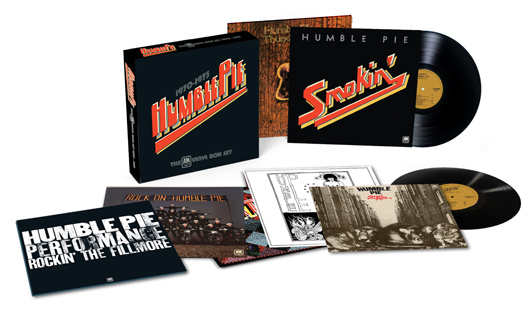
Humble Pie A&M Years Vinyl Box Set

Steve Marriott and Greg Ridley are with us no more, but with the full input of both Frampton and Shirley, The A&M Vinyl Box Set 1970-1975 commemorates their great work. Collecting all seven of the group’s A&M albums across nine slabs of 180g vinyl, it presents this part of the group’s legacy in better-than-ever audio

“Eat It, in particular, had sound problems originally,” says Jerry Shirley, who adds that they have “now been eradicated once and for all, so that our fans, old and new, can hear it as was it was intended to be”. Much love and care has been put into assembling the package too, with the albums coming in a hardback slipcase and replica artwork – including the die-cut sleeve that originally housed Thunderbox.

“Jerry and I worked together with A&M for some time to get this released,” Peter Frampton notes, adding, “We pay tribute to our two lost brothers, Steve and Greg, and hope you enjoy this as much as we did putting it all together.

Image may contain: one or more people, outdoor and nature

It was only a few weeks back we were falling head-over-heels in love with “Daylight Matters”, the first single from Cate Le Bon’s upcoming album “Reward”, and this week Cate might just have gone and released an even better track! Reward’s second single, “Home To You”, is a stunning exploration of the idea of home, and how subjective a concept that can be.

Clocking in at nearly seven dreamy minutes, Home To You, is something of a low-key epic; the drums shuffle, the guitars pluck out easy runs and burbling, as the year’s finest bass-line adds much of the propulsion. Only the marimba like keys seem to step out of the dreamy gorgeousness, adding a gently tropical feel, like a cocktail umbrella adorned drink in a working men’s club. In its own subtle way, Home To You, is a reflection on the modern world, questioning how we are so quick to judge whether someone belongs, and where they should call home; “home to you, is atrocity in the town”.In that unique way she possesses, Cate seems to fuse her abstract lyricism into something moving and relatable. Without seeing the scene, you still feel the painting her words her create, instinctively you relate, instinctively you know this is the kind of song that can change your life.

“Reward” is out May 24th via Mexican Summer Records. 

With a sonic style that swirls effortlessly inside a generous melding of warm psych-folk, explosive garage psych and entrancingly fuzzy sixties sounding musings (or retro-psych as the kids like to call it these days), ‘The Dandelion’ began life as a solo project by ‘The Dolly Rocker Movement’ frontman, Daniel J Poulter, eventually releasing it’s debut long player ‘The Strange Case Of The Dandelion’ back in 2013. Shortly after the release however,  Poulter walked out and the super talented Nathalie de Silver took over songwriting duties, subsequently releasing some impressive collections of music alongside a revolving door of live musicians.

With a brilliant self-titled EP released in 2014, a very interesting sophomore release in 2015 called ‘Seeds Flowers and Magical Powers of The Dandelion’ and a dedicated worldwide following, ‘The Dandelion’ have announced a brand new thirteen track album entitled ‘Old Habits & New Ways Of The Dandelion’ via the Greek-based independent record label ‘Blackspin Records’, and have just launched a lengthy European tour throughout April taking in France, Spain, Greece, England, Scotland, Belgium, Austria, Croatia & Germany to support the album. ‘Old Habits & New Ways Of The Dandelion’ is penned in for official release on April 1st 2019 and will be available on various vinyl formats

http://

The Dandelion (Sydney, Australia) The unstoppable 60’s garage druids are back after a 2 year break…
THE NEW LP “Old Habits & New Ways of The Dandelion” will be out April 1st! On Deluxe SpiderChild cassette with foldout lyric sheet & CD / colored Vinyl via Blackspin Records,

http://

The current line up though, consists of Nathalie de Silver – vocals/guitar/songwriting/producer,Laura Murdoch – organ/vocals/theremin, Josh White – drums/vocals & Lauren Crew – bass. 

Image may contain: 2 people, text

Image may contain: 2 people, tree and outdoor

We last heard from She Keeps Bees, the duo of Jessica Larrabee and Andy LaPlant, back in 2014, when they shared the critically acclaimed record, Eight Houses. The subsequent five years have been something of a personal journey, Jessica losing her father, before the pair moved to upstate New York and began a family of their own. The result of all that change is their new record, “Kinship”; a record full of death, birth and the endless cycles of nature as we know it.

This week the band have shared the latest offering from Kinship, in the shape of the striking title track. Built around a primal, pounding drum beat and Jessica’s prominent vocal, it’s only on repeat listens that all of the intricate musical details reveal themselves, whether that’s the twitching keys or the subtle percussive flourishes that counter the main driving beat. Lyrically, as you’d perhaps expect it’s a song of togetherness and connectivity, in particular it focuses on the idea of water as the binding force of all nature, the one constant that links us to all life and the planet around us, “living water mother of all, visible manifestation of chaos”. Hypnotic and never hopeless, Kinship seems to be a record that sits on the cusp of an environmental, and very human, crisis, yet it refuses to go meekly, it is a record ready to fight for a better future, for ourselves, our children and our planet as we know it.

Kinship is out May 10th via Ba Da Bing Records. 

No photo description available.

The new Fat White Family album has landed. Look at that poster too. On Limited gold vinyl. Serfs Up! is a lush and masterful work, lascivious and personal. Tropical, sympathetic and monumental. It invites the listener in rather than repel them through wilful abrasion. Fat White Family have broken previous default patterns of behaviour, and as such their third album heralds a new day dawning. Echoing within the arrangements throughout are traces of blissed-out 60s Tropicalia, Velvets / Bowie sleaze-making and star-gazing, 80s digital dancehall, David Axelrod-style easy listening, joyous Pet Shop Boys synth crescendos, acid house, post-PIL dub, metropolitan murder ballads, doom-disco and mouth-gurning, slow-mo psychedelia so by the time it comes to a close only a fool would deny that Serfs Up! is something very special indeed.

An album steeped in lush, lascivious, tropical warmth – imagine Arcade Fire in a trippy haze with Alan Vega heading down to the doom-psych-disco.

Fat White Family – “When I Leave”, from ‘Serfs Up!‘, out 19th April 2019 on Domino Record Co

Fat White Family – “Tastes Good With The Money”, from ‘Serfs Up!’, out 19th April 2019 on Domino Record Co.

“I’m always changing,” Esther Rose sings at the top of her sophomore album, “You Made It This Far”. The line is at once a promise and a plea, a concise distillation of her commitment to evolution as well as her dogged determination to meet every challenge in her path with unconditional acceptance. Laid-back yet deliberate, her delivery here marries old-school country and rural folk with a plainspoken philosophy that’s thoroughly modern, and the end result is a record that’s as joyful as it is restless, one that weaves fiddle and lap steel around profound revelations .

“There’s this theme of radical acceptance running through the whole album,” explains Rose, who recorded the album live to tape at Mashed Potato Records in New Orleans in just four days. “I didn’t realize it until after I’d finished writing the songs, but they all came from this place of trying to understand and truly accept myself and others in our most vulnerable moments of confusion or despair.”

A New Orleanian for the last decade, Rose first gained national prominence with the release of 2017’s This Time Last Night, an intoxicating debut, her “honest, gorgeous country songs” and rave that “her voice has a pitched-up June Carter quality, her melodies are simple like Jimmie Rodgers’s, and her tone is reminiscent of bluesy, lovelorn greats like Rex Griffin and Patsy Cline.” The record earned Rose many festival performances from Savannah Stopover to AmericanaFest alongside dates with The Punch Brothers, Pokey Lafarge, and The Deslondes, and it even caught the ear of fellow Detroit native Jack White, who was so taken with the music that he invited Rose to duet with him on his Boarding House Reach album and to share the stage for a live performance at Jazz Fest.

http://

While writing the songs that would become You Made It This Far, Rose found herself working through a period of tumultuous change, grappling with a breakup, a move, and a family illness all at once. Splitting her time between New Mexico and New Orleans, she pondered what it takes to love and to be loved, to be vulnerable enough to let someone in and brave enough to face the pain when they’re gone.

Screen-Shot-2019-04-14-at-12.35.23-PM-1555259743

This past Saturday was Record Store Day and one of the more notable releases was a brand new album by The Flaming Lips, King’s Mouth. And while the complete album remains a Record Store Day exclusive for now, one of its songs, “All For the Life of the City,” has been officially released online. Listen to it below, King’s Mouth had a limited gold vinyl pressing of 4,000 copies, but will be getting a wider release in July. It features spoken word vocals by Mick Jones of The Clash.

The lead single, “All For The Life Of The City,” from the King’s Mouth is a concept album based on the band’s art installation of the same name. King’s Mouth launched in 2015 at Oklahoma City’s the Womb. Visitors experienced a seven-minute LED lights and visuals show inside of a giant head.

The album is about a king who dies while trying to save his subjects from an avalanche. “We started out with a half-hour’s worth of abstract musical, dynamic stuff, and that ended up being 10 minutes by the time we got to the first museum opening in Baltimore,” frontman Wayne Coyne says “Then everywhere we’d go people would think, ‘This is going to be an album…’ We didn’t plan it that way, but I think it became more and more apparent that it could be a record.”

King’s Mouth, a concept album about a community mourning the noble death of a benevolent monarch, is part of a larger art installation of the same name, which is currently on display at Rough Trade NYC through May 31st. A press release adds:

Introduced in 2015, the installation has showcased its psychedelic visuals and soundscapes through North America in museums such as Meow Wolf in Santa Fe, NM, the American Visionary Art Museum in Baltimore, MD, the Pacific Northwest College of Art in Portland, OR and Wayne [Coyne]’s own creative space, The Womb, in Oklahoma City, OK. A true handcrafted marvel, it consists of a giant metallic head that welcomes spectators inside. Once inside of the foam month, an LED lightshow begins in tandem with music from the album. Now, the record doubles as the sonic companion to the exhibit and allows fans to experience the aural side at any time.

Completing the project is a literary tome titled, King’s Mouth: Immerse Heap Trip Fantasy Experience, which tells the story of the King’s Mouth through words and visuals by frontman Wayne Coyne.

In describing his vision of the project, Coyne said: “The King’s Mouthimmersive/child-like qualities are born from the same spark and womb as The Flaming Lips live performances. The King’s Mouth adventure was made for humans of all sizes, ages, cultures, and religions.”

4,000 vinyl copies of the album were released last Saturday for Record Store Day. Come July 19th, King’s Mouth will be release worldwide in all formats (digital, CD, vinyl, etc.) through Warner Bros.

10 years

Ten Years After were an English blues rock band who, between 1968 and 1973, had eight albums in the UK Top 40 albums chart and twelve albums in the US Billboard 200. Vocalist, guitarist and principle songwriter Alvin Lee formed The Jaybirds with bassist Leo Lyons in England in the early 1960s. Joined by Chick Churchill on keyboards and Ric Lee on bass, they switched their name to Ten Years After in 1966; a reference to the birth of rock ‘n’ roll with Elvis Presley a decade earlier.

This limited LP on green vinyl is Exclusive for RSD and the first of a handful of releases to comemorate the 50th Anniversary of the bands legendary appearance at Woodstock in 1969. The Cap Ferrat Sessions took place during the recording of their ‘ Rock & Roll Music To The World’ album and first appeared on the 2017 10CD Box Set ‘ 1969-1974’ . This is the first release outside the box set and first time on vinyl.

Tracklist:
Look At Yourself (2017 Remaster)
Running Around (2017 Remaster)
Holy Shit (2017 Remaster)
There’s A Feeling (2017 Remaster)
I Hear You Calling My Name (2017 Remaster)

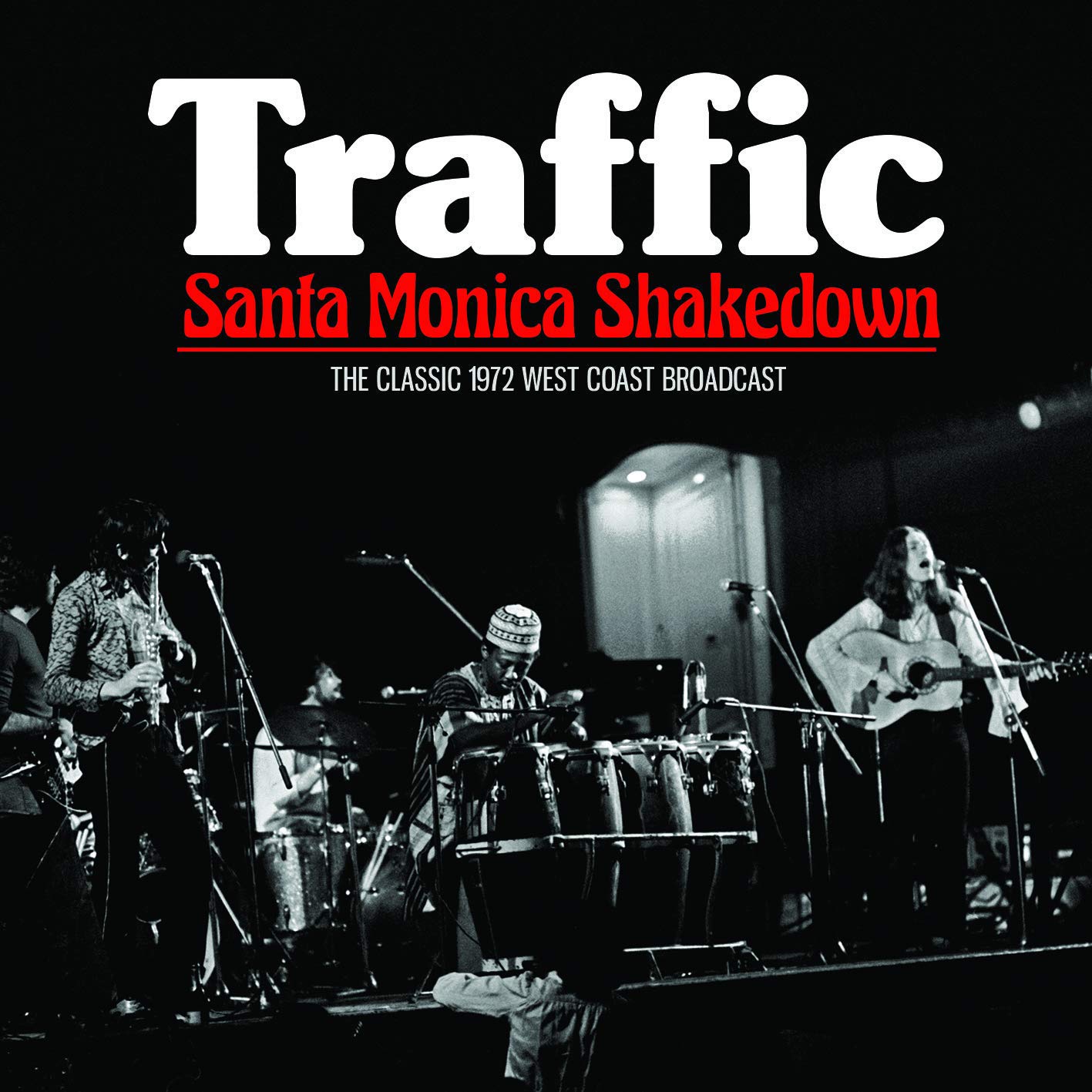
This Dynamic broadcast recording from the band Traffic in 1972 featured Steve Winwood, Jim Capaldi, Dave Mason, and Chris Wood who met at a nightclub the Opposite Lock in Aston, Birmingham in the mid-1960s. At the time Winwood was still performing with The Spencer Davis Group, but when he quit in April 1967, the quartet formed Traffic.

Traffic signed to Chris Blackwell’s Island Records, and their debut single “Paper Sun” became a UK hit in the summer of 1967. Further hit singles followed and their debut album, “Mr. Fantasy”, was successful in the UK. Dave Mason left the group by the time Mr. Fantasy was released, but re-joined for a few months in 1968, long enough to contribute to their second, eponymous album. The band however was discontinued following Winwood’s departure in early 69. He then formed the supergroup Blind Faith, which lasted less than a year, recording one album and undertaking one US tour. After the break-up of Blind Faith, Winwood began working on a solo recording, bringing in Wood and Capaldi to contribute, and the project eventually turned into a new Traffic album, “John Barleycorn Must Die”, their most successful record of all.

In 1971 the group released The Low Spark of High Heeled Boys (1971), a Top 10 American album but one which did not chart in the UK. They toured America in early 1972 to promote the LP, during which they performed an extraordinary concert at the Santa Monica Civic Auditorium on 21st February, which was broadcast across FM radio along the West Coast, and is featured in its entirety . The quite superb performance includes cuts from their two finest albums.

recorded at the Santa Monica Civic Auditorium in 1972, this concert seems to kick off with a somewhat spacey, mildly exploratory version of the title tune of the band’s then-current LP, “The Low Spark of High-Heeled Boys”; Steve Winwood and Chris Wood get to stretch out nicely on this one, on piano and electric sax, respectively. “Light Up or Leave Me Alone” comes next, on which former drummer Jim Capaldi gets to do his white Sammy Davis, Jr. thing while Stevie offers up some wicked guitar licks. (Until his recent collaborations with Eric Clapton, many seemed to have forgotten what a fantastic guitarist he’s always been!) A straightforward yet tasty as can be rendition of “John Barleycorn” follows, featuring some terrific work by Chris on flute; “Rainmaker” makes for a perfect segueway after this one, highlighted by more lovely flute work from Chris and a rousing percussion interlude from Reebop Kwakubaah. The classic Traffic diptych of “Glad”/”Freedom Rider” comes next, accompanied by some psychedelic light FX, and then Stevie sings effortlessly and beautifully on “40,000 Headmen.” “Dear Mr. Fantasy” closes out this set in rousing fashion, featuring some more staggering guitar work from Winwood.

In 1967, when the still-teenaged keyboardist Steve Winwood left the Spencer Davis Group (for whom he’d sung lead on hits like “Gimme Some Lovin'” and “I’m a Man”) to start a new band with guitarist Dave Mason, few observers thought their idea of blending pop, rock, and jazz would work. Immediately, though, Traffic scored giant hits with Winwood’s east-meets-west “Paper Sun” and Mason’s acid-jazzy “Hole in My Shoe”. Between those songs, the smoking-guitar driven title track, the swinging instrumental “Giving to You” and the haunting ballad, “No Face, No Name, No Number”, Traffic’s debut established both players as elite members of the new guard of late 60s British rock.

“I knew it wasn’t just a good piece or a good track for a record,” Traffic drummer and lyricist Jim Capaldi once said of their song “Dear Mr. Fantasy” the pseudo-title-cut from the band’s kaleidoscopic debut LP. “I knew it was going to be a real milestone-type piece.” His hunch was spot-on.

The British quartet never cracked the pop charts with the spiraling psych-rock song. (In fact, they never even issued it as a single.) But the six-minute long “Fantasy” was designed more as a deep, mind-expanding bong hit than a quick joint puff: Steve Winwood’s bluesy howl and the group’s live-in-the-room exploration tapped into the same jam-sprung freedom flourishing at that time from America’s West Coast.

Fittingly, since much of Traffic’s early repertoire reveled in whimsy, “Dear Mr. Fantasy” originated from a doodle. “I’d drawn this character playing a guitar, with puppet hands instead of his own hands,” Capaldi recalled in a video interview celebrating the 50th anniversary of Mr. Fantasyin 2017. “I wrote a letter next to it: ‘Dear Mr. Fantasy, play us a tune.'”

At the time, the band Capaldi, Winwood, multi-instrumentalists Dave Mason and Chris Wood were holed up at Sheepcote Farm, a rural cottage in Berkshire, England, owned by baronet Sir William Pigott-Brown, a friend of Island Records founder Chris Blackwell. Experimenting with weed and LSD, and living among the filth of their own dirty dishes and laundry, the young men cooked up much of Mr. Fantasy at this ragged sanctuary.

“There was no running water, there was a well and no electricity,” said Winwood “Blackwell took the gamekeeper’s cottage down the lane so he could make sure we rehearsed and wrote material. It was a place where we could make as much row as we liked – and we certainly did.”

During one ordinary vice-filled afternoon, “Fantasy” emerged.

“I was asleep upstairs in the cottage, and I heard this nice little bass line going and some guitar,” Capaldi said “I woke up, went down — we’d jam all time of the day, and we’d all take breaks, do whatever.”

“[I] found that they’d written a song around the words and drawing I’d done, I was completely knocked out by it. Chris wrote that great bass line. We added some more words later and worked out a bigger arrangement too.”

“Dear Mr. Fantasy” “was done on impulse with practically nothing worked out, because it was almost jammed,” Winwood told Rolling Stone in 1969. “The initial spirit of the whole thing was captured on record — which is very rare. That was one of the things, because it’s not specifically an outstanding melody or an outstanding chord sequence or anything. It’s basically quite simple. They’re very simple lyrics and they’re repeated three times. … It wasn’t half so strong after we’d done it. It was time that gave it a lot of meaning.”

Armed with a batch of songs that sprawled from psych to blues to soul to Beatlesque Indian nods, Traffic eventually moved to London’s Olympic Studios with producer Jimmy Miller, with whom Winwood had collaborated as part of his previous band, the Spencer Davis Group.

Miller was crucial in capturing the song’s free-flowing vibe on tape, which they only achieved after scrapping the traditional recording booths and tracking as a live four-piece: Winwood on electric guitar and vocals, Mason on bass, Wood on organ and Capaldi on drums. A surprise fifth member was Miller, who augmented the groove by rushing from the control room to lay down some extra percussion.

“We were in the middle of a take and there’s a part where the tempo changes it jumps and I look around, and Jimmy Miller’s not in the control room,” by the side of engineer Eddie Kramer. “The next thing I see out of the corner of my eye is Jimmy hauling ass across the room, running full tilt. He jumps up on the riser, picks up a pair of maracas and gets them to double the tempo! That, to me, was the most remarkable piece of production assistance I’d ever seen. They were shocked to see him out there, exhorting them to double the tempo. Their eyes kind of lit up. It was amazing.”

“Fantasy” thrives on that anything-can-happen energy: Capaldi’s thumping kick drum accents and tumbling fills, the double-time grooves, Winwood’s Jimi Hendrix-like solo, that tempo-shifting finale. From 1967 onward, it became a staple of Traffic’s live show performed more than any other song in their catalog.

And kindred spirits followed suit onstage. Grateful Dead introduced a faithful cover in 1984, a showcase for keyboardist-singer Brent Mydland, and continued to perform it up through 1990. (Jerry Garcia even joined Traffic for a version during their 1994 reunion tour, documented on the live set The Last Great Traffic Jam.) Several other rock legends have paid tribute, including Hendrix, Crosby, Stills & Nash, mid-’90s Fleetwood Mac (featuring a briefly tenured Mason), Peter Frampton and Eric Clapton (alongside Winwood).

“Dear Mr. Fantasy” “was done on impulse with practically nothing worked out, because it was almost jammed,” Winwood told Rolling Stone in 1969. “The initial spirit of the whole thing was captured on record — which is very rare. That was one of the things, because it’s not specifically an outstanding melody or an outstanding chord sequence or anything. It’s basically quite simple. They’re very simple lyrics and they’re repeated three times. … It wasn’t half so strong after we’d done it. It was time that gave it a lot of meaning.”

  • Steve Winwood – guitar, lead vocal
  • Dave Mason – bass guitar, harmonica, backing vocal
  • Chris Wood – organ, backing vocal
  • Jim Capaldi – drums, backing vocal
  • Jimmy Miller – maracas