The Seed, The Vessel, The Roots And All, the highly anticipated full-length debut by New Pagans, finally arrived on March 19th. The Belfast band’s biting, noisy and raw brand of post-punk is inspired, striking an impressive balance between biting wit and an understated sweetness. This symmetry can be marked in single “Yellow Room,” as frontwoman Lyndsey McDougall effortlessly flows from pleasant verses into powerful, anthemic choruses and a snarling breakdown. The song lyrically takes inspiration from the iconic feminist novella The Yellow Wallpaper by Charlotte Perkins Gilman, and pulls from McDougall’s experiences feeling silenced as a new mother, advocating for an increase in parent-and-baby mental health programs in Northern Ireland.
New Pagans create music that’s not only vivid and engaging but also home to massive riffs and rare dynamics. The bands audible influences range from PJ Harvey to Sonic Youth while lyrically the band deliver protest songs, songs about women, songs about mothers and songs about conversations overheard on Belfast’s public transport systems. Their live shows are also something to behold and have just been the recipients of the best live act at The Northern Island Music Prize 2020. Music is the focus and an important vehicle for the healthy message the band promotes. New Pagans is a proud advocate for women’s rights, visibility and inclusion in the global music industry – an industry dogged with a history of stark gender inequality.
Debut album “The Seed, The Vessel, The Roots and All” out now via Big Scary Monsters.
As with anywhere in the world during these post-pandemic times, there are both positive and negative aspects to residing in Belgium right now. In Flanders, there is a rise in far-right extremism, rooted in the N-VA party and the Ons Land movement, which want Flemish independence from the homeland and an end to remaining lockdown curfews. But in more grounded Leuven, national virologist Marc Van Ranst has stressed science over skepticism in his regular TV broadcasts over the past year, calmly reassuring the populace that such low-contact isolation can truly save your life. And current Prime Minister Alexander De Croo is on the same cautious page, as he just curtailed Belgium’s scheduled Outdoor Plan for April, as the government worries that even schoolchildren can contract the mutating European virus and, sans symptoms, infect their unsuspecting families. Naturally, there’s a huge left/right uproar about the safety-conscious decision.
Following on from ‘Ease’, their shimmering debut EP, ‘Aurora’ is the coming of their first full-length and with it brings the ideal combination of Shoegaze’s most ethereal sounds and distorted haze. Isa Holliday’s vocals are instantaneously captivating as if from a dream-state; guitars weigh heavy in the atmosphere whilst drum passages vary the pace. This is a band confident in their undeniably unique brand of Shoegaze and Grunge.
The gloomy abrasion is both comforting and melancholic; something that many acts reviving this style have so often missed. Density in the instrumentation and swirling riffs means there is something here for everyone, and so take shelter in the violet murk of Aurora and witness one of the most promising new bands in Shoegaze.
“It’s one of the best shoegaze albums I’ve heard in a good long time.
Isa Holliday is glad she lives in Leuven. British born, she moved there as a kid when her chemical-engineer father was posted there for his job in water treatment. The family loved the place so much, they stayed, she recalls. And it’s where she first took up bass guitar and started playing in sludge-metal outfits like Hearserider, which eventually morphed into the conversely-ethereal new dream-pop combo Slow Crush, in which she also handles vocal duties. The band’s murky, 4AD-textured debut disc from 2018, “Aurora”, formerly out of print, has just been given a triumphant new re-release on Quiet Panic Stateside and Church Road Records in the UK and EU, and from its dense opener “Glow” to the frothy “Drift,” a thundering “Beach,” and the layered coda “Pale Skin,” it’s a perfect blend of cathedral-ringing guitars buttressing Holliday’s pneumatic, almost aqueous singing voice, which is only clearly discernible on the sole ballad, “Collide.” Dark, velvety music for even darker death-shrouded times, all conceived in Leuven’s center of sanity.
There’s one more upside to life in Leuven, she adds, cheerfully. “It’s the city where Stella Artois is brewed, and the brewery is actually only a few kilometers away from my house—I’m in the city of Stella!,” she says.
Originally released late June 2018 (from the album ‘Aurora’).
Garage rock supergroup The Surfing Magazines have unveiled their new single ‘Sports Bar’, the first release from their freshly announced Badgers of Wymeswold, out 30th July via Moshi Moshi Records: https://moshimoshi.plctrmm.to/SB Consisting of one half of Slow Club and two thirds of The Wave Pictures, The Surfing Magazines’ primary influences are Bob Dylan, The Velvet Underground and all the great surf guitar music of the 1960s. They burst onto the scene with their eponymous debut album in 2017, a lauded LP described by Record Collector Mag as “a vintage-yet-modern rock’n’roll classic”.
Marking their first release since 2017, ‘Sports Bar’ combines rumbling bass, slick vocals and witty lyricism to masterful effect. In typically mischievous fashion, the band describe it as “Like The Modern Lovers if Marc Bolan had sung lead vocals instead of Jonathan Richman, with a bridge ripped out of Pavement, only better than any of those people’s music” and in doing so strike a curious balance of self-deprecation and self-belief – a quality that permeates their music as well as their description of it. Mixing the noir surf textures of 1960s garage rock along with westcoast sun beaten harmony pop, the 17-track Badgers of Wymeswold follows the acclaimed debut and is to be released July this year. The London based foursome recorded the album at Ranscomb Studio in Rochester in February last year before the start of the first UK lockdown.
This week started today, at 9am on the dot with the announcement of Dinked Number 111 – Badgers of Wymeswold – from the most excellent Surfing Magazines, one of our most favourite of all the super, super-groups. Consisting of one half of Slow Club and two thirds of The Wave Pictures, The Surfing Magazines’ primary influences are Bob Dylan, The Velvet Underground and all the great surf guitar music of the 1960s.
The three members of Australian trio The Goon Sax are keen to talk about the band’s second album, a meditative romp about breaking up and moving on called “We’re Not Talking”. for Louis Forster, Riley Jones, and James Harrison, a Goon Sax song speaks for all of them. “We really like honest music, and so being sincere and honest is something we wanted to do,” Forster explains. “If nothing else, that was achieved. Sometimes I don’t know whether the other things we wanted [the album] to be [happened], but we got there on the honesty.”
The members of the Goon Sax were only 17 when their first album, “Up to Anything”, was released — it positively ached with growing pains and almost every song was cringingly real as if it was cribbed from a diary and set to sparsely hooky guitar pop. After time spent touring the world, gaining experience, and graduating high school, the band set out to make a more mature second record. For 2018’s We’re Not Talking, they hired Cameron Bird and James Cecil of Architecture in Helsinki to produce, brought in some string players, and paid far more attention to the arrangements of the songs. They wanted the record to hew closely to their idea of what a pop record should sound like and despite some clashes with Bird and Cecil, who have different ideas about the concept of pop, this is a wonderfully poppy record in the best sense of the word. The songs are bright and bold, the strings swoop in occasionally to lift the songs into the skies, and there’s a refreshing lightness to everything that makes the still-somewhat-difficult nature of the subject matter go down more easily. They managed to build up and expand up their sound without losing the core of what made them special. Another change was adding drummer Riley Jones to the song writing roster to join Louis Forster and James Harrison. She also steps up to the mike to sing lead vocals on “Strange Light,” one of the album’s quieter moments.
For a band with high expectations, the three share a healthy level of modesty. “Natural selection’s going to get [our band],” says Forster, even though industry heads have kept tabs on him for the past four years as the son of Robert Forster from The Go-Betweens. His mate Harrison, who penned some of the most humbling moments on the album, still doubts his own humility.
Still, there’s lots of hard work in We’re Not Talking that the band can take pride in. The nuanced layers of strings and percussion interwoven across this album took almost two years to stitch together; and even then, the band spent another three weeks threading out the extra fluff. Forster plays this down at first-“We sucked out all the fun,” he quips-but Jones insists that they’ve shaped the record into a “rocket.”
They can also all agree that the old wounds confessed in the lyrics still fester. Forster wasn’t fibbing on “We Can’t Win,” where the protagonist cries as the bus drives past his girlfriend’s house. “The day that song came out, I was having a walk,” he says. “I don’t really walk that often, [and I was] right exactly where I was walking when I wrote those lyrics. It pretty much felt terrible as well. I felt terrible again, three years after that.
Both Forster and Harrison sound more confident as vocalists, especially Harrison. He sometimes sounded like he was hiding behind artifice on their debut, which made his songs less effective. The improvement in his vocals give his songs a boost, and they’ve gone from being skippable to some of the highlights. The rumbling folk-pop of “Love Lost” is a brilliant sketch of loneliness and confusion, “A Few Too Many” is a wonderfully breezy tune, and his duet with Jones on “Til the End” is a perfect balance of his tartness and her sweetness. Once again, Forster’s songs are the biggest and most immediate. “Make Time 4 Love” is the kind of expansive indie pop Belle and Sebastian forgot how to make years ago, “Sleep EZ” channels the early Go-Betweens and adds a giant hook, and “Get Out” is a wound-up rocker that shows the band has a tougher side.
Throughout the record, the production team of Bird and Cecil give the songs some depth and greater scope, adding nice touches like cowbell and keyboards that make the songs leap out of the speakers. It’s a great combination of sound and songs that makes good on the promise the band showed on their debut, and shows them navigating the numerous pitfalls of growing up as a band in fine fashion.
The South London town of Croydon opened the arts, entertainment and conference center Fairfield Halls in 1962. With well over a thousand seats in the main concert hall, it quickly became a favoured venue for opera, theatre and, especially, pop and rock as it exploded during the ’60s. The Beatles, the Who, Stevie Wonder, Pink Floyd and Elton John played there; Free, the Nice and Soft Machine recorded live albums in the venue.
When guitarist Dave Mason and drummer Jim Gordon stepped on stage in Croydon on June 6th, 1971, they’d already been there numerous times, including as part of Delaney and Bonnie and Friends, who recorded their On Tour with Eric Clapton album there December. 7th, 1969. Likewise, vocalist and bandleader Steve Winwood was familiar with the venue, playing there with Traffic most recently on May 31st, 1970, although the group’s line-up had changed in the interim. Mason, who had repeatedly clashed with Winwood over the years, was now back for another go, lasting only six gigs (including June 21st at the Glastonbury Fayre festival and the OZ magazine benefit in London on July 3rd).
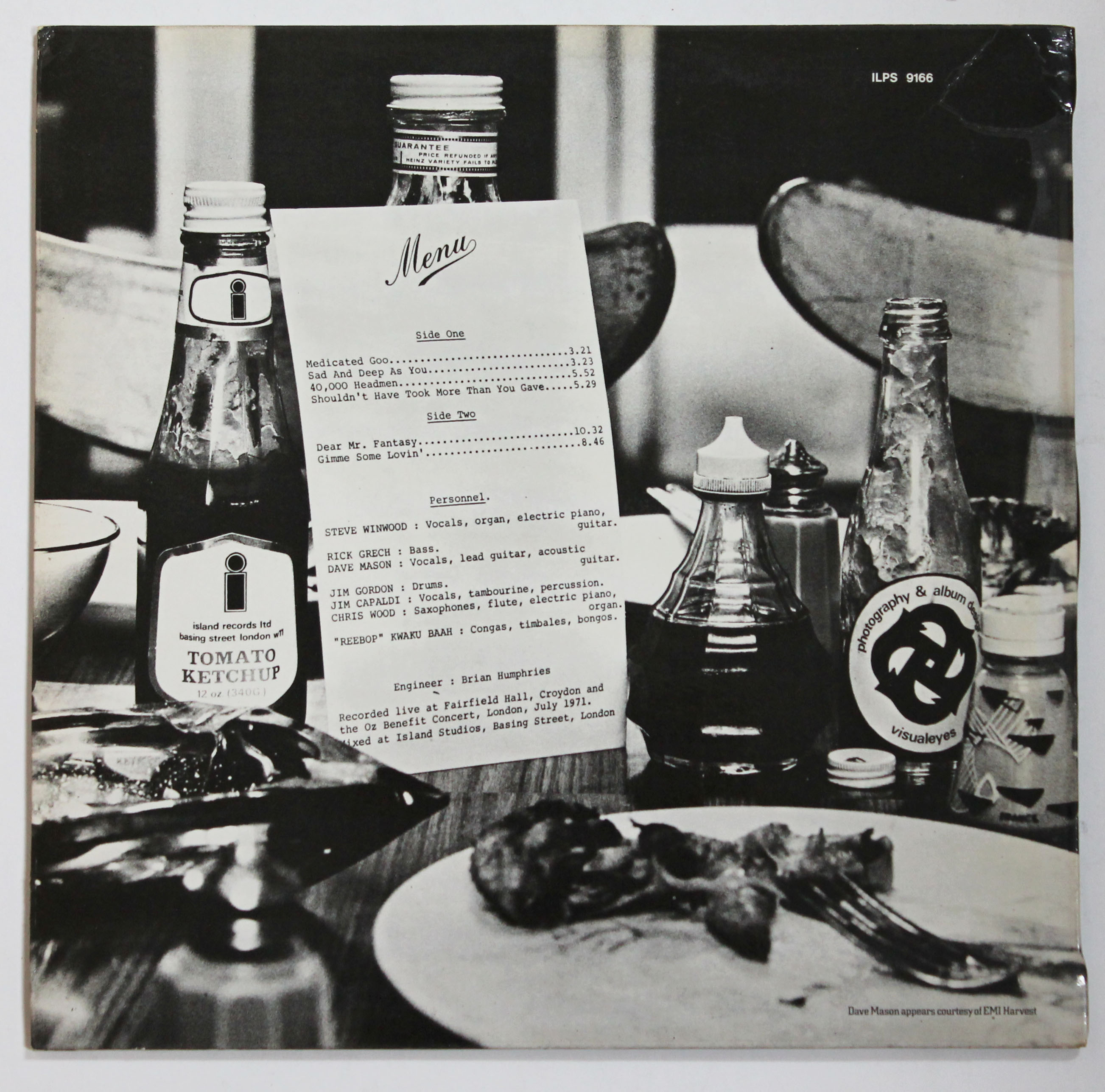
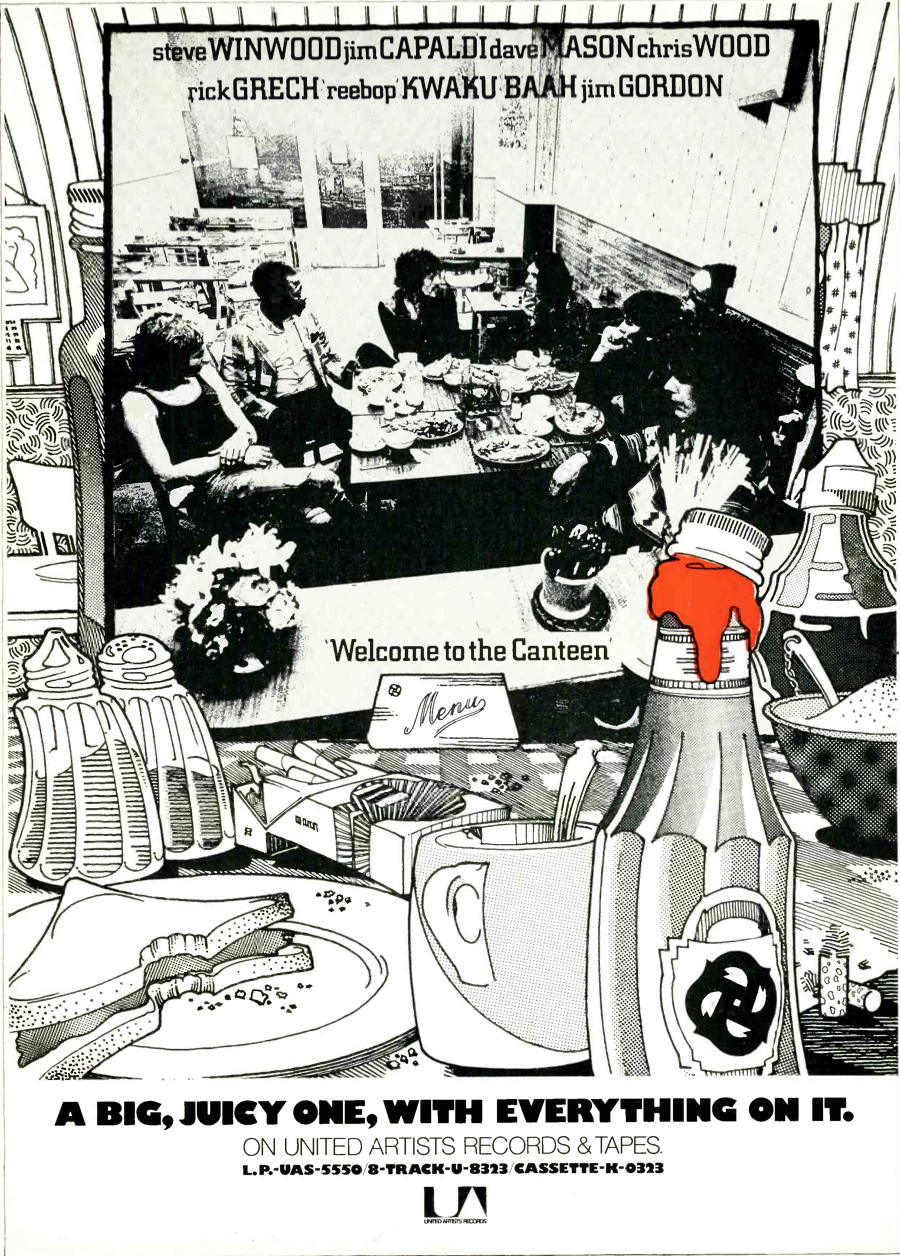
The 1971 Fairfield Halls show was billed as “Traffic With Friends,” and the live album that resulted, “Welcome to the Canteen”, wasn’t credited to Traffic at all: the front cover listed only the names of participants with no band name. Winwood sang, played keyboards and guitar, Rick Grech (ex-Family and Blind Faith) was on bass, Traffic co-founder Jim Capaldi sang and played percussion (leaving his normal seat at the drums for Gordon), Chris Wood handled saxophone, flute and keyboards as he had from Traffic’s inception, and a newcomer, Ghanaian musician Anthony “Reebop” Kwaku Baah, added congas, timbales and bongos.
Shortly after the Croydon gig, Winwood told New Musical Express that he already knew the current line-up wasn’t permanent. “There is every possibility of getting other guys in, but I don’t know dates or specific time.” Winwood was downbeat and uncertain, and said he was “not optimistic about the future.” His crystal ball was cloudy; Mason went home to Los Angeles, but the remaining six-piece recorded a classic LP a few months later, “The Low Spark of High Heeled Boys”.
“Welcome to the Canteen” contains three tunes from Traffic’s early days: “Medicated Goo,” “40,000 Headmen” and “Dear Mr. Fantasy”’ two originally on Mason’s 1970 debut solo album Alone Together (“Sad and Deep As You” and “Shouldn’t Have Took More Than You Gave”); and a nine-minute blast through the Spencer Davis Group hit “Gimme Some Lovin’,” which Winwood had sung when he was still a teenage phenom.
There is nothing from Traffic’s most recent album, John Barleycorn Must Die. Engineered by Brian Humphries and mixed at Island Studios, the tapes are not of a particularly high quality, with a thin dynamic range and a bit too much “sound of the room”; some of the vocals seem to be very distant, as if we have a balcony seat instead of one in the front row.
“Medicated Goo” is far funkier than the original 1968 single. Winwood and Capaldi harmonize well, the guitar work is gritty, and the congas give it a very different flavour. The crowd recognizes “Sad And Deep as You” when Mason begins singing “Lips that are as warm could be/Lips that speak too soon.” The song benefits from Wood’s up-front flute winding around Mason’s acoustic guitar, subbing for Leon Russell’s central piano part on the original studio version.
With one of Winwood and Capaldi’s finest combinations of melody and lyrics, “40,000 Headmen” is next. Winwood’s on acoustic guitar, singing a tale that balances between psychedelic surrealism and Gulliver’s Travels: “Forty thousand headmen couldn’t make me change my mind/If I had to take the choice between the deaf man and the blind/I know just where my feet should go and that’s enough for me/I turned around and knocked them down and walked across the sea.” Winwood sings with gospel fervour, Reebop’s punctuation is well-placed and occasionally explosive, and Wood lays down some more jazzy flute lines that go well with Gordon’s light, swinging drums.
The LP side ends with Mason singing “Shouldn’t Have Took More Than You Gave.” Gordon really shines, Winwood is strong on organ, and Mason’s vocal and guitar playing are top-notch, with echoes of his friend Jimi Hendrix especially during the long concluding solo.
The second side of the original LP contains two lengthy workouts, 10:57 of “Dear Mr. Fantasy” and 9:02 of “Gimme Some Lovin’.” The first features some spectacular Winwood/Mason electric guitar duelling, and was described by Rolling Stone’s Ed Leimbacher as “eleven swirling, blending, building, wonderous minutes…with Winwood as pensive/yearning/mournful as ever.” Reebop begins “Gimme Some Lovin’” before Gordon takes over with a driving rhythm right out of his work with Delaney and Bonnie. The whole band moves like a locomotive, from Winwood’s intense organ work to Mason’s insistent riff. Every so often in the background you can hear Wood’s saxophone struggle for some room.
Released in September 1971, Welcome to the Canteen reached #26 on the Billboard LP chart in America, but flopped in their native Britain. In the U.S. the whole incendiary performance of “Gimme Some Lovin’” was issued as a 45 rpm single (cut into A- and B-sides), credited to “Traffic, Etc.” It made it to #68 on the Billboard Hot 100, but was the last hurrah for Traffic’s association with their American label United Artists. Their long time British label Island set up its own U.S. operation, distributing music through Capitol, and that’s where the next chapter appeared in late 1971 with the studio album Low Spark of High Heeled Boys.
There were many different Traffic projects, tours and lineup changes to come. More recent history has included some really good times and some very bad ones for Winwood and co. The original four members were inducted into the Rock and Roll Hall of Fame in 2004, with Stephanie Wood standing in for her late brother Chris, who’d passed away in 1983 before reaching his 40th birthday. Kwaku Baah died in 1983 as well, the same year Jim Gordon, during a psychotic episode, murdered his mother. He’s still incarcerated in a state prison in Northern California.
Grech died in 1990 at the age of 44, and Jim Capaldi at the age of 60 in 2005. Now septuagenarians, Steve Winwood and Dave Mason remain active, with Winwood issuing the solid Greatest Hits Live album in 2017 and Mason releasing a terrific re-recording of his solo debut called Alone Together Again in 2020. Both expect to be on the road again as soon as the Covid-19 pandemic recedes. Maybe Fairfield Halls will be on the itinerary once again.
Traffic in 1971 : Rick Grech, Reebop Kwaku Baah, Jim Capaldi, Steve Winwood, Chris Wood, Dave Mason, Jim Gordon
To some, Real Estate’s jangly, easy going sound is anachronistic in the current tightly wound world of popular music. To others though, their brand of indie-influenced surf rock is the perfect solution to the stress of everyday life. Their latest EP—the jammy and perpetually entertaining “Half a Human” distills their essence in an approachable bite-sized package. Quite simply, it’s fun, profound, and undoubtedly delightful.
Though it begins with the rather abstract and twinkly “Desire Path,” Half a Human quickly finds its feet, jumping headfirst into the title track, which is a well-paced journey filled to the brim with dreamy melodies and cascading patterns.
Whether it be the slippy, ride-driven verses of “Soon” or the beachy waves of “In the Garden,” the arrangements are all perfectly constructed and exceptionally atmospheric. “Ribbon,” the concluding act, is equally calm and controlled with simplistic yet catchy lyrics to boot (“This vessel sustains me/But it cannot contain me”). In particular, Julian Lynch’s dextrous lead lines soar alongside the band’s steady rhythm section, with Martin Courtney’s vocals slotting in excellently atop the finely layered mix. In an incredibly satisfying manner, nothing is more complex than it needs to be.
Some of the tracks may get a tad repetitive, but they are established solidly enough that it does not seem tedious or boring. Instead, the 24 minutes one spends listening to “Half a Human’s” six tracksjust fly by.
Once again, the lads from Ridgewood, New Jersey have nailed it, creating a concise, dreamy effort that beautifully captures the feeling of transitioning from winter to spring. Half a Human isn’t just well put together, it’s downright dazzling. (www.realestatetheband.com)
Real Estate – “Half a Human” from ‘Half a Human EP,’ out now on Domino Record Co.
Lafayette, Louisiana musician Renée Reed has released her debut album of lo-fi dream-folk from the Cajun prairies. Gorilla vs. Bear describes it as “an effortless, inspired union of the haunting folk music that Reed was raised on and a lilting, lost ’60s French-pop gem.”
“I Saw A Ghost” by Renée Reed Video created by Emily Curran and Joseph Howard From her self-titled record coming March 26th, 2021 via Keeled Scales. Renée Reed grew up on the accordion-bending knee of her band-leading grandfather Harry Trahan; in the middle of countless jam sessions at the one-stop Cajun shop owned by her parents Lisa Trahan and Mitch Reed.
Soaked in the storytelling of her great uncle, folklorist Revon Reed and his infamous brothers from Mamou; and surrounded by a litany of Cajun and Creole music legends, both backstage at the many festivals of Southwest Louisiana and on the porch of her family home. And while Renée’s music is certainly informed by these deep roots, her dark dreamlike folk has more in common with contemporaries like Cate Le Bon and Jessica Pratt. It’s also not unlike the intangible magic contained in Mazzy Star’s songs.
Renée Reed’s self-titled debut album is out everywhere today!
Since 2007 these DIY sonic alchemists from Nottingham have been creating whacked out soundscapes and songs that appear to have been born from another universe, all from the confines of their sonic bunker.
Captured live as they toured their latest LP “Goodbye To The Light” (on Fuzz Club Records) at the at Het Bos, Antwerp 17/11/16 and Paradiso, Amsterdam 19/11/16. Capturing the raw blown out power and the tangible energy of the group’s infamous live shows as you listen in to the band laying waste to tracks from all three of their long-player albums, where tracks are stretched out and played to within an inch of their lives. So please sit back and enjoy – over four sides of vinyl – The Cult of Dom Keller, live from the confines of your stereo.”
In 1968, Mi’gmaq folk singer, poet, and director Willie Dunn released “The Ballad of Crowfoot”, a short film looking at colonialism from the perspective of Indigenous peoples in North America. Set to his ballad of the same name about the influential 19th century Blackfoot chief, it juxtaposed archival images and newspaper headlines detailing the many injustices they faced, including stolen land, the killing of buffalo, disease, religious conversion, and more. Considered by many to be the first Canadian music video, the film employed techniques used decades later by documentarians like Ken Burns, establishing Dunn as one of the most vital voices of his generation.
Kevin Howes remembers being introduced toThe Ballad of Crowfoot as an Ontario high school student in the ’90s when an English teacher showed it in class. “It was very affecting to watch, but to be honest, I think its depth went over my head at the time,” he says. “Not only until years later when I started digging into music a lot deeper and came across Willie’s second album, I was able to put the two together.”
The Toronto-based music historian and DJ featured several tracks by the Montrèal-born artist and activist on the Grammy-nominated Light in the Attic compilation Native North America (Vol. 1): Aboriginal Folk, Rock, and Country 1966-1985, including the scathing “I Pity the Country,” which gave Howes the opportunity to meet Dunn and learn more about his career. The singer passed away in 2013, but their conversations would be the impetus for curating Creation Never Sleeps, Creation Never Dies: The Willie Dunn Anthology, a 22-song collection spanning his entire career. Like fellow Canadians Joni Mitchell, Gordon Lightfoot, and Buffy Sainte-Marie, Dunn got his start playing coffeehouses in the ’60s, before getting involved with the National Film Board of Canada, directing films including 1969’s These Are My People…and 1972’s The Other Side of the Ledger: An Indian View of the Hudson’s Bay Company, and tirelessly advocating for Indigenous and environmental issues (even running for political office in 1993).
“To honour someone like Willie Dunn, you have to put in a lot of work, this isn’t a simple playlist and a couple quick interviews,” says Howes. “Something that was very important for me as a producer of the project was to engage Willie’s family, peers, and people who were influenced by him as much as possible.”
One of those people was Willie’s son, Lawrence Dunn, who not only served as the anthology’s associate producer, but also shared first hand experiences of growing up with his father and seeing him performing festivals and powwows in the ’70s, ’80s, and ’90s. “He used to tell me stories at night, and he wouldn’t have a book. Sometimes he would bring a book, and I’d go ‘Oh why are you bringing that?,’” recalls Dunn. “The stories that came out of his head were always the best ones.”
Besides “The Ballad of Crowfoot” and “I Pity the Country,”Creation Never Sleeps, Creation Never Dies also includes “Charlie,” a highlight from Willie’s 1972 self-titled album. The song tells the tragic tale of Chanie Wenjack, a 12-year-old boy who froze to death after running away from a residential school in 1966. Created by the Canadian government’s Department of Indian Affairs and ran by Christian churches, these schools separated an estimated 150,000 Indigenous children from their families, forcing them to abandon their native languages, and exposing them to frequent physical and sexual abuse at the hands of their teachers. Inspired to make music after hearing Hank Williams, other songs see him proudly celebrating his mixed background (his father was English/Cornish; his mother was Mi’gmaq), drawing equally from European poetry and Indigenous folklore and real-life heroes.
Despite Willie having a worldwide following and mentoring several generations of artists (some of whom contributed to the anthology’s extensive liner notes), mainstream success largely eluded him throughout his career. “He was always grinding the axe and trying to push his music out to a wider audience, but he ended up hitting a lot of walls,” says Dunn. “I think part of that has to do with the content of the kind of music he was singing and the message he was putting out.” Still, many of the topics Willie sang and spoke about are all-too-relevant today, including environmental destruction. Dunn notes the parallel between the singer’s involvement in the 1977 James Bay Festival—a nine-day Montréal event in support of the James Bay Cree who were fighting a hydroelectric dam being built on their territory—and the Wet’suwet’en people fighting the same against a federal pipeline in recent years.
Similar to the Native North Americagatherings that took place across Turtle Island around the compilation’s release, Howes hopes to organize live events celebrating Dunn’s music and films when the pandemic is over, and views Creation Never Sleeps, Creation Never Diesas a “beginning of something that could unfold for others down the road.” “Willie has more than enough incredible music, I could see other anthologies following this in the future,” he says. “There’s more to be heard.”
While “new music” obviously serves as a descriptor for the ten tracks on the debut record from Philly’s Another Michael, “big pop” may be a bit misleading—rather than embracing the hyperpop movement at its presumable crest, these recordings are mostly soft bedroom-esque recordings generally falling in line with labelmates like Field Medic and Sun June. The latter of the two title tracks, “Big Pop,” feels sufficiently upbeat for its name, though it’s led by bold acoustic guitar rather than infectious synths.
Sometimes, there is value in taking time to sit with a finished product and pick apart each piece. After the pandemic pushed the planned release date by several months, Another Michael had nearly a full year to spend with their debut album, New Music And Big Pop, between submitting the final master and releasing the first track. “I’m actually more connected to the record now than I would have been, maybe, had we released it sooner,” says Michael Doherty
1. “New Music”
Shortly after posting a voice memo of the first verse on SoundCloud, I spent an entire day writing and recording what would be the rest of the song in our basement. It was uncommon for me to have a day like this, where I set out to record some real drums myself and really carefully demo something. But at the end of the night I brought the song upstairs and showed it to everyone. Scoops, who is our dear friend and engineer/producer, insisted that we could use most of what I’d done as the album version and that really helped direct the sound and vision of what was to come throughout the process of finishing the album. When I listen back now, I really get so transported back to our initial year of living in Philly and using music as a way to grow into new experiences.
2. “I Know You’re Wrong”
This was the most upbeat guitar song we were playing at shows for awhile. We had originally recorded this one in Albany before moving, but decided to redo it and go for something more energy driven. I was really craving snow that winter, because we didn’t have any the year before. That’s the image I wanted to paint with that end line, I just wanted everything to stop for a few days.
3. “What Gives?”
First song I wrote after we moved to Philly, and one we recorded at our house there. We finished Land as soon as we moved in and the lyrics in the second verse are about that. It feels good to have catalogued that moment in a song that’s unrelated to the project. Also, I guess that was foreshadowing the music references to come. Should note here that our friend Jacob Crofoot plays guitar all over the record and does it so wonderfully here.
4. “My Day”
The guitar part for this song came first, it was my first time finger picking sixteenth notes like that. I have a hard time strumming quietly, and it felt good to have dynamic limitations with finger picking for the first time. We decided to let this one be the album’s solo guitar song—I think the arrangement variations are key to the album’s sound.
5. “Big Pop”
When it comes to song writing, I can get really in my head about ripping something off. But writing “Big Pop” was a chance to let go and take some classic rock and roll motifs and bring them into the Another Michael world. My friends Connor and Aurora inspired this song, they listen to lots of great power pop music and writing this song made me think of getting in the car with them and driving to a show together.
6. “What the Hell is Going On?”
I wanted to write a song that sounded like it could be on Fearless by Taylor Swift, or even more relevant to the time, Golden Hour by Kacey Musgraves—just a really warm and pillowy singer/songwriter sound. The band taps into it so well, I think. There’s also a lyrical nod to our song “Football” on here.
7. “I’m Not Home”
I wrote this song alone in my room a few days after my 26th birthday. Within that experience, I would have never guessed that it would become one of the louder and more experimental-leaning cuts. We were recording this one late into the night, very cloudy vibes. Scoops was feeding Jacob spoonfuls of hot sauce after each of his takes. At the very end of the sessions it seemed unclear whether or not the song belonged on the album, but we took a closer look and rearranged the layers to build as opposed to play forward all at once, and it was meant to be.
8. “Row”
I’d been playing with variations of the opening riff for a few months and finally stumbled upon one that led to a full song. I wanted to arrange it to strike a balance between our acoustic and electric elements. Mount Eerie’s album Sauna was a big inspiration for this song.
9. “Hone”
The only song on the record that mostly features just Nick and I, and the oldest one of the bunch. Lots of life changes going on amongst all the lyrics on this album, but I’m probably my most direct about that here.
10. “Shaky Cam”
This one ended up becoming the most studio-focused of the bunch. I started by tracking into Scoops new 8 track tape machine in the spring of 2017 with the rhythm section of friends Josh Marre on drums and Dan Paoletti on bass. We had planned to meet up for recording that afternoon, and I had finished writing the song that morning without knowing we’d get around to it. Later that year, Another Michael began to identify less ambiguously as my solo project and the live band was solidified. So we had a night at home where Nick, Alenni, and Jacob added their parts, and then we switched over to the computer for vocals, and that’s when the song really started to take its shape. Big thanks to Josh and Dan for helping us shape this one.
There is a spirit of soaring indie-pop in several of these songs, though—perhaps Michael Doherty’s vocals most inspire comparisons to Nada Surf—and Doherty will be the first to tell you the project was nearly as inspired by Taylor Swift and Kacey Musgraves as it was by Phil Elverum. To give us a better understanding of the record—as well as a proper introduction to Another Michael—Doherty went deep on each song from the album






 The Fat Angel Sings