Boston duo Vundabar (Brandon Hagen and Drew McDonald) are releasing a new album, “Either Light”, on March 13th via Gawk Records. On Wednesday they shared another song from the album, “Petty Crime,” via an amusing self-directed video for the track inspired by The Sopranos.
Previously Vundabar shared Either Light’s first single, “Burned Off,” via a playful video for the track. Either Light is the follow-up to 2018’s Smell Smoke and finds the band working with a producer for the first time, Patrick Hyland (Mitski).
Hagen had this to say about Either Light in a previous press release: “The album is about the transitional lightness that follows a period of heaviness. After years of being caught up in a dark period marked by sickness, strife and worry, and using it as the context in which I saw myself, I suddenly found I’d outgrown that story. With that came a feeling of lightness that was opposite the feeling which preceded it.”
‘Either Light’ out March 13th 2020 on Gawk Records
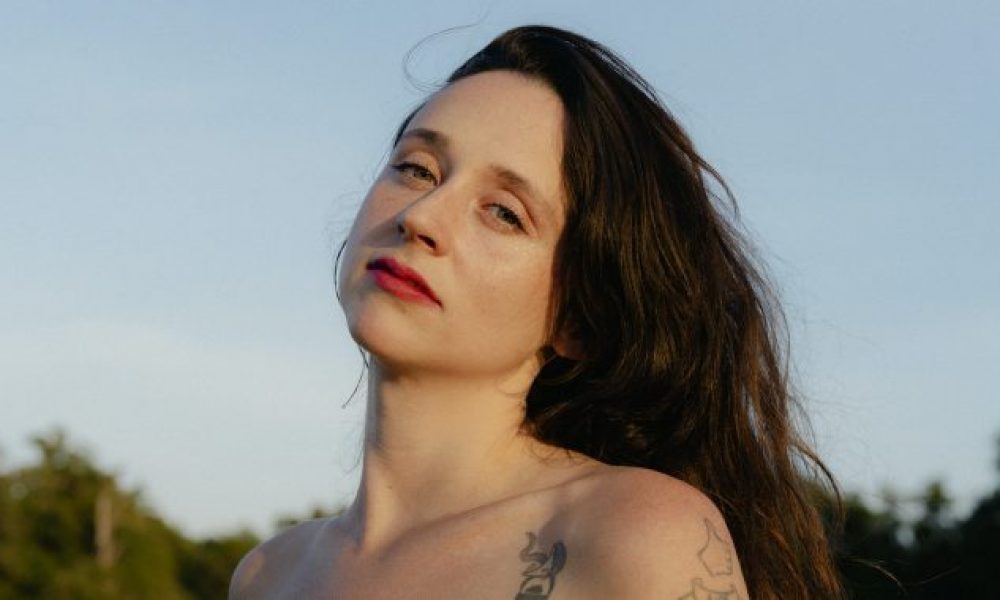
Not with a fizzle, but with a bang. Lyricist of Waxahatchee, Katie Crutchfield has taken this notion to heart with latest emotionally blazing track Fire. It is our first taste of her newest and fifth full-length album “Saint Cloud”, which will be released on the 27th of March via Merge Records.
Crutchfield’s inspiration is derived from her experiences and journey through life. This ties in well with the band’s name which was inspired by the Waxahatchee Creek, Crutchfield’s hometown in Alabama. Latest track ‘Fire’ captures the sun setting on the Mississippi River while Crutchfield drove from Memphis into West Memphis, AR.
The indie-folk track is a revisitation to stripped-back simplicity. Crutchfield perfectly describes it as a “personal pep talk”, as the album was written quickly following her choice to become sober. The vocals remain central throughout, with only a feather-light touching of keys, tapping drums and a shining strumming guitar. Crutchfield always has a knack for painting a picture with words, and her flair adds a sublime and luminous quality to the track. With lyrics such as “If I could love you unconditionally/ I could iron out the edges of the darkest sky”, and “It’s not as if we cry a river, call it rain/ West Memphis is on fire in the light of day.” Musically it’s a return to her roots such as her EP Great Thunder released in late 2018, and leaves any excessive instrumentals at the door.
From the album “Saint Cloud”, out March 27th on Merge Records
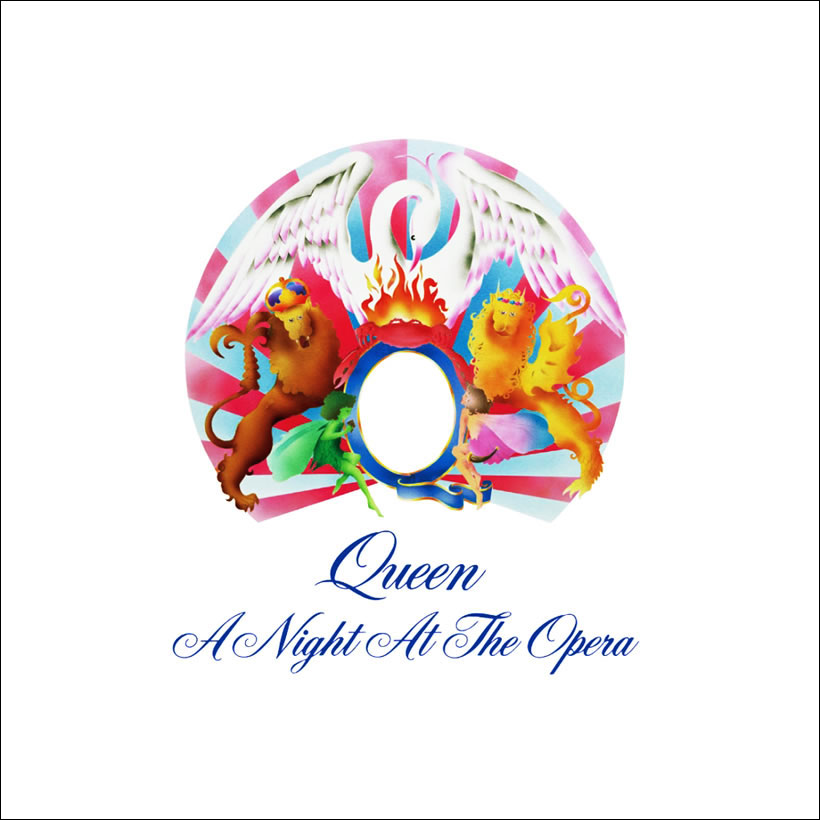
As the 1970s became the 1980s and all four members of the rock band Queen blossomed as songwriters, their albums started to sound like musical tugs-of-war. In fact, Freddie Mercury compared the group’s competitive streak and overall dynamic to “four cocks fighting”. However, the feathers were already flying on 1975’s ground-breaking, six million-plus selling fourth album, “A Night At The Opera”.
The UK tour to support the release of Sheer Heart Attack got underway during the autumn of 1974, and after taking in Europe and America, it finished at the Budokan in Tokyo, Japan, on 1st May 1975. Between the band’s return and the start of another UK tour on 14 November 1975, Queen recorded the album that would turn them from big stars to superstars. Work on Queen’s fourth album, another co-produced by the band along with Roy Thomas Baker, began in August 1975, and it was only finished shortly before the opening date of their tour at Liverpool’s Empire Theatre on 14th November. A Night At The Opera, as we all now know, is a masterpiece.
John, Roger, Brian and Freddie took much needed holidays before work on the new project began in earnest with a three-week writing and playing session in a rented Herefordshire house. They then decamped over the Welsh Marches once more to Rockfield Studio. The band later worked in five more studios (Roundhouse, Sarm East, Scorpio, Lansdowne, and Olympic) in their pursuit of perfection, and in so doing, their own self-belief was fully justified.
Everything about Queen’s fourth LP sounds big. The production. The performances. The sheer scope of the songs. You can boil it all down to the hit “Bohemian Rhapsody” if you want, but all of ‘A Night at the Opera’ is on this scale. It was their fourth studio album, and almost 45 years later the iconic “A Night At The Opera” is still one of the most talked about albums of all time. Queen’s discography spans over two decades, with 15 albums total, but “A Night At The Opera” is the masterpiece that made the band legendary.
“A Night At The Opera” set the forefront for rock albums to come. With its intricacies and surprising twists and turns, this album is anything but boring. And there is never a wrong time to review and talk about it.
The timeless and beloved hit song “Bohemian Rhapsody” changed how we listen to music today. With praise from big names from the ‘60s (The Beach Boys) and names from today (Panic! At The Disco), this song still is relentlessly covered, loud and relevant. Featured in movies like the famous scene in “Wayne’s World” and still one of the most played songs of all time, “Bohemian Rhapsody” isn’t your average album single. It’s what made Queen one of the most famous bands of all time.
“Bohemian Rhapsody” challenged all preconceived notions of what it meant to record a rock song. The song itself was never made for radio, clocking in at nearly six minutes long. It’s filled with obscure allusions and an inconsistent pace that should’ve sent fans running, but instead sent them to No#1 in the charts.
Though “A Night At The Opera” has one of the famous songs of all time, the album, overall, is full of incredibly organized chaos. Kicking off with a sneering “Death On Two Legs (Dedicated To…)” that’s followed by a less serious “Lazing On A Sunday Afternoon.”
The album isn’t complete without Roger Taylor’s tongue-in-cheek “I’m In Love With My Car,” a rock song that Taylor felt was more important and better quality than Mercury’s “Bohemian Rhapsody.”
“A Night At The Opera” explores various genres within itself. From the ragtime “Seaside Rendezvous” to the folky “‘39,” there is everything in the nearly 45-minute long, showcasing Queen’s ability to explore various genres, emotions and stories.
The ballad “Love Of My Life” was written by Mercury for his ex-fiance and close friend, Mary Austin. Mercury pleads in the song for his love to not leave him, a very different feeling than the seeming indifference he showcases at the beginning of the album. An orchestral feel with strings, piano and Mercury’s poignant vocals, that later progresses into a rock song with a brief Brian May solo, “Love Of My Life” reinforces Mercury’s lyrical vulnerability and songwriting expertise.
“A Night At The Opera” is a complete collection of everything good that’s ever come out of Queen’s songwriting. It’s intricate, in-depth, it has multiple layers. It’s to be taken very seriously and not seriously at all somehow at the same time. It’s incredibly detailed and has somehow managed to land among the greats. It is Queen’s career-defining LP, and to be taken seriously by many more generations to come.
The 12 tracks that make up A Night At The Opera comfortably broke the 43-minute mark, and like its predecessor, the sequencing of this record creates its own dynamic. This is an album that should be listened to in its entirety.
12) Lazing On A Sunday Afternoon
Rock, pop and vaudeville – it was all fair game to Freddie Mercury. As fun as it is, the trouble with Lazing On A Sunday Afternoon is that Mercury had already written one vaudeville pastiche, Bring Back That Leroy Brown on Queen’s Sheer Heart Attack album. The world didn’t need another. Freddie’s ‘Lazing On A Sunday Afternoon’ continued to showcase his piano playing skills and his growing confidence on keyboards helped to make the whole album so much better.
11) Good Company
Brian May has always been a one-man guitar orchestra, and rarely more so on this homage to Dixieland jazz, in which he sang a charming When I’m 64-style lyric while his guitar mimicked a ukulele-banjo and a clarinet. Once heard, rarely played again, though (unless it comes up unexpectedly on iPod shuffle and you can’t forward it quickly enough). Brian’s ‘Good Company’ is one of his wise family pieces – a song full of sound values and mature reflection. Recorded with the ukulele and his trusty Red Special to hand, their overlapping mimics a traditional Dixieland jazz band feel; the poignant narrative has a twist in the tale.
10) God Save The Queen
Queen’s version of the National Anthem closes A Night At The Opera album – and quite rightly so. Where else should it go? Still a testament to Brian May’s regal guitar skills, the most surprising thing about God Save The Queen is that it took the band four albums to get around to recording it.
9) Seaside Rendezvous
More old-time musical japes from Freddie. But preferable to Lazing On A Sunday Afternoon thanks to Mercury and Roger Taylor’s pin-sharp harmonies, some imaginative use of kazoo and the singer’s final payoff ‘Give us a kiss!’ which, unusually for Freddie, is delivered with all the grace and panache of driver Stan Butler leering at a buxom ‘clippie’ in the 70s TV comedy On The Buses.
8) Sweet Lady
Even Brian May’s tidy Zep-meets-Free riff can’t save Sweet Lady from obscurity. True, there’s a nice Communication Breakdown-style guitar dust-up at the end, but May would do it better in the years ahead (see: Tie Your Mother Down, Hammer To Fall…). Also contains one of the worst Queen lyrics ever: ‘You call me sweet, like I’m some kind of cheese…’ Brian’s ‘Sweet Lady’ accentuated the almost wilful diversity of Queen at this point in their career, with its live rhythm section and heavily distorted rock thrash in ¾ time. Mercury’s ‘Seaside Rendezvous’ is another track that shows the band’s inventiveness, since Freddie and Roger provide a woodwind section performed by just their voices, along with a tap dancing sequence they performed on the mixing desk with thimbles over their fingers.
7) The Prophet’s Song
On paper this Brian May-composed pomp epic should be one of Queen’s finest hard rock moments. But it struggles to match past gems such as Brighton Rock and Father To Son. Instead, it’s an oddly sluggish affair – like Jethro Tull on Night Nurse – but salvaged by that insane a cappella vocal mid-section. Brian’s lengthy, ‘The Prophet’s Song’, that was inspired, if that is the right word, when he was feverish with hepatitis during the Sheer Heart Attack sessions. A heavy, moody piece, ‘The Prophet’s Song’ was the ideal centrepiece for the forthcoming tour. Its Biblical atmosphere being accentuated by the guitarist’s use of the toy koto, a traditional Japanese stringed instrument more usually associated with experimental classical music.
6) ‘39
Brian May once described 39 as “sci-fi skiffle”. But while he does set a Robert Heinlein-inspired lyric to a Lonnie Donegan guitar thrashalong, its sing-song campfire melody and simple charm make it May’s best song on A Night At The Opera. Brian May’s ‘39’ is his first composition to appear on this album and it is a science fiction come space travel number that is a reminder of his learned interest in astrophysics and astronomy in general. Given the song’s weird skiffle arrangement, Brian asked Deacon to play double bass, and the number was included in Queen’s set-list by 1976, becoming an instant crowd favourite.
5) I’m In Love With My Car
Some would give Roger Taylor points on his licence for I’m In Love With My Car, the B-side to Bohemian Rhapsody. But why? The 1975-vintage Taylor, with his blonde girl’s hair and fine line in self-aggrandising, laddish rock songs (see also: Tenement Funster), captures the essence of Queen’s barefaced cheek and grandeur. Plus, any song that rhymes ‘forget her’ with ‘carburettor’ can’t be all bad, can it?
4) Love Of My Life
It says much about Queen’s embarrassment of riches that this romantic ballad (reputedly written for Mercury’s soon-to-be- ex-girlfriend Mary Austin) was dropped from the set in the mid-80s despite becoming an audience singalong at shows in the late ‘70s. Other, lesser bands would have clung on to it for dear life – and forever.
3) You’re My Best Friend
Freddie Mercury nicknamed Queen bassist John Deacon “the ostrich”. Deacon’s songwriting moments were rare, but he laid some golden eggs (the most golden being Another One Bites The Dust). However, You’re My Best Friend, a slightly twee pop song dedicated to Deacon’s missus Veronica, came first. Not that his bandmates liked it: Taylor thought the lyrics too soft and Mercury refused to play electric piano, making The Ostrich play it instead. But what did they know?. More new ground is broken by John Deacon’s ‘You’re My Best Friend’, which in 1976 became the eminent bass man’s first composition to be released as a Queen single, and a hit at that. Very much John’s baby, he even supplies the Wurlitzer organ.
2) Death On Two Legs
For all his charm and wit, Freddie Mercury could be a vicious sod. And the opening track on A Night At The Opera, apart from being close to its best, is certainly its most vicious. Lyrics such as ‘You suck my blood like a leech’ were aimed at Queen’s ex-co-manager Norman Sheffield, and were so vituperative the now late Sheffield threatened Queen with a lawsuit. From its Hammer Horror movie intro through May’s scything guitar solo and Mercury’s impassioned ‘You’re tearing me a-p-a-r-t’, this is Queen at their rococo rock finest.
1) Bohemian Rhapsody
Over-familiarity, over-exposure and hearing that terrible version in a recent TV ad for a well-known holiday company, has truly taken the shine off Bohemian Rhapsody. Yet to put Queen’s mini-symphony anywhere other than at number one seems churlish and, worse still, fake. More than 40 years on, its daring fusion of heavy metal, show-tune balladry and light opera remains the high watermark on A Night At The Opera, and a tribute to 70s Queen’s collective imagination and sheer bravado. Composed in six sections, mostly by Mercury in his Holland Park home, this was the song that divided opinion even within the ranks. Surely they couldn’t expect to get away with this? Mercury was certain of its merits, but seldom gave much away concerning the lyrical structure and the references to classic opera, Old Testament seers and the principal characters Scaramouche and Galileo.
Ironically, prior to releasing it as a single, one senior EMI executive was convinced that it was too long and he tried to convince the band that it needed to be edited if it was to stand any chance of getting any radio plays.
Mixing the gloriously bombastic with the sweetly simple, May’s guitar solo is bang on the money. ‘Bohemian Rhapsody’ was very much “Freddie’s thing” and also his tour de force, containing as it did elements of works in progress from earlier ventures.
As if the song wasn’t visual enough, it was accompanied by a ground-breaking video, and while it was said to be the most expensively constructed single made to that point in time,
And that wasn’t the end of the affair, and there was only one way to follow it. A revisit to May’s arrangement of the National Anthem, ‘God Save The Queen’ (surely that didn’t go unnoticed in Sex Pistols circles either); it was something they’d been using as a tour finale for some time. Instrumental, multi-layered and strangely affecting, May would achieve a kind of lifetime ambition many years later when he performed it from the roof of Buckingham Palace for the Queen’s Golden Jubilee in 2002; it was also a kind of homage to Jimi Hendrix’s Woodstock version of ‘The Star-Spangled Banner’.
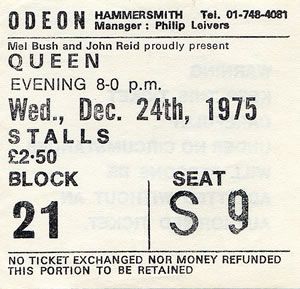
And so the album was released on 21st November 1975 and as a result, that Christmas belonged to Queen. The sold-out tour that had begun a week before the album’s release culminated with a Christmas Eve concert at Hammersmith Odeon that was videotaped and broadcast by the BBC on The Old Grey Whistle Test.
A Night At The Opera, as we all now know, is a masterpiece. Everything from its title (borrowed from The Marx Brothers 1935 movie) to the music, the album’s artwork and the whole pomp and circumstance of the entire package is majestic.
On February 14th 2020 Montreal psych-pop group Elephant Stone will release their sixth full-length, ‘Hollow’, on Fuzz Club Records. It arrives following their 2016 LP, ‘Ship Of Fools’, and a number of recent side-projects and collaborations, such as the Acid House Ragas project and new band MIEN with members of The Horrors and The Black Angels.
The first Elephant Stone record made in frontman and sitarist Rishi Dhir’s own Sacred Sounds studio, ‘Hollow’ is an ambitious, dystopian sci-fi concept album which he says is inspired by The Who’s ‘Tommy’, Pretty Things’ ‘S.F, Sorrow’ and the second side of The Beatles’: “There are a lot of unhappy people out there who are trying to find a way out. They are looking for meaning and something to believe in… or nothing to believe in. We all want the same thing but are trying to achieve it in different ways. With this in mind, I set forth writing a song-suite telling of a world of unhappy souls who have lost connection with each other.
From Side A (‘The Beginning) though to Side B (‘The Ending’), the story told through Elephant Stone’s renowned garage-psych alchemy takes place immediately after mankind’s catastrophic destruction of the Earth and what happens when the same elite responsible for the first world-destroying climate disaster touch down on New Earth, a recently-discover planet sold with the same life of prosperity as the one they’d just destroyed. As soon as the chosen few step off the Harmonia ship built for the journey, it’s clear that all is not what it seems and humanity appears destined to make the same mistakes: “The storyline touches upon the plundering/poisoning of their home, the elite, demagogues, false idols, the truth as seen by children, and, ultimately, the fight for the survival of their species.”
Indie rock trio Demob Happy return with explosive new single ‘Mother Machine’, their first new music for 2020.
Following 2019 single releases ‘Autoportrait’ and ‘Less Is More’, ‘Mother Machine’ sees the former Artist Spotlight band Demob Happy complete the trilogy delving headfirst into futuristic sonic realms, rewiring sprawling space-rock with a fierce and direct dynamic energy. Speaking of the track, frontman Matt Marcantonio states: “These last three singles have been like a trilogy, expressing things I’ve felt over the most intense year of touring I think we’ll ever do, and things I’ve learned about where we’re all going. “I wanted to leave ‘Mother Machine’ ’til last as there’s a lot of new sounds in it, and I like what it says about the future.”
‘Mother Machine’ debuted on Jack Saunders’ BBC Radio 1 show as the first Maida Vale session of 2020. Fans can also expect performances of ‘Autoportrait’, ‘Be Your Man’ and a special rendition of ‘Less Is More’ also featuring a cover of Daft Punk’s ‘Robot Rock’.
Demob Happy are currently recording the anticipated new album to follow 2018’s ‘Holy Doom’.
The band have also announced their first shows of 2020 with UK headline dates in collaboration with DIY Magazine for Independent Venue Week.
In addition to his new album, Jason Isbell unveiled the lead single, “Be Afraid,” as well as a tour with dates that run from February until September. and span headlining shows to festivals. Grammy Award-winning singer, songwriter and musician Jason Isbell and his band the 400 Unit will release their highly anticipated new album, “Reunions”, May 15th via Spunk Records. Produced by Grammy Award-winning producer Dave Cobb and recorded at Nashville’s historic RCA Studio A, the album features 10 new songs written by Isbell including album track, “Be Afraid,”.
Reunions is Isbell’s seventh full-length studio album and the fourth released with his band, the 400 Unit: Derry deBorja (piano, keyboard, organ, omnichord), Chad Gamble (drums, tambourine), Jimbo Hart (bass), Amanda Shires (fiddle) and Sadler Vaden (acoustic guitar, electric guitar). The new album also includes background vocals from special guests David Crosby (Crosby, Stills & Nash, the Byrds) and Jay Buchanan (Rival Sons)..
Jason Isbell & The 400 Unit have shared a new song from their forthcoming album Reunions which is out May 15. “Only Children” is spare and somber and quite lovely.
“There are a lot of ghosts on this album,” Isbell said in a press release. “Sometimes the songs are about the ghosts of people who aren’t around anymore, but they’re also about who I used to be, the ghost of myself. I found myself writing songs that I wanted to write 15 years ago, but in those days, I hadn’t written enough songs to know how to do it yet. Just now have I been able to pull it off to my own satisfaction. In that sense, it’s a reunion with the me I was back then.”
Of the release, Isbell shares, “There are a lot of ghosts on this album. Sometimes the songs are about the ghosts of people who aren’t around anymore, but they’re also about who I used to be, the ghost of myself. I found myself writing songs that I wanted to write fifteen years ago, but in those days, I hadn’t written enough songs to know how to do it yet. Just now have I been able to pull it off to my own satisfaction. In that sense it’s a reunion with the me I was back then.”
Originally from Green Hill, Alabama and now based in Nashville, Isbell is widely renowned as one of the greatest songwriters of his generation. Since the release of his breakthrough solo album, Southeastern, in 2013,
NPR Music calls him, “one of the finest singer-songwriters working at the intersection of folk, country and rock today,” and continues, “his songs have an exquisite, rawboned realism and deeply embedded class consciousness,” while American Songwriter declares, “There’s no better songwriter on the planet at this moment, no one operating with the same depth, eloquence or feeling” and USA Today proclaims, “he has developed into one o the great American songwriters…in a world where most pop songs are lies, Isbell is determined to find truth.”
Jason Isbell and the 400 Unit“Be Afraid”Southeastern Records marketed and distributed by Thirty Tigers
Jason Isbell’s seventh solo album, “Reunions”, will be released on May 15th.
Musically, Sheffield post-punk outfit The Comsat Angels were difficult to pin down. Steve Fellows’ sporadic guitar-playing, Mik Glaisher and Kevin Bacon’s beat interpretations were often oddly elliptical, and Andy Peake restricted himself to a predominantly textural role, providing the subtlest of emotional hints with a variety of sombre organ tones and tempered white-noise.
But it wasn’t so much the elements as the way they combined which forced you to take note; one moment cavernous sounds that had you looking deep into the abyss then a wrench in the opposite direction to something much more hopeful. There was a peculiarly edgy, off-centre logic about the ordering of space and sound in The Comsat Angels’ music. It was, above all, intriguing.
Their first LP, Waiting for a Miracle, it’s the blurry city scape of the band’s hometown of Sheffield. And that’s not giddy teenage kicks making the photo blurry; it’s despondency in the face of existential futility. The band cites another science fiction tale in the song “On the Beach” but it has no need for the novel’s post-apocalyptic narrative: the world of the Comsat Angels is already a bleak and hostile wasteland.
On the very first track singer Steve Fellows declares, “I surrender,” and matters rarely perk up from there. Fellows also plays guitar, but the musical heart of the album comes from Mik Glaisher’s expansive drums and Kevin Bacon’s pulsating bass, which often serves as lead instrument while Fellows lets feedback ring. Andy Peake’s keyboards form the crucial fourth element of the Comsat Angels, leading several choruses and piercing verses with sharp bleats of neurotic melody.
The postpunk sound would quickly become a formulaic blueprint, of course, but the Comsat Angels served as one of its sonic architects. Their lyrical approach adopts the cold efficiency of a modernist architect. “Don’t wanna be your baby,” Fellows sings on “‘Baby'”, the extraneous quotation marks themselves problematizing the word. Midway through the song Fellows starts pleading, “say something… say anything,” at which point he begins shouting the title repeatedly. A nominal term of endearment becomes a mark of alienation, a syllable to fill otherwise unbearably empty discursive space.
And that’s the band at its most romantic; elsewhere, on the single “Total War”, a relationship is militarized: “this is total war, girl.” No wonder Fellows “can’t relax” on the album’s other single, “Independence Day.” Both songs rely on stark minimalism centered around Glaisher’s steady beat, which on “Total War” moves slowly enough for each thump of the kick-drum to hang in the air. The result is a heavy but powerful album, fairly unrelenting in its foreboding emotional tone but far from devoid of pop smarts. The band may be forgotten, but someone heard them: the killer bassline on “Real Story” beacame a Killers bassline when that band presumably drew inspiration from it for their own similar-sounding “Jenny Was a Friend of Mine.”
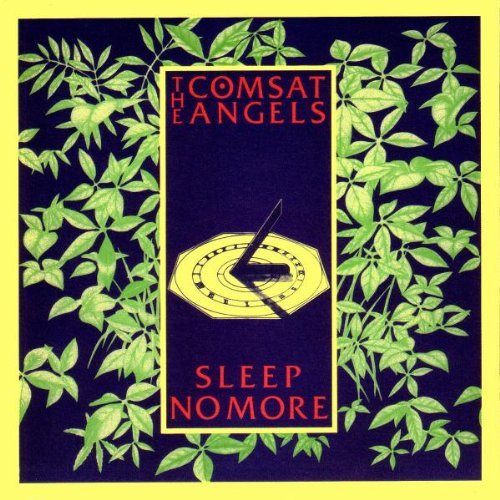
Those familiar with British history understand the devastating effects of heartless Thatcher policies, but novices curious as to how dire things had already gotten by 1981 can simply hear it in the music: the grey cover of the Cure’s Faith spoke for the music inside, while Echo and the Bunnymen took a temporary step away from pop on Heaven Up Here, among other examples. Sleep No More goes further into the void, sounding like an album written under self-imposed martial law. Glaisher’s drums again lead the band, with a massive boom; only Public Image Ltd.’s Flowers of Romance that year relied as heavily on percussion. Like a John Bonham biography directed by Ingmar Bergman, Glaisher was recorded in a stairwell to add heft to his sound. But stomp like Bonzo he does not; restraint is the goal on this most pent-up of albums. Bacon scales things back even further, allotting exactly two notes to his bassline for the verses of “Be Brave.” Tension mounts continuously throughout the album; “Dark Parade” describes the hostage situation in Iran (which helped Ronald Reagan win his role as reactionary American complement to Thatcher in 1980).
Sleep No More is a stunning work, even if it largely defies song-by-song breakdown in presenting a unified front. That front never falls prey to monotony, though, as the Angels display a mastery of dynamics. Glaisher’s inexorable beat drops off on the ambient “Restless,” and when the band next launches into the furious guitar riff of “Goat of the West” the effect is crushing. “It’s so funny,” Fellows sings, “but I’m not laughing.” Typed out, the lyrics look dour and plain, but with the jagged guitar and Peake’s sharp keyboard intervention jabbing at them.
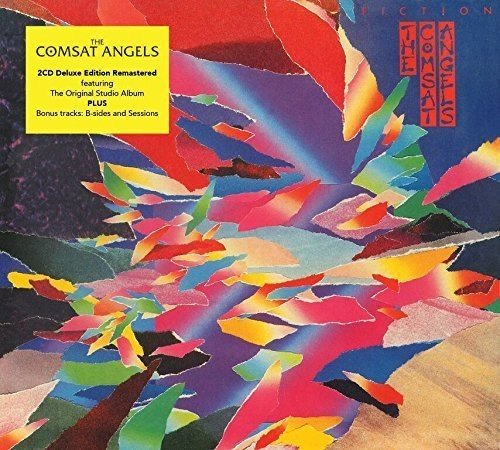
Unable or unwilling to sustain the overwhelming gloom of its sophomore effort, the Comsat Angels turned in lighter directions on 1982’s Fiction. Glaisher again leads the way: the album’s first sounds are of him swishing at the hi-hat, which immediately informs one that new emotions are at play. Fellows verifies this, declaring, “the sky will clear again, after the rain.” Though Glaisher soon forsakes brushstrokes for heavier stick-thuds, Fiction rarely strives for the hopelessness of its predecessor. Fellows sings with more approachable emotions and Peake asserts his presence more fully, making his keyboards a structural element of the compositions rather than its frequent previous status as a supplement. “Zinger” delivers interestingly oblique lyrics, though the liner notes undermine their effect by revealing he wrote the song as part of a bet to see if he could create a song about nothing.
The driving “Eye Of The Lens”, one of The Comsat Angels’ heavier recordings, saw tribal drumming, reverberated guitar and synths fused to form an atmospheric soul-stealing number.
Waiting for a Miracle (1980) established the band’s tense pull and austere musical force, and the next year’s Sleep No More followed the debut’s logic to its limit, wound so tightly the soundwaves of its songs practically take corporeal form; if they did, it would be as the towering black monolith from 2001, looming overhead in physical defiance of human attempts to ascribe meaning. It’s an unjustly ignored landmark in musical bleakness, and it’s no surprise third album Fiction failed to maintain its intensity. That album still merits praise,
If Friction’s solid but lesser songs gave some indication of new directions for the Comsat Angels, “Time Considered as a Helix..”. confirms that. The first 13 of its 19 tracks deliver taut renditions of material from the first three albums and assorted ephemera of the period Renascent has done a marvelous job collecting, bolstering each disc with non-album singles, b-sides, demos and outtakes, fleshing out the songs in new and often more human arrangements, but after the random cover of the obscure Rolling Stones song “Citadel”, the tracks here reveal the unfortunate slide of the Comsat Angels
From this episode of TOGWT, the unsettling tension of “Ju Ju Money”, a track that would have its studio issue on the band’s third album, ‘Fiction’ in August 1982.
The Angels would go on to sign with Jive, score a near-hit on the Weird Science soundtrack, and generally vanish from the public radar. A comeback in the 1990s abandoned their failed chart-pandering but proved temporary.
That this band existed and put out two great albums and one fairly strong one before succumbing to the allure of potential commercial success. That that success wouldn’t come should have been obvious to a band that once sang of “waiting for a miracle, but nothing ever happens”, but perhaps they got distracted by the “Ju Ju Money” on display in Fiction. At any rate, the timing may be slightly off again, as the retro-postpunk wave seems to have crested, but the Comsat Angels at their best transcended trends and flew the genre coop, traveling on their heavenly wings straight for greatness.
Band Members
Stephen Fellows (guitar, vocals), Kevin Bacon (bass), Mik Glaisher (drums), Andy Peake (keyboards, vocals), Simon Anderson (guitar, 1993-95), Terry Todd (bass, 1993-95)
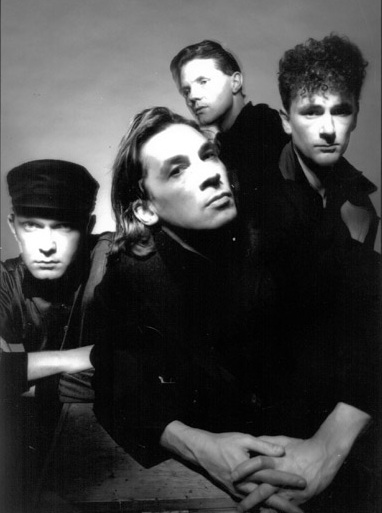
The Comsat Angels were an English post-punk band from Sheffield, Named after the J. G. Ballard short story “The Comsat Angels”, the foursome’s original lineup (lasting from 1978 to 1992) consisted of Stephen Fellows (vocals, guitar), Mik Glaisher (drums), Kevin Bacon (bass) and Andy Peake – (keyboards). Their music has been described as “abstract pop songs with spare instrumentation, many of which were bleak and filled with some form of heartache”. They have been credited as being an influence on later post-punk revival bands such as Blacklist, Bell Hollow, Editors and Interpol.
The Comsat Angels sent a copy of their debut EP, “Red Planet”, to John Peel, who liked it and gave the band a session, which Polydor Records picked up and signed the group to their label. The group overall did 4 sessions for Peel’s show and in an interview singer Stephen Fellows praised Peel for helping the band sign to Polydor:
“These days you have singles on the album and singles that are played on the radio and that help sell records, but that kind of thinking wasn’t really as prevalent then.. A band like us didn’t generally get played anyway. If John Peel hadn’t got hold of ‘Red Planet’and given us a session, Polydor probably wouldn’t have heard of us and signed us .Once they had done I don’t think they knew exactly what they had. They left us to get on with it really. I don’t recall any A and R input at all.”
Recorded: 1981-02-03. Broadcast: 09th February 1981.
The complete session recorded by The Comsat Angels on 3rd February 1981 for the John Peel show on BBC Radio 1 and broadcast on the 9th of that month.
Tracklist: 1. Be Brave (0:07) 2. At Sea (4:02) 3. Eye Of The Lens (8:13) 4. Dark Parade (12:12)
From TIME CONSIDERED AS A HELIX OF SEMI-PRECIOUS STONES: THE BBC SESSIONS 1979 – 1984
Closer To Grey is the new album from Portland’s Chromatics. Closer To Grey is the first album the band released since 2012. Amongst others, it contains reverent cover versions of Simon and Garfunkel’s The Sound Of Silence or Jesus And Mary Chain’s On The Wall. The minimalistic Synth-Sound of previous albums is not lost though, and singer Ruth Radelet proves once again how tender and at the same time powerful a voice can sound.
Chromatics are no strangers to pulsating synths and electronic melodies, all wrapped around with lead singer’s Ruth Radelet’s dulcet tones. With their latest single “Toy,” the band further embraces their danceable and intoxicating sound by diving into a cinematic exploration of forgetting those who hurt you, despite possessing strong feelings of love towards them. Keyboard strokes and bustling drum machine beats all coalesce into a shimmering listening experience that fits perfectly for those late-night stargazing and introspective moments.
London based five-piece HMLTD release their long-awaited debut album, “West of Eden”. The expansive, labyrinthine debut has been several years in the making, a daring collection of songs created to incite conversation about proposed new visions of masculinity, the decadence of western capitalism and the violence of insecurity and repression. Across its 15 tracks, the band’s artistic vision is realised in full technicolour, with all shades of their sonic palette used to create an album that is equal parts lush and abrasive.
HMLTD formed back in 2015, but they only hit our radar screens when we saw them at a festival the previous year year. And now, they’ve engrained themselves in our psyches. Formerly known as Happy Meal Ltd, the London-based sextet are charting a new course for glam rock and punk with their extremely outlandish live performances. You’d be forgiven for thinking you’re watching the cast of a musical as lead vocalist Henry Spychalski dances his way around stage through their sets. There is almost certainly no other performer or performers around like HMLTD.
They’re going to be a big love or hate band, but that’s probably what the band will be trying to draw out of those watching. The music is like a mix of Bowie and Adam Ant, with real cool ’80s vibes in songs like “Proxy Love”. The experimental band were picked up by Sony Records in 2017, so expect to hear a lot more from HMLTD over the next few years, whether it’s love for their sound or dislike for their bizarre style. Either way, they’ll be great to get a reaction.
HMTLD are Henry Spychalski (vocals), James (guitar), Duke (guitar), Nico (bass), Zac (keys), and Achilleas (drums).
Arguably the most stylish new band doing the rounds at the minute, but have they got the substance to match? Find out for yourselves as their collision of new romanticism, punk, funk and all things in between looks set to bring Friday’s fringe event to a chaotic close.
No band in the UK is talked about as much as HMLTD. Live, they’re like a potent mix of The Cure, Jesus and Mary Chain and The Prodigy and with Faris Badwan having been in the studio with them recently it wil be exciting to see what comes out next year. 2017 is theirs for the taking
West of Eden, due for release on 7th February 2020.