Zachary Cale is an American songwriter/musician based in NYC. False Spring is his 6th full length album. To be released May 29th, 2020
From pop to rock to hip hop to country, music is increasingly being mechanized. Autotune, synths, mixers, and laptops are the items of choice, as artists focus on creating loud, anthemic, and catchy songs. Pockets, however, exist within each genre, where a musician or band rewind the clocks and create music from bygone eras. Their music is driven by a simple but embracing melody and features stories which should be read and not just heard. Singer-songwriter Zachary Cale is one such individual, whose indie-folk approach recalls Guthrie, Dylan, and Baez. To call him a throwback would be a compliment because he is a rare breed today.
Five years ago, the Louisiana-born, Brooklyn based Cale released the masterful Duskland, which was indie-folk given the widescreen treatment. Since then, he’s released a couple of EPs, including a covers one, but otherwise he’s been relatively quiet. Earlier this week, however, he announced that his sixth full-length album will be released later in the spring, and he shared its first single, “Riverbed”.
“Riverbed” is a classic slice of indie-folk and Americana. There aren’t any bells or whistles. There are just the familiar, sweet notes of a keyboard and a couple of guitars and the steady pulses of rhythms. Cale’s soft vocals, meanwhile, rise through the sweet melody, and he’s reflects on his life. For nearly five minutes, he delivers a confession, and, in the process, he seeks redemption. It is not through the concrete streets of Manhattan that he searches for forgiveness and a resurrection. Instead, he takes us back to Louisiana and the stream behind his childhood home. Together, we dip into its waters and find salvation.
The brand new studio album from L.A.’s premiere psych band, The Warlocks! ,The Warlocks started because of the their mutual love of all things Rock and Roll. We love a lot of the 60s, 70s and some 80s inspired music. We are not a retro band though. We all always try new stuff and from time to time hit something great.
This ambitious album tells a single story, of two star-crossed lovers who commit a bank heist together, over the course of 10 gorgeous, dense layered guitar tracks spiced with keyboards and reinforced with powerful bass and percussion grooves!, Holy shit, I have a few versions of we don’t need money on demo and unreleased recordings, but how cool to hear it fully formed! love that heavy fuzz bass and beat. amazing! Love the whole thing.
The Rough Justice of The Warlocks’ The Chain, The longtime L.A. psych-rockers’ tenth studio album is released on April 3rd, 2020
“Creamy, dreamy, glass breaking-style storytelling” is how Bobby Hecksher describes the psychedelic-rock sound of The Warlocks’ tenth full-length studio album, The Chain, on Cleopatra Records.
“We’re telling a story this time,” Hecksher says about the album’s ripped-from-the-headlines concept, which he says had been percolating for a few years before it suddenly came to him with the delirious intensity of a fever-soaked dream, like that “out-of-body experience you get at a show when you’re drenched in sweat and suddenly feel so alive.”
That concept, Hecksher says, is based around “a Bonnie & Clyde-ish twenty-something couple who rob a bank but get caught and then are cast down the bottomless pit of our justice system. The main characters, Rocky and Diamond, come from different means and thus have very different outcomes. It’s a loose collection of ‘you got fucked and swept under the rug’-type feelings revealed amid happy songs about their relationship, provided as a kind of relief
Band Members
Bobby Hecksher,
JC Rees,
Jason “Plucky” Anchondo,
Earl V. Miller,
Chris DiPino,
Will be available on both CD and limited edition colored vinyl in your choice of PURPLE or SILVER! vinyl
released April 3rd, 2020
“Deerhoof is a weapon loaded with the future.” – Agustín Fernández Mallo, Spanish physicist and writer
Normal is never coming back. Whether by a collective dismantling or sheer collapse, our old illusions are being hollowed out. Over the past couple of years, Deerhoof has been asking themselves if there was any music they could create that expressed how the rapidly changing future might actually feel. The finished product, Future Teenage Cave Artists, finds Deerhoof in a revolutionary mood, but also haunted by memories of a lost world and every failed attempt to save it. People already cut loose from the system, already surviving with new ways of life—these hopeful heroes are Deerhoof’s inspiration. These are the Future Teenage Cave Artists.
Faithful listeners will recognize a certain alienated but transformational figure who shows up in Deerhoof songs going back to their earliest days. Take the narrator of “The Perfect Me” from 2007’s Friend Opportunity: an orphaned but eager soul attempting to entice other wounded wanderers who might lack a home, a clan, a family, a history. But on Future Teenage Cave Artists our protagonist is threatened by terror lurking around every corner. Add to that the fact that our “cast-off queen,” our “maniac,” our “terrible daughter” are watching themselves get orphaned in real time by an older generation in power that would rather see life on Earth destroyed than give up archaic systems of capital.
Like a lot of the inimitable music they have released over the last quarter-century, the Deerhoof of Future Teenage Cave Artists, Satomi Matsuzaki on bass and vocals, Ed Rodriguez and John Dieterich on guitars, and Greg Saunier on drums, vocals and piano) stitches together fragments of R&B and classic rock and transforms them into a new language of revolution, forgoing verse-chorus structures for dream logic and blind intuition. But what makes this album different is its intimacy—the blues riffs and slide guitars are joined by soft, rickety pianos and whispered three-part harmonies.
In this sense, FTCA inverts the formula of Deerhoof’s last album, Mountain Moves, which invited a wide community of collaborators to band together in an open celebration of solidarity. The new one, on the other hand, is borne of self-isolation and deprivation. It’s the sound of a sparkling, manic musical intelligence being disconnected from a nourishing public and devouring itself inside its own cocoon: a desperate lunge at metamorphosis.
At times FTCA indeed sounds as if the band has retreated to the caves, recording with unreliable electricity and insecure food supplies. Guitar pedals malfunction mid-take, reverbs chop off mid-tail, drum fills collapse mid-phrase. Some musical moments, as gorgeous and touching as anything Deerhoof has ever written, stop short for no apparent reason, giving way to queasy smudges of sound. Many of the instruments and voices were recorded with nothing more than the built-in mic of a laptop. Harsh splices make no effort to hide the seams. Hard panning leaves many of these imperfections weirdly naked in the mix.
In this way FTCA joins a storied lineage of pop records that expose the insular and reclusive nature of recording itself. Like Let It Be, There’s a Riot Goin’ On, or Sister Lovers, this record is its own “making-of.” Absence is a central character in the drama. For every heartwarming melody or pile-up of parade drums or shard of loopy guitar noise, there is musical acknowledgement of the toll that a constant threat of cataclysm takes on mental health. This is a sonic and lyric funeral for a way of life that is never coming back—an afterparty, back when the doomsday clock hit midnight. There are raucous toasts to the departed in high style, as sassy and spasmodic as anything they’ve done—see Side A; there are moments of profound sadness, maximally small, descending into madness, shrieking with loss—see Side B. All funerals remind us that life goes on, somehow.
In that time after the end times, it’s not only the food systems, energy systems, and political systems that will have to be rebuilt. Myths, stories, and rituals we use to make sense of the world are up for revision, too. Might not agile networks of mutual aid be our best example of civilization, and our makeshift DIY basement shows be the real high art? One answer might be found in the two-and-a-half decades that this improbable combination of personalities and backgrounds we call Deerhoof has spent on stage, cultivating quick-wittedness and improvisation. This is a record about resilience and the persistence of hope in a future beyond any reasonable justification for it. Like so many young people today, Deerhoof seems to be already living in that future.
What is this instinct to hate on everything?” asks singer/songwriter Anna Burch on her song “Not So Bad,” the first single from her new sophomore album If You’re Dreaming, which is out today on Polyvinyl. This is Burch’s second LP for the label, following 2018’s Quit the Curse. Sam Evian produced the new record. “Not So Bad” is kind of like a dreamscape, as its delightful music video, which features several dance sequences and plenty of twirling. The chorus is a response to Burch’s question: “It’s not so bad,” she sings. “I’m still here,” she later says, “if it’s not clear.” The video was directed by Burch, and Ben Collins was the director of photography.
Tell Me What’s True – new single + video inspired by Scorsese’s 1974 film Alice Doesn’t Live Here Anymore.
“Tell Me What’s True” is taken from Anna Burch’s sophomore album, If You’re Dreaming, out April 3rd, 2020.
Linnea Siggelkow, the Ontario singer/songwriter better known by the moniker Ellis, today shares her debut LP Born Again through Fat Possum Records. “March 13” followed the singles “Fall Apart” and “Embarrassing,” which were released earlier this year. “‘March 13’ plays right after the last single ‘Embarrassing’ on the track listing, and is a reflection on a night that I did embarrass myself,” Siggelkow said in a statement. “I acted badly and put someone I cared about in an unnecessary and uncomfortable situation, but refused to admit at the time that I was out of line.” While Ellis won’t be able to embark on a planned tour with Ratboys due to the coronavirus pandemic, she hopes that the record helps those who feel alone—which is a much-appreciated sentiment, now more than ever in the time of social distancing.
“march 13” from Ellis’s debut album ‘Born Again’ (out now)
Though its title is taken from the Old English term for “the sound of winter,” much of James Elkington’s solo debut bears a distinctly autumnal vibe. With a feel that harks back to the British singer/songwriters of the early ’70s, Wintres Woma ultimately seems to capture the slow seasonal slide from fall’s gentle unbuttoning into an icier, more frigid landscape.
Elkington hails from the U.K. but makes his home in Chicago, where they know a thing or two about winter. He has a varied history that includes fronting indie rockers The Zincs and co-leading art-folk outfit The Horse’s Ha with Freakwater’s Janet Beveridge Bean. But over the past couple of years before beginning work on “Wintres Woma”, he had been working primarily as an accompanist, playing guitar and other instruments with British folk-rock legends like Richard Thompson and Michael Chapman, as well as Steve Gunn, Jeff Tweedy, and others.
Elkington’s first solo statement was cut in just five days at Wilco’s sonic headquarters, The Loft in Chicago. It seems to key in on the sensibility of artists like Thompson, Chapman, and their peers, who blurred the lines between folk, rock, and jazz in the ’70s with their nimble guitar work, and combined it with a poetic lyrical bent. The delicate-but-precise acoustic guitar patterns at the core of Wintres Woma sometimes feel like descendents of Nick Drake complex finger-picking latticework, especially when Elkington’s lines are countered by Nick Macri’s fluid stand-up bass on the speedy “Make It Up.”
The only track not written by Elkington, an instrumental take on the traditional Scottish folk song “The Parting Glass,” is so adventurously re-harmonized that it scarcely resembles its source, bringing to mind the trailblazing 1960s acoustic explorations of British guitarist Davey Graham. And the combination of Elkington’s sonorous baritone and virtuosic fretboard forays makes a strong case for him as the spiritual heir to the late U.K. folk legend Bert Jansch.
But for all of Wintres Woma’s links to a scene that was approaching its peak when Elkington was a zygote, the dominant artistic voice here is an unflinchingly singular one. The lyrics, in particular, travel a path that seems entirely their own, with imagery unusual enough to force your synapses into new configurations, and a bittersweetness palpable enough to take you by the tear ducts and squeeze.
“In the drug harbor, friends became verbs, chanting in squares the where and the why,” he sings in “When I Am Slow” atop a folkish guitar melody that could be either minutes or hundreds of years old. “Shut that accordion mouth and stop crying fat wedding-band tears,” he admonishes the subject of “The Hermit Census.” And it’s tough to imagine anyone else managing to slip a line like “entrails were made into garlands to welcome my reign” into a ballad as warmly homey-sounding as the crepuscular, harmonica-laced “Sister of Mine.”
The arrangements on the self-produced album are spare (if not stark) from start to finish, and mostly played by Elkington himself, with occasional assists on violin, viola, percussion, and the aforementioned bass and cello. With Elkington’s intimate, plum wine vocals and tactile guitar work at the core throughout, each track feels like a stylishly scrawled diary entry we’ve somehow wrangled the permission to read.
But whether Elkington is whistling through the graveyard on the ironically perky-sounding “Grief Is Not Coming,” recounting the surreal dream state of “Greatness Yet to Come,” or navigating his way through the nightmarish visions of “Hollow in Your House,” his combination of timeless folk flavorings and an artful modernity blend into a wistful but never forlorn kind melancholy. It’s the kind that steps far enough back from the shifting of the seasons of life to know that the whole thing is just a dream to be played out, a dance to follow through, on the way to becoming one with the true sound of winter.
British lo-fi rockers Happyness have shared a new single, “Ouch (yup),” from their forthcoming third album Floatr, out on May 1st. Following previous singles “Vegetable” and “Seeing Eye Dog,” “Ouch (yup)” also maintains their lo-fi roots, but it’s not an empty pastiche. It grapples with the personal and political defeatism that’s so easy to slip into these days—wondering how long we can (and should) tread water and marveling at how we convince ourselves that things are set in stone when they really aren’t. But it’s not overly bleak, thanks in part to their enlivening guitar passages and Jonny Allan’s trustworthy vocals
Listen to ‘Ouch (Yup)’, the third single off Happyness upcoming record ‘Floatr’ taken from their forthcoming third album Floatr, out on May 1st. Floatr follows 2017’s Write In and 2015’s self-recorded debut Weird Little Birthday. The band began as a three-piece of Jonny Allan, Ash Kenazi and Benji Compston back in 2013 and now boasts a core lineup of Allan and Kenazi (who has recently come out and often performs in drag on stage) alongside live members Max Bloom (Yuck), Anna Vincent (Heavy Heart) and Scott Booker Roach (Social Contract).
Following previous singles “Vegetable” and “Seeing Eye Dog,” “Ouch (yup)” also maintains their lo-fi roots, but it’s not an empty pastiche. It grapples with the personal and political defeatism that’s so easy to slip into these days—wondering how long we can (and should) tread water and marvelling at how we convince ourselves that things are set in stone when they really aren’t. But it’s not overly bleak, thanks in part to their enlivening guitar passages and Jonny Allan’s trustworthy vocals.
“It’s about processing the stuff you leave behind, and not getting complacent and not assuming anything,” the band says. “We were going through some massive life changes around the time we wrote this song, and Brexit was happening (remember that!). It’s about disbelief I guess. And the slow excruciating dawning of reality. Reality is a weird rush, the truth sets you free. Those kinds of things.”
While Madeline Dowd’s visual artwork playfully relays adult themes through childlike imagery, her band Crisman swaps the acrylics and spray paint for hazily-filtered vocals gently layered over slow-core arrangements to find yet another medium for masking emotional turmoil with innocence.
In 2011, Dowd left her hometown of Alpharetta, Georgia for Denton, Texas, where she met Boone Patrello, who records under the moniker Dead Sullivan. Their chemistry led to 2018’s Crisman Tape, which Gold Flake Paint called “a hidden and unhurried gem in the current DIY scene.” For the band’s self-titled debut studio album, Dowd and Patrello teamed up with another fellow Denton musician in MAH KEE OH’s Grahm Robinson. Contrasted against the childlike playfulness of Dowd’s paintings, the band’s collective experience is refracted throughout the measured ten-song collection.
The melancholic and sinuous lead single “Surprise” pulls from childhood memories of wanting to be included and feeling misunderstood in order to lend its start-stop riffs an emotional touchstone. On “Cya,” the band employs acerbic distortion and twinkling arpeggios to explore the immaturity and inevitability of trying to forget a person or feeling that lingers far too long, where final single “Icee Blue” is about experiencing the infectiousness of a romance, a thematic reproduction of the song’s infectious composition.
Born out of real stories of human migration, including those of Ward’s own ancestors, “Migration Stories” plucks us out of our lives and places us somewhere mysterious and unknown, beyond this world. Ward sings of the need for reunion with a loved one, transcending any time or place and giving an epic, mythical feeling to a well-worn concept.
If, as M. Ward says of his 10th album, Migration Stories, “music is a filter” through which to process the onslaught of heart-wrenching news we’re fed each day, then we are even more fortunate to have it than he probably realized while he was making it. Music can make it all go down a little easier, or, even better, it can invite us to take on a new perspective and inspire change. Migration Stories does indeed accomplish this. It makes us listen a little more closely and look for the beating heart at the center of even the stories that seem to gut us. Born out of real stories of human migration, including those of Ward’s own ancestors, Migration Stories treads perilous ground through his gauzy, dreamy tone.
From the opening track “Migration of Souls,” we are plucked out of our lives and placed somewhere mysterious and unknown, beyond this world. Ward sings of the need for reunion with a loved one, transcending any time or place and giving an epic, mythical feeling to a well-worn concept. The song’s melody seems to float above us like a dream. It is romantic, even as it recalls a traumatic experience. That describes much of Migration Stories. The sinister dangers of migration linger, but Ward captures the anticipation on the quest for something better, and mostly, the in-between of it all. These songs live in that purgatory, the dream state of imagining what lies ahead.
Ward employs the organic delicateness of his voice to tell these stories with a tender touch. Even on the noir-tinged “Heaven’s Nail and Hammer,” Ward moves with great care and we can take comfort in the hypnotic repetition of his chorus as he sings, “I see heaven, heaven, heaven / Through the holes in the sky.” “Chamber Music” has a similarly murky undertone, but Ward’s gentle vocals make it more of a lullaby. And even as “Independent Man” brings in subtle saxophone and a groovier sound, Ward keeps it cool and collected. Whether knowingly or not, Ward has made Migration Stories a tonic to soothe our worried minds.
“Unreal City” by M. Ward from the album ‘Migration Stories,’ available now
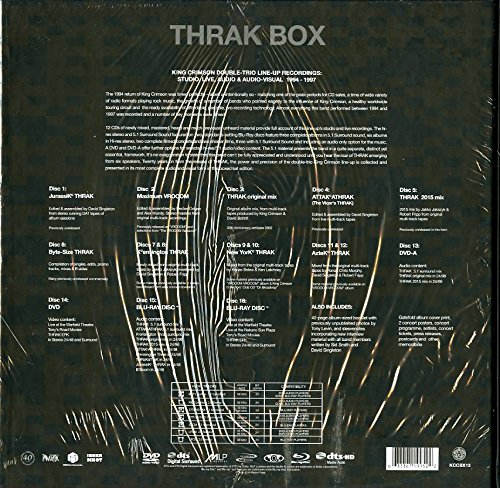
The 30th Anniversary edition of King Crimson’s “THRAK” is now available to download. Released in 1995, it features the Double Trio of Fripp, Gunn, Mastelotto, Belew, Levin & Bruford and was the first full-length King Crimson album since 1984’s Three Of A Perfect Pair. “Thrak”, was the eleventh studio album from King Crimson was released 25 years ago today. Appearing a decade after Three Of A Perfect Pair an expanded six-piece King Crimson consisting of the 80s quartet of Fripp, Belew, Levin, and Bruford augmented by Trey Gunn (touch guitar) and Pat Mastelotto (drums and percussion), reconvened and set about creating Thrak.
While I didn’t love this era of King Crimson as much as the John Wetton era there was no way I was missing out on this box set. I began buying these with “The Road To Red” and although it set me back a few hundred quid I went out and got the other three (“ITKOK”, “Larks Tongue In Aspic” and last year’s “Starless”). While the price might appear hefty on the surface, the contents are a bargain, currently this box is retailing at £95 for 12 CDs, 2 DVDs & 2 Blu Rays, you do the math, it’s a steal. At the time most fans were taken aback at the unexpected appearance of the mini-album, VROOOM. in October 1994, announcing as it did, the return of King Crimson to active service. Thrak followed in April 1995 to widespread critical acclaim. Replete with a snarling metallic edge,the band could be heard taking a decisive leap forwards. The Double Trio, as Fripp dubbed them, deliver a brace of brand new Crimson classics, with the bulldozing riffs of VROOOM clearing the way. Dinosaur’s ironic, hook-laden choruses lurches into epic pop song territory, while the title track plunges deep into stormy, turbulent ensemble improvisation.
King Crimson has always had a habit of surprising its audiences. Since stepping off the stage at Montreal’s Le Spectrum in July 1984, Fripp, Levin, Belew, and Bruford had gone their separate ways. Although its dissolution had not been accompanied by the sombre pronouncement that King Crimson had ceased to exist forever as it had been in 1974, fans and observers could have been forgiven for assuming that there was little or no chance of King Crimson treading onto a concert stage ever again.
Onto the contents, while nowhere near as exhaustive as the Wetton era sets the emphasis hear is on quality rather than quantity.There are 3 complete live shows on CD, 2 on Blu Ray and video (an upgraded “Deja VROOOM” and an unreleased show from San Fransisco, the SF show picture quality is a long way from the rumoured HD visuals but the soundtrack is superb), an expanded version of the long out-of-print “VROOOM” EP, an audio documentary about the making of the album using outtakes from the studio session reels, the original and 2015 mixes of “Thrak” (the 5:1 mix really showcases The Double Trio as it should be heard), a CD of improvs and a CD of B-sides, outtakes and odds-and-sods.
On top of that you get a full colour book, posters, postcards and other memorabilia. Giving “Thrak” this new lease of life has really opened my eyes to what an incredible and unique album it is, I enjoyed it before but it never had the same impact on me that the likes of “Red” or “Discipline” had, now it has. King Crimson are setting the standard for this format, opening the vaults for fans in a way that no other band has, roll on the next one!
Fripp’s decision to put King Crimson back together had been made in the second half of 1990 though, as he later noted, without a clear idea of what the band would look like at that point. Clarification came two years later during the period he was working with David Sylvian.
Here’s what the Thrak Box looks like when it’s unboxed…A 16 disc limited edition box set featuring studio and live recordings – many previously unreleased – from King Crimson’s mid-1990s double trio line-up.
Highlights include a new ’21st Century stereo reimagining’ of THRAK (by Jakko Jakszyk and Robert Fripp), ATTAKcATHRAK (a David Singleton edited collection of improvs), and Max VROOOM, which sees a release for the long out of print mini-album VROOOM. The second blu-ray includes concert films, a Thrak epk and Tony Levin’s Road Movies.
Much of the material is presented in new 5.1 Surround & Hi-Resolution stereo mixes.
I came to the King Crimson party a little late in my rock fandom life. I didn’t buy Court Of the Crimson King until about six years ago, and I know this will cause some to scream .Despite that initial reaction I decided to investigate the album ‘Red’ a few years ago when I heard that it had a big influence on Kurt Cobain’s sound, now that did hit the mark and I still rate it as my favourite Crimson album. Suddenly I was looking for more King Crimson and Lark’s Tongues and Starless arrived in my collection. Also, having recently invested in a new toy to play 5.1 surround sound I was buying these CD+DVD-A versions each one impressing me both musically and in their 5.1 mixes, Steven Wilson, as usual, having done an excellent job. Then last year I thought it might be time to check out a bit of later King Crimson and decided to go for Thrak, the title just suggested it would be closer in sound to Red. Those first crashing chords to VROOOM seemed to confirm that. Another good investment I thought, that is until this summer when all of a sudden we found that a new CD DVD-A version was to be released (Along with a 16 disc box set for those with large bank accounts).
The surround sound mixes have been really impressive with all the previous Steven Wilson 5.1 mixes, Crimson are perfect for 5.1 and Mr Wilson knows just how to envelope you in their sound, but of course it’s not Steven Wilson who has mixed this album it is Robert Fripp and current guitarist and vocalist Jakko Jakszyk. It seems Wilson is not the only one who knows how to do a 5.1 mix. Fripp and Jakko have done an excellent job, of course the double trio format that Robert Fripp introduced on this album suits 5.1 perfectly with six instruments spread around your room, this is great fun. Of course it’s not just the 5.1 mix we have here but also a brand new stereo mix as well. On the previous albums I had bought in this dual format I had been unable to compare the new stereo mixes as these were the only versions I had, but for the first time with a Crimson album I can compare and contrast the new and old stereo mixes (Isn’t that supposed to be half the fun). I have to say I like this new mix, it wasn’t that I had previously thought there was anything wrong with the previous mix, but all of a sudden the two drums are brought further up in the mix and all of sudden many of the tracks become so much more interesting hearing those two drummers up front, just take a listen to VROOOM to really hear it. The whole album has an even better feel to it, whether it be the grungy guitars of VROOOM, and THRAK, Adrian Belew’s attempt at Alice Cooper style vocals on Dinosaur or his Beatlesesque vocals on Walking On Air, a track that also feels like a throwback to the first album, you do feel that the new mix has improved an already impressive album.
* CD 1 JurassiKc THRAK – an assemblage of material from the recording sessions for the album – placing the listener in the studio with the band as the material was composed and recorded including seven pieces that didn’t make it onto the final album.
* CD2: Max VROOOM – features the long-unavailable mini-album VROOOM, augmented with tracks and edits from the KC Club release: The VROOOM Sessions. All material re-compiled & remastered at DGM.
* CD3: THRAK – is the 2002 remaster of the original album
* CD4: ATTAKcATHRAK (The Vicar’s THRAK) is a sort of sequel to THRaKaTTaK insofar as it’s assembled from live improvs, but is also very different. One of David Singleton’s best pieces of production, the editing process for the new improv album provides more form and function to the material without compromising the spirit of the original improvs. Unlike THRaKaTTaK, which was based on stereo board recordings, this album is newly mixed, in both stereo and 5.1 Surround Sound, from multi-track tapes.
* CD5: THRAK – is the transformative 2015 Jakko Jakszyk/Robert Fripp remix of the original album, described by Robert Fripp as a “Re-imagining of stereo in the early 21st century.”
* CD6: Byte Size THRAK – is a compilation of singles edits, live tracks from promos, a 12″ mix edit – some of which are making their debut appearance on commercially available disc and extracts from writing sessions from the final Nashville rehearsals in 1997.
* CDs7/8: Kcensington THRAK -is a newly mixed release of the band’s London concerts in 1995. Mixed from multi-track tapes by Jakko Jakszyk, and mastered by David Singleton and Robert Fripp (“To make it rock even harder”). Other than video releases, it is also the first live show from this band available in surround sound.
* CDs 9/10: New YorKc THRAK – features a complete setlist from the 1995 run of shows in the city, some material previously released on VROOOM VROOOM (now deleted) and the KC Club release On Broadway. Drawn from multi-track tapes, mixed by Adrian Belew & Ken Latchney. All newly remastered at DGM.
* CDs 11/12: AzteKc THRAK – features a complete setlist from the Mexico City concerts in 1996 – released, in part, on VROOOM VROOOM – mixed from the original multi-tracks by Robert Fripp, R Chris Murphy and David Singleton, and recently remastered at DGM.