Neil Young has released “Vacancy,” the latest offering from Homegrown, the previously shelved 1975 album he’s finally releasing on June 19th.
One of the seven unreleased tracks on the album, “Vacancy” opens with a churning guitar riff, as Young sings “Who are you?/Where are you going to?” He then addresses an old lover: “I look in your eyes and I don’t know what’s there/You poison me with that long, vacant stare.” One of the seven unreleased tracks on the album, “Vacancy” opens with a churning guitar riff, as Young sings “Who are you?/Where are you going to?” He then addresses an old lover: “I look in your eyes and I don’t know what’s there/You poison me with that long, vacant stare.”
Recorded at Young’s Broken Arrow Ranch Studio in January 1975, the track features Stan Szelest on Wurlitzer organ, Ben Keith on lap slide guitar, bassist Tim Drummond and Karl T. Himmel on drums.
“Vacancy” follows the single “Try,” another previously unreleased track he performed on tour between 2007 and 2008. He recently performed the title track — released off 1977’s American Stars ‘N Bars — during his home concert series in quarantine.
Young, who recently announced a Bootleg Series, dropped a 2019 solo acoustic rendition of “Southern Man” in the wake of mass protests over the police killing of George Floyd. “Have hope,” he wrote in an op-ed on his website on Monday. “I feel a change. … We know black lives matter. My heart goes out to all our black families affected, so that’s all the black families through American history. I feel like we are turning a corner. All Together, all colours on the street. We know our mission is the right one for America and for mankind.”
Neil Young’s “Vacancy” from ‘Homegrown’ available on June 19th.
Their debut album “Good Songs for Bad People”, due for release on June 12th is a compilation of dark and mysterious tracks that possess a hauntingly atmospheric quality that seems to seep into your bones. It opens with the mind-boggling “Entering Drag City”, which sets the tone perfectly. Distorted and irksome melodies are dark and unnerving. This darkness carries itself though the remaining nine tracks in various forms.
“Working For The Men” is dreamy, with melodies sifting in and out of the musical consciousness. It starts bright with a repeated guitar riff and soft muted flute but it dips into darkness. The guitar melody is on an aggressively exact loop that supports the muted vocals and drags you down into an inescapable trance. A Spanish guitar gives some light relief at the end of the track, which acts as a palette cleanser for the rest of the album.
Good Songs for Bad People bounces through many musical genres including hip-hop, dream-pop and jazz but it is evident that Drab City also likes to inject some level of theatrics into their tracks. Starting with a dramatic flair, “Troubled Girl” quite literally tells the story of a ‘troubled little girl, from a small troubled town, with nowhere to go’. The tempo of the track is that of a weary wander and picks up with a subtle level of funk that is both sultry and mysterious. Moving into the instrumental section at the end of the track, it transforms with some chill extraterrestrial vibes, creating something truly otherworldly.
Old-school sci-fi vibes are in abundance in male-vocal dominated “Problem”. This track places itself on the darker side of ’70s psychedelia. The slow pace and wavering melodies are intermittently interjected with various musical motifs but what really drags you out of this perfectly formed musical lull is the hypnotic spoken section in the middle. Maybe it’s because it’s French spoken word or because the track moves at such a slow pace, but it transports your mind to somewhere dark and melancholy.
Good Songs for Bad People is thought provoking and hits on a darkness that is difficult to manifest musically. What is really special is its soundtrack quality. It sounds like a musical manifestation of Twin Peaks, but more grounded in the current reality. It is haunting and despite my attempt to describe it, I still feel like I’m missing out on something deeper, something that can’t be understood. And that mystery, mixed with Drab City’s encompassing understanding of music; honestly, as debut albums go, it doesn’t really get any better than this.
Then on the heels of two stellar EPs, Melbourne’s Rolling Blackouts Coastal Fever first appeared on our radar at SXSW 2017. The marvelous quintet piled on guitars unapologetically in each of their breezy pop songs with life on the world’s roads and skies laid ahead for them. Their excellent 2018 debut LP, Hope Downs, solidified their status as a touring powerhouse, but the grind eventually made the band turn inward when writing “Sideways to New Italy”. “We saw a lot of the world, which was such a privilege, but it was kind of like looking through the window at other people’s lives, and then also reflecting on our own,” says singer/guitarist Fran Keaney. “She’s There” opens almost unconsciously with a nasty guitar hook that threads into a song about longing and pondering someone’s absence who might be thousands of miles away. “Falling Thunder” is a more traditional pop groove that’s still heavily stacked with guitars and asks “Is it any wonder? We’re on the outside / Falling like thunder, from the sky.” And while RBCF is shifting to make sense of their place in the world, they’re still very much committed to doing so while absolutely shredding.
Just two years ago, This Australian indie pop band Rolling Blackouts Coastal Fever rose to international prominence with the release of their critically acclaimed debut LP ‘Hope Downs’ which found an eager audience around the world. Showing absolutely no signs of second album fatigue, they make their welcome return with the newly released ‘Sideways To New Italy’.
Inspired by the New South Wales village of the same name where drummer Marcel Tussie grew up and spent his formative years; nostalgia plays a major part in this wonderfully wistful record which channels the melancholy and turns it into a dynamic explosion over ten tracks.
It also reflects on how immigration is increasingly becoming a contentious issue thanks to the dangerous rhetoric of popularist politicians, which contrasts sharply with the bands views who see the benefit of blending cultures as proven by the Venetians who came to New South Wales in the 1800’s and brought their rich history to their new home.
On their second full length record, “Sideways to New Italy”, Rolling Blackouts Coastal Fever have turned their gaze inward, to their individual pasts and the places that inform them. From a town in regional Australia that serves as a living relic to how immigrants brought a sense of home to an alien place, to the familiar Mediterranean statues that dot the front lawns of the Melbourne suburbs where the band members live, the inspiration for the record came from the attempts people make at crafting utopia in their backyard (while knowing there is no such thing as a clean slate). In searching for something to hold onto in the turbulence, the guitar-pop five-piece has channelled their own sense of dislocation into an album that serves as a totem of home to take with them to stages all over the world.
“These are the expressions of people trying to find home somewhere alien, trying to create utopia in a turbulent and imperfect world.” These guys continue to grow as songwriters- there are a ton of catchy melodies across this album, and not a weak track. I can’t wait to see them perform these songs live! . The tightest 3-guitar band I have ever seen, full stop. The dual-lead guitar crescendo in Cars in Space is pure bliss, something Verlaine and Lloyd would have been proud of.
Released June 5th, 2020
2020 Rolling Blackouts Coastal Fever under license to Sub Pop Records
‘Sideways To New Italy’ is now available on Limited Edition Sky Blue Coloured Vinyl, Standard Vinyl and a Bundle containing both records.
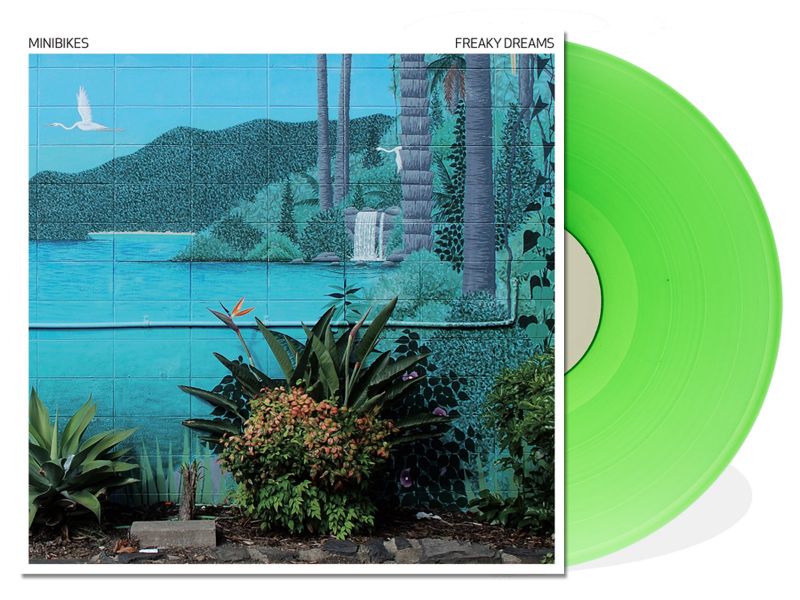
Minibikes have been soundtracking Australia’s endless summer for over a decade now, releasing their debut collection of tropicana rock ‘n roll For Woods Or Trail in 2011. Since then the somewhat elusive four-piece of Marcel Borrack, Libby Chow, Nathan Farrelly and Al Barden have been scarce on the live music scene, having played a handful of intimate gigs in their time together, but are gearing up to change this trend in a post-COVID world, no doubt to welcome their forthcoming album Freaky Dreams to the world. Their sophomore LP was recorded with Tim Harvey (Jade Imagine, Gena Rose Bruce) and is released today. Available now through Cheersquad’s Bandcamp in a limited edition fluro green or black vinyl.
Things happen slowly in the world of Minibikes… Time seemed to be a big influence on writing, recording and releasing this album. It all started when I walked past the mural that’s on the album cover. It was an aquamarine slice of paradise on the side of a motel, and it set the mood for writing the songs. I wanted to capture lush fantasy and grimy reality in the same place, so I spent a long time gazing at this scene, trying to evoke that feeling in the songs. Along the way I’d be in other towns on the east coast of Australia and similar images of palm trees and whales would reveal themselves, as if by magic they seemed to be everywhere like in some freaky dream. I discovered they were all the work of artist Geoff Slater, who turned out to be awesome and generously allowed me to use the cover image. When I emailed him and explained how I’d been inspired by his work he said “Inspiration has natural power”. I thought “Wow, this guy walks the walk”, so I wrote “Magic Happens” as a tribute to the beachy, 70’s new-age vibes I was imagining him exuding. Now I’ve never met Geoff and I may be completely misrepresenting him in my thinking, but without a doubt he’s a big part of the Freaky Dreams story.
The rest of the songs followed, all of them trying to meld seemingly disparate imagery or instrumentation into a single, if slightly blurry vision. The kind of feeling you might get when you stare into a mural too long I guess.
Released June 12th, 2020
Another freaky dream from the Minibikes featuring Snowy “Freaky Dreams” out on Cheersquad records and tapes.
A compilation of a ton of covers we’ve done, from 2003-2020!, Be sure to check out the albums and singles these are from!. The Dollyrots are a female-fronted rock n’ roll band from California. Rockers Kelly Ogden and Luis Cabezas juggle the family business — their irrepressible pop-punk quartet The Dollyrots
Get this download for FREE for a limited time!.
When you hear acoustic strum’s and harmonica, you possibily think Bob Dylan—especially when it sounds this much like Bob Dylan. But Tré Burt isn’t just trying to play copy-cat Dylan on his 2020 album “Caught It from the Rye”. He clearly takes Dylan seriously as an influence, yes, but Burt has his own thing going on, and, as pointed out in February, it’s distinguishable mostly for its vivid swath of Black emotions. “And Mother Nature, I guess she caters / To those with white skin / I don’t feel well anymore / To darkness I’m returnin’,” he sings on “Undead God of War,” a protest song of sorts.
But he also succeeds at singing from an even more personal perspective. “Real You” expresses a Leon Bridges-like yearning for vulnerability, and “Moth’s Crossing,” which sounds like Dylan more than any other song (seriously, it’s almost creepy!) is a lusty, lovely call to a potential mate.
Tré will hit home with just about any folk fan, but particularly those that long for a little bit of old fashioned folk revival sounds à la Joni, Joan, Bob and Leonard mixed in.
“Caught It from the Rye” from newly-signed Oh Boy Records artist, Tré Burt.
Alicia Bognanno channeled the 1997 Chumbawamba classic “Tubthumping” when it came to writing her new single, “Where to Start” The first song off of Bully’s upcoming third album, Sugaregg (out August 21 via Subpop records).
“I was listening to ‘Tubthumping’ by Chumbawamba and picking apart the melodic structure and sort of trying to mimic that,” Bognanno tells us. “I’m not even joking; it still makes me laugh to think about. But let’s be real, that is undeniably a solid song. ‘Where to Start’ addresses the frustration that comes along with love having the ability to fully control your mood and mental state for better or worse. It was therapeutic to funnel some lightheartedness into what can be an otherwise draining state of mind.”
“Where to Start” boasts Bully’s characteristic high-energy snarl, as growling guitars lead into Bognanno’s raspy-throated condemnation: “I don’t know where to start/I don’t know where to start with you.” Decidedly more jangly guitars then usher us all the way into the guts of the song — a mixture of sweet and sour, soft and frustrated.
Wow wow wow SUGAREGG is finally available for pre-order today and officially out August 21st. I spent the past 3 years working on this record and am so very excited, proud and terrified haha. Sometimes ya just gotta take a big leap, do all you can and hope for the best ya know what I mean? Anyhow the most greatest thanks to everyone involved: Wes Mitchell, John Congleton, Zach Dawes, Graham Walsh, Heba Kadry, Ryan Matteson, Madelyn Anderson, Tony Kiewel and everyone else whomst I absolutely adore at Sub Pop. More soon!
“Driver 8” kicks off the strongest two-song sequence on “Fables of the Reconstruction” with a bluesy guitar riff that mimics the forward thrust of a locomotive. Add in the insistent repetition of “Take a break, Driver 8/ Driver 8, take a break” that carries over from the first verse into the chorus, and you’re left with the distinct impression of a train barreling through a Southern landscape with no brakes and a crew strung-out on lack of sleep. But something about the song’s mood or urgency shifts as it arrives at the second verse, where all of a sudden Michael Stipe pauses to soak in the imagery that surrounds him: a tree house on a farm, church bells ringing, children playing in the field. But just as the driving riffs give way to arpeggiated chords, so do these pastoral relics of the South give way to images of power lines and other vaguely sinister representations of modernity. Like many of the best R.E.M. songs, “Driver 8” doesn’t pick sides. Not quite sad and not quite celebratory, it keeps its quiet revelations close to the chest.
Fables of the Reconstruction contains plenty of wisdom — including this song, inspired by the title of the book Life: How to Live written by a local Athens character named Brivs Mekis. The lyrics are whimsical — they detail Mekis’ eccentric habits — but suit the bustling music. In particular, Bill Berry’s drumming bristles with spring-loaded energy, which pushes the song forward and highlights the urgency inherent in Peter Buck’s circular riffs and the water-falling backing vocals. R.E.M. dusted off “Life and How to Live It” occasionally even during their final tour, and it became even more galvanizing as the years passed.
Rolling Stone wrote: “Listening to Fables of the Reconstruction is like waking up in a menacing yet wonderful world underneath the one we’re familiar with. R.E.M. undermines our certitude in reality and deposits us in a new place, filled with both serenity and doubt, where we’re forced to think for ourselves.”
The band’s fourth LP – A concept album with Southern Gothic themes and characters Released: 10th June 1985 – 35 years ago
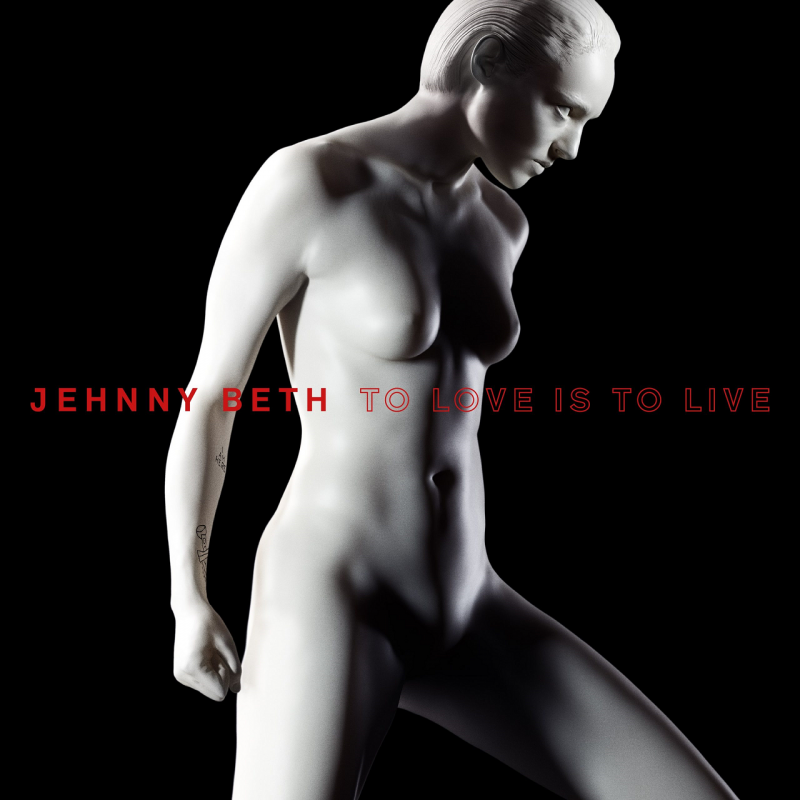
Jehnny Beth was the formidable and mysterious leader of Savages’ flinty monochrome attack, remoulding stark post-punk into gender-fluid shapes. Retiring the band after two Mercury-nominated albums, and returning to France after more than a decade of self-discovery in London, this solo debut is the product of an intense period of self-reflection, softening the carapace of her English persona to ponder innocence and rustic roots.
Beth’s friend PJ Harvey laughingly dismissed her poetry as “terrible”, and even Cillian Murphy’s spoken-word turn can’t redeem some po-faced portentousness, or a chilly air of theory familiar from French erotic provocateurs such as Catherine Breillat. Mostly, though, Beth digs deeper, building an artistic identity capable of both transgressive rampages and introspective quiet.
Ambivalence is constant, as she plays with guilt and pines for innocence. “We Will Sin Together” suggests Jean Genet-like underworld adventures beyond good and evil, but allows for simple, lusty pleasure (“All I want is your sexy eyes/Your legs parting to the skies”). “Flower” is a breathily shivering ode to an LA stripper, delicate falling leaves of guitar adding grace to its electro glide. The thrusting cyber-swagger of “I’m the Man” dives deepest into Savages territory, only to make a startling feint into Seventies boudoir balladry, like Barry White gatecrashing The Prodigy. Even cocky humour slips in, when the elusive feminine Pimpernel of “Heroine” insists: “All I want is some good use of my great body.”
Beth’s rediscovery of her schoolgirl studies in jazz piano and literary bent both pay off in “The Rooms”, an enigmatic vignette of secret erotic exchanges with a heavy, languid atmosphere of French provincial shadows. “The French Countryside” is a limpid piano ballad, wide open to romantic ecstasy and the past. While retaining steely strength this is a fuller self-portrait, warmed by flesh and blood, remembered family and love.
‘Flower’ comes from Jehnny Beth’s debut solo album ‘To Love Is To Live.’
The album will be released June 12th
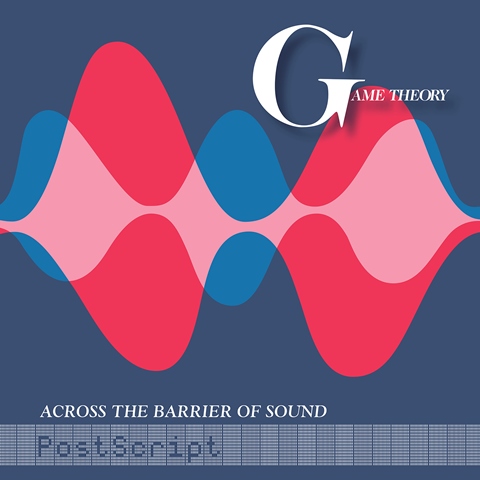
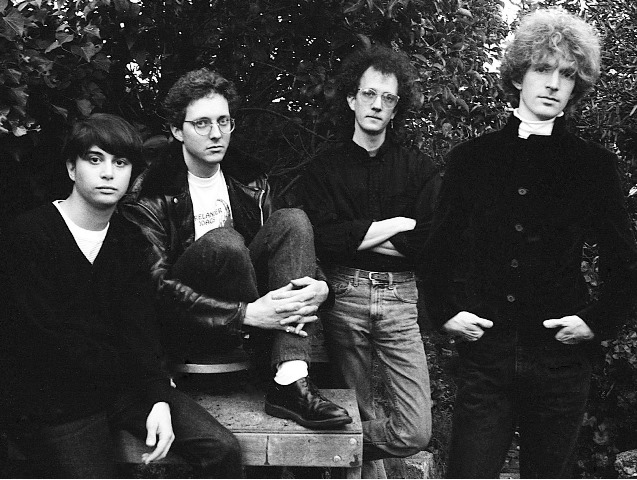
The totemic California art-popsters Game Theory, band have a new collection “Across The Barrier Of Sound: Postscript” this compilation tracks the Game Theory of 1990 and 1991: a period when mainstay Gil Ray had joined Game Theory as their drummer and backing vocalist in 1985 At this time Ray was also playing guitar and keyboards in the band. These became Game Theory’s final, under-the-radar years and, until now, have not been the subject of an official release.
Gil Ray’s passing in January 2017 means that just half of this latter-day, four-piece Game Theory is still with us. Bandleader and founder Scott Miller took his own life in 2013. The other members were recently arrived drummer Jozef Becker and bassist Michael Quercio. Becker is best known from his then-recent spell with Thin White Rope. Earlier still, he played with Miller in Alternate Learning.
Quercio, the fourth member of the Across The Barrier Of Sound line-up, joined in 1989 when his band The Three O’Clock fell apart after their patchy 1988 album Vermillion album which was issued by Prince’s Paisley Park label (Prince wrote a track for the album). Miller and Quercio had co-written “The Girl With The Guitar”, which was on the 1985 Three O’Clock album ArriveWithout Travelling. Game Theory also recorded the song. In essence, the reconfigured Game Theory of 1990 and 1991 was a form of family affair.
It came together as Miller took stock after the assured 1988 album Two Steps From The Middle Ages and around the time of the early 1990 Game Theory compilation Tinker To Evers to Chance. The collection included a few new tracks made with Becker and Quercio but then without Ray. At this point, Miller was seemingly pondering his band in a retrospective light. All the flux and shape-shifting means that the 24 tracks on Across The Barrier Of Sound: Postscript are as per the last word of the title: an add-on to what’s known. Especially so, as nothing was intended for release. It is not an unissued album.
Four of Across The Barrier Of Sound’s tracks – “Inverness”, “Idiot Son”, “My Free Ride”, and “Take me Down (to Halloo)” – are finished studio recordings. “Treat it Like my Own” was first heard on a fan club cassette (different versions of two other songs from that cassette are collected). Otherwise, the sources are home demos (mostly solo) and a couple of live tracks. This is a window into what was going on in Game Theory’s world, rather than a Game Theory release as such.
Revealingly, the sense of this as a period of flux is reinforced by Miller’s post-Game Theory band The Loud Family subsequently recording much of what’s made it onto Across The Barrier Of Sound. “Go Back To Sleep Little Susie (Aerodeliria)”, “Idiot Son”, “Inverness”, “Jimmy Still Comes Around”, “Slit my Wrists” “Some Grand Vision” and “Take me Down (Too Halloo)” are familiar in their later forms. Lyrics may have changed. Odd parts of melodies and song structures differ too. But the blur between Game Theory and The Loud Family is clear.
As an album was not the goal, everything comes across as transitional. Indeed, it is hard to see how a band with Miller as its leader could have – in the long term – accommodated Quercio, another strong, idiosyncratic singer and songwriter. A single band with both had to have had a finite shelf life.
However, some of what’s collected ranks with the best of Game Theory and The Loud Family. In contrast, despite a home-recorded version of The Three O’Clock’s “A Day in Erotica”, little nods towards Quercio’s recent past.
Of the studio-proper tracks, “My Free Ride” is brilliant: classic Scott Miller with a beautiful melody and exquisite singing. The version of “Take me Down (to Halloo)” feels tentative though – doubtless due to the familiarity of the later Loud Family version. “Inverness”, again cut later by The Loud Family, also suffers due to the same reflexive comparison. “Idiot Son”, instead, is more angular, spikier than when it was tackled by The Loud Family. A home demo of “Jimmy Still Comes Around” is a wild ride, suggesting Miller had a jagged identity in mind for the end-days Game Theory. A lovely, poised solo recording of “Some Grand Vision” could have stood on its own if buffed up with a full arrangement.
Obviously, Across The Barrier Of Sound: Postscript is not an entry point into this important band. For that, head to Real Nighttime (1985) , The Big Shot Chronicles (1986), Lolita Nation (1987) and Two Steps from the Middle Ages (1988), all of which capture the Game Theory Scott Miller in excelsis; as a pop auteur on the Todd Rundgren level.
And also, despite the songs included, Across The Barrier Of Sound: Postscript is not a lost prequel for The Loud Family. Instead, what’s compiled is a vital snapshot of transition. As to where this short-lived Game Theory could have gone if Miller and Quercio had stuck with it? No one will ever know.