Posts Tagged ‘singer songwriter’

Pete Townshend Solo Goes Digital

Pete Townshend’s solo work is almost as prodigious as his work with The Who, The 11  album releases cover “Who Came First”, his 1972 album and his first away from The Who. The album is a collection of music dedicated to Meher Baba, Townshend’s spiritual master and includes fellow Baba followers, including Ronnie Lane and Billy Nicholls.

Townshend’s first proper solo album (following two tribute albums to his spiritual adviser Meher Baba) features demos he recorded for the Who’s ‘Lifehouse’ project, which turned into 1971’s ‘Who’s Next.’ Songs from the earlier solo records — which were collaboration LPs with limited distribution — are also included. Before the various ‘Scoop’ albums and the expanded versions of Who LPs that include early sketches of songs, ‘Who Came First’ was the closest peek inside Townshend’s songwriting process.

In “Rough Mix”, he teamed up with Ronnie Lane on what is a fine record that features Eric Clapton, John Entwistle and Charlie Watts that includes material written by Townshend and Lane. Among the standout tracks is the beautiful, ‘Heart To Hang Onto.’ Co-credited to Ronnie Lane, the Small Faces bassist who earlier had worked with Townshend on the 1970 Meher Baba tribute LP ‘Happy Birthday,’ ‘Rough Mix’ started as a Lane solo album that was supposed to be produced by Townshend. They eventually found themselves in a full collaborative project that also includes help from friends . The result is more of a folk-rock record by the two vets used to more aggressive forms of rock ‘n’ roll. A curious but enjoyable detour.

Empty Glass included ‘Let My Love Open The Door’ as well as ‘Rough Boys’, ‘Empty Glass’ and ‘A Little Is Enough’Townshend was going through a lot when ‘Empty Glass’ was released in 1980: the death of Who bandmate Keith Moon, a fractured marriage, a drinking problem and the fact that punk was making groups like the Who obsolete. He pours it all out on his best solo album, the first to include all new material written specifically for a project. He confronts all of his demons here; he came out with scars and a Top 10 single with “Let My Love Open the Door.” His best work since the Who’s 1973 LP ‘Quadrophenia’ and his most personal ever.

1982’s All The Best Cowboys Have Chinese Eyes includes ‘Face Dances pt 2’ and ‘Uniforms (Corps D’Espirit)’ and a companion promotional video featuring seven of the tracks was made for the fledgling MTV Network. Between 1980’s ‘Empty Glass’ solo outing and this LP, the Who released ‘Face Dances’ and were wrapping up work on one final album (before a reunion LP nearly a quarter century later) and then mounted a farewell tour (that turned out not to be). So Townshend, working as a solo artist with few band commitments to weigh him down, made a record that indulged in his winding wordplay and his sometimes impenetrable cultural theories and criticisms. It’s every bit as heavy-handed as you would expect from a guy whose rock ‘n’ roll dissections often went over the heads of the average Who fan.

Townshend solo
For White City, Pete returned to the concept based song cycle that had utilised in The Who. The album tells the story of life on a working class council estate in Pete Townshend’s old West London stomping ground. The songs deal with lost love, racial tension and broken dreams.  this one based on a real-life London district from his childhood. He doesn’t paint a pleasant picture: brewing race wars and crushed dreams are commonplace. David Gilmour adds some bite with his guitar, but ‘White City’ doesn’t have a whole lot to say, and sorta just spins in place once it gets moving. Like many Townshend solo LPs, the music seems like an afterthought to the narrative.

The Iron Man is Pete’s version of the Ted Hughes story of the same name. Townshend’s Who bandmates Roger Daltrey and John Entwistle join him on two songs from this musical adaptation of Ted Hughes’ 1968 sci-fi novel. Released in 1989 Pete had met Hughes when he was working at the publishing house Faber and Faber. The album features contributions from music luminaries Nina Simone and John Lee Hooker (who performs as the eponymous ‘Iron Man’).

1993’s Psychoderelict is a multi-layered concept album featuring dialogue harking back to his ‘Lifehouse’ project. It’s another concept album by Townshend, ‘Psychoderelict’ centers on a washed-up rock star who returns to the spotlight after a press-grabbing controversy is cynically hatched. Like ‘Empty Glass,’ the album digs deep into Townshend’s personal life, but the story is kind of a mess — which led to a new version of the album to be released without the interlocking dialogue pieces. Characters here would resurface on the Who’s 2006 album ‘Endless Wire.’The resulting tour featured actors performing alongside the live band.

The critically acclaimed “Scoop” series of albums gives the listener a privileged peek behind the scenes of one of popular music’s greatest songwriters. The albums showcase Pete’s demos for both The Who and his solo recordings. Scoop, was released in 1983 and includes versions of Who classics such as ‘So Sad About Us’, ‘Squeeze Box’, ‘Circles’, ‘Behind Blue Eyes’ and ‘Love Reign O’er Me’. Another Scoop followed in 1987 and includes demos of ‘Pinball Wizard’, ‘Substitute’, ‘You Better You Bet’ and ‘Pictures of Lily’. Scoop 3’ surfaced in 2001 and included Pete Townshend’s initial versions of the classics ‘The Real Me’, ‘ Sea and Sand’ and ‘Eminence Front’.

In February 1985 Pete performed two charity shows at London’s Brixton Academy. The sold out shows benefitted the ‘Double O’ charity, which was formed by The Who in the 1970s. The band, performing under the banner ‘Deep End’, featured Pink Floyd guitarist David Gilmour. They performed ‘I Put A Spell On You’ and ‘Barefooting’ as well as more contemporary songs like The Beat’s ‘Save It For Later’ as well as classics such as ‘Pinball Wizard’ and ‘Behind Blue Eyes’ also make an appearance on the album, Deep End Live.
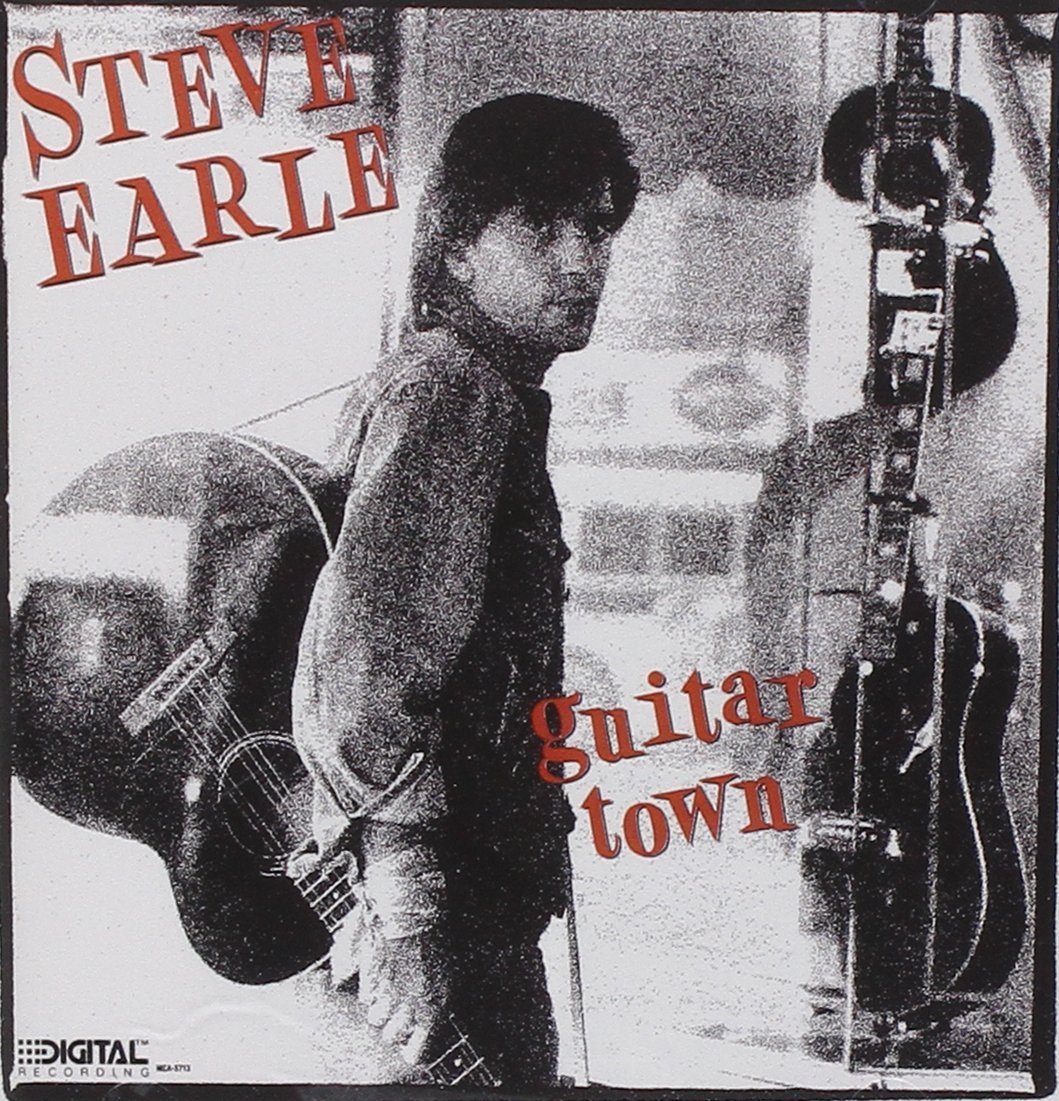
steveearle

What I appreciate about Steve Earle is that he writes about a side of humanity that I don’t live. He writes about irresponsibility, about separation by choice, about the rambles of a man who searches but never seems to find. Steve Earle’s tribulations are well known and rather unimportant to mention . With his many great albums behind him, it is important to remember Guitar Town, a terrific piece filled with a variety of styles and the kernal of all the things Earle still seems to represent.

Steve Earle seems to be always questioning why. and with Guitar Town, the questioning has never been more succinctly stated or as catchily written. Inspired by Earle’s attendence at a Bruce Springsteen concert, this singer/songwriter masterpiece lovingly exploits the conflict between the hero’s desire to stay in a small town and the need to leave. Set in 1980’s Reagan-era America and featuring Duane Eddy-style reverberated guitar lines blazing through dangerously infectious melodies, Guitar Town’s dusty, blue-collar vignettes relentlessly engage and tug at the heart strings, and Earle’s stark character development revives desperate (“Someday”) and exhuberantly hopeful (“Guitar Town”) emotions from the listener’s childhood. This ‘Dylanesque-country’ sound inadvertantly awakened a young, rock-loving, college-educated country audience yearning for the disappearing rock sounds of John Mellencamp and Bruce Springsteen. Earle set the mark on the top rung for this type of new country, and with the public expecting only the best, Nashville delivered its finest and most daring projects of the post-Hank Williams era. Easily the most groundbreaking Nashville recording since Waylon Jennings’ “Honky Tonk Heroes” sessions, Guitar Town was named one of Rolling Stone’s Top 100 Recordings of the 80’s and was praised in the rock press (Robert Cristgau’s “The Village Voice” and Dave Marsh’s “Rock and Roll Confidential”) long before receiving favorable country reviews. Guitar Town continues to exert a massive influence on songwriters 16 years after its release and is widely regarded as a cornerstone of the 1980’s “New Traditionalist” movement in Nashville. Steve Earle may never understand the full impact this recording will continue to have on future generations of songwriters. As his music continues to move towards exclusively political themes, it becomes clear he will not visit Americana territory again, but since he virtually defined the genre with this monolithic MCA debut, he can leave well enough (or, in this case, near perfect) alone.


://

Today is the 13th year anniversary of the album by Songs Ohia ‘Didn’t It Rain’

Last night WXPN in Philadelphia aired the first of it’s Folkadelphia Unsung specials focusing on Jason Molina and Songs: Ohia, specifically ‘Didn’t It Rain’, which was recorded in Philadelphia in 2002.

Listen to the whole show here: http://bit.ly/xpn_songspecial_blog
Hear covers by local Philly artists: http://bit.ly/xpnfolk_sohspecial_covers
Hear the originals on Spotify: http://bit.ly/xpnfolk_songsoriginals

PLEASE Donate to MusiCares in honor of Jason Molina:www.grammy.org/musicares/donate

JMpress_2015a

Welcome to the first chapter of Folkadelphia’s new project that we’ve gotten in the habit of calling Unsung. In the history of music, there are many unsung artists and albums that we firmly clutch close to our hearts. These artists create the kind of music that we wish other people knew more about or cared more deeply for. We wish that we could share with others our exact feelings about how we’ve been touched and affected by some musicians. We want to show them the light. We want to sing these musicians’ unsung song for everyone to hear. With this series, we hope we can provide a way for people to connect with music that has been influential beyond its commercial impact and, perhaps, appeal. It’s never too late to find a new favourite band and honor their legacy and discography.

For this first part, we focused on what has become one of my favourite albums: Songs: Ohia’s Didn’t It Rain, which was recorded in Philadelphia in 2002. I never knew Jason Molina nor did I ever see him perform live while he was alive. I came to his music pretty late in the game too, just a handful of years ago during my college radio stint, but I always knew there was something special there. He could create these staggeringly beautiful portraits, often just with his words, his voice, and an acoustic guitar. He could also blow you out of the water with these epic guitar-heavy unabashed rock-and-roll tracks. But he always had a dark, brooding, introspective thematic quality I found appealing. I always pondered on the fact that while his lyrics felt so personal and tied to Molina himself, they were universal, they spoke to me, they spoke to others. I guess that’s just the hand of a master songwriter. He certainly was that and a lot more too.

During my years at college radio with my self-imposed solitude in the stacks and the listening room, I stumbled upon most of the Songs: Ohia and Magnolia Electric Co. catalouge. The album I was drawn to, but never felt like I could deal with or easily absorb was Didn’t It Rain. It felt like it was in its own little bubble, a perfect world that I was peering in at, perhaps as if through a glass darkly at the time. Secretly Canadian, Molina’s longtime record label, recently reissued the album with bonus tracks and demos, and it was just last year I finally revisited the record. Something must have clicked. Maybe it’s my age, my position in life, my mourning for the late songwriter, or it was just that time, but I fell for Didn’t It Rain‘s charm. It’s charm is that is without charm; the album is a bare bones affair, stripped of sleekness, studio magic, and flair. It was recorded live in a room in Philadelphia with a handful of people, some strangers to each other, and committed to tape with almost no overdubs or editing. This sounds a lot like some of the straight up folk records I admire from the early years of recording technology. Didn’t It Rain ends up being a snapshot in time, a near-perfect capture of creativity firing on all cylinders. You don’t always need walls of sound to impress, sometimes you just need a simple chord and a harmony, followed by silence to make an impact.

thanks so much to Folkadelphia for all of this article please check out their wonderful and informative site

http://

Ryley Walker is the reincarnation of the true American guitar player. That’s as much a testament to his roving, rambling ways, or the fact that his Guild D-35 guitar has endured a few stints in the pawnshop. Swap out rural juke joints for rotted DIY spaces and the archetype is solidly intact. His personal life might be tumultuous and his residential status in question, but his bedrock is disciplined daily rehearsal and an inexhaustible wellspring of songcraft. The board was barely reset from the ‘All Kinds of You’ sessions before Ryley was corralling his by-then-rejiggered band back into Minbal studios in Chicago to solidify a totally new direction in his creative vision. ‘Primrose Green’ couldn’t be restrained. It begins near where ‘All Kinds of You’ leaves off but quickly pushes far afield. The title sounds pastoral and quaint, but the titular green has dark hallucinogenic qualities, as does much of the LP.

http://

Big Phony is a Seoul, Korea based singer/songwriter, originally born and raised in New York City. Off stage Big Phony is simply known to his friends and family as “Bobby.” At an early age Bobby began secretly practicing his older brother Eddy’s guitar in defiance of warnings that he would surely get his ass kicked if he so much as laid a finger on it. Because of Bobby’s dedication to and success in surpassing his brother’s skill level, mom eventually transferred ownership of that guitar over to Bobby.

Bobby’s family relocated to Los Angeles, leaving him in New York City so he could attend the legendary School of Performing Arts and Music and Art, which has produced a long list of talent including Al Pacino, Adrian Brody, and Bela Fleck. Living alone at such an early age, Big Phony devoted his time to writing in his New York City apartment.

With strong religious conviction, Big Phony left for Boston to attend a Christian college to study to be a pastor. He quickly realized that this was not the path for him and returned his focus to his music. After college, he moved to Los Angeles to be closer with his family. It was in Los Angeles where Big Phony began his pursuit to be a singer-songwriter. He quickly built a devout fan base with his songs and performances. In early 2006 he returned to New York to build that same kind of following and began splitting his time between both cities crashing on couches.  In 2011, Big Phony moved to Asia and where he currently resides in Seoul, South Korea. There he continues to write & perform, and furthermore, he is learning more about his “roots”.

Big Phony delivers honest lyrics and natural talent. There’s a fragile but controlled quality in his voice, which he attributes to thin apartment walls and easily disgruntled neighbors. Fans of Elliott Smith, Bright Eyes, and Death Cab For Cutie will instinctively gravitate towards Big Phony’s sound. His latest projects “LONG LIVE THE LIE” (electronic album) & the alternative release “BOBBY” (acoustic album) are available now.

Tobias Jesso Jr.‘s debut album Goon comes out March 17th.  Following the previously-shared tracks “How Could You Babe”, “Hollywood”“Bad Words”, he’s offered up another album cut, “Without You”, which features Danielle Haim of Haim on drums. Ariel Rechtshaid produced.  he performed “Without You” in a La Blogothèque session

Photo: Andy Ford /NME
Tobias Jesso Jr: Meet the new king of heartbreaking melody. When Los Angeles based Tobias first uploaded his demo track ‘Just A Dream’ in August 2013, we hailed it as coming from the same school as Harry Nilsson, John Lennon and Elton John. Tender, heartfelt and true, it’s safe to say that his forthcoming debut album, ‘Goon’ will become one of the year’s most acclaimed.
albums for sure , catch hime at some UK festivals this summer.

13170

Joan Shelley’s music is startling,  It startles because of its closeness, the near-instant sense of familiarity we feel when you listen to it. Her songs fill the air around you, echoing and resounding like a voice lost in the later of American and British folk revivals – some Anne Briggs maybe even a little of Linda Thompson. But none of them are “trad arr. Shelley.” Joan wrote them all. Listen to her sing and it’s evident. You’ve never heard that voice before, either. its just perfect and timeless. Electric Ursa was recorded in Louisville, Kentucky and marks Joan’s first release for No Quarter Records.

It includes collaborations with new labelmate Nathan Salsburg, as well as several other of Louisville’s fine musicians. In the eight songs that make up this record, we are seeing an artist in her stride, able to move seamlessly between darkness & light, attempting to reconcile the wild expanse of the future with the burdens of memory. And at the center of it all are songs of a nature beautiful, precise, and clear vocals , delivered to us by her singular voice.

Over the past five years, Joan Shelley has recorded several albums, toured with her band, on her own, and as a duo with Daniel Martin Moore, playing concerts for spellbound audiences all over the globe.

Upcoming shows  UK tour dates:

04 Mar | The Glad Cafe, GLASGOW ,05 Mar | The Old Fire Station, PENRITH, 06 Mar | View Two Gallery, LIVERPOOL ,07 Mar | The Lounge at Gullivers, MANCHESTER, 08 Mar | De La Warr Pavilion, BEXHILL-ON-SEA ,09 Mar | Regal Eagle Session, LONDON, 10 Mar | Rough Trade West, LONDON 6pm, 11 Mar | The Green Note, LONDON

http://

His full-length debut, ” All Kinds Of You”, came out less than a year ago, 25-year-old Ryley Walker is already returning with a follow up release titled  “Primrose Green” in April . Ryley Walker has been getting his fair share of positive attention, often focusing on his guitar playing and the unique and unpredictable forms his vocal melodies and song structures take. Despite being raised in the industrial Northern Illinois town of Rockford and cutting his teeth in Chicago’s noise-rock scene, the other constant with Walker is that people always want to compare him to ’60s and ’70s folk musicians like Nick Drake, Bert Jansch, John Martyn, and Tim Buckley. (more…)

“Love Isn’t Anybody’s Fault” is a Pop Rock song by BC Camplight that released in 2015 on “How To Die In The North

BC Camplight’s first album since 2007 sounds like he’s spent the intervening years playing mad scientist with these captive pop songs. Heir to both Brian Wilson and Harry Nilsson, this Manchester-based American presides over the piano with hangdog sweetness before taking his twinkling melodies for brash hairpin turns. Watch out for sudden flirtations with a wonky funk bass, maybe some mariachi horns and jarring guitar jags, and observe how “Grim Cinema” jumps from aw-shucks Beach Boys homage . BC Camplight spins such contradictions into pure gold: “Just because I love you doesn’t mean I love you,” goes the chorus of the lead single.


Small Houses performs “Old Habits” on Audiotree Live, February 16th, 2015.

Small Houses is a Philadelphia, PA based alt-country project featuring the songs and poems of Flint, MI native Jeremy Quentin. Artfully crafted finger-style guitar playing, and softly sung melodies describing the people, love, and homes of Quentin’s life. Jeremy Quentin, the vocalist behind Lansing’s Small Houses, sings with an earnestness that’s hard to deny… Quentin’s music is based on delicate folk melodies and his plucked six-string, with sparse acoustic arrangements that are quietly beautiful.  Small Houses, is an indie folk artist and multi-instrumentalist who charmingly captures his surroundings in verse. Spinning tales full of honesty and gentle, pretty melodies. I find myself having difficulty describing the quality of such a set. Fantastic? Inspiring? Flawless? Launching with a few solo pieces by Jeremy Quentin, his hypnotic style and furious fingerpicking show me what the Michigan music scene is really about. This is the best kind of entertainment,