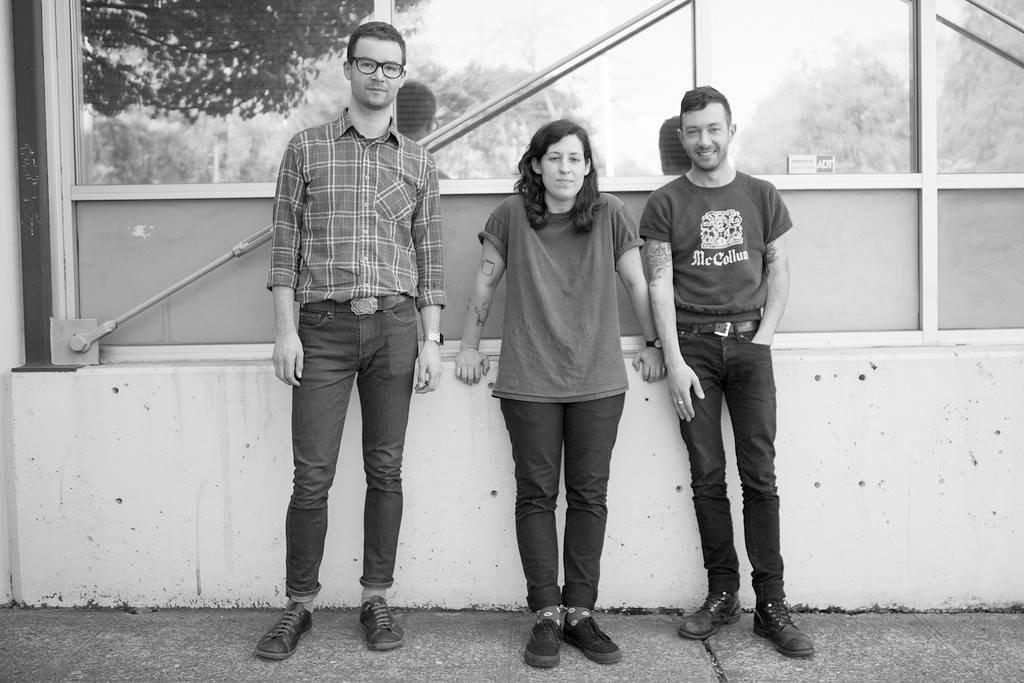
Posse’s “Kismet” as the inaugural release in their Document series! ,
Taking inspiration from the original concept behind the founding of the label’s attempt to document our home city of Omaha through music and art, each release featured in the Document series will comprise of an exclusive 7-inch record featuring unreleased music from various artists outside of the label’s roster and a specially curated zine highlighting the artist’s hometown / music scene. This Seattle indie rock band had a poet laureate, Posse would since 2010, across two previous albums, the trio chronicled the banality and disappointments of life in their Northwest city with wit and sadness and hilarity. The sound they crafted to accompany their stories were beautifully spartan; just two guitars and a drum chugging along in a haze. Check out the bands EP “Horse Blanket” it is the band’s final record having decided to call it time up. I really hope we hear somethinhg soon from its members.
“Saddle Creek started up as a way to spotlight and document what was happening in the music and art community of Omaha, NE. We know there are a lot of great music scenes all around the world that don’t have the spotlight they deserve, so with that in mind we thought creating this series would be a cool and unique way to reference our past while at the same time reaching out to bands that we aren’t currently working with and allowing them to shine a light on the art and music of their own communities. It’s our way to try to capture a band and a city in a specific place at a specific time.”
Melbourne’s The Shifters finally follow up their cassette from a couple years back with this slightly more melodic but no less urgent single. They still sound steeped in early Fall dashed with bits of psychedelia. Based in Melbourne Australia’s The Shifters have been making a really impressive noise over the last couple of years, still in their infancy but growing stronger with each gig they do, the band have grown to become one of more interesting new groups to emerge from Melbourne’s Underground in recent years.
The group’s debut 7″ Creggan Shops impressed me with its monotone sleeve and scratchy guitar punk genius.
Market Square Recordings are proud to be releasing the band’s second 7″ A Believer b/w Contrast of Form.
Both sides combine great DIY art punk of the highest calibre.
A Believerstarts proceedings with rhythmic drum work very reminiscent to Television Personalities 1988 single “How I Learned To Love The Bomb” a steady tribal beat opening way to a mesmerising chord and fender jaguar laden hook. The track also has a very Fall-esque vibe about it, with the way the organ flows through the track…. but ultimately this is The Shifters in their most snotty art-punk best, the song is poppy, its catchy and its the sound of a great new talent.
The b-side Contrast of Formis basically a trademark sound for this band, this in my opinion is some of the most perfect outsider pop happening in the world right now, the song takes us on a journey explaining the story of a weirdo artist and his ambitions to be a “real” artist and also to possibly “take flight” the song is open to interpretation, thats what’s so cool about this song.
Musically The Shifters follow in a similar course forged by their Antipodian brothers from the early 80s NZ underground scene, groups of which came out of the embryonic Flying Nun Records catalogue, bands like the Stones, The Clean and The Bats… in-fact Contrast of Form is the closest I’ve heard a recent band capture the Dunedin sound without even trying…. there must be something cool in the water down-under??
This two-sided art-punk killer 7″ by Melbourne Australia’s fantastic scratchy guitar heroes The Shifters is available now.
Anna Tivel’s songwriting crushed me with this album. She has two songs that are absolutely incredible on this album, “Dark Chandelier” and the song “Illinois.” Tivel is adding her name to a legacy of singer songwriters that includes the likes of Bonnie Raitt and Allison Krauss. She’s that good. If you think I’m exaggerating, just listen to this album. Set yourself aside an hour and listen to every song on this track. You will be a believer by halfway through the first song, trust me.
The poetic lyrics carry a ton of weight, speaking for common people. This is not the kind of music that will fly over your heard about life in fast places with fast people. This is complicated music about simple people, deeply satisfying in the truth and the grit and the mire. Tivel’s vocal tone is perfect for the kind of music she sings. She demands your attention.
Small Believer is Anna Tivel’s fourth studio album Its an amazing collection of patchwork stories drawn from conversations with strangers, on the road, in restaurants, bars, and rest stops. Produced by guitar mastermind Austin Nevins (Josh Ritter, Anais Mitchell), the songs float on a raft of electric guitar, pump organ, and sparse bass and drums. ‘Small Believer’ is spacious and honest, a lyric-driven exploration of the things that move within us. Tivel takes great care with every syllable and every story, chipping away until what remains is blindingly true and deeply affecting. This album came out late September on Fluff & Gravy Records.
In the autumn of 1967, Bob Dylan took a mysterious trip to Nashville. “As I recall, it was just on a kind of whim that Bob went down,” Robbie Robertson, who had spent much of that summer wood shedding with Dylan and the rest of the Band in upstate New York, would later say. To this day, no one knows for sure when Dylan wrote many of the 12 songs he recorded on his secretive visit. He hadn’t played a single one of them during his mythic sessions in the basement of “Big Pink” near Woodstock that year, and he reputedly composed several of the best new tunes (“The Ballad of Frankie Lee and Judas Priest,” “I Dreamed I Saw St. Augustine” and “Drifter’s Escape”) during his two-day train ride from New York to Nashville. Once there, he knocked out his eighth album in just three sessions in a local studio. “We did the whole thing in nine, nine and a half hours,” says Charlie McCoy, who returned from the Blonde on Blonde sessions to play bass on the new material. “He was focused. And he never used a lyric sheet. To memorize those lyrics, with all those double meanings, was impressive.”
Bob Dylan released his eighth LP “John Wesley Harding” on December. 27th, 1967. This record marked Dylan’s return to acoustic music and traditional roots, after three albums of electric rock music.
The album was well received by critics and enjoyed solid sales, reaching #2 on the US charts and topping the UK charts. The commercial performance was considered remarkable considering that Dylan had kept Columbia from releasing the album with much promotion or publicity. Less than three months after its release, John Wesley Harding was certified gold by the RIAA.
“All Along the Watchtower” became one of his most popular songs after it was recorded by Jimi Hendrix the following year. How long did it take for you to realize that “All Along the Watchtower” was not written by Hendrix?
John Wesley Harding came as a shock to fans, and decades later, it stands alone in Dylan’s discography – a hard pivot away from the revolutionary rock & roll masterpieces that preceded it, and equally distant from anything else he’d done or would do. Its tightly crafted country-folk songs lack traditional choruses but teem with cryptic tales and strange warnings. “There was to be no wasted language, no wasted breath,” Allen Ginsberg later said of the approach to songwriting that Dylan adopted after Blonde on Blonde. “All the imagery was to be functional rather than ornamental.” Dylan himself traced the change to his 1966 motorcycle crash: “I thought I was just gonna get up and go back to doing what I was doing before,” he recalled in 1969. “But I couldn’t do it anymore.”
Dylan began incorporating explicit religious language into his lyrics; much has been made of Beatty Zimmerman’s report around this time that her son kept “a huge Bible open on a stand in the middle of his study.” The death of Dylan’s early idol Woody Guthrie, on October 3rd, 1967, less than a month before recording began, may well have influenced songs like “I Dreamed I Saw St. Augustine” (a surreal riff on the labor-rally folk standard “Joe Hill”).
The sound of the album was bracingly austere, which Dylan later explained as a reaction to the “very indulgent” psychedelic orchestration of albums like the Beatles’ Sgt. Pepper’s Lonely Hearts Club Band. Casting aside his own ambitious arrangements on the previous year’s Blonde on Blonde, he called back only two of his sidemen from that album – McCoy on bass and Kenny Buttrey on drums – and kept his interactions with them at a bare minimum. “He didn’t talk to us, which was unusual,” McCoy says. “Just did not communicate. I think he appreciated what we were doing. It was hard to tell.”
When I Paint My Masterpiece: Don’t beat yourself up if you don’t recognize the other three men in the photo on the album’s cover. Flanking Dylan on his left and right are sibling Bengali minstrels Luxman and Purna Das, the latter of whom has performed in more than 140 countries. Behind them is a local carpenter named Charlie Joy. Legend has it that if you turn the album cover upside down, you can see an image of The Beatles in the knot of the tree. While photographer John Berg acknowledges the resemblance, he denies that the likeness was intentional.
It’s All Good: The gem of the collection, of course, remains “All Along the Watchtower,” an urgent tale that centre’s around a cryptic conversation between a joker and a thief. While fans and academics alike have tried to make sense of the song’s sparse narrative for decades, an acoustic strum, a howling harmonica, and an ominous drumbeat tell us all we need to know: that something grim — perhaps even apocalyptic — is about to go down, and the characters best get away while they still can. Jimi Hendrix would go on to transform the simple acoustic song into an expansive jam full of portent and electricity. For what it’s worth, Dylan preferred the guitar god’s version and styled his own performances of the song after Hendrix from then on.
It Ain’t Me, Babe: Near the middle of the album sits “The Ballad of Frankie Lee and Judas Priest,” a rambling morality play that sticks out among its more laconic brethren. While Dylan does offer us a moral at the story’s conclusion, most listeners will probably echo the sentiments muttered under the breath of the boy in the penultimate stanza: “Nothing is revealed.”
Blowin’ in the Wind: “Outside in the distance/ A wildcat did growl/ Two riders were approaching/ The wind began to howl” — from “All Along the Watchtower”
Closing track “I’ll Be Your Baby Tonight” offers a welcome respite after 11 tracks that make you feel like you didn’t pay enough attention in Sunday school or your Bible as literature class. The ambling send-off holds no grand mysteries, offering only the promise of a bottle and some companionship for the night. We’ll take it.
While Dylan has used “All Along the Watchtower” (Setlist.fm shows it’s his most-played song) as a thundering closer for hundreds of performances on his Never Ending Tour, other songs from John Wesley Harding, like “Drifter’s Escape” and “The Wicked Messenger,” have joined “I’ll Be Your Baby Tonight” as semi-regular inclusions between better-known fare.
John Wesley Harding found a very different Dylan returning to his first proper recording after his infamous motorcycle crash and sessions with The Band at Big Pink. More a collection of acoustic parables than anything else, the album is noted for its simple arrangements, economical lyrics, and Biblical qualities. Gone is the kinetic electricity and fountains of language gushing forth on previous releases, yet there’s something appealing to these simple, yet still mysterious, tales, especially when absorbed as a whole. While bands like The Beatles were pushing boundaries, Dylan — who insisted the record be released without publicity or a single — seemed to be in retreat. Regardless, the album climbed the charts in 1968 and has grown in esteem among both fans and critics ever since.
Happy 49th Birthday to the LP “John Wesley Harding”!!
Another great release from Courtney Barnett and I’m sure a very big deal for her being involved with Jack White. Hopefully Jack realises that it’s just as big a deal for him to work with Courtney. The A-Side is superb whilst “Shivers” is an excellent cover of a legendary Birthday Party track from right back at the start of their career and not penned by Nick Cave but Rowland S Howard.
Produced by Jack White for Third Man Records’ Blue Series The Band
Courtney Barnett – Guitar & Vocals
Bones Sloane – Bass Guitar
Dave Mudie – Drums
A. Boxing Day Blues Revisited is written by Courtney Barnett (it is not the same song as Boxing Day Blues…)
B. Shivers was written by the late Rowland S. Howard and first performed and recorded by The Boys Next Door.
The alt-pop band’s new video is a beautiful, “uncomfortable, voyeuristic experience,” the track is taken from their forthcoming New Year’s Eve EP.
Pale Waves new video for ‘My Obsession’, and drenched in gloom, it’s a shadowy visual fitting the song’s plunge into infatuation. The video shows the band’s Heather in the bath with a mannequin – as you do – and to be honest the whole thing is creepy as fuck. “I wanted to create an uncomfortable, voyeuristic experience for the viewer,” she said. “To make them feel they are intruding on a world they shouldn’t be a part of. Ultimately, it is a representation of desperation, loneliness and grief.”
They’re one of the only bands releasing new music (almost five albums to be exact this year, including Polygondwanaland, with several tracks released in the last several months). “Sketches of BrunswickEast” has already made most Top 50 best albums lists of 2017. We could be done here, but we’re not.
After singles “All Is Known,” “Beginner’s Luck” and “Greenhouse Heat Death,” the band have released “The Last Oasis.” Since we only remember things in short spurts here on the internet, “All Is Known” is every guitar riff ever used in rock ‘n’ roll, “Beginner’s Luck” is a smooth, cheeky gambling crooner, “Greenhouse Heat Death” is psych-meets-goth death inside of a greenhouse (this is literally what the song is about) and “The Last Oasis” is low-key and lovely, even upbeat at times, proving that you can lead a horse to water but you cannot make him drink the optical illusion.
As the landscape of the film industry continues to be turned on its head, the rules of independent cinema have remained consistent in one key way: Make a movie that finds eyeballs and turns a profit, and you’ll get to make another—probably, with a bigger budget. After Moonlight, Barry Jenkins has a TV series and a James Baldwin adaptation on the horizon. Sean Baker, who shot his breakout Tangerine on iPhones, is receiving near-unanimous critical acclaim for his latest film, The Florida Project. With surprise success comes the opportunity for more. Nick Ebeling’s documentary on the star and his assistant, Satya de la Manitou, titled Along for the Ride.
This EP is the first release of Bashan – the project of Gemma Thompson, guitarist of the band Savages. The tracks are formed as direct responses to the work of the painter Morris Graves – repetition, waves crashing against the cliff face, vertical drops and oncoming headwinds, sound guided by the currents.
released October 16, 2017 ,Written and recorded in Leipzig, Germany.
All music written by Bashan. Guitars performed by Gemma Thompson.
Percussion and Harmonium performed by Sam Sherry.
Ebeling infuses the documentary with flashy artistic decisions to keep the viewer engaged—utilizing black and white cinematography, reenacted scenarios, and a consistent breaking of the fourth wall—but his wisest creative choice was in employing Gemma Thompson to score the film. With her main band, Savages, Thompson hammers her guitar, creating a blend of chaos and catharsis that is one of the chief catalysts for the band’s refreshing take on punk. With Along for the Ride, however, Thompson sheds this weight significantly, adding a haunting subtlety to the film that lingers long after the final credits roll.
The Citradels are an Anti-psych Industrial Wimp rock band from Melbourne, Australia.
We hope you enjoy what we have worked hard to create. The Citradels are self-releasing their eighth album, “God Bless”. God Bless is a concept album of sorts. It abstractly explores themes of influence, religion and morality through characters from a small town gradually falling out of touch with its surrounds.
Recorded, mixed and mastered by the band from mid 2016 to early 2017, the album is a progression of the sound that the Citradels have developed since their inception five years ago. God Bless is a honing of the 60’s pop writing treated with elements ranging from doo-wop to dream pop, krautrock to country and Gregorian chant to shoegaze. The early Citradel’s sound remains but has been refined and God Bless represents a maturing of the creative concept.