Courtney Marie Andrews spent over nine months of 2017 on the road, with multiple trips across the US, Canada, Europe, Australia and New Zealand. That’s nothing new for Andrews, though. She’s been touring relentlessly since leaving her Arizona hometown at 16. It’s a life that inspired much of her 2016 breakthrough album, Honest Life. While that album’s themes spoke to the isolation and rootlessness inherent in a life on the road, most of its songs were actually written during an intentional, extended break. The success that followed its release, however, didn’t afford her the same break to write the material for her new album.
Courtney Marie Andrews performing live in the KEXP studio. Recorded September 7th, 2016.
Songs: How Quickly Your Heart Mends, Irene, Table For One, Rookie Dreaming,
James Mercer gives a country-ish story song the Shins treatment, complete bubbling sound effects and a big entrance by a skating rink organ. The sound is comfy and relaxed, but the sweet storytelling is the star. Mercer recounts the details of his musical awakening as an Air Force brat – bonding with the cool kids over shoes, concerts and a tape by the Jesus and Mary Chain.
An American indie rock band with roots in Suffolk has released a tribute to Mildenhall as its latest single.
The Shins latest release, Mildenhall, reflects on leader singer James Mercer’s time living at RAF Mildenhall as a teenager. The musician moved to the airbase aged 15, after his dad was stationed there. The lyrics say: “At 15 we had to leave the States again, dad was stationed at an RAF station they called Mildenhall.
“Black moss on a busted wall, the cobblestones made it hard to skate I thought my flattop was so new wave, Until it melted away in the Suffolk rain. Well god damn, you miss the USA.”
The song, featured on the band’s Heartworms album, talks about watching bands down the corn exchange and his sister’s time at the local tanning salon. “I wonder where my sister was that night, back at home under the tanning bed lights, “I can still see the glow, strange rays from her window each night, as I was skating home.
“Started messing with my dad’s guitar, taught me some chords just to start me off, “Whittling away on those rainy days “And that’s how we get to where we are now.”
Using guitars, vocals and sparse electronic elements, Prism Tats pulls from various visual and musical inspirations to create waking dream sub-realities that devastate and elate. Prism Tats is the musical moniker of Garett van derSpek, who’s originally from South Africa but now based in LA. He released his self-titled debut album in 2016, followed by last year’s 11:11 EP, and he’s notably opened shows for such indie vets as Guided by Voices and Nada Surf. He’s now set to release a new full-length, Mamba, on March 2 via ANTI-Records, which was produced by Chris Woodhouse, who’s worked with Thee Oh Sees, Ty Segall, The Intelligence, and others.
Like the other bands Woodhouse works with, Prism Tats channels classic garage rock with a knack for pop hooks and a bit of psychedelia. You can hear that for yourself on Mamba‘s lead single “Daggers,”
The new album ‘Mamba’ comes out 03.02.18 via ANTI- Records.
The death of a loved one is an inevitable aspect of life for everyone, but we’re never quite prepared for it. Whether it’s unforeseen or expected, it’s always a shock that can send us reeling when it happens. Ellen Kempner, the Boston-based songwriter and guitarist of Palehound, understands this firsthand. In relatively close succession last year, Kempner experienced the sudden death of one of her close friends and, later, the decline and passing of her grandmother. “I have been pretty lucky my whole life up until now to have not lost anybody significant to me,” Kempner tells NPR. “It’s always been one of my biggest fears: losing family or a friend … Honestly, the only way I could think to make sense of it was to write songs about them, for them, and about myself in the midst of it all.”
On A Place I’ll Always Go, the forthcoming follow-up album to Palehound’s superb 2015 debut, Dry Food, Kempner documents this tragic period of her life in revealing detail, channeling her grief into compassionate and relatable songs that mull over love, mortality and the lingering ache felt with their absence. She also grapples with the overwhelming, sometimes at-odds floods of emotions and guilt that arise when attempting to get back to everyday life — which can often feel insignificant in the aftermath of loss, but is crucial to healing.
The results can be heard on the new album’s galvanizing first single, “Flowing Over,” which both captures Palehound’s trademark sound — scrappy and buzzy guitar rock, bolstered by Kempner’s dexterous riffs — and, thanks to the band (which now features drummer Jesse Weiss and bassist Larz Brogan), also offers some darker, nuanced shades that evoke the album’s themes.On “Flowing Over,” Kempner is as direct and personal as ever. “And I know your words are sugar but now’s not the best time for me / I’ve got teeth with roots down to my feet,” she sings before careening into the cathartic chorus, “Flowing over ’til I’m empty!”
Kempner says she wrote “Flowing Over” as “kind of a callout to myself to get my act together. I have really bad chronic anxiety and always find myself doing things that perpetuate it, like listening to a sad song when I’m already super down. It’s a masochistic habit I have of psyching myself up so intensely that I explode and then spend the rest of the day feeling helplessly exhausted.” And while Kempner describes listening to sad songs in order to feel better, “Flowing Over” feels like the type of song people might turn to in their own tough moments.
When coupled with a fantastic music video, “Flowing Over” takes on a different meaning. Featuring the Boston League Of Women Wrestlers (or BLOWW), the video, directed by Jay Buim, depicts a group of women and non-binary wrestlers preparing for a match: They suit up into wild, colorful costumes and evocative makeup; assemble their DIY ring; and do some stretches. And then it all erupts into an all-out, action-packed melee — full of flips, chokeholds and pummeling faces into mats. While the ferocious, fun exuberance matches Palehound’s heavy power chords and gnarly hooks, the video also infuses the song with a message of inclusion and empowerment.
In a statement to NPR, Kempner reflects on the video’s origins:
The first time I saw BLOWW perform, their energy was so intoxicating that I couldn’t get them out of my mind for days. Watching other women/non-binary people exert so much of their time and energy into their passion, I immediately felt inspired to step up my game.
“Flowing Over” is taken from Palehound’s album, A Place I’ll Always Go, out June 16th, 2017.
“Bare Trees” is the sixth studio album by British-American rock band Fleetwood Mac, released in March 1972. This is their last album to feature guitarist Danny Kirwan, who was fired during the album’s supporting tour.
One of the most intriguing is: what if Danny Kirwan had stayed with them after the release of 1972’s “Bare Trees?” The group’s sixth album saw the guitarist – just 21 years old at the time of its release – cementing his position as the central creative force behind Fleetwood Mac, writing five of the album’s nine songs (not counting the final, spoken-word track) and putting his musical stamp on the rest of the group’s contributions.
And yet Kirwan was fired during the August 1972 US tour the group undertook to promote the record. His increasingly difficult behaviour had come to a head when an argument with fellow guitarist Bob Welch about tunings led to violence and a dressing-room demolition. Still, Bare Trees is an underappreciated gem in the early Fleetwood Mac catalogue, emphasising what a talent Kirwan was as well as giving listeners notice of the emerging songwriting prowess of Welch and Christine McVie.
To showcase “Bare Trees”, Fleetwood Mac went on tour with Savoy Brown and Long John Baldry during the Spring and Summer of ’72. The tour, billed as “The British are Coming” turned out to be a traumatic affair. On the road, Kirwan “just got more and more intense,” Fleetwood said. “He wouldn’t talk to anyone. He was going inside himself which we put down to an emotional problem that we had no idea about. We thought he was just being awkward. I had no idea he was struggling to that level.”
At one pivotal gig, Kirwan and Welch fought over tuning, to the point where the troubled guitarist refused to go on-stage. “That’s the cardinal thing you just don’t do,” Fleetwood said. “In essence, he had a breakdown.” Kirwan smashed his guitar, then let the band struggle through their performance without him. Afterwards, he launched into a critique of their playing. “It was the straw that broke the camel’s back,” said Fleetwood. “That particular pain and story needed to stop.” the guitarist’s volatile temperament meant that, despite their musical chemistry, he began to clash with Green, as he told Guitar magazine in 1997: “We just didn’t get on too well basically… We played some good stuff together, we played well together, but we didn’t get on.” Green left Fleetwood Mac in May 1970, leaving Kirwan and guitarist Jeremy Spencer stepping in to fill his formidable shoes on Kiln House. But they looked to be on the verge of collapse until keyboard player Christine McVie joined them on tour, providing the musical glue that would hold them together.
In the years before Fleetwood Mac became a household name, the British/American band spotlighted a succession of blues-inspired guitar aces, and on “Bare Trees”, that slot is held down by Danny Kirwan. “It’s a well-rounded album,” noted drummer Mick Fleetwood of the 1972 Reprise set. “Like Lindsey [Buckingham], Danny had the chops with layering techniques, and the ability to know what’s right and wrong in the studio.” Kirwan also penned half of the 10 songs here, including the terrific “Dust,” His “Sunny Side of Heaven” was an instrumental, which, at the time, was mixed in with some radio station sign-offs. “Danny’s Chant” features the use of wah-wah guitars, while the lyrics for Kirwan’s composition “Dust” were taken from a poem by Rupert Brooke.”Trinity”, another Kirwan song, was an outtake from the album that was subsequently released in 1992 on the 25 Years – The Chain box set.
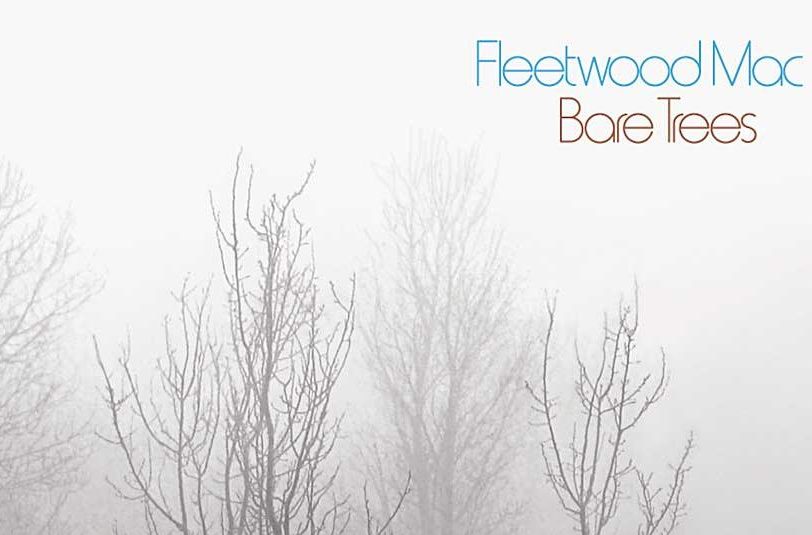
It’s astonishing that Bare Trees – recorded in just a few days at De Lane Lea Studios in Soho, London, in March 1972 – not only holds up so well, but suggests an unrealised future in which Kirwan became Fleetwood Mac’s long-term leader. The cover art of spindly trees cloaked in fog might have prepared the listener for an austere, wintry listen, but any such ideas are quickly rebuked by the good-time boogie rock of the opener, Kirwan’s Child Of Mine, given extra heft by some winningly gritty guitar work.
The two Welch-penned songs, the slow-burning, jazzy groove of The Ghost and the schmaltz-heavy Sentimental Lady, suggest a leap forward in the guitarist’s songwriting prowess (though the latter comes on strong, it works well in the context of the album). Meanwhile, McVie’s two numbers, the road-weary blues-rocker Homeward Bound (“I want to sit at home in my rocking chair/I don’t want to travel the world”) and the soft-rock bliss of Spare Me A Little Of Your Love, give notice of the writer she’d become.
Bare Trees is the sound of a band coming together, growing in confidence and establishing an identity. It’s also worth celebrating on its own merits.
Christine McVie and fellow guitarist BobWelch also contribute winners in “Spare Me a Little of Your Love” and “Sentimental Lady,” respectively. If you have any interest in exploring the music of the Mac before the Buckingham-Nicks era, make Bare Trees your first stop.
At their best, the Flaming Lips are like sci-fi/fantasy authors who create new worlds as an attempt to make sense of our own. The sad and shimmering ballad “The Castle” is an incredible example of this, as Wayne Coyne builds a fairy tale in order to understand his friend’s suicide, with a ruined castle representing her unique spark of humanity that’s gone forever. “Her love is still buried there, in the ruins of the castle,” he warbles in mournful realization. The band have released a music video for ‘The Castle’, marking the first new music from The Flaming Lips since their ‘Dead Petz’ collaboration with Miley Cyrus.
Frontman Wayne Coyne described ‘Oczy Mlody’ as sounding like “Syd Barrett meets A$AP Rocky and they get trapped in a fairy tale from the future.”
Official Music Video for “The Castle” From The Flaming Lips. Listen to the new album ‘Oczy Mlody’ . The Flaming Lips released a series of videos explaining the album, with Coyne describing the meaning behind the album’s Polish language title and the songs ‘Nigdy Nie (Never No’ and ‘Almost Home (Blisko Domu).’
“At first it appealed to us because it appeared to sound like a drug; it reminded us of oxycodone,” Coyne said. “And then I think this initial appeal made us curious about what it could mean, and I believe when we looked it up, the very first thing we saw was that it meant ‘eyes of the young’… We wouldn’t like the title ‘Eyes of the Young,’ but we liked how these other jumbled words could mean that.”
Mike McLeod booked studio time at Manny’s Estudio International in East Los Angeles. Far less glamorous in reality than it all may sound says Mike. Joining the Shifting Sands for the sessions was guest guitarist StevenSchayer – a then LA-based musician with NZ connections, having played in The Chills during the early 90’s US-based “Soft Bomb” album era. Steven brought a different flavour to complement the independent DIY No. 8 wire approach of The Shifting Sands.
Manny Nieto also brought a different flavour to the table, producing the tracks. Manny has worked with SteveAlbini and has recorded bands like the Breeders and Los Lobos.
Whereas previous albums had been layered in fuzzy guitars and synthesizers, this session involved less layers, but more harmonic breadth within the layers. Tom added bass tracks on an 8 string bass, Mike adding a bass 6 – a guitar tuned down one octave.
While there are less layers of harmonic distortion – a characteristic component of the Shifting Sands sound – there is still a lot of harmonic complexity, just realised in a different way to the approach the Shifting Sands took on their first two LPs. These songs reflect a special moment in time, in the sweltering heat of Los Angeles, while the band were far from their busy normal lives and able to spend time purely focused on making music, in a vastly different environment to their home town of Dunedin,
“Run” is one side of a new 7″ single from The Shifting Sands due for release late in January 2018.
Working again with Dave Fridmann, the veterans push their minimalism to the max. The guys in Spoon build walls of gauzy synthesizers or drizzling Middle Eastern sounds, then tear them back down – going to work with scalpels of guitar, pop gun drums and frontman Britt Daniel’s sandpaper sneer of a voice. The boys have it both ways on ‘Hot Thoughts,’ making their band sound bigger and stranger (the restless programming of “WhisperI’lllistentohearit,” the saxophone exhalation of “Us”) while remaining committed to their aesthetic of sharp separation. Midnight grooves meet sharp songwriting on yet another strong outing from one of the most consistently great bands around.
Britt Daniel has said that “Tear it Down” wasn’t written as a political song, but a tune about tearing down walls (made of “bricks and ill intentions”) couldn’t help but capture elements of the moment. But this organ-spiked head-nodder is more than just that, as it intertwines a doomsday scenario and alternate reality with a na-na-na bridge and Spoon’s typically sharp, percussive persistence. Britt Daniel has said that “Tear it Down” wasn’t written as a political song, but a tune about tearing down walls (made of “bricks and ill intentions”) couldn’t help but capture elements of the moment. But this organ-spiked head-nodder is more than just that, as it intertwines a doomsday scenario and alternate reality with a na-na-na bridge and Spoon’s typically sharp, percussive persistence.
Nine albums in, Spoon might have finally cracked the code. Hot Thoughts succeeds first and foremost as a disarmingly subtle way of taking a meaningful evolutionary step as a band. Even a quick listen reveals that the Austin vets have taken their sonic palette to its most adventurous conclusion. It’s not the first time they’ve been willing to bathe their sound in synthesizers or other electronic treatments (witness “New York Kiss,” or “Was It You”), but it’s the first time they’ve let some of the elegant sonic spaces truly overtake the record. In many ways Hot Thoughts feels like a tribute to David Bowie, who personified the elusive bridge between the conflicting pop, punk, art and party impulses that the Gen-Xers have always struggled to find. It is crisp, arch and flowing, proving Spoon to be among Bowie’s most astute heirs in spirit.