Patrick Doyle was a founding member of the London band Veronica Falls, who released their self-titled debut album back in 2011. That record was followed in 2013 by ‘Waiting For Something to Happen’, the band’s last studio LP to date. Patrick has been involved in some wonderful guitar based Indie pop .
As well as Veronica Falls, Doyle also made solo music under the monikers Boys Forever and Basic Plumbing. He also played with the likes of Sexy Kids and The Royal We.
Tributes have poured in for the Veronica Falls drummer and solo musician Patrick Doyle, who has died at the age of 32. News of Doyle’s death broke overnight on social media, with a heavy flow of tributes pouring in for the musician from his peers and fans. The Boys Forever Facebook account confirmed Doyle’s passing in a post this afternoon (March 4),
Doyle’s Veronica Falls bandmate Marion Herbain led the tributes to the drummer, writing on Instagram that the tragic news hadn’t “fully sunk in yet”.
“I’m glad I got to spend some of the best years of my life by your side, as a bandmate and a friend. RIP, P. dogg.”
Sad news to confirm the death of Patrick Doyle. He was 32. Patrick was Veronica Falls’ drummer, and made solo music as Boys Forever/Basic Plumbing. His family are immensely proud of all he achieved.
Released on 5th August 2016 via new label Amour Foo, Boys Forever’s self-titled album is a tumultuous collection of splintering pop songs, underpinned by acid tongued lyrics and shivering vitriol, written and performed in its entirety by Doyle.
Having been a member of various bands for over a decade, Boys Forever is Doyle’s first solo project. Though born from disillusionment and despair and the insecurities of a brand new start, the resulting album is paradoxically sparky, gorgeous, swooning garage-pop, a perfect balance of bitter and sweet, happy and sad. Recorded by Andrew Schubert (together PANGEA, Wand, No Parents) at Golden Beat studios Los Angeles, the record captures the LA sun, while retaining the melancholic onslaught of the London winter in which it was written.
The ‘Voice In My Head’ video is a snapshot of Patrick’s visits to Los Angeles. He says: “Having recorded the album during overnight sessions the year before, I felt that when I returned to Los Angeles in March I wanted to see more of the city. My friend Mat picked me up and we drove around all day, trying to visit as many typically LA places as we could. We went to the Observatory, Hollywood High and Santa Monica Pier. Mat cut the footage together with some that I shot during recording sessions last year at Golden Beat in Glassell Park.
Wolf Alice have just finished up an Australian tour on the back of second album ‘Visions Of A Life’, and have now shared a new video for ‘Sadboy’.
But the four-piece seem to be getting in the spirit of Haloween in the new clip: it sees the band head to an extremely house party, and sees Ellie Rowsell getting into an extreme spot of bother.
Wolf Alice are set to play a host of summer festivals this year, including Reading & Leeds, Latitude, TRNSMT and more. They’re also set to support Foo Fighters on a handful of stadium dates.
“Sadboy” Wolf Alice Visions Of A Life. Available now
Mike Campbell was born in Panama City, Florida. He grew up there and in Jacksonville, Florida, where he graduated from High School in 1968. At 16, he bought his first guitar, a cheap Harmony model, from a pawnshop. His first electric guitar was a $60 Guyatone. Like Tom Petty, Campbell drew his strongest influences from The Byrds and Bob Dylan, with additional inspiration coming from guitarists such as Scotty Moore, Luther Perkins, George Harrison, Carl Wilson, Jerry Garcia, Roger McGuinn, Keith Richards, Brian Jones, Jimmy Page, Mick Taylor, and Neil Young. The first song he learned to play was “Baby Let Me Follow You Down,” a song which appeared on Dylan’s eponymous debut album.
Mudcrutch moved to L.A. and signed a record deal with Shelter Records, recording an album in 1974 that ended up being shelved. Campbell then joined Petty to start up the original Tom Petty and the Heartbreakers in 1975 along with Benmont Tench (keyboards), Ron Blair (bass guitar) and Stan Lynch (drums).
He formed a band named Dead or Alive which quickly disbanded. Campbell first met Tom Petty through Mudcrutch drummer Randall Marsh when they were auditioning him and he suggested his friend Mike to play rhythm guitar.
Like the other players in the Heartbreakers, Campbell avoids the virtuoso approach to playing, preferring to have his work serve the needs of each song. Guitar World magazine noted “there are only a handful of guitarists who can claim to have never wasted a note. Mike Campbell is certainly one of them”. He is a highly melodic player, often using two or three-strings-at-a-time leads instead of the more conventional one-at-a-time approach. “People have told me that my playing sounds like bagpipes,” he muses. “I’m not exactly sure what that means.” His estimation of his own style is typically modest: “I don’t think people can really top Jimi Hendrix and Eric Clapton as far as lead guitar goes. I like my playing to bring out the songs.” Like Tench, he is heavily involved in constructing the arrangements for the Heartbreakers’ tunes. And also like Tench, he prefers rawness to polish in the studio and onstage.
Directed by Justin Kreutzmann, this 15 chapter web documentary features Mike Campbell taking us on a tour of his guitar collection and explaining the stories and significance behind the instruments as they relate to his own personal journey and the music of Tom Petty and The Heartbreakers.
0:01 “Chapter 1: Introduction – Treasured Gifts That Keep Giving” 7:50 “Chapter 2: A Sound Is Born On The 1964 Fender Stratocaster” 13:32 “Chapter 3: The Irreplaceable Fender Broadcaster Part 1” 18:46 “Chapter 4: The Irreplaceable Fender Broadcaster Part 2” 23:47 “Chapter 5: Thicker and Dirtier – The Gibson Goldtop” 29:18 “Chapter 6: Chimes of Freedom The Rickenbacker Sound – Part 1” 34:40 “Chapter 7: Chimes of Freedom The Rickenbacker Sound – Part 2” 40:14 “Chapter 8: In Between Bright and Heavy That Gretsch Tone” 46:33 “Chapter 9: A Whole Studio On Your Guitar Vox” 51:03 “Chapter 10: Biting Clear and Loud The Gibson Les Paul Jr. and SG” 57:23 “Chapter 11: Begging To Be Played The 1959 Gibson Les Paul” 1:04:37 “Chapter 12: The Surf Sound of The Fender Jaguar/The Mike Campbell Duesenbeg and the Super Bowl” 1:10:32 “Chapter 13: Handle With Care: (Another) Invaluable 1964 Fender Stratocaster” 1:16:39 “Chapter 14: The Homestead and Studio” 1:23:37 “Chapter 15: Assorted Specialties and Conclusion”
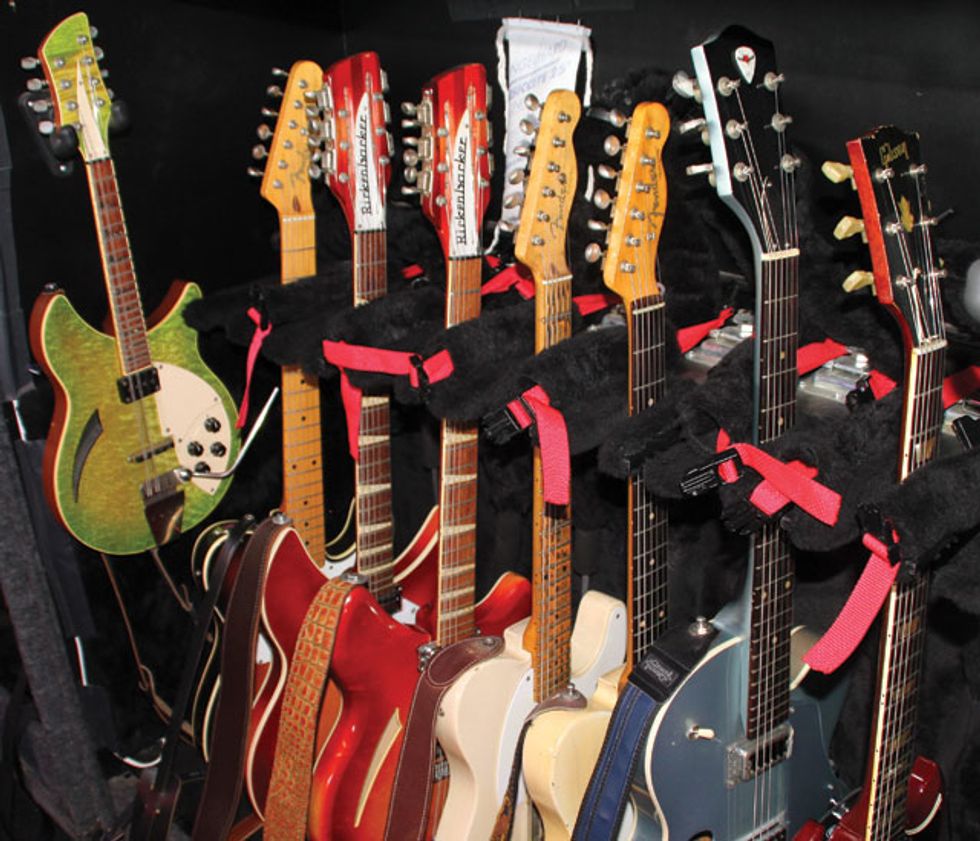
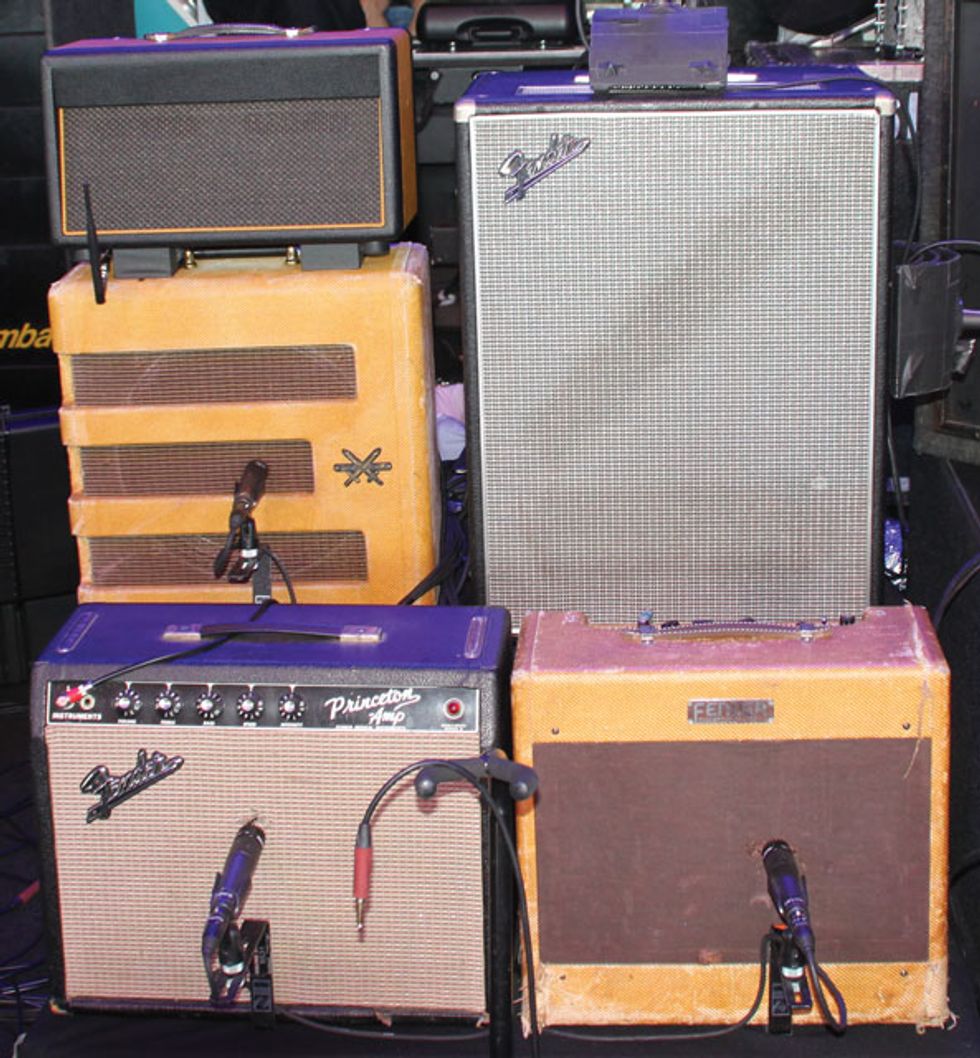
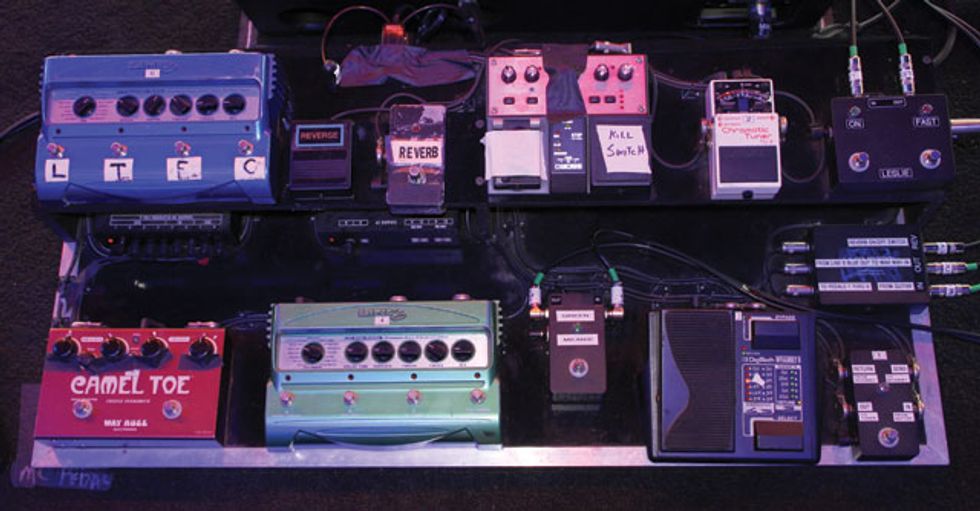
Mike Campbell’s drool-inducing lineup of vintage guitars and amps he brings on the road. Campbell’s guitar tech, Steve Winstead, walks us through every guitar, amp, and pedal and lets us in on Campbell’s time-tested formula for great tone.
Guitars
One side of Campbell’s guitar arsenal covers all the bases. From the left side we have “Little Ricky,” which is a Rickenbacker-style mandolin with a whammy bar. Next is a recent Fender Custom Shop Tele with a B-Bender used as a backup, then a pair of Rickenbacker 12-strings—the one on the right is used on “Free Fallin’.” A pair of ‘50s Teles follows those as well as a Gretsch 6186 Clipper tuned to open-G for “I Won’t Back Down.” Finally, there’s a mid-’60s Gibson SG that Campbell’s been favoring for this tour after recently digging it out of storage.
The basic formula for Campbell’s amp rig is to crank up some low-watt amps and let the PA do all the heavy lifting. The bulk of his sound comes from a 1963 Fender Princeton and a 1954 Fender tweed Deluxe. He augments that with a custom Fender Excelsior and a Fender Vibrotane for Leslie-type effects.
Effects Campbell relies on a rare Dunlop Camel Toe for his distortion, a Line 6 DL-4, the Green Meanie switch (which brings his Fender Excelsior amp in and out), a DigiTech Whammy II, Line 6 MM-4, a custom switch for his 1962 reissue Fender reverb tank, a Boss RC-30, and a Boss TU-2 tuner.
Singer-songwriter Savannah Conley has released her sophomore EP, titled “Twenty-Twenty.” Savannah Conley is a singer-songwriter based out of Nashville, TN. Her music has been classified as “organic pop”. It has a quirky, edgy feel to it, but also utilizes instruments such as upright bass and ukulele.
The new batch of songs from the Nashville native was produced by Dave Cobb and is being released on his label Low Country Sound. “She really reminds me of a southern Mazzy Star and I was blown away with her lyrics,” Cobb said of the young artist.
The Electric Prunes came together in Southern California during 1966 and soon became regarded as one of the seminal US psychedelic groups, thanks to the hit singles ‘I Had Too Much (To Dream Last Night)’ and ‘Get Me To The World On Time’.
Through their various incarnations, the Prunes recorded five albums for the Reprise label between 1967 and 1969 with legendary producer Dave Hassinger helping to create their unique and distinctive psychedelic sound.
Under the direction of composer and arranger David Axelrod, the Prunes helped pioneer the Religious Rock genre with the “Mass In F Minor” and “Release Of An Oath” LPs. This collection brings together their entire output for the very first time, including stereo and mono versions of their first three albums.
As the opening track on the compilation NUGGETS, “I Had Too Much To Dream (Last Night)” introduced many to garage rock; a few years before that seminal compilation, it helped introduce The Electric Prunes as the title track to their debut album The title is a pun on having “too much (alcohol) to drink”: its lyrics describe how the singer has woken from dreaming about an ex-lover. The 1967 Reprise collection also included the Seattle-to-Los Angeles transplants’ other Top 40 hit, “Get Me To The World On Time,” along with material by pro songwriters Annette Tucker and Nancy Mantz that showed the quintet were game for ballads (“Onie”) and novelties (“Tunerville Trolley”) as well as tough rockers. A half-century on, I Had Too Much To Dream (Last Night) still remains electrifying to this day.
At the time, the Electric Prunes comprised singer James Lowe, lead guitarist Ken Williams, rhythm guitarist James “Weasel” Spagnola, bassist Mark Tulin, and drummer Preston Ritter. The oscillating, reversed guitar which opens the song originated from the rehearsals at Leon Russell’s house, where Williams recorded with a 1958 Gibson Les Paul guitar with a Bigsby vibrato unit. According to Lowe,
“We were recording on a four-track, and just flipping the tape over and re-recording when we got to the end. Dave cued up a tape and didn’t hit ‘record,’ and the playback in the studio was way up: ear-shattering vibrating jet guitar. Ken had been shaking his Bigsby wiggle stick with some fuzztone and tremolo at the end of the tape. Forward it was cool. Backward it was amazing. I ran into the control room and said, ‘What was that?’ They didn’t have the monitors on so they hadn’t heard it.
“Dazed and Confused” is a song written by American singer-songwriter Jake Holmes in 1967, It was described as “a stark, spooky folk-rock track with stinging reverbed lead guitar, Holmes‘ own pained vocals, and furiously strummed rhythm guitar that winds itself into an anguished climax. Holmes recorded the song for his debut album “The Above Ground Sound” of Jake Holmes and he performed it in the late 1960s and early 1970s on the New York City folk scene and the college coffee house circuit. The lyrics refer to the effects of a girl’s indecision on ending a relationship. This version from Live Supershow 1969 .
In August 1967, Holmes opened for the Yardbirds at a Greenwich Village gig in New York. According to Holmes, “That was the infamous moment of my life when ‘Dazed and Confused’ fell into the loving arms and hands of Jimmy Page.” When the track appeared on Led Zeppelin’s eponymous debut album in 1969, Holmes was aware of it at the time, but didn’t follow up on it: “In the early 1980s, I did write them a letter and I said basically: ‘I understand it’s a collaborative effort, but I think you should give me credit at least and some remuneration.’ But they never contacted me.
After hearing Holmes perform the song in 1967, English rock group the Yardbirds reworked it with a new arrangement. It became a centerpiece of the group’s tours in 1968, several recordings of which have been released. “Dazed and Confused” was further adapted later that year by Yardbirds guitarist Jimmy Page’s “New Yardbirds” group (soon to be rechristened Led Zeppelin) for their debut album, Led Zeppelin. “Dazed and Confused” became a concert staple with solos that sometimes stretched the performances to 45 minutes.
When the Yardbirds disbanded in 1968, Page planned to record the song in the studio with the successor group he had assembled that summer. According to Zeppelin bassist John Paul Jones, the first time he heard the song was at the band’s first rehearsal session at Gerrard Street in London, in 1968: “Jimmy played us the riffs at the first rehearsal and said, ‘This is a number I want us to do’.” The future Led Zeppelin recorded their version in October 1968 at Olympic Studios, London, and the song was included on their debut album Led Zeppelin (1969). “Dazed and Confused” was the second song recorded at the Olympic sessions.
Page recorded the song in one take with a Telecaster and violin bow as he had performed it with the Yardbirds. Singer Robert Plant wrote a new set of bluesier lyrics, according to Page, though Plant is not credited on the album. Other sources say Page wrote the new lyrics himself. Whichever the case may be, Plant’s vocal is raw and powerful, delivered with “unrelenting passion.”Other than the lyrics and vocal, the song remained very similar to that performed by the Yardbirds earlier that year.
This bolt of lightning likewise illuminates the already thick and portentous soundscape further setting a tone for the impending sonic onslaught. John Bonham (drums) sneaks in with a rock solid downbeat beneath Plant’s opening line. During the bridge [Bonham] explodes front and centre with his trademark blend of keen rhythmic gymnastics and straight-ahead swinging percussive support. The band collectively combust throughout the remainder of the cut as they alternate between scintillating and scorching.”
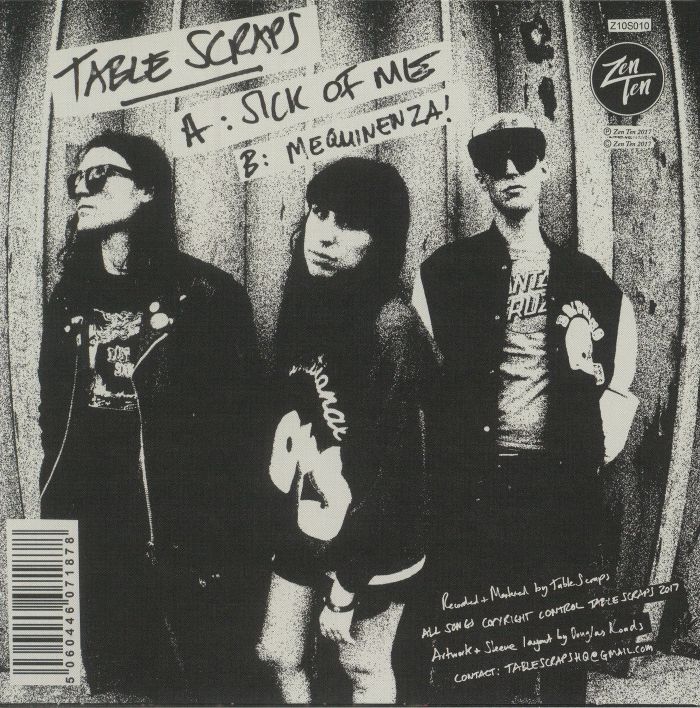
Based on the strength of their first offering and the way they’ve carefully and credibly building their already strong fan foundations on the DIY circuit, Birmingham trio Table Scraps might not be hoovering up the crumbs from the feasts of others for too much longer.
As an outfit, they leave the distinct impression that they know exactly what they want and aren’t going to settle for anything less, even at this early juncture. Everything about them – from the aesthetics of the band, to their music videos and their self-produced output – feels considered and on-point. Their sludge-imbued garage punk undoubtedly owes a debt of gratitude to the likes of The Cramps and Turbonegro, but picks and chooses its influences carefully and smartly across a span of decades from the rock’n’roll history books.
There’s a culture around this trip of a record that’s hard to deny, one that’s steeped in the US traditions of Dinosaur Jr and the MTV explosion, but also borrows heavily from the UK garage rock scene of the Sixties and throws a dash of hometown heroes Sabbath into the mix for good measure. All this is of course a long-winded way of saying that Table Scraps ooze cool from every greasy pore of their video-store-stalking, leather-jacket-clad malcontent bodies.
‘Sick of Me’ is the first single from the new LP ‘Autonomy’ – Released Feb 23rd on Zen Ten.
At this point, some 47 years after Jimi Hendrix’s death, it’s probably unrealistic to expect that a set of deep-vault studio tracks can expand the guitarist’s legacy in any meaningful way. This no doubt dismays the Hendrix obsessives, who pine for the long-whispered-about radical experiments they believe Hendrix squirreled away in some Electric Ladyland broom closet. Both Sides of the Sky is the third and purportedly final instalment in a trilogy of albums (starting with 2010’s Valleys of Neptune and 2013’s People, Hell & Angels dedicated to highlighting Jimi’s creative development throughout the last two years of what was an incredibly short albeit spectacular career.
For the rest of us, the arrival of any sort of Hendrix material, especially if it’s captured in the studio, is a chance to be awed, all over again and in surprising ways, by this human’s freakish powers of musical persuasion. No rock figure before or since could breathe fire like Hendrix does, on his beloved well-known albums and on the assortment that is Both Sides Of The Sky. Even when he’s playing the well-worn heard-it-a-zillion-times blues like the opening track “Mannish Boy.” Even when he’s dropping an over-the-top theatrical solo on his original “Hear My Train A-Comin'” that alternately celebrates and shatters blues tropes.
Both Sides of the Skycomes out March 9th via Experience Hendrix LLC.
Both Sides Of The Sky culls music from sessions Hendrix began in 1968 as the follow-up to Electric Ladyland – but never completed as a cogent single album. Though its track list includes a tune with original Jimi HendrixExperience members Mitch Mitchell and Noel Redding, the bulk of the set features the lineup that became Band of Gypsies – bassist Billy Cox and drummer Buddy Miles. Given the high-elevation stratospheres the second great Hendrix trio visited later on, it’s interesting to hear the group attend to rhythm in more foundational ways – check out the way they lock into and maintain the blazing breakneck pace of “Stepping Stone.” The steady backing allows Hendrix to tear into the massive contorted fistfuls of notes that define his solo.
Starting with “Mannish Boy,” a bluesy funky rocker that finds Hendrix exploring his inner Muddy Waters, the cut is also the first known recording he made with Buddy Miles (drums) and Billy Cox (Bass) in April 1969, several months before the trio officially named themselves the Band of Gypsys. “Lover Man,” also recorded with Cox and Miles in December 1969, is another up-tempo tune Jimi had been tinkering with since 1967’s Are You Experienced but never quite managed to perfect to his satisfaction.
Hendrix was open to all kinds of ideas during this period, and some of the most interesting moments involve studio visitors. Stephen Stills sings and plays on two tracks (his original “$20 Fine” and a new Joni Mitchell tune called “Woodstock,” which features Hendrix on bass). Johnny Winter appears as a Hendrix jousting partner on “Things I Used To Do,” and a figure from Hendrix‘ pre-stardom days, the singer and saxophonist Lonnie Youngblood, steps in for “Georgia Blues.”
He lets rip on a scorching “Hear My Train A Comin’,” backed by Mitch Mitchell (drums) and Noel Redding (bass), followed by a country-tinged rendition of “Stepping Stone,” the last single released during his lifetime.
On other tracks Jimi burns the midnight amp via “Jungle,” a previously unreleased instrumental, along with an embryonic take of “Sweet Angel” (recorded in January 1968), a song inspired by a dream Jimi had of his late mother, and continued to work on until his death.
Fans of Crosby, Stills & Nash may be fascinated to hear a nascent reading of Joni Mitchell’s “Woodstock,” with Stephen Stills singing and Hendrix filling in the role on bass. On other tracks Jimi branches out, exploring new musical territory on the medium-tempo ballad “Send My Love To Linda,”
All these performances – along with the searching guitar/sitar/drums instrumental “Cherokee Mist” that closes the album – overflow with the single salient trait that made Hendrix unstoppable: his spirit. No matter what he’s playing, whether it’s a workman’s blues or some high-concept improvisation, he conveys, just through the way he sings and the way he shapes the notes, that what he’s doing matters. And will not be stopped. There’s always something deep and existential on the line, and it is that emotional intensity – not the songs, not the flashy solo playing – that defines every Hendrix encounter. This one just doesn’t disappoint.
Beginning in the late 1960s, Pete Townshend was on the forefront of the development of home studios. In a world before ProTools and GarageBand, the idea of having a recording studio in your own home was quite extraordinary, but Townshend took to it immediately and started producing amazingly rich demo recordings on which he sang and played every instrument (including drums and bass). For tracks that later found their way onto TheWho albums, these demos provided a template for the other members of the Who to flesh out with their individual parts, adding their own flourishes and touches. It’s incredible, however, how fully Townshend had already worked out the arrangements of these future Who classics. In many respects he’d figured everything out ahead of time, and it was just up to the Who to lay it down in a professional studio, bringing to it the animal electricity that only the Who could.
The first album for which Townshend did extensive home demoing was 1969’s Tommy, a perfect example of his arranging genius, as his home recording maps out the song pretty much exactly in line with the Who version that would sweep the world by storm: He heard in these demos exactly what we hear today—that Keith Moon’s manic drumming, John Entwhistle’s muscular bass, and Roger Daltrey’s guttural vocal fury launch these songs to a whole other level.
Of TommyPete Townshend said, ” Until we made TOMMY we had largely been our own bosses. Suddenly all that changed – for the first time in our lives we were really successful, really taken over by the audience, and we had to do as we were told. America, the great consumer nation told us, ” There are 50 million kids over here that want to see you perform. What are you going to do about it – stay in Twickenham and work on your next album, or come on over here and perform ? ” So we went on over and got involved in the standing ovations and the interviews, the 19 page Rolling Stone article, the presentations of the gold albums, all that. It took two years to work on anything new. ”
Out of the work from Tommy, I don’t recall this song ever being released. I extended Keith’s opening drum lines and the song, as well. I only know of two other takes that exist, but by far — I love this one the best.