The original band of the Animals, broke up in 1966 and this band was entirely new except for lead singer Eric Burdonand drummer Barry Jenkins, who joined the original lineup when John Steel left in February 1966. With the new band, featuring guitarist Vic Briggs, bassist Danny McCulloch and electric violinist John Weider, Burdon began to move from the gritty blues sound of the original mid-1960s group into psychedelic music.

The album is the first to feature nearly entirely original material, written by Eric Burdon and band members, and involving equal songwriting credit. This practice would continue with the following album, The Twain Shall Meet,

The album opens with the sound of waves washing over the title track, “Winds of Change”. “Poem by the Sea” is a spoken-word piece by Burdon with a swirl of echo-drenched instruments. “Good Times” and “San Franciscan Nights”

Burdon dedicated the album to George Harrison of the Beatles, whose espousal of Hindu philosophy following a visit to India the previous year Burdon cited as an inspiration. Burdon was also a fan and friend of Jimi Hendrix and wrote the fifth track as an answer song to Hendrix’s “Are You Experienced” Burdon was so inspired by Jimi Hendrix’s music that he wrote one of the psychedelic era’s rare “answer” songs, “Yes I Am Experienced,” as an homage to the guitarist; the latter’s influence could also be heard in “It’s All Meat,” the LP’s closing track,

Winds of Change was the band’s first real psychedelic rock album. They praised the closing track “It’s All Meat” and the hard rocking cover of the Rolling Stones “Paint It, Black” as rare examples of psychedelic rock songs by the Animals that are strong and convincing one of the group’s handful of memorable covers from this period, “Paint It Black” — driven by John Weider’s electric violin and Vic Briggs’ guitar, and featuring an extended vocal improvisation by Burdon, their approach to the song was good enough to make it part of the group’s set at the Monterey International Pop Festival that June, and also to get a spot in the documentary movie that followed.

“The Black Plague” opens with a Gregorian chant structure that recalls “Still I’m Sad” by the Yardbirds, and was another vehicle for Burdon’s surreal spoken contributions.

“Hotel Hell”, is an obscure but very fine (and quite moody) track on Eric &The New Animals’ first album, “Winds Of Change” The album was released in 1967, which peaked at a halfway point on the US charts. With a brand new band of New Animals, “Winds Of Change” introduced a “kinder and gentler” Eric, ready to take up the cause of peace and flower power on “warm San Franciscan Nights”…and all that… It was a surprise to many, and the LP was termed a “psychedelic album” (a sign of the times, of course). It was quite experimental really, with a variety of styles and song types, some working exceptionally, some not as well. “Hotel Hell” works great – it is an understated bluesy ballad, recounting a singer’s lonely life on the road .”and I’m so very far…. from my home…” I recall reading that Eric wrote the song, inspired (or perhaps depressed) by his stay in a Northern Californian Central Valley town when touring back in those days – and no, he wasn’t “stuck in Lodi again…” It was somewhere else. “Hotel Hell” is perhaps the best track on the album, with Eric’s voice and phrasing perfectly on target for the subject matter. It ain’t the original Animals….but it is “Something Else”, in more ways than one. And how about that horn in the background! Whoever is playing it was not credited, but what a great touch, giving the song kind of a Spanish feel as well. Great performance! Excellent song!

The Animals :

  • Eric Burdon – vocals 
  • Vic Briggs – guitar, piano, arrangements 
  • John Weider – guitar, violin 
  • Danny McCulloch – bass 
  • Barry Jenkins – drums 
Additional Personnel
  • Keith Olsen – “stepped in on some tracks to deputise on bass after Danny McCulloch broke his wrist

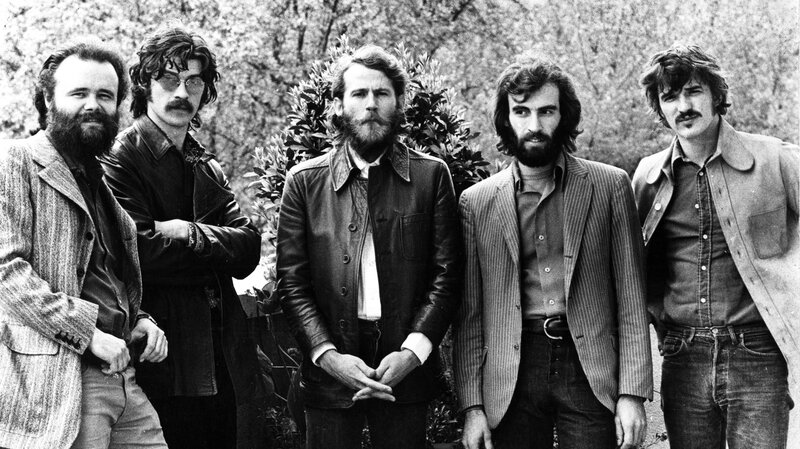
In the midst of the country’s turbulence in 1968, five musicians later named simply The Band hunkered down in a salmon-colored house in upstate New York to craft Music From Big Pink, an album that brought the rural folk Americana sound to popular music and to the classic album canon.

Before finding their footing with this debut album, Levon Helm, Robbie Robertson, Rick Danko, Garth Hudson and Richard Manuel played as backing musicians for Ronnie Hawkins and Bob Dylan. After the 1966 Dylan tour, the group hunkered down in the Big Pink house in West Saugerties, N.Y.

You likely know the rest of the story. To mark the 50th anniversary of its release, Music From Big Pink is getting a reissue worthy of one of the greatest albums ever recorded. On August. 31st, the record will receive a new stereo mix on CD and digital, with five outtakes, alternative recordings and an unreleased a cappella version of “I Shall Be Released.” including the new stereo mix of the album’s historic single “The Weight” .

The Band will also release a double-LP vinyl box set of the album, which includes the CD, digital access and a high-res surround mix on Blu-Ray. It also includes a reproduction of the 7-inch single “The Weight” b/w “I Shall Be Released,” and a hardback book with an essay by music journalist David Fricke and photos by Elliott Landy.

The box set of Music from Big Pink’s reissue includes two LPs, CD, Blu-Ray, 7-inch vinyl and a hardback book. And yes, there are limited-edition versions with pink vinyl.

This beautifully packaged 50th-anniversary box set offers a brighter, sharper mix than past reissues, so you can really hear the lust in “Chest Fever,” the sorrow in “Long Black Veil” and the half-past-dead blues in “The Weight.” There’s also an insightful essay by Rolling Stone‘s David Fricke, and a new a cappellaedit of “I Shall Be Released” that shines a lovely spotlight on Richard Manuel’s falling-angel falsetto. If you love the Band, it’s mostly nothing you haven’t heard a couple thousand times before, but little else is needed. A half-century later, the brotherhood of Robbie Robertson, Levon Helm, Rick Danko, Manuel and Garth Hudson still makes you want to join the party. Listen to “Tears of Rage” and you’re right there in the dream: Someone’s delivering a darkly significant monologue (“We carried you in our arms/On Independence Day…”) while your hosts offer you a drink and a seat by the fire. How could you not accept, if only to find out what happens next?

In his 1993 memoir, titled This Wheel’s On Fire, the dearly departed Levon Helm wrote, “We wanted Music From Big Pinkto sound like nothing anyone else was doing. This was our music, honed in isolation from the radio and contemporary trends.”

Although the album was not immediately popular on its release, Music From Big Pink is now widely recognized as one of the most influential albums of all time. July 1st marks Music From Big Pink’s 50th anniversary.

[cover art]

This was a film that covered Bob Dylan on his 1966 European tour backed up by the Hawks that eventually became The Band minus, Levon Helm. The film was to be shown on ABC television but ABC rejected and saying it was “incomprehensible” because Dylan himself was one of the editors and wanted the film to have more of an artistic feel.  It was shot under Dylan’s direction by D. A. Pennebaker, whose groundbreaking documentary Dont Look Back chronicled Dylan’s tour the previous year 1965 British tour.

It was filmed by D.A. Pennebaker who filmed Dylan’s 65′ European tour when he played acoustically called Don’t Look Back. Don’t Look Back is terrific. This film is very disjointed. This is the Dylan period that probably is my favorite. The Hawks are raw and powerful and Dylan was

There are some highlights to this odd film. A spontaneous piano duet with Dylan and Johnny Cash, John Lennon and Bob Dylan very high riding around in a cab, and the famous concert footage from the  infamous Manchester Free Trade Hall concert, wherein an audience  member yells out “Judas” because of Dylan’s conversion to electric music. After the Judas remark, he proceeds to tell Robbie Robertson to play it loud and they kick off in a vicious “Like a Rolling Stone.” My favorite live version of that song. Those folk music fans were harsh.

The film is disjointed and frustrating to watch because some of the songs you want to see and hear are there…but only partly. You will be seeing Dylan performing something and then flash away to something else. Some of the concert footage and film from this ended up in the Martin Scorsese movie No Direction Home…I would recommend No Direction Home to be seen by everyone. Other scenes include Dylan and Robbie Robertson in hotel rooms writing and working through new songs, most of which remain unreleased and unpublished. Among these songs are “I Can’t Leave Her Behind”, which was later covered by Stephen Malkmus for the I’m Not There soundtrack.

Bob was pale and nervous and there is no secret he was doing drugs heavily through this movie. After the tour, Dylan had his motorcycle wreck heard around the world and after he recovered he didn’t tour for years.

The cab ride with John Lennon is historical now. Both of them in sunglasses and Lennon trying to inject humor into the situation and Dylan is ok at first and then starts getting sick as the filming stops. As Dylan shows signs of fatigue, Lennon urges him to get a grip on himself: “Do you suffer from sore eyes, groovy forehead, or curly hair? Take Zimdawn!…Come, come, boy, it’s only a film. Pull yourself together.”

Lennon would later recall in an interview with Rolling Stone that he and Dylan who were “both in shades, and both on fucking junk, and all these freaks around us.

If you are a Dylan fan it’s worth a watch. I’m glad we have “No Direction Home” to see some clear film segments on that tour. Eat The Document has not been officially released but you can get a bootleg of it or watch most of it on youtube.

 Thanks to PowerPop… An Eclectic Collection of Pop Culture

Image may contain: 1 person, standing

Over the span of their first five albums, the Roadside Graves were quintessential, New Jersey roots-rock storytellers, with songs full of empathetic third-person narratives. On their fifth album, and first for the esteemed Don Giovanni label, they are ready to tell their own. At its best, Acne/Ears unassumingly places itself within reach of New Jersey’s A-list of confessional indie rockers.

http://

It’s as unflattering as you’d expect from a song called “Acne/Ears”, two facial features that seem to exist for the sole purpose of causing adolescent embarrassment. “Some boys are filled with piss and vinegar/ Some boys are filled with just pus and blood,” John Gleason sings, recalling the days when his breakouts were so profuse, he didn’t even bother going to school. It’s similar to Strand of Oaks’ breakthrough single “Goshen ’97”, in which a sullen teen finds relief by singing terribly in the mirror even when he could hardly bear to look at himself.

John Gleason’s creaking vocals about a lonesome kid holed up in his bedroom. There is a larger scope here, as if that kid finds a suburbia full of other holed-up kids, but it’s when they get together, when they are just “boys in basements making noise” that the song erupts into rollicking, full-band joy. We see much of the louder joy and frustration of this record rise out of solitary quiet. On string-laden “Endangered”, Gleason calls for help because he’s in danger “just like the fish in the sea.” On Acne/Ears, trouble isn’t really a change in the program but more like the same come down. Sometimes, on the heartbreaking loss of “The Whole Night”, it’s too much to bear. Other times, on “Gospel Radio” for instance, it’s the music that makes it all bearable, that can turn pain and closed bedroom doors into wide open spaces of sound, into release. Like the suburbs these songs sound born from, Acne/Ears sprawls outward, in a few small moments almost too far, but in the end the record keeps its shape while offering surprising turns throughout. For Roadside Graves, it’s not about escaping the pain, it’s about making something bigger than it.

girlsnames

On their fourth album, Northern Ireland’s Girls Names plunge themselves down into a dark, dark place. It’s not as immediate as previous efforts, but I think I like this new one more than anything they’ve done so far. It brings to mind the moody “difficult” post punk the Sound’s All Fall Down and Comsat Angels’ Sleep No More.

‘Karoline’, the latest song to be taken from our new album Stains on Silence, out 15th June on Tough Love Records

Our latest album on Lolipop/Burger—’Psychsploitation Today’—has had a great run, garnering a lot of attention & rad vibes. You may have heard that there were videos being made for all 10 album tracks…not only is that true, but we’ve also made a 35-minute movie featuring all of the tracks. Carve out some popcorn time for ‘Psychsploitation Today: The Video Album’

The Prefab Messiahs are back with a new installment of wiggy Garage-Pop-Psych scheming. Their fourth full-length release ‘Psychsploitation Today’ comes to you via Lolipop Records, with Burger Records .

These 10 self-produced songs represent a unique kaleidoscopic voyage through today’s cultural zeitgeist — taking on everything from 21st century media “Psychsploitation” to explosive ruminations about the “Last Day On Earth.” 

The Prefabs’ front Xerox Feinberg, a self-described “Lost Generation Wanna-be Spokesperson,” calls the album “a mental and sonic continuation of the things we were obsessed about from the beginning — mashing up the sounds and attitudes of ’60s garage-psychedelia with post-punk ’80s stuff and dragging all that into whatever ‘today’ is — while generally trying to poke people in the ribs and skewer some of the Big Shams behind all the Shiny Facades. We’re still trying to toss everything into the mix including the kitchen sink. We’re still bemused and shocked and disgusted with The State of Things — and also in love with the noises in our heads. The Prefab Messiahs’ work is never done.”

Released January 26, 2018

The Prefab Messiahs music with a 60’s influenced rock laden in lots of harmonies and layered vocals. Animation suits the music well and would especially appeal to collage kids–underground stuff, with much subtle, hidden commentary about life and its struggles without being heavy. Could watch it again and again and each time see something funny and new in the content.

Image may contain: 1 person, close-up

Hilang Child is the project of London singer-songwriter Ed Riman. You may have heard him last year on the debut album from Lost Horizons, the new project from Cocteau Twins’ Simon Raymonde, whose Bella Union label is putting out Hilang Child’s upcoming album Years. Riman is sharing a video for the album’s new single “Crow.”

The track is characterized by a U2 dramatic, boundless crashes, but Riman’s voice evokes the gracefully hollow harmonics of Robin Pecknold and Fleet Foxes. Its lyrics move with a bright and earnest determination, and the video feels appropriately meditative.

Riman spoke of the new single:

“Crow” is the most hopeful song on this album. I wanted to write something that sonically created the feeling of glimpsing at a brighter future; a release of euphoric energy in anticipation of better times incoming. I went for a more ‘live’ and visceral approach rather than the measured/layered songwriting that features on the rest of the album, as I always knew it was going to form the album’s crashing climax despite being one of the earliest songs I wrote for it.

“Crow” is taken from the debut album by Hilang Child.

Lay Llamas essentially is Italy’s Nicola Giunta creating multi-textured psychedelic rock. On Thuban he has a few guest to help him out including Goat and Clinic, but this is his show of rhythmic dalliances into north Africa, Thailand and the Beta Band’s Edinburgh.

Dwelling in the night sky of the Northern hemisphere, Thuban (named after the Arabic for ‘snake’ also known as Alpha Draconis, and sometimes as the ‘dragon’s tail’) was the star closest to the North pole from the fourth to the second millennium BC. Yet in a migration that perhaps allows us to consider our own insignificance in the realm of the cosmos, its never-ending trajectory will mean that it will once again become the polar star by 20346AD. It’s a star system powered by mystical significance enough for both Matt Groening to include it in Futurama and for David Icke to consider it the homeland of the shapeshifting reptiles that he maintains secretly control Earth. For Nicola Giunta of Lay Llamas however, this mysterious point in the night sky offers pause for thought. “A polar star is something that drives the travellers towards a safe place. But in the age we’re living now it seems hard to recognise a polar star. Do we have to wait for that? How many times? Do we have to look in another direction?”

Nonetheless, the personal journey Giunta has embarked on in the four years since Lay Llamas’ Rocket Recordings debut Østro has been characterised as much by forward motion as cosmic drift. A number of smaller releases on labels such as Backwards, 4 Zero and ArteTetra followed, as the live band that notably supported Goat at London’s Roundhouse and effortlessly managed a psychic demolition job of considerable force at Liverpool International Festival of Psychedelia was replaced by a different constellation of musicians. Yet following the departure of vocalist Gioele Valenti, Thuban is very much Nicola’s brainchild, involving as many of twelve different musicians yet with him writing lyrics, singing, producing, mixing and recording at his home, whilst utilising new instruments from marimba to sax to kalimba to pilot this craft to dimensions unknown. The result has been a step beyond the kraut-damaged psychedelic mantras of Østro into a realm seemingly without boundaries, one in which a pan-global fascination with rhythmic hypnosis and an unquenchable experimental zeal manifests hermetically-aligned revelations aplenty.

It’s as much a voyage of discovery for himself as the listener, as he reveals, both stylistically and creatively. “Everything around us is transforming, always! You know, I’m not a proper songwriter, I consider myself a sound crafter. An experimental alchemist of sounds and visions. And sometimes I start with an idea and finish with something really different” True to form, Thuban maps out terrain where collaborators including members of Clinic (on the sax-assisted ritualistic darkness of ‘Cults And Rites From The Black Cliff’) and Goat (on the jubilant tropicalia serenade ‘Altair’) can contribute to the air of earthy vibrancy and fertile exploration. Moreover, Mark Stewart of The Pop Group’s spoken-word contributions to the searing ‘Fight Fire With Fire’ (styled by Nicola as ‘dystopian afrobeat’) steers the album to new pinnacles of intensity informed by science fiction yet with explicitly political force. For all the outward exploration of its sonics, and even considering the excursions through inner space that they resemble, this is an album with its feet firmly on the ground in the here and now.

http://

“I was born and grew up in Sicily, but now I live in the north part of Italy” says Nicola. “That extremely south part of the Europe represents the main gate for a lot of people that coming from Africa, Asia and the Middle-East. A real cultural melting process is on the way. And there’s not any kind of fascist law that can stop this. Thuban talks about ancient sea travels, ancient cultures, ancient rites, but also about today’s travellers, travellers from all ages. Travellers that are still looking for their Thuban, for their polar star to reach a safe place to live with their family.”

Released June 15th, 2018

mapc

Math & Physics Club have been known to cover an REM song, I remember them doing an excellent version of Shaking Through from Murmur, so it not surprising to hear them dropping REM references throughout the new album Lived Here Before. Don’t worry, if you are a fan of their subtle understated pop, they haven’t gone all End of the World as We Know it. They have this great ability to subtly incorporate influences without them overpowering their own of delicate pop.

Upon the release of 2018’s Lived Here Before, it’s been five years since the last Math and Physics Club album, but all the hallmarks of their sound remain intact. The required amount of guitar jangle, sweet indie pop melody, tender and true lyrics, and Charles Bert’s wistfully sincere singing are all on display, and the band delivers a few songs that stand with its best work. The gently rumbling “Threadbare,” the warm-hearted “Broadcasting Waves,” and the insistent “All the Mains Are Down” are all first-rate examples of the best kind of indie pop, when the music, words, and voices work together to wrap the listener in the audio equivalent of a long, strong hug. The record is more than just a few great songs, though. Like on their last album, Our Hearts Beat Out Loud, the band continues to expand its sound, becoming more muscular than ever and stretching the songwriting a bit.

Tracks like the circular “The Pull of the Tides” and the almost C&W “Take a Number” wouldn’t have appeared on an early MAPC album, and Lived Here Before is enriched by their presence. The rest of the record has a fuller, more dynamic sound than the previous album too, and when the songs rock, like on “Past and in Between,” they have some real punch. The ballads like “Dear Madeline” also have a real echoing beauty that the band has previously hinted at but can fully realize now. Credit the production by indie rock veteran Chris Hanzsek for the improved sound, the band for the expansive arrangements, and Bert for coming up with MAPC’s strongest set of songs to date. Put it all together and it’s the best record the band has done and some really fine indie pop that shows the long-running style has some life left in it yet.

Band Members
Charles Bert (vocals, rhythm guitar)
Ethan Jones (bass, keys, etc)
James Werle (guitar)
Kevin Emerson (drums)

Image may contain: 2 people, people smiling

Image may contain: one or more people and text

Pure Comedy brought the universe into his musical world, grand-scaling both Tillman’s cleverness and an earnest love for humanity, On God’s Favorite Customer, he sounds all by himself wracked with self-doubt, on the verge (perhaps at the apex) of hopelessness. He’s his comically dark self during hazy nightmare “Mr. Tillman,” mind fractured and teetering at the edge of bender doom in a hallucinogenic hotel. “Hangout At The Gallows” is positively, dreamily dour, and “The Palace” is nearly cripplingly lonesome. There’s little to adorn most of these songs lyrically economical, sonically without much pageantry—but the intimacy and honesty results in some of Tillman’s most stunning songwriting. On the aching “Just Dumb Enough To Try,” he forces a death grip on hope for the victory of love and self-betterment, against all odds, and “The Songwriter” deftly examines the destruction that can be inherent when your partner is your muse.

“Please Don’t Die” rolls easy with an understated twang, howling harmonica, and twinkling piano, combining some of Tillman’s best moves heart-baring vulnerability, swirling melodies, and just a touch of the surreal—to convey that familiar feeling of when we just can’t stand to lose someone.

Father John Misty is a contentious character. His last album, Pure Comedy, He ruthlessly bashed most aspects of human nature for over an hour, upping the ante of cynicism found on his two previous albums. But on June’s God’s Favorite Customer, Joshua Tillman turns his ever-critical gaze inward to write an album full of both touching self-reflective ballads and ironic psychedelic pop singles. These songs return to themes Tillman has previously tackled: battling alcoholism, his dedication to his wife and general critiques of humanity, but in a way that seems more hopeful or, perhaps, more trivialized. This slight positivity is amplified in a sonic change:

He turns from the safe, Randy Newman-styled of piano-lead singer-songwriter tunes to embody elements of vintage psychedelic pop and flex his vocal range. “Date Night” and “Mr. Tillman” are both short, funny songs perfectly poised to become radio hits. Ballads “The Songwriter” and “The Palace” sound more like traditional Misty, but are more sad than purely cynical. It seems Tillman has gotten over his hatred of everyone and everything, and given us an album with songs that both put us in our feels and deserve to be belted out in angst.

Father John Misty has announced he’ll be coming to Leicester’s De Montfort Hall and The Forum, Bath (Official) later this year as part of his 2018 World Tour! see dates on the top header.