The new wave of British heavy metal was just revving up. And it was during that transitional period when many of Europe’s most promising rock bands of the day were gaining notoriety Likee Jethro Tull, the Uriah Heeps, the DeepPurps, the Thin Lizzys and the like. It also was during that time when a fledgling progressive band from London began making its presence known on the international scene. And it was 45 years ago this month (May 1974), when UFO released one of its quintessential studio sets.
Produced by Leo Lyons, bassist for the legendary British band, Ten Years After, “Phenomenon” was the third record from UFO. Featuring founding members, vocalist Phil Mogg, bassist Pete Way and drummer Andy Parker, it marked the band’s debut for Chrysalis Records — the label that would release most of the iconic UFO catalog. “Phenomenon” also was noteworthy for being the first UFO LP to feature then-relatively unknown 19-year-old guitar ace, Michael Schenker sandwiched between his two stints with the Scorpions.
One of the most beautiful aspects of music, particularly rock music back in that day was that it was a time when music artists were afforded the freedom to be just that — artists. And although UFO would become known largely as a high-energy European metal band, Phenomenon represents a creative effort free of boundaries — a genuinely gorgeous piece of art painted with very broad brushstrokes.
Phil Mogg’s vocals were honest and pure, from start to finish. Parker’s efficient, dry-sounding drum work added a certain oomph to the record’s organic feel. And Schenker and Way’s raw guitar and bass contributions were simply magical. Yet, despite the authentic classic rock sound and the heart-stopping performances, what made Phenomenon truly special was the songs themselves — most of which were penned by Mogg and Schenker.
The ten-song slab kicks off nicely with the driving early BÖC-flavored, “Too Young to Know.” While not exactly reflective of the band’s future hard rock blueprint, the melodic, acoustic-based tunes, “Crystal Light” and “Time on My Hands” are both bona fide stand-outs.
Serving up several slices of less-tasted treats, including the down and dirty, Humble Pie-style remake of the Willie Dixon classic, “Built for Comfort,” Phenomenon also is arguably best known for its two signature staples, the arena-sized, hard rockin classics “Doctor Doctor” and “Rock Bottom.”
Props are also owed to Schenker for his masterful job of pinning blistering lead work to melodic acoustic riffs on “Space Child,” as well as for his emotion-filled, biting work on “Queen of the Deep”— the record-closing epic that showcases Mogg’s most passionate performance.
In sum, while UFO has produced more than 20 celebrated studio records during its impressive 50-year career, Phenomenon just might remain the band’s strongest work to date — a compelling collection that’s well worth revisiting, or discovering for the very first time.
Fifty years ago this summer, more than 400,000 fans convened at Max Yasgur’s farm for a music festival that would come to define not only the era, but the entire ethos of music festivals to come. With every passing decade, the magic of Woodstock has been celebrated and, indeed, re-marketed to new generations of music fans. The ’90s saw two new Woodstock-branded festivals and an array of 25th anniversary products, including a compilation called Woodstock Diary and a 4-CD box set. To mark the festival’s 40th anniversary in 2009, yet another box was compiled, this time with six discs. Along the way, labels released standalone collections of individual artists’ performances and the festival became a brand unto itself. Here we are, half a century on, and Rhino has released a new, chronologically sequenced 10-CD collection called Woodstock – Back To the Garden: The 50th Anniversary Experience. When news broke of yet another collection, the usual questions arose: “How much Woodstock is too much Woodstock?” “What could this box bring that the others didn’t?” Well, the answer is simple.
With better technology, new research, and a team of curators and audio wizards dedicated to presenting the festival as it was, Back To the Garden is the most comprehensive view yet of the iconic festival. Previous anniversary collections had left out artists entirely (in many cases due to a tangled web of rights restrictions), effectively erasing them from public perception of the festival. That issue is rectified here, as every artist who took the stage that weekend is present somewhere on the 10-CD, 162-track, 13-hour-long set. (And for those with deeper pockets, the entire weekend will be released on the mammoth 38-CD/1-Blu-ray “Definitive Archive” version on August 9th.) Compilation producers Andy Zax and Steve Woolard and their team of audio specialists have also made wise sonic decisions that remain more faithful to what’s really on the tapes than any Woodstock collection has before. In short, Back To the Garden brings listeners closer than ever before to being there at Yasgur’s Farm – minus the mud, the tent, and the traffic!
See, despite all the Woodstock-branded releases we’ve seen in the past fifty years, the general perception of the event is mostly based on the mythology that followed the concerts, shaped by the editing choices of director Michael Wadleigh’s documentary film crew and the often head-scratching audio decisions made for the original Woodstock soundtracks and other tie-in albums (to say nothing of the erroneous accounts that performers would tell in interviews for decades to come). While some box sets have attempted to set the record straight, a number of issues have remained, until now.
The original Woodstock soundtracks on Cotillion – Woodstock in 1970 and Woodstock Two in 1971 – sold in droves. Each sought to rekindle the feeling of being at the event, but tape research issues, faulty recording practices, and questionable curatorial decisions meant that the collections weren’t all they were cracked up to be. Fake applause was flown in, tracks were edited and overdubbed, and the compilers even used recordings that weren’t from Woodstock! Ravi Shankar also released what was purported to be a live album from the festival but – that’s right – they were all studio recordings dubbed over with canned applause and sold to an unsuspecting public.
As Woodstock’s anniversaries were celebrated over the years, and historians and compilation producers sought to present a more accurate view of the historic weekend, listeners have been treated to better collections. But the four-disc, 25th anniversary box set still relied heavily on Frankenstein’d creations, overdubbed additions, and non-Woodstock performances. The 6-CD, 40th anniversary collection from 2009 presented a more faithful overview of the three days and set the record straight with regard to who performed what and when, but some issues remained. Licensing frustrations meant that producer Andy Zax’s original vision for the set – to release every recording from the entire weekend – wasn’t to be. Some artists weren’t represented at all, despite the existence of their Woodstock recordings. The new Back To the Garden: The 50th Anniversary Experience adds some 7 hours more material than was present on the 40th anniversary set, and all the tracks sound better than ever before.
The commitment to authenticity is what has guided the team’s every move for each iteration of the Back To the Garden 50th anniversary sets. For example, the instrument placement in Brian Kehew’s new stereo mixes is based off extensive photo research that determined where members were situated onstage. The music is largely sourced from the existing multitrack masters, and the team has chosen to restore previously edited performances to their original, full-length glory.
The compilers also elected to leave in several fascinating stage announcements from John Morris and Chip Monck, as well as a lesser-known political speech from Abbie Hoffman before the famous Pete Townshend confrontation, plus banter, audience reactions, and other cinema verité elements caught by the all-important audience microphone. Check out the rain sequence at the end of Joe Cocker’s set. The beautifully constructed four-minute piece drops the listener right into the audience as a rainstorm engulfs the crowd. Between the sounds of the wind and rain, we hear panicked pleas from the MCs, audience members urging people off the teetering towers, Barry Melton keeping folks optimistic with the “No Rain” chant, stagehands covering equipment and cutting the power, and finally, the sound of a particularly squeaky-voiced spectator hollering out: “Hey, Joe Cocker! Isn’t the rain beautiful? Joe?!”
As a result of all the realism, listeners who are used to older, doctored-up Woodstock collections may wonder what happened to that extra reverb, the flown-in applause, the beefed-up “Fish Cheer,” or any number of studio effects that marred the presentation of the legendary recordings. The team’s resolve to strip away those unnecessary excesses – while keeping the occasional feedback and hums that really happened – has paid off, making Back To the Garden an indispensable and significant collection.
In some cases, the team had to utilize existing mixes. Melanie’s four songs are sourced from a mono soundboard tape, Richie Havens’ and Mountain’s sets come from vintage mixes, and the Jimi Hendrix material was prepared by Eddie Kramer for Experience Hendrix. Despite this handful of disparate sources, the sonic identity of Back To the Garden remains consistent throughout all 10 CDs. The set has been impeccably mastered by Dave Schulz, who chose to – you guessed it – remain faithful to the sound of the reels by avoiding peak limiting and only using compression when absolutely necessary. According to a post from Zax on a popular music forum, the team’s approach to mixing and mastering was “reparative and restorative when necessary, and try-to-leave-it-the-hell-alone the rest of the time.” For the first time, the goal has been to let the music of Woodstock speak for itself, and the results are revelatory – especially when it comes to those legendary performances that are forever a part of Woodstock’s mythology.
“Hello! Can you hear?” So asks Richie Havens before launching into his now-iconic opening set that brought him to the mainstream. Havens treated the audience to a medley of Jerry Merrick’s “From the Prison” and the peace-and-love anthem “Get Together,” alongside hits and improvisations. With increased fidelity and an engaging stereo mix, listeners can indeed hear all nuances of his performance. Even the most familiar songs, like “Handsome Johnny” and “Freedom,” remain fresh here.
But even more enjoyable are the tracks from lesser-known acts, like the energetic pop-rock sound of Sweetwater, the anti-establishment zaniness of Quill, and the folksy Bert Sommer. Sweetwater followed Richie Havens with a set of folk-rock that’s been largely forgotten to time. In fact, the first time they were included on a Woodstock collection was in 2009. The two cuts from that box set – energetic folk-rockers “Look Out” and “Two Worlds” – are repeated here, and supplemented with a brief and delicate, “Ruby Tuesday”-like slice of baroque pop called “Day Song.” Together, they show the range of a group that was long written out of the Woodstock mythology. In the same vein comes Sommer, whose lilting opener “Jennifer” and breathtaking, previously unreleased rendition of Paul Simon’s “America” are two gems from the collection.
Fantastic performances are at a surplus here, but some of the most noteworthy are Arlo Guthrie’s “Coming Into Los Angeles”; Mountain’s “Theme for an Imaginary Western”; and Crosby, Stills, Nash, and Young’s “WoodenShips” and “Sea of Madness.” These tracks appeared on the original soundtrack albums, but the performances were not from Woodstock. Arlo’s iconic scene in the film incorporated audio from a performance at the Troubadour in L.A. from four months after the festival, while the CSNY came from the Fillmore East in September 1969 and Mountain from an unknown show. On the actual multi-track tape of Woodstock, Guthrie’s vocal mic feed is absent until the second verse. To remedy this, Kehew and company blended the mono PA mix with the stereo multi-tracks, yielding a convincing result that’s still 100% Woodstock.
Along similar lines, Ten Years After’s performance was subjected to technical issues so their powerful “I’m Going Home” received drum overdubs from Larry Bunker (not Corky Laing, as is often reported) to beef up Ric Lee’s performance for the soundtrack. Back To the Garden presents the track overdub-free, and it’s still just as incendiary.
Indeed, the most famous Woodstock performances – Sly and the Family Stone’s medley, CSN’s “Suite: Judy Blue Eyes,” and The Who’s “We’re Not Gonna Take It/See Me, Feel Me” medley among them – are present here in their definitive versions. But it’s the wealth of previously unreleased material that makes this set a must. For fans of folk, there’s Richie Havens laid-back, half-hummed “With a Little Help From My Friends,” Tim Hardin’s impassioned, jazz-inflected “Misty Roses” and “Reason To Believe,” Country Joe’s ode to a lovely lady called “Janis,” Joan Baez’s country-rock interpretations of “Last Thing on My Mind” and “I Shall Be Released,” and The Incredible String Band’s non-album track, “Gather ‘Round.” Horn rock mavens will savor the selections here from Blood, Sweat & Tears’ set, including the hits “You’ve Made Me So Very Happy” and “Spinning Wheel,” both sounding better than ever thanks to advancement in polyphonic tuning technology.
Previously unheard highlights include Grateful Dead’s take on Merle Haggard’s “Mama Tried,” Canned Heat’s slow-building, 11-minute jam on “On the Road Again,” The Who’s rollicking versions of “I Can’t Explain” and “Shakin’ All Over,” alongside a lengthy set-closing jam on “My Generation” that teases their not-yet-completed “Naked Eye.” Keef Hartley Band delivers the jazz-rock epic “Half-Breed Medley,” while The Band is represented by four unheard tracks: “Chest Fever,” “Tears of Rage,” “This Wheel’s On Fire,” and “I Shall Be Released.” In all, there are 35 tracks making their CD debut on Back To the Garden. Each offers a new glimpse into an event that we thought we knew.
Accompanying all the music is a beautiful hardbound book designed by Masaki Koike that houses the discs and liner notes. It’s illustrated with rare photos from official festival photographer Henry Diltz, memoribilia, press clippings, and tape box images. Inside, compilation producer Andy Zax details his mission for the set and the efforts that the team made to deliver such an all-encompassing set. Jesse Jarnow also contributes an essay detailing how the festival unfolded, placing the reader at the festival as expertly as Zax and Co. do with the music. It’s all wrapped together with a burlap strap, a key design component that’s meant to fray over time, evoking that mission to “Get ourselves back to the garden.”
Woodstock: Music from the Original Soundtrack and More, a 3-LP set on half blue/half hot pink vinyl, along with its follow-up, “Woodstock Two” on two LPs on half orange/half mint green vinyl. On the same day, Rhino Records will release two brand-new collections of material previously unavailable on vinyl. “Woodstock Three” (3-LP, 180-gram black vinyl) and “Woodstock Four” (2-LP, 180-gram black vinyl) showcase material that will be released on CD in the Back To The Garden: The Definitive 50th Anniversary Archive box set. As previously announced, Vinyl Me Please will be releasing a 10-LP bundle box set featuring all four Woodstock soundtrack collections on their own exclusive color vinyl variants
WOODSTOCK THREE and WOODSTOCK FOUR both feature performances by artists who didn’t appear on the original soundtracks (Creedence Clearwater Revival, Janis Joplin, Sweetwater, Blood Sweat & Tears), as well as additional recordings from artists featured on the original soundtracks (Canned Heat, Melanie, Arlo Guthrie and John Sebastian).
Between August 15th-18th, 1969, more than 400,000 people converged on Max Yasgur’s 600-acre dairy farm in upstate New York for Woodstock. 32 turns performed over the weekend including Joan Baez, The Band, Crosby, Stills, Nash & Young, Creedence Clearwater Revival, Grateful Dead, Jimi Hendrix, Janis Joplin, Jefferson Airplane, Santana, Sly and the Family Stone, and The Who.
On the heels of their announcement of the expansive Woodstock 50 campaign, Rhino has announced a new series celebrating The Summer of ’69: Peace, Love, and Music. Beginning on July 9th, the campaign will feature a three-week-long roll-out of limited-edition vinyl releases of classic recordings from the Woodstock era by the likes of Van Morrison; The Monkees; Grateful Dead; Crosby, Stills & Nash; and many more.
Woodstock – Music From The Original Soundtrack And More (3-LP, half blue/half hot pink vinyl) Woodstock Two (2-LP, half orange/half mint green vinyl) Woodstock Three (3-LP, 180-gram Black Vinyl) Woodstock Four (2-LP, 180-gram Black Vinyl)
PicaPica’s debut album “Together & Apart” was recorded at the end of 2018 and is produced by Mobo / Mercury Nominated Producer Sonny Johns who also plays bass on the record. Together & Apart” is about health and heartache, spring and shade, love and loss and life, PicaPica are able to balance life’s joys and sorrows beautifully, effortlessly, and in continuous harmony, viewing life’s coloured photographs as imagined through their silvery negatives.
‘Together & Apart’ is about health and heartache, spring and shade, love and loss and life. PicaPica are able to balance life’s joys and sorrows beautifully, effortlessly and in continuous harmony, viewing life’s coloured photographs as imagined through their silvery negatives.
PicaPica features the vocal interplay of Josienne Clarke and Samantha Whates, dual front women who create powerful harmonies atop layers of texture created by Adam Beattie and Sonny Johns, a tiding of magpies picking shiny moments of tone and timbre from 60s West Coast, sunshine pop and indie folk. Josienne and Samantha met on the London acoustic music scene several years ago and immediately shared a love of singing and writing. They have been unofficially collaborating for years, often singing backing vocals for each other’s projects or just singing harmonies together for the pure enjoyment of it.
The other half of PicaPica, Adam Beattie – Scotland’s king of soft-spoken chanson – brings gently morphing textures and detailed guitar playing to every bar, while Sonny Johns is a Grammy, Mercury and MOBO- nominated producer / engineer. Sonny’s bass playing and production give PicaPica’s otherworldly compositions a seriously grounded sound.
The band first appeared on the scene with their debut EP Spring and Shade back in 2016 and are now returning with this new 12” featuring delicate yet empowering new track Cast in Stone. The release also features two remixes from Seb Rochford – best known for drumming with the legendary Patti Smith – who has also performed on PicaPica’s upcoming debut album.
Californian folk-rock band The Byrds enjoyed immediate success in 1965 with their first single, a cover of Bob Dylan’s ‘Mr Tambourine Man’. The song was a watershed moment in pop music – combining Dylan’s poetic, creative lyrics with Roger McGuinn’s chiming twelve string electric guitar. The song launched the genre of folk-rock, influencing acts like Tom Petty and R.E.M..
By the time of their fifth album, 1968’s The Notorious Byrd Brothers, The Byrds were in turmoil, released in January 1968, on Columbia Records With three talented singer-guitarists competing for attention in their original lineup, band relationships were competitive and strained. Ace songwriter Gene Clark had already left the band, and David Crosby was fired in October 1967, during the sessions for The Notorious Byrd Brothers. The breaking point was the song ‘Triad’, about a ménage à trois, a song that the other members considered too risque at the time. Drummer Michael Clarke also left the band during the recording sessions, and much of the drumming on the album is from studio players Jim Gordon and Hal Blaine.
The Notorious Byrd Brothers was completed by the two remaining Byrds; McGuinn and bassist Chris Hillman, using studio musicians to fill out the sound. The Byrds had often recorded songs from outside songwriters, famously Bob Dylan, and this time two songs from the pen of Carole King and Gerry Goffin are covered. Even though he was fired during the sessions, David Crosby’s also influential on the record – as well as contributing three songs, his rhythm guitar and vocals are on half of the songs. He also plays bass on ‘Old John Robertson’.
1967 was the year of psychedelia, but albums like Dylan’s John Wesley Harding and The Band’s 1968 debut swung the pendulum back to an earthy, homespun feel. The Notorious Byrd Brothers splits the difference – psychedelia mingles with country touches like pedal steel. There’s also the band’s usual folk-rock, and other styles are explored – ‘Old John Robertson’ starts as jaunty country, but detours into a baroque string quartet. Closer ‘Space Odyssey’ is the most disparate. a Moog coloured sci-fi experiment.
It’s these experiments in texture that make The Notorious Byrd Brothers among The Byrds’ best album. There’s enough of the Byrds’ usual folk-rock to make Notorious a representative album but every track has a different sonic palette, lovingly thought out and distinct.
1960s themes of love and unity are prominent in songs like ‘Natural Harmony’, but there are also hints of darkness in the drug song ‘Artificial Energy’ and the anti-Vietnam war ‘Draft Morning’.
The Byrds’ first six albums are all strong, and 1967’s Younger Than Yesterday is a strong contender as the band’s best album. In the aftermath of their sixth album, 1968’s Sweetheart of the Rodeo, Hillman quit the band leaving McGuinn as the only original Byrd. Later Byrds albums are more like McGuinn solo records, excepting the 1973 reunion of the original lineup on The Byrds.
The album’s opening track, “Artificial Energy”, features a prominent horn section and as such, can be seen as a stylistic relative of “Lady Friend” and “So You Want to Be a Rock ‘n’ Roll Star”, two earlier Byrds’ songs that made use of brass. The song deals with the dark side of amphetamine use and it was Chris Hillman who initially suggested that the band should “write a song about speed”. The title was suggested by drummer Michael Clarke, and his input in the creation of the song was sufficient to afford him a rare writing credit Although the song’s lyrics initially seem to be extolling the virtues of amphetamines, the tale turns darker in the final verse when it becomes apparent that the drug taker has been imprisoned for murdering a homosexual man, as evidenced by the song’s final couplet: “I’m coming down off amphetamine/And I’m in jail ’cause I killed a queen. Although the press had accused the Byrds of writing songs about drugs in the past, specifically with “Eight Miles High” and “5D (Fifth Dimension)”, when the band finally did record a song unequivocally dealing with drugs it was largely ignored by journalists.
“Artificial Energy” is followed on the album by the poignant and nostalgic Goffin–King song “Goin’ Back”.With its chiming 12-string Rickenbacker guitar and polished harmony singing, band biographer Johnny Rogan has described the song as providing a sharp contrast to the negativity and violence of the opening track The song’s lyrics describe an attempt on the part of the singer to reject the cynicism that comes with being an adult in favor of the innocence of childhood.Thematically, the song recalled the title of the Byrds‘ previous album, Younger Than Yesterday, and the understated pedal steel guitar playing of Red Rhodes gives the track a subtle country flavor.
“Goin’ Back” Each of the previous Byrds albums features a iconic lead single; ‘Mr Tambourine Man’, ‘Turn Turn Turn’, ‘Eight Miles High’,and ‘So You Want To Be A Rock and Roll Star’are arguably their four best known songs. The nostalgia of ‘Goin’ Back’, written by King and Goffin, has flown under the radar a little, but it’s a lovely song, wistful and nostalgic.
Another song on the album that deals with the need to escape the confines of society is David Crosby’s “Dolphin’s Smile”.The song was an early example of Crosby’s penchant for using nautical imagery in his songs, a thematic trait he would utilize in future compositions, including “Wooden Ships” and “The Lee Shore”.The theme of unfettered idyllic bliss is further explored in the Hillman-penned “Natural Harmony”.Like “Goin’ Back”, “Natural Harmony” conveys a sense of longing for the innocence of youth, albeit filtered through the awareness-raising properties of psychedelic drugs. It has been suggested by some commentators that the song exhibits the strong influence of Crosby’s writing style, with its laid-back, jazzy feel and dreamy, high tenor vocal part.A second Goffin–King composition, “Wasn’t Born to Follow”, also displays country and western influences, albeit filtered through the band’s psychedelic and garage rock tendencies. The song’s country leanings are underscored by the criss-crossing musical dialogue between the electric guitar and pedal steel.The rural ambiance is further heightened by the striking imagery of the lyrics which outline the need for escape and independence: a subject perfectly in keeping with the hippie ethos of the day.
The McGuinn and Hillman composition “Change Is Now”, with its lyrics advising the listener to live life to the full, represents a celebration of the philosophy of carpe diem (popularly translated as “seize the day”).Within this context, the song’s lyrics explored a number of other themes, including epiphenomenalism, communalism and human ecology.The quasi-philosophical nature of the song prompted McGuinn to flippantly describe it in a 1969 interview as “another one of those guru-spiritual-mystic songs that no-one understood. An early instrumental recording of the song, listed under its original working title of “Universal Mind Decoder”, was included as a bonus track on the 1997 reissue of The Notorious Byrd Brothers. “Change Is Now” is notable for being the only song on the album to feature both Crosby and future Byrd Clarence White together on the same track.
“Draft Morning” was one of the three songs that Crosby had contributed before he was forced from the band. McGuinn and Hillman had forgotten some of Crosby’s lyrics, so made up their own to fill in the blanks, much to Crosby’s displeasure. Despite the confused circumstances, ‘Draft Morning’ is beautiful – Hillman’s bass is loud in the mix, providing much of the melodic interest, while McGuinn’s exploratory solo temporarily upsets the serene atmosphere.
“Draft Morning” is a song about the horrors of the Vietnam War, as well as a protest against the conscription of men into the military during the conflict. The song was initially written by Crosby, but he was fired from the Byrds shortly after he had introduced it to the rest of the band. However, work had already begun on the song’s instrumental backing track by the time of Crosby’s departure. Controversially, McGuinn and Hillman decided to continue working on the song, despite its author no longer being a member of the band Having only heard the song’s lyrics in their original incarnation a few times, McGuinn and Hillman couldn’t remember all of the words when they came to record the vocals and so decided to rewrite the song with their own lyrical additions, giving themselves a co-writing credit in the process. This angered Crosby considerably, since he felt, with some justification, that McGuinn and Hillman had stolen his song. Despite its troubled evolution, “Draft Morning” is often considered one of Crosby’s best songs from his tenure with the Byrds. Lyrically, it follows a newly recruited soldier from the morning of his induction into the military through to his experiences of combat and as such, illustrates the predicament faced by many young American men during the 1960s. The song also makes extensive use of battlefield sound effects, provided for the band by the Los Angeles comedy troupe the Firesign Theatre.
Another of Crosby’s songwriting contributions to the album, “Tribal Gathering”, was, for many years, assumed to have been inspired by the Human Be-In: A Gathering Of Tribes, a counter-culture happening held in San Francisco’s Golden Gate Park on January 12, 1967. However, in recent years, Crosby has revealed that the song was actually inspired by another hippie gathering held at Elysian Park near Los Angeles on March 26, 1967. Played in a jazzy, 5/4 time signature, the song’s vocal arrangement was greatly influenced by the music of the Four Freshmen, a vocal group that Crosby had admired as a youngster.
Another song on the album that uses a 5/4 time signature, albeit with occasional shifts into 3/4 time, is the McGuinn and Clark composition “Get to You”.The song recounts a plane trip to London, England, just prior to the advent of autumn, but the identity of the enigmatic “you” mentioned in the song’s title is not specified in the lyrics and thus, can be interpreted as either a waiting lover or as the city of London itself. Although Clark helped to co-write the song, he had left the Byrds by the time it was recorded and therefore does not appear on the track.
“Get To You”Gene Clark was bought band into The Byrds to replace Crosby. He only lasted three weeks, but was around for long enough to write ‘Get To You’ with McGuinn. ‘Get To You’ has a tension between McGuinn’s folk roots and psychedelia, and the time signature shifts between 5/4 and 3/4.
“Old John Robertson”, which had already been issued some six months earlier as the B-side of the “Lady Friend” single, was another country-tinged song that looked forward to the band’s future country rock experimentation. The song was inspired by a retired film director who lived in the small town near San Diego where Hillman grew up. John S. Robertson was something of an eccentric figure around the town, regularly wearing a Stetson hat and sporting a white handlebar moustache, which gave him the appearance of a character out of the old American West. In the song, Hillman tells the children of the town and their cruel laughter at this colorful figure, as well as the combination of awe and fear that he elicited in the townsfolk. During the recording of the song, Crosby switched instruments with Hillman to play bass instead of his usual rhythm guitar. The track also makes liberal use of the studio effects known as phasing and flanging, particularly during the song’s orchestral middle section and subsequent verse. The version of “Old John Robertson” found on the B-side of the “Lady Friend” single is a substantially different mix from the version that appears on The Notorious Byrd Brothers album.
The final track on the album, “Space Odyssey”, is a musical retelling of Arthur C. Clarke’s short story “The Sentinel”, which was also the inspiration for Stanley Kubrick’s 1968 film, 2001: A Space Odyssey.The song makes extensive use of the Moog modular synthesizer and features a droning, dirge-like melody reminiscent of a sea shanty. Since “Space Odyssey” predates the release of 2001: A Space Odyssey, McGuinn and his co-writer, Robert J. Hippard, composed lyrics that referred to a pyramid being found on the Moon, as was the case in “The Sentinel”. However, the pyramid was replaced by a rectangular monolith in both the film and the accompanying novelization.
At the time of release The Notorious Byrd Brothers wasn’t a big hit album – it barely cracked the top 50 in the US,
In 1973, Jon Landau wrote in Rolling Stone: “Younger Than Yesterday and Notorious Byrd Brothers stand with Mr. Tambourine Man as their greatest albums and I used to have a hell of a time choosing between them.”
On the website Rate Your Music, The Notorious Byrds Brothers is tied with Younger Than Yesterday on 3.87/5 as The Byrds’ best album.
On the website Acclaimed Music, The Notorious Byrd Brothers is ranked as the #294 best album of all time. It’s ranked as The Byrds’ fourth best album, behind 1968’s country record Sweetheart of the Rodeo at #192, Younger Than Yesterday, and Mr. Tambourine Man.
The Notorious Byrd Brothers is included in the original edition of 1001 Albums You Must Hear Before You Die, along with four other Byrds’ albums. The book also quotes Chris Hillman, who says “I’ve talked to more people over the years who’ve said that’s their favourite Byrds album”.
November 2019 marks the 40th Anniversary of the release of The Raincoats’ self-titled debut album and the band plan to celebrate with a series of live performances in the UK and at Le Guess Who? Festival in Utrecht.
“In 1979, The Raincoats helped shape the timeless notion that punk is what you make it to be — an act of raw expression, not any one sound. Their anarchy was poetic. Ana da Silva (vocals, guitar) and Gina Birch (vocals, bass) formed the group in 1977 while they were students at Hornsey College of Art in London. Da Silva and Birch were inspired to make a band after they saw the Slits perform live earlier that year. Birch stated in an interview “It was as if suddenly I was given permission. It never occurred to me that I could be in a band. Girls didn’t do that. But when I saw the Slits doing it, I thought, ‘This is me. This is mine
The group’s debut album ‘The Raincoats’, was released 40 years ago by Rough Trade Records at its radical beginnings, setting a crucial precedent for feminist work within a DIY context. In 1979, the Raincoats weren’t working and three of the four members were living in squats – Vicky Aspinall in Brixton, Gina Birch in Monmouth Road, Bayswater, where the band frequently rehearsed. The squatting culture informed the lifestyle and music of the band with an onus on improvisation and DIY.
the Raincoats became an all female band as they were joined by the Slits’ ex-drummer Palmolive and the classically trained violinist Vicky Aspinall, with this line-up making their live debut at Acklam Hall in London on 4th January 1979. In May 1979 after Rough Trade Records released their first single, “Fairytale in the Supermarket”. Johnny Rotten was an early admirer of the band, and later stated: “The Raincoats offered a completely different way of doing things, as did X-Ray Spex and all the books about punk have failed to realise that these women were involved for no other reason than that they were good and original”. In November 1979, Rough Trade then released the band’s self-titled debut album which received considerable acclaim from the press. Palmolive had left the band in September, shortly before The Raincoats came out, and teenager Ingrid Weiss joined the band on drums
The Raincoats have offered creative and spiritual inspiration for several generations of artists like John Lydon, Kim Gordon, Kurt Cobain, Carrie Brownstein, Bikini Kill, Priests, Angel Olsen.”
The Marias are meticulous. Every element of the Los Angeles band there is a vibe as vintage as it is fresh and new, and it feels natural, unthinkingly but supremely cool. There’s a formula here — but somehow, nothing about The Marías feels formulaic.
Superclean Vol 1., released in early November 2018, feels like velvet grazed against the skin — chill bumps included. Combining bossa nova, funk, coquettish 60s yé-yé, lounge, and psychedelic dream pop, The Marías offer a sultry pastiche, an instantly likable meld guided by the kind of soft-soothing vocals . It’s the first EP for the band, a debut built on the seemingly fated meeting of singer María — as an artist, she uses her first name only — and drummer-producer Josh Conway.
The gloomy video for “ABQ,” a track from The Marías’ second EP, Superclean Vol. II, mirrors that feeling, Anxiety is a sneaky, shapeshifting thing on your mind. It can be profoundly intense to the point of physical debilitation; other times it’s a looming, creeping sensation of paranoia, negativity, fear, and insecurity slithering snake-like through your thoughts.and unsurprisingly, singer María penned this slow-march during an anxious state while traveling in a van on the band’s first tour.
“I remember recording vocals and having to go underneath a blanket so that no one could hear or see me,” she says in a press statement.
In the video, women cloaked in hooded capes surround María like a black cloud, even when she seems to be in the clear and calm, standing strong in brighter light alongside a horse and wearing a white gown. These cloaked figures are an allusion to that blanket, which became María’s safe haven on tour.
Working for a fourth time with director Ian Lipton, María co-directed “ABQ,” and together they convey the eternal mental tension of living with anxiety. In the moments where the cloaked women surrounding María look directly to the camera, though, it’s startling: a jolt to the viewer that cuts through the bleak color palette. Each moment of intentional focus feels like an acknowledgment, a spark of awareness that anxiety is conquerable. Eliminating it altogether may not be possible, but with effort, we can better control it.
Directed, produced, written and edited by María and Ian Lipton
Formed in Los Angeles in late 2016, The Marías have hypnotic guitar riffs, smoke– velvet vocals and nostalgic horn solos, there’s something undeniably sensual in the group’s dreamlike fusion of jazz, psychedelia, funk and lounge.
Vocals/guitar – Maria
Drums/vox/producer – Josh
Lead guitar/vox – Jesse Perlman
Bass – Carter Lee
Keys – Edward James
Clairo has announced her debut album “Immunity”. It arrives August 2nd via FADER Label. Ahead of the LP, she’s shared the lead single “Bags,” which was produced by Rostam and—like the whole album—co-produced by Clairo.
Clairo had her breakout Diary 001 EP in 2018. That same year she released a handful of tracks, including a cover of Brockhampton’s “Waste,” a joint song with Cuco (“Drown”).
it has hollow grunge guitar chords and a stolid, noncommittal hip-hop beat accompany Clairo as she details the way a breakup can — too late — clarify things: “Can you see me using everything to hold back?/I guess this could be worse, walking out the door with your bags.” The bitterness accumulates, line by line and beat by beat, low-fi instruments coming and going like waves of anger, calculation and desperate self-preservation: “Pardon my emotions/I should probably keep it all to myself, knowing you’d make fun of me.”
Los Angeles-based trio Cherry Glazerr released a new album, Stuffed & Ready, back in February via Secretly Canadian. This week they shared a remix of the Blonde Redhead-sounding “Daddi” by musician/comedian ReggieWatts. These days Watts is best known as the band leader on The Late Late Show with James Corden, but before that he had successful comedy and music careers and even once did a hilarious TED Talk.
The band’s Clementine Creevy had this to say about the remix in a press release: “I think a lot of rock musicians secretly would love to make a club floor banger – and Reggie helped us get there with his amazing booty shaking remix of ‘Daddi.'” Stuffed & Readyis the band’s fourth album and the follow-up to Apocalypstick, which was released on President Donald Trump’s Inauguration Day in 2017. Instead of focusing on political songwriting, the craziness of the last two years made 22-year-old Creevy turn inwards.
“I am telling my story of how I feel and where I am in life,” she said in a previous press release. “I’ve felt the need to explain my feelings…not just state them, but search for why I feel the way I do honestly. With Apocalipstick, I was an over-confident teenager trying to solve the world’s problems. With Stuffed & Ready, I’m a much more weary and perhaps a more cynical woman who believes you need to figure your own self out first.”
An initial version of Stuffed & Readywas recorded in early in 2018 with engineer/musician John Vanderslice. Creevy said that resulted in a “very live sounding, self-produced album, which was cool, but wasn’t exactly what I wanted to put into the ether right now.”
The band then turned to Carlos de la Garza, who had co-produced Apocalipstick. “I wanted a producer to push me,” Creevy explains. “I wanted to be questioned, to rip my songs apart and look at their guts and pour myself open again. And I wanted it to sound massive.”
Though they already have two EP’s under their belts, Plastic Mermaids is the delirious but delightful new band you never thought you needed. Perforating a gigantic chamber pop sound with woozy hues of space rock and ornate orchestral flairs, Plastic Mermaids brandishes a richly-textured blueprint that few can replicate, and ‘Taxonomy’—the latest cut from their debut album out now via Sunday Best Recordings—offers an apt glimpse into their wacky world of sound and visuals.
In celebration of today’s release of the Suddenly Everyone Explodes, the Isle of Wight-based five-piece has also unveiled a bizarre new music video for their fourth and final single.
As they’ve so peculiarly accomplished through their music, the band also has a knack for weird world-building through their videos. ‘Taxonomy’ is yet another dizzying visual effort that pairs perfectly with their brand of psych-pop, but this time they follow the route of clay animation in the same vein as Bruce Bickford who created stop-motion animations for the great Frank Zappa. While the result is no Bickford, Plastic Mermaids self-produced endeavor comes pretty damn close with the help of about 20 of their fans.
On the track, the band reflected on the grueling production of the new video: “Doug did some maths and realized that if we shot one frame every minute it was going to take us 54 hours of constant animation. Not wanting to die of exhaustion we decided to put a message out on our socials to see if we could get any extra helpers and we had about 20 Plastic Mermaids fans (of all ages) come and help us with the model making and animating. It was still a pretty intense experience trying to average one frame every 30 seconds and if we hadn’t had anyone help us we’d probably still be animating now!”
The claymation visual is disorienting and at times unnerving as disfigured clay beings hallucinate after feasting upon some DMT-infused ice cream served and sold by a creepy little mustache man. But the strange concept doesn’t end there. After tripping out, those who ate the ice cream experience explosive side effects—literally.
Our debut album ‘Suddenly Everyone Explodes’ is out now
Paul McCartney is reissuing four live albums on CD and vinyl, with limited coloured vinyl editions available.the legendary artist announced a look back at his past live performances with four new titles: reissues of Wings Over America, Choba B CCCP, and Paul Is Live, plus the world premiere of the complete Amoeba Gig. All four albums will be released on July 12th from MPL/Capitol/UMe in digital formats, on CD, and on both black and limited edition color vinyl.
The following descriptions have been provided by Macca: himself
BUY NOW FROM AMAZON.COM
“Amoeba Gig:”
Amoeba Gig is the first full length commercial release of Paul’s surprise free concert at Hollywood’s Amoeba Music on June 27th, 2007. To date only four songs have seen wide release as the Amoeba’s Secret EP, two of which were nominated for Grammy Awards in 2008: “That Was Me” for Best Male Pop Vocal Performance and “I Saw Her Standing There” for Best Solo Rock Vocal Performance. A few years later in November 2012, an extended 12-song excerpt of the Amoeba show titled Live in Los Angeles – The Extended Set was made available free to PaulMcCartney.com premium members for a limited period. And come July 12, 2019, a full 21-song recording documenting possibly the most intimate L.A. show Paul has ever played will be made available to the public for the first time. The millions of people not among the luckier than lucky few hundred rubbing elbows with the likes of Ringo Starr and Woody Harrelson during that once in a lifetime in-store set will be able to experience those performances of Beatles classics “The Long And Winding Road,” “I’ll Follow The Sun” and “I’ve Got A Feeling,” Flaming Pie’s “Calico Skies,” plus Carl Perkins’ “Matchbox,” Jan Garber’s “Baby Face” and an emotional rendition of “Here Today.” Additionally, the LP will include an exclusive soundcheck recording of “Coming Up.”
Amoeba Gig has been newly remixed by Paul’s engineer Steve Orchard and will be available in configurations including CD, 2 x 180g black vinyl, and limited edition color vinyl (LP1 – clear, LP2 – hazy amber transparent).
Paul Is Live:
Recorded during the U.S. and Australian swings of the tour in support of 1993’s Off The Ground, Paul Is Live is Paul’s fifth live album. Originally released that same year, the album is famous for the multiple meanings and clues embedded in its title and cover art, all of which play on the “Paul Is Dead” conspiracy/hoax. In addition to a wealth of Wings and Beatles classics, covers of Roy Brown’s “Good Rockin’ Tonight” and Leiber and Stoller’s “Kansas City” and more, Paul Is Live also offers a peek behind the curtain: Three songs improvised on the spot and exclusive to the album, all recorded during rehearsals in various locations over the course of the tour.
Paul Is Live has been newly remastered at Abbey Road Studios and will be available in configurations including CD, 2 x 180g black vinyl, and limited edition color vinyl (LP1 – opaque baby blue, LP2 – plush peach white opaque).
Choba B CCCP:
The live-in-studio Choba B CCCP (Russian for “Back In The USSR”) was released in the Soviet Union in 1988, making Paul the first Western artist to issue an album exclusively for that market. In a conscious decision to get back to his roots, Paul spontaneously spent two days covering his favorite hits from the 1950s. The sessions produced 22 songs in total (and one of the outtakes being a version of The Beatles’ “I Saw Her Standing There”). Choba B CCCP was a deeply personal album and a way to acknowledge fans who had supported him and The Beatles since the start. “When I was very young I asked my dad if people wanted peace,” Paul explained at the time. “He said to me, ‘Yes, people everywhere want peace – it’s usually politicians that cause trouble.’ It always seemed to me that the way The Beatles’ music was admired in the USSR tended to prove his point, that people the world over have a great deal in common. In releasing this record exclusively in the Soviet Union, I extend the hand of peace and friendship to the people of Russia.” Choba B CCCP was released in the rest of the world following the 1991 collapse of the Soviet Union.
Choba B CCCP has been newly remastered at Abbey Road Studios and will be reissued as the original 11-track Russian release. It will be available in configurations including CD, 180g black vinyl, and limited edition opaque yellow vinyl.
Wings Over America:
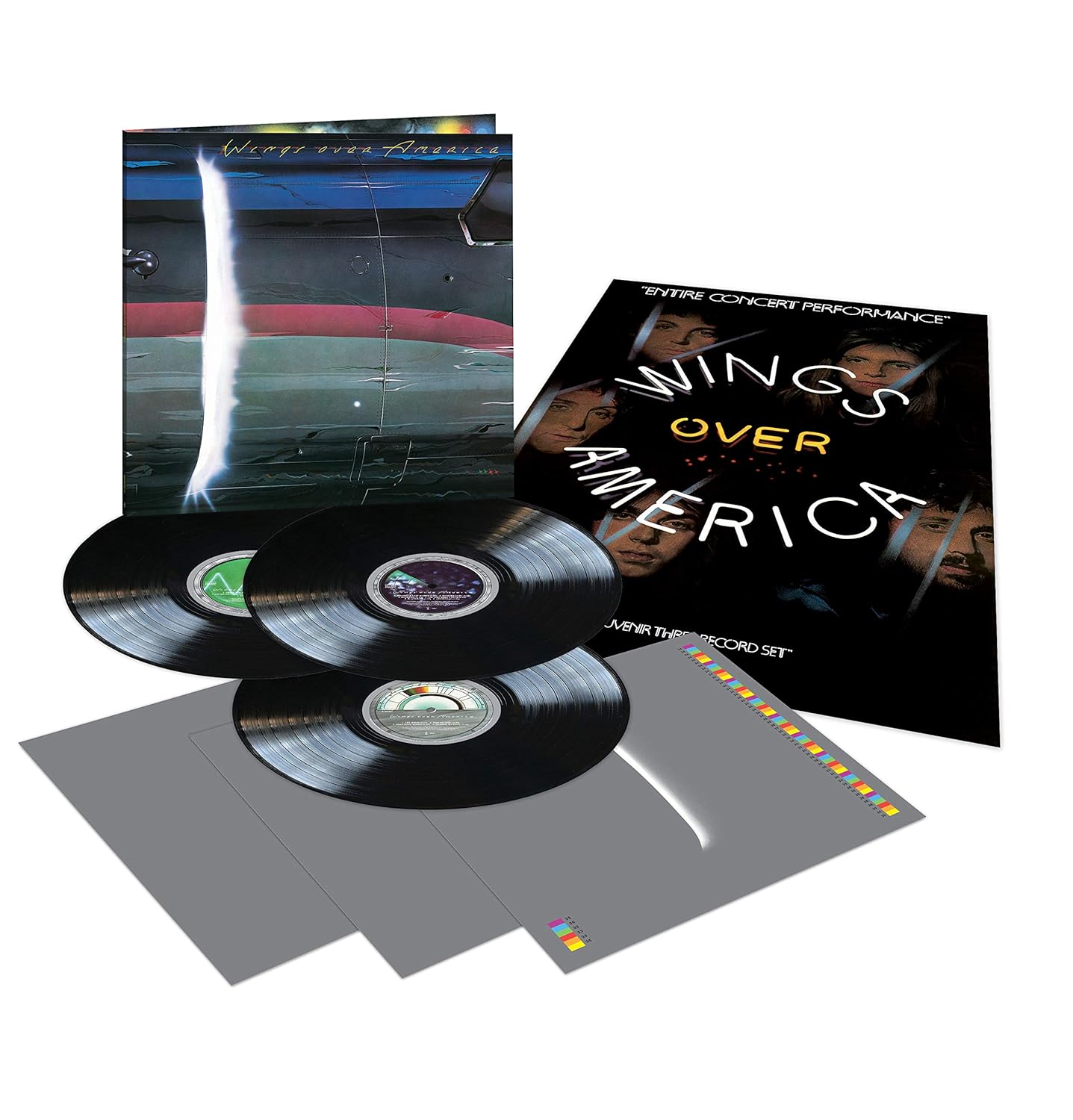
Rare No. 1-charting triple live album, Wings Over Americais a document of one the most sophisticated and dazzling rock shows of the 1970s or any decade. Paul and the band would eventually perform to more than 600,000 people at 31 shows in the US and Canada, ending with three historic nights at The Forum in Los Angeles. It’s no exaggeration to say that the excitement that greeted Paul McCartney & Wings (Linda McCartney, Joe English, Denny Laine and Jimmy McCulloch) in the spring of 1976 as they embarked on what would become their one and only North American tour was overwhelming. Having released four consecutive chart-topping albums — Red Rose Speedway, Band on the Run, Venus and Mars and At The Speed Of Sound – not to mention 1973’s Academy Award-winning James Bond theme “Live and Let Die” – Wings’ career was in full flight… and as Paul’s first U.S. tour since The Beatles, the sheer joy of both the band and its fans were off the charts throughout the 90 hours of recordings distilled into this triple album. Wings Over America was last reissued in 2013 as part of the Paul McCartney Archive Collection series winning the Grammy Award for Boxed or Special Limited Edition Package.
Wings Over America will be available in configurations including double CD, 3 x 180g triple vinyl, and limited edition color vinyl (LP1 – transparent red, LP2 – transparent green, LP3 – transparent blue) both come with original souvenir poster.