Yes, Neil Young has returned with his legendary backing band Crazy Horse, for their first album together since 2012’s well-received Psychedelic Pill. “We believe we have a great Crazy Horse album,” Young wrote recently on his Archives website back in April. “One to stand alongside the albums Everybody Knows This Is Nowhere, Rust Never Sleeps, Sleeps With Angels, Psychedelic Pill and all the others.” Big talk, but based on first taste “Milky Way” — almost as haunted and vulnerable as Young’s unnerving recent New York Times profile — it’s at least got a shot at living up to it.
Official audio for Milky Way from Neil Young with Crazy Horse from their upcoming new album ‘Colorado’ Available on October 25th.
M.C. Taylor has been singing about his kids since before they were even born. Before his eldest child, Elijah, arrived in 2009, Taylor — who for the past 10 years or so has made records with a revolving cast of musicians under the moniker Hiss Golden Messenger — wrote a sweet back-porch hymn called “I’ve Got a Name for the Newborn Child.”
But on his new album, Terms of Surrender, the tenor of Taylor’s relationship to his children feels different: more high-stakes, almost desperate at times. In several songs, he carries on imagined conversations with his son and daughter. Sometimes, they give him a pep talk (“Daddy, take down your sorrow”); more often, he’s apologizing to them for his shortcomings. “When you think of me,” he pleads to his daughter, Ione, in “Happy Birthday Baby,” a crushing song he wrote for her fifth birthday, “think of me better than I think of myself.”
When asked about this stark lyrical shift, Taylor pauses, then confronts the question head-on.
“I had this feeling that I could not shake that maybe I’m not going to be around for much longer, that maybe something’s going to happen to me,” Taylor says. “These tunes are, in part, imagined conversations that I am having with the people that are close to me, as something to leave behind, almost a last-testament type thing. I’m still here. I’m feeling good. Things are great. I love my family. They love me. But, you know, if I die somewhere out there on the road, what do I want my last sung words to be? That was definitely something that was on my mind.”
Since 2008, when Taylor self-released a collection of off-kilter folk tunes called Country Hai East Cotton, the Durham, North Carolina–based Hiss Golden Messenger has evolved into one of the most vital roots-music projects of the past decade — part solitary singer-songwriter outlet, part communal roots-rock collective. Taylor’s music turns the most banal of musician woes — the tribulations of life on the road, spending extended periods of time away from family— into gorgeous meditations on love and lack. Perhaps not coincidentally, Hiss Golden Messenger have became a favorite among fellow musicians, adored by everyone from Mumford and Sons and the Hold Steady to Jenny Lewis and the National’s Aaron Dessner, the latter two of whom appear on Taylor’s new record.
Taylor has grown his following, in part, by churning out an unusually large quantity of music, releasing nearly an album per year during the past decade. As Phil Cook, who’s become Taylor’s right-hand multi-instrumentalist (Cook’s words: “a sous chef in the kitchen of Mike Taylor”), puts it: “Mike has got a prolific bone to pick with the universe.”
But after several years of incessant gigging, recording, and writing, Taylor’s life ground to a halt in 2018. His father had a heart attack. He went through a “pretty huge interpersonal drama” with a close friend (chronicled, in part, on his new song “Katy (You Don’t Have to Be Good Yet”)). The meds Taylor had been taking for his depression, which had gotten worse in recent years, were simply not working. And he continued to struggle with what he calls the “spiritually complicated” parts of being a touring musician, the parts that involve spending a healthy chunk of the year away from his wife and children.
Terms of Surrender, Hiss Golden Messenger’s latest collection, documents — in sometimes frighteningly honest specifics — the crushing lows and precious saving graces of this turbulent time. Typically, after Taylor writes an album, he goes back and tweaks his lyrics “ever so slightly, to make it something that I’m going to be able to sing every night.” Terms of Surrender did not go through such a process.
“Mama, I’m standing on the ledge-i-o,” he mumbles, as if to obscure what he’s saying, on “Down at the Uptown.” “Run, jump or fly? I think I caught a bad one.”
Taylor has made several personal strides since the period chronicled on Terms of Surrender. During the making of Terms of Surrender, he started seeing a therapist for the first sustained period of time in his life, and it’s helped him “understand that it’s OK to have these feelings of anxiety, and that there are ways to let them pass through you and not destroy you.”
“I’m not putting this record out under any sort of duress,” he continues. “Making this record was an absolute ball; I was trying to get my meds right, and nobody really knew that, so I’d be going into the bathroom and having all these weird side effects and would be trying to shake it off and splash water on my face, and then go back out into the tracking room. It was amazing and terrifying, but great. The biggest danger that we have in our lives is forgetting how hard or complicated something was. For me, to have this reminder offers a path towards not going through that in quite the same way again.”
Taylor has a nervous, reflexive laugh that tends to surface right after he says something particularly intense, as when, discussing his father’s recent heart attack, he says, “Emotional heart trouble is big in my life, but shit, so is physical heart trouble.”
Emotional heart trouble is a helpful way of thinking about Hiss Golden Messenger as a whole. The central tension in Taylor’s music is the gulf between two distinct emotional zones: one, a brooding world of midlife angst and parental anguish; the other, a peaceful refuge of familial bliss and vivid Southern landscapes. In his best songs — 2012’s “Balthazar’s Song,” 2016’s “Heart Like a Levee,” 2019’s “I Need a Teacher” — these two spheres collide, each one informing the other.
“Sometimes I’m writing about things as they are in my life, and sometimes the songs are aspirational, where I’m trying to imagine a world in which things exist the way I posit them in the songs,” Taylor says.
The central challenge of Hiss Golden Messenger, then, has been how to hold room for both breezy major-key folk and dark, rhythmically stormy country-blues. Figuring out how to do that, Taylor says, was the foundational discovery that helped define the group and differentiate it from the previous musical lives he’s lived — with the hardcore band Ex-Ignota and alt-country outfit the Court and Spark — in his teens and twenties.
“I had found all these ways to create harmonic suspensions in the chords through different tunings to conjure that bittersweetness, the happy-and-sad-at-the-same-time thing,” he says. “I really had to search to figure out how to make those feelings appear in the chords, how to not commit to a major or minor chord so that it’s very hard for people to understand what they’re supposed to feel.”
The upshot is that, though Taylor works within well-established musical traditions, Hiss Golden Messenger — Taylor has said that the odd moniker holds no special significance — don’t sound quite like any of the scores of similarly minded Americana-based bands that have proliferated during the past half-decade. A few years ago, Taylor was playing with Heartbreakers keyboardist Benmont Tench, who, upon trying to learn the Hiss Golden Messenger song “Drum,” remarked, “Man, this song is crooked.” This delighted Taylor.
“There are a lot of parts of my music that are rhythmically a little bit crooked,” he says. “There’s a lot of crooked old-time songs, and maybe I sort of picked that up by osmosis.”
Taylor, who has a graduate degree in American folklore, goes on to say that he envisions his music as “country-soul, but I’m thinking of country-soul as an existential quest, a quest to understand and position the vast musical traditions of the South as a living and contemporary language that gave birth to everything good in American music.”
Perhaps because of how eloquently he’s able to articulate his musical project, Taylor is sometimes paralyzed by the idea that people regard him as someone who has capital-A “answers.”
“I get the sense sometimes that people might think I know something more than I do, which I really don’t,” he says. “I’m not a churchgoer. I wasn’t raised a believer. I just feel like love is a powerful, animating force in the world, and I’m trying to say that in the most non-hippie way that I can. I feel like, when people are talking about God, they’re talking about the animating force of love. That’s the way I understand it, that sort of holiness. For me, that makes belief and hope easier, because it’s something we’re not necessarily asked to take on faith. I can create love in my own house, and I can show my kids how to create it as well.”
Taylor laughs, perhaps realizing that, in answering a question about his fear of people feeling like he knows some greater truth, he has, inadvertently, spelled one out. “I’m sorry,” he says.
Phil Cook thinks of it this way: “The world is full of love songs, pretty cheap love songs, and I think Mike’s songs are about something that is much more difficult to pin down,” he says. “Not things people can sit down and say, ‘Here’s what it’s all about.’ I think Mike just searching, he’s got a lot of questions, and he’s not shy about saying: ‘I don’t know the fucking answer to any of this shit.’”
In February 2018, Taylor headed to a cabin in the foothills of the Blue Ridge Mountains in Virginia to begin writing songs for what would eventually become Terms of Surrender. Before he started to write, he took a small dose of mushrooms, “just enough to feel them,” and went outside.
“It was dusk and it was really cold and still,” Taylor says. “I could just hear the wind and the evening birds, and there was not another soul around. But then, out of the corner of my ear, I heard the faint sound of voices, kids laughing and playing. I thought I was tripping. I mean, I was tripping, but I thought that maybe I was tripping even harder. But then I realized that the property I was on was abutting this other piece of property that I couldn’t see. There must have been a family out doing their thing. For that minute or two, when I was just standing on this hillside in Virginia, completely alone and hearing these voices, and laughter, it was really beautiful, actually.”
The scene Taylor describes feels uncannily like something straight out of a Hiss Golden Messenger song. And then, almost as if prompted, he goes on:
“It was like being in this liminal space, not really knowing where I was or what I was experiencing, and it was really nice. It wasn’t terrifying, actually; it was comforting, in a way. It was a very particular feeling, and it really stuck with me. It was almost hopeful, we’ll say.”
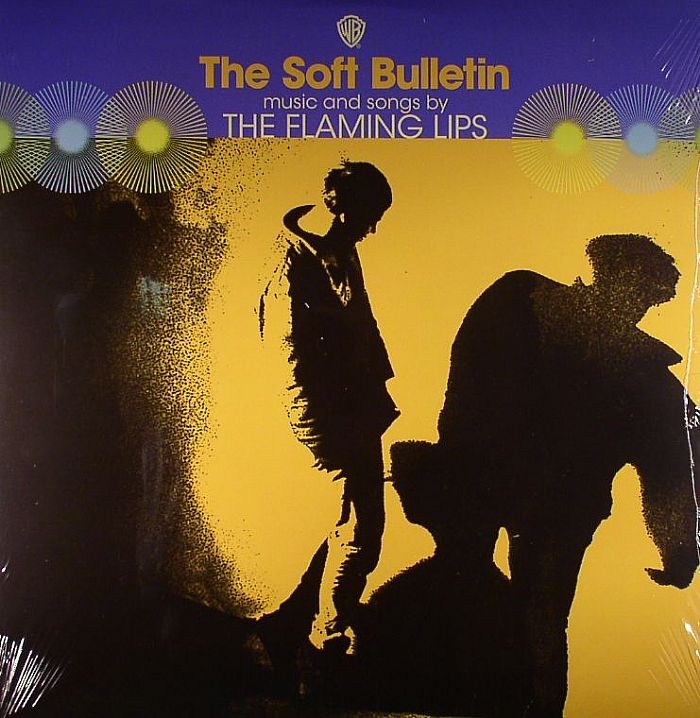
The Flaming Lips offer an oral history of The Soft Bulletin, with intimate interviews examining the stories behind this modern classic. The Soft Bulletin is the ninth studio album by The Flaming Lips, released by Warner Bros. Records on May 17th, 1999 . The album was released to wide critical acclaim and hailed by critics as a departure from their previous guitar-heavy alternative rock sound, into a more layered and intricately arranged work.
The Flaming Lips will celebrate it’s 20th anniversary of their 1999 masterpiece The Soft Bulletin with a limited edition vinyl reissue this October. The 2-LP reissue, released exclusively through subscription service Vinyl Me, Please and pressed on mustard yellow, preserves the album’s original 13-song vinyl track list – including the track “Slow Motion,” originally omitted from the U.S. CD release – and is accompanied by a new art print designed by frontman Wayne Coyne.
The album is now considered by many to be the Flaming Lips’s masterpiece, “The Soft Bulletin is a record that’s always with us… and we’re always considering it… we’re always playing it… we’re always celebrating it,” Coyne said of the reissue in a statement.
“Densely textured, awkward but somehow melodic, The Soft Bulletin finds these pop oddballs with their poker-faced humor firmly intact — ‘When you got that spider bite on your hand/I thought we would have to break up the band,’ sings Wayne Coyne in his strained Neil Young-style voice, referring to an accident that could only have happened to the Lips, and did,” Rolling Stone wrote of The Soft Bulletin in a 1999 album review.
“Their music isn’t, how you say, universally accessible, and the weirdness gets same-y, but no one else has posited a parallel universe in which the Sixties and the Nineties exist simultaneously, allowing for a peculiarly convincing brand of monolithic robotic swirl.”
“Over the past twenty years, The Soft Bulletin has cemented its standing as a modern classic of American rock music. The Flaming Lips’ distinctive use of theme, melody and unorthodox recording techniques accelerated them to an early-career magnum opus that has inspired countless artists,” Vinyl Me, Please Head of A&R Alex Berenson said in a statement.
Archival Materials Provided by The Flaming Lips, Michelle Martin-Coyne, The Fearless Freaks Directed By Bradley Beesley, Scott Booker, Dave and Mary Fridmann, George Salisbury, Warner Brothers Records
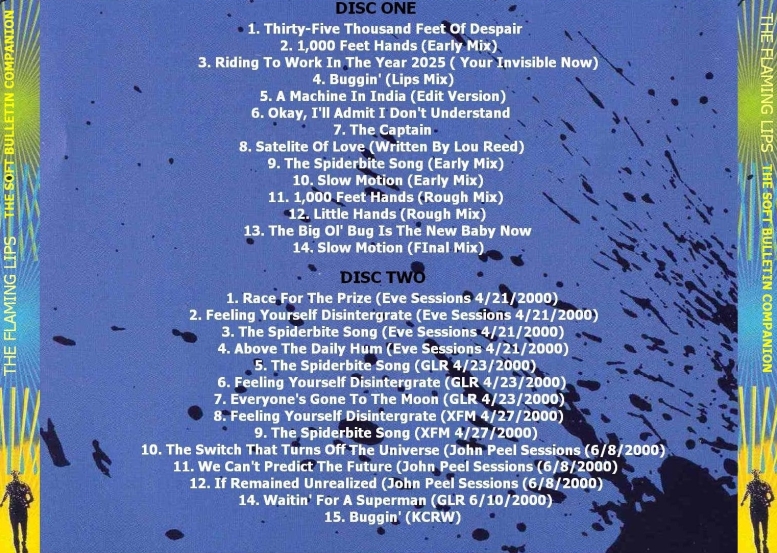
On January 31st, 2006, Warner Bros. re-released The Soft Bulletin in the US as a two-disc package titled The Soft Bulletin 5.1. It includes a remastered CD and a DVD-Audio disc that contains a 5.1-channel surround sound mix of the album.
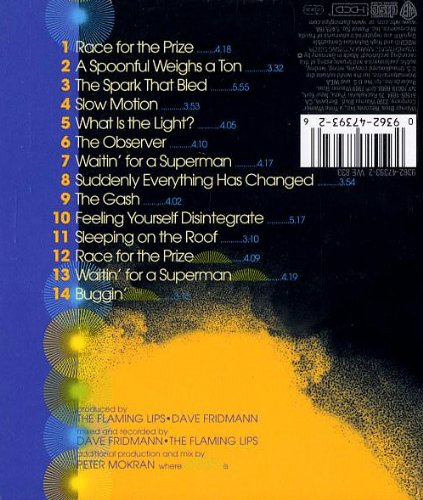
The Soft Bulletin has so many special moments it could easily half-fill a 10 of the Best on its own. But on an album where nearly every song’s a gem, from the brittle beauty of The Spiderbite Song to The Spark That Bled’s gorgeous six-minute symphony, Feeling Yourself Disintegrate feels particularly precious. Here, Coyne floats high above the everyday muck and, cushioned by soft pillows of celestial synths and strings, realising that his body’s been slowly breaking apart ever since he was born; that all life is destined to die. “Love in our life is just too valuable / Oh to feel for even a second without it / But life without death is just impossible / Oh, to realise something is ending within us,” he sings gently, and for just a fleeting second, he’s grabbed hold of nirvana. In slightly grubbier fashion, The Soft Bulletin helped Warners see the light, too: after years of bemoaning the band’s lack of commercial success, they suddenly had a mainstream breakthrough act on their books. Their next project would be even bigger.
“The Spark That Bled” and “What Is The Light”, “Waitin’ for a Superman”
The Soft Bulletin, originally released in 1999, still stands as a pinnacle of what pop music can be at its most magical and inventive, an album rattling with wondrous sounds and ideas you’ll want to hold on to forever. On one hand, it’s their most sonically breathtaking work, built on otherworldly noises and instrumentation that sound as if they’re being beamed from a future disco in an orbiting space-station; on the other, it’s their most moving and vulnerable, too, with Coyne finding more frailty than ever before in his outlandish ideas. Race for the Prize, a touching tale of two scientists prepared to sacrifice themselves and find a cure that will save the world, is a belter: just listen, now, to the giant crack of those distorted drums, that giddy piano riff, the rush of those shrieking synthesised strings that fizz in your synapses like sherbert being poured on your brain. And then Coyne, somehow, touches looks past the HG Wells-like set-up to hit just the right nerve and bring you back down to Earth. “Theirs is to win / If it kills them,” he yelps. “They’re just humans with wives and children.” It’s four-odd minutes of glorious, perfect psych-pop, and a bittersweet sci-fi masterwork to boot.
The Flaming Lips
Wayne Coyne – songwriting, vocals, guitar, keyboards, theremin
Michael Ivins – bass, keyboards, backing vocals, engineering
The cover artwork of the album is a modified version of a photograph taken by Lawrence Schiller for a 1966 Life magazine article on LSD, The Soft Bulletin is still an undeniably essential listen that belongs in every record collection
Recorded October 8th-10th 2018 at Uniform Recording in Philadelphia, PA. Produced, arranged, composed, and performed by Sam Cook-Parrott. Engineered by Jeff Zeigler. Mastered by Ryan Schwabe. Cover design by Perry Shall. Photos and bouquet by Kate Illes. Center label design by Michael Cantor. Special thanks to Marco at Salinas for putting it out, my band for not being mad that I made a record without them, my roommates for putting up with my loud ass while writing and practicing this, to all my friends and family, and most of all to anyone who considers themself a “fan.” It’s my life’s great honor to rock for youWe are a rock band of rockers who love to rock. We also can be just one person who is much quieter but still loves to rock.. –Sam We are a rock band of rockers who love to rock. We also can be just one person who is much quieter but still loves to rock.
White Lies have shared their new single ‘Hurt My Heart’. The three-piece are currently in retrospective mode, re-visiting debut album ‘To Lose My Life’ on its 10th anniversary.
Recorded in Los Angeles whilst on hiatus and what has been a busy year traversing various continents in support of album ‘Five’ released earlier this year, their first for new label [PIAS] Recordings.
The brooding, synthpop sound of ‘Hurt My Heart’ is one of a couple of tracks the band recently recorded with US producer Andrew Wells (5 Seconds Of Summer. Fall Out Boy).
Taken from their forthcoming second album, the John Congleton-produced ‘Devastation’, due out November 8th via Fiction Records, Pumarosa have released new cut, ‘I See You’.
“The song is about having the confidence to look back into the face of the guy who is talking you down, or taking your space, and saying “I see you!” I’m not going to be silent or make myself small so that you can feel ok. It’s not ok! And it can be fun!” explauns frontwoman Isabel Muñoz-Newsome.
“There is a swagger to enjoying power, And it can be fun! Theres is a swagger to enjoying power, and you can feel that in the verses of the track. and you can feel that in the verses of the track. The lyrics to ‘I See You’ ware inspired by the experience of me and my girlfriends. And also by the #MeToo movement.”
Looking to escape this dreary weather and get transported to another galaxy? Well, let this video take you away to the land of Honeyblood and her new track ‘Bubble Gun’. Full of post punk hooks, intergalactic battles and bad-ass silver ensembles, you can watch Stina Tweeddale, flanked by two accomplices fight conspicuous aliens and sticky situations. Honeyblood will be bringing their infectious sound to The Garage on 31st October
Starring HB & band (Stina Tweeddale, Debbie Knox-Hewson and Anna Donigan) plus Jules Rodríguez
The voice and the space between the words are unmistakably Josienne Clarke.‘Things I Didn’t Need’ is a powerfully brittle love song. The arrangements of all the songs are barer than the chamber folk of SEEDLINGS ALL, Josienne’s stunning 2018 duo album with Ben Walker. There is room to hear every emotional syllable and nuance with voice, strummed electric guitar and some atmospherics to make the whole thing crackle. The effect is hypnotic, giving weight and power to every word.
Expect to hear these tracks soundtracking poignant moments in arty TV dramas soon. ‘Season And Time’ features a beautiful picked acoustic and Clarke’s wonderfully melancholic voice with some wonderful lyrics. ‘Never Lie’ adds some atmospheric textures and layers to Josienne’s fine voice and guitar, building a wonderful soundscape. Three tracks, individually sublime, also act as a starter, hinting at the rich treasures and sounds on Josienne Clarke’s forthcoming album that she describes as filled with misery, anger and a, longing for better.
Opening lines can be so crucial to a song, the way they set a mood, create a scene and instantly plant the listener squarely in the centre of proceedings. “You’ve got your problems but I’m the one that needs to change”, is how Josienne Clarke’s new single, If I Didn’t Mind, greets you. Instantly thrusting you into the centre of a failing relationship, a row so instantly real you feel like you’re going to be ducking flying plates and pulling your hands out of the ways of slammed doors. The track is lifted from Josienne’s upcoming debut album, In All Weather, a record about pulling yourself out and starting again, “I exiled myself, moved to an island, metaphorically and literally; broke up with everything but songwriting, to re-make myself and learn to let it all go in peace”.
Built around a fluttering bass-line, and rolling drum beat, most of the track’s melody is carried by Josienne’s vocal. Throughout there’s a calmness and a strength to the delivery, that doesn’t disguise the hurt underneath, almost if Josienne is steadying herself determined to make her point. Discussing the album as a whole, Josienne has suggested In All Weather is, “a manifesto of how to leave and how to change”, a series of songs about breaking-up and crucially about moving on, on this evidence one enthusiastic writers claim that these are, “the best break-up songs since Blood on the Tracks”, might actually have some legs.
In All Weather is out November 8th via Rough Trade Records.
A favourite discovery of the year, Soot Sprite The band have recently signed to Special Subject, the Exeter-based sad-gaze trio are set to put out their debut EP, “Sharp Tongues”, next month, and have this week shared the latest taste of the record, new single, Vs. Self.
Like much of Sharp Tongues, Vs. Self is a reflection on themes of self-esteem and anxiety, as songwriter Eli Cook explains, “when going through times of heightened anxiety, it’s sometimes difficult to recognise that you’re your own worst enemy”. Lyrically, the track seems to be battling with the danger of constant comparison and the swirling feeling of life tumbling by all too quickly: “I’m tired of fighting with myself, lost sleep and writing doesn’t help, it’s not just one thing spinning round got more plates than a circus clown”, before the track ends with the repeated plea, “slow it all down, slow it all down”. The chaotic tumbling in the lyrics is reflected in the music too, with waves of bright-guitar and propulsive bass creating dense spirals of sound, only settling down at the tracks end into a contemplative stillness. At once familiar and forward thinking, Soot Sprite’s music dips one toe into the late 90’s alternative scene and then sprints forward into 2019, sounding fresh, intriguing and very, very exciting.
From Sharp Tongue 12″ EP out 11th October on Specialist Subject Records.
A ‘companion collection’ of live, whole takes recorded to 2” tape.
“I was very lucky to have 3 afternoons alone at Roundhead studios, in late 2017 and early 2018, when as a band we were just about finished mixing the full band versions I’m so proud of. Those had taken a long time to realise; it was a fun, beautiful, big project. So much happened during the process… I felt a need to get a snapshot of the songs at the end of it, with all that learning, reflecting on where they’d begun, and where they’d ended up.”