Nk201810

Two stunning BBC sessions from the heyday of the british band fronted by Steve Winwood and Jim Capaldi. One shot recorded before the release of the debut album on Island Mr. Fantasy, the second – December the 11th – right after. Facing the beginning of a new groove revolution after the blues explosion.

Nk201902

Things are getting more sophisticated down here. The band just released his debut album and is ready to roll. Second self-titled album is almost there, so a number of key tracks like Pearly Queen,Who Knows What Tomorrow May Bring and Feeling Alright. Three different radio sessions from winter and the hot summer of ’68.

Classic Radio Broadcasts: On their formation in April 1967 Traffic experienced instant success and rapidly expanding popularity. That they accomplished so much in such a short space of time attests to the talent of the band s particular blend of creative forces, but also might explain why the first few years were so tumultuous. Although Steve Winwood was already a widely respected figure due to his time with The Spencer Davis Group, the strength of Traffic’s debut single, Paper Sun, took many observers by surprise. A number 5 hit in the UK, the song signaled that Winwood had matured into one of the most significant figures in British music and, as further material appeared over the course of 67, that Traffic were a major arrival on the scene – Dave Mason’s Hole In My Shoe gave the band a UK number 2 in August and November s Here We Go Round The Mulberry Bush their third successive top ten hit. When the group s debut album, Mr. Fantasy, arrived in December, it was to rapturous acclaim on both sides of the Atlantic; but trouble lay ahead. In early 68 Dave Mason quit, citing artistic differences. Although he briefly re-joined the band during sessions for their second album, Traffic, he left again shortly after and Traffic never really recovered. Winwood exited in early 69 (to the shock and surprise of Jim Capaldi and Chris Wood) and formed Blind Faith alongside Eric Clapton & Ginger Baker.

Despite their eventual reformation in 1970 (minus Mason), 67- 68 thus stands alone as the original pure era in Traffic s history. With the impact that the band made on British music at the time, they fast became fixtures of radio programming, on John Peel s Top Gear show in particular. Collected here are the complete BBC performances by Traffic from across 1967-68, a fascinating journey that traces the evolution of the band over the course of its quintessential period, from Paper Sun in September 67 to Feelin Alright in July 68, Dave Mason’s last great gift before he walked.

Image may contain: 3 people

The Shelters fan a fresh flame with classic fuel on their second full-length, “Jupiter Sidecar”. Ebbing and flowing between rock ‘n’ roll roots, surf swagger, synth swells, and unassuming pop ambition, the Los Angeles-based group thread it all together with catchy melodic hooks. This approach quietly cemented them as a fan and critical favorite following the release of their self-titled full-length in 2016, which was produced by Tom Petty.

The Shelters returned to his Malibu studio to craft Jupiter Sidecar and to mourn the loss of their friend and mentor – and in the process learned to rely on one another like never before.

Band Members
Chase Simpson,
Josh Jove,
Sebastian Harris

New album Jupiter Sidecar out now!

Led by the indefatigable Brent Rademaker (Beachwood Sparks, the Tyde) the band’s sound on its third album is more or less a swirling stew of cosmic American country in the style of Gram Parsons, a kind of happy-go-lucky, Beach Boys-esque sunshiny pop and a rather careful Tom Petty and the Heartbreakers-influenced rock. – WINNIPEG FREE PRESS

The real success of GospelbeacH’s music is the effortless way that they combine different styles and influences within their classic Southern Californian sound. – FEAR AND LOATHING

The joy that emanates from each of these songs, is a beautiful thing to behold, and digs deep into the now quaint aspects of peace and love. For matters of the heart, smoke deep, dig it deep, and turn on. – ECHOES AND DUST

This album has layers. Taking Neal Casal out of it for the moment, Rademaker and songwriting partner Trevor Beld-Jiminez have brought GospelbeacH to a unique place with this latest effort – all three studio releases have three dramatically different, but complementary soundscapes. “Pacific Surf Line” has a heavy Crosby/McGuinn/Hillman Laurel Canyon vibe, 2017’s “Another Summer of Love” brings out more of the Tom Petty influences, especially with the Benmont Tench-like wizardry of keyboardist Jonny Niemann, and title track “Let It Burn” is something else. It’s somewhere between Bob Dylan’s “Blood On The Tracks” and Tom Petty’s very underrated “Echo.” – TAHOE ON STAGE

Let It Burn” is GospelbeacH’s exquisite follow up to “Another Summer Of Love” and the third proper studio album by the famous Los Angeles rock combo. The band’s prestigious collective resume includes members of Chris Robinson Brotherhood, Beachwood Sparks, Circles Around The Sun, The Tyde, and Hard Working Americans.

There’s probably no sweeter SoCal sound circa 2019 than this band. – BLURT MAGAZINE

Its mood is a winning blend of downbeat and defiant, in a way a reflection or snapshot of modern America itself. – HARMONIC DISTORTION

This record’s a real peach of an album, but one that is tempered by the tragic loss of guitarist/ vocalist Neal Casal. – TERRASCOPE

Image may contain: one or more people

“What If”, Rhys Lewis addresses this often-detrimental rumination in a way that’s earnestly emotional and touchingly impassioned. Although his lyricism is stunning, with just his vocal performance Lewis manages to convey both the emotions behind his painful reflections on lost love and the intense adoration he once felt. It’s perhaps in the track’s second verse that Lewis reaches his most earnest detailing in previous inability to see in himself what his ex-girlfriend saw in him.

Love can be a boundless feeling. It can lock us into an armored bubble, keeping us from harm. Although it has its magic, love can break hearts and it can silence the clash of two pairs of lips. Dreaming of love will never be as intense as the real coming together of two honest chasers of passion. We all need affection to live a purposeful life. We also need to pick ourselves up when love begins to lose its flame.

Singer/songwriter Rhys Lewis embarks on creating fables within his songs. The young musician tantalises with new track “What If”. It’s a multi-layered, triumphant, cathartic ballad of sorts. Throughout the track, he conveys a sense of loss, describing that he must patch up love’s stricken body, and that he must bring the girl back into his world.

The descriptions are poignant. Lewis’s ability to stir up emotion makes him such a unique songwriter. He dazzles but also seeks redemption, and he implements into everything he produces, a light. This light may not always be brighter than the sun, but it’s always there.

“What If” is yet another forward thinking track. It doesn’t raise hell, but the subject matter is eventful and the arrangements are intricate. Lewis knows how to construct chords and compelling lyrics which intertwine to create a showpiece.

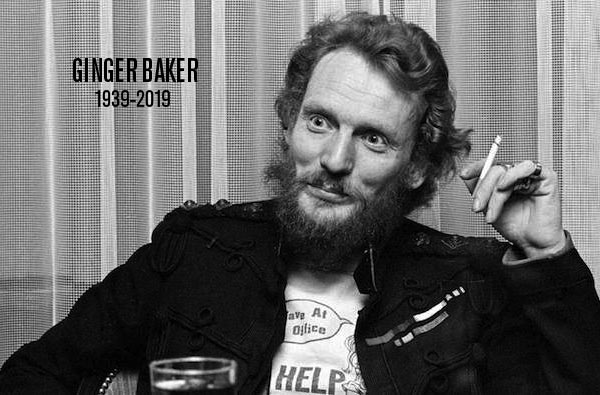
Ginger Baker 1939-2019

Ginger Baker, drummer and co-founder of 1960s blues-rock supergroup Cream, died on Sunday (October. 6th), his family confirms. He was 80 years of age.

He’d been struggling with failing health for some time and had been hospitalized after falling “critically ill” last month.

“We are very sad to say that Ginger has passed away peacefully this morning,” a brief statement on his Facebook page announced. “Thank you to everyone for your kind words to us all over the past weeks. Baker’s death follows a 2016 fall in his home and subsequent open heart surgery after being diagnosed with a heart condition, and the news follows recent posts on his social media channels that he was hospitalized in “critically ill” condition.

Baker leaves behind a legacy as the drummer for Cream, his 1960s power trio with guitarist Eric Clapton and bassist Jack Bruce that tossed up the blues with sunshine-pop, with “Sunshine of Your Love” and “White Room” in 1968. The band split in 1968 and reunited in 2005 for a residency at the Royal Albert Hall, captured that year on the live album Royal Albert Hall London May 2-3-5-6, 2005.

His first professional band, Alexis Korner’s Blues Incorporated, where he replaced Charlie Watts (who left to join the Rolling Stones) and met bassist Jack Bruce, with whom he’d play in the Graham Bond Organisation and then form Cream in 1966. From almost the start, their relationship was a tumultuous one, with the mercurial Baker often lashing out at his bass-playing bandmate.

Later in life, Baker often appeared in the press as a lovable, irascible grouch, living in South Africa with his Zimbabwean wife, Kudzai, while treating his emphysema and degenerative spine condition. During Cream’s brief reunion, he sang his oddball interlude “Pressed Rat and Warthog”.

“It’s a knife-edge thing for me and Ginger,” Bruce was once quoted ,“Nowadays, we’re happily co-existing in different continents, although I was thinking of asking him to move. He’s still a bit too close.”

The son of a tobacco shop employee and a bricklayer who was killed in WWII, Baker was enamored early on with jazz legends like Art Blakey, Max Roach and Philly Joe Jones. He made the rounds in traditional jazz combos in the mid-1960s before coming into orbit of British blues nuts Eric Clapton and Jack Bruce. The former was fresh from the Yardbirds and John Mayall’s Bluesbreakers; the latter would jam with Baker in the blues-jazz band the Graham Bond Organization. Considering themselves the “cream of the crop” of British bluesmen, they called themselves Cream and released their debut Fresh Cream in 1966.

Apart, the members of Cream were good-to-great blues sidemen. When they got together, they were dynamite. Their riff-heavy originals like “Sunshine of Your Love” inspired riff-mongers from The Allman Brothers Band to Lynyrd Skynyrd. When they tackled the blues, they were reverent, staying true to the melodic backbones of Skip James’ “I’m So Glad” and Willie Dixon’s “Spoonful” while giving them a fresh, modern feel.

Cream released two more albums during their run, 1967’s Disraeli Gears and 1968’s double-disc Wheels of Fire, and 1969’s Goodbye, a mix of live and studio recordings, followed after their split. Despite existing for only two years, Cream sold over 35 million records over their lifespan. Cream one of the period’s biggest bands. His self-penned instrumental “Toad,” which was on the group’s debut album and credited as one of the first rock drum solos on record, became a concert centerpiece, often stretching to 20 minutes.

With Cream in the rearview mirror, Baker and Clapton started another blues-rock supergroup, Blind Faith – featuring bassist Ric Grech and Traffic keguitarist Steve Winwood — in 1968. The band burned out even quicker than Cream, releasing a 1969 self-titled album and undergoing one tour before going their separate ways. In 1972, Baker released two solo albums, Ginger Baker at His Best and Stratavarious, in which he dabbled in jazz fusion and Afrobeat.

From 1980 onward, Baker briefly joined space-rock agitators Hawkwind, one of over a dozen drummers in the band’s history. “Ginger fitted the band like a glove,” their guitarist Huw Lloyd-Langton said in the 2004 biography The Sage of Hawkwind. “His style was just right for it.” During the dawn of metal, Cream’s heavy blues was sometimes cited as an influence, which made Baker irate.

Baker went on to stretch beyond blues-rock, playing on Public Image Ltd.’s 1986 album Album and in a jazz trio with Bill Frisell and Charlie Haden. In 2009, he published an autobiography, Hellraiser: The Autobiography of the World’s Greatest Drummer. He stayed behind the kit until heart issues laid him low in 2016. “Just seen doctor… big shock,” he wrote on his official blog. “No more gigs for this old drummer. Everything is off. Of all things, I never thought it would be my heart.”

Orindal Records is proud to present the first vinyl release by Chicago singer/songwriter/guitarist Julie Byrne.

The first time we heard Julie’s debut cassette, You Would Love It Here, It’s The Perfect Place For You (Solid Melts), we immediately fell in love with her gentle, understated folk songs. Accompanying herself on a fingerpicked acoustic guitar, Julie sings about memory, hope, and coping with loss. There is restraint and measure in her singing and playing, and both ache with the same fragile beauty.

The two songs on this brief EP tell a complete story; “Holiday” recalls a New Year’s Eve in New York City, future plans made, and the fall-out of a fleeting romance, while the b-side, “Marmalade,” carries a dimming torch into the future, through changing seasons, bringing peace and closure to uneasy memories.

http://

Faster or Greener than Now was recorded live to tape on an April afternoon by Owen Ashworth. Vintage echo and spring reverb effects were added to color Julie’s performances, lending a haunted atmosphere to these raw and intimate recordings.

The title of this record was taken from a Frank O’Hara poem.

Originally released December 4th, 2012

Songs, vocals & guitar by Julie Byrne

Image may contain: 3 people

The descent into darkness is a trope we find time again across history, literature and film. But there’s also an abyss above. There’s a winding white staircase that goes ever upward into the great unknown – each step, each turn, requiring a greater boldness and confidence than the one before. This is the journey on which we find Angel Olsen. The singer-songwriter’s artistic beginnings as a collaborator shifted seamlessly to her magnificent, cryptic-to-cosmic solo work, and then she formed bands to play her songs, and her stages and audiences grew exponentially. But all along, Angel Olsen was more concerned with a different kind of path, and on her vulnerable, new album, “All Mirrors”, we can see her taking an introspective deep dive towards internal destinations and revelations. In the process of making this album, she found a new sound and voice, a blast of fury mixed with hard won self-acceptance.

By her usually prolific standards, it’s been a long time between albums for Angel Olsen. “All Mirrors” is her first album for three years – an epic gap given that she used to average an LP a year in the early stage of her career. As usual, Olsen has redefined her sound once more, offering up impassioned songs that come backed by bold, wall of sound style production from John Congleton.

There are many moments of stirring intensity, where swirling strings, eccentric electronics and low-slung indie-rock grooves join forces to create stunning and arresting musical works of art. The more contemplative moments often sound a little like “Mezzanine”-era Massive Attack or Portishead, though Olsen’s voice and Congleton’s production are always unique enough to make comparisons with those bands moot.

The mid-album ballad, “Spring.” Over warm, gently warped piano, Olsen opens with advice: “Don’t take it for granted, love when you have it,” she singe, before observing almost in passing how quickly time flies: “Remember when we said we’d never have children, I’m holding your baby now that we’re older.”

For anyone who’s ever invested too heavily in a hypothetical future, or mentally broken apart every minuscule bit of a fresh and failed romance, that lyric can be a terrifying reminder that we will never know what will happen next. Olsen says as much in the next few lines: “I’m beginning to wonder if anything’s real, guess we’re just at the mercy of the way that we feel.”

Her message never veers into existential-panic territory, though, instead held steady by the song’s even-paced, rolling rhythm, and Olsen’s fuzzy vocals, hovering like a reassuring guide. She ends her gentle journey on the only piece of certainty she has access to: the fragile and fleeting present. “So give me some heaven, just for a while,” she sings, before her falsetto takes off into the heavens: “Make it eternal, there in your smile.”

“Spring” is the song that stayed with me the longest, through my dozens upon dozens of replays lying in my darkened bedroom, cooking with my roommates in my kitchen, singing by myself in the shower, like a forever-looping Twilight Zone-ish theme song. There is no true rhyme or reason to anything; there are just things that happen to us and people we meet, and we should try to enjoy everything while it lasts. It may not be a satisfactory revelation and — don’t get me wrong — it will emotionally wreck you. But once the tides of perpetual uncertainty subside, it’ll feel quite freeing.

The debut self-titled album from Dyson Stringer Cloher (out Oct 4th) was recorded at Wilco’s The Loft studio in Chicago April 2019 with Grammy Award winning engineer Tom Schick and Wilco’s Glenn Kotche on drums.

There’s an undeniable intimacy to this collaboration between Jen Cloher, Mia Dyson and Liz Stringer. The powerhouse singer-songwriters released an EP and toured extensively under the Dyson Stringer Cloher moniker in 2013, before splitting off to conquer their own corners of the local and international indie music scenes.

It’s quite a show. The trenchant, Cloher-led rocker Falling Clouds frames the album as a manifesto for women and gender non-conforming artists too often relegated to a supporting role: “Nothing against Paul or Nick, but if you want to be remembered then you better have a dick.” Such gendered iconoclasm broils along in the background and comes to a head later on in the album with the equally resounding Be Alone, a boot-stomping statement about self-actualisation, where to be alone is a gesture of power rather than passivity or failure.

Dyson Stringer Cloher’s ten tracks happily plumb an array of modes and moods. There’s an energy to the album that seems to have absorbed the entire oeuvre of women-led rock music. With My Hands delivers its chunky guitar riff and rimshot-driven chorus with a swagger worthy of The Runaways; it is tailor-made to get audiences jumping. Elsewhere Believeris stadium-sized rock that winks at The Jezabels.

Now, nearly three decades later, these three artists are inspiring a new generation. Supergroups don’t always work, but this is a winner.” – STACK

“A manifesto for women and gender non-conforming artists too often relegated to a supporting role.” – The Music 

“An album that celebrates the importance of music in each of their lives.” – The Australian

‘With My Hands’ from Dyson Stringer Cloher’s self-titled album is out October 4th, 2019 on Milk! Records.

The arrangements and musicianship are as solid as the songwriting is memorable – from the tightly wound beats and dialogical guitar section that steer future road trip anthem The Other Side down its sombre highway, to the brushed snare and picked guitar that bring colour and texture to the bitingly confessional Young Girls. All of which provides a perfect setting for the three-pronged vocal onslaught, the contrast and complementarity of the singers’ voices helping to ensure that this collaboration is as aurally rich as any.

Lest you fear that Dyson Stringer Cloher are taking themselves too seriously, for a change of pace there’s, well, Too Seriously a tongue-in-cheek gospel-country romp delivered with alternating lead vocals and honky-tonk flair, and more than a little Wilburys-esque goofiness. It’s a moment to both celebrate and lampoon this whole supergroup business, albeit coupled with a little obligatory hard-bitten wisdom about rising above life’s more bruising knocks.

Be Alone’s pounding drums and haze of fuzz guitar bring things to a rousing climax ahead of the album’s stunning benediction, Can I Borrow Your Eyes. Sung largely a cappella, aside from a wafer-thin bed of synth, the closing track finds the singers’ voices blended in perfect three-part harmonies, their contrasting styles united into a singular vision. It sums the album up nicely, and leaves the listener to slip back into the world warmed by the knowledge that these are three artists who’ll be remembered, together and alone.

Mia Dyson – Vocals / Guitar / Bass
Liz Stringer – Vocals / Guitar / Bass / Keys
Jen Cloher – Vocals / Guitar
Glenn Kotche – Drums / Percussion

“In a self-experiment, I drew my face with black thread. The first to be affected were the eyes and mouth, because I could not see or speak – communication was destroyed….the details of my face seemed to be gone and, at the same time, frozen. It was similar to the act of mummification. I reached for the scissors and freed myself”

These are the words of Annegret Soltau, the German avant-garde feminist artist, whose work graces the cover of Julie’s Haircut’s transcendent new album. It’s a piece that maintains as much of its power and relevance today as in the time of its inception 40 years ago, yet forms a curious parallel with a record that is nothing if not the sound of psychic liberation from the shackles of oppression and of the everyday.

‘In The Silence Electric’, the latest record from a band with a quarter-century-history, is notable for its deft balance between hypnotic radiance and otherworldly intensity, between beatific calm and palpable anger. Yet it’s also a record which has arrived through a strange process of osmosis from a band confident enough to let subconscious and metaphysical aspects steer them in the appropriate directions.

The result was nonetheless also informed by a recent live soundtrack project the band embarked upon in tandem with Josef Von Sterberg’s 1928 classic ‘The Last Command’, as well as recent visits by the band’s Andrea Rovacchi to Mozambique, where he was subsumed by the local music and culture, bringing back a finger piano which makes its presence felt amidst the polyrhythms and primal scream therapy of ‘Pharaoh’s Dream’.

For all the nature of its divings, the result is a collection of supremely confident and cohesive ditties that sees the deep-end diabolism and mantric intensity of their Rocket debut, 2017’s ‘Invocation And Ritual Dance Of My Demon Twin’ expanded into a righteous fury and
incandescent splendour. Whether it’s the heavy-lidded rapture of ‘Lord Help Me Find The Way’ (like Spiritualized transposed to 1970s Berlin) the menacing dream-state of ‘In Return’ or the Suicide-damaged psychic assault that is ‘Sorcerer’, all is subsumed by a bold singularity of intent, amidst a colourful firestorm of electronic monomania, jazz-tinged atonality and indelibly memorable vocal hooks.

http://

Even when we write about very dreamlike situations, or metaphors, we always address very real, concrete aspects and problems of our life” says Luca “There is a lot of the classic dualism between sex and death on this record. Sometimes it’s more dark and gritty (“In Return”), sometimes it’s more elevating (“Anticipation of the Night”).

“There’s a theme springing from the title of the record and the photos of Annegret Soltau that deliver some sense of helplessness, suffocation, difficulty in communication” notes Luca. Yet for all this – and paradoxically enough – ‘In The Silence Electric’ is both this mysterious and rebellious band’s most adventurous and most direct record to date – not to mention an ever more compelling transmission from renowned experts in altered states.

Released October 4th, 2019

Sleater-Kinney is back with their new single “Animal” from the sessions that brought you The Center Won’t Hold. Sleater-Kinney delivers a song about rebellion, retaliation and rage. It’s about letting go of all politeness and filters and letting the “animal” side speak. Vocals were recorded in St Vincent’s home studio – the perfect place to unleash a voice like this!.

The duo made their return earlier this year with comeback album ‘The Center Won’t Hold’.

Mom + Pop Released on: 2019-10-02  Vocals, Guitar: Corin Tucker , Vocals, Guitar: Carrie Brownstein , Drums: Janet Weiss Producer: St. Vincent