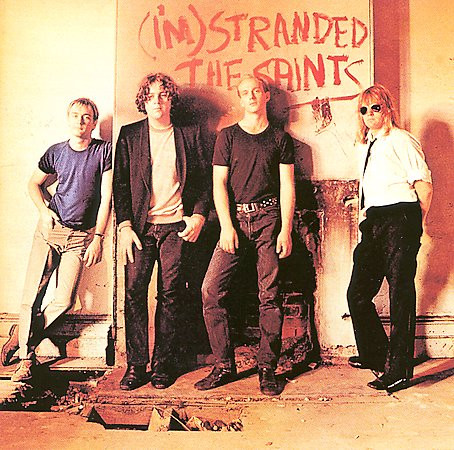
September. 28th in 1976: pioneering Australian punk group The Saints reissued their soon-to-be hugely influential debut single “I’m Stranded” (backed with “No Time”) on the Power Exchange label, where it would receive broad distribution (they had previously released a private pressing of the single on their own Fatal Records, that is now a collector’s item); the single pre-dated vinyl debuts by such UK punk rock peers as Sex Pistols, Buzzcocks, The Damned & The Clash…
In order to understand how pop-punk broke in Australia,The Saints arrived at a time where tensions in their native Brisbane were considerably high — police would often break up shows, and punk music served as a major ‘fuck you’ to authorities at large.
It’s often said that Australia’s Saints were the Antipodean Ramones, having developed similarly minus awareness of Da Brudders. But Ed Kuepper was more chaotic and violent-sounding than Johnny Ramone—and was capable of lead work as blistering as, say, Brian James’. Kuepper made the Saints their own entity. The Saints were one of Australia’s earliest punk bands and they’ve gone down in history as the first group outside of the United States to release a record. They followed 1976’s “(I’m) Stranded” single with a 1977 album of the same name, and the punk world was forever altered. Every song on the album is full of swagger, urgency, and sincerity as the band blazes through scorching rock numbers and a few blues-drenched ballads. Once you hear Chris Bailey exclaim “Come on!” or hear the buzzsaw whirlwind that is Ed Kuepper’s guitar playing, you’ll know why The Saints are one of Australia’s greatest musical exports.
Released in February 1977: Australian punk band The Saints followed up the roaring domestic success of their single “(I’m) Stranded” with their debut album of the same name, on EMI Records (Australia)/Harvest Records (UK)/Sire Records (US); full of rough, exhilarating rock’n’roll noise, it remains one of the greatest debut LPs of the era; “Erotic Neurotic” was the second single, released that May shortly before the band relocated to the UK; in 2010, the album was ranked #20 in the book ‘100 Best Australian Albums’…
Although not given their due at the time, this band and this song have gone on to serve as the blueprint for how Australians typically approach the genre. There’s a strong underlying sense of melody here, too. While John Lydon and Iggy Pop would often just howl and squawk, Chris Bailey knew how to get his hooks in. By doing so, he created one of the most famous choruses in Australian rock history, in turn paving the way for pop-punk.
The Saints are an Australian rock band, which was formed in Brisbane in 1974 as punk rockers. The founders were Chris Bailey (singer and guitar), Ivor Hay (drums) and Ed Kuepper (guitar and composer). Next to Pilar Bailey. In 1975, contemporaries with the Ramones Americans, The Saints used the fast rhythms, the strident voice and guitar “buzz saw” that characterizes the first years of punk. With their first single, “(I’m) Stranded,” in September 1976, they became the first punk band outside the United States to release a record, ahead of other well-known groups, including the Sex Pistols and The Clash .
They are one of the first and most influential groups of the genre, according to Bob Geldof, “Rock music in the seventies was changed by three bands: The Sex Pistols, The Ramones and The Saints.” In early 1979, The Saints split, leaving Bailey to continue with the band, with a variable lineup, like a pop punk band. The band was included in the Australian Recording Industry Association (ARIA) Hall of Fame in 2001
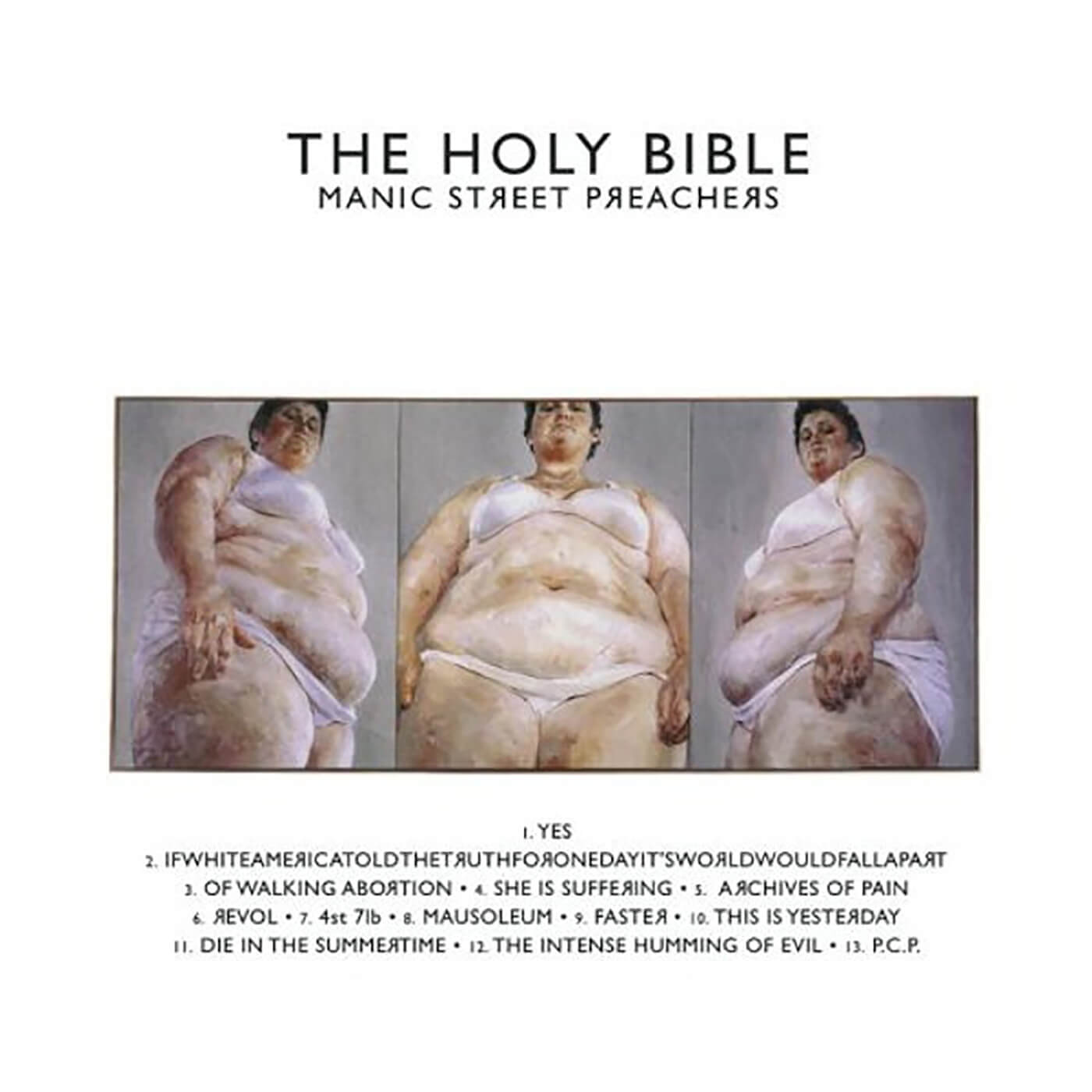
Released on August 30th, 1994, the Manic Street Preachers’ third album “The Holy Bible” remains one of the most unique, singular albums in history. The most ground breaking moments in music have rarely stemmed from those who’ve rigidly stuck to the blueprints for commercial success. It’s those artists who’ve made tough choices and hard-swerves into uncharted territory, that have made the most important dents. Few records have impacted listener consciousness quite like the third album from The Manic Street Preachers, “The Holy Bible”. A marked departure from the radio-friendly sheen of the preceding “Gold Against The Soul”, here was a document less preoccupied with garnering radio airplay than it was with ripping apart the foundations of the political systems that shaped an expanding, globalised world. Its broader conceit convincingly predicted the western world’s slide into a barbarous, fascistic future, while its citizens stand idly by, opiated by consumerism.
When the band began work on their third album at the start of 1994, all was not well within their camp. Drummer Sean Moore recalls that the Manics believed they had been “going a bit astray” with the cleaner, more Americanised sound of “Gold Against the Soul”, and a conscious decision was made to lean back into their more stripped-back British influences, artists such as Magazine, PIL, Gang of Four and Joy Division.
In parallel to its bleak broader concerns, “The Holy Bible” also serves as an act of brutal self-examination, with the band’s mercurial lyricist and chief aesthete Richey Edwards, regularly directing his wrath at himself throughout the album’s run-time, deconstructing his mental and physical health, most pointedly on the heart-rending “4st 7lb” – a song informed by his own battles with anorexia.
Charged with injecting Edwards’ disordered lyrical outpourings into suitably boiling arrangements, the Preachers’ central guitarist, James Dean Bradfield was the album’s musical lynchpin, and crafter of its many blistering guitar sounds. He bound Edwards’s often stream-of-consciousness tirades with a harsher edged gothic veneer – a far cry from the bright day-glo glam of the preceding album.
In a cramped Cardiff studio, Bradfield carefully sequenced complex broadsides of intimidating, sledgehammer power chords, coupled with melodic, serpentine leads and petrifying squalls of tension. As Bradfield said to journalist Ned Raggett at the time “We did it really quick. It’s more direct. I don’t think it makes concessions to the listener at all. It’s really honest, and it just goes for it.”
Sadly, it’s a record that’s often evaluated in the context of what happened next, with Richey Edwards’ tragic disappearance (and the eventual assumption of death) overshadowing many perceptions. Assessed on a purely musical level, “The Holy Bible” still stands as the Manic Street Preachers’ most blazingly intense, harrowingly dark and profoundly compelling work.
Though Edwards was its prime instigator, the collective agreement to pursue a darker direction had stemmed from a shared sense that the band was at an impasse, following the muted reception that met their previous record. “There was a realisation that we hadn’t got as big as we thought we would have.” Manics’ bassist and additional lyricist Nicky Wire reflected, who also admitted that the switch was spurred by the band wanting to be ‘100 per cent truer to ourselves’. James Dean Bradfield, too was conscious of the band beginning to slide into a predictably ‘rockist’ niche.
In pursuit of this truer sound, the band resisted label pressure to record in a luxurious studio in sun-drenched Barbados and instead decamped to Cardiff’s minuscule Sound Space Studios. It was here the four set to work on concocting the more upfront sound which was more in-keeping with their formative influences, such as Joy Division, The Clash and Magazine.
Though friend and engineer Alex Silva was on hand to capture and engineer the four, no overall producer was designated. Silva said that “I think at the time, the band had an ideal, James said that ‘No albums have been produced since Led Zeppelin III’. So in that case, they felt there was no need for a producer as such – maybe because the term ‘producer’ carried too much weight for them. I’m fine with my credit, I just recorded what was there.” Another guiding hand who would enter the frame later in the process came in the shape of mixer Mark Freegard, who said that the recording choice to initially capture the album on 1-inch tape factored into the demo-like sound the band were striving for.
For “The Holy Bible” sessions, Bradfield minimised the number of guitars, and stuck largely to his trusty white Gibson Les Paul; a staple instrument that he’d purchased from a Denmark Street guitar shop back in the early 1990s. It’s a guitar that has appeared in some form on every MSP record. “It is my most valuable six-stringed friend” he lovingly expressed. Bradfield also used a buttercream Fender Jazzmaster for a handful of other songs, including the tonal switch of the glistening open-G-forged “This Is Yesterday” – a gorgeous composition that serves as the record’s brightest moment, a lone glimmer of candlelight in the stygian abyss.
James used both a Marshall amp through a 4×12 cab, as well as a Vox AC30 throughout the recording, with the occasional use of Soldano amp, output through the same Marshall cab. Though this was the core of the rigid and deliberately minimal set-up, Bradfield’s Fender Twin Reverb was occasionally wheeled into the studio to wrangle a few more interesting tones. Pedals were also kept at a relative minimum, though an unmistakable BOSS Hyper-Fuzz (rumoured to have actually been owned by Richey Edwards) is regularly deployed. A CH-1 Super Chorus (with a super fast oscillation) augments the sound of Faster’s opening squeal and is used in more slowly oscillated form for the racing barrage of “Of Walking Abortion’s” intro.
Though Edwards shaped the record from a conceptual standpoint, he never actually recorded any guitar parts himself, entrusting the more capable Bradfield to meticulously lay down each part. On the resulting tour however, Richey was known for sporting an elegant Thinline Fender Telecaster (later to be used by Bradfield) as well as his own Les Paul Standard.
Working from Edwards’ unstructured, essay-like lyrics, James assembled tight chord sequences, layered with turbulent eddies of noise, while also slotting Richey’s words into immaculate top-line melodies. It was a challenging, unconventional approach; “Some of the lyrics confused me. Some were voyeuristic and some were coming from personal experience. I remember getting the lyrics to [album opener] “Yes” and thinking ‘You crazy fucker, how do I write music for this?’” he recalled in the liner notes for the tenth anniversary edition of the record.
The main reason why “The Holy Bible” still retains such power is Richey Edwards. It’s hard to think of many, if any, pieces of music that detail the very worst aspects of humanity in such stark and unflinching detail as Edwards does here. His lyrics wildly swing from selfish and scathing to pain, regret, self-loathing and isolation in the most shocking way.
From the outset, Bradfield’s supreme gift for riff-craft is palpable. Propulsive opener “Yes’s” lead riff in E major manages to set both the jogging pace of the track, while also being spiky enough to mirror the bubbling paranoia of its lyric. As Bradfield fiercely delivers Edwards’ fractured observations on the parallels between prostitution and the broader notion that ‘everyone has a price’, this lasooing, spritely riff keeps the arrangement energetic, trickling out the scale’s notes rhythmically while a punctuated hammer on G♯ from F♯ contributes to a sense of unease. Jumping to a fuzzed-up, punkier tone for what is technically a pre-chorus (though in reality serves as the first of two different choruses for the song), the band ramp up the intensity with a sequence that switches to A major, before sliding back to E, a tonal switch of a C♯ and G♯, before a leap to a B major bridges us toward the chorus proper – a cacophonous, doom-laden ascent from E to C♯m, leading us to a wavering wobble over the precipice of a 7th position E5 power chord. It’s an exhilarating start that decrees the shifting violent sonic tone of the record.
The volatility is kept as the second track’s laddering 6-note riff jostles for attention, untangling itself to reveal the ferocious assault of “Ifwhiteamericatoldthetruthforonedayit’sworldwouldfallapart”. In lieu of a conventional chord sequence, Bradfield arpeggiates a deathly-sounding Cmaj7 shape, fretted down in the E note of the A string on the 7th fret. This macabre motif frames a venomously spat lyric, as Edwards’ words unpick the hollow fallacy of the exported American dream. A hard-lurch into a rhythmically double stopped E major chord ushers in what sounds like a cavalry charge, surging down a hill, as drummer SeanMoore thunders on his kit militaristically, and James swings between four valiant-sounding chords.
This newer, more intense, version of the Manics wasn’t just the result of stomping on a fuzz pedal and hammering out a salvo of power-chords, Bradfield’s writing on “The Holy Bible” is more carefully constructed than ever. The spindly, palm-muted arpeggios of “She Is Suffering” sounds like an inverse, gothic re-working of The Police’s Every Breath You Take while the perilous atmosphere of the tense “Die In The Summertime” finds Bradfield creatively playing off Edward’s lyric with a rigid two-note riff. “It’s quite a muso album” Bradfield claimed at the 2015 NME Awards, “It’s all very interlocked with each other – and it’s very fast.”
Even a close listen to the record’s punchy post-punk triumvirate of Revol, Faster and P.C.P affirms Bradfield’s commitment to housing and enhancing Edwards’ potent themes above all. “Faster” in particular is notable for its squalling high-oscillation Chorus pedal wail, as well as its thorny, push-and-shove verse part; both sections built from two wildly different, but complementary, variations of the same two notes (G♯ and A). The pulsing heartbeat of the verse part allows for the record’s most fluid stream-of-consciousness tirade. “I remember reading the first line of “Faster” – ‘I am an architect, they call me a butcher.’ – and I thought ‘Fucking hell, I can’t fuck this up, I’ve got to write some great music to this”, Remembered Bradfield, .
Interspersed throughout the record, are a series of – often chilling – spoken word audio samples (captured with Sean Moore’s newly purchased S1000 Akai) taken from a range of films, documentaries and interviews. These clips preface the thematic concerns of the songs-proper, such as the haunting clip of Irene MacDonald, the mother of Jayne MacDonald – a victim of atrocious serial killer Peter Sutcliffe – which prologues Edwards’ capital punishment-oriented “Archives of Pain”. This song proved to be a controversial one, with a seemingly pro-death penalty lyric that would perturb analysts for decades to come. Driven by Nicky Wire’s sludgy bass line, James sheds some high register rivulets of sound before snapping in line with Wire’s brutal riff-march. Haunting chorus-soaked arpeggios frame its chorus section, as Edwards’ most sinister lyrics yet are delivered. A fittingly odd arrangement for a particularly grim piece.
At its darkest, “The Holy Bible” underscores its writer’s unrelentingly bleak outlook on humanity, and the shape of the systems that govern it. It’s unquestionably a troubled mind that lay behind “Of Walking Abortion’s” indictment of humanity’s indifference to suffering, “The Intense Humming of Evil’s” fragments of barbarous holocaust imagery and “Mausoleum’s” black-skied, corpse-ridden landscape. But, it’s “4st 7lb” where Edwards’ own personal pain reveals itself more candidly. The first song recorded for the album, this remorseless semi-self-portrait of a struggling anorexic, also illuminates his gift for poetic lyricism. For the track, Bradfield opted to set a tormented tone with an off-kilter, jittery riff, adrift amongst waves of feedback. The arrangement builds out with snaking fuzz riffs and staccato chord punctuation, as well as an ethereal, chorus-drenched second section, which features some harmonious Les Paul licks. It’s a painterly approach that wrings out every drop of the lyric’s underlying emotional heart.
Ever since its release on August 30th 1994, “The Holy Bible” has been held as the high watermark of the Manic Street Preachers’ recorded output. It was a plunge into the dark which ultimately proved greatly cathartic for many listeners, deeply securing the band in the hearts and minds of its fanbase.
As with Nirvana’s In Utero (released the same year) and Joy Divison’s Closer, it is routinely dissected by those looking for greater insight into the mental state of its lyricist, seeking deeper understanding of what happened next – the mystifying disappearance and assumed suicide of Richey Edwards, who was last seen on February 1st 1995.
Reflecting on the record’s twentieth anniversary, in an interview with NME, Nicky Wire said “On “The Holy Bible” I think [Richey] invented a new lyrical language, which wasn’t easy for James to fucking put music to!”, while Bradfield reflected that, in contrast to the album’s harrowing tone, the band had a good time making it; “We were all getting on really well. It felt like we were taking the band seriously again. It was like a big monolithic slab of stone had just planted itself in the middle of the band, and we just had to follow every route. It was a good feeling again. It kind of felt like a restart.”
Inevitably though, the grief that followed Edward’s disappearance, led James to pore over the making of their last work together, and Edwards’ increasingly self-destructive behaviour, such as his propensity to self-harm. “I think back to those times and I think, ‘Why didn’t we see the gathering storm,’ but we were still in thrall to the canon of visual work that Iggy Pop had done, and people like that. You know, we still felt as if we were part of rock’n’roll expressionism I suppose.” He said in “Assassinated Beauty”.
While the Manics strove on in the wake of Richey’s departure, filling out their discography with an extensive canon of records across the ensuing decades – including politically-charged infectious latest offering “The Ultra Vivid Lament” – the shadow of their third record hangs still looms over their legend.
Looking back at the NME Awards in 2015, James reflected; “It’s an album that represents a quite fraught, but quite happy time in our lives. We knew we were making something special. We felt we had nothing to lose. Richey wasn’t in such bad shape when we were actually making that record, it was the calm before the storm. Everything is indelibly etched in our hearts, in our minds, and in the music.”
Heartbroken as they were, and changed forever by their friend’s disappearance, James Dean Bradfield, Nicky Wire and Sean Moore chose to carry on, ultimately achieving far greater commercial success than “The Holy Bible” could ever have given them. To celebrate its 20th anniversary, the trio dusted off their army fatigues and played “The Holy Bible”in full on tour, but it was quite awkward to see these now happy and content middle aged men trying to replicate something so visceral.
In 2024, listening to “The Holy Bible” is a reminder of how gripping and stimulating it is to hear an artist truly, utterly unafraid to fearlessly confront and embrace the depths of the ugliest and most distressing parts of society. It remains one of the heaviest, most unique, special and singular albums in history.
PJ Harvey’s 1993 sophomore “Rid Of Me” is a perfect album, a monumental release that radiated mischief and androgyny. It took apart the perculiarities of performing gender, and began her ascent in becoming one of the most important figures in contemporary music, underground or otherwise. Presented alongside the album demos, “Rid of Me” thunders with the same throaty and menacing intensity it did almost 2 decades ago.
September 24th, 1993, Polly Jean Harvey made her “Tonight Show” debut with a peculiar solo performance of the title track from her second album, “Rid of Me”. Her black hair looked crunchy and wet, so shellacked with product it gleamed. Sloppy streaks of raspberry lip liner ringed her mouth, and thick brows framed eyes that radiated mischief. In a dramatic departure from the androgynous black uniform she’d adopted in advance of her debut, 1992’s “Dry”, she wore a gold, sequined cocktail dress that sparkled in the light. Her self-presentation screamed femininity—but the form that femininity took was so performative, so purposefully imperfect, it confronted you with the arbitrary strangeness of gender itself, the visual equivalent of repeating the word “woman” over and over until it sounded like a foreign utterance.
After the tense summer tour that had followed Rid of Me’s spring release, she had split with her bandmates, drummer Rob Ellis and bassist Steve Vaughan, in the trio they’d called PJ Harvey. So Polly appeared on Jay Leno’s “Tonight Show” accompanied only by her guitar. From a technical standpoint, it wasn’t a stellar performance. On the album and in concert, Ellis had taken over the haunting falsetto backing vocals: “Lick my legs, I’m on fire/Lick my legs of desire.” Even the demo was mixed to layer Harvey’s throaty, menacing leads over her high-pitched chant.
But on Leno’s stage, she played both overlapping parts at once, and the effect was hair-raising. Her falsetto sounded involuntary and unnaturally girlish, a genderless being’s impression of women, as though the song of violent obsession had awakened some histrionic alternate personality within Harvey. She closed by taking her hand off the strings, repeating the “Lick my legs” chant a cappella smiling more to herself than to the audience. Leno pronounced her performance “very nice,” with all the forced enthusiasm of a high-school English teacher who’d asked the quiet girl to read her poem aloud. In the short interview that followed, he raised what must have seemed like an innocuous topic: Harvey’s rural roots on a sheep farm in Dorset. “So you still go back and do the chores?” Leno wanted to know. She responded with a list of tasks that included castrating sheep. “For the male lambs that you don’t want to become rams, you have to ring their testicles with a rubber band,” Harvey explained, as frank as any lifelong farmer would be. “And after about two weeks, they drop off.” The crowd roared as though she’d made a joke. Her Leno appearance feels like a truer representation of who she was at the time than any contemporaneous profile.
The British weeklies lost their minds about every new song her band put out—and more so about every image of Harvey that accompanied them. She had appeared naked from the waist up, her back to the camera, on the cover of NME in 1992, offending the delicate (and hypocritical) sensibilities of Melody Maker. Even the cover of “Rid of Me”, Maria Mochnacz’s photo of the artist in the bath, which exposed only her head, shoulders, and a shock of wet hair in whip-like motion, caused an outcry.
In the burbling bass tones that tie most of the songs together, simmering under the surface of “Rub ’Till It Bleeds,” twitching through the intro to “Yuri-G,” building tension in the hushed interlude a minute before “Dry” launches its final attack. She also imported these sounds from an agricultural region thousands of miles from Dorset: the Mississippi Delta. “Rid of Me” was neither the first nor the last PJHarvey album that, unlike the punk-derived rock so many of her white contemporaries were making at the time, felt grounded in the blues. 1995’s “To Bring You My Love”, her masterpiece of dark sensuality, drew even more heavily on the structures and tropes of American roots music. But “Rid of Me” is still the PJ Harvey release that succeeds most spectacularly in evoking the unvarnished emotional intensity of the blues without ever resorting to mimicry.
At other moments on the album, it’s the sparseness of the instrumentals that throws Harvey’s words into relief: “I might as well be dead,” she bellows, amid the droning guitars and clanking percussion of “Legs.” Then, suddenly, the song is ending, and only the ghost of a strum accompanies the chilling final line, “But I could kill you instead.” On “Dry,” written for the album of the same name but saved for “Rid of Me”, a similar quiet sets in the first time Harvey utters the defining kiss-off of her early career: “You leave me dry.”
“Man-Size,” which appears in two very different versions, makes for a cathartic shout-along rocker; as a poem recited over a haunted string sextet, it’s unsettling enough to soundtrack a Hitchcock thriller. Amid the campy, sci-fi/rockabilly sprint of fan-favourite single “50 Ft. Queenie” and brutal verbal assaults like “Snake,” “Missed” is the most conventionally pretty song. In a chorus that escalates as she repeats “No, I missed him,” Harvey could be baring her lonely soul.
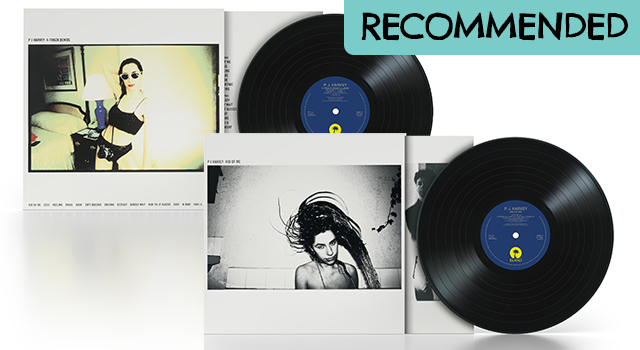
“Rid Of Me” and 4 Track Demos vinyl reissues, Originally released through Island Records UK in 1993, “Rid Of Me” was produced by Steve Albini and features the singles “50ft Queenie and “Man-Size”. The 4 Track Demos, also released in 1993, is a collection of demos recorded at home between 1991-1992 and presents a number of songs from “Rid Of Me” in their first incarnation. Artwork for both was shot by long-term creative collaborator Maria Mochnacz.
When Field Report’s Chris Porterfield started writing the follow-up album to 2015’s Marigolden, he was about to become a father for the first time. His forthcoming album Summertime Songs reflects all the anxiety, self-doubt, and hope that follow on from such a massive life change, but it also speaks to the context in which he was writing: the 2016 election.
The band’s sound adjusted for this new material. In the past, Field Report staked its name on the singer-songwriter’s M.O.: poetically charged lyricism confessed against an earnest guitar. On Summertime Songs, the bands casts its net wide, drawing in synths, up-tempo rhythms, and chromatic crescendos to electrify Porterfield’s lyricism with a resounding crackle. The opening song “Blind Spot” magnetically captures the moment a person can change another’s life. Porterfield describes himself in terms of space—“This heart is a cold cave, my mind is a parking lot”—but in recounting those absent places, he failed to account for the presence lingering in one. “You were in my blind spot,” he sings on the hook, the band’s backing vocals adding a touch of shoegaze.
Out this week, Summertime Songs is a remarkable step forward for Field Report, electrifying their music with a fresh undercurrent of emotion. Worry and talk—and talk about worry—have a special place within the singer-songwriter tradition, but so does physicality, movement, and life. “I love you in the low light baby, but let’s dance,” Porterfield sings.
The opening conversation in “Summertime Songs” is somebody asking “Why don’t you try summertime songs?’ and all of the things that that implies, which would be maybe more simplicity, maybe a little more upbeat, maybe a little less verbose. So there’s that, and then also me doubting my ability to be a good parent and maintain sobriety, and be as good as required for that kind of thing. It’s a bit Springsteen, it’s a big Arcade Fire, it’s a bit LCD Soundsystem, it goes into some soaring U2 stuff at the end, all tongue in cheek at first, but then it tied into this thing that felt right.
Little Cloud Records was founded in October 2016 by Mike Nesbitt, Josiah Webb and Mike’s twin brother, Joe. What started as a way to release Magic Shoppe records has become a vehicle for releasing vinyl for other bands we dig. This includes releases from Pete International Airport (Pete Holmström of Dandy Warhols), New Candys (dark psych rockers from Venice, Italy), The Orange Kyte (tripped-out Irish transplants living in Vancouver, BC), Firefriend (São Paulo psych warlords) , Heaven (Brooklyn based psych rock) and Arizona’s Wiccan Godesses, Burning Palms.
We’re partnering with a Portland, OR vinyl based plant and Joe runs a Chicago based printing facility. This allows us to produce all records, printing jacket design / printing and vinyl pressing in-house. We have been established by Cobraside in the United States and Fuzz Club Records in the UK. For digital distribution we use our own department to plaster your bit Across the usual suspects … like Spotify, iTunes, Google Play Music, Amazon Music, YouTube Music and many more.
With new record Bloody Lovely set to be released on Feb 2nd, DZ Deathrays are driving up a new avenue, exploring a “swagger-rock” sound that’s bigger and nastier than ever before.
The video for Total Meltdown saw you turning into three dimensional versions of yourself in an eerie, alternate reality,frontman Shane says about the song:
The song was written in two parts, originally when we were doing Blood On My Leather I had the riffs of Total Meltdown and I couldn’t finish any vocals for it. And I sort of had a mind meltdown after being under pressure in the studio so I wrote the verses about that, about having a mini meltdown but it’s not really that serious.
The chorus was then written maybe two weeks before we went into the studio, I had written six choruses for that song and was just screaming things into the microphone. So that’s why the chorus and verses don’t have any connection at all. It’s a big dumb rock song.
The upcoming record Bloody Lovely, had a more conscious decision to drop the dance beats from before. We just want this record to have more of a live feeling and a swagger-rock, poppy sound. It took us so long to write it but now its been done for a year I’ve forgotten how different it is from the rest of them. It’s a bit bigger and nastier and I think the songs are a bit more pop.
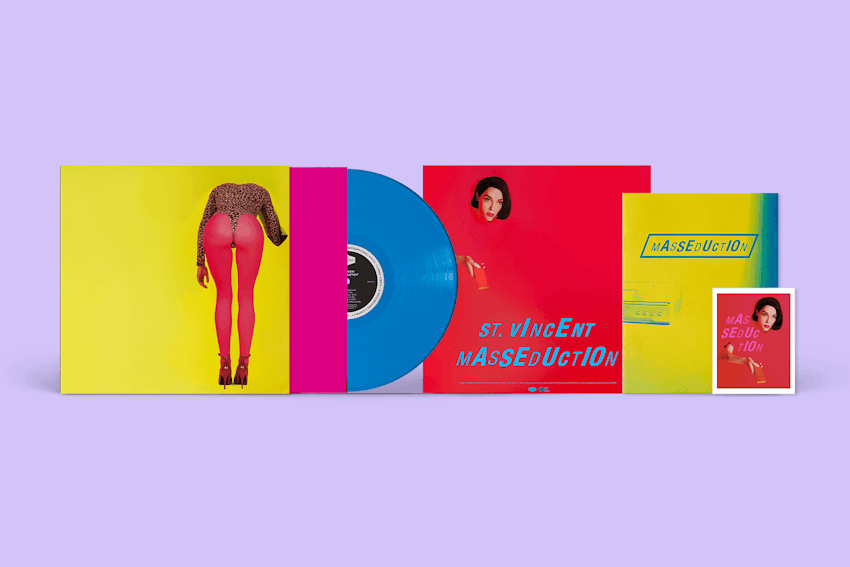
Masseduction, St. Vincent’s fifth solo album, is a neck-snapping magnum opus. Though dark, it avoids the kind of overdone, maudlin doom and gloom that mopes instead of shocks; it’s the most conceptually perfect and perfectly constructed album in a whole catalog incredible albums. Every second and noise is accounted for, but it’s not so stuffy that there isn’t air to breathe. Rather, the fester of drugs, fame, loss, sex, indulgence and suicide found on Masseduction are strained through Annie Clark’s signature clever grin. While other artists attempted high-concept album roll-outs in the last year, none did so as successfully or cohesively as St.Vincent’s Masseduction — in part because her themes are vital in our current cultural conversation. For her first album in three years, AnnieClark dissects sexuality, power dynamics, and fractured identity in an industry embroiled in assault and harassment. And though she addresses the loss of control head on, she asserts her own power and control without ever presuming either can be had. Masseduction is defiance writ large by exploring reality’s smallest and most pervasive pains.
Read through the write-ups on St. Vincent’s brilliantly Kubrick-esque new record and count up how many times the male producer of this record is mentioned. It is a weird level of ignoring the endless work St. Vincent has done cultivating her sound. From her early days in Polyphonic Spree to the perfect pop of Strange Mercy to that psychotic record with David Byrne to the new album Masseduction her most succinct statement, like it or not — St. Vincent has willed her vision into life. “Los Ageless” is her best song too. Well, that’s probably “Year of the Tiger”. But “Los Ageless” is her most succinct song, it’s her most well-executed song. It soft and delicate in its delivery while still being thrifty in its layers.
“New York” may be Annie Clark’s finest ballad, and the competition for that title is stiff. Her 2014 self-titled LP alone offered two credible contenders: “Prince Johnny” and “Severed Crossed Fingers”, the latter song being that masterpiece’s crowning achievement. But in an album packed with errant pop extravaganzas, “New York” stands in stark contrast as Masseduction’s grand and naked centerpiece.
Apart from a soaring gospel chorus, what makes “New York” so remarkable is its thematic plasticity. Is Clark lamenting the end of the early-aughts NYC music scene, recently documented (to great acclaim) by Lizzy Goodman? Is she mourning the death of David Bowie? Is she addressing her breakup with Cara Delevingne? The answer is, of course, all of the above and beyond.
“New York” is a classic composite song that, in the right light, fits this or that narrative. Which is to say, it’s universal, an elegy for many occasions, a multi-faceted opus. Choose your own adventure. But it only soars so high because Clark’s shattering melody can easily bear such a heavy burden, with weightlessness and might.
We named Los Angeles Police Department as a band to watch based on the strength of their debut album released in 2014 , and they followed that up with a string of singles over the last year, including “Insecurity,” “Water And Wine,” and “Hard.” Today, Ryan Pollie has announced that LAPD has signed to Anti- Records for a full-length coming later this year, and has since shared a new single called “The Plane 2.” It’s the most lush and ambitious thing that Pollie’s put out under the name yet, a gleaming declaration of devotion that crackles past the four minute mark before cutting out abruptly for a warm piano outro.
SoCal songwriter Ryan Pollie expertly weaves bedroom pop under the moniker Los Angeles Police Department. and is now gearing up to unveil his follow-up LP later this year.
Pollie’s first for label ANTI- (Japandroids, Neko Case), the record is being teased today with a new single called “The Plane 2”. A press release writes that it’s a love song “deeply adventurous in arrangement,” an apt description considering the loops and layers of twinkling xylophone, dusty percussion, and elastic synths.
The Wave Pictures return with a brand new, vinyl only album called A Season in Hull, due out on 12th February on their own label Wymeswold Records. The album was recorded on acoustic guitars in one room, with a bunch of their friends, live in to one microphone on singer Dave Tattersall’s birthday, January 28th, 2015. The songs were written as quickly as possible and the recording captures that specific moment in all its spontaneous, thrilling and immediate glory. As Tattersall elaborates: “That’s what this is – a one-microphone happy birthday recording.”









 The Fat Angel Sings