Greta Van Fleet have shared the latest single from their forthcoming album, “The Battle at Garden’s Gate”. “Heat Above” Rooted in the reality of these trying times, the song comes as an inspirational response to the ongoing negativity in the world. “There’s plenty of love left in this world, even though it may not seem like it,” bassist/keyboardist Sam Kiszka said in a press statement. “And that’s what ‘Heat Above’ is about, rising to the stars together.”
The song’s positive vibe paired with the typically triumphant delivery of Greta Van Fleet make “Heat Above” particularly grandiose. Vocalist Josh Kiszka continues to hit the high notes with ease, and the band sounds as confident as ever, building a soaring crescendo. While Greta Van Fleet initially drew comparisons to Led Zeppelin on their previous EPs and the debut album, the band appears to be exploring a more prog-rock sound on the new effort, with “Heat Above” even giving off some Rush vibes.
As Sam explained, the song bridges the gap between the band’s early material and the new album. “Well, in a way, it acts as a bit of a thesis in this whole body of work,” he told Zane Lowe in an interview for Apple Music. “And it really does, I think, particularly bridge the previous album with this newest album. Years in the making. This song has been years in the making. This particular track. I think it’s the oldest track on the album. We wanted to do the track for a while and just haven’t really gotten around to it. And we pulled it off the shelf, dusted it off and reformatted it and we did some other writing on it.”
The Battle of Garden’s Gate is the follow-up to the band’s successful 2018 debut, Anthem of the Peaceful Army. The previous single, the seven-minute “Age of Machine”, also showcased a more progressive side of Greta Van Fleet, while the first taste of new music, “My Way, Soon”, delivered a more breezy sound.
New album, “The Battle at Garden’s Gate,” available 4.16.21
Did you see Black Country, New Road at Future Yard festival in 2019? They were hot property even then, with just two singles to their name; now, they’re the most talked about band in the UK. The seven-piece’s debut album, For the first time, was released on Friday, and I’d be surprised if you missed it: the album was 6 Music Album Of The Day as well as Rough Trade‘s Album Of The Month; there was a Guardian interview, an Apple Music 1 feature and great reviews from NME and Loud And Quiet.
Black Country New Road’s thrilling debut – “For The First Time” – our February Record of the Month. It is aggressive and inspiringly searching music, they are doubtless one of the most exciting artists to have emerged in the last few years. It’s far from easy going, but it really is a must-listen. London post-rock septet Black Country, New Road hail from the famed Brixton Windmill scene (Fat White Family, black midi etc). ‘For the first time’ is their debut album and follows the highly-rated singles ‘Athens, France’ and ‘Sunglasses’. The engaging, literate lyrics contain stories of terrible sex and tabloid pop culture references whilst the music is reminiscent of Slint and Sonic Youth experimenting with jazz maybe.
Their much-anticipated debut album “For the first time” was released on February 5th 2021. Recorded with Andy Savours (My Bloody Valentine) during the early part of this year and then finished at the end of the nationwide lock-down, the album is the perfect capturing of a new band and all the energy, ferocity and explosive charge that comes with that whilst also clearly the work of a group who have no interest in repetition, one-note approaches or letting creative stagnation set in. Featuring six new songs including reinterpretations of early tracks “Sunglasses” and “Athens, France”, “For the first time” is a sonic time capsule that somehow manages to bottle the past, the present and the future.
“We wanted it to sound exactly how we love to sound live,” says saxophonist Lewis Evans. “This is basically representative of our first 18 months”, continues frontman Isaac Wood.
Indeed the band found they had to stop themselves running too far ahead in order to document this album in a way that felt as truthful as possible.
“We see this as being a stop in the road” explains Isaac. I’ve always been interested in a really honest portrayal of what a band is and what they’ve been working on. I think it’s really nice if people can see an artist like: this was them in the early days, this was their next phase and that they’re quite clear and honest about genuine progression as people and musicians.”
The band have today also shared the new track, “Science Fair”. Minimalist and foreboding, “Science Fair” opens around their rhythm section, precise percussion and bass locking in to allow a residual build from the rest of the band, viola and sax loop and layer over fits and squalls from dual guitars, a synth break and an ever-anxious narrative laid down by Isaac Wood. Climbing towards his desperate exclamation of – “it’s black country out there!” – the song caves in on itself during a blistering, caustic final breakdown. Already a live favourite, “Science Fair” is paired to a video directed by Bart Price who said the following about its themes:
“When developing the music video for ‘Science Fair’, I was thinking about fictitious worlds that we visit through our screens, such as the American high school. Despite our lack of direct experience, these worlds become a universal means of communicating about and understanding things like what it means to grow up, or what it means to be in a friendship group, or to be in love. I wanted to create such a world around Black Country, New Road, placing their music at the heart of a small American town, that in a sense we’ve all been to and lived in.”
Despite having just those two early singles to date, Black Country, New Road – their name originally found on a random Wikipedia generator – have made an impressive impact on fans and critics alike. Declared “the best band in the world” by The Quietus, with glowing reviews from The New York Times to The Guardian, a cover feature for Loud & Quiet, a live BBC 6 Music session, selling out shows across the country (including 1700 tickets in London), being invited to festivals around the world including Primavera and Glastonbury, and finding themselves on French TV sandwiched between Sonic Youth’s Kim Gordon and Radiohead’s Ed O’Brien.
Their live performances gaining legendary status among fans of the emerging scene that coalesced around vaunted south London venue The Windmill, and which gave rise to many of their peers and contemporaries such as Fat White Family, black midi and Squid, artists with whom they have variously supported, toured with and collaborated with over the years.
Taken from the album ‘For the first time’, released 5th February on Ninja Tune:
Fleetwood Mac have unveiled a Super Deluxe reissue of their 1980 live album, “Fleetwood Mac Live”. The LP captured the iconic line-up in top form at tour stops along their global trek in support of their 1979 studio album, “Tusk”.
Three songs from Tusk are featured on “Live!”, including “Sara,” “Over and Over” and “Not That Funny” – while the rest of the track listing included a selection of highlights from throughout the band’s storied career, including massive hits like “Dreams,” “Go Your Own Way,” “Don’t Stop” and “Rhiannon.”
The upcoming 3-CD/2-LP expanded reissue features a newly remastered version of the original 1980 release, plus more than an hour of unreleased live versions of classic Fleetwood Mac tracks, recorded between 1977 and 1982. The 14 live tracks that debut on the Super Deluxe Edition include “Tusk,” “Gold Dust Woman,” “Songbird” and “The Green Manalishi (With the Two-Pronged Crown).” The set also includes a bonus 7-inch single featuring previously unreleased demos for “Fireflies” and “One More Night”
An unreleased live performance of “The Chain” recorded in Cleveland in 1980 is available now as a digital download/streaming services.
The Fleetwood Mac Live: Super Deluxe Edition is presented in a 12 x 12 rigid slipcase and comes with a booklet filled with rare photos, a full itinerary for the “Tusk” Tour, plus a history of the live album by writer David Wild. He writes: “Then and now, Fleetwood Mac Live artfully marks a fascinating time period for a group that, in one form or another, has been on the global stage for more than half a century… It’s a wildly entertaining rock ’n’ roll circus in full swing under a big tent of the band’s own creation as they leave audiences dazzled in locales from Paris, France, to Passaic, New Jersey.”
The majority of the original album was recorded live between 1979 and 1980, save for a few exceptions: “Don’t Let Me Down Again,” was recorded in 1975 during the tour for Fleetwood Mac;Dreams” and “Don’t Stop” are from the band’s soundcheck in Paris; while “Fireflies,” “One More Night,” and a cover of the Beach Boys’ “Farmer’s Daughter” were all recorded in California during a special show for the band’s crew, family, and friends.
In addition to the Super Deluxe set, a special limited Tour Edition will also be available. With only 1,000 copies being released, this set adds a replica ticket, backstage pass, ad, button, sticker and iron-on patch from the era to the collection.
Sub Pop Records has signed Hannah Jadagu, an 18 year-old singer, songwriter, and producer from Mesquite, Texas, to release her music throughout the known universe. Her first release is the sprightly indie pop single “Think Too Much”. As for how the song was produced, the incredibly resourceful Jadagu recorded “Think Too Much” using her iPhone 7, an iRig, a microphone, guitar, and Garageband iOS, a process that has served her well throughout her young recording career.
“‘Think Too Much’ is the only song that I’d written with the intent of putting it on an EP,” Jadagu says. “Sonically, I was challenging myself to make a song that was high energy, fun, and a ‘bop,’ as I like to call it. At the time, I remember listening to a lot of Dayglow, Jean Dawson, and Winnetka Bowling League, and thinking to myself, ‘These people are making such catchy and fun songs without even trying.’ Then I thought to myself, ‘You’re really thinking too much.’ I asked all my friends what they thought about ‘too much,’ compiled their responses, chose some fun chords and rhythms inspired by Snail Mail and Phoenix, and went to work.”
She continues, “Essentially the song is a conversation with myself, as heard through the chants and the ‘kids voices,’ which is just my voice recorded in different pitches and tones. The lines ‘You’re just getting started, you’re the coolest I know’ were inspired by one of my favourite teachers in high school. She never actually taught me, but she was the young, cool teacher that would come into my leadership class, and we would bond over music and stylistic choices (Shout-out, Ms. Drillette). After letting go, and using a scrapped guitar demo I had, I was able to finally write and produce ‘the bop’.”
Sub Pop first became aware of Jadagu in early 2020 via her Soundcloud recordings “Unending” and “Pollen.” While growing up in the Dallas suburb, she began making music at home, as a fun and creative outlet. Bedroom pop artists like Her’s, Gus Dapperton, Yeek, and Sales served as inspiration, as did listening to mixtapes in the car that her mom made, while they drove around town.
“When I was in elementary school, I would always finish my work early to play on the computers and use GarageBand on the early Macs,” Jadagu says. “That was my first glimpse into music production. Then, I gravitated towards percussion and school choirs, even joining the Children’s Chorus of Greater Dallas.”
The multitalented Jadagu currently resides in New York City, and is in her first year attending NYU. She will release her debut EP later this spring. Hannah is definitely just getting started, and we could not be more excited.
Armed with a freer, more collaborative approach to both writing and recording, Teleman‘s 11-track album “Family of Aliens”, is a fluid collection of glorious pop-songs fluent with new electronic textures and united by the sharp lyricism, buoyant guitars and instantaneous melodies that are synonymous with Teleman.
Teleman’s third studio album is the alluringly named Family of Aliens.
“We want to keep evolving and keep discovering. This band is one long journey for us, and we never want to stop developing and finding new ways of creating music. I’m always wanting to better what we’ve done before. To go deeper, to find something more beautiful, more catchy, more challenging, more interesting … just more.”
It’s evident the much-loved quartet have evolved, cultivating and honing their sound as a very-welcome and anticipated proposition for 2018.
Oscar-nominated composer and songwriter Owen Pallett releases “Island”, an album of lush and shimmering orchestral textures, that explores the very essence of what it is to be alive. “Island”, the latest album from Oscar-nominated composer and songwriter Owen Pallett, released on Domino / Secret City Records (Canada). Almost entirely acoustic, Island begins with 13 darkened chords and was recorded live at Abbey Road Studios with the London Contemporary Orchestra. The introduction is the sound of waking up alone and on the shore of a strange land. What follows is a shimmering and luscious orchestral album that draws across the full breadth of Pallett’s discography, from ‘Heartland’’s Technicolor to the glittering, fingerpicked guitar that marked Pallett’s first records with their trio, Les Mouches.
Recorded live at Abbey Road Studios with the London Contemporary Orchestra, Pallett draws across the full breadth of his discography from Heartland’s Technicolor to the glittering, fingerpicked guitar that marked Owen’s first records with the trio, Les Mouches, he has produced an album of such celestial, lush orchestral beauty, that once lost you may wish to be never found.
“Owen Pallett’s new album may be his best yet” The Quietus” A gorgeous, immersive listen” Clash 8/10
Owen Pallett – “Paragon of Order”, taken from the album ‘Island’, out now on Domino / Secret City.
What it was not was a vocational interest—at first. Carly Simon embarked on the path of higher education via Sarah Lawrence College initially; when she wasn’t attending classes, Simon wrote songs for her own enjoyment. At the behest of her second eldest sibling Lucy, Carly was soon conscripted into The Simon Sisters—the winsome folk duo cut three albums between 1964 and 1969 across the Kapp and Columbia labels. Limited chart success drove the pair to amicably part and return to their pre-Simon Sisters lives.
Flitting through a series of side jobs among them a counselling position at the Indian Hill Camp in Western Massachusetts, circa 1969—Simon kept writing material. In the spring of 1970, journalist Jacob Brackman a close friend and future creative compeer to Simon, organized a dinner party at which the enterprising musician crossed paths with manager Jerry Brandt. Taken with Simon, he offered to represent her as a client. Shortly thereafter, her demo made its way to Jac Holzman, proprietor of Elektra Records.
Like Brandt, Holzman sensed that Simon had the potential to make a mark, but he and his freshman artist each held very different views on how to actualize this opportunity. Holzman felt Simon was better suited singing other people’s songs; Simon saw herself as an “in-house talent”—or plainly put, a stock lyricist. For Simon, the anonymity of being a songwriter for Elektra would afford her artistic autonomy without having to conventionally venture back into the public eye. This impasse didn’t endure for long.
Considering all the pros and cons of her situation, Simon bravely stepped into her role as the leading lady behind Carly Simon. Labour on the long player commenced in the late fall of 1970 with its reveal earmarked for February of 1971. Eddie Kramer, a proven producer whose work with Jimi Hendrix had thrilled audiences, was put forward to steer Carly Simon at Holzman’s suggestion Simon agreed. Jimi Hendrix producer Eddie Kramer may seem an odd choice to helm a singer-songwriter collection, but the combination works, with folk-rock and string arrangements framing Carly’s voice beautifully. The material is also remarkably assured, offering nuanced looks at the ebb and flow of relationships
Because Simon was not only a songwriter, but an arranger too, her working relationship with Kramer was occasionally fraught with tension the two weren’t always in agreement over the compositional direction for “Carly Simon”. A balance was dutifully sussed out though and Kramer did his best to cast a sound for the album so it could communicate Simon’s ethos effectively.
Opening with the evocative chamber pop of “That’s the Way I Always Heard It Should Be” and closing on the amber-hued folk of “The Love’s Still Growing,” these two selections and the eight in between are presented unassumingly by Simon. And yet, a dichotomous air of purpose lingers over Carly Simon the intent of its titular heroine to demonstrate her eclectic stylism cannot be disguised. Kramer pulled out all the stops with an expert crop of session instrumentalists under his direction bringing fullness and colour to each track, but Simon also made sure she wasn’t obstructed as a singer. Her vocal instrument which spins from dusky to silvery tones plays well against the demure psychedelia of “Another Door,” the genteel country of “Rolling Down the Hills” and the bluesy rock of “Just a Sinner.”
That latter cut was one of three entries on Simon’s self-titled debut not to bear her writing-composing stamp, along with “The Love’s Still Growing” and “Dan, My Fling,” which were penned by Mark “Moogy” Klingman, William “Buzzy” Linhart, Fred Gardner and Jacob Brackman, respectively.
Brackman’s script for “Dan, My Fling” was loosely based on Danny Armstrong, a former flame of Simon’s. That she intimated this real-life tale to Brackman and trusted him to translate it to song form with Gardner spoke to the strength of their shared personal-collaborative bond. Simon and Brackman partnered again on “That’s the Way I Always Heard It Should Be,” the lead-off single from Carly Simon.
Prior to signing with Elektra, one of the post-Simon Sisters gigs the singer-songwriter held down was with the National Broadcasting Company or as it was commonly known, NBC. Simon was scoring “Who Killed Lake Erie?,” a documentary special regarding lake pollution that aired in 1969. Said special is where the musical seeds were sewn and later repurposed for “That’s the Way I Always Heard It Should Be.” With the haunting, orchestral accompaniment in hand that was to give Simon her first formal chart smash, she reached out to Brackman for assistance.
A bold inquiry into the viability of the institution of marriage, the song story drafted for “That’s the Way I Always Heard It Should Be” came out of the many discussions Simon and Brackman had about the inevitable matrimonial transition relationships took. Although she did not write “That’s the Way I Always Heard It Should Be,” Brackman’s narrative guidance ensured that it stayed in Simon’s voice. It was the perfect anthem for a generation coming of age during the ever-evolving Women’s Liberation Movement.
Barring “Reunions,” an ethereal anecdote on friendship written in a three-way split by Simon, her close friend Billy Mernit and Kramer, the remaining words and arrangements for “Alone,” “One More Time,” “The Best Thing,” “Another Door” and “Rolling Down the Hills” sprung solely from her imagination. A vivid sense of curiosity, emotion and power permeates these pieces where Simon continues to explore all the finer points of love and the general human condition. Simon’s entries—and those that she did not create herself hang together superbly and promised that Carly Simon would be a cohesive listening experience.
Simon made quite a splash in the inaugural quarter of February 1971 with both Carly Simon and “That’s the Way I Always Should Be.” The album and single wowed pundits who correctly denoted Simon as an instant sensation to rival the likes of Joni Mitchell and Carole King her two eventual peers whose first LPs had already made landfall in 1968 and 1970. Some reviewers, unmoved by Simon’s charms, snarked that her project was too coifed and poised, a supposed by product of her “well-to-do” background. That small bit of negative critical chatter did not keep Carly Simon from selling solidly. When Simon netted two GRAMMY Award nominations in 1972 for Best Pop Female Vocalist and Best New Artist, it served to further cement her standing as a rising star; she won in the latter category.
What followed that maiden affair was a wealth of commercial, critical and creative triumphs. But it all began with “Carly Simon”, a sensual and intellectually charged collection that announced Simon not only as a woman of the moment, but a figure set to endure for decades to come.
Happy 50th Anniversary to Carly Simon’s eponymous debut album “Carly Simon”, originally released February 9, 1971.
With recording as basically the only medium in which to experience new rock bands these days, the full-throated belting and high energy antics which work on-stage aren’t always the way to tap into an audience’s feelings. The truth is, the opposite tactic does the trick. Today, from our homes, we seek connection, communion, and acknowledgement that all this isolation is hard. And giving into the gloom – even just for the length of one, intimately recorded EP – can be more of a cure than ignoring the darkness by pumping your fist.
“All Night” was fully recorded and produced in Loveland, Colorado, though IsadoraEden’s residential history includes New Orleans, Brooklyn and her current home, Denver. The soft elocution in her young, muted alto reflects this well-travelled soul; one who’s stories we believe regardless of how few words they contain or how many years they took to accrue. Together with co-writer/band-mate Sumner Erhard, Eden builds thoughtful musical structures and well-woven instrumental textures throughout.
All Night’s producer, mixer and mastering engineer Corey Coffman (Gleemer, Slow Caves, Corsicana) should be given due credit for framing Eden’s minimalistic, melodic exhilations with just the right amount of dramatic rock beauty. Like a shoegaze-y Soccer Mommy cloaked in timid sincerity, Eden’s voice offers sad solidarity to those who will listen, while she, Erhard and Coffman carry her shy messages on the shoulders of stately guitars, dignified drums and echoey atmosphere.
oh my… yet another brilliant new band out of Ireland… Turnstiles hail from Galway and last month they released their self-titled debut EP. It is four tracks of tense, minimal, scathing political punk rock and it is outstanding. Brooding anger fills the every note, excellent lyrics articulate the rage. My favourite track is the blistering “In A State” One of those tracks that says everything I love about Music. I hope I get to see this live.
‘The Turnstiles’ begins so manic like, with the piercing and talented drumming by Luke Mulliez setting up ‘Something To Die For’ so epically. There is a a ferocious amount of passion and grit on the opener, with the guitar lines being both manic and determined. Straight off the bat we hear how ballsy Turnstiles are and it feels like we have been hit out of the park already by their sound.
‘Just Bleed’ may enter more calmly but still has the same intentions as the previous song, a Fontaines DC like bass intro by Jake Tiernan starts everything off, with the band later entering the fray, in a piercing nature. The mixing of the drumming sends chills down my spine and of course Callum’s passionate vocals does too. There is such an aura with this song, which is something that a lot of Post-Punk bands are doing so well, it really reinforces the focused and important lyrics.
The driving nature on ‘In State’ is infectious, the conviction and thought provoking lyrics is also noteworthy as they are rather impressive. The guitar work by both Colm Sweeney and Cillian Ryan are a standout, the lead runs along the rhythm guitar so well…they feel like they are as one and move like they were human the chords and notes.
On ‘Omniscient Delusion’, the gritty catchy riff is playful and angrily passionate, while the bass punches through so well. Again the lyrics are interesting, the commentary of how the world is dealing with endless potential of information at our fingertips is indeed interesting. The impact of that great potential is overwhelming and the band do really well at talking about this whole topic, especially with how large they deliver it.
The Galway 5–piece band have finally released their debut, self titled EP, which is filled with angst, infectious conviction and at points, catchy hooks. Here we find frontman Callum Mitchell delivering thought provoking lyrics with pure passion and desire, as his vocals punch through the bands loud sound so enticingly that reinforces the bands purpose and aims.
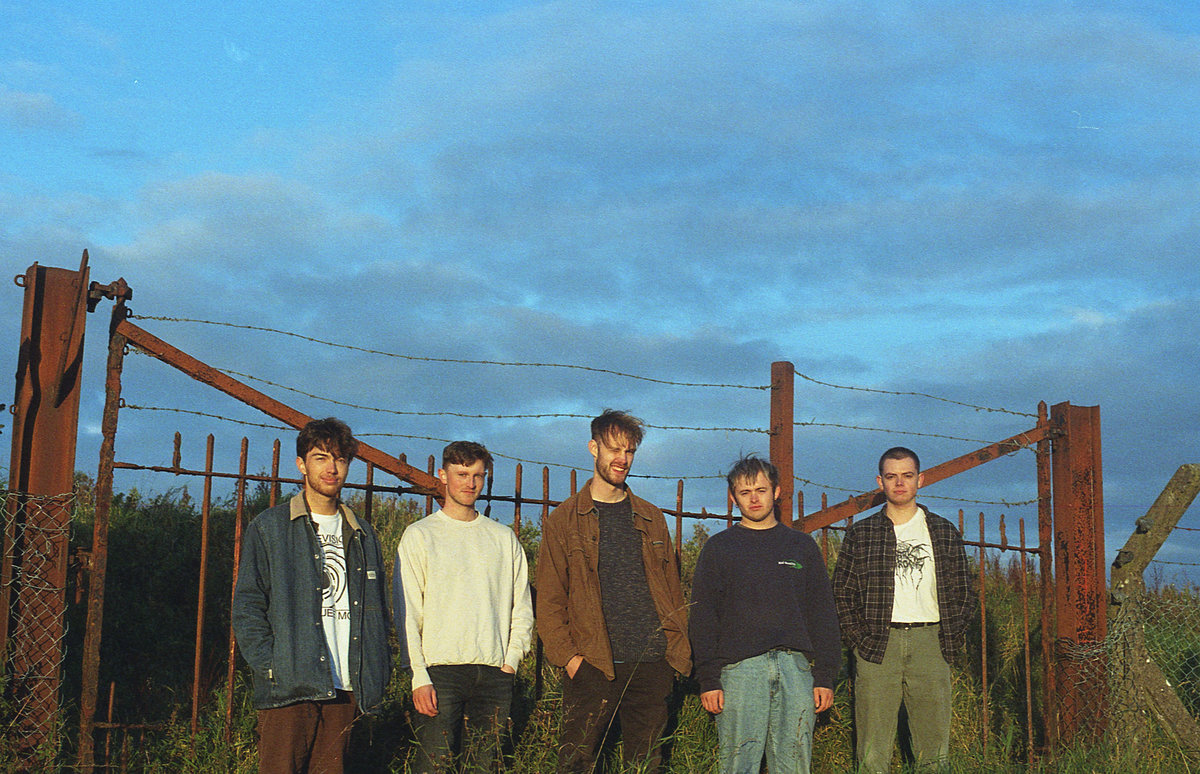
Cillian, Callum, Jake, Colm and Luke from Galway City. In a year where we couldn’t play live, writing and recording this project has been our sole focus and we hope that comes through in the music. We started playing together in 2019.
When Carole King began her career in the late 1950s, Phil Spector had just begun to redefine the sound of pop. Elvis dominated the US charts, rock’n’rock was here to stay – at least. King records her first songs with a certain Paul Simon, marries Gerry Goffin in college a little later and makes music with him. The two had their first hit in 1960 with “Will You Love Me Tomorrow” for the black girl group The Shirelles. For the duo, it’s the beginning of a steep career: The Monkees, Aretha Franklin and Dusty Springfield all have their numbers at Rolodex. But the two separated in 1968, King moved to California and tried to boost her still moderate career as a performer. She collaborates with Joni Mitchell and finds a new composition and studio partner in James Taylor, who also accompanies her on her debut on guitar. This is what she soberly calls “writer”. She can write songs after all, but she doesn’t like the role as a potential pop star.
Originally released on February 10th, 1971. Carole King’s “Tapestry,” surely one of the greatest singer-songwriter albums of all time…abetted by Joni’s wonderful voice, of course….
She will nevertheless be one when “Tapestry” is released in February 1971, on which you can also hear the song co-written with Taylor, which will later shape the “Gilmore Girls”. The album becomes one of the best-selling in history, but the others usually collect the fame. “You’ve Got a Friend” becomes world-famous in his simultaneously released version of Taylor, “(You Make Me Feel) Like a Natural Woman” is still remembered by most as an Aretha Franklin number and even “Where You Lead” celebrated its greatest commercial success in the interpretation by Barbra Streisand. King probably won’t have bothered her any further, because she is also more songwriter than singer on “Tapestry”, interested in the perfect pop formula and what can be expressed in it. That’s a lot about twelve songs precisely because King’s approach is characterized by telling reduction.
This does not mean, however, that “Tapestry” is not exactly the stylistic patchwork promised in the title. Starting with the thunderous blues of “I Feel the Earth Move” or “Smackwater Jack” over the quasi-soul of “It’s Too Late” to the piano-emphasized ballads, King absorbs the essence of this and that genre, integrating it with quite reduced means – piano, sometimes guitar, drums, bass, less often supplemented by other instruments – in songs that do not seem to make much concessions to this or that convention. , but to express their own standards. It’s all about song writing, not individual self-expression. To pop music in its purest form. The arrangements are waterproof, solos are hardly any and if they are, they are short. “Tapestry” is in its own way an album without ego and thus an absolute anomaly of its time and beyond.
This can be seen above all in King’s singing. It’s not expressive, it’s inductive: big gestures, wild phrasings, there’s no such thing on this album. A lot of content in a few words. After all, it is not a question of communicating a singular emotional world in the most impressive way possible, but of finding an expression of the general from the individual. The lyrics deal almost exclusively with absences and the desire for presence, for love, friendship, human bonds and desires. The big pop themes, that is, which in 1971 have already completely overstretched and merged into words. Why King’s lyrics take on almost small-talk character at times and thus circumvent the pathos: “So far away / Doesn’t anybody stay in one place anymore” is the motto at the beginning of “So Far Away”. At first, this reads not for personal sensitivities, but for an all-too-familiar commonplace: a casual, annoyed remark in which much resonates – anger, powerlessness, despair. In “Tapestry” many such phrases are woven in, which in themselves mean nothing and in the context of King’s songs everything. Better, because simpler lyrics were hardly written in pop history.
King was and is a hit supplier who turned others into pop stars with her music and, as if by mistake, became one herself. “Tapestry” is full of songs that, once they’re in it, don’t go away so quickly. However, it is also an outstanding album, which with a lot of modesty transfers big themes into songs that after a long time resemble a coming home. Even if in the meantime they become independent as earworms and eventually begin to annoy. Because that’s really big pop. It was rarely larger than on “Tapestry”
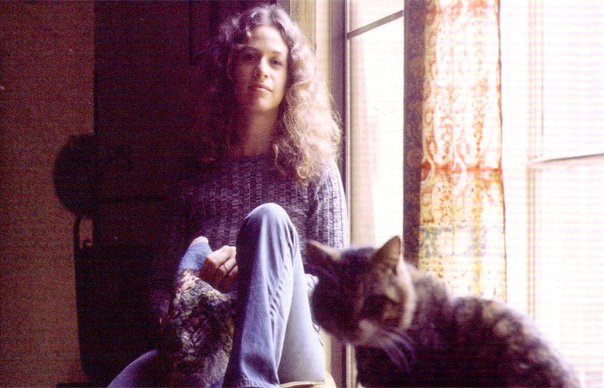
The cover photograph was taken by A&M staff photographer Jim McCrary at King’s Laurel Canyon home. It shows her sitting in a window frame, holding a tapestry she hand-stitched herself, with her cat Telemachus at her feet.
Legendary voice and songwriter born in Brooklyn in 1942. She released 20 albums between 1970 and 2012







 The Fat Angel Sings