One month and 20 shows into his 1980 tour,Bruce Springsteen took a turn east, from Los Angeles to Arizona. The River, his new two-record set, had reached the top of the charts, which should have put anyone in the best of moods. And even though he was about to play to a Phoenix audience that had supported him going back to 1974, something must not have been sitting well with him as the sun came up on November 5th. On stage that night in Tempe, he would tell the crowd, “I don’t know what you guys think about what happened last night, but I think it’s pretty frightening.” It was the day after the landslide election of Ronald Reagan.
That historic event and the performance it helped inspire have been central threads in the Tempe 1980 story. Another is the knowledge that footage of the legendary concert existed, the missing counterpart to the multi-track audio used just once, for “Badlands” on Live/1975-85.
Now, for the first time anywhere, 35 years later to the day, fans can see a complete song from the fabled concert. The film itself, part of the anniversary box set The Ties That Bind: The River Collection, comes out on December 4th. In an exclusive first look, we present an excerpt from that two-hour-and-40-minute Tempe 1980 concert film: not “Hungry Heart” or “Badlands,” but “Ramrod.”
“Ramrod” has always stood out. It was among the first River songs Bruce Springsteen performed (in Pittsburgh, one of the last stops on the 1978 tour), and it was the last great stretch of rock on the album. Its concert arrangements have varied, from straight-down-the-middle on the River tour, to acoustic rave-ups, whether solo in 2005 or with the Sessions Band in 2006. As recently as last year, anyone who wants to know the time will find out soon enough after Bruce tells the E Street Band, “Let’s roadhouse!”
On The River, Springsteen set up “Ramrod” not as a rambunctious, pile-driving encore, but as the lead in a series of goodbyes, casting that entire LP side — the last of four, rather than the two he had intended only a year before — as “summational.” Until that detail was revealed in the initial coverage of the new box set, one might never have put two and two together quite that way. But it was that attention to detail, sometimes woven into songs that might otherwise come off as simple rockers, with which The River cut a deep bed.
Few songs typify the 1980 E Street Band better than “Ramrod.” To the car, the girl, and the story arc, Bruce joined a live-in-the-studio sound he’d been seeking, including a rich Clarence Clemons solo and the complementary work of Roy Bittan and Danny Federici. Max Weinberg called it his favorite song to play. As the tour went on, “Ramrod” gained prominence, often serving as the set-up for “Rosalita.”
Watching it 35 years later, the first thing one notices about “Ramrod” is the array of wonderful viewing angles. Director Thom Zimny says that a four-camera crew captured the evening’s proceedings. Numerous vantage points, including wide shots from the back of the floor, show a vintage performance in ways no other video release has before Tempe. One might easily conclude more than four cameras were present: they seem to be everywhere.
That results in stunning moments, from a zoom to the audience through the Big Man’s wide stance, to a close-up of Bruce and Miami Steve at the mic and Bruce’s fancy footwork at the end. The interplay between the band members is remarkable, and so is the plain-as-day fact that they’re having fun up there. For any longtime fan, the ability to watch what was previously only a listening experience is astounding.
In part, Tempe’s legend stems from its availability: a decent soundboard recording of this night has long circulated among fans (though it can’t compete with Bob Clearmountain’s new juggernaut mix from the original multi-track audio tapes). And speculation about the existence of a video component has bolstered its reputation. But the show’s rep (Springsteen performed 18 of the new LP’s 20 songs in Tempe), and a clamoring for footage, ultimately comes down to the intensity of the performance.
As he’s told it over the years, Springsteen wasn’t exactly enthused about being filmed, fearing interference with his audience. But it’s good that he tolerated it to the extent that he did; 35 years later, we have a treasure on our hands. Tempe captures a transition, a moment where Springsteen was still largely content to let the music do the talking for him.
Watch “Ramrod” a time or two, and that becomes apparent. A film crew can’t hurt, it turns out; elections and hit songs come in handy, too (at the time, “Hungry Heart” was well on its way to becoming Bruce’s first Top Ten hit). More than anything, what shines through is the pure, unadulterated joy of Bruce Springsteen and the E Street Band playing rock ‘n’ roll, like they could do it ’til half-past dawn. –
The Ties That Bind: The River Collection, which includes the Tempe 1980concert film with more than two-and-a-half hours of the 11/5/80 performance, is just one month away. Thanks to Backstreets magazine.
Demob Happy – Dream Soda
For every histrionic ‘Rock is Back!’ headline coined in the wake of Royal Blood’s anomalous chart success, there’s a band like Demob Happy, to whom it never occurred that rock was ever anywhere but in the marrow of their bones. Like the first, best, Queens Of The Stone Age record, the Brighton group’s debut album is a riotous, vomit-crusted affair. Rocks & reminds us a bit of Nirvana – both excellent qualities!
Armed only with an arsenal of guitars and northern chips on their slender shoulders Brighton’s rising garage rock force Demob Happy have this year asserted themselves as one of the UK’s most exciting new bands. Drawing on the likes of Nirvana, Queens of The Stone Age, Melvins, The Beatles, The Stooges and Kyuss for source material, their off-kilter pop music constantly stretches beyond their genre to create a spontaneous clatter of fresh and exciting sounds. They have retained accolades with recent single ‘Wash It Down’ and lived up to NME’s declaration that the band are delivering “some of the most riff-heavy songs of recent years”, having also been championed by the likes of The Independent, DIY, Best Fit, The 405, BBC Radio 1, 6 Music and XFM.
Breakup records are nothing new. They’re one of the most practiced concoctions in pop music today but every now and then, one comes along that pushes the art form in new directions. “Deep in the Iris”, the third album from Montreal trio Braids, is one such album. Rather than continuing the evolution of their former sound—as displayed on 2013’s stark, searing “Flourish//Perish” the band instead takes a softer, sunnier approach. While the lyrics are as cutting and introspective as anything you’ll come across, the music is anything but. Departing from jarring arrangements, the band employs warm Björk-esque beats and inviting rhythmic soundscapes as a backdrop to Raphaelle Standell’s stunning vocal work. Deep in the Iris doesn’t so much explore new depths as it does new heights. It isn’t the sound of fracturing, but the healing process.
Braids “Deep In The Iris” LP
Out 28th April on Arbutus Records / Flemish Eye.
There’s placid grace to Deep In The Iris, the third and latest full-length by Braids, but don’t let that fool you. Something’s churning beneath the album’s calm, cool surface. Unlike Flourish // Perish, the Montreal trio’s icy, challenging record from 2013, Deep In The Iris represents a thaw: Throughout its nine songs, singer RaphaelleStandell-Preston and her cohorts Taylor Smith and Austin Tufts art-rock with melodic allure, confessional directness and quivering warmth. Where Flourish // Perish used prickly electronics and cavernous arrangements to hold humanity at arm’s length,Deep In The Iris turns those same elements into lulling hymns to cleansing and redemption. Braids is not only more approachable than ever; it’s downright magnetic.
Her breathy vocals, as liquid and acrobatic as ever, elevate a line that in lesser hands would have seemed clichéd. Meanwhile, the band underscores the bittersweet melancholy with hypnotic patterns of percussion and synths. The hooks are subtle, but they’re huge.
That boldness, both instrumentally and lyrically, is even more striking in “Miniskirt.” In the past, Standell-Preston has couched her lyrics in a haze of poetic abstraction; here, she goes for the throat, calling out misogyny, the male gaze and the language of slut-shaming with piercing, confessional force. The song could almost pass as an epic R&B ballad, at least at first: After a sumptuous, stadium-worthy intro, it corkscrews through a tangle of jittery beats and atmospheric eeriness that never wanders into self-indulgence. Even within the album’s most complex and confrontational track, there’s an immaculate pop edge that mesmerizes.
By the time “Warm Like Summer” bursts into a dazzle of soulful croons, glimmering loops and shuffling drums, it appears that the album’s springtime release is no accident: This is the sound of renewal and regrowth, as joyful and as painful as that can be. In “Letting Go,” Standell-Preston sings with dreamy contentment, “We laid on the bank and had our fill.” On the lush, stuffed-to-bursting Deep In The Iris, Braids has done exactly that.
Of anyone in the band, David Gilmour had the most trepidation about creating an individual experimental piece for the studio disc of Ummagumma. And he ended up with the best thing on the project. The three-part suite repurposes an existing tune for the rustic opener, but Gilmour’s guitar steamrolls through the middle portion before landing on a George Harrison-ish bit of space-twang for the climax.
The official video for ‘Careful With That Axe, Eugene’ by Pink Floyd recorded live in Brighton and originally released on the ‘Ummagumma’ album.
From 1969, Ummagumma was the band’s first double album and has one of their most iconic cover images. Ummagumma is an eclectic mix of both live and studio recordings.
The album was re-mastered in 2011. Go to http://www.whypinkfloyd.com for more details. UMMAGUMMA, the 1969 album from Pink Floyd celebrates its 46th anniversary today.
Using a unique concept, the first disc is a live album taken from their set list at the time and the second contains solo compositions by each band member. A double album by the English progressive rock band Pink Floyd. It was released on 25 October 1969, through Harvest Records. The artwork was designed by regular Floyd collaborators Hipgnosis and features a number of pictures of the band combined to give a Droste effect.
Although the album was well received at the time of release, and was a top five hit in the UK album charts, it has since been looked upon unfavourably by the band, who have expressed negative opinions about it in interviews. Nevertheless, the album has been reissued on CD several times, along with the rest of their catalogue.
Although the sleeve notes say that the live material was recorded in June 1969, the live album of Ummagumma was recorded live at Mothers Club, Erdington Birmingham on 27th April 1969 and the following week at Manchester College of Commerce on 2nd May of the same year as part of The Man and The Journey Tour. The band had also recorded a live version of “Interstellar Overdrive” (from The Piper at the Gates of Dawn) intended for placement on side one of the live album, and “The Embryo”, which was recorded in the studio before it was decided that the band members each come up with their own material.
The studio album came as a result of Richard Wright wanting to make “real music”, where each of the four group members (in order: Wright, Roger Waters, David Gilmour and Nick Mason) had half an LP side each to create a solo work without involvement from the others.Wright’s contribution, “Sysyphus”, was named after a character in Greek mythology, usually spelled “Sisyphus”, and contained a combination of various keyboards, including piano and mellotron. Although initially enthusiastic about making a solo contribution, Wright later described it as “pretentious”. Waters’ “Several Species of Small Furry Animals Gathered Together in a Cave and Grooving with a Pict” contained a variety of vocal and percussion effects treated at various speeds, both forwards and backwards, and was influenced by Ron Geesin, who would later collaborate with both Waters and Pink Floyd. Waters’ other contribution Grantchester Meadows was a more pastoral acoustic offering and was usually played as an opening to concerts over 1969. Gilmour has since stated he was apprehensive about creating a solo work, and admits he “went into a studio and started waffling about, tacking bits and pieces together”,although part one of “The Narrow Way” had already been performed as “Baby Blue Shuffle in D Major” in a BBC radio session in December 1968. Gilmour said he “just bullshitted” through the piece. He asked Waters to write some lyrics for his compositions, but he refused to do so. Mason’s “The Grand Vizier’s Garden Party” featured his then wife, Lindy, playing flute, and Mason playing a seven-minute drum solo
The cover artwork shows a Droste effect featuring the group, with a picture hanging on the wall showing the same scene, except that the band members have switched positions.The cover of the original LP varies between the British, American/Canadian and Australian releases. The British version has the album Gigi leaning against the wall immediately above the “Pink Floyd” letters. At a talk given at Borders bookstore in Cambridge on 1st November 2008, as part of the “City Wakes” project, Storm Thorgerson explained that the album was introduced as a red herring to provoke debate, and that it has no intended meaning. On most copies of American and Canadian editions, the Gigi cover is airbrushed to a plain white sleeve, apparently because of copyright concerns; however, the earliest American copies do show the Gigi cover, and it was restored for the American remastered CD edition. On the Australian edition, the Gigi cover is completely airbrushed, not even leaving a white square behind. The house used as the location for the front cover of the album is located in Great Shelford, near Cambridge.
On the rear cover, roadies Alan Styles (who also appears in “Alan’s Psychedelic Breakfast”) and Peter Watts were shown with the band’s equipment laid out on a runway at Biggin Hill Airport. This concept was proposed by Mason, with the intention of replicating the “exploded” drawings of military aircraft and their payloads, which were popular at the time.
Song titles on the back are laid out slightly differently in British vs. North American editions; the most important difference being the inclusion of subtitles for the four sections of “A Saucerful of Secrets”. These subtitles only appeared on American and Canadian editions of this album, but not on the British edition; nor did they appear on original pressings of A Saucerful of Secrets.
The inner gatefold art shows separate black-and-white photos of the band members. Gilmour is seen standing in front of the Elfin Oak. Original vinyl editions showed Waters with his first wife, Judy Trim, but she has been cropped out of the picture on most CD editions (with the original photo’s caption “Roger Waters (and Jude)” accordingly changed to just “Roger Waters”). The uncropped picture was restored for the album’s inclusion in the box set
Pink Floyd David Gilmour – lead guitar, vocals, all instruments and vocals on “The Narrow Way” Nick Mason – percussion, all instruments (except flutes) on “The Grand Vizier’s Garden Party” Roger Waters – bass guitar, vocals, all instruments and vocals on “Grantchester Meadows” and all instruments on “Several Species of Small Furry Animals Gathered Together in a Cave and Grooving with a Pict” Richard Wright – organ, keyboards, vocals, all instruments and vocals on “Sysyphus”
After a collection of two EPs released earlier this year, this is a revelation of a debut: stunning, fully-formed, suffused with wintry atmosphere, As a female singer-songwriter whose palettes are artpop and synth-pop, the comparisons come fast and inevitable: one-time label mate Grimes (the comparisons end there), the avant-pop likes of Julia Holter, and, of course, Kate Bush—in particular, and of all things, Bush’s work with the Trio.Bulgarka
Yet Julia Ainsworth’s vision is singular. “Candle” is an orchestral piece blown to bits by a backmasked digital gust. (If . has a characteristic trick, this is it.) “Moonstone” periodically sounds about to turn into a Purity Ring song at half-speed, but settles as an otherworldly almanac of words and sounds. “Malachite” is the kind of gothy synthpop dozens of more seasoned artists have failed to get this gloriously right. “Take Your Face Off” doesn’t seem like it should work, swooping through cello gloom, R&B melisma, sunsoaked keyboard lines, and twitchy synth lattices, it evokes Tori Amos (in a couple places, Ainsworth channels near-exactly some Amos inflections that aren’t that common), Dawn Richard (another doppelgänger, in her low range and songwriting ambition) and the Art of Noise And, somehow, it all coheres. It’s intricate enough to reward close listening and immediate enough in its pleasures to sound astonishing from listen one; during its best moments, “Right from Real” is breathtaking in the best way: the way where you didn’t know music could do this.
The world is fucking huge! That realization usually hits us sometime in our teens, and we start to come to terms with the fact that we’ll never get to go everywhere we want to go or do everything we want to do. It’s such an old way of thinking when we’re young setting ourselves up for disappointment before anything happens and Girlpool’s debut often feels like yearning for a life that’s too short. The duo is out there seeing the world now, but this album was mostly written before any of that seemed like a possibility. They sound both impossibly young and already world weary.
The debut album by Girlpool came out 1st June 2015 (2nd June in the US) on Wichita Recordings worldwide.
Available to pre-order now on Wichita store – CD + LP includes a signed poster, Directed by Allyssa Yohana. Taken from Girlpool’s debut album, “Before The World Was Big”, Cleo Tucker and Harmony Tividad, the two members of this band, are products of LA’s still-teeming DIY punk scene, but they don’t have to play loud to be heard. And they’ve since relocated to recent DIY mecca Philadelphia, but while they’re nearly as tuneful as their big-sister band Waxahatchee, they haven’t lost any of their basement-hardcore urgency. Instead, they sing songs about feminism and friendship and fucking assholes, their voices in nyah-nyah close harmony over their minimal guitar-and-bass backdrops. They don’t have a drummer because they’re too punk to need a drummer.
Remember the time Bono wasn’t an arena rock god? It’s hard to believe that there was the time whenU2 were a small Irish band emerging from the Post-Punk scene—back when they started their career over 35 years ago, on this day (October 20th) with an amazing debut album called Boy. Recorded over a time span of five months, by a band that borrowed a lot from their peers – namelySiouxsie and the Banshees, from whom they pilfered the Glockenspiel sound that defines their first hit single “I Will Follow”, andJoy Division, whose producer MartinHannett was supposed to produce U2’s debut album. but after Ian Curtis’ untimely death, however, the Factory Records sound engineer was unfortunately too distraught to do so. Despite this, Steven Lillywhite’s production is quite remarkable, and it’s had to imagine “Boy” sounded any different than it turned out to be.
There are many stories to be told about U2’s excellent debut record – one being that the band nearly disbanded because of their Christian faith which didn’t really promote being in a rock band, and another regarding their close connection to the Virgin Prunes – and that the brother of Prunes guitarist Guggi, Peter Rowen, is the boy on the album cover as well as Dik, the Prunes’ drummer, being U2 guitarist The Edge’s brother, and so many other stories.
In case anyone forgot, let it be written there – this is a celebration of a band that has been amazing and rightfully went on to achieve huge success, becoming one of the biggest bands of all time, ad giving us great tracks such as Stories For Boys, The Electric Co., An Cat Dubh, I Will Follow or Out Of Control – just on this album alone—which is now considered a classic. Before Bono went became some sort of mutation of The Fly, U2 went on to release equally strong, sometimes even stronger releases like October, War, The Joshua Tree, Rattle and Hum or Achtung Baby. Nevertheless, U2’s youthful debut is my favorite album of the band, displaying the band’s youthful take on Post Punk, Wave and their influences while already letting glimpses of what they could become shine through their seemingly naive playfulness.
Simple Minds “ONCE UPON A TIME” – RELEASED 30 YEARS TODAY:
It was 30 years ago today that thisalbum was released “Once Upon A Time” . One of their best best seller’s no doubt. The memories of making it, and then seeing it do so well the world over, will always stay with us. As will our thanks to all who supported us by buying and listening to the music contained within “the vinyl grooves” The best years of our lives? It was certainly among them. Onwards and upwards! Jim Kerr.
In December 2015, multiple formats of the album will be re-issued in Box Set form
The original 8-track album on one CD (remastered)
The original 8-track album on one LP (remastered)
2CD Deluxe edition (2-CD set, second CD includes single mixes, b-sides, remixes and live recordings)
Blu-ray version of the album (audio only), with surround mixes of the album
Super Deluxe 5CD/1DVD set (includes both discs from the 2CD Deluxe Edition, plus another disc of rarities, b-sides and remixes, two discs featuring Live in the City of Light. DVD contains 5.1 Surround and Stereo mixes of the original album plus promo videos)
Once Upon a Time is the seventh studio album by Simple Minds, originally release 1985
Although already successful in their native UK and Europe, the band had also now become popular in the US, mainly due to the Keith Forsey-penned “Don’t You (Forget About Me)” which appeared on The Breakfast Club soundtrack and had become a No.1 hit there. However, the band deliberately left the track off the album due to their reluctance to record it. Four singles were taken from the album; “Alive and Kicking” (UK No. 7, US #3), “All the Things She Said” (UK No. 9, US #28), “Sanctify Yourself” (UK No. 10, US #14), and “Ghost Dancing” (UK #13). The album topped the UK charts, and peaked at No.10 on the US charts (5 consecutive weeks in Top 10 of Billboard and 16 weeks in Top 20).
The album was available with two covers upon its original LP release. The alternate cover uses the back image for the front and vice versa. It also moves the Simple Minds logo to the right of the cover. The two cover images fit together when placed side by side or above each other, and the release of the album in British record shops saw the two covers placed in a grid, alternating like the two colours on a chessboard. The album cover was standardised for the original CD release and this version has since been used for the various reissues of the album. A limited edition picture disc album was also released.
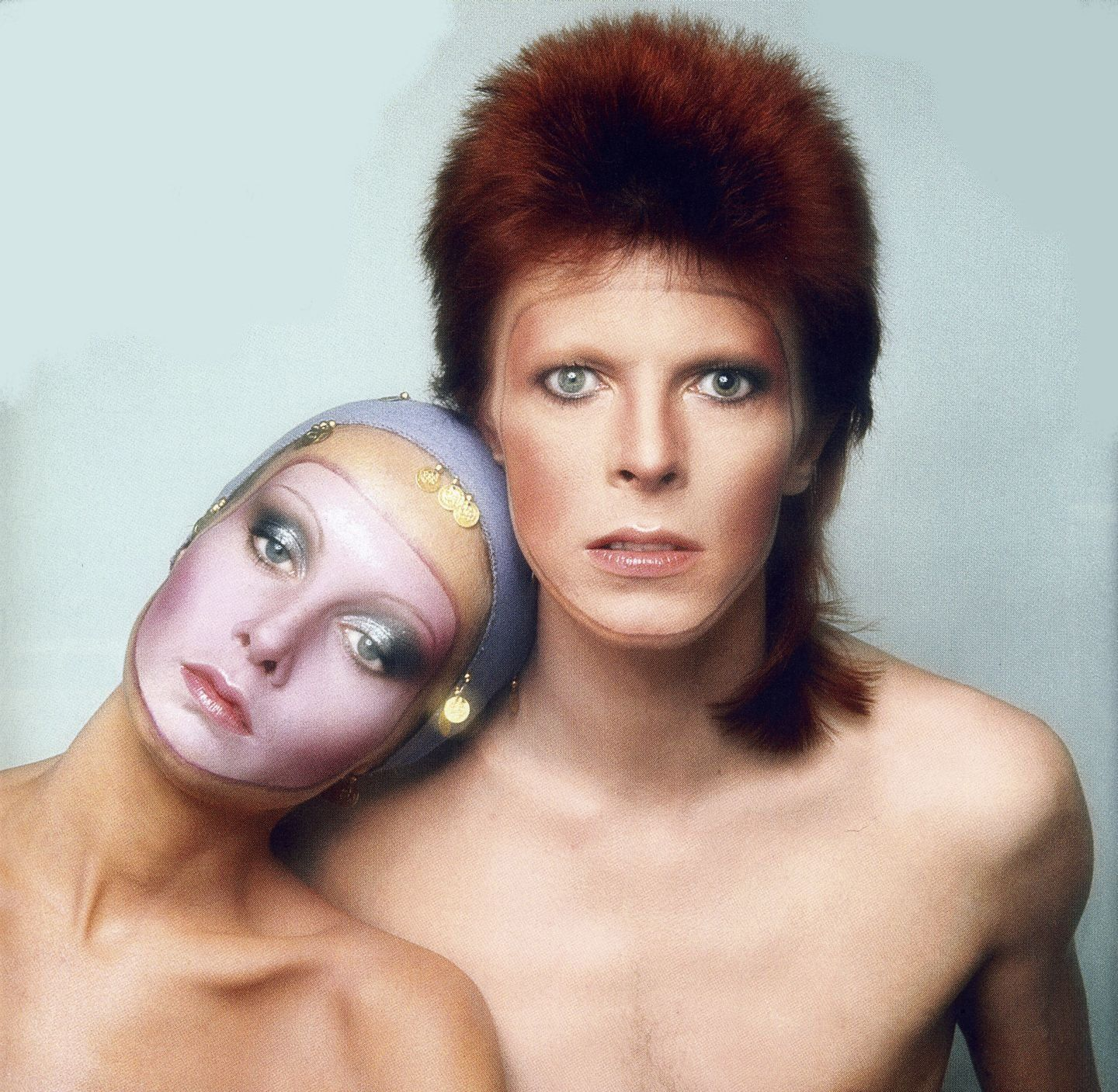
David Bowie: “Pin Ups” is the seventh album by David Bowie, released on October 19th, 1973. It reached and topped the UK Albums chart.
“Pin-Ups” is Bowie’s tribute to the artists that he admired in the London years of 1964-67. It is the last time that Bowie would record an album with Mick Ronson on guitar and Ken Scott at the production helm. “Pin Ups” was Bowie’s last studio album with the bulk of ‘The Spiders From Mars’, his backing band throughout his Ziggy Stardust phase; Mick Woodmansey was replaced on drums by Aynsley Dunbar.
“Pin-Ups” is the underrated classic in David Bowie’s glam-era crown. A lot of Bowie’s own fans overlook and even disdain it, citing everything from the politics that led to its creation (of which, more shortly) to the absence of any fresh Ziggy classics on board.
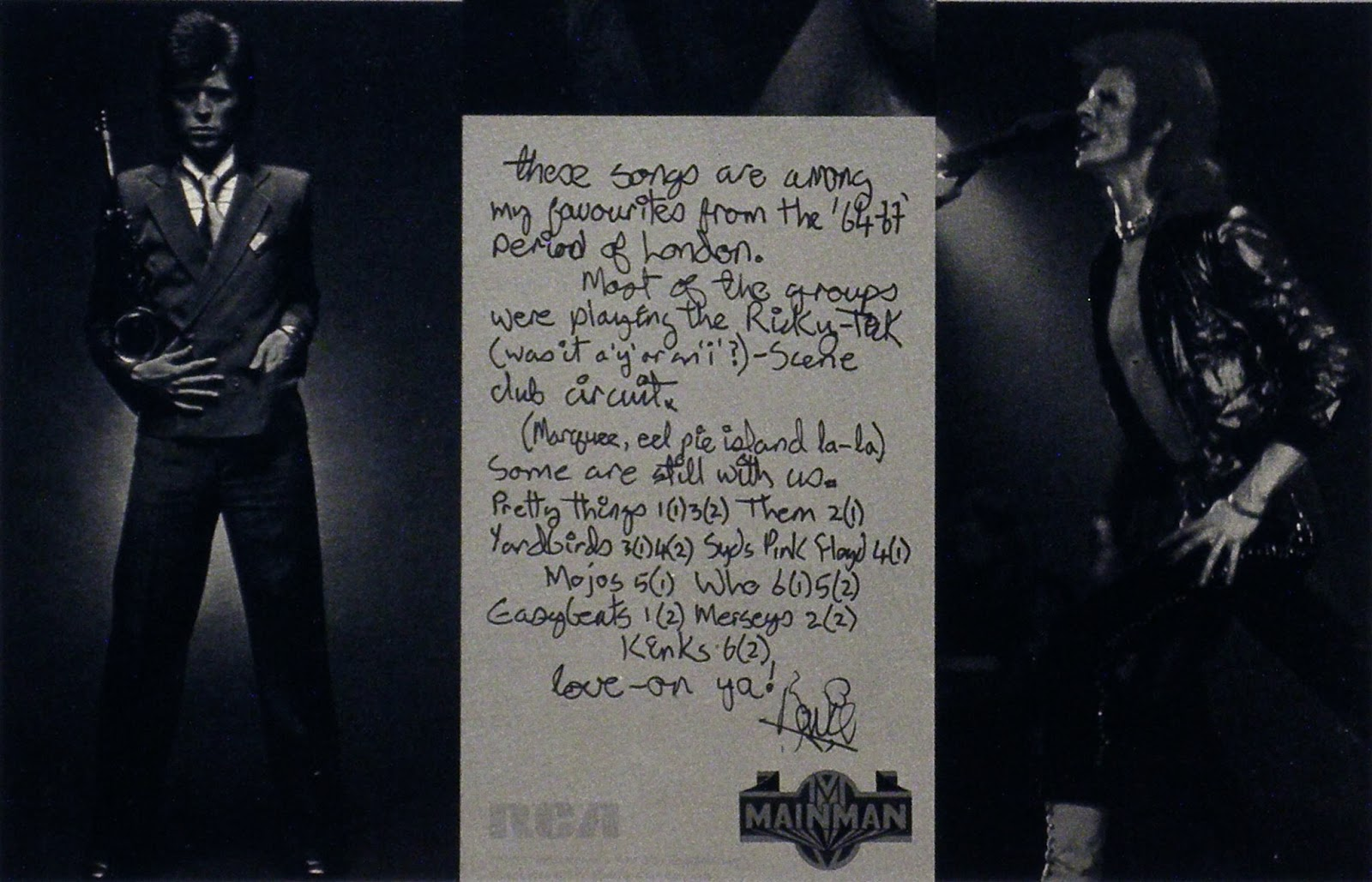
Outside of the U.K., it must be said, a degree of cultural bias also plays a part in the album’s dismissal. For British listeners of the time (and even today), most — if not all — of the album’s contents were recognizable hit singles, the key exception being a Kinks B-side. And what records they were — two apiece by The Yardbirds, The Who and the Pretty Things, individual cuts by The Kinks and Them, The Easybeats and The Mojos, The Merseys and what Bowie referred to as “Syd’s Pink Floyd.”
It seems incredible today, but not one of them was 10 years old at the time Bowie swooped upon them — Floyd’s “See Emily Play” was barely six! But, already, they felt like relics from a different era, which of course they were. The calendar might insist it took just a decade for rock to reach from the beat boom to glam rock, but in musical terms it might have been centuries, with both psychedelia and progressive rock having enjoyed their heydays in between.
Bowie was still hot off his July 1973 “retirement” when he headed over to the Château d’Hérouville studios in France to begin work on his next album, the successor to the now four-month-old (!) “Aladdin Sane”. Behind the scenes, however, matters were fraught. A dispute with his publishing company, Chrysalis, had effectively sent the writer out on strike — a situation, of course, that Chrysalis assumed could have just one winner. Bowie was contracted to deliver another LP before the end of the year. What was he going to do — record a bunch of cover versions?
Some of the bands, he pointed out, “are still with us….” and indeed they were. The Who and The Kinks were both alive and kicking, the Pretty Things were poised on the cusp of a comeback, and Pink Floyd were celebrating one of the biggest albums of the year (and now of all-time), “The Dark Side of the Moon“.
The beast that cut that epic, however, was very different from the one that created Bowie’s selection; “See Emily Play” was just their second 45, from spring 1967, and was penned by their original principle songwriter, Syd Barrett — and he certainly wasn’t still with us. Rather, two years had elapsed since Barrett’s last public appearance, in an age when two years seemed a very, very long time, and the rumours of his so-called “madness” were already beginning to circulate.
The idea behind “Pin Ups” was to create a pause between Bowie’s intense conceptual albums “Ziggy Stardust”, “Aladdin Sane” and “Diamond Dogs“. In order to do so, he recorded a cover album, without losing the glam rock atmosphere.
But that was not true for all territories — in the United States, for example, only four of the originals even made the Top 40. A few more may have been familiar from their parent LPs, but still… what Bowie designed as a seamless examination of a specific period of time and place was easily translated into a hopelessly random gathering of unknowns and obscurities.
“Pin-Ups” alone can truly be said to capture the spirit of the days it evokes, as well as the music. “Pin-Ups”took an honest look at the songs’ impact on one generation, and effortlessly engineered them to have the same effect on another. And “Pin-Ups” alone made you want to hunt out the original records, just to hear what Bowie himself heard in them.
Within the MainMan organization established by Bowie’s manager Tony Defries, Jayne County was seething. “I had given David a set of demos, only for David to decide it would be better to do this album of covers. He thought that was a great idea. We would do songs by [Iggy] Pop, Alice Cooper, the Velvets, Nico, and one of his own. And it would probably have been a great album, but even that he just talked about for a few weeks before going off to do something else… which turned out to be “Pin-Ups.”
Over at Island Records, meanwhile, Bryan Ferry — whose own band, Roxy Music, had been opening for Bowie just one year earlier was contemplating his own collection of favoured oldies.
There was no correlation whatsoever between the two records; while Bowie focused on a narrow window in the mid-1960s, Ferry swept up a more catholic (not to mention idiosyncratic) gaggle, dating back to 1935 (the title track) and forward to the end of the ’60s (“Sympathy for the Devil”).
Nevertheless, for a few weeks that summer, the watching world was treated to the quite unedifying spectacle of two top pop stars battling it out over who came up with such a notion first. There was even talk of legal action, with each party apparently assuming that the other was out to steal their thunder, and it was surely only the sheer stupidity of the entire feud that ultimately saw it sink from view. At least, one hopes that’s what it was because, in truth, the only people who really had a bone to pick were The Sweet. They’d been talking about making a covers record for over a year.
It’s unclear precisely when Bowie hit on the final vision for “Pin-Ups”, although it was certainly on his mind in the days following his retirement concert. One report even reckons he sat up late that night, playing through old records and concocting a running order there. Nevertheless, when another NME writer, Charles Shaar Murray, visited the studio, he spotted the sheet music to Roxy’s “Ladytron” lying around, while rumour insists that they also taped The Beach Boys’ “God Only Knows” (hopefully making a better job of it than Bowie did on “Tonight”, a decade later), The Lovin’ Spoonful’s “Summer in the City” and The Stooges’ “No Fun.”
However, the only confirmed extra was the backing track for a version of the Velvet Underground’s “White Light/White Heat,” a song that had been a part of Bowie’s live set for much of the last 18 months. In any event, it remained unheard until guitarist Ronson took it for his own second album, 1975’s “Play Don’t Worry”, and, in any case, they also recorded versions of Bowie’s own “Watch That Man” and “The Man Who Sold the World” for release as Lulu’s next single.
Neither does there appear to have been much discussion over which songs would be recorded, with the only known casualty being Bowie’s own contribution to 1967, “The London Boys,” which he intended slicing up to form bridges between tracks on the album (he eventually returned to the song in 2000, during the sessions that became “Toy“). Plus, it would have fit the “Pin-Ups” concept perfectly.
“Pin-Ups” was recorded with much the same team as Bowie had employed throughout his golden years — producer Ken Scott, guitarist Mick Ronson and bassist Trevor Bolder, plus keyboard player Mike Garson, sax player Ken Fordham and backing singer Geoff MacCormack.
Spiders from Mars drummer Woody Woodmansey, however, had been let go, to be replaced for the sessions by Aynsley Dunbar — a player whose own pedigree on that ’60s circuit was as bold as any of the songs he was now rerecording. In fact, as a member of the Merseybeat band The Mojos, he’d actually played on one of them, “Everything’s Alright”!
The sessions were smooth; Dunbar aside, the personnel had been working together for over three years at this point, and they slipped immediately into their expected roles.
The choice of material, too, delighted them all Ronson, for example, had been a massive Yardbirds fan during the 1960s, and just weeks after jamming with Jeff Beck at the farewell show (a surprise, he admitted, that he had in no way expected), he was thrilled to be re-creating two of their early masterpieces, a version of Billy Boy Arnold’s “I Wish You Would,” which was a single for the band’s Eric Clapton incarnation, and “Shapes of Things,” a massive hit for the Beck era lineup. Plus, as Yardbirds drummer Jim McCarty, cowriter of the latter, later remarked, “Bowie introduced us to a whole new generation of fans, some of whom had barely stepped out of their nappies when we made those records.”
Bowie, too, played favourites with the spotlight. Two Who numbers, “I Can’t Explain” and “Anyway, Anyhow, Anywhere,” he explained at the time, reminded him of his days as a mod, “wearing clothes that no one else was wearing” (a decade later, little had changed!), and liking The Who because “they were kind of like us,” albeit clad in outfits that were “five months out of date. They were our band because they were very mod.”
The Pretty Things were another lingering passion. “David used to follow the band when we started out,” the Pretties’ late frontman Phil May said in 2013. “Every gig we did at the very start of our career, he was always there, just soaking up everything.
“But he wasn’t like a normal fan. I thought first of all, maybe he’s gay, or maybe he’s a stalker, because he was very different from the other fans. He was obviously very bright, very sensitive and very shy — I never would have thought he’d turn into Ziggy! But he was just absorbing everything,” And that included the passion of the Pretties’ first two singles, “Pin-Ups” opening “Rosalyn” and, later in the cycle, “Don’t Bring Me Down.”
“Here Comes the Night” (Them), “Friday on My Mind” (the Easybeats), the Floyd and Mojos numbers each one was painstakingly disassembled, and then thoroughly rebuilt. For “Pin-Ups” was never an exercise in the nostalgia that traditionally permeates ventures such as this. Rather, it was as if Bowie was asking, if these bands were starting out now, with the same players and the same songs, what would they sound like? It is unlikely that he was wrong in the majority of his conclusions.
The Kinks’ “Where Have All the Good Times Gone” is the clincher. Underpinned by the lascivious grind of Ronson’s guitar, the epitome of glam rock’s most subversive instincts, Bowie sings with genuine wistfulness, more so even than Ray Davies on the 1965 original. It is as if he, Bowie, knows that an era is ending — not only for the Spiders, whose last album this would be; not only for glam rock, whose day was slowly closing; but also for himself.
“Pin-Ups” was the last album Bowie would make for which he would neither be second-guessed by the critics or questioned by the industry. It was also the last upon which he could simply be himself, before the ch-ch-ch-chameleon image he had so carefully cultivated over the previous two years began — as he always knew it would to bite back.
The face on the cover of “Pin-Ups”, with 1960s model Twiggy (“Twig the Wonder-kid” from “Aladdin Sane’s” “Drive-In Saturday”) resting her head on his shoulder, was still recognizably Ziggy Stardust. True, when you flipped the sleeve over, you encountered a live shot that MainMan photographer Leee Black Childers complained resembled “a chicken liver sculpture,” but we remained in familiar territory.
Henceforth, however, every new album would demand a new persona — Halloween Jack, Philadelphia Soulboy, Thin White Duke, Berlin Hermit, New Romantic Clown, Trendy Restaurant Waiter — and it would be a new century before Bowie could return to such relaxed pastures again. Where had all the good times gone, indeed.
It’s ironic, then, that on an album that positively bristled with epic performances of immortal songs, the best known should be the one that least merits it a place in such company — “Sorrow,” a mawkish ballad that was initially composed for The McCoys by the American songwriting team of Bob Feldman, Richard Gottehrer and Jerry Goldstein. (It was covered in the U.K. by TheMerseys.)
The Easybeats (Australia) and Them notwithstanding, “Sorrow” was the sole “foreign import” on the album; more importantly, it was the only song not penned at least partially under the influence of the British beat boom, as opposed to the American pop market, and it sticks out a mile.
Released as a late 1973 single, however, it reached No. 3 in the U.K., No. 2 in Ireland, and topped the chart in Australia, New Zealand and South Africa. It was still turning up in Bowie’s live set a decade later, and when the BBC Proms gave over an evening to the songs of David Bowie following his passing, “Sorrow” was the only cut from “Pin-Ups” that made it into the show (performed by John Cale). And it still sounded out of place.
For a lot of people, however, that’s what the entirety of “Pin-Ups”is out of place, a makeweight novelty space-filler that Bowie knocked out between the serious business of performing his own songs.
Which is a shame because, in many ways, it’s one of the most honest records he ever made. “This is me,” it says, “and this is the music I loved.” No great statements, no artistic license (compare anything from “Pin-Ups” with the grotesquely overwrought take on “Let’s Spend the Night Together” on “Aladdin Sane”), no overarching concept. Just a series of snapshots of the 1960s London club scene, and a night with one of the greatest jukeboxes in the world.
So, what are the chances of “Pin-Ups” receiving the same box-set treatment that predecessors “Space Oddity” and “HunkyDory” have received, and Ziggy and “Aladdin Sane” likely will? Probably slim. Whether the fault lies with scheduling reasons, unforeseen delays or simply sheer bloody-mindedness, the popular assumption that every successive Bowie album would have its 50th anniversary marked with a deluxe edition has already swerved horribly off-piste.
At the time of writing, we are 11 months into Ziggy’s jubilee year, and we’re only now getting a box set of its predecessor. Assuming a Ziggy set makes it out in 2023 and “Aladdin Sane” in 2024, that places us halfway through the decade before “Pin-Ups” even gets looked at, by which time the Bowie universe will be celebrating 50 years of “Fame,” while demanding to know what happened to the “Diamond Dogs” box.
There are certainly a few scraps that would make entertaining bonus material, most prominently the 15-minute promotional “Pin-Ups Radio Show”, featuring five songs from the album plus Bowie’s thoughts on the subject. It could include the three songs Bowie performed during the 1980 Floor Show NBC TV special in October 1973 — “I Can’t Explain,” three takes of “Everything’s Alright” and… you guessed it, “Sorrow.”
There’s the original Chateau cut of “I Can’t Explain,” ditched in favour of a new, slower version recorded at Trident Studios, London; the Velvets track; and maybe (or maybe not) there are the aforementioned rumored recordings. But in truth there really wasn’t time to mess around with too many songs. Interviewed in 1986, Ronson recalled the process as one of the most straightforward sessions he’d ever played.
“We had the records, we knew the songs, and the arrangements came together in the studio. It was just a quick run-through, then press record and next!” The entire record was completed in three weeks, during which time they also recorded the Lulu single and mixed the tapes of the farewell gig. Even the “Sorrow” B-side, Jacques Brel’s “Amsterdam,” was recorded close to two years earlier (although that hasn’t stopped it making the bonus tracks on sundry CD reissues).
Adventurously, a few of Bowie’s other stabs at mid-1960s covers could be considered he tackled The Who’s “Pictures of Lily” in 2001, and The Kinks’ “Waterloo Sunset” in 2003. Add the aforementioned Stones number, and live renderings of The Beatles’ “Love Me Do” and Cream’s “I Feel Free” but no. Different moods, different times, different intentions.
What else is there, though? There are no radio sessions, no latter-day remixes and, at least so far as we know, no deathbed demands that someone rip the original master tape to shreds and then rerecord it as a different album entirely.
None of the faithful standbys that have sustained other posthumous Bowie packages are out there.
What there is, on the other hand, is a near-pristine, almost perfect and utterly unvarnished glimpse inside the musical mind of the single greatest British rock superstar of the 1970s. And, if anybody really wants to mark its anniversary, how about a compilation of the 12 original singles that Bowie stacked up to play while compiling the album?
Bowie’s liner notes explained the thought process behind the songs he was recording. “These songs are among my favourites from the ’64-’67 period of London. Most of the groups were playing the [Ricky Tick]-Scene club circuit. [Marquee, Eel Pie Island, La La].”