Manic Street Preachers will reissue their 2007 album Send Away The Tigers in May as a 10th anniversary edition that offers a wealth of audio and video bonus material.
The ’10 Year Collectors’ Edition’ is a 2CD+DVD bookset that offers the original album (remastered by James Dean Bradfield), unheard demos, a bonus disc of b-sides and rare tracks and a DVD packed with content, including the band’s full Glastonbury set, promo videos and rare/unseen footage from rehearsals.
It’s worth noting that the band appear to have ‘done a Morrissey’ (aka ‘doing a George Lucas’) and fiddled with the album. According to track listings on the official site, Underdogs is now removed (although the demo is included) and replaced with Welcome To The Dead Zone, which was originally an extra track on CD2 of Your Love Alone Is Not Enough.
The bonus disc is fairly similar to the 2009 ‘4REAL’ reissue although two versions of Umbrella, acoustic renditions of Send Away The Tigers and Your Love Alone Is Not Enough (with Nina and James), plus the four tracks ‘live at the O2’ are not repeated on this new anniversary edition. Similarly, this new set has three or four selections not on the Japanese set (plus the demos and DVD of course).
This set comes packaged in a book which looks very similar to the book presentation of the album deluxe editions that started in 2009 with Journal For Plague Lovers. Nicky Wire has also contributed handwritten lyrics and imagery from his personal archive.
A gatefold 2LP vinyl edition not only includes all those unhead demos on the second LP, it actually includes an extra one not on the 2CD+DVD set – I’m Just a Patsy (cassette home acoustic demo). This includes a download codes.
Send Away The Tigers 10-year collector’s edition will be released on 12th May 2017. Note: There was a limited number of signed editions available from the Manics’ store but it must have been a very small quantity since they’ve all sold out within 3 hours of the official announcement!
Bob Dylan’s first album can hardly be faulted. It is a brilliant debut, a performer’s tour de force on an album called Bob Dylan, he was a somewhat typical-sounding folksinger who revealed little of the originality and revolutionary spirit that would guide further albums like “Highway 61 Revisted, Blonde On Blonde and Blood On The Tracks, making him one of the most significant artists of the past 100 years.
Of the 13 songs found on Dylan’s self-titled debut, only two were written by him. Another handful were traditional tunes on which Dylan gave himself arrangement credit. But seeing that those two originals “Talkin’ New York,” done as a talking blues, a popular form among folksingers of the era, and “Song to Woody,” a tribute to musical hero Woody Guthrie written in Guthrie’s very own style , were far from original, the release of Bob Dylan on March 19th, 1962, which hardly seemed like a monumental event at the time. Seventeen songs were recorded, and five of the album’s chosen tracks were actually cut in single takes (“Baby Let Me Follow You Down,” “In MyTime of Dyin’,” “Gospel Plow,” “Highway 51 Blues,” and “Freight Train Blues”) while the master take of “Song to Woody” was recorded after one false start. The album’s four outtakes were also cut in single takes. During the sessions, Dylan refused requests to do second takes. “I said no. I can’t see myself singing the same song twice in a row. That’s terrible.”
Even now, the record bears few hints that the wobbly-voiced singer backing himself on acoustic guitar and harmonica would, in just a few short years, alter the course of folk music, pop music and rock ‘n’ roll.
The album was recorded over two days in November 1961 in a New York City studio with legendary producer John Hammond, whose long career included pivotal roles in shaping the musical legacies of Benny Goodman, Billie Holiday and Springsteen . He had met Dylan just a couple months earlier, when the young musician was enlisted to play harmonica on a record by folksinger Carolyn Hester. The album was ultimately recorded in three short afternoon sessions on November 20th and 22nd (1961). Hammond later joked that Columbia spent “about $402” to record it, and the figure has entered the Dylan legend as its actual cost. Despite the low cost and short amount of time, Dylan was still difficult to record, according to Hammond. “Bobby popped every p, hissed every s, and habitually wandered off mike,” recalls Hammond. “Even more frustrating, he refused to learn from his mistakes.
Dylan was absorbing an enormous amount of folk material from sitting and listening to contemporaries performing in New York’s clubs and coffeehouses. Many of these individuals were also close friends who performed with Dylan, often inviting him to their apartments where they would introduce him to more folk songs. At the same time, Dylan was borrowing and listening to a large number of folk, blues, and country records,
Hammond immediately signed Dylan, who began to search for songs that would make up his first album. Most of them were pretty familiar numbers to the singers and budding songwriters who hung around the New York City folk clubs Dylan frequented. Traditional favorites like “In My Time of Dyin’,” “Man of Constant Sorrow” and “House of the Rising Sun” were among those laid down in mostly single takes in late 1961.
Bob Dylandidn’t make much of a dent with music fans upon its release. In fact, it didn’t even make the albums chart. But it was a learning experience for the singer-songwriter, who was quickly finding his voice among the bustling folk scene. He was loved by his contemporaries, and soon he had enough confidence to perform his own songs in his own style.
Almost 15 months later, Dylan returned with “The Freewheelin Bob Dylan”, which included mostly original songs like “Blowin’ in the Wind,” “A Hard Rain’s a-Gonna Fall” and “Don’t Think Twice, It’s All Right.” The link to his debut was there, but it was almost like a new artist had emerged over the course of a year. It was a new Dylan this time out, and his legend was just around the corner.
Side one
“You’re No Good” – Jesse Fuller 1:40
“Talkin’ New York” – Bob Dylan 3:20
“In My Time of Dyin’” – trad. arr. Dylan 2:40
“Man of Constant Sorrow” – trad. arr. Dylan 3:10
“Fixin’ to Die” – Bukka White 2:22
“Pretty Peggy-O” – trad. arr. Dylan 3:23
“Highway 51” – Curtis Jones 2:52
Side two
“Gospel Plow” – trad. arr. Dylan 1:47
“Baby, Let Me Follow You Down” – trad. arr. Eric von Schmidt 2:37
“House of the Risin’ Sun” – trad. arr. Dave Van Ronk 5:20
“Freight Train Blues” – trad., Roy Acuff 2:18
“Song to Woody” – Bob Dylan 2:42
“See That My Grave Is Kept Clean” – Blind Lemon Jefferson 2:43
The indie rock sound is massively popular in Glasgow right now, to the point where it can feel repetitive. PAWS, however, offer a fresh sound that’s unlike any other bands on the scene. They take the reverb-drenched alternative rock that Glasgow seems to love and add a brighter style that sounds a bit more American. It’s no surprise, then, to hear their latest album, “No Grace” was produced by Blink-182’s Mark Hoppus. They have a more sophisticated style than blink’s pop punk, but it’s nice to bring a bit of sun to this grey city. With their first American tour kicking off this month, they’re already going global and could well be the next big thing to come out of Scotland.
On their debut self-titled record, Horse Jumper of Love present nine intensely intimate songs. Combining the slowed the slowed down indie rock of Codeine and Duster with the melancholy gravitas of Mt. Eerie, Horse Jumper’s songwriting is marked by expertly crafted minimalism.
Initially released on cassette by Boston’s Disposable America, ‘Horse Jumper of Love’ is now available on vinyl for the first time ever with the addition of “Orange Peeler,” a bonus track previously not featured on the album.
Mothpuppy’s new record is out now, Opening track “Kilgore Falls“, one-minute and forty-four seconds of leaping vocals and stirring violin, is the gleaming epitome of their sound in fact. On initial listens I found it to be wildly invigorating, The music remains exhilarating and it’s backed up by a lead vocal that burns with realness, the bottled-up sound of making the most of a day that lies right there in front of you. “All my songs are just letters and I hope they reach you some day,” Morgan Murphy sings with a gusto and a buried sense of longing that feels crushingly pertinent, even to those of us on the outside of such a story.
This kind of unbridled desire for making the most of what you’ve got is wonderfully invigorating but it feels beaten down, for much of the record, by life’s (and other people’s) ability to shackle such things. The album takes many twists along its journey, a tale of gross male machismo on “Basketball Court” is powerfully unsettling, while the fragile but utterly compelling “Follow Thru”takes it somewhere else entirely.
Murphy is Mothpuppy’s focal-point throughout and while the band is billed as a five-piece, her guttural voice and poetic words pitch her as chief protagonist, and she positively thrives in such a role, presenting a sustained and continual slideshow of emotional honesty that joyously comes alive in the form of pop songs; the five-minutes of “Space”, for example, a gleaming example of all the frayed fortitude of their craft coming together in exquisite, empowering, emotive majesty.
That sense of unshackled outpouring continues in to the following track “Cranberry Juice”, a brilliantly resounding, jagged piece of guitar-pop which closes with Murphy bellowing the line “I know that I’m alive, I don’t know why. Well maybe I would have died a long time ago, but I’m still here.” A definitive, poignant example of the record’s journey from that initial seizing-of-the-day to full blown declarations of defiance in the face of it all, the track might well be Mothpuppy’s calling card; an emphatic message, in the arms of a gleaming composition, delivered with all the bluster that we hope always shapes our favourite art. And a message that continues to resonate each and every time we meet it.
Ryan Vieira – bass, scream Becca Kotula – violin Morgan Murphy – vocals, guitar Shawn Durham – drums Becca Willis – guitar, glass cup
Deluxe vinyl edition comes with four interchangeable colour schemes.
We’ve all gotten a bit worn out with Father John Misty lately, whether it’s take on Nickelback’s misunderstood classic “How You Remind Me” or his justification of the second controversial Taylor Swift lyric in the past few years. The man himself is completely aware of how his words come across in the press, yet he persists because he’s put it upon himself to save the “dying artform of interpretive thinking.”
This is why the man’s latest bit of promo for his forthcoming third studio LP, Pure Comedy, is such a welcome change of pace: It doesn’t involve Father John Misty speaking! Instead, you get to listen to some perfectly pleasant lounge music while he silently unboxes the album’s vinyl packing. It’s actually a really impressive display, and hopefully will go a good bit better than his previous venture into the world of deluxe packaging , Like I Love You, Honeybear, Pure Comedy goes to town on the vinyl packaging, although hopefully this time without the warping issue caused by the former’s ambitious pop-up artwork.
Father John Misty unboxes the deluxe vinyl edition of his forthcoming album Pure Comedy. Father John Misty’s album Pure Comedy will be released April 7th, 2017 on Deluxe 2xLP / 2xLP / CD / DL / CS in Europe through Bella Union and the rest of the world from Sub Pop.
Horsebeach is the Manchester-based project masterminded by multi-instrumentalist and producer RyanKennedy. Two years on from the chiming majesty of II, he returns with “Beauty And Sadness” – ten rain-soaked vignettes touching on love, loss, regret and remorse. Conceptual, confessional and boldly melodic, it’s a deeply textured LP fusing the familiar C86 jangle with chirping synths, grooving rhythms and expansive ambience whilst meditating on break ups and fuck ups with striking lyrical honesty.
Melancholic, but never miserable, “Beauty And Sadness” is a celebration in the exquisite pain of longing. Named after Yasunari Kawabata’s 1964 novel of the same name – a book which helped Kennedy through a difficult breakup – the source of the album’s title gives a clue as to what lies within, as Ryan explains; “It’s about regret and an overlaying sense of loss but also a realisation of the beauty of starting again. I found some beauty in sadness, as it forced me to re-evaluate everything.”
Although the sound may be a departure from Horsebeach’s norm, the recording process remains the same with Kennedy overseeing all aspects of production. Taking full control of his melodic output, Beauty And Sadness is the third record to be released on Horsebeach’s own Alone Together imprint.
Drawing on inspiration from either side of the Atlantic, both new and old, Horsebeach’s music retains a certain appreciation to classic British guitar bands – The Smiths, Felt and groups from the C86 era are all indebted here. But Kennedy gives it a unique twist by delving into ambient electronics inspired by the likes of William Basinski and Jefre Cantu-Ledesma. From the album’s dream-like intro – soft with velveteen pads and the delicate romanticism from a speech sample of Japanese author, Yukio Mishima – hazy synths give way to propulsive percussion, rippling guitars and soaring chord progressions as the band’s bittersweet signature sound evolves with newfound poise and purpose.
Anohni must have taken Trump’s victory especially hard. Unless she saw it coming. On last spring’s Hopelessness, the artist formerly known as Antony Hegarty set her soul-squeezing alto to songs about drone warfare, government spying and the links between environmental degradation and the subjugation of women. Electronic producers Hudson Mohawke and Oneohtrix Point Never served as wingmen, and the result was one of the year’s finest, fiercest, most unexpected pop albums.
Anohni reassembles the team for Paradise, a companion EP with the same basic formula: harsh beats plus heavy subject matter. After years fronting the chamber-pop ensemble Anthony and the Johnsons, the British-born, California-raised singer has finally found her lane. For as transfixing as she sounds over strings and pianos, Anohni is almost too human for organic instruments. She needs something to offset the emotional intensity of her vocals, and cockeyed electro-pop of HudMo and OPN does the trick. She finally comes across like a citizen of this modern world she’s so worried about.
The main difference with Paradise—also recorded before the election is a slight shift in lyrical tone. On Hopelessness, Anohni got some shock value out of blasting the president (“Obama”) and singing ironically from the POVs of people begging to be obliterated (“Drone Bomb Me”), spied on (“Watch Me”), and killed by the state (“Execution”). The closest Anohni comes to that here is “Jesus Will Kill You,” on which she distorts her vocals but keeps her message to Christian businessmen and politicians quite clear. “What’s your legacy?” she asks over a needling Eastern flute sound and drums that boom like boots on sheet metal. “Burning fields in Iraq/burning fields in Nigeria/burning oceans/burning populations.”
That contrast of vicious agit-prop and palatable pop isn’t quite as pronounced on the other songs, which take on a more nuanced, often more personal feel. On the anxious trap jam of a title track, Anohni hints at some of the inner turmoil contributing to her unease: “Staring at myself, I feel giant and trapped.” On “Ricochet,” a soulful pop tune begging for a house remix, she tells God she’s not interested in reincarnation—one life is more than enough.
The icy synth-hymn of “You Are My Enemy” gets at Anohnis feminist worldview, which holds men culpable for destroying the planet. Those ideas carry over to “She Doesn’t Mourn Her Loss,” which presents the Earth as a mother sucked dry by ungrateful children. As acoustic guitars creep into the mix, Anohnis voice quivers, and barely audible rumbling evokes crumbling ice caps. It’s a gorgeous moment, but compared to last year’s “4 Degrees,” a facetious hooray for climate change, it’s a little lukewarm. Anohni has never had trouble flooring us with her big feelings.
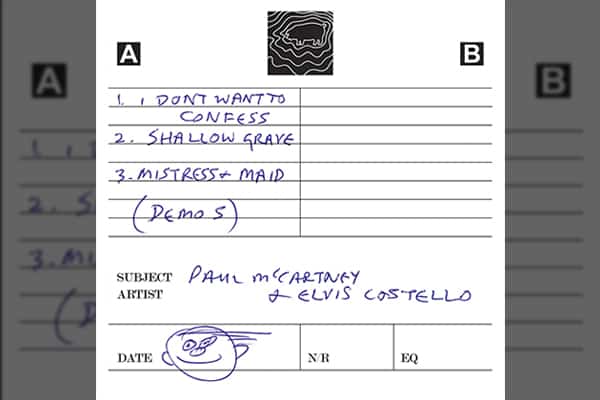
As controversial as the next release of the Paul McCartney Archive Collection’s approach to “Flowers In TheDirt” has been, the official release of demos from McCartney’s writing sessions with Elvis Costello has made for some excitement as regards the release for Record Store Day. Some of those fateful “McCartney/McManus” demos are now slated for an extraordinary release.
Three unheard cassette demos, part of the much-maligned download-only portion of the deluxe box set (which will also feature previously released B-sides and remixes, instead of this content on a physical disc), have been announced as a cassette for the 10th annual Record Store Day celebration on April 22nd. Those demos are “I Don’t Want to Confess,” “Shallow Grave” and “Mistress and Maid”–for the first time “available in the same form as when Paul and Elvis first cut them directly to tape.”
In a statement, Paul said of these demos:
The demos are red hot off the skillet and that’s why we wanted to include them on this boxed set. What’s great about these songs is that they’ve just been written. So there’s nothing more hot off the skillet as I say. So that was the kind of great instant thing about them. I hadn’t listened to them in ages but when I did I knew we had to put them out. We made a little tape of them and sent them to Elvis, who loved them too. We said we should put out an EP or something and now the moment’s finally arrived.
Peter Silberman released the first installment in a six-part performance film titled Impermanence at the GlassHouse, which follows the progression of his solo debut, “Impermanence” beginning with album opener “Karuna.” The “Karuna” segment, directed by Derrick Belcham and filmed in the Glass House, does credit to both Silberman’s vision and its performance space. Filmed in one sweeping shot, the video traces the curves, corners and walls of the house built by architect Philip Johnson, forcing the audience to reconstruct the house in their own minds. On display, as well, are two dancers, Rebecca Margolick and Stephanie Crousillat, whose motion interplays with the shadows. Belcham, in a statement, gave some insight into his artistic vision:
It is rare to find a project in which each element is a person, practice and aesthetic that I love completely. The sound of Peter’s performance reflecting off the surfaces and enclosures, Rebecca and Stephanie’s spatial relationship with the architecture of the Glass House, the visual reflection of the House itself, the exchange of words and chords with the bodies of the dancers augmented by Natasha Takemoto and Joy Wolcott’s perfectly-toned garments created a beautiful world to explore with the camera. These dynamic partnerships allowed for theater-level exploration as the events were captured in a single take and single shot.
Peter Silberman’s measured performance is perfectly housed here the microtonal nuances of his wavering falsetto were given an ideal space in which to expand.