I wrote about Alexandra Savior a couple weeks ago here but she deserves another round of attention because “Belladonna of Sadness” is a stunning album release. It’s hard to find anything that doesn’t sound like anything else these days, genres have blended so thoroughly that most our new reward is the structures certain artists build using different ones. Maybe it’s always been that way? Maybe. To some degree at least. And “Belladonna of Sadness” certainly doesn’t exist in a vacuum. It does, however, strike you almost immediately with a stark sense of its particular self. Said another way, this album and the artist behind it find a strict joy in their own identities. Outsiders are not welcome and not needed here. We can, however, listen in if we’d like and we’ll be doing that very thing for a long time to come
Wave is an album by the Patti Smith Group, released May 17th, 1979 The title track was a tribute to Pope John Paul I, whose brief papacy coincided with the recording sessions. The first single off the album was “Frederick”, a love song for her husband-to-be Fred “Sonic” Smith with a melody and structure bearing resemblance to “Because the Night”, the group’s biggest hit. The second single, “Dancing Barefoot”, has been covered by many artists.
“Wave” is an album by the Patti Smith Group, released May 17th, 1979 on Arista Records. This album was less commercially successful than its predecessor, “Easter“, although it continued the band’s move towards more radio-friendly mainstream music. It was produced by famed artist/producer Todd Rundgren.
Artists Patti Smith and Robert Mapplethorpe met in New York City in 1967 and were in a love affair until 1974, when Mapplethorpe realised he was homosexual. Their early years together are documented in Mapplethorpe’s intimate black-and-white portraits of Smith, two of which featured on the covers of Horses (1975) an Wave(1979). In 2011, Smith interviewed for Time, “I was his first model, a fact that fills me with pride. The photographs he took of me contain a depth of mutual love and trust inseparable from the image. His work magnifies his love for his subject and his obsession with light.” The pair remained friends, artistic collaborators and soul mates until Mapplethorpe died of Aids in 1989. The photographer also shot album covers for artists including Paul Simon and is famed for his portraits and controversial images of the underground BDSM scene in the late 1960s and 70s.
The title track was a tribute to Pope John Paul I, whose brief papacy coincided with the recording sessions. The first single off the album was “Frederick“, a love song for her husband-to-be Fred Sonic Smith with a melody and structure bearing resemblance to “Because The Night” , the group’s biggest hit. The second single, “DancingBarefoot”, has been covered by many artists.
The band broke up after this album was released, and Smith went on to marry Fred Smith. She spent many years in semi-retirement following the birth of their children, Jesse and Jackson, until her 1988 solo comeback album, “Dream Of Life” . The 1996 remaster of Wave includes Smith’s original version of “Fire of Unknown Origin.”Blue Öyster Cult‘s version was released on their album of the same name in 1981. The back cover of the original LP bore a quote from the Jean Genet poem, “Le Condamné à mort:”
Oh go through the walls; if you must, walk on the ledges
Of roofs, of oceans; cover yourself with light;
Use menace, use prayer…
My sleepers will flee toward another America
Upon its release in 1979, the album garnered mixed reviews, attracting either positive or negative commentary on its polished production and conventionality. Reviewers were not favourable in their reviews of the album, with the former negatively likening it to Radio Ethiopia, Smith’s last album to be critically maligned and the latter concluding her review with “is this the blandest record in the world?”.Melody Maker were more appreciative of the album, praising Rundgren’s hand in the production and considered the songs to represent a newfound focus for Smith and the band.
All songs were written by Patti Smith, except where noted.
Taking their moniker from the notion of ‘Liberation Upon Hearing In The Between’ from the Tibetan Book Of The Dead, Josefin Öhrn + The Liberation’ took little time to make their mark on the wider world, brandishing a radiant sound that stands effortlessly apart from the increasingly staid and often paradoxically predictable world of modern psychedelia.
Having already been nominated for a Swedish Grammy with their debut EP, Diamond Waves, their full-length 2015 debut on Rocket Recordings, Horse Dance marked out a territory in which beguiling repetition could sashay with sweet pop suss, melodic flourishes with experimental intensity, and it was summarily rapturously received on arrival, making new fans like 6 Music’s Lauren Laverne and earning them appearances at Roskilde Festival and Eindhoven Psych Lab.
Yet clearly this was only the beginning of a journey of discovery ,and few would have guessed how the band’s sound would quickly evolve into still more enchanting and enlightening strains. Their second effort Mirage, which follows a mere year after its predecessor, sees the band sculpting sprawling, hypnotic jams into elegant nocturnal serenades with such serendipity that their actual creation remains a little hazy even to themselves. “We agree on not remembering very much about how these tracks came about, that all of them were written on the road and that most of them came fully formed” note the band. “Most were really long to begin with, but we found it relieving to break away a bit from the mandatory psych jams a little bit. We also just realised that none of them were written in daylight, which might be why memory is so elusive.”
Indeed, this hypnagogic approach seems to fit well with the primary inspiration for the five-piece, which centred on ‘the state where dreams, visions and the present are entwined’ – the domain of surrealists and mystics, not to mention cinematic epiphanies such as Morgiana, Daisies and Tarkovsky’s Solaris.
True to form, Mirage see the band taking a chic tradition of avant-pop that extends all the way from Serge Gainsbourg and Françoise Hardy to Broadcast and Saint Etienne, and warping it mercilessly to their own darker ends.
Whilst the brooding yet sultry ‘Sister Green Eyes’ is no less than a sharp slice of velveteen motorik-pop and ‘Looking For You’ reinvents three-chord garage-rock attack with mighty finesse, The Liberation are just as comfortable dealing out the heavy-lidded and electronically-driven ‘In Madrid’ or the dive in the hallucinatory deep end of ‘Circular Motion’, on which they’re aided and abetted by Lay Llamas’ Nicola Guinta.
Fresh excitement for the band lies in wait, courtesy of a UK tour with Goat and an appearance at LiverpoolInternational Festival Of Psychedelia, yet amidst the psychic forces responsible for this kaleidoscopic effort who can say what will follow. “Horse Dance was very much about conjuring the strength needed to cut ties” the band elucidate. “Mirage may be about having left but having no clue what’s next – the power in being completely lost and thriving on it” Yet the seductive splendour of these ten songs åmake manifest a parallel world of disorientation and deliverance in which one would be a fool not to want to languish adrift.
If you’ve been riding the crest of the Aussie psychedelic rock wave for a while, you may already be familiar with down-under wonders, The Babe Rainbow. Their debut EP from Flightless Records in Sept. 2015 (produced by Stu Mackenzie from King Gizzard ) made instant ripples on a label that just keeps delivering the goods. The band returns this summer with their debut full-length LP, and the timing just feels right. Can you say it could be the summer soundtrack?
The Babe Rainbow represents a slightly folkier, stripped-down and sweeter side of the Psych rock scene, and captures everything you loved about the late-60’s movement in the first place. If King Gizzard’s Paper Mâché Dream Balloon was your bag, you simply cannot go wrong with clicking the ‘Buy’ button. The Babe Rainbow’s debut EP went fairly fast and fetches quite a bit on the aftermarket, so don’t wait around too long!
The Babe Rainbow’s self titled debut album due out onFlightless Records on June 2nd 2017
Fiona Apple’s album’s master tapes had been sitting in the vault at Sony without a vinyl release, The release of “Tidal” special vinyl, went into the process of making Tidal and getting it mastered by the guy who mastered the album when it was made in 1996.
”
When I’m strong like music / Slow like honey / Heavy with mood.”
For most men, hurting women isn’t a deliberate project. Often, it’s accidental, or even pure carelessness. Yet, I do not know a single woman who has not been hurt by a man. Neither do you. Insidious or thoughtless, it doesn’t really matter. There’s an ache that goes unspoken among all the women I know; the ache of the first male rejection, the initial understanding and loss of power, the wound that bleeds a lesson: The world does not consider you to be fully human. This goes double or even triple for women of color, queer women, and those coping with disabilities, other marginalized identities, and traumatic experiences. Most of us do not have words for it. Somehow, at just 17-years-old, Fiona Apple did. Her stunning debut album, Tidal diluted that ache and mixed it with moonlight, one part per thousand.
Why you need this classic record in your collection,
A classically trained pianist born in New York City to a family full of professional entertainers, Fiona Apple managed, with a little help from her friends, to get her 3-track demo into the hands of Sony Music executive Andrew Slater. Bowled over by the convergence of her piano prowess, astute song writing skills, emotional depth, and world-weary contralto, all of which belied her seventeen years of age, Slater signed Apple to his Clean Slate label, part of The WORK Group, a subsidiary label of Columbia Records. “I couldn’t believe [the demo] was written and sung by a 17-year-old,” a bemused Slater admitted to Billboard in June 1996. “It sounded like a 30 year-old singer who had written a lifetime’s worth of material. I thought someone was playing a joke on me.”
“Slow Like Honey” is the key for unlocking Tidal. No, it’s not as feisty as the thrilling opener, “Sleep To Dream,” the first song she ever wrote (at 14), and the one that is full of so much swagger that the foremost rapper of our era, Kanye West, cites her as an inspiration upon his own matchless self-confidence. “Honey” is stronger, simmering quiet in the sticky-sweet of seduction. Here, Fiona confidently takes back possession of her own sexuality, even if it’s only in her dreams. She becomes the instigator and seductress, the lingering, fascinating thought, an object of desire whose subjective demands must be followed. “The First Taste” quietly, carefully echoes these appetites: “I lay in an early bed / Thinking late thoughts / Waiting for the black to replace my blue”. Desire becomes so much trickier when it has been subsumed and stolen at such a young age. Trying to construct pleasure outside the undertones of pain requires a massive amount of imagination, an act of grace or God. “Slow Like Honey” is both. Coming just before these two, I hear “Criminal” — the album’s crowning commercial single for a reason — not, as often portrayed, as the confession of a bad slut, but the imagined inversion of her own trauma: What if I was the powerful one? And, what if she was? The world adored this narrative, as it will, embracing any excuse to cast a woman as the perpetrator and not the victim. Top 40 charts favour the temptress, but never “Me and A Gun” Only one of these songs portrays the sexual violence that is actually experienced by over half of the female population “Criminal” is a magnificent fantasy. In some ways, it is comforting to cling to this side of the story. There is strength in mythic re-tellings, especially for survivors. A prevailing criticism of Tidal is that it’s “emotionally indulgent.” I disagree, but also wonder: Which emotions are the one that qualify as indulgences? Fiona’s emotions on Tidal are as tightly-coiled as cobras, they strike and retreat, they lose no ground.
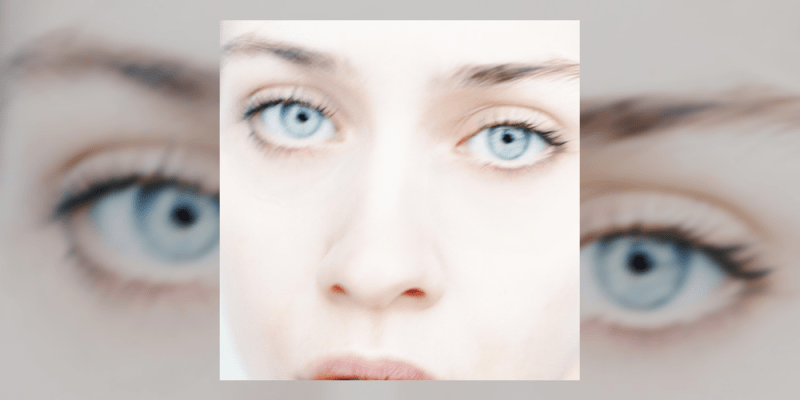
I see pain in the eyes of women I’ve never met, and feel a kinship. There is pain in Fiona’s eyes on the extreme closeup that serves as the artwork of her debut. But she looks unafraid. She looks in control. When “Tidal” came out, I was already well-versed in the ways men would wield their power over me with the rather epic, careless abandon that only masculinity breeds. What I wasn’t familiar with, however, was the steely, determined resolve that Fiona — and many other women before and since had manufactured to process this trauma. Rage can be a weapon of defense when it is calm. One of the most sinister forces behind this seething and majestic record was Fiona’s rape at the age of twelve by a strange man who stalked her all the way inside her New York apartment building. His act of domestic terrorism took calculation, foresight and brutality, but still, he felt empowered to feed her a script of self-blame: “Next time don’t let strangers in,” an adult man told a child after he’d finished sexually assaulting her. Of course, we have no choice; the strangers are already inside, they’re the men and boys we love and trust, fathers and husbands, brothers and uncles. Many of them appear to to care about us. Until they don’t. Until they become strangers again. For every Fiona before and since — it’s not your fault that the child is gone.Even when disturbed and unhappy, Fiona treats her feelings with the utmost respect, delivering solemn disaffection and a languid self-loathing with the kind of reverence usually reserved for romance. Some of these songs were written in minutes, but none of them verge on hysteria. They are calculated summations of years spent aching.
“Rage can be a weapon of defense when it is calm.”
Fiona Apple was a classically-trained pianist from the age of eight, her father and mother, though never married and separated earlier on, were both professional performers. As a teenager, she finagled a three-song demo into the hands of producer Andrew Slater, who signed her almost immediately upon hearing her voice, began to manage her, and even produced Tidal. Her songs are vampy and confessional, heavy with mood, but there is nothing adolescent about the experiences recounted. Between Slater’s shepherding and the expertise of multi-instrumentalist Jon Brion on marimba, harp, vibraphone and more, Tidal pieced together teenage Fiona’s otherworldly song writing into the sleek ten-track album that defined her. Of course, it would also be the men who tied the tracks to an era; these songs would feel ancient if they weren’t occasionally soldered to the ‘90s. (Later on, when she was older, Fiona would mount a massive resistance to the overproduction on the early, leaked version of her 2005 album Extraordinary Machine.) Yet, a thing out of time is never as tender.
“Honestly, I’m not a very skilled pianist,” Apple admitted during a 1997 Keyboard magazine interview. “I can play my own stuff, obviously better than anyone else can, but as far as other music goes, I’m really not very good. It’s hard because…when we were making the album, Andy Slater was always saying, ‘No we have to take it back to what you wrote it on. Back to the roots, that’s the only way it’s going to sound real.’ And the whole time I was saying ‘But I don’t want to play piano on this. I only wrote songs on the piano because it’s the only instrument I know. I don’t want this to be a fuckin’ piano album.’ But Andy kept saying, ‘No, this is how you sound. This is you.’”
In 1996 an interview in billboard that tells the story of Apple and Slater’s meeting and teases her debut, Tori Amos appears as the top of a box office grossing list, having just sold out Madison Square Garden. This was the world that welcomed Fiona with open arms, boosted her to sell three million copies of her debut, and turned her into a star, despite whatever reticence she may have had about celebrity. According to one strain of folklore surrounding the record, Fiona insisted that the name, “Tidal”, was taken in part because of its phonetic proximity to the funny emptiness of “Title.” But given the wild power of the thing that had come out her, she must have known this magnetism needed proper naming. What primeval force is more fitting than the tides to preside over such a magnificent airing out of wounds? Nothing is quite solid on Tidal anyway, and despite the ferocity, it is always a peaceful album, lapping like waves. The hypnotizing pull of these highs and lows make Tidal even easier to sink into; it is a record that swells and rages on an instinctual level. It remains one of the most important artistic distillations of female trauma because of the way she harnesses her pain, transforming it into a quiet source of power.
There’s little unrequited pining in Fiona’s version of the events, no matter how painful; “Shadowboxer” butterfly-floats above a stinging, out-and-out battle of wills, “Never Is A Promise” brooks no bitterness, though it’s disengagement is far from forgiving. Actually, most of the album occurs entirely in Fiona’s head; she is caught up in oblivion but remains focused on turning her hurt into something steadying and beautiful, still concerned with possibilities and potential outcomes. This is not indulgence, but a survival mechanism. On the album’s final two tracks, “Pale September” and “Carrion,” whose respective circumstances occupy very different ends of the emotional spectrum, she again commands and imagines the power she has over her partners. Poised even while candidly discussing most invasive and intimate events, her voice grows husky with rage on “Sullen Girl,” the track that confronts her assault head-on. She gives us the story, however cloaked the details may be, she gives us the full-throated vulnerability of coping, breaking, and mourning, in the process becoming one of the most self-aware female narrators of the ‘90s, or hell, in the entire history of rock.
Following the release of “Tidal”, Fiona Apple won the coveted VMA for Best New Artist, an award she wasn’t expecting. Instead of basking, she couldn’t help but continue to disrupt, urging her fans to ignore whatever picture perfect awards show narrative they’d just seen: “Go with yourself,” she commands, bug-eyed and nervous, entirely positive we don’t need her — or anyone else. Quietness won’t work here, so she screams into the night her infamous pronouncement — “This world is bullsh*t!” — pleading with us to believe her, a teenager in a fancy dress and long, loose curls, unconquered by a red carpet or some accolades. Her pain speaks a different language in public, but the grammar of empathy remains the same.It would be a relief if women did not have to create art out of pain so often, and if the work didn’t resonate so deeply whenever we are allowed to voice it freely. “I’m strong like music,” Fiona sings at the end of “Slow Like Honey” a self-fulfilling prophecy for an audience of one that ended up resonating with millions. “I’m very thrilled that other people can get something out of my songs,”
Fiona Apple’s debut album “Tidal”, originally released July 23rd, 1996.
Girlpool have released a video for ‘Powerplant’, the title track from the long-awaited follow-up to the band’s debut album. Relatable songs about growing up as a regular gal and learning to be confident while simultaneously figuring yourself out.
Video director, Philip Steiger says “the music video is a meta-narrative nightmare exploring the power dynamics and manipulation behind an insincere candidness.”
Powerplant is available for pre-order now and out via ANTI- Records on May 12th.
It’s fair to worry that the raw quality of Cleo Tucker and Harmony Tividad’s voices might get muddled with the addition of drums to Girlpool’s signature guitar-only sound. A full band isn’t necessarily the key to a great record, but in the case of the duo’s sophomore release Powerplant, a full band allows Girlpool to reach higher, deeper — even rawer — potential. Their eager and observational lyrics once again come alive with harmonies that stab you in the gut. With Girlpool you can be silly and serious at the same time. You can use jokes and poetic one-liners to express disenchantment and frustration with your surroundings. As time goes on and Tividad and Tucker enter their early 20s, they’ve become even more in-sync than before,
The band has also announced a full European tour in September .
Listen to the full album “Powerplant” by Girlpool available now
Heart’s second album began to define their sound. The Zeppelin drive is in full force here, on songs like “Barracuda” and “Kick It Out.” But they also prepped for their ’80s pop career by showing a sensitive side on some of the LP’s deeper cuts. It was released in May 1977 on Portrait Records, and re-released in 2004 with two extra bonus tracks. 1977’s Little Queen was Heart’s second ‘official’ album and features the line-up that had toured their debut classic ‘Dreamboat Annie’. Little Queen is a more adventurous album with a mix of rock and folk that, for the most part, works extremely well. The flute and mandolins play a large part in the overall sound of the album. Nancy Wilson’s acoustic guitar is certainly up in the mix for this remastered version. It’s not the most amazing remastering, after hearing the Fleetwood Mac reissues, but there is still vast improvement. ‘Barracuda’ delivers the sonic attack the music deserves. Roger Fisher still amazes on lead guitar.
“…Beauty Take Us…” they etched into the run-out groove of Portrait JC 34799 – their second album in early May 1977. And Heart’s sophisticated Seattle Rock has been doing just that for decades ever since.
After a blistering debut in the shape of “Dreamboat Annie” on Mushroom Records the year prior (Arista in the UK) – the dynamic songwriting duo of Nancy and Ann Wilson at the core of the band (the caped sisters on the front cover with their band of intrepid gypsies behind them) stumped up yet another radio-friendly tennis-racket wielding winner in “Little Queen” – housing as it does huge fan-faves to this day like “Barracuda” and “LoveAlive”. And this superbly remastered Legacy ‘Expanded Edition’ CD even adds on a cover of Led Zeppelin’s “Stairway To Heaven” as one of two bonus tracks – a near ten-minute live version from 1976 that might have its Jimmy Page & Robert Plant originators nodding in tearful appreciation.
This year marks the 40th anniversary of Heart’s second album, Little Queen, which arrived during a legal scuffle with Mushroom Records. Newly signed to Portrait, the band worked at breakneck speed when it was on the road to complete the record and get it out before Mushroom could interfere and halt the recording of the album and possibly jeopardize the future of the new songs that they were working on.
As Wilson points out, it was a prolific time. It helped they were young. “I think you would have had to have been 26 or 27 years old to do that,” she laughs. The album that they emerged with, Little Queen, remains one of their best, and features songs like “Barracuda,” “Kick It Out” and the title track that remain fan favorites.
“We were still figuring out how to write songs, record them and tour at the same time. I think that year, we did something like 250 shows,” she recalls. “Our health suffered, but we were so young that we just kept on doing it. I remember it being a complete immersion in songwriting, recording and touring, all at once. It was a real big thing. It was like when they shoot a rocket off from a planet — the first stage of the rocket has to be the most powerful to get it off through the gravitational pull, and that’s what that year was like for us.”
July 2015 saw Shirley Collins celebrate her 80th year – an age that would seem frankly ridiculous for a woman as spritely as her, had it not been for all she’s achieved. From her seminal field-recording trip to America with Alan Lomax to her lauded musical career, to her role as historian and protector of the folk tradition – all of these things are testament to the breadth of her influence.
And so we arrive at ‘Shirley Inspired’. It would be almost lazy to the talk about the resurgence of folk music or the ‘new folk’ sound – the recordings issued here by Earth Recordings are so much more than that. This is the very essence of folk – songs handed down from person to person, interpreted by modern musicians – as a way of keeping these songs alive.
Make no mistake these are modern versions; we’ve the soulful dirge of Bitchin Bonnie Billy Bajas’ ‘Pretty Saro’; the rabble- rousing minimalism of Stewart Lee (yes him) and Stuart Estell’s ‘Polly On The Shore’; the prism-like vocals of Ela Stiles’ ‘Murder of Maria Marten even Graham Coxon’s traditional affair evokes something altogether more rebellious, his clawing, feral style is much in evidence here. This compilation was an inheritance of sorts: borne to us from the kickstarter appeal that funded ‘The Ballad of Shirley Collins’ – a film that is currently being made about the First Lady of Folk Music’s life. We here at Earth now have the privilege of giving these songs a tangible existence in the shape of this special recording.
The woman herself had this to say: “I’ve been overwhelmed by the generosity of the singers and musicians who responded to the invitation to be part of the Shirley Inspired collection. Their choice of songs is fascinating, the interpretations of them fresh and various, beautiful and sometimes challenging! Listening to these recreations shows me again that English folk music has timeless power and significance.”
Proceeds of this album go directly towards the production of ‘The Ballad of Shirley Collins’, a film by Fifth Column. Tracks kindly donated by the musicians involved.
Matthew Sweet will release a new studio album, Tomorrow Forever, in June.
The 17-track long-player is a follow-up to 2011’s Modern Art, although he did issue Under The Covers Vol 3 with Susannah Hoffs in between.
You can preview the new single right now and the album can be pre-ordered on 2LP vinyl and CD. TomorrowForever is the first album recorded after Sweet moved back to Nebraska and features guests such as Rod Argent (piano on a couple of songs), the Bangles’ Debbie Peterson and Jayhawks’ frontman Gary Louris.
The album was originally funded through Kickstarter , where if you pledged $10,000 you could get Matthew to “produce/engineer/mix a song from his home studio with you” and “spend 2 days with him in the studio!”
You can even get a sneaky look at the packaging thanks to a couple of images posted on Matthew Sweet’sFacebook page
After David Bowie died in January 2016, his occasional collaborator Iggy Pop recalled the superstar musician’s impact on his career. Iggy didn’t undersell Bowie’s importance. “He resurrected me,” Pop told the New York Times “He was more of a benefactor than a friend in a way most people think of friendship. He went a bit out of his way to bestow some good karma on me.”
Bowie had been doing that ever since he’d heard the Stooges’ first two records, impressed by the force of nature known as Iggy and his pals’ gritty drive and wild noise. At the height of Ziggy-mania, he helped the former JimOsterberg kinda-sorta put the Detroit band back together and served as producer 1973’s “Raw Power” . But the Stooges imploded again, leaving Pop broke, drug-addicted and directionless. He checked himself into a mental institution.
While there IggyPop was paid a visit by Bowie, who then invited him on his 1976 tour. With both in the grip of drug addiction, they made a plan to move to Europe, get clean and make music at the same time. This marked the beginning of Bowie’s vaunted “Berlin Trilogy”, although the shift in musical style and tone actually began as the partners began working on what would become Iggy’s solo debut, “The Idiot”.
Pop and Bowie began sessions at Château d’Hérouville, just outside Paris, in the summer of 1976. Although they were staying in France, Iggy claimed that the two were inspired by “the idea of Berlin,” as well as the so-called krautrock of bands such as Neu! and Kraftwerk . In contrast to the garage rock of the Stooges, Pop and Bowie worked with drum machines, synthesizers and even toy instruments. It was very experimental even by Bowie’s design, according to Pop.
“I think I functioned as an outlet for his overflow. Because there are things he did with me that he couldn’t do as David Bowie, because it would have slowed him down or might have been a wrong move,” Pop said in 2006. “And then he was also able to use me to practice. … He made an Iggy album first, but watched the engineers there in the studio, learned how they worked, thought about it, had a chance to get to know the desk, and have daydreams about his own record while he worked on mine.”
So Pop saw The Idiot as a sort of test run/impetus for Bowie’s forthcoming “Low” which also began to take shape in France, then Germany in 1976. More than a decade later, the Thin White Duke confirmed Iggy’s take on the situation.
“Poor Jim, in a way, became a guinea pig for what I wanted to do with sound,” Bowie wrote in the Sound + Vision liner notes. “I didn’t have the material at the time, and I didn’t feel like writing at all. I felt much more like laying back and getting behind someone else’s work, so that album was opportune, creatively.”
Iggy would characterize his and Bowie’s working relationship in a few ways. One of them was that Bowie was like a film director. After all, he did encourage Pop to sing like Mae West on “Funtime.” Bowie would sometimes initiate a musical idea, a title, a concept and prod his collaborator to flesh out the idea. Pop later compared the relationship to My Fair Lady‘s Henry Higgins and Eliza Doolittle.
“He subsumed my personality, lyrically, on that first album,” Pop recalled, comparing it to having “Professor Higgins say to you, ‘Young man, please, you are from the Detroit area. I think you should write a song about mass production.’”
And “Mass Production,” with its finale of intertwined synthesizers, became The Idiot’s closing track. “Dum DumBoys” came about when Bowie suggested that Iggy write lyrics about his former band. For “Nightclubbing,” Bowie told him to imagine he was “walking through the night like ghosts.”
But not all of the concepts came from David. Iggy developed “China Girl” after falling for the girlfriend of French singer-actor Jacques Higelin, who was recording at the same studio. One night, Pop confessed his passion to Kuelan Nguyen, who replied with “Shh…” The lyrics were paired with something Bowie and Pop had created on toy instruments.
By the time the duo moved from Paris to Munich to Berlin, they had the material, although Bowie’s producer TonyVisconti recalled having to do quite a bit of mixing to get Pop’s album ready for release. Inspired by Fyodor Dostoyevsky’s novel of the same name (a Bowie idea),The Idiot was released on March 18th, 1977.
Even though The Idiot material predated the Low sessions, Bowie’s album was given precedence. It’s likely that the star wanted to debut the new “sound” with his own LP, not the one he had co-written and produced, but bore Pop’s name and picture on the sleeve.
Still, Bowie joined Pop’s band on keyboards to help promote The Idiot, which Iggy describedas “a cross between James Brown and Kraftwerk.” Meanwhile, Pop and Bowie’s German expressionism would continue, as Bowie made two more LPs in the trilogy and the duo collaborated onLust for Life, which came out only six months after The Idiot.
Even though Pop’s solo debut has been criticized for Bowie’s heavy hand, the record had a major influence on future new wave, alternative, gothic and electronic rockers .