“Melee” is an album that doesn’t strive to fend off anxiety. No, Dogleg are one step ahead of it. Instead of exhausting themselves of doing their best to downplay its exhaustion, the Michigan punk band let all its ugly emotions into their system, do its worst, then sweat it out, and for it, their music is a catharsis for anyone who has walked through a dark day.
It doesn’t hurt that Dogleg are fully capable of burdening themselves with the worry and distress. A bro might recommend working hard and playing harder, but only guitarist and lead vocalist Alex Stoitsiadi, bassist Chase Macinski, rhythm guitarist Parker Grissom, and drummer Jacob Hanlon properly put that into action in their punk-post-hardcore-emo-crossing sound that has been tingling goosebumps among their live revelers these last few years throughout midwest VFW halls and DIY punk fests.
The early spirits of Title Fight, PUP and Joyce Manor’s bottled up emotions come to mind throughout Melee, but so does the Get Up Kids’ “Ann Arbor” bleed right through Dogleg’s hearts in this instance, as the 10 songs that pack in a gut-punch throughout “Melee” come barreling in with reckless choruses big enough to go toe to toe with any depressive episode.
They’re channeled through the elements of polar intensities with “Kawasaki Backflip”, riffs going off the rails as a drunken house party goes on without on “Bueno”, spiraling out in “Headfirst” and “Hotlines” in nihilistic, self-pitying whoas with clocks moving in hyperspeed, or breaking bones and connections on “Wrist.”
Never once do Dogleg let eve a millisecond pass them by on Melee where they aren’t rapidly cycling the air around them either. While the words may paint a bleaker picture, the rising Michigan four-piece are fully plugged into the game of life and all its stages, slugging it out whole-heartedly. If it all bodies them, at least they went down punching every button hard.. and fast.
Dogleg’s Melee will be released March 13th on Triple Crown Records.
New Zealand indie-pop band Yumi Zouma released a new album, “Truth or Consequences“, today via Polyvinyl, their first for the label. Now that the album is out, The band self-produced the album and it was mixed by Jake Aron (Solange, Grizzly Bear, Snail Mail). While formed in New Zealand, Yumi Zouma’s members currently reside in various cities around the world: New York City (Josh Burgess – guitar, vocals), London (Charlie Ryder – guitar, bass, keys), Christchurch, New Zealand (Christie Simpson – vocals, keys), and Wellington, New Zealand (Olivia Campion – drums).
Yumi Zouma shared Truth or Consequences’ lead single, “Cool For a Second,” via a video for the track The album also includes “Right Track / Wrong Man,” a song the band shared back in December. Then they shared another song from the album, “Southwark,” via a self-directed video for the track,
The band released a new EP, EP III, last September 2018 via Cascine Records. EP III was the follow-up to Yumi Zouma’s sophomore album, Willowbank, which was one of our Top 100 Albums of 2017. In May 2019 they shared another brand new song, “Bruise,” that was a standalone single .
Boston duo Vundabar (Brandon Hagen and Drew McDonald) released a new album, “Either Light”, today via Gawk Records. On Wednesday they shared one last pre-release single from it, album opener “Out of It.” And then today they shared a video for another song.
Holler Film directed the “Out of It” video, which features the band in the back of a moving car, on a rowboat, and in other situations.
Vundabar will release their new album Either Light the follow-up to 2018’s Smell Smoke, which we called “the intersection of personal and political punk.” The Boston band are sure to deliver more fierce social and introspective rock on their new release, which was produced by Patrick Hyland.
Previously Vundabar shared Either Light’s first single, “Burned Off,” via a playful video for the track. Then the band shared another song from the album, “Petty Crime,” via an amusing self-directed video for the track inspired by The Sopranos. Then they shared another song from the album, “Montage Music,” via a lyric video Either Light the follow-up to 2018’s Smell Smokeand finds the band working with a producer for the first time, Patrick Hyland (Mitski).
Hagen had this to say aboutEither Lightin a previous press release: “The album is about the transitional lightness that follows a period of heaviness. After years of being caught up in a dark period marked by sickness, strife and worry, and using it as the context in which I saw myself, I suddenly found I’d outgrown that story. With that came a feeling of lightness that was opposite the feeling which preceded it.”
‘Either Light’ out March 13th 2020 on Gawk Records
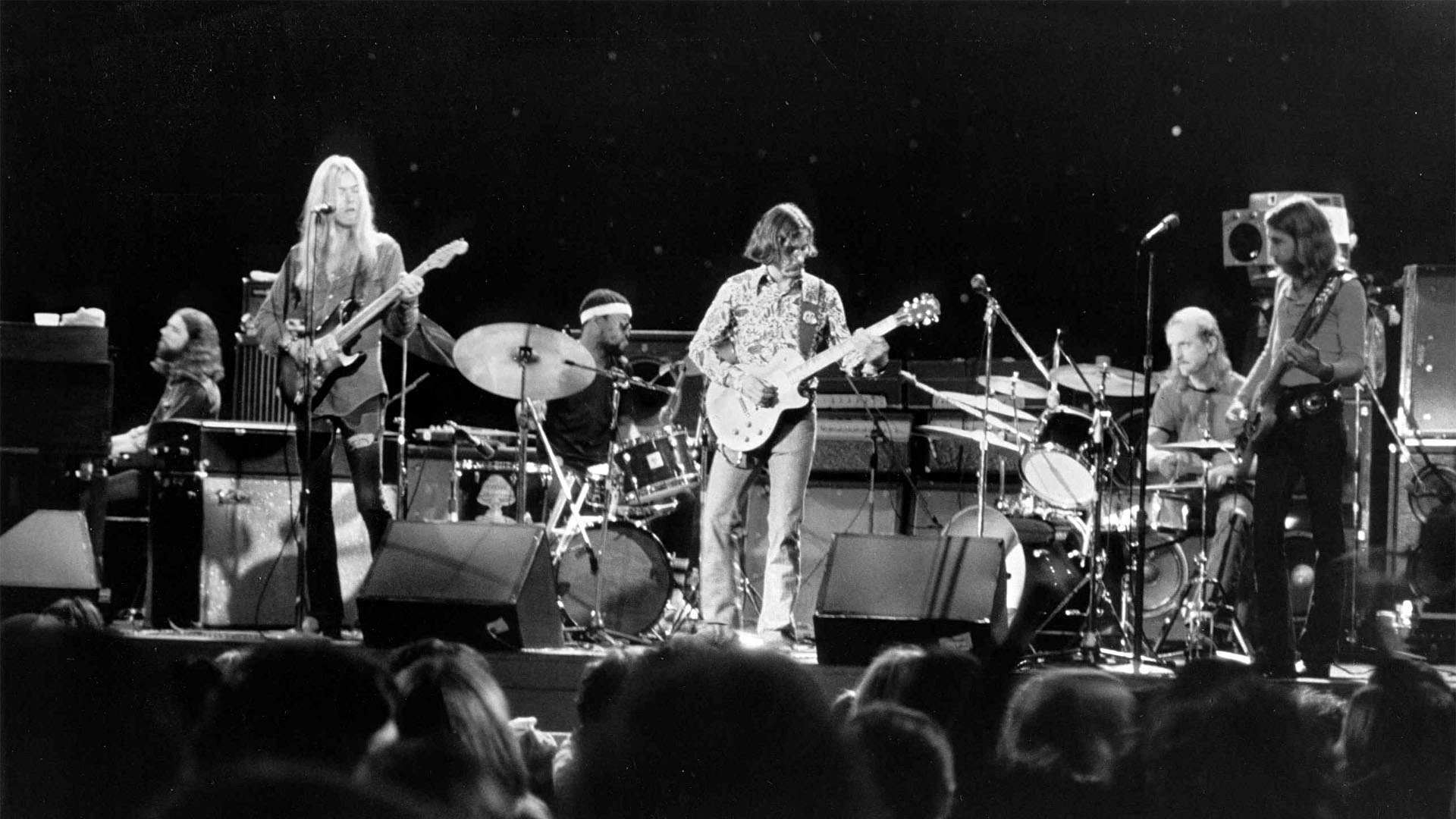
Today marks the anniversary of completing the recording of one of the most legendary live albums to ever grace this Earth. When thinking about The Allman Brothers, At Fillmore East is one of the main treasures that comes to mind. The double LP is most tangibly definitive of the band’s authentic sound, giving them both artistic and commercial breakthroughs, and is the kind of record you can spin on a daily basis and still find something to love about it. “At Fillmore East” was recorded over two nights — March 12th and 13th, 1971 — for which the band was paid $1,250 each show. The shows were typical performances for the band, and regarded as slightly above average by drummer Jai Johanny Johanson. Ads for the shows read: “Bill Graham Presents in New York — Johnny Winter And, Elvin Bishop Group, Extra Added Attraction: Allman Brothers. The Allman Brothers Band started out as the opening band for Johnny Winter and Elvin Bishop for 3 nights, March, 11th, 12th & 13th, 1971 at the Fillmore East in New York City.
Although Winter was billed as the headliner, by the third night, the 13th, the ABB were closing the show. On the 12th and 13th, they recorded their shows. The recording would go on to be released as “At Fillmore East”.“The true brilliance of this live recording is in the shorter pieces. The longer pieces (“Whipping Post,” “You Don’t Love Me,” and “Mountain Jam”) have their moments, but those moments are diluted in the self indulgent noodling typical of many 1970’s live performances. If The Allman Brothers Band: The Fillmore Concerts contained only “Statesboro Blues,” “Stormy Monday” and “One Way Out,” it would still have a place as one of the finest live recordings ever released.
“Statesboro Blues” and “One Way Out” have Duane Allman’s dense and precise slide guitar pitted against Richard Betts’ round lead guitar, with “One Way Out” providing Betts with his finest recorded guitar solo. “Stormy Monday” juxtaposes Allman and Bett’s distinct lead styles in an orgy of perfect blues phrasing. Gregg Allman’s jazzy organ interlude is an added delight.”
Tom Dowd produced At Fillmore East; he had previously worked on their second studio album, “Idlewild South”. He had recently returned from Africa from working on the film Soul to Soul, and stayed in New York several days to oversee the live recording.
It was a good truck, with a 16-track machine and a great, tough-as-nails staff who took care of business,” recalled Dowd. He gave the staff suggestions and noted the band had two lead guitarists and two drummers, “which was unusual, and it took some foresight to properly capture the dynamics. Things went smoothly until the band unexpectedly brought out saxophonist Rudolph “Juicy” Carter, an unknown horn player, and longstanding “unofficial” band member Thom Doucette on harmonica. “I was just hoping we could isolate them, so we could wipe them and use the songs, but they started playing and the horns were leaking all over everything, rendering the songs unusable,” said Dowd. He rushed to Duane during the break to tell him to cut the horn players; while Duane loved the players, he put up no fight with Dowd. The final show was delayed because of a bomb scare, and did not end until 6 am.
Each night following the shows, the musicians and Dowd would “grab some beers and sandwiches” and head to Manhattan’s Atlantic Studios to go over the performances. Set lists for following shows were crafted by listening to the recordings and going over what they could keep and what they would need to capture once more. “We wanted to give ourselves plenty of times to do it because we didn’t want to go back and overdub anything, because then it wouldn’t have been a real live album,” said Gregg Allman, and in the end, the band only edited out Doucette’s harmonica when it didn’t fit. “That was our pinnacle,” said Dickey Betts later. “The Fillmore days are definitely the most cherished memories that I have. If you asked everybody in the band, they would probably say that.
Deap Lips a collaboration between Flaming Lips and Deap Vally released their self-titled debut LP Friday, and with it the project’s colorful video for their cover of Steppenwolf’s Easy Rider classic “The Pusher.”
Since the Oklahoma City psych-rockers and the Los Angeles rock duo first announced their collaboration in December, the project has released tracks “Hope Hell High” and “Home Thru Hell.”
“I can’t remember exactly when I became aware of Deap Vally… but let’s say it was sometime just before I saw them play,” Wayne Coyne previously said in a statement of the collaboration, which pairs him and the Lips’ Steven Drozd with Deap Vally’s Lindsey Troy and Julie Edwards. “I was in Raleigh visiting with the creator of the World’s Largest Gummy Bear, and so getting to experience Deap Vally was just one more cool thing of many cool things that were happening to me. Deap Vally really rocked the mostly all dude crowd that was there to scream to WolfMother. I met Lindsey that night and we both were glad we met. Deap Vally got my phone number and about a year later hit me up, out of the blue … and invited themselves to come to Oklahoma City and jam with us and maybe come up with a couple songs for their ‘collaboration’ album that they were working on.” Coyne added that their “The Pusher” cover was previously considered for one of Miley Cyrus’ projects with the Flaming Lips but ultimately ended up on Deap Lips.
Mike Bloomfield – is the subject of a new multi-disc anthology produced by Al Kooper, “From His Head to His Heart to His Hands”, released by Columbia/Legacy – is rock’s greatest forgotten guitar hero. From 1965 to 1968, he was nothing less than the future of the blues, charging the primal forms and raw truths of his idols – B.B. King, Muddy Waters, Howlin’ Wolf – with cutting-treble tone, breakneck improvising and incisive, melodic articulation on a machine-gun series of classic records: Dylan’s epochal single “Like a Rolling Stone” and the Highway 61 LP; the Butterfield band’s ’65 debut album and ’66 raga-blues thriller, East-West; and the 1968 Top 20 hit Super Session, a dynamic jamming collaboration with Kooper. In 1966, Eric Clapton, on the verge of his own stardom, called Bloomfield “music on two legs.” But in the Seventies, as Clapton ascended to sold-out arenas, Bloomfield slipped into twilight in San Francisco, working with low-profile bands and making small-label records while wrestling with chronic insomnia and heroin.
Bloomfield – (1943-1981) Born in Chicago, Bloomfield gravitated toward the Blues after playing in high school Rock and Roll bands. He was born to play the Blues, spending time in Chicago’s South Side Blues clubs with black bluesmen such as Sleepy John Estes, eventually performing with Chicago’s finest, Howlin’ Wolf and Muddy Waters during the early ’60s. He also met harmonica player, Paul Butterfield and guitarist Elvin Bishop. A grandfather, Max, owned a pawnshop, and Bloomfield got his first guitar there. Born left-handed, he forced himself to play the other way around. “That’s how strong-willed he was,” says Goldberg. “When he loved something so much, he just did it.”
The Butterfield Blues Band was born in 1965 with the addition of keyboardist Mark Naftalin, bassist Jerome Arnold, and drummer Sam Lay. The debut album the eponymous “The Paul Butterfield Blues Band,” was released in October 1965 and met with little success nationally. But more important, Bloomfield played on Bob Dylan’s epic single “Like a Rolling Stone,” and on most of the tracks of Dylan’s 1965 “Highway 61 Revisited,” album. Additionally, he also joined Dylan at the Newport Folk Festival in July, along with the balance of Butterfield’s band (sans the leader). and keyboardists Al Kooper and Barry Goldberg. This was Dylan’s historic appearance in which he strapped on a Telecaster, and the band played electric – the first instance of an electric-guitar performance by the folk rocker. Dylan remembered Bloomfield as “the guy that I always miss. . . . He had so much soul. And he knew all the styles.”
“He put tremendous force into what he was doing,” says pianist Mark Naftalin, who played with Bloomfield in the Butterfield band, then on many post-’68 gigs and sessions. “But that’s not the same as ambition. He turned away from possibilities of success ritually.
The Butterfield Blues Band’s second LP “East-West” from 1966 fared much better than its predecessor and has gone on to become a classic. During this period, Bloomfield also contributed guitar on albums by Chuck Berry, James Cotton, and Mitch Ryder. Next, after relocating to San Francisco in 1967, he formed Electric Flag with his long time collaborators Goldberg and Nick Gravenites, and bassist Harvey Brooks and drummer Buddy Miles completed the band. Michael was organic – he played directly from his heart into an amp,” says keyboard player Barry Goldberg, who met the guitarist in high school in Chicago and was in Bloomfield’s psychedelic-R&B big band the Electric Flag. “When he shook a string, it was like Otis Rush. He had the intensity in his soul. He didn’t need anything else.
They appeared together for the first time at the Monterey Pop Festival and released the “A Long Time Comin,” album in 1968, featuring “Killing Floor,’ “Texas,” and “Wine,” among other tasty tracks. The record was seen as uneven, and hostilities between band members and heroin abuse subverted the group. Teaming up with Kooper once again and Steven Stills., The band released the one-off “Supersession,” with one of Bloomfield’s finest moments on the soulful “Albert’s Shuffle,”
The classic example is Super Session, Bloomfield’s only hit record under his own name. Tracks from that album, outtakes and associated live material – arguably some of his most sublime, furiously poetic soloing on record – comprise From His Head‘s second CD. Guitarist Jimmy Vivino, the bandleader on Conan and a lifelong Bloomfield disciple, cites the gleaming tangle of vocal-like phrasing and diamond-hard melodic certainty in “Albert’s Shuffle,” the opener on Super Session, as the peak. “The intro and first chorus are breath taking,” he raves. “And it’s just a Les Paul Sunburst into a Super Reverb amp with that Bloomfield tone – no bass, volume all the way up. And you control it from the guitar.”
But Bloomfield is on only one side of the original LP. He quit the sessions after one night of recording, leaving Kooper a note: “Alan, couldn’t sleep. Went home.” Kooper finished the album with Stephen Stills. “You know what it was in retrospect? Michael wasn’t properly challenged by anyone,” Kooper says now. “Even I didn’t want to take that position. I’d rather be his friend.”
The album was a big hit landing at #12 on the Billboard Album Charts, and resulting in a sequel “Live Adventures of Mike Bloomfield and Al Kooper”, recorded at Fillmore West. Bloomfield turned to solo. session and backup work for the next 12 years, including guitar on a track of Mother Earth’s “Living With the Animals,” in ’68. He also produced James Cotton’s “Cotton in Your Ears,” sessions in ’69, and contributed to Janis Joplin’s “I Got Dem Ol’ Kosmic Blues Again Mama,” 1969 album – and helped put together the band.
His last major work was on “Fathers and Sons,” on the Chess label reuniting with Butterfield and Lay, backing Chess masters Muddy Waters and pianist Otis Spann. He gave up guitar playing in 1970 because of his addiction but did manage a few more albums in the 1970s, including “Triumvirate,” in 1973 with Dr. John and John Hammond Jr., and a reformed Electric Flag for an album “The Band Kept Playing.” He sat in with Dylan at San Francisco’s Warfield Theatre on 11/15/80, and continued to play live dates, with an appearance at S.F. State College on 2/7/81 that would be his last.
Sadly, Bloomfield was found dead in his car from a heroin overdose on 2/15/81. His guitar prowess would live on in his wake, and Rolling Stone magazine ranked him #22 on its list of “100 Greatest Guitarists of All Time,” in 2003, and he was inducted into Blues Hall of Fame in 2012 and the Rock and Roll Hall of Fame in 2015.
Porridge Radio grew out of Dana Margolin’s bedroom, where she started making music in private. Living in the seaside town of Brighton, she recorded songs and slowly started playing them at open mic nights to rooms of old men who stared at her quietly as she screamed in their faces.
Though she eventually grew out of them, for Margolin these open mic nights unlocked a love of performing and songwriting, as well as a new way to express herself. She decided to form a band through which to channel it all, and be noisier while she was at it – so Porridge Radio was born.
Inspired by interpersonal relationships, her environment – in particular the sea – and her growing friendships with her new bandmates (bassist Maddie Ryall, keyboardist Georgie Stott, and drummer Sam Yardley) Margolin’s distinctive, indie-pop-but make-it-existentialist style soon started to crystallise. Quickly, the band self-released a load of demos and a garden-shed-recorded collection on Memorials of Distinction, while tireless touring cemented their firm reputation as one of UK DIY’s most beloved and compelling live bands.
As the band’s sound – bright pop-rock instrumentation blended with Margolin’s tender, open-ended lyrics – has developed and refined, Porridge Radio have also received enthusiastic radio airplay on the BBC, Radio X and more. Now, they are taking that development a step further, as they put out their label debut, “Every Bad”.
Official video for ‘Circling’ by Porridge Radio, taken from their forthcoming album ‘Every Bad’ due 13th March.
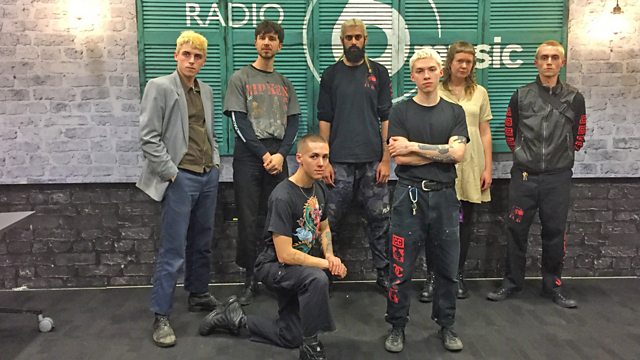
Canadian seven-piece Crack Cloud make an arresting spectacle. As well as playing conventionally, the four guitarists strum their guitars’ headstock, creating a high-pitched “ching” sound. Their furiously intense post-punk also takes in two keyboardists – one of whom is a tall, Canadian-Pakistani man with a beard, dyed blond hair and gold nail varnish who also plays a penny whistle.
Stage-front, founding member Zach Choy is their hypnotic, shirtless drummer. He has “laughing at the system” tattooed over his bellybutton and plays left-handed on a drum kit set up for a right-handed person. Why doesn’t he swap the kit around? “I have a hard time following the rules,” he says the next day, to much laughter, as the band mill around the house where they stayed after the gig, drinking coffee and dyeing their hair.
Crack Cloud are certainly unconventional: a multimedia collective of musicians, film-makers, artists and designers, made up of recovering addicts and people who work with mental health patients and people with addiction. Their influences stretch from Gang of Four and Talking Heads to Fela Kuti, Malcolm X and hip-hop. Thus far, the band have recorded two excellent EPs (on Coventry indie label Tin Angel, after the label owner, Richard Guy, flew to Canada to meet them) and are recording an album that will be more informed by hip-hop, with “less post-punk tropes and more storytelling,” says Choy.
Onstage and off, they are unmistakable; their dense videos and screen-printed outfits have the paramilitary chic of anarchist punk collectives Crass or Chumbawamba. “We all live together and some of us are siblings,” Choy explains. “If people think we look like a cult, then we are making our mark.” But living Crack Cloud 24/7 goes deeper than clothing. “The band is our recovery programme,” keyboardist Mohammad Ali Sharar explains. “Pouring ourselves into it is a way of staying alive, or at least sober and together. So we can’t do anything by half-measures.”
Choy was born in Canada to immigrant parents – a Welsh mother and Chinese father – but when he was 11, his dad died of leukaemia three months after diagnosis. Unable to process the grief, he started drinking, which “accelerated and escalated” into serious narcotics. “I was very unpredictable, volatile. Addiction wasn’t the issue. That was my way of avoiding the trauma.”
Sharar’s own deeply rooted issues had sent him down “deep, dark paths”. The son of Punjabi immigrants, he grew up in Red Deer, Alberta, experiencing racism and what he calls a “stunted youth in a very Islamic household, and a lot of domestic abuse and violence”. A hard line at home meant he had to choose between following the rules or living on the streets. “Fall in love with a white girl? You’re done,” he explains. “So then you have to choose love over family.”
Is that what happened? “Oh yeah,” he chuckles. “Weird traumas at a young age. Sleeping outside high school for days on end, then having to submit and think: ‘I’ll never see this person [his girlfriend] again.’” Artistic and punk communities initially seemed inclusive and welcoming, but Sharar soon felt tokenised. Choy says that if you strip away the “multicultural facades” from many DIY scenes, you are left with a lot of privilege. “We didn’t have that. We’re not art students. We’re coming from a different place.”
Thus, the pair plunged off what Sharar calls “the deep end. Every substance. Meth. Downers. We never really injected, but it was … speed, ketamine.” He ended up feeling suicidal.
Choy’s rock bottom and turning point came in his early 20s when he realised he felt too messed up to call his mother, who had always been supportive despite having her own addiction issues.
Music became “an obsession that replaces the substance abuse”, says Choy. His father’s huge record collection was still at home. After initially connecting with the fury in punk, grindcore and powerviolence, he later enjoyed the calm of Brian Eno albums. The idea that Eno, a non-musician, could facilitate musicians gave Choy the spark of the idea for Crack Cloud, and the band congregated around people who were “fundamentally about recovery and taking care of your mental health”, rather than making money.
Sharar funnelled his intense demeanour into the band’s idea of “creativity with no rules”. Guitarist Jon Varley is also moving on from addiction, while multi-instrumentalist Daniel Robertson met Choy when working in a homeless centre; he was recreating his “whole world view” after growing up a devout Christian. Although seven members have come to the UK, the Crack Cloud community now consists of 20 people. “We spend all our time working on stuff,” Sharar explains, “so anyone who spends time with us kinda gets dragged in.”
Their work in low-barrier care (care services that try to be as accessible to users as possible) and overdose prevention is as much a part of their operation as the band. Vancouver is in the midst of an opiate and fentanyl crisis; people with addiction issues migrate to the Downtown Eastside’s specially provided safe spaces for drug use. “It’s basically a shoot-up zone,” Choy says. “The appearance is terrifying but once you immerse yourself, as we do with our work, you realise it’s a very inclusive community that are dealing with their own traumas.”
“You see horrific things, but also beauty,” says Robertson, who hasn’t experienced addiction. “As an artist, that’s really inspiring.”
Crack Cloud is a recovery and survival mechanism for its members and a means of processing their experiences so that they can help others tackle similar issues. They are a fearsome live band-cum-high-functioning support network, but, says Sharar: “I don’t want to forget why I was angry. It was meaningful and it came from a real place.”
Setlist; 00:00 Post Truth 3:00 Bastard Basket 6:38 Time Unsubsidized 9:12 Graph Of Desire 10:40 More Of What 13:00 Ouster Stew 15:50 Empty Cell 19:48 Image Craft 23:48 Tunnel Vision 27:55 Drab Measure 33:23 Swish Swash Live at Moers Festival 08-06-19
Crack Cloud’s two EPs are available on a single album, Crack Cloud, out on Tin Angel.
A deeply personal album for bandleader Rob Grote – all of the songs were written in his bedroom as a means of coping with struggles he was facing at the time with no intention of them putting them on a record. He wound up with 32 songs during that writing session, of which he and the band chose the 11 featured on the new record. The new album was produced by the band and frequent collaborator Keith Abrams, and mixed by Dave Fridmann (The Flaming Lips, Spoon, MGMT, Tame Impala).
Rob has said: “You Know I’m Not Going Anywhere” is born into the world today. I’m so super proud of this record. It feels like we’ve come full circle in a sense from where we began. We started this thing with ambition, attitude, and no clue what we were doing. It was always just feeling our way through the dark. From being a bunch of young kids thinking we were gonna “make it,” to feeling like we definitely weren’t, to not giving a fuck either way, I’m super lucky to have continued creating waves of sound with my favorite people forever. A depth of understanding and consistently always having each other’s backs has been the throughline of it all. This record is a departure and return, a paradox like the many lives we’re always trying to reconcile as one, and it feels amazing that you can hear it all today. I hope you feel something in it that is yours as much as it is ours.
Birthed from the ether of imagination and now in physical form, we present to you, You Know I’m Not Going Anywhere Thank you so much to everyone involved and everyone who’s ever believed in us. I hope it keeps you company through the madness of the world and when it all gets to be too much, you can turn to it and escape.
Cheap Regrets from The Districts 4th album ‘You Know I’m Not Going Anywhere’
In stores March 13, 2020 on Fat Possum Records
Arthur Lee (1945-2006) – 1960s – Born on March 7th, 1945, Arthur Lee would have celebrated his 75th birthday this week… Lee was the lead singer and front man of Los Angeles Rock band Love. He formed the band in 1965 with old classmate Johnny Echols, along with Bryan Maclean (guitar, vocals), Ken Forssi (bass), and Alban Pfisterer (on the first album). Building up a sizable following at Hollywood area clubs, the band came to the attention of Elektra Records at the Whisky-a-Go-Go and was offered a recording contract. Love’s first hit was a cover of the Manfred Mann’s “My Little Red Book,” a Burt Bacharach/Hal David composition, culled from Love’s self-titled first album released in 1966. The follow-up, “De Capo,” 1967 was released a month before “The Doors,” debut album which was also issued on Elektra Records with both engineered by Bruce Botnick. While the Doors debut climbed to #2 nationally on the strength of the chart-topping single, “Light My Fire,” “De Capo,” managed to reach only #80, but contained the band’s biggest selling single “7 and 7 Is.” Whether the Doors’ success impacted Love is debatable but the band’s third album “Forever Changes,” was its masterpiece, and is rightly considered one of the finest albums of the ’60s – and arguably one of the best rock albums ever.
It contained a song for the ages “Alone Again Or,” with its glorious guitar intro and the sublime horn solo at the bridge. The album was Lee’s crowning achievement ranking #40 on Rolling Stone magazine’s list of the 500 Greatest Albums of All Time. It was to be the last album with the original group. There would be three more albums with different personnel, and Lee would carry off and on with a reconstituted Love up until his passing in 2006. If you want to understand Lee’s genius as a songwriter and musician, listen to these three albums to hear other brilliant songs such as “Orange Skies,” “She Comes in Colors,” Signed D.C. and “Red Telephone.” Lee never got his due owing to many issues, but make no mistake, he was one of the seminal Rock musicians from the ‘60s.
Arthur Lee & Love– 2003 – “Alone Again Or,” Originally on one of the singular albums of the 1960s “Forever Changes,” this sublimely beautiful song of heartbreak will yet tear your heart apart. Demonstrating that he had lost none of his prodigious talent, Lee leads Love in a powerfully touching rendition of one of his signature songs made all the more poignant because Lee would pass from this world just three years later from complications surrounding Leukemia treatments in his hometown of Memphis, Tennessee on August 3, 2006. he was 61. If you can make it through the trumpet solo without shedding a tear…To truly feel this song, turn it up…This is a truly epic performance.
First of 3 songs performed by Arthur Lee and Love in 2003. This song and “You Set The Scene” are from a US presentation of “Later.. with Jools Holland” on the Ovation Network.
Arthur Lee’s 1981 solo album is re-pressed by Friday Music on CD. The late Love frontman provided the liner notes for this album, on which he revisited “7 and 7 Is” and paid tribute to his band with “I Do Wonder.”
As a visionary and leader of the 60s iconic band Love, Arthur Lee’s prolific words and music continue with this second solo release. Out of print for over three decades, Friday Music is proud to offer another installment of the Love & Arthur Lee Remaster Series . Includes the fan favorite One, a new take on 7 & 7 Is and a nod to Love with I Do Wonder. Featured players include the late seventies Love and the late great guitarist Velvert Turner. Original liner notes by Lee as well as definitive remastering by Love archivist Joe Reagoso.