Image result

“DEREVAUN SERAUN” is a piece I wrote a couple years back in five movements for voice, piano and string trio. Each movement is written about a different piece of literature, exploring the value I see in each work and the impression it has made on me, and there is nothing more to it than that. The pleasure of books – of good verse and stories and ideas – is a very simple thing, and I felt that some lofty unifying theme for the entire piece would be a betrayal of that belief. I think that when a work resonates with you it is an instinctive response to something. You can be taught to understand a challenging book, but not to feel affection for it; I think a lot of conversation around art, especially around literature, sometimes forgets this. In my experience, the art I like the most, irrespective of its ‘difficulty’, is the art I can advocate most directly and plainly, and about which I can say: “I read this piece and now I do not read or think in the same way that I did before”, or: “This is a story that I could not explain to someone; I do not understand it word-for-word, yet I feel like innately I understand the whole, and that the whole spoke to me”. This is a piece about five books that I like and why I like them.” – Kiran Leonard

http://


Image may contain: one or more people, cloud, sky, night, mountain, outdoor and nature

For nearly ten years, Amber Coffman was a member of New York indie genre-breakers Dirty Projectors, singing alongside her then-boyfriend Dave Longstreth. Her soft, silky voice stood out on the band’s biggest songs, like “Stillness Is the Move,” and, as the band grew in exposure, she branched out to unexpected features with Major Lazer, Snoop Dogg, and J. Cole between albums. But then, last year, Longstreth announced that the next Dirty Projectors album would be a solo project, that Amber Coffman had exited the group, and the two had broken up. In a statement shared shortly after Longstreth new album release, Coffman has said it was “never my intention or wish to leave the band” and that she was blindsided by Longstreth’s solo plans under the Projectors name.

Behind the scenes, though, Coffman knew a solo career was always her end game — a path she’d been on since her start with the band, though she took the side streets to get there. On June 2nd, her solo debut, City of No Reply, (produced by Longstreth before they had a full falling out) will see a release that’s been a decade in the making. Coffman finding her own sound, then moving to California influenced the album, learning when to say no to collaborations, and why she continually worked with Longstreth even after their breakup.

From 2003 until 2011, over the span of six studio albums, an EP, plus a double-disc live extravaganza, and hundreds of live shows, the Oak Park, Illinois a suburb of Chicago siblings Matthew and Eleanor Friedberger wrought a polarizing, idiosyncratic iconography; by and large, audiences were either reveling in the cavalcade of inside jokes, or they were resolutely weren’t.  formed in 2000 in Brooklyn New York.

While garage rock and blues were the Fiery Furnaces’ core idioms, they weren’t afraid, over time, to wrangle pop, prog, musical theater, folk, gospel, tinny-ass carnival spew, and hard rock into a mod-indie equivalent of Choose Your Own Adventure paperbacks, if said paperbacks were cheekily ghostwritten by Thomas Pynchon or David Foster Wallace. Double-stitched with baffling turns of phrase and dizzyingly archaic verbiage, each song — sung by Eleanor usually; performed by Matthew mostly — rendered a separate world teetering precariously between exaggerated caricature and waking reality. The lyricism was millennium-era-Ghostface gratuitous, sold by Eleanor with a go-for-broke panache so courageous that, on albums like Widow City and Blueberry Boat, it felt almost globe-conquering — flip, far-ranging, esoteric, mean-spirited, and sympathetic. What couldn’t the Fiery Furnaces do? Where couldn’t they lead anyone who cared to tag along as banks of keyboards, organs, and synthesizers squelched merrily from one absurdist, maddeningly specific scenario to the next? Their potential, at times, felt downright limitless .

The Fiery Furnaces issued six studio albums over seven years, a productivity rate familiar to Woody Allen and rock bands in their stride in the 1960s and 1970s. Then they toured behind these records, each of which was no-fucks-given weird and batshit bonkers its own special way. During all of this, Matthew cut and released 2006’s Winter Woman/Holy Ghost Language School, a double album that was essentially the Fiery Furnaces sans his sister — all the while dropping hints that, someday, his sister would make amazing solo music. Then, from its title on down to the song names, 2009’s I’m Going Away was very plainly the writing on the wall. By the time the band’s spigot stopped flowing, two conflicting emotions were at play: a sense of unwelcome deprivation and a feeling that maybe, yeah, everyone (band and audience) needed to enjoy a respite from the breakneck Fiery Furnaces roller coaster.

In the years since, Eleanor made good on the solo career Matthew anticipated; while 2011’s Last Summer and 2013’s Personal Record can’t approach the no-holds-barred pluck of the Furnaces at their prime, Stare At The Sun almost legitimizes the hiatus, and may just be the most narcotic tune anyone associated with this band has ever produced. Matthew, meanwhile, decamped for Europe, cut a series of limited-edition or otherwise obscure LPs, and drifted away from the cultural conversation, resurfacing to form last year. Longtime Furnaces sidemen Jason Loewenstein (of Sebadoh) and Bob D’Amico continue to tour (and slay) as Circle Of Buzzards. Life goes on; it’s just not as audaciously strange as it was when the Furnaces were inescapable. To paraphrase so many The Official Handbook of the Marvel Universe entries, whether or not Matthew and Eleanor opt to reactivate the band “remains to be seen. Eleanor released her third solo LP, New View, which seems like as good a reason as any to look back at the catalog of the band that introduced us to the Friedberger siblings and their considerable talents.

The band released their fifth LP, entitled “Bitter Tea”, in April 2006. In interviews they stated that the album was influenced by the sound of synthpop group Devo, and Eleanor Friedberger stated the album was “definitely the poppiest thing we’ve done “Bitter Tea” their difficult album, their David Lynch movie.” Now as at the time of release, “Bitter Tea” confounds so thoroughly that drawing a thematic bead beyond, say, “an exceptional, lovesick EP buried within an impenetrable, drug-damaged LP” is next to impossible. It’s like sitting down to a delicious bowl of Cream Of Wheat festooned with dead weevils; it’s as though Matthew and Eleanor wrote a handful of direct, soul-bearing pop songs and then, feeling a bit naked and abashed, took great pains to muddle and obfuscate them. (Sometimes — sometimes — I wonder if I’d feel a mite differently about this if they’d waited a full two calendar years between studio albums, whether I was suffering some sort of Furnaces fatigue.)

From the oil-slick fricassee of “Black-Hearted Boy” to the snapped-synapse zap of “Nevers” to the title track’s beat-switching mania to how “The Vietnamese Telephone Ministry” courts Satanic noise, Bitter Tea scans as a gross over extension, everything sabotaged and back masked as fuck, with needless reprises piled on top. Yet — yet — “Waiting To Know You” is glowing, torch-song pop despite detritus cluttering the bottom of the mix; breakneck Gamblers Anonymous travelogue “Borneo” somehow becomes more exhilarating with each listen; “Teach Me Sweetheart” is a career-topping marvel of sensual simmer and psychosexual tension; “Police Sweater Blood Vow” is primo fake electric Dylan. The band did a short tour in October and November 2006, supported by San Francisco rock band, Deerhoof. This tour saw Matthew on keyboard, Eleanor on vocals, Jason Loewenstein  on wah-wah guitar, Bob D’Amico on drums and the addition of Micheal Goodman on percussion. The songs had a tropical feel to them, and most of the tracks from “Bitter Tea” were played as one long song, lasting 30 minutes—a medley format the band previously used

http://

In a sense, Tea is almost the Furnaces’ Wowee Zowee — the album where warts and dimples get equal time. But the record’s shortcoming — i.e., the band’s indecisiveness, neither going full-on pop or willfully scuttling and defacing every beautiful note — is ultimately what lands it in the least enviable slot in a “Worst To Best” feature.

The Fiery Furnaces’ approach to live performance was to transform a generous catalog into a strenuous, Naked Lunch-esque exercise, squishing a handful of bars and verses from several songs together, often sacrificing entrenched melodies and cadences and erecting bizarre new creations in the process. Depending on the listener’s temperament — or, possibly, inebriation level — this willful upsetting of standard live behavior was exhilarating, confusing, or off-putting. On the one hand, it assumed (perhaps dangerously) a serious commitment and degree of patience on the audience’s part; on the other hand, it likely kept the band invested in national and international tours that stretched for weeks. The digipack for Remember, compiled from 2005, 2006, and 2007 shows, boasts an eye-roll worthy admonition: “Please do not attempt to listen to all at once.” And sure, fair enough — two discs and 132 minutes of recontextualized Furnaces will try the patience of the staunchest fan. Sometimes the set can seem more like a provocation for a specialized game of Name That Tune than a way to immortalize a particular vision of this band. At other moments, Remember actually surpasses the chestnuts it’s lovingly roasting: injecting “My Dog Was Lost But Now He’s Found” with a sweaty, pulse-pounding urgency; reimagining “Tropical Ice-Land” as Scooby-Doo zombie funk; turbo-charging “Black-Hearted Boy” with faux Wurlitzer. Still, 19 times out of 20, when I feel a Furnaces craving coming on, Remember isn’t what I reach for.

The band’s Eighth studio album “I’m Going Away” was released in the US on July 21, 2009, on Thrill Jockey Records and the UK on August 24, 2009. A second album, Take Me Round Again , which presents many of the same songs from “I’m Going Away” in a new way, was released on November 10, 2009. These tracks were made individually by Mathew and Eleanor, resulting in some overlap. These songs have the same lyrics as “I’m Going Away”, but consist of completely new instrument and vocal recordings that give a new take on the same material.

http://

An LP-length “Dear John” letter if there ever was one, I’m Going Away wears its dolor with a characteristic schizophrenia. This means that “Drive To Dallas” breaks up its teary downbeat guide with psychedelic guitar pyro and plaints that verge on mania, and that there are a pair of ecstatic barnburners about partying with a girl named “Charmaine Champagne.” It means that identity-crisis ballad “Lost At Sea” dips and swings so sweetly that the whammy bars and cymbal smashes wash away the tears as they bury this album’s semi-subtextual lede: This is the Fiery Furnaces bidding adios to us, and to one another, at least for a while. Thematically and lyrically, I’m Going Away is arguably Matthew and Eleanor at their most direct and straightforward; there’s a dearth of bizarre musical experimentation, and decidedly less irony than usual. These songs feel like pre-Brill Building standards; it doesn’t require much imagination to picture pick-up bar bands, hard-luck chanteuses, and emancipated church singers absolutely slaying audiences with a heartstring-riffling bit of like “Even In The Rain.” (“Staring At The Steeple” is a bit darker, but it’s a better fit here than any other area of the catalogue.) The Furnaces’ latest (and perhaps last) album feels loose yet coherent, warm yet straitlaced, possessed of a bummed-out jubilation. And, sure, it’s a pinnacle of sorts, but one you’ll rarely revisit for pure pleasure, since it’s a reminder that rowdier work proceeded it and that (more than likely) nothing will succeed it.

A collection of singles and compilation cuts, EP arrives in January 2005 the band released a 41-minute compilation disc named EP . It featured two new songs, all of the band’s singles and B-sides (with the exception of an alternate version of “We Got Back The Plague” found on the “Tropical Ice-Land” single), and was for this reason a contrast to the epic and, according to some, inaccessible nature of Blueberry Boat. almost by default; for all their electrifying zest, no cohesive theme unites these 10 nuggets, and it’s impossible to reconcile them with what’s included on the proper LPs. The ironically autumnal “Here Comes The Summer” is bled, curiously, into the bizarre “Evergreen,” wherein vocal and performance alike seem to be succumbing to the effects of a natural poison. With “Smelling Cigarettes” the Furnaces expand their range of grotesque suburban miniatures; on “Duffer St. George” they extend their passport for the weakest of their customs stamps. There’s also a wily, semi-backmasked reprise of “Tropical Iceland” that makes the Gallowsbird’s Bark version seem staid in comparison. Meanwhile, “Sing For Me” suggests a vintage Candy Land game board transmuted into song, and for the first and last time in the Fiery Furnaces mythology, Matthew gets the stage all to himself.


Widow City is a rock record with synthesizer assists that is very loosely about a libertine who killed (or wants to kill) a loathsome toad of a husband and elope with her girlfriend; the telenovela-esque narrative is unclear in the way that the through line of the Aeon Flux animated series is fuzzy. None of which matters when the result is this rich, arch, mischievous, and non-Bitter Tea. Cherry-pick just about any number here and you’ve got a winner: the tremulous, heroic “Duplexes Of The Dead”; “My Egyptian Grammar,” drenched in digital harps, near-dub, and girl-group chagrin; the valorous Valkyrie funk of “The Cabaret Of The Seven Devils”; the marvelous, babble-mouthed jabberwocky of “Pricked In The Heart.” City’s sole failing, despite a bevy of tracks that clock in under three minutes, is its length.

http://

It’s worth wondering — from my perspective, anyway — whether the Furnaces’ career would have continued to build steam had they constrained themselves from Tea forward to short, strong albums 30-35 minutes long with no more than, say, 10 songs. In June 2007, it was announced that the band had signed with Chicago labe Thrill Jockey Records and their album “Widow City” was later released on October 9th, 2007. Unlike their two previous efforts, this album lacks a central concept and has a 70s rock album feel. The band toured in support of the album throughout the later months of 2007 and early 2008. A live compilation album, “Remember”, was released on August 16, 2008.

The Grandmother Album, as it is colloquially known, clocks in at about an hour. This is significant. Gallowsbird’s Bark rang up at a respectable 46 minutes and change, pushing the envelope of sonic propriety just slightly; Blueberry Boat ballooned out to 76 minutes but was so captivatingly crackers that nobody noticed. Rehearsing My Choir (released in October 2005), saw the band return to an experimental sound once again. A concept album featuring the Friedbergers‘ grandmother, Olga Sarantos, narrating stories about her life, Rehearsing My Choir was met with widely differing opinions from both the press and the band’s fans, being branded “difficult” even by those who rated it highly. Sarantos previously worked as choir director at a Greek  Ortodox church, and her croaked reminiscences form the backbone to this peculiar, piecemeal storybook of an album. Jason Loewenstein of the band Sebadoh and Bob D’Amico took over band duties for the supporting tour,exists in a strange temporal nether-region where, depending on your temperament, it’s: a) way, way too long and totally unlistenable, b) very rough going, or c) perfect. On Choir, the Friedbergers cede the Captain’s chair to Olga Sarantos, their then-83 year-old-grandmother. Eleanor is (willingly) reduced to a character and Greek chorus queen, while Matthew’s compositional mode shifts from “whacko boogie-woogie” to “demented Prairie Home Companion score.” The narrative ping-pongs around 20th century Chicago, powered by wicked gleam in Sarantos’ eye, her tongue (probably) firmly in cheek; this is her show, a bygone diorama of love letters, dicey lunch counter, factories doubling as brothels, and no-fucks-given historical revisionism so warped and zany that copies of this album should be distributed free to every person on the verge of becoming a grandparent. The drubbing Choir takes among fans makes some sense: Sarantos’ Larry “Bud” Melman-esque voice, a lack of anthemic cuts, the fact that by 2005 the internet was already in the process of sanding the average listener’s attention span down to nothing. My personal suspicion is that as Furnaces fans age, their appreciation for the album’s twists and turns will rise, not to mention what the album represents: two indie-rock titans pretty much winning at indie-rock and then teaming up with their elderly grandmother to cut an LP that celebrates her and sheds light on the wiseacre genes her grandkids rode into a specific iconography. No, Choir is probably never going to tear it up when you and the squad are driving to the shore, but throw it on the next time you’re staring down a long drive to visit your parents; you might be surprised how moved you feel, and you might reflect on how far removed the world of your youth — hell, the world of five years ago — is from where you find yourself, right now.

For anyone arriving at Gallowsbird’s Bark Released in 2003 the raw, primal punch of this debut release may come as a shock. Not fully comfortable with the notion of the studio-as-instrument, Eleanor and Matthew leaned hard on a Lo-fi, juke-joint spontaneity; spiced with distorted guitar and whimsical keyboards, Matthew is primarily responsible for the band’s studio instrumentation and songwriting, while Eleanor handles the majority of the vocal duties. almost every song here is a near-nonsensical expression of fun or play-acted steeple-chase for the open-hearted kidult to mumble psychotically on endless commutes or during board-meeting lulls. The gentle, generous “Bow Wow” could slip unremarked upon into a Sesame Street Live revue. “Inca Rag/Name Game” explodes piano-recital silliness into amplified-blues trawl. “Crystal Clear” and “Leaky Tunnel” dash so breathlessly through free-associative shit-fits that it’s possible to miss the giggles and twinkles embedded in the scenery at first. Most interesting — and overlooked, critically — is the way “I’m Gonna Run” and “Two Fat Feet” adroitly nudge weight-associated self-shaming into a realm so deeply Dali-esque that external fat jokes lose much of their sting. While Blueberry Boat has earned every plaudit it receives, the Furnaces would never quite nail the joyful spirit of this ramshackle album .

The Fiery Furnaces, released their second album, “Blueberry Boat”, in the summer of 2004. It is also often interpreted as a multi-layered concept album and their most transcendent, come across as at least 94 percent disengaged from the here and now. Sonically, narratively, and personally, the ideal versions of Matthew and Eleanor are space aliens or time travelers in self-denial.

Blueberry Boat represents the apex of this notion an LP that by every account should fall flat on its face; it could only have worked on an indie label. (It’s also almost 80 minutes long; if Boat came out now, it’d have a much harder time finding and keeping an audience. an album featuring a meandering epic (“Chief Inspector Blancheflower”), a shaggy-dog ramble predicated on “dog” being an acronym for “god” and vice versa (“My Dog Was Lost But Now He’s Found”), and a peppy, idle piano ballad about being kidnapped into white slavery (“Spaniolated”). Boat is like a mansion where every space is designed in a garishly different manner but the whole is somehow implausibly welcoming even though it should be terrifying.  “Quay Cur,” the ten-minute lead track on Blueberry Boat, switches from dirty, gurgling organ to slide guitar-fueled ditties, pulsing electronic beats, highlighting the Fiery Furnaces’ variety in songwriting. Some critics, however, interpreted this type of material as evidence that the album is unfocused. The epic nature of the majority of the songs made them unsuitable for radio play so the band prepared “Single Again,” a take on a traditional folk song as a substitute.

The title track fever-dreaming disjointedly through a John Barth novel rewritten by Garrison Keillor; “Chief Inspector Blancheflower” and galumphing “Chris Michaels” trolling the America of Maury; vertigo-suffering “Mason City” hopping into a DeLorean to explore 1910; skeletal curio “1917” and synthesized crack-puff “Birdie Brain” .

Every moment here is an uneasy triumph, even when they involve random snatches of Inuit and clashing, Wolf Eyes-grade cauldrons of noise. Yet a reflective sadness surrounds every boarding of Boat, too, because in the wake of this LP, nothing the Fiery Furnaces accomplished would be quite as startling or left-field. that vital spark of lunatic invention every musician would kill to ignite.

http://

The Fiery Furnaces went on an extended hiatus following a brief 2011 tour. Their final concert before the hiatus was on May 27, 2011 at the Primavera Sound  Festival in Barcelona.

On July 12th, 2011, Eleanor Friedberger released her first solo album, titled “Last Summer” . She released her second album “Personal Record” on June 4th, 2013, and her third, “New View” on January 22nd, 2016.

Philly band Hurry’s new LP is pure power pop in the vein of the Posies and Matthew Sweet, revealing a band that is serious about its frivolity. When Hurry expanded to a trio for 2014’s Everything/Nothing, there were two ways to view Matt Scottoline’s formerly solo project. One: a solid Philadelphia band making fuzzy, mid-fi indie rock. The other was as an offshoot of Everyone Everywhere, who released two of the first truly outstanding albums

Hurry’s third LP “Guided Meditation” sounds like a credibility bid for Scottoline’s fledgling new band. The cover might be a Brian Eno homage, but there is no magical “Enoxification” happening here. Scottoline’s vocals aren’t subject to the same fuzz as the guitars. And there you go: Hurry decided they’re really a power-pop band at heart, not indie rock.

Regardless of how much Scottoline’s beloved Yo La Tengo or Guided By Voices influenced the writing of Guided Meditation, this is more in the lineage of the Posies and Matthew Sweet, acts who would’ve been considered pure pop had they existed in a different decade or just simply sold more records. And like them, Scottoline writes from a position of weakness, of being “dumb and in love” and not always both at the same time: he’s incapable of handling life due to the prospect of a new crush on “Fascination” (“overthink and overplan imagining you hold my hand”), uses relationships as a shield from life’s responsibilities (“Under Her Thumb”), retreats the moment those responsibilities start piling up (“Nothing to Say”) and ends Guided Meditation wishing for a kind of zen existence that requires nothing out of him (“I Wanna Be You”).

Image may contain: 3 people, people standing and outdoor

Hurry doesn’t overcomplicate things musically—they abide by the Weezer Method that states all vocal melodies should sound good as guitar leads and that instant gratification can be replicable gratification. Hurry are capable of expanse and modest grandeur, though like Everyone Everywhere, they find a kind of psychedelia in everyday fatigue—“Love is Elusive” cruises through six-and-a-half minutes of flanger clouds towards a sunburst of layered harmonies and “Nothing to Say” feels like companion piece to Everyone Everywhere’s definitive “I Feel Exhausted” if cubicle-bound anxiety was traded for a three-beer daze at happy hour.

http://

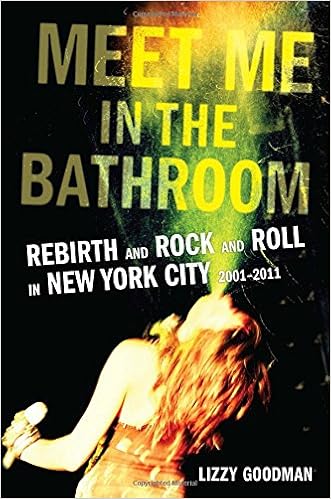
In 1998, five New York friends — Julian Casablancas, Albert Hammond Jr., Fabrizio Moretti, Nick Valensi, and Nikolai Fraiture — formed a band called the Strokes. They released a debut album, Is This It , in 2001. In 2009, Music magazine NME named it Album of the Decade; Rolling Stone Magazine ranked it No. 2, behind Radiohead’s Kid A. This is an account of what happened in between, starting in 2002.

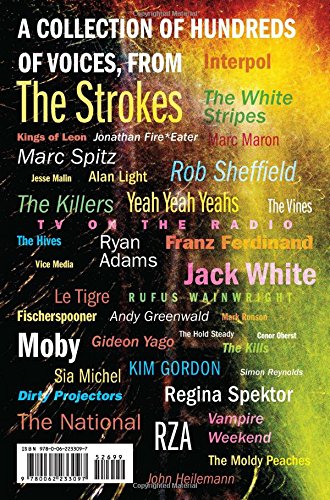
Meet Me in the Bathroom charts the transformation of the New York music scene in the first decade of the 2000s, the bands behind it–including The Strokes, The Yeah Yeah Yeahs, LCD Soundsystem, Interpol, and Vampire Weekend–and the cultural forces that shaped it, from the Internet to a booming real estate market that forced artists out of the Lower East Side to Williamsburg. Drawing on 200 original interviews with James Murphy, Julian Casablancas, Karen O, Ezra Koenig, and many others musicians, artists, journalists, bloggers, photographers, managers, music executives, groupies, models, movie stars, and DJs who lived through this explosive time, journalist Lizzy Goodman offers a fascinating portrait of a time and a place that gave birth to a new era in modern rock-and-roll.

read this excerpt:

Ryan Adams (musician): One night I was hanging with the Strokes guys and Ryan [Gentles, the band’s manager]. We were really stoned because we were basically always smoking pot. It was very late. Fab would always play me a song that he had written, some beautiful, romantic song. So one night, jokingly, I’m almost certain, Fabby said, “Dude, what if John Mayer was playing that guitar right now?” And I said, “I can make that happen.” Now, I lived down the block from John Mayer, and he’d been talking to me about his new song for a while. So I texted him, because he was always up late back then. I said, “Come to this apartment. Bring an acoustic guitar. I really want to hear your new song.” I didn’t tell them that I’d done it. So everyone is sitting there and I was like, “Let’s all take bong hits.” I really wanted it to get crazy. We smoked some bong hits; I probably did some blow. The doorbell buzzer rings, and I open the door, and John Mayer walks in with his fucking acoustic guitar, and they were all slack-jawed. John sat down and played the fucking acoustic guitar — three or four songs that probably have gone on to be huge — while those guys just sat there staring at me like, Oh my God, you’re a witch.

Gideon Yago (journalist): Ryan Adams, he was one of those guys where I just remember being like, I just don’t know. I didn’t take to him very well. I mean, that to me was the beginning of the end.

Albert Hammond Jr. (guitarist, the Strokes): When he shows you a song, he doesn’t stop for hours. You’re like, “Oh, that reminds me of a song I wrote.” And you play a G chord and he’s like, “I know what you’re talking about,” and he grabs the guitar back. There’s no way to play music with him. It’s the Ryan show, always.

Ryan Gentles (manager, the Strokes): I introduced Jim Barber and Ryan Adams. Courtney [Love] was dating Jim at the time.

James Barber (former A&R executive): Courtney thought the Strokes were a positive cultural influence. She was doing this MTV special. She wanted them on.

Marc Spitz (journalist): She was like their Yoda. Their coke Yoda. I’m not saying she gave them cocaine. I mean, most everyone was on cocaine, but it seemed like as soon as they really made it, she was all over them. And she was not in the best shape at the time. Maybe not the Jedi you want whispering in your ear about how to be a rock star.

Image

Ryan Gentles: I was friends with Courtney; she would call me at random hours to give me advice. Then she did this overnight-broadcast thing for MTV.

Marc Spitz: It was called 24 Hours Of Love, and the premise was that she would take over the MTV soundstage, the one in Times Square, for 24 hours.

Albert Hammond Jr.: When you’re fucked up and the idea is funny, you just do it. You’re like, Oh, yeah. We’ll go up there and hang out with Courtney Love. By the time you’re in a taxi and you’re in traffic, you’re like, Wait, what are we doing here?

Ryan Gentles: She was all strung out and drunk; it was almost embarrassing. She was running up and down the hallways naked.

Albert Hammond Jr.: Oh, she was fucked up.

Ryan Gentles: I actually adore her in a way. She’s so smart. But I don’t know her. I don’t think anybody knows her.

Jenny Eliscu (journalist): Gentles briefly managed Ryan Adams during that era, which seemed to not go great.

Ryan Gentles: Ryan and I were buds. And went down to New Orleans and madeLove Is Hell. Then I had to quit, because the Strokes exercised a clause in their contract that said I wasn’t allowed to manage other artists.

Albert Hammond Jr.: Julian had a very clear thing, and we liked to do things a certain way. I think a lot of things they blame Ryan for is stuff the band just doesn’t want to do. Image

Ryan Gentles: Do you know how many times I begged the Strokes to do some shit and they just said no and it was idiotic and everyone in the world knows they should do it?

Amanda De Cadenet (photographer): They’re the band that turned down a million dollars for some Heineken ad. That’s dumb.

Dave Gottlieb (former VP of marketing, RCA): We got a request from Heineken for … it was either “Hard to Explain” or “Last Nite.” I think it was “Last Nite.” It was $600,000.

Ryan Gentles: When they were making Room On Fire they said they felt my attention wasn’t all theirs. They said, “You have to stop managing Ryan Adams.” It sucked. He’s super-talented, and I was ambitious, and I liked his music a lot, and I still do. How did he take it? Real bad.

Catherine Pierce (musician): Julian thought Ryan [Adams] was a bad influence on Albert.

Albert Hammond Jr.: Ryan would always come and wake me at two in the morning and have drugs, so I’d just do the drugs and kind of numb out. I knew I would shoot up drugs from a very young age. I’d been wanting to do heroin since I was 14 years old.

Catherine Pierce: [Albert] used to say, “I love drugs. I’m not an addict, I love drugs!”

Albert Hammond Jr.: In that Room on Fire time, I definitely got into a lot of pills and the beginning of opiates. That OxyContin kind of thing.

Catherine Pierce: Albert and Julian really loved each other and were kind of dependent on each other. Julian’s acceptance was really important to Albert, and I think Albert’s opinion was really important to Julian.

Albert Hammond Jr.: When Julian and I stopped living together, that’s kind of when it changed.

Catherine Pierce: It was such a weird time, because everybody was simultaneously psyched about “Oh, we’re all becoming famous, this is awesome, let’s all hang out.” But it was also like, “Wait, Ryan’s a bad influence.”

Albert Hammond Jr.: I remember Julian threatening to beat Ryan [Adams] up if he hung out with me, as a protective thing. He’d heard that Ryan would come and give me heroin, so he was just like, “If you come to my apartment again with heroin, I’m going to kick your ass.” I hadn’t really been doing it in baggie form until Ryan showed up. He was definitely a bad influence.

Ryan Adams: That’s so sad, because Albert and I were friends. If anything, I really felt like I had an eye on him in a way that they never did. I was around and we actually spent time together. He would show me his songs. It was like, “No one ever listens to my music, but do you want to hear it?” I would be like, “Fuck yeah!” I loved him so deeply. I would never ever have given him a bag of heroin. I remember being incredibly worried about him, even after I continued to do speedballs.

Is This It

Julian Casablancas (front man, the Strokes): Did I specifically tell Ryan to stay away from Albert? I can’t remember the details, to be honest. I think heroin just kind of crosses a line. It can take a person’s soul away. So it’s like if someone is trying to give your friend a lobotomy — you’re gonna step in.

Ryan Adams: I didn’t do drugs socially, and I don’t remember doing drugs with Albert ever. I wanted to smoke cigarettes and drink, like, dark red wine or vodka and write all night.

Albert Hammond Jr.: For me, the drug stuff was a release. I don’t know how to explain it. Success depressed me.

Ryan Adams: It was very dramatic, the way it all went down. I was asked to meet one single person in a bar and I got there and it was the whole band and Ryan. I was more or less given a lecture, a hypocritical lecture, and then they told me that I was not going to be part of their scene anymore. It was very weird. It was easy to brand me as the problem. I would suspect that they soon learned that I was not the problem.

Andy Greenwald (journalist): One thing about the 2000s is that everything happened too fast. The time that passed between Nirvana and Candlebox probably was two or three years. The time between the Strokes and Longwave was like 18 months. And there were diminishing returns. The Strokes weren’t really that big. Everyone needed them to be that big and desperately wanted them to be big, but they kind of weren’t.

Brian Long (former A&R executive): Bands like the Strokes, they sucked on the proverbial major-label tit, drank the last gulp of milk that was there. They were the handoff from one era to another era. I remember when their second record came out, we really liked them and were championing them, but we were all wondering if they could develop in a way that would make an interesting career. The analogy we used to make was, will they end up making a London Calling? Could they be that? Or is it going to be just cutting different colors from the same swath of fabric? And that’s kind of what’s happened.

Dave Gottlieb: Room on Fire is as good as Is This It; the problem was the band did not sell it. You’d ask, “What’s your vision? What are your goals?” They didn’t really have an answer.

Jim Merlis (publicist, the Strokes): When the reviews started coming in, they all said that it sounds exactly like the first record.

Albert Hammond Jr.: With Room on Fire [2003], people were giving us shit because they said we were sounding too much the same. With the third album, we were getting shit that we don’t sound like Room on Fire. We got fucked by the same thing twice!

Moby (musician): The Strokes were the first band of that era that went beyond just being PR darlings, and suddenly people were buying the records. It’s interesting, in their case, because they never sold that many records, but they made really good records. The reach, the awareness of them was so much greater than the record sales.
Dean Wareham (front man, Luna): It’s hard to make something perfect. They made a perfect record, and that’s hard to do again.

Jenny Eliscu: It’s important to zoom out and look at what happens when a genuinely so-fucking-good-it’s-insane band happens — it’s always disappointing on the commercial scale. The Stooges were never a commercial success. And yeah, the internet culture of today accelerates the pace at which you’re looking for the next example of the thing, and we get bored with the thing, because everyone knew about it so quickly and disseminated it so quickly. Hipsters get over shit so quickly. But it’s important to state that there’s a difference between the underground and hipsters. The underground is real and permanent. It’s more art than it is commerce. The Killers … and Kings of Leon were never part of the underground. Fuck no.

Nick Valensi (guitarist, the Strokes): We had conversations that went along the lines of “Gosh, I think our songs are better than ‘Mr. Brightside’ by the Killers, but how come that’s the one everyone is listening to? They did it a different way. They recorded it in a different way. They promoted it in a different way. We could be that big.”

Jim Merlis: There was bad stuff going on with the band — a lot of fighting, arguing, and the shows were bad. They were really, really drunk, everything was becoming a bummer, they didn’t want to tour. They didn’t want to do anything. It was just not fun to be around them anymore.

Marc Spitz: They seemed a lot older. A lot older. And it had only been, like, two years. And they seemed defeated in a weird way. And impatient, like they just wanted it to be over, you know? They were not deluded that maybe it was over, their moment was over.

Albert Hammond Jr.: That’s probably the first time I noticed it had stopped being fun, the recording of First Impressions (of Earth, 2006]. That’s when things started getting into the gap: Friends, girlfriends, strangers would all start coming in, being like, “You should be a bigger band,” and I was like, “Yeah, we should be a bigger band …” For as strong as we were and as close as we were, we weren’t close or strong enough to fight that.

Fabrizio Moretti: That’s the house of cards that is being in the Strokes. There were a lot of emotions that were kept secret but were so evident. We didn’t know how to process them, (a) because we were children and, (b) because it’s hard to process subliminal subconscious volcanic emotions. We were kids that wanted to conquer the world, but we had no idea that we were going to be given the chance.

Marc Spitz: Even when Spin made the Strokes Band of the Year [for 2002] after the Is This It tour, it was already starting. I mean, they played like they believed onstage. They went out there to kill, every fucking night. I still haven’t seen a better band. I didn’t see the Clash, but it was like what you imagine they were like. They came out and punched the audience in the fucking mouth every night. But I remember Nick saying, even then, “Man, this is all bullshit. Like, we’re not even Band of the Year. We shouldn’t be here. The White Stripes are Band of the Year.” They didn’t want to own it, you know?

Julian Casablancas: My biggest regret in general is that I drank so much. I warded off any kind of intense introspection.

Marc Spitz: Julian was a perfectionist. And you saw Jack White was too, but something about the whole thing sat better with Jack. He acted more like a rock star. He crashed his car, he dated Renée Zellweger, he punched out that guy from the Von Bondies. He seemed more suited to that role. His vision seems pretty strong. And Jack didn’t have the burden of New York City.

Jack White (front man, the White Stripes): Sometimes being thrust out there pushes you to hurry up and figure yourself out and do away with years of fumbling. That happened to the Strokes; they had to get it together fast. Meg [White] and I had three albums out and an almost too realistic view that nobody was ever going to care about our music. We were assuming we had a life of playing in bars for 30 people in our future. The extra time to get our things together was good for us mentally. It still shocks me that the mainstream accepted that music; it doesn’t add up.

Austin Scaggs (journalist): I saw the Strokes’ bubble burst when I went to South America and Brazil for a bunch of shows with Kings of Leon and Arcade Fire and the Strokes. I was like, “Ryan, I’ll take the video camera, I’ll document this trip, I’ll just shoot everything and you can have whatever you want. I’ll pay for my own ticket.” Honestly, I was thinking it was going to be like Led Zeppelin, like you walk into the room and there’s a bed full of women. I thought it was going to be a giant debaucherous orgy of booze and drugs. It was the absolute opposite. To be super-blunt about it, the Strokes were crumbling right in front of my eyes, right in front of the camera. There was a lot of resentment and there was a lot of tension. When I got home I was like, “Wow, that was not what I expected.” I didn’t see one naked girl the whole time.

thin-lizzy-live-and-dangerous(live)-20130609152403

Thin Lizzy released ‘Live And Dangerous’ in 1978. Some say it is the best live album of all time. On this day June 2nd  in 1978: Irish hard rock group Thin Lizzy released ‘Live & Dangerous’ on Vertigo Records (UK), one of the classic double-live albums of the ’70s (a decade that was satured with several classic double-live LPs!); the tracks were drawn from concerts recorded in London in 1976 supporting the album ‘Johnny The Fox’ & Toronto in 1977 supporting the album ‘Bad Reputation’, with what is believed to be considerable over-dubbing; ‘Kerrang!’ magazine ranked the album on their list of ‘The 100 Greatest Heavy Metal Albums of All Time’; in 2011, British music weekly ‘New Musical Express’ (NME) ranked it #1 on their list of ‘The 50 Greatest Live Albums of All Time’…

In 1978, the then-red-hot Thin Lizzy decided that they wanted to work with producer Tony Visconti, who had made his name working with fellow glam travelers David Bowie and T. Rex. Time was tight, so a live album was in order: “Live And Dangerous” was the snarling result, a document of a band that took no prisoners even on mellower tracks like “Dancing In The Moonlight.” How exactly the Irish outfit came to be captured so effectively is still in dispute; Visconti has asserted that 75 percent of Dangerous was recorded in the studio in order to smooth out the rough spots, but the band vehemently disagrees. “We are a very loud band,” guitarist Brian Robertson told Guitar Player in 2012, “me being the loudest of all of us. So how are you going to replace my guitar when it’s so loud that it’s going to bleed all over the bloody drum kit

No automatic alt text available.

Los Angeles rockers Cherry Glazerr, are led by 19-year-old singer Clementine Creevy, the band signed to Secretly Canadian for the release of their latest album Apocalipstick. . Clem, a teen Queen with a headstrong resolve like her hero Patti Smith and a cartoon laugh like Muttley the dog, dreamed up Cherry Glazerr in her LA bedroom alone and is perhaps more capable of figuring a music career out than anyone who attempts this treacherous life path. And yet, she carries herself very lightly. “This one’s going to be a flop!” she jokes, here to discuss the newly lined-up trio’s second album, Apocalipstick. It’s every bit as epic, funny, life-assuring, doom-defiant and flaming fire as that title sounds. Now bolstering Clem’s vision is the loud-in-every-way-possible drummer Tabor Allen and the level-headed but bad-ass, multi-instrumentalist Sasami Ashworth who plays synths and notably French Horn (Clem is still scheming on how to incorporate that into Cherry Glazerr’s sound). The first time the new trio all jammed together minds were blown. “My world was rocked,” recalls Clem. “I’d never played with someone who was technically that good before. It made me think, Man I gotta really step my shit up!”

The phenomenal Cherry Glazerr at Cheer Up Charlie’s in Austin on Saturday, March 18th, 2017

Frankie Cosmos, the brainchild of 22-year-old New Yorker Greta Kline, to the growing list of Bandcamp-launched niche superstars.

Of her contemporaries, Kline is arguably the most prolific. Since the age of 15, she’s released 47 bedroom-produced projects on Bandcamp under a flurry of monikers, including Ingrid Superstar, The Ingrates, Zebu Fur, Greta, and Franklin Cosmos. Her first album as the band Frankie Cosmos arrived in 2009 as sickerwinter, a 13-track record filled with the tiny, heartfelt pop songs that Kline released at the age of 15.

And though many artists make every effort to bury their nascent work, Kline’s initial forays into writing and recording — sickerwinter included — are still available for download from her Bandcamp profile page.

http://

“I’ve been tempted to remove them, but it doesn’t really matter,” she says of her early albums. “It’s just an archive of my writing as a teenager, and no one has to listen to it.”

Kline gives off the impression that she writes for herself first. She uses songwriting to conduct intimate guitar-driven explorations of the often awkward minutiae of contemporary life, such as “stealing” free pens, watching David Blaine, and making out against parked cars. Her most recent album, Next Thing, might be the most professional-sounding work in her discography, but it holds true to her signature evocativeness and sparse sonic aesthetic. None of the 14 tracks surpass three minutes, and most finish by two.

“Your name is a triangle / Your heart is a square,” Kline croons on “Fool,” a gentle, swaying guitar-filled track in which the singer admits to feeling foolish for waiting around for a lover. Kline writes in poetic fragments, laying bare her insecurities, memories, and desires over unobtrusive melodies.

But one gets the sense that Kline sees the world in a very particular manner, sliding from one moment to the next with a cautious optimism. This mentality extends to taking her band on the road. She spent the better part of last year touring across America and Europe, and she describes the ordeal as if it were a sacred form of suffering.

“The worst part of being on the road is the times when I feel weak and evil, and like I am tearing my own life down,” she says. Even so, touring has had its shining moments, such as the time she was eating dinner with her bandmates in Oslo, Norway, and encountered an elderly man leading karaoke for the other diners.

“My bandmate really wanted to join them, so I danced with him,” she says. “It was humiliating and fun, and I felt it burn itself into my memory.”

Image may contain: 4 people

And yes, we’re aware that story sounds pulled straight from a Frankie Cosmos song, and that it might even show up in one sooner than later.

But that’s the thing about Kline: The boundaries between her music and the so-called real world are neither static nor solid. Despite her increasing popularity with critics and newfound status as a Pitchfork favorite, the deeply personal (and insecurity-laden) feelings she has toward her own songs still impact her process.

“It comes from me thinking during my writing process that no one will listen anyway,” she tells me when I ask where she finds the courage to be harrowingly vulnerable in her lyrics.

Bandcamp royalty or not, Kline still operates on the belief that listeners are an unexpected privilege, not a right. Getting her start in the East Coast DIY scene — a climate (no matter the region) where audiences are never guaranteed — is no doubt one reason why she feels this way.

And Kline, who lives in New York City, is still greatly influenced by the scene that raised that her. Many of her inspirations come from her colleagues, and she’s quick to list musicians — like Eskimeaux, Aaron Maine (who performs under the name Porches and is also Kline’s long-term boyfriend), Old Table, and The Moldy Peaches — as the sources of her creativity, along with the quintessential New York poet Frank O’Hara.

But however small and tri-state centric her life may seem from the outside, her music and plans may already be expanding beyond their original borders.

“I only find New York inspiring because it’s my home,” she says. “But as I’ve toured and experienced so many other kinds of places, I’ve also realized maybe I should try living somewhere else for a while, too.”

Expansion, however foreign a concept to someone who writes tiny heart-shaped boxes of songs, seems imminent. After all, Kline has already taken Frankie Cosmos from a bedroom recording project to a four-piece touring act playing shows all over the North America and Europe.

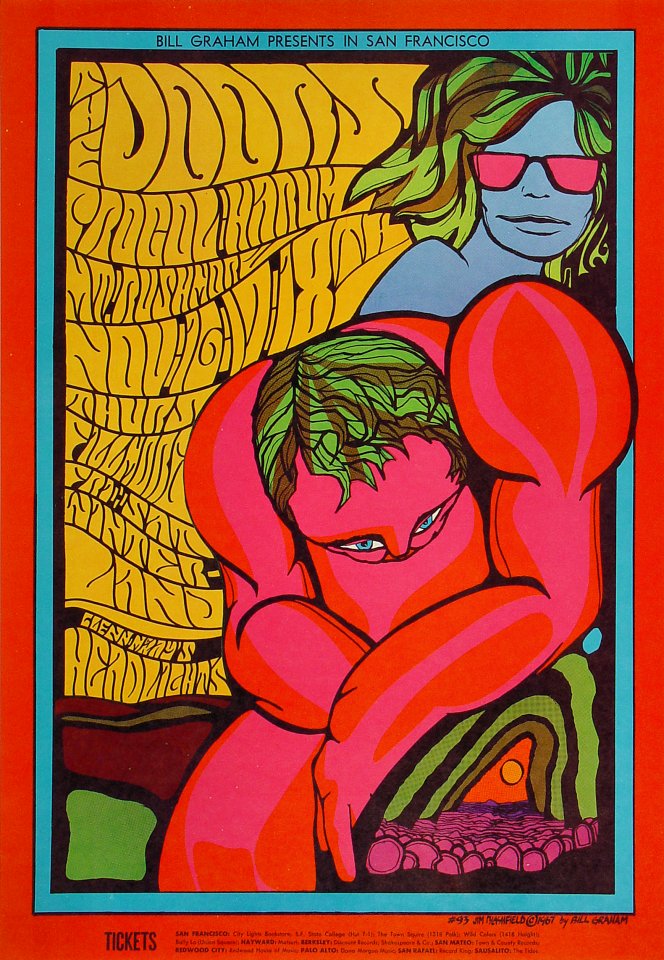
The Doors Postcard

Another split-venue offering, the Doors and Procol Harum play at this hot-hits, cool music offering personified in the cool blue and hot-to-the-touch figures. At the height of the Fillmore’s popularity in the Summer of Love 1967, Bill Graham chose artist Jim Blashfield to design a number of posters. Bold and colorful, his few designs have become highly collectible.

Transformer 2 is super excited to return with Godspeed You! Black Emperor headlining our Halloween event on Saturday October 28th 2017 at Victoria Warehouse!

Godspeed You! Black Emperor
Liars – Ben Frost – Powell – Omar Souleyman
Bardo Pond – Valgeir Sigurdsson – The Field
Demdike Stare – Sculpture – Camilla Fuchs – Civil Civic

On sale Tuesday 6th June at 10AM to pre reg customers
On general sale Tuesday 6th June at noon.