Blood on the Tracks is the fifteenth studio album by American singer-songwriter Bob Dylan, released in January 1975 on Columbia Records. The album marked Dylan’s return to Columbia after a two-album stint with Asylum Records. Most of the lyrics on the album revolve around heartache, anger, and loneliness.
The album, which followed on the resurgence of critical acclaim for Dylan’s work after Planet Waves, was greeted enthusiastically by fans and critics. In the years following its release it has come to be regarded as one of his best albums; it is common for subsequent records to be labeled his “best since Blood on the Tracks.” It is also commonly seen as a standard for confessional singer-songwriter albums; though Dylan has denied that the songs are autobiographical, but his son Jakob Dylan has stated: “The songs are my parents talking.”
With good reason, Dylan is most revered for his nearly unparalleled streak of legendary albums in the 1960s (including 1963’s The Freewheelin’ Bob Dylan, 1965’s Highway 61 Revisited, and 1966’s Blonde on Blonde), but he saved arguably his finest album ever until 1975, making one of rock ’n’ roll’s most jaw-dropping comebacks with the striking, emotional Blood on the Tracks. Despite being recorded in a ridiculous 10 days (barring a last-minute re-tracking of a few songs), the album remains Dylan’s warmest, richest recording—loads of purring organs, shuffling acoustics, and soulful rhythm sections. But as always with Dylan albums, it’s the words that steal the show, particularly on the bitter epic “Idiot Wind” and the haunting, uplifting “Tangled Up in Blue.” Rock’s most critically acclaimed troubadour kept on releasing wonderful albums after Blood on the Tracks but he never topped this classic album release.
Well, Blood On The Tracks did consciously what I used to do unconsciously. I didn’t perform it well, I didn’t have the power to perform it well, but I did write the songs; they can be changed but the idea was right…
~Bob Dylan (to Matt Damsker, September 1978)
in stunning, total contrast to the previous album, Before the Flood, this 16th Dylan album triumphantly shows more subtlety and nuance than anything he’d ever done, and as honed a use of understatement as on John WesleyHarding. At the time this was the most unexpected leap of Dylan’s career. After years of comparatively second-rate work and a considerable decline in his reputation, here was an album to stand with Highway 61 Revisited and Blonde on Blonde.
~Michael Gray
‘Simple Twist of Fate’ is another absolutely extraordinary performance. Where ‘Tangled Up In Blue’ is bright, bouncy, jangly, ‘Simple Twist Of Fate’ is soft and warm and mournful. Dylan’s voice is.. gentle and rounded.
~Paul Williams (Bob Dylan: Performing Artist, Vol 2: The Middle Years 1974-1986)
in 1975: Bob Dylan went to #1 on the US albums chart with ‘Blood On The Tracks’ (Columbia Records), his second American chart topper (it reached #4 in the UK); it has come to be regarded as one of his greatest recordings, commonly considered the ‘high bar’ for confessional singer-songwriters; Bob has denied that the songs are autobiographical, but his son Jakob Dylan stated, “the songs are my parents talking”; Rolling Stone ranked it #16 on its list of ‘The 500 Greatest Albums of All Time’…
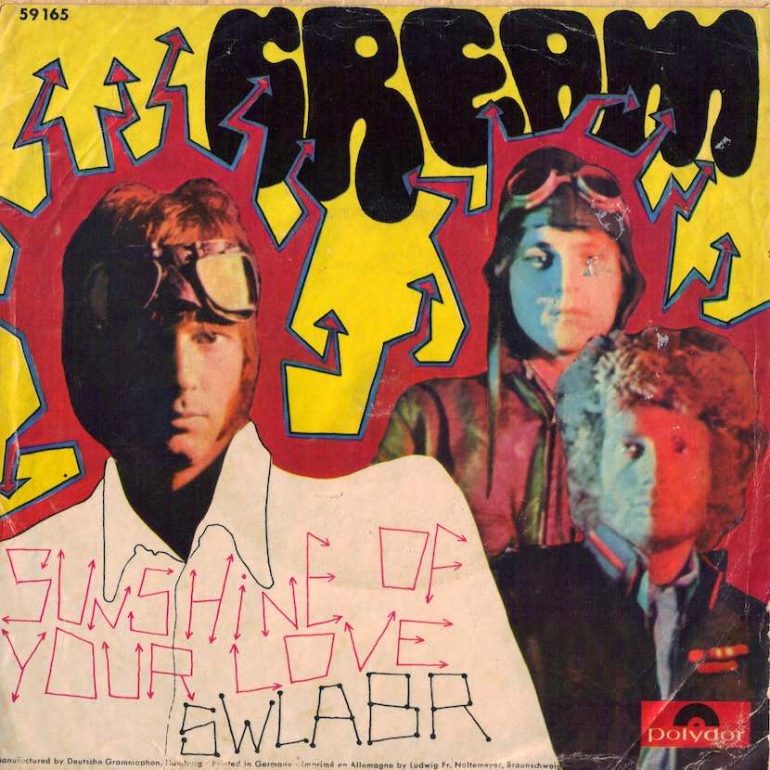
In their short time as a band the supergroup, Cream were one of the top album bands on the British, and indeed the world, rock scene. But they also amassed quite a sequence of hit singles, and in this week in 1968, they debuted on with one of their signature songs, ‘Sunshine Of Your Love.’
The trio had four previous UK singles chart entries to their name, including two top 20 hits, but ‘Sunshine’ gave them their first-ever appearance on the charts. In their own country, ‘Wrapping Paper’ announced their arrival in the autumn of 1966, reaching a modest No. 34, after which ‘I Feel Free’ hit No. 11 and ‘Strange Brew’ No. 17. ‘Anyone For Tennis’all spent three weeks on the survey in June of 1968, reaching No. 40.
‘Sunshine Of Your Love’ was composed by the prolific Cream writing team of bassist Jack Bruce and his lyric-writing collaborator Pete Brown with Eric Clapton. Clapton’s brilliant guitar solo on the recording contains a conscious reference to the Marcels’ rock ‘n’ roll classic ‘Blue Moon,’ highlighting the song’s amorous theme of a “dawn surprise.”
This classic rock anthem was introduced on Cream’s second album Disraeli Gears late in 1967, then became Cream’s biggest transatlantic single and their one gold-selling single in the States. It first reached No. 36 there in a 14-week run starting on 13th January 1968, but re-entered the top 100 in July and climbed all the way to No. 5. It later won a place in the Rock & Roll Hall of Fame.
That US success prompted the UK release of ‘Sunshine,’ as a single the better part of a year after Disraeli Gears appeared. But the track has become a rock standard, performed live by both Bruce, before his passing, and Clapton on countless occasions. The classic status of ‘Sunshine’ has also been underlined in scores of cover versions, by everyone from Ozzy Osbourne to Santana.
A double-album sampler of the Charisma label’s 1971-1972 output, “Charisma Disturbance” is a veritable behemoth and no mistake. Just a glance at the participating artists renders further comment all but superfluous Genesis, Peter Hammill, the Nice, Rare Bird, Van Der Graaf Generator, and the Incredible StringBand are more than mere giants of the U.K. underground of the age; they also represent peaks to which British prog has been attempting to return ever since. This album’s unstinting trawl through some of their most adventurous pages — “Return of the Giant Hogweed,” “Killer,” “Sympathy,” and so on — is simply the icing on the hyperbolic cake.
Charisma Records itself was never less than the consuming passion of one man, founder Tony Stratton Smith, but it is to his unending credit that he neither tried to mold his artists toward any single vision, nor impress upon them the need to shift more product. Several of the artists here would go on to enjoy huge success Genesis, of course, but also Lindisfarne and Clifford T Ward — but “The Money Game,” as one of the album’s highlights calls it, was never the be-all and end-all of the label’s release policy. And so 20 tracks rattle past with an idiosyncrasy and imagination that shares no common ground beyond the Mad Hatter who so aptly dominates the label design itself, and if you don’t discover at least a handful of bands to run out and discover — even all these decades after the fact — then you deserve to listen to track seven for the rest of your life. Altogether now, “Spam spam spam spam, spam spam spam spam.”
Side 1 –
Sinfonia Of London* Conducted By Joseph Eger Sonata Pian E Forte
John Neville -The Unanswered Question
The Nice -Intermezzo ‘Karelia Suite’
Peter Hammill -German Overalls Side 2 –
Alan Hull -Money Game
Bell & Arc -She Belongs To Me
Monty Python -Spam Song
Lindisfarne -Lady Eleanor
Bo Hansson -Flight To The Ford
Lindisfarne- Fog On The Tyne Side 3 –
Capability Brown -No Range
Rare Bird -Sympathy
Audience – I Had A Dream
Clifford T. Ward -Home Thoughts
Van Der Graaf Generator -Killer Side 4-
Music From Free Creek -Getting Back To Molly
Graham Bell -Too Many People
Jo’Burg Hawk- Dark Side Of The Moon
String Driven Thing -Regent Street Incident
Genesis -Return Of The Giant Hogweed
Listening to Bonny Doon’s self titled debut album “Bonny Doon”feels like something akin to sitting on a porch swing in the heat of the summertime, watching your neighbours strike up the barbecue, as the late-night sun sets behind houses. Or something like that. What I’m saying is that it’s a good time. Ambling, tender, weird, nice, real listen.
The band Bill Lennox, Bobby Colombo, Joshua Brooks, and Jake Kmiecik took some time to put together a track-by-track of the record, which is out via Spunk Records.
1. “Relieved”
Bill: Wasn’t sure if this one was just a humdrum strummer when I wrote it but I remember playing it for my friend while she was on LSD before I ever brought it to the band. She has the best taste in music so when she said she liked it I was pretty stoked. At the time I was living with people who collected lava lamps so I turned them all on and turned all the other lights off in the house and we listened to Slowdive most of the night. Hopefully that neon glow comes through in the album version.
Jake: The lyrics of this song and the warmth of the instrumentation always make me think fondly of the way time passes and the friendships this band has formed, and how there’s beauty and comfort in that.
2. “Summertime Friends”
Josh: This is a song that we’ve played five or more different ways, and recorded three times now. It’s been an up-tempo punk jam, it’s been really sparse, stoned and warped with everything being run through an echoplex, and here we do it in pretty straight forward style and just try to have fun with it. I think it was one the last songs we tracked for this record. Our friend Fred Thomas, who engineered a lot of the record, plays drums on it and Jake slid over to piano. It had previously appeared on a tape with a slow and dreamy quality, but Fred suggested we try it like this and we did it a few times and that was it. It has kind of a gang vocal quality because we just did them live in the room.
3. “What Time Is It in Portland?”
Bobby: A hokey question as a starting point for a spiraling ramble about change, this song seems kind of indulgent upon reflection. And maybe also because it frames it like something that happens all around me while I comfortably play the role of static observer. That’s not really how change works, but it can feel that way and it’s tempting to cast it like that. I am really happy with how this version came together. I wrote it before we started the band and it was one of the songs we tried out when Bill convinced me that I should also sing. Originally he was the only singer. We always called the guitar breaks Jimmy Buffett leads, though I don’t know his music well enough to know if that’s apt or wishful thinking.
4. “Lost My Way”
Bill: We all played in punk bands before we started this band so a large part of how we approach music is informed by that. We still kind of consider ourselves a punk band in many ways and this song is an example of how it is hard to let that go. One time we got too stoned and decided we’d play it half speed at a show, not sure how it was received. I really love the extended jam at the end. We play it different every time now but I’m happy with the way this version was captured. We were listening to a lot of krautrock at the time and Bobby and I saw Faust play around the time we recorded this. The singer kept reprimanding the audience for looking at their phones while they were playing and they had a guy playing a giant oil can as a drum pretty much the whole set. It was great.
5. “I See You”
Bill: This song was a roadmap for us in a lot of ways in that it helped us begin to find our voice. It was the first real song I ever wrote and when we played it together it just felt natural and like we all understood the feel and vibe of it. It was the first song we played at our first show. It’s on our first 7″ and it’s the first single on this record.
6. “(you can’t hide)”
Bobby: A lot of songs on this record were approached and recorded multiple different ways, and this is just a fragment of a different arrangement of “You Can’t Hide,” as captured by a blown out room mic. There is maybe a strange logic to including unfinished instrumentals filtered through clipping room mics when we had so many songs to choose from (we probably recorded about 25 for this record), but I think of them as little windows into the process and I think there’s beauty in those moments of unpolished spontaneity.
Josh:Bobby and I spent countless hours processing things through an echoplex on this record. That tape echo was a huge part of our sound and process for experimenting with songs during tracking and mixing. This one has the echoplex oscillating wildly over the whole track, as well as processing both guitars and the drums. A lot of things we do maybe don’t make the most sense but we are all about trying to get emotional impact out of our songs, however that happens.
8. “Never Been to California”
Jake: This song, at least at the time of writing and recording, felt very reflective of Bill’s songwriting process. It deals a lot with a sense of place and ruminations on where one resides, both physically and spiritually. The “blue bridge” mentioned in the first verse is a reference to the Ambassador Bridge which can be seen from the house Bill and I lived in at the time. It connects Detroit and Windsor, Canada. This song was also an exercise in a more country-esque side of our sound, a taste that brought the four of us together in a unique way.
9. “Maine Vision”
Josh: This one came as a vision in Maine, while we were standing on a rock overlooking an inland bay of the Atlantic. The melody just popped in Bill’s head and he started going “neh-neh neh-neh neh-neh neh-neh neh-neh neh neh-neh-neh” so we went back to the cottage we were staying in and jammed it out. We had just finished our first tour and drove from NYC up to outside of Portland to meet up with Bobby’s brother and relax in Maine for a few days. We are always trying to make Bonny Doon as sustainable as possible for our lives and mental health, and band retreats to cabins in beautiful places is a big part of that. There was a heavy kraut influence on this one, the one-minute track on the record was cut from an eleven-minute jam.
10. “Evening All Day Long”
Bill: I like the way this song rolls along and I love bobby’s guitar playing at the end, it’s bouncy and playful and has a sense of humor that I dig. Neither of us consider ourselves “good” guitar players but I think we’re both big fans of each other’s playing. The guitar mirrors Bobby’s lyrics too, there are jokes with a sort of existential campiness tossed in there to lighten up what could just be a straightforward sad song.
11. “(crowded)”
Josh: A longwave instrumental. There is a lot left out in the mix of this one, like all the words for one thing. It’s one of those songs that we kept adding to and adding to try and get it to feel right, and then ended up stripping everything away and just using the instrumental. It’s actually just the mic on Bill’s guitar amp and all the other instruments bleed through it. Bobby ran it through an old chorus pedal to give it a little extra movement. There’s a series of Velvet Underground bootlegs called the Guitar Amp Tapes, which are just a tape recorded in the back of Lou Reed’s amp. I could listen to those all day, they just have the feeling.
Detroit’sBonny Doon delivered one of last year’s most delightfully surprising debut albums early last year with the self-titled record. The band members cut their teeth playing in bands like TYVEK and Growing Pains, bands known for their rugged sound – but Bonny Doon shuffled out of that scene with a much more laid back heart-on-their-sleeves melodicism in the mold of Wilco or Ryan Adams.
The band’s Bill Lennox told us that Bonny Doon had already recorded their second album , captured in the beautiful Key Club on Lake Michigan. Today they have officially revealed details of the album, which is called Longwave, and will be coming out through their new label, Woodsist Records, on 23rd March.
As a glimpse of what’s to come on Longwave, Bonny Doon have released the song ‘I Am Here (I Am Alive)’. It continues in the same, instantly amiable tone that was so winning on the debut Bonny Doon, but over the course of its five minutes it shows off a more patient and meditative songwriting sensibility. It’s a definite broadening of their sound, which suggests that Longwave is going to be an involving and compelling listen.
Swami John Reis and Rick Froberg have been making noises together since high school. The mean swagger of Hot Snakes. Reis and Froberg are responsible for some of the most turbulent rock and roll of their, or any, generation.
Hot Snakes streamlined Drive Like Jehu’s complex compositions and emerged as bona fide downstroke warlords. They have made 3 studio albums of high-velocity, slash-your-face, piss-punk: 2000’s Automatic Midnight, 2002’s Suicide Invoice and 2004’s Audit in Progress. The band ceased activity in 2005 but reunited for a triumphant world tour in 2011, planting the seeds for what would further happen.
Now, after a 14-year hiatus from the studio, Hot Snakes have kicked down the door back into our lives with their new album, Jericho Sirens, due out March 16th from Sub Pop Records. The new album blasts out of the speakers with the furious “I Need a Doctor,” inspired by Froberg’s experience needing a doctor’s note in order to miss an important work function. “Yeah, I had to be quick on my feet,” says Rick. “Luckily a friend had a stack of stationary from Planned Parenthood and I used that to forge a note relieving me of my obligation”.
Throughout Jericho Sirens, Froberg commiserates with the frustration and torrential apathy that seems to be a fixture in our daily lives, while also reminding us that we have no fucking clue. “Songs like ‘Death Camp Fantasy’ and ‘Jericho Sirens’ are about that,” he says. “No matter where you look, there’re always people saying the world’s about to end. Musically, the album incorporates the most extreme fringes of the Hot Snakes sound (the vein-bulging, 78-second “Why Don’t It Sink In?” the manic, Asian Blues on speed of “Having Another?”), while staying true to longstanding influences such as the Wipers, Dead Moon, and Suicide on propulsive tracks such as “Six Wave Hold-Down,” one of the first songs written for the project during a Mummer Parade 2017 session in Philadelphia. Other moments like the choruses of “Jericho Sirens” and “Psychoactive” nod to Status Quo and AC/DC with Froberg admitting, “I still flip bird and ride my BMX on top of cop cars.”
Jericho Sirens was recorded in short bursts over the past year, mostly in San Diego and Philadelphia with longtime bassist Gar Wood,Jason Kourkounis and Mario Rubalcaba, both of whom drummed on prior HotSnakes releases but never on the same one. For Reis, reactivating his creative partnership with Froberg was one of the most rewarding aspects of the process: “Our perspectives are similar. Our tastes are similar. He is my family. And what more is there to say? My favorite part of making this record was hearing him find his voice and direction for this record. I came hard.”
In tandem with a full back catalog reissue series and the new album, Hot Snakes will return to the road in 2018 to incinerate the villages, and they’re already looking ahead to more music. Says Gar Wood, “There’re already 2 more records written and recorded. We wanted to come out with this one using the more mainstream sounding stuff to give people a chance to catch up.”
Jericho Sirens (Release Date: March 16th, 2018) Sub Pop Records, Catch the band LiveTuesday, January 30th Rescue Rooms, Nottingham, United Kingdom.
Jim Phillips, a Santa Cruz native, is a graphic artist whose design work includes rock posters, skateboard decks and surfer T-shirts. Permanently settling in California in 1968 with his wife and new son, Phillips began designing for Bill Graham Presents and Family Dog, where he later became Art Director. Phillips has always encouraged beginning artists, and he continues to paint surfer and skateboard art, designs the infrequent poster and collaborates on various projects with his artist son, Jimbo.
Jim Phillips, a Santa Cruz native, is a graphic artist whose design work includes rock posters, skateboard decks and surfer T-shirts. Permanently settling in California in 1968 with his wife and new son, Phillips began designing for Bill Graham Presents and Family Dog, where he later became Art Director. Phillips has always encouraged beginning artists, and he continues to paint surfer and skateboard art, designs the infrequent poster and collaborates on various projects with his artist son, Jimbo.
Designed by Jim Phillips, a Santa Cruz native, is a graphic artist whose design work includes rock posters, skateboard decks and surfer T-shirts. Permanently settling in California in 1968 with his wife and new son, Phillips began designing for Bill Graham Presents and Family Dog, where he later became Art Director. Phillips has always encouraged beginning artists, and he continues to paint surfer and skateboard art, designs the infrequent poster and collaborates on various projects with his artist son, Jimbo.
The Age of Atlantic is the second in a series of rock music samplers released by the Atlantic label in the UK. The compilation is credited to Janet Martin. Issued at a budget price of UK £0.99, ($US 2.00 approx in 2007), the album was for many an inexpensive introduction to new rock acts, and was one of the earliest samplers of “progressive” or “underground” music.
The gatefold’s exterior was modelled in plasticine and, on its front, showed the logos or punning representations of the featured bands, whose album covers were depicted in the interior. The rear features the track listing scratched into a flattened layer of plasticine. The design is credited to Hamish & Gustav.
The track listing is wildly eclectic illustrating the diversty of Atlantic’s roster at the time. You get some fun rockers (Zep, Vanilla Fudge), some white boy blues (The Allman Brothers) and Prog (Yes, Iron Butterfly) and leftfield Americana (Dr John, Buffalo Springfield and Delaney and Bonnie).
Side One
“Comin’ Home” – Delaney & Bonnie (with Eric Clapton)
“Tonight” – MC5
“Black Hearted Woman” – Allman Brothers Band
“Survival” – Yes
“I’m a Good Woman” – Cold Blood
“Whole Lotta Love” – Led Zeppelin
Side Two
“Termination” – Iron Butterfly
“The Last Time” – Dada
“Communication Breakdown” (Page/Plant/Jones/Bonham) – Led Zeppelin