Hardly Art Records is pleased to announce that Seattle riffers Versing have officially joined the roster. The four-piece has been turning heads in the city for the past two years with their taut and brainy take on Northwest rock, and today they’ve shared “Silver Dollar,” a digital single that constructs a narrative around the social injustice of so-called “affluenza.”Revolver premiered a music video for the track this morning,
“Silver Dollar” is a new digital single from Seattle band Versing.
The founding members of Versing initially met at their college radio station in Tacoma, a port city on the Puget Sound. When the trio’s short-lived garage band—whose repertoire included what they refer to as “a mean Boyracer cover”—went kaput, they added a fourth member, shuffled some instrumental duties, rechristened themselves Versing, and relocated to Seattle.
Now consisting of Daniel Salas on vocals and guitar, Graham Baker on guitar, Kirby Lochner on bass, and Max Keyes on drums,
Since the release of their first single three years ago, the Washington D.C.-based three-piece Governess have become a bit more mellow, adding dreamy power pop to the mix. Bassist Kieca Mahoney, drummer Erin McCarley, and guitarist Kim Weeks all contribute vocals, which frequently blend together in beautiful, haunting harmonies à la Grass Widow. But their shoegazey guitar melodies and sweet-sounding voices often betray the stories behind the songs—see the despairing “Decay,” filled with images of hopelessness. If there is a theme to Zero, released via Sister Polygon Records, it is frustration with the inanity and difficulty of life. “This life is panic / We’re sinking in dark water,” McCarley sings on “Gaslit.” On “Space Garbage,” a droney, atmospheric track, the trio contemplate our existence on Earth as the floating trash of the galaxy. Governess may find existence exhausting, but Zero helps sweeten the here and now.
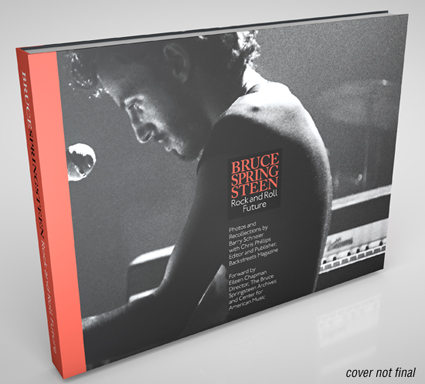
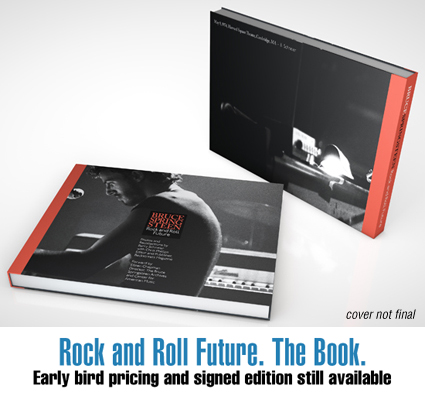
A new hardcover photography book focused squarely on Bruce Springsteen’s legendary Harvard Square Theatre performance on May 9th, 1974. With the E Street Band including Ernest “Boom” Carter, Clarence Clemons, DannyFederici, David Sancious, and Garry Tallent, it’s also the night that inspired Jon Landau’s famous Real Paper review.
The evening of May 9th, 1974, is legendary in the annals of rock ’n’ roll. It was the night the little-known BruceSpringsteen & the E Street Band opened for Bonnie Raitt at Harvard Square Theater, dazzling the critic JonLandau into writing “I saw rock & roll future and its name is Bruce Springsteen’’ in the local alternative weekly The Real Paper, one of the most revered gigs in rock history.
Springsteen’s band at the time of the Harvard Square booking featured a pianist with strong jazz and classical leanings, David Sancious. (He left in August 1974.) It is Sancious who makes the band’s first impression so strong, opening with a long, melancholy, and ruminative solo on “New York City Serenade’’ It slowly leads into Springsteen’s yearningly searching vocal, with the impressionistic, romanticized lyrics that seem part Bob Dylan’s“Desolation Row’’ and part Lou Reed’s “Walk on the Wild Side’’ The song was aiming for theatrical grandeur and also reverent intimacy, and the effect it has on hushing an audience can still be felt today.
But then he moves away from that territory on “Spirit in the Night,’’ a song that still has its cryptically spooky Dylanesque lyrics but also builds into a more traditional soul shout-out, thanks to Clarence Clemons’s saxophone solo. The band then goes into soul-oldies heaven with a cover of “I Sold My Heart to the Junkman,’’ which had been a 1962 girl-group hit. On these three songs and five others, it’s evident that Springsteen and his tightly rehearsed ensemble were trying simultaneously to draw from the music’s past and to create a future. This is the night they came to be forever recognized for it.
Rock and Roll Future is a collaboration between Backstreets Publishing and Barry Schneier, the only photographer in the venue that night 44 years ago. This is our first foray into online crowdfunding; it was quickly tapped as a “Project We Love” by Kickstarter, and we reached our initial funding goal less than a week into our 30-day campaign.
Now that we’ve reached the minimum funding we needed to publish, our focus moves from the chance to make a book to how to make the best book we possibly can.The more backers we have by the campaign’s close on July 13th, the better we can make the finished product.
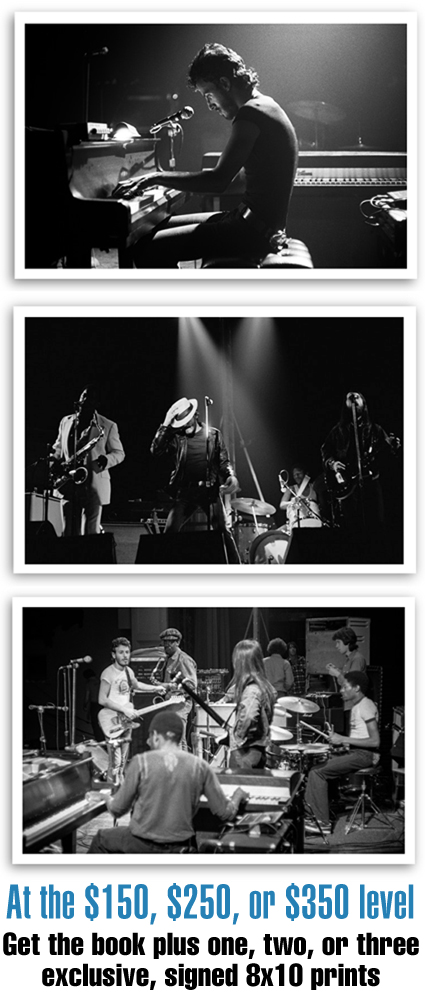
For the next 17 days, you can get exclusive Kickstarter rewards: early-bird pricing on the book… signed copies… beautiful photographs from the night as exclusive, signed prints, from 8×10 to 16×20… these are all still available when you pledge at various levels to support Rock and Roll Future.
Actually, Landau — who went on to become Springsteen’s manager — didn’t see the performance that can now be heard at the hall of fame. He went to the second show that night, when the set list not only was somewhat changed — Springsteen opened with “The E Street Shuffle’’ — but showcased a new song, “Born to Run.’’ Landau had seen Springsteen at a Cambridge club called Charlie’s Place just a month earlier.
The band’s previous music has always been opulent, anthemic quality but that is missing from their new track. “Big God” it is sparser, but gorgeously so. If Florence Welch’s ethereal vocals made her sound like a goddess on previous tracks, she’s a distinctly grounded one on “Big God” as she sings of messages left on read and a lopsided relationship. “Is it just part of the process? / Jesus Christ, it hurts,” she asks, and the small wounds feel all too real.
Florence Welch has opened up in a personal interview to The Guardian about why she has given up alcohol after a period of non-stop partying and also about the impact of her Grandmother taking her own life.
Welch is due to release her fourth album High As Hope with Florence + The Machine this Friday and has revealed she drank because she “didn’t know how to come down from touring” as well as heavy drinking before performances to combat her “shyness“.
“That’s when the drinking and the partying exploded, as a way to hide from it,” She added: “I was drunk a lot of the time, on extra dirty Martinis – my way of drinking three shots at once. I was never interested in a nice glass of wine.”
She also spoke of how she ‘rarely slept’ in the early years with Florence + The Machine and how she would often end up going on ‘two day parties’ and waking up in weird locations wearing other peoples’ clothes.
“The partying was about me not wanting to deal with the fact my life had changed, not wanting to come down” the 31-year-old said. She added: “It always felt like something had picked me up and thrown me around various rooms and houses, then gone ‘boom!’ It happened every time, and every time it was shocking.”
She continued: “When I realised I could perform without the booze it was a revelation. There’s discomfort and rage, and the moment when they meet is when you break open. You’re free.”
The Londoner also opened up about her Grandmother’s tragic suicide and how this has changed her outlook on life. She said: “My mother’s mother committed suicide. And the way she was loved by her mother has related to the way she loves us, which then is the way we love others.”
Before adding: “My grandmother fell, so sometimes I feel like we’re all still in this loop, falling with her. The trickle-down of tragedies.”
Third Man Records is absolutely ecstatic to be releasing the excellent live document of (Sandy) Alex G’s Blue Room performance. Recorded on the 2017 US tour supporting his critically-acclaimed album Rocket (voted among the best albums of that year) and not long after a notable feature on Frank Ocean’s album Blonde, this standalone LP is his first live set to be captured and made widely available for his very loyal fan base to enjoy.
Featuring work from self-released tapes, Lucky Number, Orchid Tapes and Domino Recordings, this daydreamy and intricate retrospective opens a private window into (Sandy) Alex G’s lovely lyrical wordplay and cozy stage persona.
Culture Abuse, the San Fransisco band who play ratty garage-punk with ridiculously strong melodic hooks, The band’s 2016 debut album Peach was an under-the-radar monster. They’ve collaborated with Wavves a couple of times, a combination that makes a lot of sense. They also just got off tour with Turnstile and Touché Amoré, and that combination makes sense, too. Their music works just fine for moshing, but it’ll rattle around in your head all day, too.
Culture Abuse are part of the Epitaph roster now, and their new album Bay Dream is released very soon. They issued a earlier single “Calm E,” which is good. And now they’ve shared another new song called “Bee Kind To The Bees,” which is even better.
“Bee Kind To The Bees” is a sharp, polished piece of driving, guitar-centric power-pop. If it existed in the age of ’90s alt-pop radio, it might’ve turned Culture Abuse into Better Than Ezra. But as catchy as it might be, it has a messy lovable-loser thing going for it, too.
“Bee Kind To The Bugs” by Culture Abuse from the album ‘Bay Dream,’ available now
Modesty and plain good manners might prevent them from saying so themselves, but the fact that StephenMalkmus and The Jicks have thrived, rather than simply endured over 17 years and delivered six albums of buzzy, sub-cultural significance, constitutes an impressive legacy. The challenge with album number seven is one that any successful band with integrity faces: how to safeguard that legacy and hold on to their identity without rehashing old ground (unthinkable), and also say something meaningful while (crucially) having fun doing it? Meeting that issue head on in the run up to The Jicks’ seventh record involved some “navel gazing”, according to singer, songwriter, and guitarist Malkmus and not only in terms of what it means to be releasing music in 2018. If, like him, you’re a voracious consumer of all kinds of culture and feel the need to interact with it, rather than just react, then inevitably “there’s a world that prompts you to put your best foot forward”. With Sparkle Hard Malkmus, Mike Clark (keyboards), Joanna Bolme (bass) and Jake Morris (drums) do exactly that. And they hit the ground running – on air treads.
The former Pavement frontman offers up a collection of simultaneously effortless and intricate songs, reaffirming his ability to write hook-heavy indie rock, and throwing in a few new tricks (vocoder!) along the way. Between a fiddle-fueled duet with Kim Gordon (“Refute”), a chugging rumination on police brutality (“Bike Lane”), and gloaming guitar riffs (“Shiggy,” “Future Suite”), Sparkle Hardis Malkmus’s finest offering with the Jicks so far. And in addition to his melodic triumphs, Malkmus hasn’t lost any of his verbal wit since his last album, 2014’s Wig Out at Jagbags. “You know you should be blushin’ / To a hue of Robitussin” he sings on “Middle America,” while on “Solid Silk,” Malkmus observes that a working man will “Never see the butter side of his daily bread.” Overall, Sparkle Hardis a landmark offering from one of rock and roll’s most enduring figures.
On June 29th, archival record label Numero Group, releases ‘Electrophia‘, a compilation of songs, recorded in the mid-80′s and remastered from the original tapes, by American dream pop artist Happy Rhodes. To mark the occasion, American singer/songwriter Marissa Nadler, has shared a cover of one of those songs. It’s called ‘Where Do I Go’ . Since releasing Strangers in 2016, Marissa Nadler has contributed her spectral stylings to a number of different projects.
Based in upstate New York, Rhodes was known for her four-octave range and her meld of classical influences with synths and acoustic guitar. Nadler’s own interpretation of Rhodes’ 1986 track uses a sultry guitar in place of an electronic organ and synth. Her voice commands a softer, hypnotic force. Listen to “Where Do I Go” below.
Miranda Winters is a song-writer and musician best known for her role as the indomitable vocalist / guitarist of Chicago powerhouse, Melkbelly. Drawing on deep roots as a song-writer in Chicago DIY, Winters continues to evolve a signature sound by pursuing her music as a solo artist.
Miranda Winters currently fronts the chaotically good Chicago band Melkbelly, and before that she had her hand in a number of other different projects, including Coffin Ships and a solo endeavor called Flowers Everywhere. Last week, she released the first tape under her own name, titled Xobeci, What Grows Here?.
The songs on it have the same confidence that she exhibits while helming Melkbelly, but distill that into songs that sound skeletal but textured. There’s a sense that some of these, like the penultimate “Glitter House” or “With Love From St. Fake, WI (P.A.M.),” could mutate into one of Melkbelly’s signature squalls with the right ingredients, but the restraint that Winters demonstrates allows her lyricism and sour melodicism to really shine.
They also all act as showcases for Winters’ circuitous guitar skills, which can get lost amongst her main band, but here serve as particular highlights, like on the wiry outro to “A Handy Garden Plot” or with the gentle pluckings of closer “O.T.O Revised.” Winters’ solo material has a way of hooking you in
After a four year wait, Eels release their highly-anticipated new album The Deconstruction via E Works. “Here are 15 new Eels tracks that may or may not inspire, rock, or not rock you. The world is going nuts. But if you look for it, there is still great beauty to be found. Sometimes you don’t even have to look for it. Other times you have to try to make it yourself. And then there are times you have to tear something apart to find something beautiful inside.” Eels singer-songwriter E (Mark Oliver Everett).
Official video for “Rusty Pipes” from THE DECONSTRUCTION-– Out Now!