
It has been a long musical journey for the Lovell family, with plenty of twists and turns along the way, and it all started at a bluegrass festival. Sisters Jessica, Megan, and Rebecca Lovell had been studying classical music from a young age and were surrounded by an eclectic mix of music at home—exposed to everything from Alison Krauss to Black Sabbath. But it was the sound of live bluegrass that served as the catalyst for their mutual epiphany.

Rebecca Lovell explains: “We were just blown away by the passion and spontaneity of bluegrass, with everyone improvising and everyone out dancing. That was a very different experience than we’d had thus far performing in classical trios and quartets and symphonies and orchestras. We were bowled over by it and instantly flipped 180 degrees. We put away all of our classical instruments and quit our classical lessons. That was the genesis of our really involved love of music.”

In 2004, the teenage sisters formed their band, the Lovell Sisters, and hit the ground running. They made records and toured the country, appearing on A Prairie Home Companion and at the Grand Ole Opry, as well as winning the John Lennon Songwriting Competition in 2008. But by 2009, oldest sister Jessica decided to leave music. “It’s a very strange way to make one’s life,” says Rebecca.

You have to be whole hog to make it work, and she just said, ’It’s not for me,’ and moved on to other bright and beautiful things. The younger Lovells regrouped and took the opportunity to make a fresh start, electrifying their sound under the name of their great-great-great-great grandfather, Larkin Poe. The new band built on the Lovell Sisters’ momentum, introducing Larkin Poe to the world in 2010 by releasing four EPs that year. It didn’t take long before their sound caught the ears of folks like T Bone Burnett, Elvis Costello, Steven Tyler, and Keith Urban—all of whom have tapped the Lovell sisters’ talent for recordings and performances.

The duo released their newest album, Venom & Faith, hot on the heels of Peach, which dropped in late 2017. There is a sonic narrative between the two records: Megan and Rebecca decided to eschew outside help and to produce, write, arrange, and perform all of the instrumentation themselves. The result is a pair of albums that embrace a stripped-down sound based on nontraditional arrangements that focus on the sisters themselves. While Peach is a raw take on the bluesy side of their sound, Venom & Faith moves farther afield in its influences, drawing on the sounds of Southern hip-hop and alternative rock artists like Radiohead and PJ Harvey.

“Both of us are very influenced by the source music of the South—like bluegrass, blues, roots music, folk music—but we do differ a little in our individual inspiration. I’m inspired by a lot of classic rock people, like Pink Floyd or the Eagles or Black Sabbath.” Megan Lovell

We’ve been Larkin Poe now for eight years. I think it took us eight years to start making records that we finally feel represent the music we hear in our heads or the music we envision playing. So it was really just a baby-step-by-baby-step journey to realizing the dream of what it really means to be Larkin Poe.
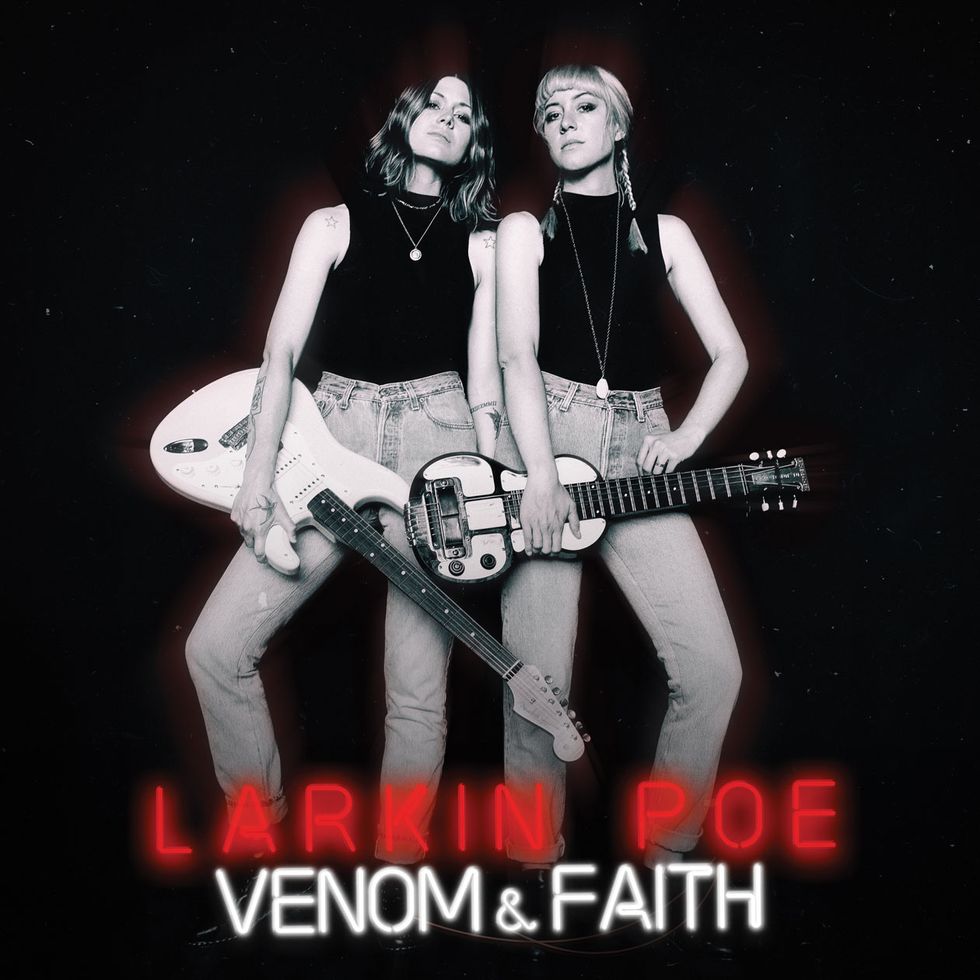
 

Image may contain: 1 person, indoor and close-up

Forgiveness can feel like a foreign concept within this year’s endless unspoolings of shock, rage and cynicism. And yet, there was Brandi Carlile — the era’s most powerful purveyor of that much-abused gift to hungry audiences, the rock anthem ,making a whole album about what it means to practice it. By The Way, I Forgive You begins with a gentle ballad grounded in Carlile’s close harmonies with her main collaborators, Tim and Phil Hanseroth; it contains the album’s title phrase. It’s a story of rejection (for Carlile, by a minister who refused to baptize her when she came out as a teen) with the moral that moving on only works when you declare the weight of the damage done. The album ends with a Joni Mitchell-inspired piano ballad about a near-disastrous fight Carlile had with her wife, the song itself the peace offering Carlile offers, in the lyrics: “Girl, you can slam the door behind you, it ain’t ever gonna close.” Between these bookmarks Carlile shares stories of the wrongs people do each other and what it really takes to enact forgiveness: resilience and recognition of wrongdoing, tempered by the determination to live fully, even with the wounds.

Carlile’s huge, warm voice, with its vibrato ending each phrase as if turning into a memory, works perfectly within the album’s grand, expressive settings, untethered to genre, massive but intimate. Whether sharing the story of “Sugartooth,” an addict and the people who love him even as he slips out of their safe hold, or assuring the bullied children of “The Joke” that they will walk in the sunlight of their own truth soon, or realizing that her father’s advice to bear no malice doesn’t contradict her mother’s about knowing when to fight, Carlile rises to meet its imperatives. Each song asks how she, how any of us, can face the ugliness life creates and still hold out a hand — toward the dark, so that it might possibly transform; toward those we love and those we fear, so that, as one prayer of forgiveness once said, we all may be delivered.

No automatic alt text available.

“Modern Meta Physic” is the debut album of Peel Dream Magazine, the nom de plume of New York City-based musician Joe Stevens. Stevens, a talented multi-instrumentalist, wrote, played, recorded, and mixed the album in his apartment in Brooklyn — quite surprising, considering how much “Modern Meta Physic” sounds like it was played by a tour-seasoned band.

A nod to BBC Radio 1 legend John Peel, arbiter of all things underground, all things quality, and all things — it must be said — “cool,” Peel Dream Magazine is highly evocative of a certain strain of independent music. As Stevens explains, “I wanted to conjure media . . . to create an outlet for subcultural wanderers. Something you can subscribe to.”

Exhausted by what he thinks of as the manipulative aspects of contemporary pop music, Stevens harkens back to the early 1990s, when The Velvet Underground resurged as an inspiration to a new set of bands wielding synthesizers, off-set guitars, and a political bent. The Peel Dream experience is defined by a gentle, fuzzy psychedelia, largely indebted to London’s onetime “Scene that Celebrates Itself.” It’s a hypnotic bit of mod-ish lo-fi pop, recalling the best of early Stereolab, Lilys, and other shaggy haired kids with vintage fuzz pedals, slim trousers, and good record collections. Stevens conjures a distinctly 90s vision of the 60s. Not the actual 60s, mind you, but perhaps a 60s daydreamed about from the creature comforts of a suburban living room. An abstraction. Shag carpet turned to bowl cut. Jean jackets — disaffected but wholesome youth. It’s not irony, exactly. It’s the love that comes from loving. And a bit of whimsy. It’s the 90s, again. Post-post.

Written and recorded over a four-week period in the fall of 2017, “Modern Meta Physic” fixates on the New Age universe of the Catskills region of New York. Stevens deals in generic bohemian fare — Far East philosophy, Native American tradition, mid-century modern cool — as he appraises the world according to privileged urban expats who increasingly call the upstate paradise home.

Not everything is tongue-in-cheek, however. Stevens also pays homage to Catskills as a place replete with natural wonder — a place of self-discovery and impromptu adventure. “I wanted to convey the Catskills the way that Brian Wilson conveyed Northern California on the post-Smile records. It’s a little trippy, a little childlike, but the feeling is real.” In “Living Room.” Steven’s surrenders to Mother Nature in a bit of dada-esque worship, transfixed by “sound, sight and weather.” On “Don’t Pick Up Slackers,” Stevens settles into a woodland getaway home as he tries to make sense of his neighbor’s “fruit diet.” One might get lost in the nostalgia of aimless road trips and cabin retreats, but there are moments where Stevens ventures on to new topics. On “Art Today,” he opines on what he sees as the maddening and thankless task of committing oneself to making art. “Us for Chanel, all are to sell. I want to tell, some days are well.”

http://

Leading off the album, “Qi Velocity” is a metronomic take on French pop that yields to a lush, twee chorus reminiscent of Belle and Sebastian. “Deetjen’s,” named after the much-loved bed & breakfast in Big Sur, would fit snugly on Unrest’s best Teen Beat material. The ambient “Levitating Between 2 Chords” suggests Oval in “94 Diskont” mode. There is an economy to these tracks — everything is distilled down to it’s essential elements, no gestures are wasted, no superfluous ornamentation taking up space. Where some might add effects, Stevens removes them, opting for surprisingly straight-forward arrangements of Farfisa, monosynth and guitar. “Due to Advances in Modern Tourism” displays a soft take on Neu!, while the organ that enters could be a sly wink to Steve Reich’s “Four Organs” or even Terry Riley’s West Coast take on minimalism. “Wood Paneling” is a lysergic trip, a memory of a memory of an experience not lived but learned — how can something feel so relaxing yet so … uneasy?

While Stevens is more than happy to show his influences on his sleeve — mind you, they’re great influences — it’s clear Peel Dream Magazine isn’t just a “sound”. The guy can write songs. And when he wants to hit a target, he hits it. Where he goes next is anybody’s guess.

Released October 5th, 2018

The Decemberists - Traveling On

We’re pleased to share that the title track from the ‘Traveling On’ EP

The EP “Traveling On” is the next iteration of The Decemberists B-sides series, a tradition that began in 2005 and serves as a follow up to “Florasongs” and “Long Live the King”. It’s comprised of five B-sides related to their last album ‘I’ll Be Your Girl’ (4 tracks that were exclusive to the Exploded Edition box set + a full band version of “Traveling On”). It is pressed onto Gold 10” Vinyl.

Here we are, in the final days of the YOUR GIRL/YOUR GHOST tour, the release of our 8th record, ‘I’ll Be Your Girl,’ a bare glimmer in the fogged rear-view mirror of time. Perhaps other bands would be content to rest on the laurels of another successful record released, another romp about the globe put to bed — BUT NOT THE DECEMBERISTS. No, folks, we have one last thing we’d like to impart to you before we go into our deserved siesta: We are announcing the ‘Traveling On EP’!

This little bugger is a sharp twenty-one minutes of songs that were recorded during the ‘I’ll Be Your Girl’ sessions but never quite found a home on the album those sessions produced. What’s the tracklisting, you ask? Look no further:

1. Down On The Knuckle
2. I Will Not Say Your Name
3. Tripping Along (Full Band Version)
4. Midlist Author
5. Traveling On

This EP will be out on compact disc, 10” vinyl and, as is the mode, digital bits via your preferred streaming service. However, if you order it now via the Decemberists shop, you can opt to receive a bespoke t-shirt as well. Vinyl copies will include a coupon for a digital download.

PLUS: if you order the EP through our web shop, you’ll INSTANTLY have access to digital files of two songs — “Traveling On” and “Tripping Along (Full Band Version).”

10” vinyl & CD released everywhere on December 14th, except UK/EU, released December 21st

The Decemberists performing “Traveling On” 2018 Capitol Records

Lump 600x600

It began when Tunng’s Mike Lindsay – a prolific, Mercury prize-winning producer – was introduced to Grammy-nominated, Brit award-winning singer-songwriter Laura Marling after her show supporting Neil Young in London. LUMP is a heady blend of wonked-out guitars, Moog synths and pattering drums, set against droning, coiling clouds of flutes and voices. The lyrics are inspired by early-20th-century Surrealism and the absurdist poetry of Edward Lear and Ivor Cutler – a bizarre but compelling narrative about the commodification of curated public personas, the mundane absurdity of individualism, and the lengths we go to escape our own meaninglessness. The composers are keen to stress that LUMP is a creation that passed through them, and they look upon it parentally. It is their understanding that, now it has come into being, LUMP is the artist, and it will continue to create itself from here on. Lindsay and Marling will assist it as necessary.

LUMP (Laura Marling and Tunng’s Mike Lindsay) perform Curse of the Contemporary on BBC Later… with Jools Holland on BBC Two (22 May 2018).

Lump mixes the stunning, instantly recognisable vocal prowess of Laura Marling with the off-kilter electronic folk-tinged oddness of Lindsay’s band Tunng. An enchanting and fascinatingly diverse outing, one to listen to in it’s entirety. Superb.

Davy Graham was quite a pioneering guitar player, starting in the ’50s. He was the first guy to really play a range of styles. He’s influenced by traditional music, he’s influenced by jazz, influenced by North African music, and he’d blend all these things together into this very hybrid style that he had. And he did this record with the wonderful English traditional singer Shirley Collins, and they would do interpretations of traditional songs, songs like ‘She Moves through the Fair’ and ‘Nottamun Town.’ In these interpretations you’d have kind of jazzy guitar influences coming in, and it really—it showed the possibilities to the next generation of what can be done with folk music. I think it’s a hugely successful record. I don’t know how many it sold at that time, probably not that many, but a lot of people who went on to have folk music careers really paid attention to that record and saw many, many possibilities on the horizon. As a guitar player he influenced people like Martin Carthy, John Renbourn, Bert Jansch, John Martyn—the next generation of acoustic guitar players all paid attention to Davy.”

Image may contain: text

Image  —  Posted: December 5, 2018 in FESTIVALS, MUSIC
Tags:

Image  —  Posted: December 5, 2018 in FESTIVALS, MUSIC
Tags: ,

Image may contain: 4 people, people smiling

The Beths performing live in the KEXP studio. Recorded October 2nd, 2018.

Our KEXP vid is up! Give it a look if you wanna see me:
– head bang my headphones off with a single bang🤘
– disintegrate into a nervous, mumbling mess💧
– be completely star struck by Cheryl

Songs: Future Me Hates Me Uptown Girl Little Death Happy Unhappy

Band Members
Elizabeth Stokes – Guitar and Vocals
Jonathan Pearce – Guitar and Vocals
Benjamin Sinclair – Bass and Vocals
Ivan Luketina-Johnston – Drums and Vocals

Image may contain: 3 people, close-up

There’s softness in the trippy funk of Khruangbin’s “White Gloves” that has wrapped around me, and I have no intention of letting it go. Delicate psychedelics spin into velvety rock that’s rooted in ’60s Thai funk and surf music. It might not be what you’d expect from a primarily instrumental Houston trio, two of whose members started out playing gospel music together, but it works.

“This is the first song with lyrics we’ve ever written. We never really thought of ourselves as having a “singer” but we knew that we wanted a voice for Khruangbin. We decided to write about something close to us, tell a story as simply as possible, and sing it together. We created the footage for ‘White Gloves’ many years ago by creating a video feedback loop with a vhs camera and an old television. We always wanted to use it in some way with Khruangbin, and after all of this time, it found what it was missing. It lets the story and the song speak for themselves. ” – Khruangbin

Even the name Khruangbin, which means “engine fly” in Thai, adds another color to the band’s story and sound. After discovering the group through its contribution to Bonobo’s Late Night Tales compilation, I have Khruangbin’s debut album,The Universe Smiles Upon You, in my personal heavy rotation

Band Members
Bass: Laura Lee
Guitar: Mark Speer
Drums: D.J.