The best songs exist as their own self-contained worlds, planets that seem out of orbit with everything else. “Finally” is one of these rare tracks, a slow-burning mood piece that evokes hazy, half-remembered dreams, snippets of memory, thoughts that pass by and disappear like clouds. Tom Snowdon’s voice is a singular, haunting instrument that holds focus as the instrumentation washes in like a slow-motion wave. Finally is the connective tissue that binds their two-part Islands project, and fittingly for its title, has been announced as the last song No Mono will release for a while.
Recorded at Pieater’s BellBird studio in Melbourne, the album came together over a three-year period, mostly in Melbourne, but pieces sketched all over. It was entirely written, recorded, produced and mixed by Tom Snowdon and Tom Iansek.
“Islands” brings the previously separated “Islands part 1” and “part 2” together in a whole state, and includes the previously unreleased track ‘Finally’, which helps close the “Islands” chapter.
“Islands” the culmination of years of songwriting and performance, and draws from broad influences including Snowdon’s upbringing in the remote desert town of Alice Springs and his relationship to central Australia. It also oozes Tom Iansek’s boundary-pushing production.
No Mono’s music explores and is inspired by the emotional and other-worldly. “Islands” is a record about transition through crisis and sanctuary.
The back half of “Islands”(originally released as “part 2”) serves to complement and expand on the haunting first half. The BPMs are increased, and the energy at times borders on frantic, but there’s also a swagger. Percussion is used to bewilder – at times frantic, scattered or glitchy. Snowdon’s vocals are less tender, as he battles to find connection and empathy. Yet despite the eerie energy, there is always an alien beauty to the whole, and ultimately a faith in keeping hope.
Deluxe Islands vinyl is now available – it includes all songs on parts 1 and 2 and bonus track ‘Finally’, which we released this week. Our “Islands” records were always meant to be two parts of a whole. They’re together here with some new art by Tom Iansek.
“I have to feel kind of worthless again to want to make music,” Kevin Parker said of the long gestation time between the forthcoming Tame Impala album “The Slow Rush” and 2015’s world-beating “Currents”. While the dreamy introspection of Parker’s past music treats the passing of time as a man-made construct, recent Tame Impala output suggests he has been thinking a lot about the subject of late. Patience, the first of his three 2019 singles, extolled the virtues of waiting around, but It Might Be Time flips the script, seeing him obsess over friends growing up and moving on, realising he isn’t as young as he once was. “Nothing lasts forever,” he sighs as if just realising this truth, while a prominent synth swings from side to side like a pendulum – or is it ringing out like an emergency siren? Either way, there’s an urgency to this track that we’ve yet to hear from Tame Impala, and we’ve got all the time in the world for it.
Band Members
Kevin Parker – Guitar / Bass / Drums / Sing
Jay Watson – Keys
Dominic Simper – Guitar / synth
Cam Avery – Bass
Julien Barbagallo – Drums
When they first came to prominence, the DMA’s copped a lot of Oasis comparisons, mostly due to Tommy O’Dell’s Gallagher-esque sneer and the band’s penchant for dressing for the Manchester mist rather than the Sydney sunshine. But over the course of two albums, it has become clear that they are closer in sound to other Northerners like the Verve, the Stone Roses, and the Charlatans – bands that deal in chorused-out guitars, peeling melodies and baggy beats – with the odd strum-along to break things up. Silver is a tender tune, a shimmering summery song that straddles their Preset-produced second record, and the heart-on-sleeve balladry of their debut single Delete. Of course, anyone with enough guitar pedals can approximate a classic sound, but top-shelf songwriting and O’Dell’s ringing bell of a voice means that DMA’s stand alone, despite the many comparisons.
Our new album ‘For Now’ is out now. Includes the new singles ‘In The Air’, ‘Dawning’ & the title track ‘For Now’.
The Jezabels are one of the most successful Australian bands of the last 10 years, but as the decade slides to a close, frontwoman Hayley Mary has struck out on her own with perhaps her most radio-friendly composition to date, a masterwork of forward propulsion and powerful vocals. Whether by happy accident or subversive design, the chorus melody echoes that of Katy Perry’s Hot N Cold, which simply means this earworm will remain lodged in your head for weeks on end. A strong bridge falsetto slides over a stomping 4/4 beat, tasteful guitar parts dance around the vocals, and a harmonica joins in at the 11th hour to bring the whole thing to a thrilling close. This all bodes very well for a solo album, which should materialise next year.
Hayley Mary The Piss, The Perfume ℗ I OH YOU Released on: 2019-10-14
Richie Furay’s, Rock history career is a smorgasbord of tales of the lost and forgotten, of things that went awry and never quite were. But Richie Furay’s long and winding story jumps out.
Furay, now 72, stood at the epicenter of musical and cultural change from the 1960s into the 1970s. Onstage, he literally stood at the center of the Buffalo Springfield, the short-lived quintet that foreshadowed and implemented so many of the rapid, diverse musical changes then unfolding. Offstage, Furay played the talented buffer between the explosive egos of Neil Young and Stephen Stills. They were bigger, flashier artists who would keep driving the music’s evolution in then-undreamt-of directions—and in the process overshadow Furay’s own pioneering artistry.
What happened to Furay with Poco. The Springfield’s ashes were still warm in 1968 when he founded that band, with fellow Springfield refugee guitarist-producer Jim Messina. The quintet forged a model for the country-rock hybrid that would dominate airwaves and sales for decades, scored a few moderate hits and critical raves, and wowed crowds with their showmanship. But Gram Parsons, the Grievous Angel, aiming in his own ways at that target with the Byrds and the Flying Burrito Brothers, soon loomed larger: for starters, Furay wasn’t getting blasted with Keith Richards, and the Stones weren’t covering his songs. Messina left Poco to team up with Kenny Loggins, and others followed, including Furay in 1973.
In that era of “supergroups,” Furay joined forces with old pal Chris Hillman (Byrds, Burritos) and singer-songwriter J.D. Souther in the Souther-Hillman-Furay Band for two uneven albums. The first went gold; the second tanked. To many, Furay, like the tired concept of supergroups, was starting to seem like a historical footnote.
That’s when pedal steel genius Al Perkins (Burritos, Manassas) started talking with him about Christianity. Worn out by record-biz bullshit, frustrated and disappointed by his career, his marriage on the rocks, Furay left L.A. for Colorado and became a believer. In 1976, he cut an early Christian rock album, ‘I’ve Got A Reason’; hardly anybody cared. In 1983, he quit music to become the culturally conservative pastor of Calvary Chapel, halfway between Denver and Boulder. Until 2007, he rarely performed. Then he formed a band, released a fine live two-CD set, toured briefly, and lapsed back into silence. Two years ago, he put out another solid album, and has been touring pretty steadily ever since.
Richie Furay wasn’t some sort of Zelig, luckily standing in the right places as the right times. His talents made him crucial to how events unfolded. He has a great, underrated voice and a high-energy, exuberant presence (two talents as important to a preacher as to a musician); has written a couple dozen classic tunes that clearly evince his complex musical craft and deft, surprising word play; and plays one helluva rhythm guitar. He deserves to be more than a footnote in the bands history he helped shape.
Our story begins in early 1960s New York City, where two young singers, Furay from Ohio and Stills from Texas, met in the folk-revival scene. Soon they worked together in a short-lived hootenanny group called Au Go Go Singers. On their album, against a pallid period-piece backdrop, Furay sings a Tom Paxton tune, “Where I’m Bound”
After the Au Go Go Singers fell apart on the road, Stills lit out for L.A., and discovered a fascinating scene in flux. Almost immediately, he was pushing Furay to follow him; the Monkees’ producer told Stills he’d find work once he assembled a band, so he went at that goal hard. Next came the fabled accidental meet-up with Neil Young and Bruce Palmer. Unable to locate Stills and Furay in L.A., the duo was heading to San Francisco in the 1953 Pontiac hearse they’d driven down from Canada, but got stuck in a traffic jam on Sunset Boulevard. Somebody spotted somebody else—who did what when in this oft-told origin story depends, as in Rashomon, almost entirely on who’s talking—and the foursome managed to get together. It was the birth of the Herd, soon to become the Buffalo Springfield—a name they all agree was copped from a sign on a steam roller.
Following their incredible sold-out six-week run at the Whisky A Go Go and record company offers and counteroffers, Atlantic Records founder Ahmet Ertegun, looking for a handhold in this bustling L.A. scene, flew in from New York and signed the band for $12,000.
Initially, Furay was the Springfield’s front man. Young wrote the eccentric “Nowadays Clancy Can’t Even Sing” their first single, but Furay, who’d learned it from Young months earlier back in New York, sang it. He also did the vocals for Young’s “Do I Have to Come Right Out and Say It?” and “Flying On The Ground Is Wrong” Young likes to say the producers didn’t like his odd voice and he was paranoid about singing, and no doubt that’s true. After all, these particular producers’ chief claim to fame was discovering Caesar and Cleo, later known as Sonny and Cher; the Springfield unanimously hated the way their first album sounded, and afterwards basically produced themselves. But Furay delivered Young’s lyrics with characteristic nuance and conviction. “Clancy,” the band’s debut single in July 1966, became a regional hit and set them up for stardom.
Their stint in the Au Go Go Singers allowed Stills and Furay to work together more naturally. They easily shared and traded off vocals on early Stills tunes like “Sit Down I Think I Love You” and “Go and Say Goodbye” . That kept up through later Buffalo Springfield classics, like the raw, powerful “Hung Upside Down” from Buffalo Springfield Again.
In a telling musical and psychological touch, their contrasting vocals here personify two sides of the narrator’s mental anguish. A Child’s Claim To Fame Furay put his own pen to work too, on tasty tunes like “Sad Memory Can’t Keep Me Down, Words I Must Say My Kind of Love” and “Nobody’s Fool”.
But what every Buffalo Springfield fan surely remembers are the brilliant, wistful country-rock “A Child’s Claim to Fame” and the immortal country-soul ballad “Kind Woman” If he’d only written and sung these two songs, Furay would probably have earned his 1997 induction into the Rock and Roll Hall of Fame.
In mid-1968, Young left the band for the last time. Furay and Messina, who’d barely just joined the group when it disintegrated for good, pretty much pieced together the last Springfield album, compiled the excellent Retrospective and then launched Poco.
Now, of course, the whole idea of country-rock seems stupifyingly obvious, what with everyone from the Eagles to Waylon Jennings and 40 years’ worth of descendants working the vein everywhere from New York to Nashville to L.A.. So you have to go back to grasp how strange it seemed, in the context of the multiplying cultural rifts across America.
Poco, reflecting Furay’s personality, set out to establish country-rock as a neutral zone for story-telling and musical experimentation. Furay outlined these themes in “Pickin’ Up The Pieces” the classic title track from their 1969 debut which, despite its seminal brilliance, wasn’t reissued on CD until 1995. The task brought out the best in Furay’s songwriting and confirmed his talents as one of rock’s most compelling front men; he wrote and sang almost all the songs on the band’s first two albums. Poco turned out to be ridiculously agile stylistically, a true child of the Springfield; it could rove easily from shit kicking twang to lovely ballads to heavy grunge. Messina dropped in tasty guitar licks from the books of James Burton, Albert King, and Steve Cropper. George Grantham’s drums could rock out and country-shuffle with the best, and his harmonies gave Poco’s vocals the Everly Brothers sound their material craved. Randy Meisner (who defected to the Eagles, to be replaced by Timothy B. Schmit, who’d do the same) contributed in-the-pocket, hard-driving bass and harmonies. Last but far from least was musical maniac Rusty Young on dobro, banjo, and pedal steel, which he often fed through add-ons like his organ pedal to yield spectacular sonic effects; as for showmanship, well, he set his axe on fire during their sole 1971 Carnegie Hall show. Yee-hah! with Furay’s carefully crafted songs unleashed Poco’s musical range to maximum advantage. The best Poco tunes bristle with interwoven parts: deceptively sly and sophisticated lyrics with textured vocal arrangements, endless hooks and catchy riffs, all layered so richly even a casual listen is likely to drop your jaw.
“What A Day” recycled and re-energized from its Buffalo Springfield days, kicks off their debut album with deliberate optimism and joy—and insistent rhythmic shape-shifting to get blood and feet moving. “Nobody’s Fool” a gorgeous bit of white boy soul; First Love and Tomorrow typically touching Furay ballads; and Short Changed a raunchy rocker—all showcase the band’s ability to genre-shift with the best.
But for unexpected twists are “Make Me Smile” and “Consequently So Long”. Then came the Souther-Hillman-Furay band with a Furay-penned hit, Fallin’ in Love the flight to Colorado and Christianity and bouts of silence until “Alive” in 2007. That double-album serves up a surprisingly good retrospective of many of Furay’s best songs, including Child’s Claim to Fame
In 2009, Furay’s past and his old-time fans started catching up with him when he rejoined Poco for scattered dates. In 2010, thirty years of on-then-off Springfield rumoured reunions were capped when Furay, Young, and Stills (minus the deceased Bruce Palmer and Dewey Martin) actually came together at Young’s annual benefit for the Bridge School, which serves children with severe physical and communication issues. The following year, they managed a few shows in Oakland, L.A., and Santa Barbara. Furay apparently had high hopes for an ongoing run. But Young—seriously, what’d you expect?!—bailed. After that, Furay performed only sporadically again.
Last year’s album, “Hand in Hand” seems to have reinvigorated the rock and roller in him. Maybe he worked through some demons via this song about the Springfield and/or Poco. Or maybe doing this Neil Young medley with a few choice comments is cathartic. Maybe it’s that he’d hit the big 70. Whatever the reasons, he reissued ‘Alive’ in a deluxe edition and is on the road again. Good news: his touring band has serious chops, and his voice—unlike Stills’ sadly husk, can still deliver on greatest hits like “Good Feelin’ To Know”.
Over a year ago on November 16th, 2018 the Poco “DeLIVErin’” album was recreated, recorded and filmed at the legendary Troubadour in West Hollywood. There is a forthcoming audio & concert film release of this show in early 2020 including 10 additional songs, totaling 23 in all.
There are so many ironies turning in Furay’s career that following them can make you feel like a skydiver caught in a whirlwind. But I can’t resist closing with this one: a YouTube video of the Buffalo Springfield at Monterey Pop. The credits list Neil Young, who wasn’t there, and David Crosby, who filled in for Young, and the Monkees’ Peter Tork, who introduced the band. But you won’t see the name Richie Furay, although you can’t miss him even in these blurry shots, standing center stage just like he did in Buffalo Springfield shows.
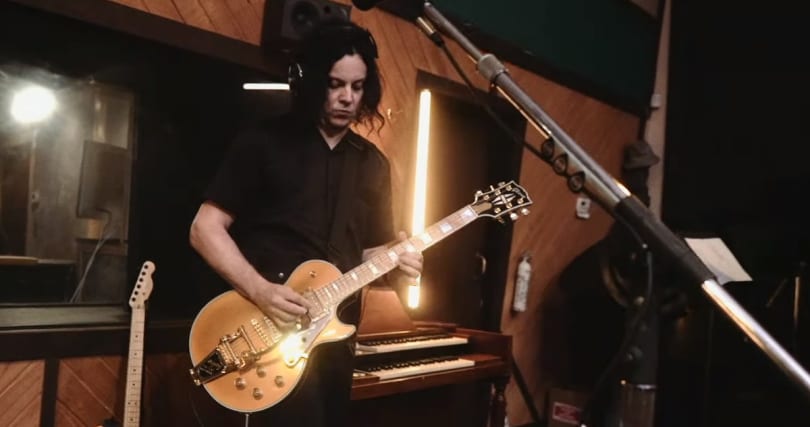
The Raconteurs perform “Now That You’re Gone” from their latest album “Help Us Stranger” and a cover of “I’m Your Puppet” at the historic FAME Studios in Muscle Shoals, AL.
“I’m Your Puppet” was written by Dan Penn and Spooner Oldham, both members of the acclaimed Muscle Shoals Rhythm Section group of session players — also called The Swampers — that originated at FAME. The song was a hit in 1966 for James & Bobby Purify. The Raconteurs – Jack White, Brendan Benson, Jack Lawrence and Patrick Keeler – included “Now That You’re Gone” on their recently released studio album.
Thin Lizzy have been eligible for induction into the Roll Hall of Fame since 1996 – by which time iconic leader Phil Lynott had already been dead for a decade. Thin Lizzy’s best record was a double live album
They’ve finally been nominated for the honor as part of the Should they receive the nod, Lynott will be inducted along with Scott Gorham, Brian Downey, Brian Robertson and Eric Bell.
Although Thin Lizzy’s moment in the spotlight didn’t last long, that doesn’t mean they’re not worthy of induction. If anything, their achievements during a relatively short run of success should be an argument in their favour. Here are five more reasons they should be honored.
It wasn’t just the fact that as an Irish group working through the period known as The Troubles,” when people in parts of the island lived under the watchful eyes of armed cops and soldiers and waited for the next terrorist atrocity. For Thin Lizzy to feature both Catholics and Protestants, thus crossing the religious divide at the center of the dispute, was remarkable in any part of the world touched by terrorism.
Inspired by Irish folk tales and the kind of gallows humor to be expected from those who grow up against a background of disorder, Lynott became a significant working-class poet, expressing in a few verses the kinds of meanings and feelings that commentators could (and did) take thousands of words to explore. While Thin Lizzy were predominantly known for fast hard rock songs, those lyrics helped introduce the concept of ballads – that is, songs that tell stories about people – to an audience not always open to the idea. “I still hear the wind whistling through the wild wood, whispering goodbye” (from “Philomena”)… “Valentino’s in a cold sweat, but he lost all his money on that last bet / Against all the odds he smokes another cigarette” (from “Waiting For an Alibi”) … “She’s got the pleasure, comes from all the cornerstones of the world / She’s so fantastic, she’s everybody’s favorite little record girl” (from “Rosalie).
As if his lyrics weren’t musical enough on their own, the construction of Thin Lizzy’s music was also remarkable. While they didn’t invent the twin-guitar approach to rock, they most certainly developed and refined it and took it to a new audience. With the words and music providing such a strong structure, it’s no surprise that the band were at their best on stage, transmitting emotions in sound and movement. So it’s also no surprise that Thin-Lizzy “Live and Dangerous”, while far from being the first successful live album in rock history, remains regarded as one of the best.
‘Are You Ready?’ is a song so taut and single-minded, so devastatingly exciting, that if a band can follow it, then they deserve to be on the stage. ‘Are You Ready?’ doesn’t appear on any of Thin Lizzy’s studio albums. It was released on the 1978 album Live And Dangerous, “recorded” (the inverted commas are important) in London in 1976 and Toronto in 1977. Live And Dangerous might not be the best live album ever made, but it’s the best album Thin Lizzy ever made, a double album that’s pretty much a pleasure from start to finish, and a live album without any of the manifold vices that traditionally afflicted such records: no 20-minute solo spots, little in the way extended interaction with the crowd, no radically inferior reworkings of beloved songs in order to keep the band mildly interested in their 3,923rd performance of it.
He seemed to see further than most, with the poet’s eye and the musician’s hands; and yet he struggled with his own demons and died aged just 36 as a result of drug addiction. While the tragedy remains raw to many, it’s one that reflects so many of the fairy-story tragedies that inspired him. If he’d been able to write a song about his own rise and fall, it would doubtlessly have been one of his best; and maybe some people hear parts of that unwritten song when they listen to the words he left behind today. That’s why he remains admired at the level of John Lennon Lemmy Kilmister and others of that ilk – he lived and died as the type of folk hero he wrote about.
Where did he get his Lynottness from? It’s worth noting that Celtic mythology and society often operated within a matriarchal structure and strong women were no rare thing in his world. Most notable was his mom, Philomena Lynott, who died aged 88 in 2019, and led a life ever larger, probably, than Phil did himself.
Fighting off the apparent disgrace of giving birth to a mixed-race child out of wedlock, Philomena fought and fought and never gave up. And although she wasn’t able to save her son in the end, many of the musicians who passed through the Thin Lizzy family, or indeed stayed in the hotel she once ran (including the Sex Pistols, whom she called “nice-mannered”) had cause to look up to her as a mother figure.
Right up until her passing she continued to battle to keep Phil in the spotlight. It’s enough of a shame that he didn’t live long enough to see his band nominated for the Hall of Fame; it’s an almost poetic tragedy that Philomena didn’t either. Still, better late than never.
Derby based Pet Crow formed in 2016 and set their stall out from the get go. Groove-laden, surf tinged garage rock to which you can dance.
2017 saw the release of their first LP ‘A Simple Guide to Small and Medium Pondlife’. Followed later that year by a 7” single ‘How Are you Wired?’, which found itself in the UK physical charts.
Since the last release Pet Crow have been very busy writing and touring. The resulting record ‘Take The Edge Off’ will be released in February 2020. With debut single ‘What We Doin’?’ released in November 2019.
Toy’s new record, “Songs of Consumption”, is an eight song collection of unique interpretations of songs that have directly inspired the band, and had some influence on their most recent record, the critically acclaimed Happy in the Hollow. Impressively, all eight songs were self-produced and recorded in home studios.
The idea was originally birthed when the band recorded four covers for the bonus 7″s that came with the Dinked and Rough Trade versions of the last album. 3 of those songs feature here alongside 5 new recordings completed last month, which comprise tracks by Stooges, Amanda Lear, Nico, The Troggs, Serge Gainsborough, Soft Cell, John Barry and Pet Shop Boys / Elvis / Willy Nelson (depending on how you know the song).
Another psych-rock gem of an album from Toy, one of the few remaining genre acts that haven’t faded into obscurity since the revival almost a decade ago? Well, not quite. What they warned us about with “Happy In The Hollow” – the track that preceded this long form – is now inescapable.
A band that have discovered a sharper, less forgiving edge wield this powerful, streamlined pop sword and do some real damage. The fact “Songs Of Consumption” is a covers album only makes the stylistic direction more pronounced. If you’ve heard the originals of tracks like the Stooges’ “Down On The Street” or the almost-unknown Nico bomb “Sixty/Forty” you appreciate what’s been done here even more. Respectively dancefloor electronica and exotic, dreamy soundscapes in those two cases. Reinventions by the reinvented.
Nilüfer Yanya dwells in life’s absurdities and anxieties. The English singer-songwriter’s ambitious debut album, “Miss Universe”, is based around a loose concept, a faux self-care hotline that promises to cure the pains of existence. Her voice flickers with controlled chaos, a glimmering falsetto in one breath and a rich rumble in the next. Shining synths give way to buoyant guitar fuzz, a la the Strokes. On a few tracks, Yanya interjects with the soothing monotone of a call specialist, emphasizing her striking power upon returning to the regularly scheduled programming.
London singer-songwriter Nilufer Yanya released her debut single Small Crimes back in 2016. Inspired by the actions of a petty thief, it is a haunting but simple tale that showcases Yanya’s lyrical talents, influenced by the likes of Nina Simone and Jeff Buckley as well as Connan Mockasin. Keep On Calling is similar in style to Small Crimes,Yanya’s vocals accompanied only by carefully picked guitar. Soon though, she adds another string to her bow, as the song transforms itself into a quasi-R&B number with only a few handclaps and a slight tonal shift. It’s still minimalist, but Yanya shows that you can do a lot with a little.
“Keep On Calling” by Nilüfer Yanya released on Blue Flowers Music