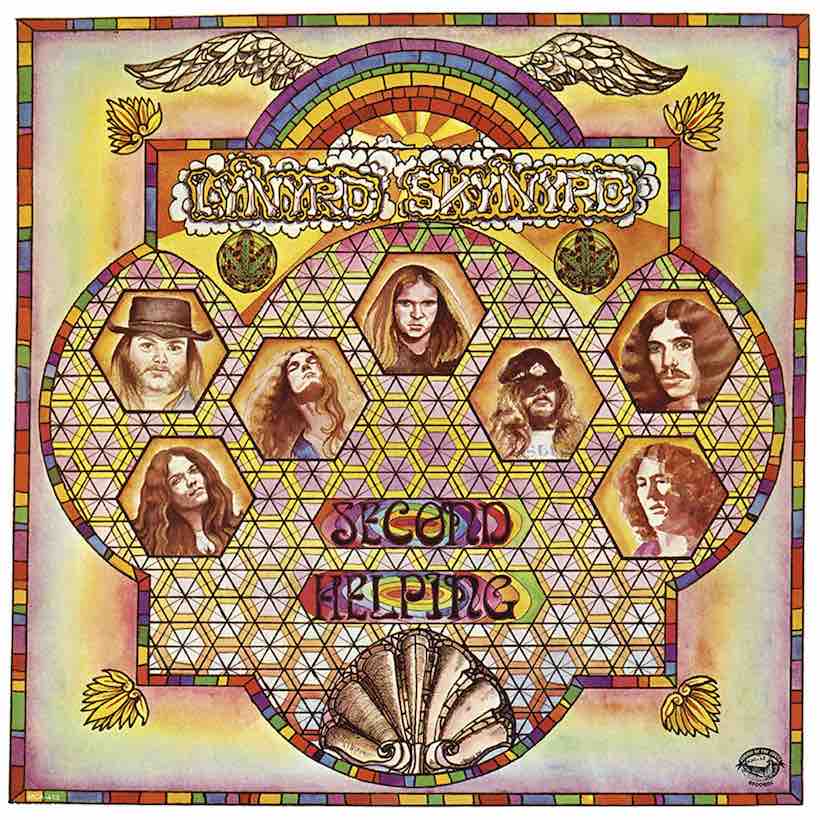
“Second Helping”, was the record that contained their biggest hit single and perhaps greatest rock theme tune of all time, ‘Sweet Home Alabama,’ was released on 15th April 1974. An answer song to Neil Young’s “Alabama” and “Southern Man”. Skynyrd’sfan base had continued to grow rapidly throughout 1973, largely due to their opening support slot on the Who’s Quadrophenia tour in the United States.Second Helping features Ed King, Allen Collins and GaryRossington all collaborating with Ronnie Van Zant on the songwriting.
After the success of their debut album, 1973’s Lynyrd Skynyrd (pronounced ‘lĕh-‘nérd ‘skin-‘nérd), the Second Helping LP was recorded chiefly at the Record Plant in Los Angeles. That was apart from that signature hit, which the band laid down in Doraville, Georgia. Recording sessions started in June 1973, a matter of weeks after they had signed off on the one before. Their producer, as with the first album and 1975’s third release Nuthin’ Fancy, was Al Kooper, whose notoriety already stretched back some 15 years to his teenage success with the Royal Teens. Kooper’s association from the mid-1960s with Bob Dylan was augmented by appearances with hundreds of other artists, not to mention his own recordings from 1969 onwards.
Kooper was also one of the musicians on Second Helping, singing and playing piano on two tracks. ‘Sweet Home Alabama’ featured the vocals of Merry Clayton, Clydie King and others. Clayton, famously the powerful female voice of ‘Gimme Shelter,’ was not the only Rolling Stones alumnus on the Skynyrd album. Saxophonist Bobby Keys played on ‘Don’t Ask Me No Questions’ (the first single from the set, before ‘Alabama’) and Skynyrd’s cover of JJ Cale’s ‘Call Me The Breeze.’
Second Helping outdid its predecessor, which had peaked at No. 27 in the US, by peaking at No. 12. It was certified gold by September 1974 and went both platinum and double platinum on the same day in 1987. “A vast improvement over their first album,” ruled Billboard in their original review at the time, “and a tribute to the combination of skill and good taste.”
Electronic experimenters Lunch Money Life. Have already made a buzz with their live shows, the London based five-piece – consisting of Stewart Hughes (drums), Sean Keating (guitar), Luke Mills-Pettigrew (bass), Jack Martin (electronics/trombone) and Spencer Martin (electronics/saxophone) – craft bizarrely brilliant soundscapes, creating, in their own words, “hits for the end-times”.
Recently releasing their new LP ‘Immersion Chamber’, the group – which was originally made-up of ten members – are now gearing up to share even more material this year, promising that “there’ll be a melancholic and introspective thread running through everything we release”. Exciting, eh?
“Truth Serum” is the first single from Immersion Chamber, arriving April 3rd via Scenic Route. lunchmoneylife.bandcamp.com
Savages lead singer Jehnny Beth has shared her latest single “Innocence,” from her forthcoming debut solo record “To Love is to Live”. “Innocence” follows her previous singles “Flower” and “I’m the Man,” and it also comes with a new video featuring live footage from a rehearsal. The album release date was pushed back June 12th (via Caroline Records), and the decision was made due to Beth’s desire to support independent record stores.
“Record stores are where I found myself as a teenager, digging through albums that ultimately shaped who I have become,” Beth says. “To release my first ever solo album in a way that would leave them out felt wrong to me; luckily, we were able to find a date that would allow us to release the physical and digital album at the same time.”
“Innocence” opens with bold, pitched-down vocals and bare percussive stomps before Beth grabs the reins, railing against the romanticism of urban utopias. It’s a slightly hair-raising ode to alienation and loneliness, cloaked in Beth’s trademark jet-black smoke and spellbinding presence.
To Love is to Live, was recorded in Los Angeles, London, and Paris, and it features a number of big names like producers Flood, Atticus Ross and longtime co-creator Johnny Hostile, plus The xx’s Romy Madley Croft, actor Cillian Murphy, and IDLES’ Joe Talbot.
Beth will also release her first book, Crimes Against Love Memories (C.A.L.M.), a collection of erotic short stories and photography, in July via White Rabbit.
‘Innocence’ comes from Jehnny Beth’s debut solo album ‘To Love Is To Live.’ The album will be released May 8th
Chicago pop-punk trio Retirement Party have announced the details of their new album, “Runaway Dog”, out on May 15 via Counter Intuitive Records. Title track and lead single “Runaway Dog” grapples with the temporary loss of inspiration and motivation, but singer and guitarist Avery Springer sounds as formidable and catchy as she ever has. “I won’t, but I think they told me so / I will never pave the road that I want to,” Springer sings over perky, zippy guitars.
title track of the Chicago rockers sophomore album.
Now that you have no choice whether or not you fancy a quiet night in, we hereby present the first of several LIVE SHOWS from the Radiohead Public Library now coming to Radiohead’s YouTube channel: https://youtu.be/gaJKOUQS1T4
Radiohead have shared their 2016 performance from Lollapalooza Berlin for their Stay Home, With Me archival video series. The two-set offering took place in September 2016, a few months after the band shared their most recent album A Moon Shaped Pool. In face, the performance kicks off with a string of A Moon Shaped Pool tracks, including album opener “Burn the Witch” followed by “Daydreaming,” “Decks Dark,” “Desert Island Disk” and “Ful Stop.”
Other highlights include a “Creep”/”Karma Police” encore.
From the band:
“We will be releasing one a week until either the restrictions resulting from current situation are eased, or we run out of shows. Which will be first? No-one knows.” Thanks to all who tuned in last week. Next up is Radiohead’s performance at Lollapalooza Berlin from September 2016.
Recorded at Lollapalooza Festival, Treptower Park, Berlin on the 11th of September 2016
Sweden’s Kristian Matsson – aka The Tallest Man On Earth – emerged as one of the most charismatic, entertaining new singer-songwriters in the world. Scowering the stage menacingly at solo performances which became infamous, his gritty twang of a voice and stunningly intricate guitar lines made early comparisons to Bob Dylan not all that ridiculous.
I will play “Weather Of A Killing Kind”. I will play other songs. I will water the plants. Kristian playing his Joni Mitchell covers. And that Bon Iver cover was so beautiful!.
I’m going to do another YouTube livestream / hang from my room this Friday, April 17th at 3pm eastern time (21:00 CET). I’m still learning how to do these, I will try to tame the buffering monster the days leading up to it.
TRACK LIST:3:27 Fields Of Our Home9:03 För sent för Edelweiss16:26 Museum of Flight23:28 Weather of a Killing Kind32:15 A Case Of You43:00 Winds and Walls52:20 Tougher Than the Rest57:40 Blood Bank1:08:46 1904 1:21:33 ‘I want to go everywhere’ (Not an actual song, I just like his strumming pattern 🙂1:22:44 Like The Wheel1:25:40 Eva Dahlgren is the musician, but I don’t know the song. 1:27:59 ‘The Most Beautiful of Souls’ (I don’t know the song, sorry!)
“Shimmering vocals, soaring synths combined with crunching guitar riffs, there’s something unique and special about this Sheffield 4-piece.” – Gigslutz
“punchy pop riffs, Purest are tapping into the sound of something great. The Sheffield outfit disguise disparity in a shimmering wall of sound determined to drown out all the chaos.” – Dork
“Purest have artfully created a hefty slab of noisy rock’n’roll here – complete with a prescription for pop!” – Original Penguin EU
“A sublime dose of shoegaze-indebted pop” – Gigwise
‘A raucous piece of noise rock that doesn’t hold back, it recalls everyone from Ride to Swervedriver in its evocation of unhinged shoegaze’ -Clash magazine
Band Members
James Rolling, Danny Davidson, Richard Bithrey, Ashley Platts
The latest single release ‘Give Up’ written and performed by Purest.
Singer-songwriter Coutney Marie Andrews shares the latest single from her forthcoming album Old Flowers, the beautifully melancholy “Burlap String.” The single is accompanied by a music video, featuring Andrews hiking a nature trail, picking flowers and laying in fields as the sun eventually sets.
You can’t water old flowers. Yes, you fall in love, you make mistakes, and so do they. You run through blackberry fields in the summer of your youth, dream in passenger seats gazing past towns and fields, imagining a future life where everything works out. I fell head over heels in love at nineteen. The kind of love where you call up your best friend and say, “I think I’ve found my soulmate.” The pull towards that first true love is strong. It consumes you, makes you question your own dreams.
We taught each other, grew up together, we were family. We fit just right, for a time. Then one day, after a long and rocky nine year road, life changed and became a complicated mess too hard to untangle. We couldn’t get our love back, no matter how many dreams that shadowed this hard truth. We grew resentful, selfish, harboring past mistakes and holding them up like armor from every blow. We grew up and our paths diverted.
‘Old Flowers’ is about heartbreak. There are a million records and songs about that, but I did not lie when writing these songs. This album is about loving and caring for the person you know you can’t be with. It’s about being afraid to be vulnerable after you’ve been hurt. It’s about a woman who is alone, but okay with that, if it means truth.
This was my truth this year – my nine year relationship ended, and I’m a woman alone in the world, but happy to know herself.
These songs came to me alone, late nights in Bisbee, Lisbon, Nashville, and London. Sometimes I’d just cry and sing, and a song would come out. I drank too much wine while writing this record, lit too many candles. You could say this was my attempt to summon the muse, but that’s bullshit, because she was just standing there naked looking me in the eyes. So I told her the truth.
Bad Company were a so-called ‘Super Group’, that is, a band made of members from previously successful bands. In this case, Paul Rodgers and Simon Kirke from Free, Mick Ralphs from Mott the Hoople and Boz Burrell from King Crimson. Their 1974 self-titled debut included recycled versions of some songs from their previous bands, Mott’s ‘Ready for Love’ from ‘All the Young Dudes’ (1972) and Free’s ‘Easy on My Soul’ from ‘Heartbreaker’ (1973). Paul Rodgers had one of the best rock voices of the 1970s and is definitely the best thing about the album. The songs are fairly standard rock ‘n’ roll fare. The first album released on Led Zeppelin’s Swan Song Records label, if you compare this to Zeppelin’s brilliant ‘Physical Graffiti’ released in the same year, it’s clear that they weren’t in the same musical league. The follow up album ‘Straight Shooter’ (1975) was a little better. Bad Company rocked fine and ‘Can’t Get Enough’ and ‘Ready for Love’ sounded good on the radio but they were second tier rockers compared to Sabbath, Purple, and Zeppelin.
One of the most important advances in the field rock ‘n’ roll marketing was the invention of the term, “Supergroup. A supergroup is a music group whose members are previously successful as solo artists or as part of other groups or well known in other musical professions.” Most people believe that Cream was the first supergroup, though there is an equally strong argument for The Steampacket, a mid-60’s U. K. band whose members included Long John Baldry, Rod Stewart, Julie Driscoll and Brian Auger.
Bad Company was marketed as supergroup from the get-go, Bad Company had their fare share of detractors when they burst on to the scene in the mid 70s. Ex-Free men Paul Rodgers (vocals) and Simon Kirke (drums) were criticised for following a more commercial path, despite the fact that their former band had enjoyed several hits. Completed by Mick Ralphs (guitar, ex-Mott The Hoople) and Boz Burrell (bass, ex-King Crimson and Snafu), Bad Company had Zeppelin’s Peter Grant as their manager – and the American market in their sights. They struck the bullseye. “Can’t Get Enough” might have had a tasty Top 40 sheen but it was expertly rendered blues rock to the core. None of them were “name” musicians at the time of Bad Company’s formation; they had played in bands who generally familiar to the listening public but hardly top-tier (Burrell’s time with King Crimson came long after In the Court of the Crimson King). All are now more famous for their work in Bad Company than their other engagements, so while the supergroup label may have been prematurely applied at the start of their journey, one could say that they earned the label through their work. They were an enormous commercial success
Supergroups often fall short of their potential, but the four guys who made up Bad Company – originally Free, Mott the Hoople and King Crimson vets – were still young and hungry enough to add some muscle to their debut album. Later records would get more bloated under the strain of their rock ‘n’ roll lifestyle, but ‘Bad Co.’ still sounds lean after all these years.
Even if the song hadn’t dealt with the constant edge of sexual desire, “Can’t Get Enough” would still appear on my playlists because the music is so sexy. After Simon Kirke’s count-in and cue, Mick Ralphs lets it rip with a clean, sustained power chord using open C tuning, riding Kirke’s slap-that-bitch beat before downshifting into the rest of the three-chord pattern that ends on the bite of the Bb-F repetition. That tiny bite feels even sharper because Kirke shifts to cymbals, clearing the way for Mick’s power chords to be heard at full intensity. After a second go-round, Mick and Simon retreat to background to allow Paul Rodgers to do his thing.
Paul Rodgers’ voice gives me the tingles—up and down my spine. Paul Rodgers singing a sex song is an orgasmic experience, Paul Rodgers is one of the most intelligent, thoughtful and intentional singers I’ve ever heard, in any genre. A lot of guys have sexy voices but they fail to discipline the talent with intent. Paul Rodgers pays careful attention to phrasing, understands the critical importance of build and is the master at creating a mood. As he explained in one interview, “To me, that’s what music is: creating a mood, and taking the listener to the place that you’re going. on “Can’t Get Enough” he’s going to drag you to the bedroom and do all sorts of wonderful things to you. The first verse is all about command. Rodgers sings the lines with confidence and precision, making it perfectly clear what he’s after. On the second verse, he eases up slightly on the word at the end of the opening line—“Well, it’s late, and I want love.” That wicked little twist communicates the sweet side of love, the opening salvo in the seduction. It’s a disarming line that makes the clarification all the more erotic: “Love that’s gonna break me in two.” Rodgers gets looser in the second chorus but what really grabs my attention here are the slightly syncopated cuts where Kirke applies the high-hat, this Mick Ralphs composition was rejected by his former band, Mott the Hoople. That means they rejected two Bowie classics (“Suffragette City” and “Drive-In Saturday) and one of the greatest rock ‘n’ roll songs ever!
They had no choice but to dial it down a bit from that killer opener, and the Paul Rodgers composition “Rock Steady” was a good choice—it keeps the intensity high while foregoing the dramatic cuts and pauses of “Can’t Get Enough.” The song is about taming the wild beast who showed up in “Can’t Get Enough,” and though Rodgers tries to convince us that he’s capable of keeping his libido in abeyance, his gritty vocal expresses the opposite. He covers the range of dynamics, attenuating his vocal when telling himself to ease up on the testosterone accelerator (“When my love . . . gets a little bit too heavy”) and breaking into all-out passion when he discovers that there is indeed erotic opportunity in the slow, deep one. Virtually missing on “Can’t Get Enough,” (low bass levels are a problem throughout the album), Boz Burrell provides some nifty bass runs and strong rhythmic support throughout this piece.
“Ready for Love” was a Mick Ralphs composition that appeared on Mott’s All the Young Dudes, and anyone who has heard that version has to conclude that Mick Ralphs was not the right guy for the vocal—this is a passionate, erotic song, and Mick’s thin, reedy voice was incapable of expressing the depths of those feelings. Enter Paul Rodgers, the best rock voice in the business when it comes to setting the mood for an erotic evening at home. The arrangement is much cleaner than the Mott version—the introduction of piano into the mix adds a touch of balancing tenderness to offset the guitar and organ, and its use as the solo instrument in the break reinforces the melancholy psychological state expressed in the opening lines Bad Company gives “Ready for Love” the treatment it always deserved—it really is a superbly written piece.
While the opening segment with its dramatic drum rolls is a bit over the top, this “Don’t Let Me Down” isn’t half bad because it doesn’t wallow in insecurity as much as express dissatisfaction with the current partner. The best parts of the arrangement occur when Sue Glover and Sunny Leslie provide background vocals to support Paul Rodgers’ soulful approach, giving the song a gospel-like feel. The band is far off the mark, though, with Kirke paying way too much attention to the snare and Mick Ralphs dropping in with a fairly weak solo.
We’ll flip it over to side two and explore the curious title track and band anthem, as promised. There are various and competing stories about its origins, including the Jeff Bridges western flick Bad Company and a seedy character Paul Rodgers saw in a book on Victorian morals used as a warning to the young to “beware of bad company.” I have no problems whatsoever with his Rodgers vocal, with his portrayal of the character, with the haunting piano refrain, with the eerie sounds in deep background or with Simon Kirke’s POW-POW that cue the chorus.
The rest of the album is pure filler. The follow-up piece “The Way I Choose” is a slightly lumbering song with a guitar counterpoint somewhat reminiscent of George Harrison’s work on “Don’t Let Me Down” and a supporting horn section that falls far short of soulfulness. Paul Rodgers sings it well but his voice is completely wasted on the shallow lyrics celebrating independence, stupidity and mistrust. It’s followed by the equally vacuous rock-star-whining-about-life-on-the-road song, “Movin’ On,”.
The album closes with what became sort of a tradition for many hard rock bands of the era: the “deep” song. This was a slow number presented in a way to suggest to the listener that hard rockers weren’t just all about fun and games but that they had a serious side and thought about meaningful things. “Seagull” is Bad Company’s “deep” song. The lyrical content is just as confused as that alleged masterpiece, with the songwriting team of Ralphs and Rodgers taking a page out of Donovan’s songwriting handbook and attempting to imbue the seagull with meanings far beyond its status as a nasty, squawky bird. Bad Company is a fairly decent debut album, all things considered. Listening to Paul Rodgers is always an engaging experience, and despite a couple of out-of-sync moments, the band is tight and relatively tight and disciplined for a hard rock band.
Bad Company’s – ‘Can’t Get Enough,” and Honey Child.” This is what a real Rock band sounds like – even after nearly 50 years – with three of the original members: Paul Rodgers, one of a handful of great Rock singers (vocals), Mick Ralphs (guitar) and Simon Kirke (drums) with Howard Leese (guitar (late of Heart). If you want to hear the band at its absolute pinnacle check out Bad Company: Live at the Hard Rock in Hollywood, Florida. It is a masterpiece.
Austin, Texas rockers Pure X have announced their first album in six years, a self-titled LP out digitally on May 1st and physically on July 3rd via Fire Talk Records. Today, they’ve also shared its two lead singles “Middle America” and “Fantasy.” “Middle America” tap into the languid, distorted sounds that fueled their rise, falling somewhere between warbled slowcore and dreamy heartland rock.
Pure X is the last band, has always been the last band. Not that there won’t be future acts, more that Pure X understands that all this pageantry, this civilization is wrapping up. It burned hot and bright like thermite used to bust a safe open, but now is the age of radiating waves, each one buckles the foundation more than the last.
It would be understandable to express such forbidden fatalism in a brittle, harsh nihilism, the stark echo of a stone rattling down an endless well. But on this album, their fourth and first in six years, there is a pre-dawn kindness. It may be funereal, but it is a Viking pyre ablaze in the middle of a river, one of those moments when the water seems to pause and reflect the clouds blooming like smoke from an invisible glass pipe.
Recorded live in the bucolic Texas Hill Country, this is their clearest, most focused work. The rhythm section is locked in–a night train through the desert. There is more singing, the weary wisdom of the lyrics ringing like Tibetan bowls. In 38 minutes, Pure X weave a culmination, all the delays and distortion, the grinding mortar of touring, the low-tide pulling them out from a cult band, to a legacy band, it’s here, understood and forgiven.
Band Members
Nate Grace, Jesse Jenkins, Austin Youngblood, Matty Tommy Davidson