Flavor Crystals are a psychedelic shoegaze band from Minneapolis, Minnesota, Hi everybody, sorry we’ve been pretty quiet lately, but we’ve been busy working on something. It’s been quite a challenging year for most all of us, but we do have some good news in this crazy thing we call 2020…Flavor Crystals album number five has arrived!. After years of exploration and weirdness, they added bubbly liquid and jelloed into a real band, recording their debut album On Plastic as a document of the sleepy wobbly blurry dreamscape vibe they found together.
For alternative music fans, the college town of Athens, Georgia, means R.E.M. and the B-52’s . Through the 1980s, the city was synonymous with a kind of against-the-grain music epitomized by those two bands’ very different styles. In 1987, Rolling Stonenamed R.E.M. “America’s best rock ’n’ roll band.” Drummer Bill Berry denied it. The best band in America, he said, was Pylon.
In its original incarnation, Pylon only lasted for five years. But no single band did more to define what it means to be an Athens band than Pylon. Formed as a performance art project by four art students who mostly did not know how to play their instruments, Pylon created a startling, original sound by combining formal experimentation with a danceable beat. Beyond their music, band members’ commitment to making art in their small, Southern college town helped transform what had been a tiny network of art students and their friends into one of America’s most important and enduring music scenes. This is how in that period when what would become alternative was new, Pylon broadened the very idea of what a band could be.
In Athens, Georgia, people got into bands the way people everywhere get into most things—through their friends.
As a high school student in suburban Atlanta, future Pylon bassist Michael Lachowski had taught himself photography by reading the Time/Life photography series and building a darkroom in his parents’ house. He met Randy Bewley, future guitarist, in the photography studio at the University of Georgia where the sculpture major from suburban Atlanta had a work-study job. Outside class, Lachowski made drawings, prints, Super 8 films, and sculptures, as well as photographs. Bewley made photographs and other two-dimensional work and later switched his major to painting. As Lachowski remembered, this kind of experimenting with genre just seemed normal at UGA: “We had an exuberant group of people; creativity was prized above all else; everybody was just putting out work. It led to us going out of the boundaries of our disciplines. A lot of us in the art school were trying out different media with a punk rock message, which is just go in there and do it. You don’t need training, or authority or legitimacy. Just figure it out.”
At the UGA library and at Barnett’s News downtown, Lachowski and Bewley followed the art and music news in publications like the Village Voice. After the B-52’s started playing New York City regularly in 1978, Bewley and Lachowski read about people they actually knew. Bewley wanted to form a band, too. Lachowski resisted. His problem with the idea was not that they were not musicians. The fact that they had no experience playing instruments was no different from the fact that they had no experience making prints or installation art before they went to art school. They could learn. Instead, Lachowski hesitated because making music seemed unoriginal: “I thought it had been done already.” But then the friends had an idea. As the band’s singer Vanessa Briscoe Hay remembered, “They’d been reading New York Rocker, and it seemed like it would be an easy thing to have a band and go to New York and get some press and come back. And that would be it.” Once they got the press, they would quit. Instead of a band, they decided, they would create a kind of performance art.
Bewley bought Lachowski a bass at a pawnshop and found a guitar for cheap at a flea market. Sometime that winter, the two friends started practicing regularly in Lachowski’s off-campus studio, a second-floor space on College Avenue right across from the university. Lachowski worked from a bass instruction book. Bewley played his guitar with an alternate tuning because he did not know the standard one. Plugged into little Pignose amps, they practiced by alternating positions, with one holding the groove and repeating a phrase while the other experimented.
In the future, these long jams would give birth to a remarkable independence between the bass and the guitar parts. At the time, they sounded like “endless riffs.” Curtis Crowe, their landlord, who lived upstairs, remembered hearing “a never-ending series of hooks—no bridges or chorus, just hooks” echoing and vibrating right up through the floor. One day Crowe reached his breaking point: “So I kinda went ahead and knocked on the door lookin’ real timid and said, ‘Hey, mind if I drag these drums in here for a little bit?’ ” The band’s future drummer “had every song memorized before I ever went down.”
When Bewley and Lachowski decided to find a singer, it made sense to them to ask art students whose work they liked. Bewley’s friend Vanessa Briscoe Hay—then Vanessa Ellison—had started out in arts education before switching her major to drawing and painting without telling her parents. After she graduated, she got a job at the local DuPont nylon factory, through word of mouth at the art school. Bewley was still in school, but Lachowski got a job there too after he graduated. Bewley told her about a performance art project he, Lachowski, and Crowe had created that involved making music. Bewley wanted Briscoe Hay to try out for the role of singer. She told him she wasn’t really a musician. Bewley insisted they were all amateurs. What mattered was they respected her as an artist.
The audition at Lachowski’s studio turned out to be oddly formal. On a music stand, her future bandmates had placed an orange vinyl notebook full of typed lyrics. They would play a song, and she would try to make the lyrics fit, sometimes cracking up in the attempt. “They couldn’t really hear what I was doing,” she remembered, but “they liked the fact that I put forth some honest effort and they liked the way I looked, and they liked me as a human being.”
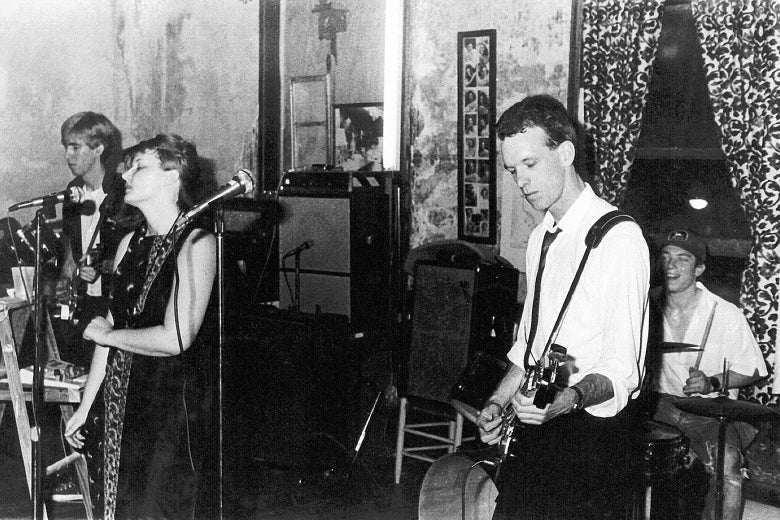
When the band debuted on March 9th, 1979, in the second-floor space downtown above Chapter Three Records, it was hard to imagine its members would soon be local stars. All the songs they played were originals, except the theme song from Batman. Briscoe Hay stood on a mirror with her back to the big windows that looked out on old campus and concentrated on the words. Bewley and Lachowski looked at their hands. Only Crowe seemed at ease. In Athens, everyone danced at parties, and yet the audience at that first Pylon show and a second at Crowe’s loft stood strangely still. As Crowe told a critic in 1981, “Nobody knew what to do, so they were real polite.” In a letter to a former professor, Lachowski added a list of comments he had heard after their first few gigs: “too art oriented,” “conceptual,” “they sound like a bunch of artists who got together and decided to have a band,” “Michael, your music sounds just like your art,” and “they’ll like what you’re doing in New York (as if to imply that they don’t really in Athens).
At their third gig, though, at a house in the country, everything changed. As Briscoe Hay recalled, “The B-52’s showed up at that party, and they started dancing and running around like crazy and everybody else did too.” After the show, Briscoe Hay said, Fred Schneider and Kate Pierson “were very supportive.” They said, “You’ve got to play New York.”
To get that date, Pylon had to make a demo. Someone bought some Kmart cassette tapes, and the four art students recorded themselves playing a few songs at Lachowski’s studio. Then Schneider gave a tape to Jim Fouratt at Hurrah, a punk dance club where the B-52’s had been playing lately. The timing was perfect. “Rock Lobster” was a New York hit, and the B-52’s reached the peak of their underground fame in the weeks before the release of their first album that July. Fouratt actually called the members of Pylon in Athens, read through a list of coming bands, and asked them who they wanted to open for. Bewley and Lachowski picked Gang of Four.
In New York, a huge crowd filled with other musicians turned out at Hurrah to see Gang of Four. Briscoe Hay borrowed a whistle from the doorman and blew it during the song “Danger.” People in the front shook Bewley’s hand after the set and badgered him with questions about how he came up with his strange tunings and original chords. After they got back home, the September 1979 issue of Interview arrived with Glenn O’Brien’s review that gave as much space to Pylon as to the Gang of Four:
Pylon, the first Athens band to hit the town since the B-52s. A tough act to follow—but Pylon is also a credit to their community. There’s not much resemblance to the Bs. Although the guitarist has real classy taste in licks that is sometimes reminiscent of Ricky Wilson’s. Pylon has a charming chanteuse up-front—sort of Georgia Georgie Girl who manages to carry off several difficult postures, including kooky, endearing, sincere and wry. And not all the songs sound the same. These kids listen to dub for breakfast. Recommended.
Interview was not New York Rocker, but O’Brien’s coverage was better than the band members’ dreams, even if they had to look up the meaning of the word dub. Their project was a success, but they did not want to quit. They were having too much fun.
In making their performance art rock, the four members of Pylon drew on what they had learned in art school about the ways that tensions between materials, mediums, and expectations could animate art. Middle-class kids holding down working-class jobs, they turned the factory into a style. Posters featuring orange safety cones and music full of machinelike repetition punctured by whistles and screams contradicted audience assumptions that small Southern towns produced only county and folk sounds and handmade things.
Their name referred to “the kind in the road, not the architectural one or the ones that hold up electricity,” as Lachowski wrote a former professor. “We chose Pylon because it is severe, industrial, monolithic, functional. We subscribe to a modern techno-industrial aesthetic. Our message is ‘Go for it!, but be careful.’ ” Working the contrast between flat, machinelike minimalism and ragged, Southern-accented amateurism, their songs used a four-on-the-floor disco beat to mash together punk’s emotional excess and industrial repetition and detachment. The bass throbbed and the drums boomed as guitar licks cut across the rhythm section without being leads. The vocals varied from deadpan recitations of short phrases to howls, and Briscoe Hay rarely flirted with the audience. Instead, she belted out vocals while bouncing up and down and shaking her head like a dancer in a Charlie Brown television special. Sometimes, she blew a shrill whistle midsong, like a referee or a cop.
Live, Pylon’s act could be shocking or jolting or heavy. It could also be deep. In fusing pop and rock forms with an avant-garde sensibility, the band members asked what art could mean in the midst of industrial decline, production-line mass culture, and rising political conservatism. And they tentatively offered an answer. “Be careful, be cautious, be prepared,” the lyrics of their song “Danger” warned. But be creative, too. “Everything is cool.” “Turn up the volume.” “Turn off the TV.” “Now, rock and roll, now.” “Read a book, don’t be afraid.” “Function precedes form. Things happen.” Pylon pushed people to think as well as dance, to put their minds and bodies back together. Playing live, the four art students could pound their awkwardness and their amateurism and their artistic vision into something transcendent. If people in Athens revived on a local scale that old dream that music could make a new world, it was because they were living it.
Pylon nurtured the creativity the B-52’s had helped spark in Athens before they left for New York. Pylon’s performances, shows by other bands, and art installations by Lachowski and others transformed the open space behind the Victorian house at 265 Barber Street where Lachowski lived into Pylon Park, one of the emerging scene’s important gathering places. The band also played the club Curtis Crowe started, the 40 Watt Club. In the summer of 1980, Briscoe Hay had to quit her job at DuPont when the B-52’s invited Pylon to open for them in New York’s Central Park. By the end of the year, band members found they could live two or three months in Athens on their New York City guarantees. Pylon became their job.
Over the next three years, Pylon toured the Midwest and Canada with the Gang of Four and played a string of dates in England. In January 1982, they sold out the large Memorial Hall ballroom on the University of Georgia campus. In April, when the 40 Watt moved from Clayton Street to a bigger venue on Broad Street, they headlined the back-to-back closing and then opening shows and packed both rooms. In Athens, Pylon ruled the scene that the band’s members had done so much to create.
If Pylon seemed wildly successful from an underground perspective, outside Athens, New York, and a few other cities, audiences often did not seem to know what to make of the group. Band members made enough money to live cheaply in Athens, but they weren’t exactly comfortable. To reach the next level, they hired a professional booking agent. He landed them a gig most bands would have been giddy to get: the opening slot for U2’s U.S. tour in support of their recently released album War. When they took the stage, crowds impatient to see the Irish band ignored them. As Briscoe Hay recalled, “People were heckling … ‘Where’s U2?’ and ‘Get off the stage.’ ” What everyone said was great felt instead like failure. It certainly was not fun. Maybe they did not really want this kind of success. Maybe their performance art–turned-band was exactly what they said it was, “temporary rock.”
At the beginning of 1983, Briscoe Hay told a local Athens paper, “I think if it ever became miserable, we would just disband,” and in retrospect she was hinting at what was to come. Band members decided around this time to break up at the end of the year, after they fulfilled their bookings, but they kept their decision secret. In Athens, most people found out when posters went up for “Pylon’s Last Show” with opening act Love Tractor.
A recording of that farewell show released in 2016 finally gave those of us who missed it a chance to listen in on this essential moment in Athens history. From the opening note of the first song, “Working Is No Problem,”Pylon played 22 songs with hair-on-fire intensity that did not let up until the five-song encore finished. Over the course of approximately an hour and a quarter of music, the crowd roared out its encouragement. Sometimes the fans sang along to lyrics like “Everything is cool” and even occasionally to guitar hooks, like the woo-woo of “M-Train.” At other times, they just yelled. No one wanted the evening to stop.
Interviewed afterward about the breakup, band members reflected on why they had started making music “as another form of artistic expression.” “We accomplished what we set out to do,” Lachowski said. “It’s not that we are miserable, it’s just that we’ve seen all we’re going to see and don’t want to put any more time into it.” “What was frustrating was not trying to live like other bands, but trying to convince everybody that we didn’t want to do it that way,” he explained. “We were the only ones that understood why we were not out there with the other bands trying to make it big.”
A critics’ darling, repeatedly named the best band in Athens, Pylon carried its art piece so far that it broke up on the cusp of stardom. “We’ll become a cult band now,” Bewley predicted on the eve of Pylon’s last show. “This is a type of suicide that’ll make us more popular in the long run.” And he was right
Randy Bewley, Vanessa Briscoe Hay, Michael Lachowski, and Curtis Crowe of Pylon
Box Set Includes:
The studio albums Gyrate and Chomp – newly remastered from the original tapes
Extra – a collection of singles, B-sides, rarities and live recordings
Razz Tape – the first-ever Pylon recording, a 13-song unreleased session that predates their 1979 debut single, “Cool”/”Dub”
Plus a 216 page, full-color, hardbound book featuring a treasure trove of never before seen images and artifacts from the band’s personal archives, and writings by R.E.M., Kate Pierson of The B-52’s, Corin Tucker & Carrie Brownstein of Sleater-Kinney, Steve Albini, Jon King & Hugo Burnham of Gang of Four, and many more
47 tracks in all, including 18 unreleased recordings
The Shins put out Heartworms, their first new album in five years, earlier this year and a video for “Half A Million” has been released.
Filmed on a white backdrop, edited, then printed out. “Half A Million” was created with 5,566 stickers, hand cut from the 4,868 frames and animated by sticking them down on top of each other at each of the 40+ locations.
The Worms Heart is a complete re-work of The Shins critically acclaimed March, 2017 album ‘Heartworms’. The album offers new reworked versions of the ‘Heartworms’ album original tracks, and the sequence is flipped as well. The album is available digitally, on all formats.
When James Mercer wrote, produced, and recorded the Heartworms album, he had this desire for an alternate version, an opposite version. The album’s slow songs would be flipped and re-recorded as fast songs, and vice versa. The reasoning was to showcase the versatility and strength of his songwriting, and the result is The Worm’s Heart. This ‘flipped’ collection is produced by Yuuki Matthews, Jon Sortland, & James Mercer; and is a must for any fan of The Shins
Sarah Mary Chadwick today shares the visual accompaniment to her “upbeat, jangly” track ‘Let’s Fight’, one of our favourites from her incredible album ‘Please Daddy’ which was released in January of this year. Premiering via American Songwriter, the ‘Let’s Fight’ clip is was shot on location over a weekend in Tasmania, by fellow Rice Is Nice artist Brent Griffin aka SPOD. Chadwick says in a statement; “Tim [Deane-Freeman] the drummer insists I can’t play this song live but he’s tripping cause I invented it. The video was shot over a dream weekend with people I love. Life’s hard and it’s easy to fight but it’s the best thing in my life to me when you grab the joy that you can.” Rolling Stone Australia have today featured ‘Let’s Fight’ as a Song You Need To Know, writing that “the track and its accompanying video is some of the finest work from Sarah Mary Chadwick to date”. Sarah Mary Chadwick is one of Australia’s finest contemporary songwriters and lyricists, and we are incredibly excited to share new material with you very soon!
“’Let’s Fight’ is a jangly, rousing song about wanting to instigate conflict, and it features some of Please Daddy’s most wounded, confrontational lyrics.” American Songwriter “With lyrics that relate to the titular call for conflict, its outward sheen is as upbeat and jangly as ever, and easily serves as one of Chadwick’s finest tunes to date thanks to it’s almost intoxicating nature.” Rolling Stone Australia
It is October 9th already. Where’d the year go? Oh yeah…… well As of midnight, my double record album “Nobody Lives Here Anymore” is now officially released. Being “born” today, this album shares a birthday with John Lennon who would’ve been 80. That wasn’t intentional but I‘ll take it, seems like a good omen. It’s strange and a little unsettling to be releasing a record right now (not to speak of simply being alive right now)—No shows, no parties no getting together… alls quiet on that front. But quiets good for listening to records. and now’s the best time for this one. I suppose it could easily get lost in the shuffle—There’s certainly more important things going on in the world—but I do hope this thing gives some love and light to those whom it reaches. I agree with Mr. Lennon when he said “love is all you need.” Lord knows we need it. Thank you very much to everyone who helped make this record happen and to everyone who continues to follow what I do and give your support. I appreciate you. To everyone who still Lives Here… Be well… Love, Max (Cut Worms)
Brooklyn-based songwriter, Max Clarke, the man behind Cut Worms, is set to unleash his latest set of tracks into the world with next week’s release of new album, “Nobody Lives Here”. The follow-up to 2018’s acclaimed second album, Hollow Ground, Nobody Lives Here was recorded at Sam Phillips Recording Studio in Memphis, Tennessee with producer Matt Ross-Spang. Ahead of that release, this week Max has shared two new tracks from the record, “Veteran’s Day” and “Walk With Me“.
As with the previous offerings from the record, both Veteran’s Day and Walk With Me showcase the more immediate approach to recording adopted for this record. Both tracks channel Max’s penchant for nostalgic-Americana; Walk With Me in particular wouldn’t sound out of place alongside Frankie Vallie on a 1960’s diner jukebox. Veteran’s Day is perhaps the more intriguing of the two; a delicious piece of unhurried folk-pop, all languid echoing piano and easy sun-dappled guitar lines, as Max sings a tale of love and disillusionment. You can almost feel him growing older as he sings, “caught up in my dream, you won’t get free, you start to get the feeling you’re lost out at sea.
Tell all the old men stop telling tales, nobody really believes in chasing white whales”. Cut Worms have always sounded like they’re from another era, here more than ever they seem to offer a perfect snapshot of the past heyday of the American dream, even if he’s far too young to remember that – right now we might all need that moment of rose-tinted escapism.
Nobody Lives Here is out November 9th via Jagjaguwar Recordings
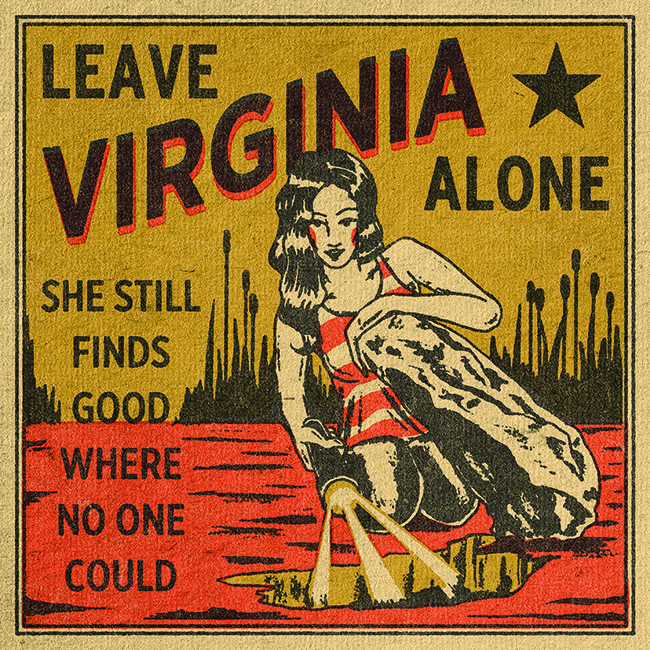
“Leave Virginia Alone,” the lead single and another previously unreleased song from Tom Petty’s long-awaited second half of Wildflowers—a collection he named All The Rest—is out now. Tom wrote “Leave Virginia Alone” in January 1993—very early in the evolution of Wildflowers.
The song debuts alongside a video co-directed by Mark Seliger and Tom’s daughter Adria Petty. The video stars emerging actress/dancer Casimere Jollette (Netflix’s forthcoming “Tiny Pretty Things”) and was shot around Connecticut as well as in and around Seliger’s studio in New York City.
In speaking with David Fricke on SiriusXM’s Tom Petty Radio, Adria notes, “We were very resourceful about trying to create a character that could be assigned to anyone.
That’s why Virginia in this video is very mysterious but she has her little glimpses of characters. We really worked to cast someone authentic—that felt like they were really feeling their feelings and someone that you could believe. We really wanted the song to do the heavy lifting in this video, and sort of step out of the way and just give it something to breathe with.” Seliger furthers, “The one idea that kept coming back to both of us is that we really want Tom to be narrating the story. We really want to hear his voice as he runs you through this journey that this woman is having.”
Official Music Video for Tom Petty’s “Leave Virginia Alone’ from ‘Wildflowers & All The Rest’ The album, Wildflowers, originally released in 1994, is commonly vaunted as Tom Petty’s most personal, most heartfelt, and most revealing artistic statement of his career. Recorded over the course of two years and originally intended to be a two-disc album, it was perhaps the most creative period in his life. The release of Wildflowers & All The Rest on October 16th, 2020 will finally gather together all 25 songs from the original recording sessions – the 15 songs from Wildflowers, plus the 10 songs that were left off the original release.
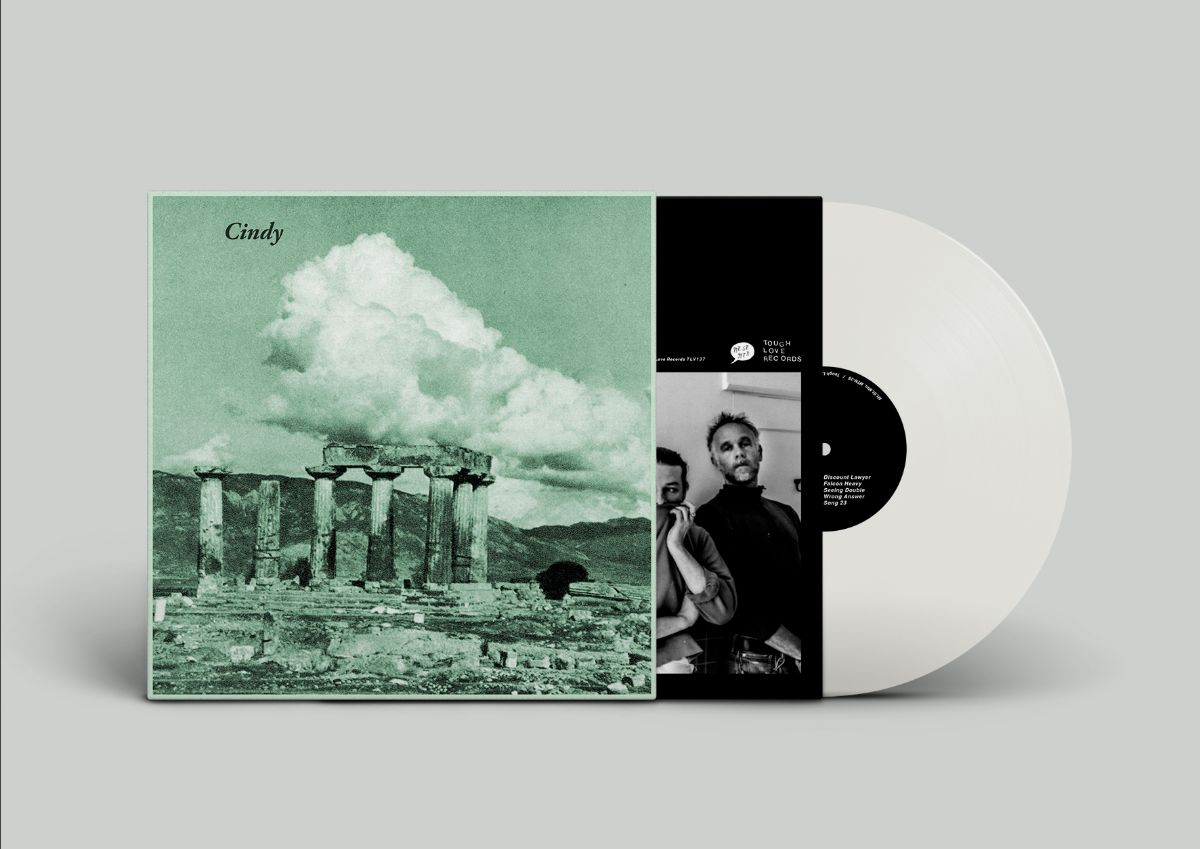
Tough Love Records have partnered with West Coast imprint Mt St Mtn for the release of “Free Advice”, the instant slowcore/dreampop classic by San Francisco four piece, Cindy. The full album is available to stream/download now, while a highly limited transparent vinyl pressing will be released on 20th November. Limited to just 250 copies, this pressing follows the long sold-out edition of 100 released earlier in the year and which was previously only available in the US.
“Free Advice” offers a sombre-yet-uplifting take on sobered dream pop. Imagine if Galaxie 500’s On Fire didn’t have a guitar solo or if The Trinity Session was stripped of its folk & blues roots; it’s just pure mood. Like sitting in a half-empty movie theater that’s playing Alphaville or Wild Strawberries and watching patron’s heads briefly illuminated from the screen; Free Advice (as with all of the Cindy output) transfers you to these momentary worlds.
Cindy is Karina Gill on guitar/vocals, Aaron Diko on synth/keys, Simon Phillips on Drums/Percussion, and Jesse Jackson on Bass/Keys + Simon and Jesse on backing vocals. The songs on Free Advice are these moments in mood: Phillips & Jackson’s rhythms create the foundation, while Diko’s keys rise and fall. Gill’s guitar rattles, vocals brood, and lyrics create these narratives that depict observers, not necessarily wronged rather, cautious and investigative of the world around them.
This year San Francisco band Cindy were plucked from obscurity into internet cult fandom with their second album, but it may as well have been their first since they were so under the radar. Free Advice is a record that is made for these times. Super chill, nearly hushed vocals accompanied by glacial guitars and some nice synthesized sounds. Galaxie 500 fans take note and snatch it up before it goes out of print (again).
“I was guzzling wine at my favourite bar in San Francisco, the Rite Spot, and the entertainment that night was some local opera singers singing along with a big video screen showing a collage of various operatic moments with subtitles. One particular subtitle, ‘Ah!-(etc)’ made me laugh, I thought it was a perfect description of life – the joy of existence against the etcetera of it all, the struggle. With a heavy head of rose’ it seemed like ecstatic poetry! I scribbled it on a napkin and thought it might make a good title for something” And so the mystery behind the title of Kelley Stoltz new record is solved. Less of a mystery is the quality contained therein… after 12 self-titled releases and a several more under pseudonyms, Stoltz is the word for “one-man-band-home-recording-pop-songs of idiosyncratic character.”
A quick follow up to his more power pop and pub rock LP only “Hard Feelings” offering in the summer, “Ah-(etc)” finds Stoltz returning to his sweet spot, writing songs that never were, but should have been in the 60’s and 80’s. As with other LPs Stoltz makes virtually every noise on the album which was written and recorded in 2019 at his Electric Duck Studio in. San Francisco.
A few friends popped in to play along… Stoltz former bandmate, Echo & the Bunnymen’s Will Sergeant adds electric guitar to “The Quiet Ones” a sort of Scott Walker lyrical take on strangers and neighbours. Karina Denike formerly of Dance Hall Crashers adds gorgeous vocals on the bossanova groover “Moon Shy”, where Sergeant pops up again in a spoken word role on the outro. Allyson Baker of SF’s Dirty Ghosts sings on “She Like Noise”, a song Stoltz wrote for her in celebration of her love of seeing live bands.
Lead track from upcoming new Kelley Stoltz album “Ah!(etc”). Out 20th November on Agitated Records.
Sisters Jennifer and Jessie Clavin grew up deep in the San Fernando Valley, and they became teenaged underground staples at all-ages Downtown DIY venue The Smell after years of sneaking into punk shows over the hill in Hollywood. Bleached originally formed when the Clavin sisters resolved to continue working with each other upon the break up of their all-girl punk band Mika Miko.
Nestled deep in the forests of Mendocino County in Northern California, huddled under the protective shade of towering redwoods and within earshot of frothy waves crashing against the Pacific coastline, squats a geodesic dome that has served as crucible for the experimental genius of Carlton Melton. Nature and Man operate under different logics. But here, Carlton Melton wholly entrusts this idyllic environment with the task of inspiring and guiding their musical improvisations. The Dome has been the ideal setting to facilitate their creativity. Without forcing a specific dynamic or theme, the band inhabits its womb-like confines to improvise, explore, dream. Their music draws on psychedelia, stoner metal, krautrock, and ambient atmospherics to convey, above all else, a mood.
A prickly guitar melody will float lazily, a wall of dissonant feedback will resolve into a hypnotic drone, or a colossal riff will exhume the soul of Jimi Hendrix. One hears Hawkwind or Spacemen 3 jamming with Pink Floyd at Pompeii Indeed, Carlton Melton have one foot in the ancient world and one tentacle in deep space. They are both the pack of proto-humans drumming with femurs in Kubrick’s 2001 and the film’s inscrutable monolith hinting at the universe’s mysteries. The “Stoned Ape” theory holds that early hominids ingested psychedelic mushrooms that provided an evolutionary boost to their brains, helping them blossom into Homo Sapiens. Imagine such cavemen trippin’ balls, their nightmarish visions sending them into feverish bouts of rage and then gentle moments of introspection. They very well could have heard the music of Carlton Melton rattling inside their skulls, first driving our ancestors mad then upward into a higher realm.
Andy Duvall (drums, guitar), Clint Golden (bass), and Rich Millman (guitar, synths) have yet to play Pompeii, but they have already wowed crowds at European festivals such as the Liverpool International Festival of Psychedelia, Roadburn, and Desertfest Antwerp. Live, they are jaw-dropping. On record, mind-altering. In fact, with each album, Carlton Melton adds a subtle new element, synapses firing new neural connections. In 2020, they release new full-length Where This Leads, marking ten years of the band’s working relationship with their UK label Agitated Records and five years of recording with Phil Manley in his El Studio in San Francisco. With Where This Leads, the band rewires the listener’s mind. “Smoke Drip Revisited” is a ticklish acid flashback, “Porch Dreams” a dabbling in country psych, and “Closer” a driving, freak-out of guitar heroics.
One senses that the group is conveying a message that cannot be expressed verbally but only suggested through synth sighs, walloping rhythms, and soaring solos. Would Carlton Melton therefore be a group of stoned apes dizzily grasping for meaning or telepathic futurists communicating to us through crude man-made instrumentation?.
Carlton Melton from the 2XLP ‘Where This Leads’ to be released October 30th 2020 on Agitated Records.









 The Fat Angel Sings