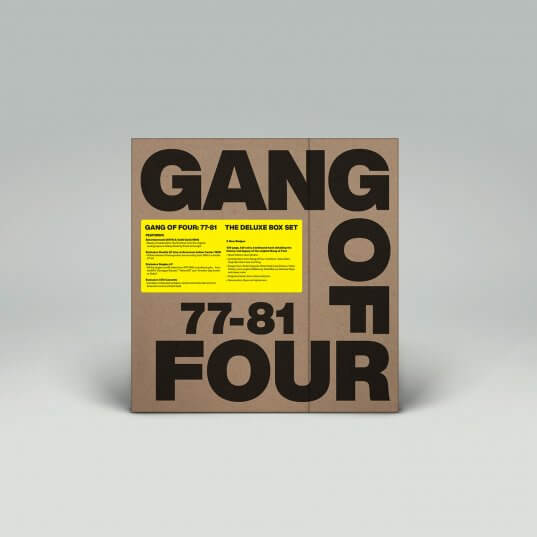
We’re very pleased to announce the new Gang of Four 77-81 Limited Edition Boxset, out on Matador Records on December 11th, available to preorder now here: gangoffour.ffm.to/boxset.ofp
The boxset features:- Entertainment! (Remastered) LP- Solid Gold (Remastered) LP- Exclusive Singles 12” LP- Exclusive ‘Live at American Indian Centre 1980’ Double LP- Exclusive Demo Cassette Tape of Outtakes, Rarities and Studio Demos- 2x New Badges- 100 Page full-colour Hardbound Book curated by Allen, Burnham and King.
“I stumbled upon a copy of Gang of Four’s Entertainment! accidentally and it went on to become one of the most influential records of my life as a producer, lyricist and fan of music in general. Their sparse, unorthodox, riff heavy guitars and nasty, funky, in-the-pocket rhythm section drew me in, but it was their questioning of the world that kept me listening as I grew. I consider them a seminal band, whose influence and effect permeates the music world in a deeper way than many realize. Thank you, Gang of Four, for existing.”
The box set contains “Entertainment!’ and ‘Solid Gold’ (both remastered from the original analogue tapes), an exclusive singles LP, and an exclusive double LP of the never officially released ‘Live at American Indian Center 1980’. Additionally, the package includes two new badges, a C90 cassette tape compiling 26 never-before-issued outtakes, rarities and studio demos from ‘Entertainment!’ and ‘Solid Gold’, and an epic 100-page, full-colour hardbound book.
The book details the history and legacy of the original Gang of Four with never before seen photos, contributions from surviving original band members, rare posters, ephemera, flyers, essays, artwork, liner notes and more. It also marks the first official publication of their lyrics.
Gang of Four was formed in Leeds in 1976 by bassist Dave Allen, drummer Hugo Burnham, guitarist Andy Gill, and singer Jon King. The band pioneered a style of music that inverted punk’s blunt and explosive energies — favouring tense rhythms, percussive guitars, and lyrics that traded in Marxist theory and situationism. They put every element of the traditional “rock band” format to question, from notions of harmony and rhythm to presentation and performance. This original line-up of the band released two monumental albums, ‘Entertainment!’ (1979) and ‘Solid Gold ‘(1981). A third, ‘Songs of the Free’ (1982), was recorded with bassist Sara Lee replacing Dave Allen. After ‘Songs Of The Free’, Burnham departed the band and Andy Gill and Jon King continued on to release Hard in 1983. After this release, the band broke up. In 2004, the original quartet reformed for tour dates and released ‘Return The Gift’ (2005).
Gill’s untimely death in February 2020 was cause for many to once again re-examine the group’s catalogue and the legacy of these early releases was widely cited. Not only did Gang of Four’s music speak to the generation of musicians, activists, writers, and visual artists that emerged in the group’s immediate wake, but the generation after that. And the generation after that, even.
In the last few years, their songs have continued to resonate with and been sampled by artists far afield including Run the Jewels (“The Ground Below”) and Frank Ocean (“Futura Free”). Now forty years since the original release of ‘Entertainment!’, Gang of Four’s legacy cannot be overstated.
Music, specifically pop music, is as much of a commodity as pork bellies. It’s bought, packaged, sold, traded and has as little to do with the Platonic triad of beauty, goodness and truth as, well, pork bellies. And it hasn’t just become this way. It’s been this way. From its inception to now, its value is what’s made it significant in the marketplace. But pressed against a wooden stage in New York at Hurrah’s in the late 1970s, what stepped out on stage had nothing to do with any kind of commercial calculus. That I could see.
See, in 1979, after a steady diet of The Ramones, the New York Dolls, Klaus Nomi, fer chrissakes, and on the strength of the name alone, a single, the press and the locale, the Gang of Four was a must see. But wrapped in the earlier vaudevillian aspect of punk rock, new wave, no wave, and a sort of well-meaning but very extant schtick, expectations were in keeping with what had already been seen. But what had been seen would in no way prepare you for what you were about to see.
Four Brits, no leather jackets, no make-up, and outside of an opening song with about two minutes of unremitting feedback, no schtick.
“We all grew up around vaudeville. It was part of the zeitgeist,” said drummer Hugo Burnham, from outside of Boston where he toils in academia and presently makes his home. But Gang of Four? “It was anti-schtick. And it was somewhat deliberate because we were serious about what we were doing but we weren’t dour. We didn’t go as far as the shoegazing thing.”
Which is almost right. Gone was the clever art school quirk of Talking Heads or the mordant rumble of a Joy Division, musicians framing what we were understanding about new music at the time. Replaced instead with something that was equal parts both cool and hot, and when they tore into their set that night it was with a life-changing brio. No “Hello Cleveland!” No foot on the front wedge rock god posturing, just songs and songs played like those that were playing them meant it. It, here, being coruscating takes on very precisely what it was we were doing while we were doing it. Again: not by accident. But very specifically, deliberately.
“We sat in pubs and talked about it,” Burnham said. Right down to things like, “No fucking feet on the monitors.”
What Burnham fails to mention and this is an amusing Rashomonesque feature of chatting with the three members still living – Burnham, singer/lyricist Jon King, and bassist Dave Allen – is that the no-feet-on-the-monitors “chat” didn’t happen in a pub. King, in a call from London, offers an alternate scenario. “It happened backstage after a show in what used to be Yugoslavia,” King laughs. “And it involved a fistfight.” So Gill and Allen settled things the old-fashioned way and while it’s unknown who won, at the Hurrah’s show there were no feet on monitors.
But first a little historical political perspective and a sense of the tableau upon which whatever Gang of Four was, was created. In the late 1970s in the U.K., there was 14 percent inflation, 18 percent in 1980, one in five adult males were out of work, interest rates were 14 percent, and there was massive industrial unrest. “In ’78 and ’79 it was called the Winter of Discontent,” King said of the hellscape that England had been even before Thatcher dug in. “There were piles of garbage four meters high in the street, people weren’t going to be buried because there was a strike of mortuary workers and grave diggers, there were dozens of IRA terror attacks in mainland UK, there were plotters looking to pull a coup d’etat, plus Russian SCUD missiles in eastern Europe and Americans sending Pershing missiles to NATO, so threats of nuclear attack. Songs like ‘In the Ditch’ on Solid Gold? That was the context we were working with.”
And given that context, a steadfast mark of Gang of Four’s genius that they didn’t zig into what was a popular pose at the time (and still really) and try to pull off the working class hero crap that had smart people dumbing down in the name of some sort of shopworn idea of what was authentic. That is, the Gang of Four were driven and obsessed with what middle class art school students should be obsessed with: making great music and art in and of the times they are living, fully realizing that you can’t fake authenticity. “Look, in looking back I have decided I really like this sort of troublesome 21-year-old me who wrote these totally un-commercial songs,” said King. But the charm, at least for the creator, is that “there’s nothing in it that is an attempt to pander to people. And it may sound kind of stupid but I kind of thought of us as like a blues band.”
“So I tried to avoid cliché, but it’s quite difficult trying to not write about things that everyone else was writing about,” King explains.” But there’s a reason hip-hop is the biggest genre in the world now and that’s because it’s got some authenticity about it; it talks about things that are actually happening. The world is a shit show now. To not write about it is a remarkable evasion of responsibility.”
Something that wasn’t missed in 1979 New York either with crime at an all-time high and the city collapsing financially. So mid-set when King dragged a metal crate on stage – “we later switched to a microwave,” Burnham said – and started blasting it with a drum stick it was both the sound of the city and the times all at once.
Adding percussive elements in and from trash, well in advance of Einsturzende Neubaten and even Stan Ridgway from Wall of Voodoo who Burnham initially thought they had lifted it from (“No,” corrects King), this was a perfect sweat-drenched statement of intent: Gang of Four absolutely were not fucking around.
And it was perhaps this quality specifically that drew the heavy. “We were political with a small P,” said bassist Dave Allen who followed a post-Gang of Four career with music tech gigs at both Apple and Intel, which is how he ended up in Portland. “But we were fighting Nazis. The fascists that came to the shows. They would jump onstage when we were playing in London, skinheads, and they had knives.” Allen, in general soft spoken, neither laughs nor smiles in the retelling. “The security guards would all run away. Having a big heavy bass in this instance helped quite a bit.”
But before reforming in 2005, Allen was the first to leave Gang of Four, in 1981, and his leaving was part of that whole not fucking around piece and almost perfectly Gang of Four-ish. “EMI were always pushing us. They wanted us to make ‘hits’. Be on the radio. Top of the Pops,” Allen sighs. “That’s not what we do. We don’t make pop songs. The 2005 reunion only lasted a few years, but Andy Gill continued with replacement musicians and died right in the midst of touring with them. He left giant shoes to fill. But even considering trying to fill them? A straight-up damn the torpedoes move. To which they are well matched. “When you try to audition a guitar player they just can’t do it,” Allen winds up. “They come in blasting thinking it is punk, but we were post-punk. It was us and Wire…”
On December 11th, Matador will release GANG OF FOUR: ’77-81”, a stunning, limited edition box set gathering Gang of Four’s influential early work.
“Cannot Be, Whatsoever” is Aberystwyth-born Ali Laceys second self-produced studio album as Novo Amor. With its beautifully crafted 10 tracks, it continues his fascinating story where his debut of 2018 , Birthplace, left off.
The process began with the albums second track I Feel Better the writing of which set Lacey on an optimistic path. Although not an album devoid of solemn moments, Cannot Be, Whatsoever is loaded with thoughtful reflection and re-discovery, and as a result its both poignant and uplifting. In Laceys own words, this new music is a shift towards the light which is perfectly introduced by Opaline today containing its own fulfilling lyric Now I feel like I’m finally me.
Yesterday saw the release of Novo Amor’s second single ‘Opaline’, which is taken from his upcoming second album ‘Cannot Be, Whatsoever’. Not only did we get a beautiful new single, but we got the first video of the campaign so far too – a cinematic stunner that was shot in the Australian outback, directed by Stefan Hunt and will have all you oldies longing for one more shot at youth.
My new single ‘I Feel Better’ is out now. I felt an incredible rush of joy and direction when I initially wrote the piano and chorus melody. At the time it felt like this song would define the album, which hadn’t been written yet. I thought it would set the tone for a more positive and joyous step forward, but months down the line the record grew this backbone of indecision, jumping from feelings of self-affirmation to self-pity, from joy and celebration to feelings of boredom and anxiety. It’s not something I really wanted, but those feelings naturally manifested themselves within what I was creating. I think that spectrum of emotion appropriately mirrors how it feels to make an album, at least for me anyway. It’s a mess and can cause a lot of grief. It gives you life, then drags it back out of you. It gives you happiness, the best days, the worst days, and makes you question your purpose and abilities. These words feel unnecessarily dramatic when describing nine months of just making music, but hey, that’s how it feels.
By the end of the album recording, the song felt like an outlier, another one of these ideas that didn’t really need to be heard. I’d worked on it too much. It felt like I was making it worse with every day of recording. It felt like the album had shifted too far away from this uplifting piano line that I’d gotten excited about months before. So, I was ready to throw it away until my friend and collaborator Ed Tullett stopped me. He gave me encouragement to at least see it though and try to make something we could be happy with. I think he (thankfully) saw more importance in this song being on the album than I did. Like most of the other tracks on the record, we worked on it together and it’s a much better record because of it. The song, while still feeling like a bit of an outlier, actually came to represent so much of what this record is for me, this range of emotion and indecision, the building up and tearing down of ideas, this clash of happiness and sadness and affirmation from others. As the song sings – “just tell me that it’s alright and I’ll be fine”.
From the album ‘Cannot Be, Whatsoever’, released November 6th 2020
The circumstances surrounding its creation have always undermined the impact of The Smiths’ final album, “Strangeways, Here We Come”. Less enlightened critics dismissed it as a damp squib following the big bang of the monolithic The Queen Is Dead, and the album’s supposedly fraught recording sessions are often given as the cause of guitarist Johnny Marr’s departure – and the band’s subsequent split – prior to the album’s release on 28th September 1987.
Divorced from the times, though, Strangeways, Here We Come (its name referring to Manchester’s notorious prison) cries out for reappraisal. Far from the runt of a spectacular litter, it’s arguably the band’s most sonically adventurous album and, in reality, the sessions that produced it were lively and harmonious.
Holed up at Tears For Fears’ studio, The Wool Hall, in Bath, The Smiths worked closely with co-producer Stephen Street and, aside from the puritanical Morrissey, who reputedly preferred an early night and his Sylvia Plath anthology, they often partied during down-time. In his 2016 autobiography, Set The Boy Free, Johnny Marr recalled the Wool Hall sojourn with fondness. “I was in my element,” he wrote. “I didn’t need to know what was going on in the outside world or see anyone other than the band and [my girlfriend] Angie… and I loved the new songs.”
The Mancunian quartet’s recent singles – the dense, anthemic Shoplifters Of The World Unite and the glam rock-inspired Sheila Take A Bow – served notice that The Smiths were keen to break new ground. Morrissey and Marr were of a mind that Strangeways, Here We Come would help The Smiths slough off their reputation as purveyors of jangly indie-pop.
Prior to the sessions, Marr had absorbed envelope-pushing albums such as The Walker Brothers’ early singles and The Beatles’ “The White Album”, and his desire for his own band to broaden their horizons was all too apparent on Strangeways, Here We Come’s opening cut, A Rush And A Push And The Land Is Ours. Though Morrissey’s lyric revisited familiar themes of unrequited love (“Oh, don’t mention love/I’d hate the strain of the pain again”), the song’s sparse, otherworldly backing track provided a notable departure, with Marr’s eerie piano motifs replacing his trademark layered guitars.
When Marr did pick up his guitar, he often played with the level of aggression he’d first displayed on The Queen Is Dead’s storming title track. I Started Something I Couldn’t Finish was driven by his serrated, glam-rock riffs, while he dropped a metal-handed knife onto his Telecaster to enhance his arsenal on the rousing Stop Me If You Think You’ve Heard This One Before. Bassist Andy Rourke and drummer Mike Joyce, meanwhile, demonstrated their own dexterity during the slow, menacing build of Death Of A Disco Dancer, while even Morrissey threw some atonal, yet strangely effective piano licks in for good measure as his comrades went for the burn during the song’s hypnotic, Can-esque final coda. https://www.youtube.com/watch?v=SckD99B51IA
However, while Strangeways, Here We Come captured The Smiths embracing new sounds and textures, they hadn’t entirely fallen out with classic guitar pop. Indeed, the album included several of the band’s defining moments, courtesy of Last Night I Dreamt That Somebody Loved Me, Paint A Vulgar Picture and I Won’t Share You. Buoyed by swirling strings and one of Marr’s most dashing arrangements, the majestic Last Night I Dreamt That Somebody Loved Me took The Smiths’ traditional bedsit angst and repurposed it with a cinematic splendour worthy of Ennio Morricone. It was topped and tailed by one of Morrissey’s finest vocals – reputedly nailed in one take – yet the abject loneliness in his lyric (“No hope, no harm/Just another false alarm”) and the absence of the singer’s usual bon mots only added to its potency.
Morrissey’s singular performance also significantly elevated the anti-music biz rant Paint A Vulgar Picture. It’s not unusual for aggrieved artists to launch verbal daggers at their labels, but lines such as “Best of, most of, satiate the need/Slip them into different sleeves, buy both and feel deceived” found The Smiths’ frontman laying into arcane industry practices and the idea that death sells with a cleaver-sharp accuracy that still stings.
By contrast, Strangeways, Here We Come’s peak was surely its gentlest track, the closing I Won’t Share You. With Morrissey’s vocal accompanied by a discreet Rourke bassline and Marr picking out the melody on an ancient lyre found in a forgotten corner of the studio, this tender, wistful postscript (“I’ll see you somewhere/I’ll see you sometime/Darling…”) immediately took on an extra poignancy after Marr quit the band during the summer of 1987, citing a combination of exhaustion and disaffection with a variety of business and management-related issues.
Inevitably, the story of the 80s’ most influential British guitar band losing their primary sonic architect dominated the UK press, and while denials were briefly issued, The Smiths publicly announced their split before Strangeways, Here We Come hit the streets. Sadly, the fallout from the band’s demise overshadowed the fact that they’d bowed out with a fantastic record that should have opened their next chapter instead of providing their premature epitaph.
Regardless, Strangeways, Here We Come did reap sizeable commercial rewards. It peaked at No.2 in the UK Top 40 and went gold on both sides of the Atlantic. It’s never had the same critical cachet as the seemingly unassailable The Queen Is Deadbut, in recent years, discerning voices have trumpeted its quality, with Consequence Of Sound proclaiming, “Strangeways, Here We Come may not receive as much acclaim as its predecessors, but it should,” Once the dust settled, both Johnny Marr and Morrissey agreed their beloved band had split on the back of their best album.
“We’re in absolute accordance on that,” Morrissey said in 2007. “We say it quite often. At the same time. In our sleep. But in different beds.”
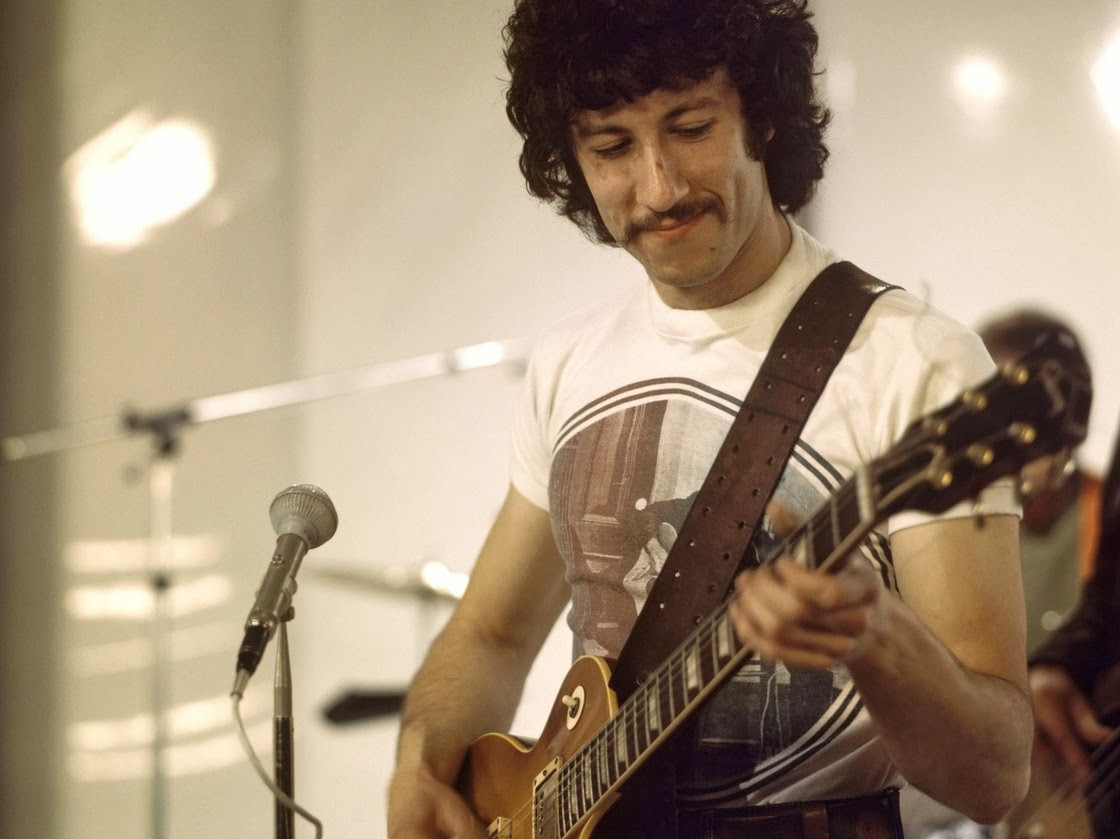
Peter Green went from being one of the most influential blues-rock guitarists of his generation to a cautionary tale among 60s acid casualties. A sensitive soul motivated by his love of blues giants like Freddie King, Otis Rush and BB King, Green’s role in founding Fleetwood Mac quickly elevated him to becoming one of the era’s most distinctive and accomplished guitarists.
By all accounts a quiet and introverted man, Peter Green disguised his innate shyness behind a 1959 Gibson Les Paul, but in three short years his music became ubiquitous, topping the UK charts. Though his discomfort with fame soon took its toll, Green’s inner torment inspired some of the late-60s’ most emotive, heart-rending songs – notably Albatross and Man Of The World – before he tragically faded from the limelight in an terrible, LSD-induced cloud of mystery.
While his successes were overshadowed by the world-conquering feats of Fleetwood Mac’s later years – the 70s albums Rumours and Tusk among them – his bandmates Mick Fleetwood and John McVie have never failed to praise Peter Green’s genius and frequently give interviews mourning the loss of the guitarist’s talent. In a sad story of lost potential there’s much to celebrate about Peter Green, arguably the finest blues guitarist to ever hail from the British Isles.
Born in London on 29th October 1946, Peter Greenbaum grew up in Bethnal Green, honing his guitar skills from age 11 onwards amid the skiffle craze. Like many of his generation, Green cut his teeth in numerous skiffle bands before the early-60s music scene seduced him into learning blues licks while mastering the lead guitar in Peter Barden’s R&B outfit Peter B Looners (later renamed Shotgun Express). At the time, the most famous blues guitarist on the circuit was indisputably Eric Clapton; the ex-Yardbirds musician was playing with John Mayall And The Bluesbreakers, whose fans were so enamoured with Eric they famously scrawled “Clapton Is God” in graffiti on a wall in Islington.
Upon hearing that Clapton had quit The Bluesbreakers, Peter Green saw a chance for his big break and applied to fill the guitar god’s shoes. John Mayall was in no doubt of his greatness. “We’ve got a new guitarist,” he said to producer Mike Vernon, founder of Blue Horizon, the label that would go on to release Fleetwood Mac’s debut album. “We’ve got rid of Eric. This one’s much better.” At a time when blues-rock acolytes were still hero-worshipping Clapton, Peter Green slowly won fans over with his unique feel and displays of pure emotion. Even Green’s idol, BB King, later complimented him, saying, “He has the sweetest tone I ever heard. He was the only one who gave me the cold sweats.”
Assuming lead guitar on John Mayall And The Bluesbreakers’ third album, “A Hard Road”, Peter Green dispelled any comparisons to Clapton by demonstrating his mastery of rapturous, ever-lasting sustain on the instrumental cut “The Supernatural”. Green’s embrace of reverb and highly-composed finger vibrato was refreshing in an era when hyperactive, energetic virtuosos like Jimi Hendrix would come to prominence; his calm restraint is what made him so special. Having grown in confidence and wanting to form a band of his own, Peter Green left The Bluesbreakers, taking drummer Mick Fleetwoodand bassist John McVie with him. “This band’s called Fleetwood Mac,” Green said, naming themselves after both Mick and John’s surnames. Though Peter Green had a vision of the style of blues he wanted the group to play, he was never entirely comfortable being at the forefront and tended to share vocals with guitarist Jeremy Spencer. Green’s showmanship, however, soon revealed him as the real driving force behind the band – crowds were wowed with his sublime guitar playing and, as Fleetwood Mac grew more tightly-knit, it was only a matter of time before they caught the attention of the mainstream.
Fleetwood Mac’s breakthrough single came on 16 April 1968, with the voodoo thump of Black Magic Woman, a spine-tingling Peter Green composition that hit No.37 in the UK but which would later become more popular when covered by Santana in 1970. The group wasted no time at all building on this momentum with a cover of Little John Willie’s lustful Need Your Love So Bad, which, released on 5th July 1968, again hit the Top 40 and continued to solidify Peter Green’s standing as a blues maestro in a league of his own.
Around this time, Fleetwood Mac was joined by another guitarist, Danny Kirwan, and their next single, released on 22nd November 1968, found the band soaring to even greater heights. The woozy, surf-tinged instrumental Albatross hit No.1 in the UK and became the group’s first international hit. With a guitar riff inspired by Santo And Johnny’s Sleep Walk, Peter Green’s sweet-sounding slide guitar was a surprising departure from Fleetwood Mac’s more raucous blues jams, leading the song to outsell The Beatles and achieve mass commercial appeal (it remains the UK’s biggest-selling selling rock instrumental of all time).
Met with an intense touring schedule in the wake of such success, Peter Green grew uneasy with the levels of fame Fleetwood Mac had achieved. As he turned to drugs to cope, and his consumption of LSD increased, the band grew concerned as Green’s behaviour became more unusual, his inner demons surfacing in unsettling ways. Often, they manifested themselves in his lyrics, exposing Green as a tormented soul struggling with his emotions.
Nowhere is Peter Green’s inner turmoil better represented than in the single “Man Of The World”, which was released on 22nd April 1969. A mournful lament seeping through gently-plucked minor chords, with Green’s achingly beautiful vocal cries – “I guess I’ve got everything I need/… “But I just wish that I’d never been born” – the song reached No.2 in the UK and did little to dent Fleetwood Mac’s commercial prospects, despite Mick Fleetwood later admitting it was an obvious cry for help.
By now, Peter Green had begun wearing robes and a crucifix. After watching a TV programme on poverty in Africa, he tried to convince his bandmates to donate all proceeds from his hits to charity. He was unsuccessful. Fleetwood Mac’s next single, “Oh Well”, released on 4th December 1969, was yet another UK hit, reaching No.2. It showcased Peter Green’s guitar playing at its best in a rowdy blues-rocker in which he protests: “I can’t help about the shape I’m in/Can’t sing/I ain’t pretty and my legs are thin.” Whatever shape he was in, it was clear that Peter Green’s way out wouldn’t be so easy.
In early 1970, Fleetwood Mac embarked on a European tour. Upon arrival in Germany they were invited to join a party at a hippie commune at Highfisch, near Munich, where the band claims Peter Green was given LSD and went on a catastrophic acid trip which sent him over the edge. “All it took was a couple of tabs,” McVie said, “and he never came back.”
Given that bassist Danny Kirwan also went on to suffer with mental illness following an acid trip at the same event, the band continues to pinpoint Highfisch as the tipping point that sent Peter Green over the brink. Having slowly grown distant from the band in the preceding months, after the party the guitarist’s personality changed beyond all recognition. “For sure he never really came back from that, to our recollection,” recalls Mick Fleetwood. The band’s final single with Peter Green, released in May 1970, was The Green Manalishi (With The Two Prong Crown), a trippy, acid-inspired garage-rock freak-out in which the devil manifests itself through greed for money and wealth, reportedly inspired by a dream the guitarist had. Despite its dark subject matter, the song still hit No.10 in the UK. Sadly, however, this would be the end of the road for Green, who quit Fleetwood Mac that same month. He later suffered a mental breakdown and, aside from an occasional solo release in the 70s, Peter Green disappeared into relative obscurity.
As Peter Green turned his back on fame and became a hermit, tabloid stories about his self-banishment from the music scene persisted for many years, much of them based on truth. Green began hearing voices and became a diagnosed schizophrenic. He sported a beard like Rasputin and let his fingernails grow long, Green was even arrested for threatening to shoot his accountant with a shotgun and underwent electroconvulsive shock therapy.
The sensationalism behind these stories takes the focus away from the brilliance of Peter Green’s music. Thankfully, by the late 90s, he was able to overcome his mental problems and resumed playing the blues, though he would never again achieve the chart successes of his youth. Upon hearing that Peter Green died peacefully in his sleep, aged 73, on 25 July 2020, Mick Fleetwood paid tribute to his old friend by commending Green for inspiring us with how music should “always be delivered with uncompromising passion”, asserting that his talent “trailblazed one hell of a musical road for so many to enjoy”. In the end, that’s what lasts – it’s the music itself by which we should measure the man.
Throughout Fleetwood Mac’s early years, Peter Green stood out as a supremely gifted guitarist with a divine ear for bluesy dexterity and sheer emotional range, blessed with a soft, spiritual voice of his own which sought to keep him from succumbing to the blue devils. He left us with a cool, calm and collected catalogue of songs which later inspired classic rock guitarists like Joe Perry of Aerosmith and even Metallica’s Kirk Hammett, forever ensuring Peter Green’s legacy as a blues legend.
“We are all dwarves standing upon the giants who preceded us,” Green once said. Little did he realise that he himself would become one of those giants.
In 1997 a brother and sister climbed into the third floor attic of their Southwest Detroit family homestead and bashed out a primitive cover of David Bowie’s “Moonage Daydream.” In an alternate reality, it’s all they ever do musically. The brother leads a spartan life as a dutiful upholsterer and the sister finishes culinary school and continues to make heart warming food.
But that doesn’t happen. Something sparks in both of them. They take their simple guitar-drums-voice approach to a local open mic night on Bastille Day. The performance was just good enough to keep them going. In what feels like a whirlwind, they record and release two 7-inch singles for a local indie label. A not-so-local indie offers to put out a full length album.
They start touring. Another album. More touring. Another album. Folks Really start to pay attention. Crazy touring schdeule’s. More albums, accolades, wildest dream after wildest dream coming true. “World-renowned” becomes an appropriate descriptor as does “long-building overnight sensation.”
The fact that people even care about the Vault at all is almost entirely predicated on the hard work and dedication that the White Stripes exhibited from the very onset of their existence. So it is with extreme reverence that we pour that same dedication into The White Stripes Greatest Hits.
We get that the idea of “Greatest Hits” may seem irrelevant in the era of Spotify and playlisting…that an act’s most streamed songs are considered their de facto “hits.” But we also wholeheartedly believe that great bands deserve “Greatest Hits” and that a large part of our successes has been built on zigging when the rest of the “music business” is zagging. The White Stripes are a great band with great fans and it feels like a greatest hits compilation from them is not only appropriate, but absolutely necessary.
With a track list traversing the entirety of their career, from late Nineties flashes of brilliance through early 2000s underground anthems, masterful MTV moon man moments, Grammy-grabbing greatness, worldwide stadium chants…the songs here are as wide-ranging as you can imagine. Two LP’s worth of those tracks are precision pressed on glorious red and white discs at Third Man Pressing in Detroit.
But for our most dedicated supporters, the legion, the ride-or-die Vault members…well, you deserve a bit more
We expanded the collection by adding a bonus LP of largely overlooked, previously scattered b-sides. That disc is pressed on an exquisite red/white/black “detonation” coloured vinyl. Of particular interest is the first-ever official vinyl appearance of the Stripes’ stellar cover of the Tegan and Sara track “Walking With a Ghost” coupled with the first vinyl issue of some tracks in over 15 years.
To climb further down the rabbit hole, the Vault version of Greatest Hits features iconic artwork from longtime White Stripes collaborator Rob Jones. Fully displaying why he’s a Grammy Award-winning designer, the Jones artwork is whimsical and engrossing and chock full of Easter eggs that will only slowly avail themselves to the most scrutinous of eyes over the long arduous passage of time.
In addition to the exclusive album art, the Vault package comes with a shockingly breath-taking custom set of three Rob Jones 8×10 silk-screen prints. There are three different sets of prints and they will be inserted into your package at random. Frameable, gallery-worthy, dare we say investible…nothing short of the brilliance that’s become par for the course from Mr. Jones.
As the final little treat for this our 46th Vault package, we’ve got a White Stripes-themed set of magnetic poetry. Yes, all the words you best know from Jack White’s lyrics…home, bone and telephone and SO many more, included here for you to randomize and make your own “little” White Stripes song. While the standard issue black vinyl version of The White Stripes Greatest Hits will be available for eternity, the Vault version will be the ONLY coloured-vinyl or artwork variation. Sign up for the Vault by midnight Central Standard Time October 31st to lock in what is truly a stunning collection celebrating the best recorded moments of the White Stripes.
Reykjavík maverick Henrik Björnsson is due to release ‘Good Sick Fun’, his eleventh album under the Singapore Sling project, on September 25th via Fuzz Club Records Inspired by goth-rock, dub and big-band jazz on top of the usual fuzzed-out rock’n’roll touchstones that are seared into Henrik’s work, the latest Singapore Sling full-length is as perversely hedonistic as they come – and that’s not without competition by any means.
An invitation to “rejoice in doing wrong”, in Henrik’s own words, ‘Good Sick Fun’ is the latest morbid and characteristically-depraved addition to a back-catalogue spanning nearly two decades from the cult Icelandic band. Arriving off the back of the 2019 ‘Killer Classics’ LP, Henrik says of the new album: “Old rock´n´roll is the main influence on this record, as on most of my records. When I release a record it means rock´n´roll has saved my life, my mind and my soul once again. And it does that quite frequently. Sometimes I start running astray, getting sucked into pointless garbage and thinking it actually matters. Then I realize that it´s absolute garbage and that nothing matters but rock´n´roll so I go and make a record instead.”
Fuzz Club exclusive vinyl limited to 200 numbered copies on clear 180g vinyl (inc. Bandcamp download card).
Fuzz Club members will receive the exclusive vinyl as part of the September membership package. Standard vinyl limited to 300 copies on 180g black vinyl
Brendan Kelly, Chris McCaughan, and Neil Hennessy are true punk lifers. They’ve all been involved in one great project or another for over 20 years (Slapstick, The Broadways, The Falcon,Sundowner, Treasure Fleet, Brendan Kelly and the Wandering Birds, etc), and when they come together as The Lawrence Arms, magic always seems to happen. Their gravelly yet melodic, shambolic yet precise approach to punk resulted in at least a few classic punk albums of the early/mid 2000s, and after an eight-year gap between albums, they proved they very much still had it on 2014’s Metropole, one of the finest and most underrated punk comebacks of the 2010s. They took another lengthy break after that (and stayed busy with other projects), but now they’re finally back again with a new album — their first in six years — and The Lawrence Arms have done it again. Skeleton Coast is a graceful late-career album that stands tall next to their classics.
Punk is often seen as a young person’s game, but The Lawrence Arms have really figured out how to progress and mature their sound without losing the charm that fans fell in love with 15-20 years ago. Skeleton Coast has everything you want from a Lawrence Arms album — Brendan Kelly and Chris McCaughan’s trademark dual vocals, big anthemic hooks, adrenaline-rush tempos, and just the right amount of tenderness bubbling up beneath the rougher surface.
The album is out now, Brendan and Chris, who gave us a track-by-track breakdown of the full LP. They had a ton of (very entertaining) stuff to say, including detailed stories about the writing and recording processes, meanings behind some of the songs, anecdotes involving Brett Gurewitz and Alkaline Trio’s Dan Andriano, a story of how John Candy’s son would’ve appeared in the video for “PTA” if not for COVID-19, and how they took influence from Crimpshrine, Bad Religion, Beastie Boys, Immortal Technique, Solange, Naked Raygun, OutKast, Looking Glass, Operation Ivy, Dead Milkmen, Nikolai Gogol, Lewis Carroll, Edgar Allan Poe, and more on this LP.
1. “Quiet Storm”
BK: This song is a clear album starter. Chris said he wanted to do a like, Crimpshrine kinda thing with this one, just a fast burner with a real simple and clear point of view. A punk song. He pulled that off in the writing and then Neil bringing in that fill on every chorus is just like the icing on the cake, making it a true tribute to that very influential and under-appreciated band, while still sounding like a classic blazing McCaughan TLA track.
CM: I wrote this song pretty fast – for me, like a few hours one night. I recorded it on my phone and texted it to BK. The chorus originally mirrored the intro – he shot me some feedback and was like “what if you did this?” and I tweaked the chorus slightly. The small change really “tied the room together” so to speak and I think made the song infinitely better. I guess it’s about how making art or whatever is mainly about action for me these days. And about how you need to find some way to drop the pull of the past and the weight of the future and acknowledge the beauty and struggle of the present. Don’t snooze on BK’s Bad Religion-inspired ahhhhh’s in the back half of the second verse.
2. “PTA”
BK: Of all the things the pandemic robbed us of, probably the worst is that I had Chris Candy (John Candy’s son, who plays in an amazing band called Chotto Ghetto, btw) on board to re-enact some of the great scenes in his father’s iconic film Planes, Trains and Automobiles with our beloved photographer friend, Hiro Tanaka (trust me, this is good casting) in the Steve Martin role for the video for this track. Welp, that didn’t happen and Felicity Jayn Heath put together a beautiful video in its own right (definitely better than whatever half-assed shit I was imagining), but I can’t help but wonder at the magic that may have been. Funny aside, if Chris and Hiro wouldn’t do it, my backup idea was to do the same thing but with me and Chris as the two main characters, but I’d be Steve Martin and Chris would be John Candy, just to make everyone think we were sniffing glue or something when we cast it.
CM: The last line of this song really drops a piano on me. It has a kind of classic BK stomp to it. Pretty sure it was the first one he sent me when we started writing. I will always think of the “You’re going the wrong way” scene between John Candy and Steve Martin in Planes, Trains & Automobiles in the instrumental break– followed by Del Griffith (Candy’s character) standing on an L platform in Chicago with nowhere and no one to go to, heartbreaking stuff.
3. “Belly Of The Whale”
BK: In a way this is a biblical reference, yes. But in a more real way, it’s about finding your place of peace in a hostile world. In the MOST real way, this is a song that I wrote after Chris and I had discussed his suggestion for the album title Skeleton Coast and once we kinda settled on that, it was really inspiring to me. The inception of the notion of the skeleton coast into this sheaf of songs, as well as the idea to title the album Skeleton Coast, both Chris’s, but we both work back and forth and, I Think, respond to each other’s thoughts and words and vibes until we wind up with a record of cohesive tunes that are coming from the same team soul. This was my “YO! I’m all in on this concept” offering. Also, Chris’s solo in the interlude has this vaguely twisted but otherwise classic vintage vibe that gives me the creeps in the absolutely best possible way, and his whimsical “aaaaahs” under the bridge before the last chorus…Quite possibly my favourite vocal performance on this whole album.
CM: I love the way this song turned out, different than I had imagined based on the original demo. More epic. When I was working on guitar ideas for this song I found a cool illustration of Jonah in the whale and used it as part of a, forgive me, mood board? The vocal cadence and clip to the song have that uniquely BK stylized delivery. I get a triumph in the face of adversity feeling when I hear this one. I tried to lean into the anthemic quality when we built out the guitars to capture a “Born in the USA” vibe but filtered through our strange world, so maybe it’s almost anti-anthem.
4. “Dead Man’s Coat”
BK: This song is very sad. It’s also got a lot going on. My bassline is very uh…I don’t know how to say this… it’s a very prominent bassline that almost is the melody at times, particularly in the instrumental parts. Meanwhile, the guitar throughout this burner of a track is suuuuuper ambient, understated and at times downright perplexing. That’s because Chris very consciously didn’t want this sounding like it just came off Oh! Calcutta!. His point of differentiation in this song, which could have been one of those muscly tracks on that record with a tiny bit of tweaking, was to play more thoughtful guitar. I actually wanted to call this song “thoughtful guitar” but “Dead Man’s Coat” had a better ring.
CM: On one hand, this song is a kind of espionage tale about the final, failed mission of an undercover agent. Beneath the loose narrative surface, it’s about various types or reckoning with your own universe. Hard to spin this out of the sombre message that even though things can change, and we have hope for what’s next, the future is always a step ahead and we’re forced to exist on these terms. There’s a short story called “The Overcoat” by Nikolai Gogol, considered by many to rank alongside the great short stories ever written. The song title and image of the coat, I suppose, are a slight tip of the hat.
5. “Pigeons and Spies”
BK: This song is odd. In a very very real way this song is a tribute to Adam Yauch and my fascination with hip hop at large, and specifically the Beastie Boys and VERY specifically MCA’s desire to mash disparate things together. In that vein, there’s a tip of the hat in here to Immortal Technique’s track “The Point Of No Return” which talks about literally everything that’s ever happened from mesozoic comets to the knights templar to supermax prisons and he even kinda tries to tie it all together. I just wanted that hip hop vibe of singing about dinosaurs, singing about weird locker room drama for young unsure people like I once was, singing about drone bombers, whatever, and then bring it all together with the idea that at the end of the day we are all just people who are, without fail, either telling you how tired we are, or consciously NOT telling you how tired we are. And I DO try to sing just like MCA in the bridge, which is done in a classic TLA-ripping-off-the-Beastie-Boys cadence. RIP and much love. This song is weird and I truly didn’t think anyone would like it. Jesus. I’m writing too much.
CM: I wanted this song to have subtle muffled guitar lines in the verses that created a sort of stakeout vibe, which was actually super inspired by “Don’t You Wait” by Solange. When we got to the bridge during my vocal tracking I stumbled embarrassingly through the vocal switch offs. Eventually, the advice from the control room was “you just gotta pretend like you’re in the Beastie Boys and channel your inner MCA” and I was able to make it happen. Hopefully cool.
6. “Last, Last Words”
BK: When I heard the demo of this, I was struck by the words and how they’re like Lewis Carroll style wildly poetic. Chris has always been a wordsmith, so that’s not totally a shocker. I didn’t quite know how I thought it could come together, though…I was sitting with Neil one night right before we left for the studio and I said “I just don’t know how that song’s gonna sound” and he said, “it’s got like the modern version of the bounce of ‘100 Resolutions’” and suddenly I saw the whole thing in my head and felt like an idiot for not having seen it myself. I literally said “OH! Say no more. You’re right!”
This was one of the most fun ones to lay down in the studio and I just can’t say enough about how cool the guitar arrangements and vocal performance turned out on this.
CM: “I put my red hunting hat on, and turned the peak around to the back, the way I liked it, and then I yelled at the top of my goddam voice, “Sleep tight, ya morons!” I’ll bet I woke up every bastard on the whole floor. Then I got the hell out.”
7. “(the) Demon”
BK: Um…Guitar solo. That’s all. This song is about celebrating your worst impulses and Yes, the lyrics are really dark, but this song is ALL about that blazing guitar solo. Funny story, when I first played this for [longtime TLA producer] Matt Allison he said “dude, I don’t know if it needs to say ‘I am the demon’ THAT many times” and I said “oh, no. It has to. That is the point. This song is about how when you recognize yourself as the demon for real, you can’t get away. It has to be too long. It has to get weird. Or else there’s no point to the song.” He relented to my vision and the song appears as is. But with that whipass solo. Who even knew 2020 was Capable of a solo like this? Another funny thing: I have a recording of Chris laying down this solo, and it’s like he’s kinda ALMOST like looking at something else. Clearly, it’s an inspired performance that couldn’t be half-assed and I know what it’s like to stare off into space when you’re trying to just feel something, art wise. But let’s say it was half-assed… this motherfucker is that good that he half-assed THAT guitar solo???? Jesus fucking Christ. I’m in the right band.
CM: When I first heard this song as an acoustic demo on my phone, I admittedly texted Brendan and was like “bruh you okay?!” Kinda dark! I’d been messing around with some guitar stuff for the second half of this track and had a rough vision of how it might turn out. I’m probably rewriting history but Matt punched me in for the end guitar solo thing and I played it and let the final notes ring out – as one does. When we cut, the collective vibe in the room was… ohhhh yeah that’s the one. Oh, and I played the solo on an ES-330 if that’s the kind of thing you’re into knowing.
8. “Ghostwriter”
BK: Kinda a big ass song on this record. This bassline is PROBABLY the most intense bassline I’ve ever come at a Lawrence Arms song with. Also, the way I had written it didn’t sit well with Matt and Neil and they kinda made me rewrite it in the studio (as they told me what to write and I stubbornly listened to them kind of but insisted on not just doing exactly what they said, because I may be old, but I’m still a baby), but the final results are that whatever that guy’s name is who plays bass for the ALKALINE TRIO is called me up to tell me that my bassline on this song is ‘Next Level,’ which was a cool compliment I don’t get very often. The salient point about this song is that it rocks and Chris took a lot of chances here, lyrically and vocally, and they all paid off but sure, random A3 guy, make it about me and my admittedly whipass basslines for some reason.
CM: I feel like I need to set the record straight. The first line of this song is “I drove the highways of a skeleton coast.” That line launched the idea for this end of the world outpost: the “Skeleton Coast” that the record is framed in. BUT it was my wife who said to me one night that it would be a cool record title. So, it was her initial spark of an idea – and that was the real jumping off point. Most of my songs on this record are kind of short-story-esque, this one of a mystery writer in exile. Yes, there is an Edgar Allen Poe reference. Yes, I built a falsetto vocal into the chorus.
9. “How To Rot”
BK: This song is fucking weird. The first lines are so inside baseball that I think I’m the only person who would ever understand them, but in short, this song is about how we, as leftists, always kill that which we love by loving it too hard, a la Of Mice and Men or something.
Naked Raygun influenced the pre chorus thing that leads into this thing that sounds like maybe the most triumphant chorus I’ve ever written that doesn’t repeat and then turns into a weird pitch shifted tribute to OutKast and then devolves into a line from “Brandy (You’re A Fine Girl)” by Looking Glass before going back into the Naked Raygun part before paraphrasing a tweet by @dril to end it all. Despite all that ridiculous stupidity, this one is the one that gets stuck in my head the most. I also honestly don’t totally understand how I wrote it, how we put it together or how it turned out as well as it did. If any of you ever want to institutionalize me against my will, this song is probably all the evidence you need.
CM: Brendan’s voice on this track has this strained tension that gives it a crazy urgency, which I dig a ton. I tried to do a “Dr. Feelgood” guitar swell in the beginning, which was pretty hilarious in the studio. The hook that does not repeat in this song may be my favorite BK melody on the record. I wanted the chorus guitars to be single note lines and just super minimal and uh I guess “punk.” If this song wasn’t so schizophrenic and run through a super weird lens – it may have echoed a kind of O!C! era of the band. Also, flange.
10. “Under Paris”
BK: This one just burns. I love that it sounds like dark streets and gas lamps and running dogs. Funny thing, at first, in the studio, we had an acoustic strumming over this whole song and it didn’t sound quite right. We talked about it and decided to try it without the acoustic and it just bloomed. Our tour manager, Toby Jeg is fond of the phrase “addition by subtraction” and usually he means like, a guy who refuses to wear a helmet and therefore dies on his ATV, but in this case, we took out this beautiful acoustic performance and ended up with the song that I think encapsulates the city part of the sound we’re going for on this… lone animals screaming into nothing in order to just find something to love.
CM: I always feel hesitant to try to say exactly what a song is about. I’m an unreliable narrator at best, the songs are at times a bit abstract or whatever, and I don’t want to push my own intentions on anyone. Songs are cool because a listener can lend their own unique world and create their own kind of meaning from them. It’s okay with me if that feels pretentious. All that said: this is an abstract short story loosely about climate change and love in a post climate disaster world.
11. “Goblin Foxhunt”
BK: The way I describe this one is “It’s supposed to sound like one of the last songs on Energy by Op Ivy.” I know it does not. I’m not talented enough to do that. But I wanted that love and innocence and weird chordage and general “fuck it, let’s stop and start and that’ll be fine” kinda vibe to shine through. This song has, to me, my favourite vocal bit that I do on this album in “we can neveeeer go baaaaack.” It sums up a lot of things and it’s done with…well, the intent was for it to be like an “We’re reaching at the stars, and we’ve come too far to not burn up upon re-entry, therefore, there’s no going back” kinda vibe, and then either turning your life into something else…blowing up your whole existence, or just living with what you love and where you are, and the realization that nothing is ever perfect. That’s how I wanted that part to sound.
The very end was not initially designed to sound like our heroes, the Dead Milkmen, but as Chris added more and more whimsy, BOOM! Suddenly, we’re all driving a Camaro back from the Bahamas. Chris really channelled whatever that sound was coming out of the hole in the wood for this one, y’all.
CM: This song hits me as a sort of homage or throwback to a lot of the punk songs we grew up on in the mid nineties. And in the most complimentary way, I felt like I already knew the song when I first heard it. My original intentions with the guitars for the instrumental outro were that they’d be super dissonant and droning – but working through in the moment this other nature took over. It’s almost a kind of Dead Milkmen, maybe even late nineties midwest “emo” vibe, and I think was inspired a bit by both. It just opened up into something more major and light and airy. I love the contrast from the front to the back half of the song, it follows this cool trajectory of change.
12. “Lose Control”
BK: This one sounds like it’s written by Mister Burns a little, right? I think this was the first song Chris sent to me where I was like “WHOA!” It’s got a very deep soul, this one. It’s a rare case (and I didn’t write this, so I’m guessing a bit, but I DO know the guy who wrote it pretty well) where it’s written from the perspective of someone you’re kinda supposed to hate and then see that he realizes what you’re just realizing about yourself and your own life and how the metaphor is for all of us and everything. Pretty smart, McCool.
CM: There was a moment in the studio where this song seemed like it might sound like a more “rockin’” Gin Blossoms song. Not that there’s anything wrong with that. It’s kind of bouncy and poppy, but it just wasn’t coming together the way I’d hoped or imagined. Somewhere in the process it clicked back in the right direction. The song is from the perspective of a villain in a vague conversation with a blackhole, beginning to reckon with his life and fate. That point of view wasn’t super premeditated when I wrote this – it just spilled out, so I followed the thread.
13. “Don’t Look At Me”
BK: This is just a sweet love song about going through hell to get what you want and somehow having that not always be enough. No matter how prepared you are. The last line of this song is the second shout out to “Brandy” by Looking Glass on this record. It’s a sad quote of resignation. This song is about literally traversing hell, and to that end, this is the acoustic demo I played to Brett Gurewitz that, upon hearing it, he said “Yeah. We’ll put out this record. Do we need to do a new contract or uh…is that why you’re here?” and I said “Yes. We had a one record deal.” Which, dude. I wouldn’t have flown from Chicago if we had a record deal in place. This was the most stressful day of my recent life (pre-plague and civil war, of course). But, all’s well that ends the way that day did.
And yo, if there’s a better metaphor for going up to Epitaph (literally a word associated with a totem to the dead) as a weird old man band to play acoustic demos for literally your favorite songwriter ever… this song is unintentionally but still basically ABOUT that day. I have to shout out Jen Razavi [of The Bombpops] for driving me there in my panic mode when she surely had better things to do. She’s much nicer than Charon, the ferrier of Greek myth, I bet. TYVM.
CM: Neil’s drum patterns and work on the record are insane and awesome, but this track just feels like such a perfect snapshot of his supernatural ability to choose moments and make everything come together. I wanted the intro to basically be like a weird homage to Knight Rider or the kind of part you could just loop and do some night driving to. With the guitars I tried to really pick my moments, pretty much a goal throughout the record. “Brandy,” the song by Looking Glass which BK references a few times on the LP, has a long history with The Lawrence Arms. It was on regular rotation in the van in our early days of touring, and found a nice home on this track.
14. “Coyote Crown”
BK: Sometimes, at the end of all things, you’re sitting there with a coyote skull on your head and a fire flickering across your face and you’re watching everything crumble as you, personally settle into the reality of nothing ever being the same again. At this point I bet you all do this every day. I know I do. Chris wrote a song about it. I picture him with the skull on his head. And I wait, like a patient boy, like a wild dog, for the solo at the end of this song in order to know I’m truly free.
CM: This is the first song I wrote for Skeleton Coast and it became clear in the studio it would be the last song on the record. I suppose there are some existential questions at play here. Who am I now? Do I have free will? I wanted it to feel like an end of times myth and maybe capture a Where The Wild Things Are fable quality. Although, I’d be lying if I said I knew any of that when I actually wrote the song. It toys with the idea of youth and adulthood and that overlap or ongoing transition, I guess. It’s an end of everything song, for sure– but for me the last line also hints at some possibility of a new world.
The brain-child of Jake Ewald of Modern Baseball, Slaughter Beach Dog’s “Safe And Also No Fear” marks Ewald’s first venture into full-fledged collaboration. Unlike 2017’s Birdie, where Ewald played every instrument, he spent a full year collaborating with bassist Ian Farmer (Modern Baseball), Nick Harris (All Dogs) and Zach Robbins (Superheaven) to construct the project’s unique sound, a blend of pop music, indie rock and folk unlike anything he’d ever produced before. Safe And Also No Fear is rooted in vague sketches of anxieties and confusion, and Ewald stands at its center questioning everything he knows about himself. “Well, since when can an honest man get high after a day of honest work?” he asks on “Good Ones,” crying out as the good ones “aren’t quite as good as you had recalled.
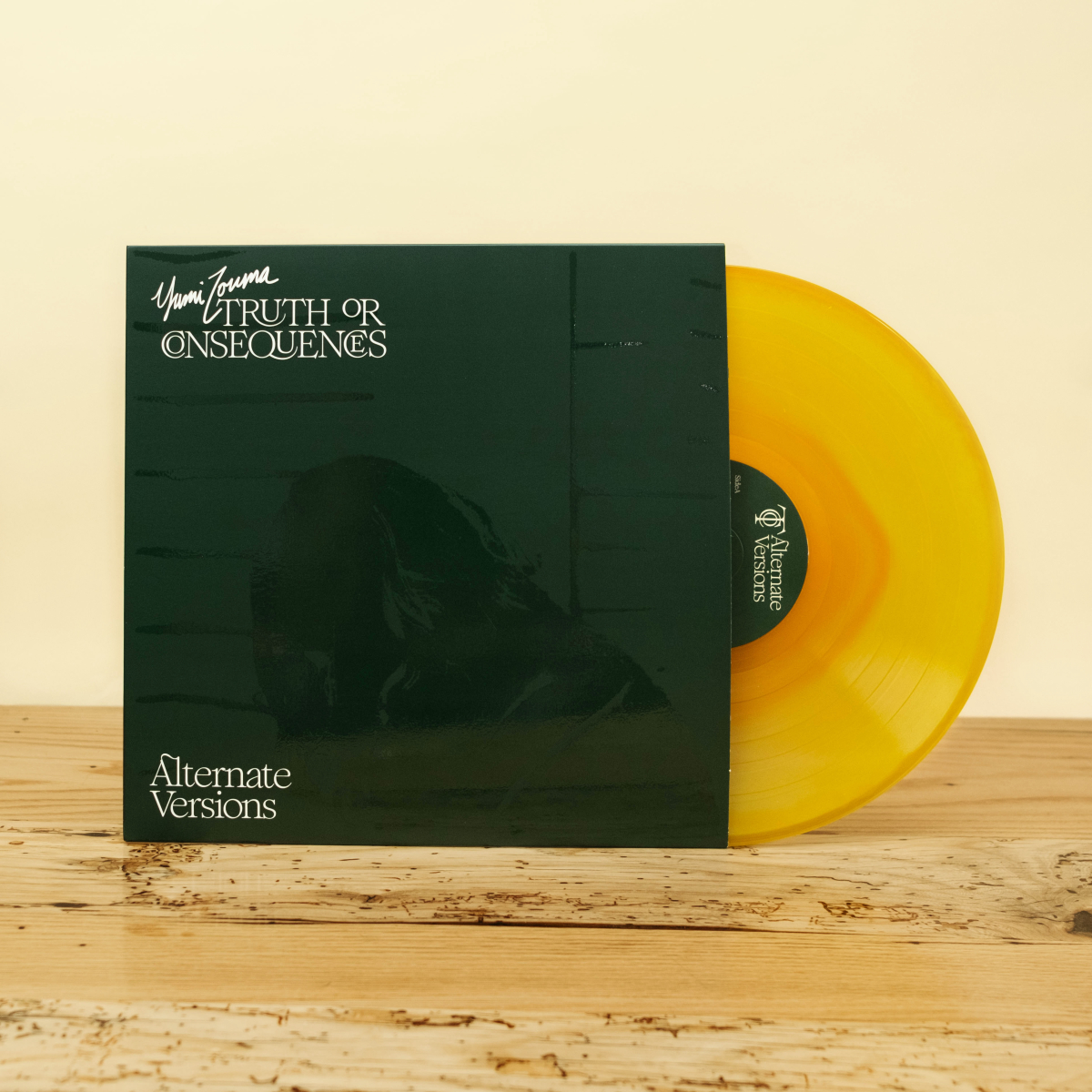
The day before the release of our third album, “Truth or Consequences”, the World Health Organisation declared COVID-19 an official pandemic. We’d arrived in the United States that morning to play the first show of our North American album release tour in Washington D.C. At this point, all of the tour dates were still set to go ahead, and we were excited to promote an album we had worked on for the last two years. This run was set to be our first ever fully sold-out US tour. The atmosphere was excitable, a little tense, optimistic. However, the chain of events that followed meant that by the time we finished our set that evening, restrictions on venues had been enacted by local governments across the country, and one-after-another, all of our remaining tour dates were cancelled. The performance at DC9 was the first and last show of the Truth or Consequences album tour. It was all over, we went our separate ways and flew home the next day – on our album’s release day.
Touring is often the final piece of the puzzle that is an album campaign – the part you fixate on alone in a room, when you perfect a song and imagine how a crowd will react. You may have listened to certain songs a hundred times during the making of the record, but when you’re out on stage, face-to-face with an audience, this is when you start to truly re-contextualise and re-interpret the music, exploring the boundaries, focusing in on different parts of each song’s musical fabric. A new vocal harmony there, a new bassline there – perhaps you add different chord voicings on guitar, or new drum fills that set a new-found intensity to a section.
So after returning home and spending a few numb weeks adjusting to this strange new way of life, April came, the reality set in, and we quickly started to miss that feeling of exploring our new songs by night. We’d missed out on such a crucial part of the process – with no concrete idea of when we might next get the chance. It felt too soon to move on – we felt the pull to work on new music, but still felt a strong attachment, an unresolved connection to this new record that we’d laboured over and had waited so long to release.
Writing new music around them, we took the songs of Truth or Consequences and found ourselves a new way of re-contextualising them safely, amidst the tragedy and fear going on in the world outside our windows – and the Alternate Versions were born. We encouraged each other to be bold, fearless, and to experiment like we would on stage – but from the comfort of our own bedrooms, living rooms and hallways. This new reimagining of Truth or Consequences is the result of that process. Ten new arrangements that reflect our feelings of optimism, helplessness, and a desire to keep exploring. –Yumi Zouma
Back in July Courtney Marie Andrews released her new album ‘Old Flowers’ to widespread critical acclaim, drawing comparisons with Neil Young, Joni Mitchell and Linda Ronstadt with many hailing it as her best work to date. As you can imagine, she’s been in high demand, appearing on the likes of NPR Tiny Desk Home Concerts, KEXP and CBS This Morning. here is a short documentary on the making of “Old Flowers”. If you haven’t already got your copy of this amazing album, you can grab one below on limited edition Sonoran Sky LP, standard black LP and CD.
“bracingly and courageously unfiltered” Album Of The Week THE SUNDAY TIMES, “With the voice of Linda Ronstadt and the songwriting gifts of Joni Mitchell, there simply isn’t anything to dislike about “Old Flowers” ★★★★ MOJO , “an honorable contribution to the canon of heartbreak albums, the subject well suited to Andrews’ delicate voice and disarmingly plain-spoken lyrics…a potent collection of emotionally raw songs” 8/10 UNCUT “this really is a beautiful album: crafted, moving & sophisticated” ★★★★★ THE TIMES
Recorded in Los Angeles Featuring Courtney Marie Andrews Andrew Sarlo Branden Stroup James Krivchenia (Drums and Percussion) Mat Davidson (Guitar, Bass, Piano, and Vocals)








 The Fat Angel Sings