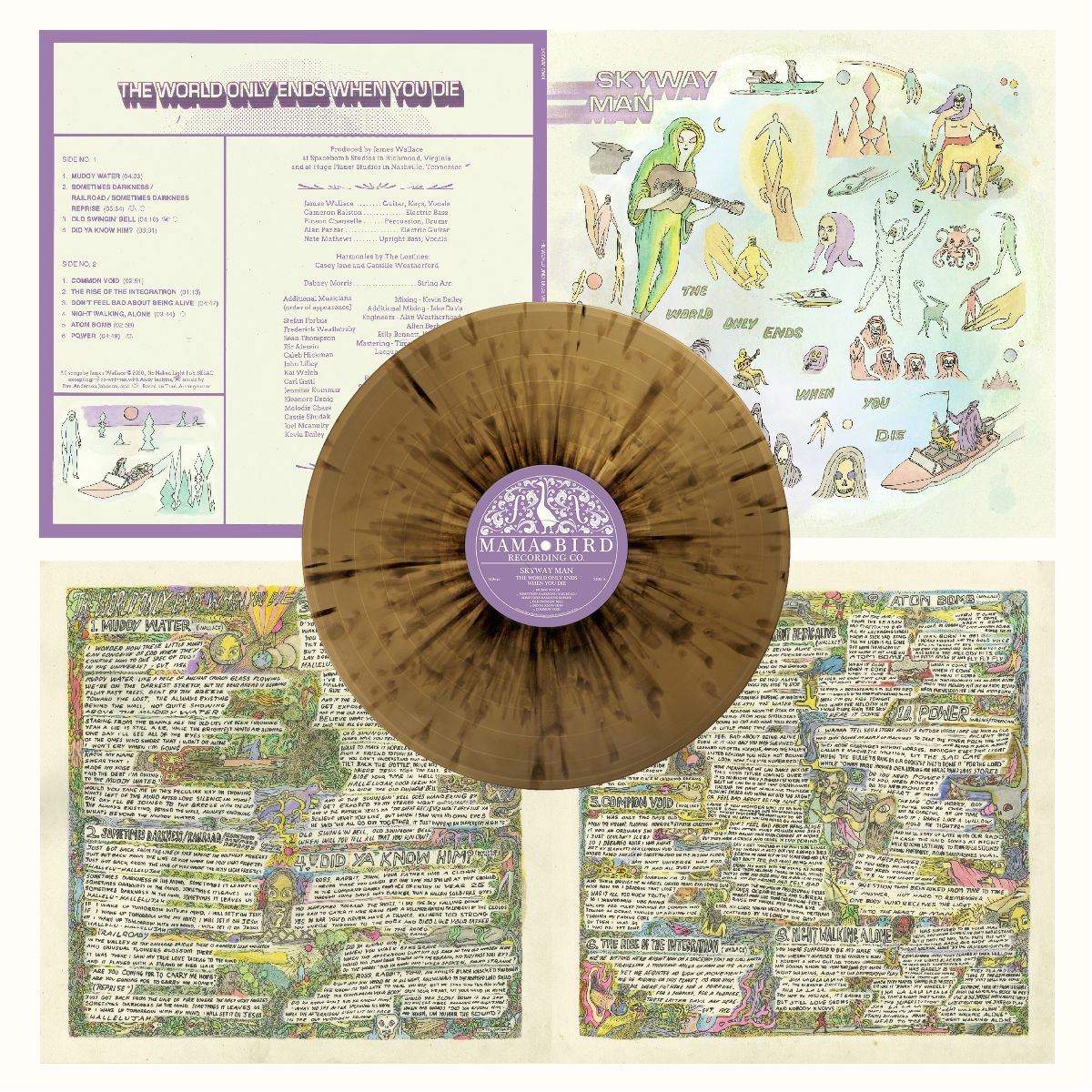
Despite its hefty title, James Wallace’s second album under the cosmic moniker Skyway Man positively blooms with vivacity. Wallace explores the very fabric of living through both ends of the telescope: Maybe it’s reminiscing on that singular feeling, way back when you were 18.
The sophomore long-player from cosmic country innovator James Wallace’s Skyway Man project, World Only Ends When You Die is a ramshackle road trip billed as a “psych-folk opera” that evokes a Muscle Shoals-backed Grateful Dead piloting a boogie van into the Greek underworld. A classic hero’s journey spurned by the twin existential crises of paternal death and a world being torn asunder by disease and competing political ideologies, the ten-track set is awash in metaphysical angst, yet positively ebullient in its response to it.
Recorded at Spacebomb in Wallace’s native Virginia with the studio’s house band and Big Easy vocal duo the Lostines, Skyway Man effusively combines elements of country, folk, blues, gospel, R&B, and indie rock, sometimes all at once — sonic touchstones include Randy Newman, Lee Hazlewood, Daniel Romano, Norman Greenbaum, Flaming Lips, and Dennis Wilson. Commencing with the slow-burning “Muddy Water,” Wallace knows that the road to enlightenment is fraught with danger (“Muddy water like a piece of ancient church glass flowing/We’re on the darkest stretch, but the bend ahead is glowing”), but he remains sanguine throughout the expedition. The radiant gospel-rock suite “Sometimes Darkness/Railroad/Sometimes Darkness Reprise” looks to Jesus for affirmation, while the airy “Rise of the Integratron” peers into the inky blue, pairing billowy Canterbury-style progressive rock with a snippet of a 1953 speech by UFOlogist George Van Tassel. It’s heady stuff, but Wallace and company imbue the proceedings with so much heart and soul — and considerable pop acumen — that the compulsion to hear and see where this sci-fi Canterbury Tales will go next never abates.
Written by James Wallace
The Musicians: James Wallace Guitars – Alan Parker Additional Guitars – Sean Thompson Drums/Percussion – Pinson Chanselle Upright Bass – Nate Mathews Electric Bass – Ric Alessio Piano/Keys – James Wallace Saxophone – Caleb Hickman Background Vocals – Casey Jane, Camille Weatherford
James Wallace’s new album as Skyway Man, The World Only Ends When You Die, is a cosmic and chooglin’ tour de force … he’s achieved something extraordinary here.” – UNCUT
“A psych-folk opera of spaced-out country and sci-fi gospel and blues, laced with mythology and nods to George Van Tassel, legendary ufologist … The new Skyway Man album is really incredible.” – AQUARIUM DRUNKARD
“This thing is something else, folks.” – NEW COMMUTE
The tenth and final chapter from Skyway Man’s ‘The World Only Ends When You Die’, out now from Mama Bird Recording Co. Released October 23rd, 2020
The bearded Nashville songwriter gets an assist from a pair of Tom Petty’s Heartbreakers on his first album in three years. Piano man Benmont Tench and guitarist Mike Campbell offer their respective services, with Campbell co-writing two tracks. Fans have already heard some of the songs live: the rollicking “Arkansas,” the smouldering “You Should Probably Leave,” and even the title track have all appeared in Stapleton set lists. As an album title, “Starting Over” can’t help but carry connotations of an artistic rebirth, but three or four albums into his solo stardom, Chris Stapleton is in no position to rip it up and start again.
Stapleton found his footing with 2015’s Traveller and he’s spent the years since digging deeper into his burnished groove, tying the binds between classic country, classic rock, and classic soul even tighter. A new beginning isn’t in the cards for a singer/songwriter who has styled himself as an old-fashioned troubadour, an outlaw with a heart of gold singing sweet love songs as often as he kicks up dust. He’s a traveller on a long road, not quite forging into undiscovered country as much as finding fresh routes through familiar terrain.
But it’s the brand-new “Watch You Burn,” written about the 2017 Las Vegas massacre, that will snap your head back: “Only a coward would pick up a gun and shoot up a crowd trying to have fun,” Stapleton growls. It’s a direct, damning statement from an artist who chooses his words ever so carefully. Working once again with producer Dave Cobb, Stapleton underscores his rootsy continuity not just with his own catalogue, but with his idols. He takes the time to salute the pioneers who came before him by covering two Guy Clark songs here (“Worry B Gone,” “Old Friends”), along with a deep John Fogerty solo cut that pairs quite nicely with the swampy choogle of the original “Devil Always Made Me Think Twice.” The biggest nod to the past arrives through a couple of key members of Heartbreakers joining the fold: Benmont Tench is on eight of the album’s 14 songs, while Mike Campbell co-wrote two of the record’s highlights, the funky vamp “Watch You Burn” and the rampaging “Arkansas.”
Starting Over has a cover that screams, “This is just an album, not a big achievement,” but that cover hides the maximal quality of the album; it’s a big, blown out, towering LP that makes room for songs about departed dogs, the Las Vegas Route 91 shooting, companionship, and the relative radness of the state of Arkansas. It’s Stapleton through and through; uncompromising and hard to define, it’s all buoyed by Stapleton’s mammoth of a voice. The former Heartbreakers are excellent foils for Stapleton and they also emphasize that he’s a bit like Petty in how he revives sounds of the past for the present and in how he turns out reliably sturdy albums. Stapleton could use a bit of Petty’s flair — there’s not a lot of humour here, nor are there any flirtations with modern sounds — but his straight-ahead style nevertheless satisfies on Starting Over.
Falling Asleep at the Wheel, the debut EP from English singer/songwriter Holly Humberstone, is only four months old, but the project’s soothing indie sounds are as welcome as ever in the tail end of the longest year in human history. The warm guitar tones on tracks like “Overkill” feel particularly appropriate for the winter ahead, helping us to find comfort in the solitude we may be facing during a first holiday season spent away from family.
It’s this track Humberstone’s favorite from the EP and her most personal track “Deep End” that she chose to play for us in her “Neighborhoods” session filmed outside her house in Grantham, Lincolnshire. Under quickly moving clouds, and on what looks like a chilly early-winter afternoon, the songwriter plays through both tracks on electric guitar. Make sure to say hi to her mom between songs.
Singer-songwriter Holly Humberstone performs two songs from her debut EP ‘Falling Asleep At The Wheel’ outside of her home in Grantham, UK.
May 2020 saw the release of one of my favourite albums of the year – Orange County’s Robert Jon & The Wreck’s ‘Last Light On The Highway’ – an album which is all you could want if you love your Southern-tinged Blues Rock. Robert Jon & The Wreck have been releasing records since 2011, along the way being nominated for numerous awards and touring with some of Blues’ biggest names like Bonamassa, Buddy Guy and Walter Trout.
Southern rock and roll band Robert Jon & The Wreck have been releasing albums since the band’s inception in 2011, collecting multiple awards along the way. Blues infused Southern rock, the band self-produced this 11 track, all-original album that’s fresh with contemporary, expansive sounds and pristine production. Led by vocalist/guitarist Robert Jon Burrison, whose voice is one of the most ear-pleasing today, the band includes Andrew Espantman, Steve Maggoria, Henry James and Warren Murrel.
A follow up to their 2019 release, Take Me Higher, the band’s newest effort blasts off with “Oh Miss Carolina,” a rock tune with deep Southern roots, led by vocalist/guitarist Robert Jon Burrison. If the beautiful harmonies don’t get you, then Robert Jon’s vocals and the tight-knit band certainly will. The first thing that knocked me out about “Work It Out,” a bluesy soul number with a full horn section, was Robert Jon’s voice—soulful with tone you have to be born with. Enter lovely piano in this rhythmic track, plus interesting chord changes, and tasty guitar riffs. This is feel good music.
There’s plenty for the lovelorn on the album but these tracks aren’t wrapped in the usual Southern rock package. “Tired of Drinking Alone” might seem like a drinking song, but beneath the bourbon and wine is a romantic tune about mending fences with a lost love, an invitation to work things out. Slide guitar and the band’s signature harmonies pave the way.
Backing singers include Mahalia Barnes, Jade McRae and Juanita Tippins. The harmonies on this album are part of the band’s signature sound, along with well-crafted songs and outstanding musicianship. One cursory listen might lead you into thinking their sound is Southern rock—they are much more than that.
There might be comparisons to The Allman Brothers’ twin guitar parts on a couple of songs, but the album soars far beyond that with heartfelt lyrics and vocals from a singer who is blessed with a voice and sincere vulnerability. Such is the case with “This Time Around,” a song about making mistakes and promising to be a better man this time around. If this were a different decade, this song and several others would be #1 summer hits.
Quality songwriting abounds on this record, including “One Last Time,” with one helluva melody, the band’s stellar harmonies and tasteful guitar riffs. This song takes a delicious turn at minute three with darker chords, a descending bass line and one killer guitar solo. Country rock ballad, “Gold” is a heartbreaker of a breakup song. Sung from the point of view of the one who was ditched and betrayed, Robert Jon’s vocal is raw with emotion and he tells the story with vivid lyrics. The guitar by Henry James is as moving as the vocals and the song itself. Heartbroken or not, this song will make you feel something. And isn’t that what good songwriting is about?
Closing the album is, “Last Light On The Highway Part 1 and Part 2”. This made me want to see Robert Jon & The Wreck live. Part 1 opens with moody acoustic guitar, haunting vocals and ethereal backing vocals. Robert Jon’s sings, “The thunder of the road is my only friend. I’ll keep driving ‘till I’m the last light on the highway.”
“Last Light On The Highway Part 2” is pure excellence. Pushing the envelope in all the best ways, this is big production with big drums, a descending bass line, twin electric guitars, and strings (a nod to Gideon Klein for string arrangements), all riding into the rough weather of gritty guitar riffs. This track is so interesting musically and the piano is part of what makes it so good. It merges into a driving rocker with a galloping pace, and rises to crescendo with expert drumming, guitar and strings.
Last Light On the Highway is your pre-summer feel-good album.
Sylvan Esso is Amelia Randall Meath and Nick Sanborn. A Band. With the swift demise of concerts as we know them this year, the live album has taken on a significance it’s not enjoyed for the better part of a half-century. So lucky were we that Sylvan Esso released “With” and its accompanying concert film a month into what felt like the end of everything good. Calling on a row of musician-friends hailing from Landlady, Hand Habits, Bon Iver,Mountain Man, and Mr Twin Sister, the already-great-live duo burn through a jaw-dropping set that recasts their catalogue with the warmth of eight further beating hearts, giving fans less of a reason to mourn the shows that could not be, but rather a glimmer of those to look forward to yet.
Surprise! Our new “With Love” EP, featuring songs from the extra special From The Satellite performance, is available for streaming. Like its sister record “With” this album reimagines Sylvan Esso’s works as a full band, adding new layers and textures to these classic songs. The live version of “Free” at the end of this is hauntingly, intimately perfect. Twenty minutes and fifty eight seconds of sublime joy. The big band Sylvan Esso vibe is the finest thing there is.
This tour existed only to exist, not to promote a new album or celebrate a milestone. No, Sylvan Esso simply wanted to do something fun. For themselves, for their fans, and for us, their friends, who got easily roped into being in the ten piece band. We were all sent the song list in advance, with just a few written ideas of what some of us could do on each song, but largely it all remained open for interpretation and when we convened in the house to rehearse in Durham for the first time. On the first day we played the song “Wolf,” checking the pulse of the band, how would we sound together, how would we arrange together, and how much homework did everyone actually do? The first take of that song put everyone immediately at ease and also turned up the temperature. Because it went really well. We knew how good this could sound, how different it could be from the original recordings and how special that would feel for the crowd, and for us. “Wolf” ended up being the first song in the set. “Wolf” became the anchor, before the rocket ship would take off each night. Yes I know I made a boat analogy early. And now I’ve shifted to space. That’s an accurate representation of how this show ended up.
The first four days we would just keep chipping away at songs, written on a large piece of butcher paper on the wall in fat marker, and we’d cross them off one by one as we hit them. The first day was a dream because we learned five songs and they all sounded great. The second day was impossible, because we had to learn five more songs, and then suddenly the songs from the first day weren’t so perfect anymore. That’s the big problem with getting better. Your ceiling goes up, the standards rise, and the goods can always keep improving, which means, in more pessimistic terms, it can always also keep sounding worse. There were twenty songs to learn, so there was a lot of bucking and bobbing back and forth between feeling over-confident and supremely challenged. Sometimes that had to do with how hungry we were.
After the family style rehearsals concluded, we headed to Los Angeles for tech rehearsal. To get there involved thirteen of us, band and crew, flying on an airplane. Thirteen people each checking three bags. Thirteen people moving through the airport together is insane. It’s like a school trip. After the tour was done Nick and Amelia remarked on how ridiculous it was that we didn’t do any warm-up shows, how insane it was that we jumped into the fire at the Walt Disney Concert Hall, a Frank Gehry designed space for the LA Philharmonic where a portion of the audience sits behind you. But we did it. For over two thousand people on night one, we did it, and we did it surprisingly well. We had our expectations set to cautious, because sometimes the first show can be a true disaster, it almost is supposed to be, but everyone cared so much and worked so hard and the stakes felt so high that somehow a meltdown just didn’t happen.
The last two shows were homecoming shows in Durham, a little different feeling from the classic theatres, and these were the shows that were filmed for what you’re seeing here and now. I’m excited to watch it just so I can see the light show from the front. We were so sad when it ended but there wasn’t a formal goodbye. Folks trickled off to go home, and a bunch of us watched a movie the next day. It’s implied that we will be together again, we’re just not sure how or when. Those of us who don’t live in North Carolina feel ourselves threatening ourselves to move there, but I don’t see it happening for me. I like being called to serve and being swept into the vortex, then returning home to wait for the next vortex to assemble
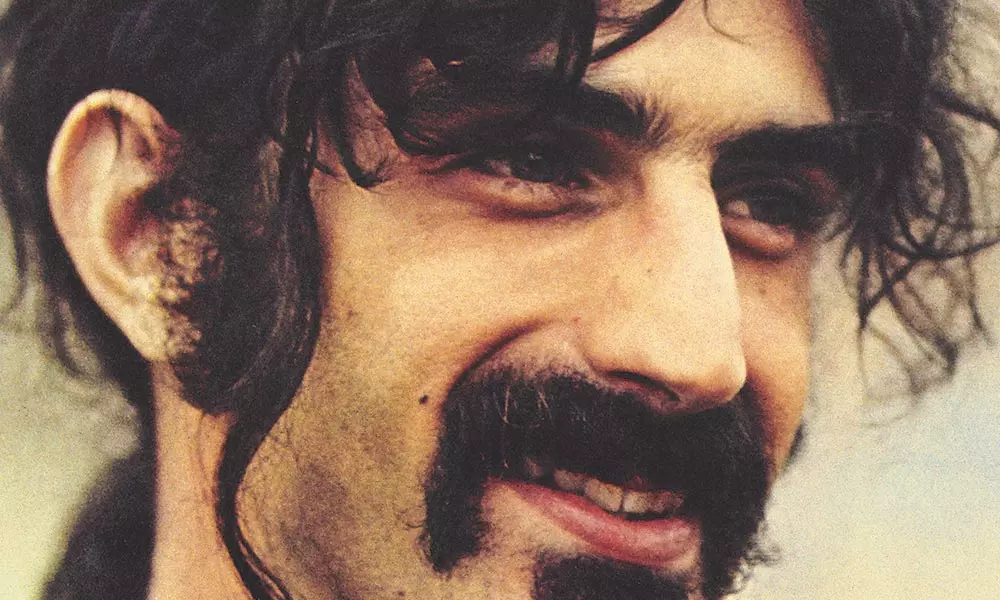
Born on December 21st, 1940, Frank Zappa packed a ridiculous amount of great music into his 52 years on this planet. During his lifetime he made nigh-on 100 separate recordings, put out dozens of classy compilations, fistfuls of singles (some of them super rare), and was the subject of various tribute albums. Among such a plethora of work, the best Frank Zappa songs stand as a testament to a remarkable mind the likes of which we’re unlikely to see again.
His legacy is equally vast: inspired in part by his earlier band The Mothers of Invention’s , Zappa’s discography has touched on avant-garde, musique concrète, industrial, neo-classical and theatrical rock.
Zappa is one of the few artists operating in a rock or post-rock medium who deserves the epithet “genius.” He poked fun at both the establishment and the counterculture with varying degrees of venom. He was also an advocate for free speech and personal choice, and was quite prepared to accept any barbs that came his way. Celebrated by the Velvet Revolutionaries in Prague, he also became a friend of Czech writer and philosopher Václav Havel. Closer to home, Zappa also earned a place within the upper echelons of Rolling Stone’s list of Greatest Guitarists Of All Time.
He could make metal, pop, rock, and blues, along with free-form jazz (à la Albert Ayler) and even classical. His own influence, meanwhile, ranges far beyond commercial success. Zappa had ideas to burn and would undoubtedly still be recording today, had it not been for his early death in 1993. Above all, he was a great musician and a venerated songwriter. Below we offer a selection – and it can only be that some of the best Frank Zappa songs.
Zappa in the 60s
What better place to start than at the beginning: the opening track on the Zappa/Mothers 1966 debut, Freak Out! In “Hungry Freaks, Daddy,” Zappa addresses the countercultural view of the Great Society. America was in both class and social turmoil at this time, and a psychedelic treatment was undercut not with Frank’s often-quoted cynicism but a fair degree of analysis. One assumes that a certain David Bowie was in contact with this album, since his song “Moonage Daydream” seems to reference the mantra, “Freak out, far out…” and he may have lifted his son’s name from the soon-to-come song “Wowie Zowie.
If you want to explore rock conspiracies, then unravel the ditty “Who Are The Brain Police?” A highly creepy Orwellian diatribe, it earns its place among the best Frank Zappa songs – not least for having freaked out its writer, who admitted that its gestation was a concern. “At five o’clock in the morning, someone kept singing this in my mind and made me write it down,” he recalled. “I will admit to being frightened when I finally played it out loud and sang the words.”
But Zappa wasn’t content to stay within the margins of hippie-speak. On “Brown Shoes Don’t Make It,” from the 1967 album “Absolutely Free”, the song’s bluesy origins give way to a cavalcade of musical styles – baroque, surf and rock opera among them. The lyric is a black comedy and another social satire, and the song remains the blueprint for Zappa’s revolutionary attempt to address the underground in a seven-plus-minute musical.
The Mothers’ third album, “We’re Only In It For The Money”, is an obvious send-up of materialist rock culture that even takes a poke at Sgt Pepper’s… For many Zappa fans, each track could make its case among the best of his songs. Perhaps the weirdest one is the short piece “Concentration Moon,” on which people – dissidents, minorities, et al. – are dragged away on buses and incarcerated. It’s no pastiche, but a heavy little number that still resonates.
Time for a breather. Time to “Stuff Up The Cracks.” The late ’68 album Cruising With Ruben & The Jets offers plenty of opportunity to unwind with a little experimental doo-wop. One of Zappa’s early loves, dating back to his own Italian-American roots, doo-wop has influenced many of the best Frank Zappa songs. Blessed with a cool Ray Collins vocal, some hot horns, and a sublime long-fade guitar solo from the main man, this is vintage Mothers, right down to the locked-down-tight rhythms of Roy Estrada and the percussive fills of Jimmy Carl Black and Arthur Dyer Tripp III. You might say this is atypical Frank, but then what is typical Frank?
“Hot Rats” (1969) is crammed with goodies, but the perennial live favourite, the instrumental “Peaches En Regalia” (also released as a single) retains its currency as one of the best Frank Zappa songs. From an early solo period when Zappa was embracing fatherhood with the birth of son Dweezil, this sumptuous track features studio-effect half-speed mastering and progressive fusion elements. Imagine it as a bizarre cross between Steely Dan and Weather Report, and enjoy the journey while Shuggie Otis plucks his bass and the masterful Ian Underwood carries the horn and organus maximus parts. Every time you play it you’re bound to hear something fresh.
Zappa in the 70s
Skipping with a heavy heart over “Burnt Weeny Sandwich” we land on Weasels Ripped My Flesh and an expanded Mothers featuring Lowell George (en route to Little Feat fame). Both live- and studio-based – and Mother-great throughout – it boasts a classic early Neon Park artwork and includes “My Guitar Wants To Kill Your Mama.” Nothing problematic here, just grand warp-rock with a surprisingly folky central acoustic guitar solo and the type of rolling blues rhythm one might also hear on a period Steve Miller Band album.
Recorded live at University Of California, Los Angeles, 1972’s “Just Another Band From LA” features The Turtles’ Howard Kaylan and Mark Volman (aka Flo & Eddie) and shouldn’t be overlooked. To get more bang for your buck, lay back and immerse yourself in the utterly madcap “Billy The Mountain,” a rock opera parody that slaps The Wizard Of Oz next to a sly allusion to Crosby, Stills & Nash’s “Suite: Judy Blue Eyes.” Given the experimental nature of this cracked tune, one suspects most of it was improvised on the spot after a few studio run-throughs, but that adds to the humorous tension.
Ever-prolific, Zappa and his Mothers were on fine form again during 1973’s “Over-Nite Sensation”, a flat-out comic rock extravaganza with more sexual innuendo than you can shake a stick at. Derided at the time, it sounds excellent today thanks to “Camarillo Brillo,” “I’m the Slime,” “Dinah-Moe Humm,” “Dirty Love,” et al. – but grab onto “Montana,” featuring Tina Turner and The Ikettes, as well as oddball singer Ricky Lancelotti. Fiendishly complex and funky, the track allows the ensemble to blow hard – none more so than Uncle Frank, whose long solo is a tour de force.
Zappa enjoyed a renaissance during this period, and 1974’s “Apostrophe (’)” would be his most successful album in the US. “Don’t Eat the Yellow Snow” kicked off a “suite” concerning an Eskimo and a fur trapper, but ends up as one of Frank’s zaniest and most profane tunes. Don’t let that put you off. It’s one of the best Frank Zappa songs of the mid-70s. Audacious rhythms and percussion proliferate, and DiscReet even released the song as a single, which helped the parent album break into the charts . Remarkable, considering the subject matter. (“Cosmik Debris” is another highlight from the standout album.)
For something slightly less leftfield, try “Cheepnis,” a delicious item on the live-album-with-overdubs “Roxy & Elsewhere”. As an experiment in echoing the FX on B-movies, this is hard to beat, with the new-look Mothers including Napoleon Murphy Brock and pioneering funkster George Duke.
The Mothers concept ends on One Size Fits All, which opens with the progressive fusion of “Inca Roads” but generally sends itself up thanks to a sequence of time signatures and a famous Zappa guitar solo.
During another prolific year, Zappa teamed up in earnest with his labelmate, friend, and kindred madman, Captain Beefheart (aka Don Van (Glen) Vliet). However, the results were less avant-garde than one might expect. Every track on 1975’s “Bongo Fury” satisfies, but we’ve picked out the appealing “Advance Romance” for its parodic but affectionate insight into how a love song is written and deconstructed. Soulful mid-70s blues.
The more minimalist approach taken on “Zoot Allures” brings old tropes back into the fold: doo-wop and blues-rock in particular. Disco, German culture, and sexual stereotypes all crop up in the lyrics, but for dark social commentary lock into “Wind Up Workin’ In A Gas Station,” where the sardonic dismantling of the work ethic manages to be blackly comic.
Without decrying Studio Tan and Sleep Dirt – fine albums both – take a look at Sheik Yerbouti, a monumental double-album recorded at London’s Hammersmith Odeon and The Palladium, New York. One song that didn’t get much homegrown airplay was the scatological “Bobby Brown,” in which Zappa’s delight at ignoring the boundaries of taste reaches a zenith. Hugely popular in Northern Europe, the song may be Zappa’s most successful commercial moment: the single shifted enough copies to go gold and became a firm live favorite.
In 1979, Zappa increased his fascination with Xenochrony and progressive guitar solos, but also enjoyed a period of intense exposure on North American FM radio. “Joe’s Garage” (from Joe’s Garage Act I) is based on a tongue-in-cheek, put-down of garage punk but, by using the God-fearing epiphany of the protagonists, it mutates into a punk classic that sticks it to corporate censorship while being unashamedly misanthropic.
On the same album, you’ll find “Watermelon In Easter Hay,” a song that’s often cited as being Zappa’s favourite composition. Much lighter than anything else on Joe’s Garage, the fluid guitar solos, occasionally reminiscent of Pink Floyd’s David Gilmour, make it worth the price of admission alone, and it is a testament to Zappa’s compositional skill. (The original title was “Trying To Play A Solo With These Guys Is Like Trying To Grow A Watermelon In Easter Hay.” Bit long, maybe.)
Zappa in the 80s
After a sequence of albums dedicated to the art (and debunking) of guitar histrionics, Zappa enjoyed a later hit with “Valley Girl” a song that introduced fans to the culture of San Fernando schoolgirl “Valspeak.” The outcome was a double-edged sword, since Zappa was often viewed as a novelty act, but the track transcends its own joke and stands as one of the best Frank Zappa songs of the era. It elevated its inspiration (and vocalist), Moon Unit Zappa, along with his then 14-year old daughter, to the status of a star in her own right. Better still, it enabled the album Ship Arriving Too Late To Save A Drowning Witch to break the Top 30, while the single peaked at No.12.
By the 80s, it was arguable that Zappa, while not turning his back on rock music, had become far more interested in his other loves: Boulez, Stravinsky, Eric Dolphy, and post-bop free jazz in general. To complete this journey, dig into the version of “Uncle Meat” on 1993’s The Yellow Shark, the final disc released during Zappa’s lifetime. Revisiting one of the best Frank Zappa songs of the 60s, this version, featuring the Modern Ensemble, helps wrap up a career of immense achievement. Tom Waits (who, as a fledgling artist, once supported Zappa on tour) described it best: “The ensemble is awe-inspiring. It is a rich pageant of texture in colour. It’s the clarity of his perfect madness and mastery.
One of Zappa’s final performances is the album’s closer, the epic “G-Spot Tornado,” on which he overcame his illness and marched on stage in Frankfurt in order to conduct the Ensemble and received the ovation of his life. We won’t see his like again.
I’ve followed and loved Lucia & The Best Boys for a while now, I’ve always loved her raw vocals, which are always paired scrumptiously with the chuggy guitar riff and killer melodies. Lucia & The Best Boys walk the fine line between retro 80s synth-pop and modern alternative rock, mixing elements of both fearlessly. Their most recent effort, Eternity EP can be listened to in under 15 minutes, each listen unveiling a new sound or poetic lyric to fixate over. The band travelled across the pond to work with Carlos de la Garza, a name that may be familiar to fans of Paramore and Wolf Alice. His influence on the EP can be heard in the melted guitar rhythms which effortlessly blend with the synth to create dynamic and repeat-worthy material. There is a lot of experimentation on this EP, with echoed and layered vocals giving dramatic depth to each track.
Overall, the band have matured from their earlier singles and completely honed their sound to become distinctively Lucia & The Best Boys. Lyrically, the songs feel much more poetic and dreamlike, rather than the realist approach to their earlier tracks Summertime and When I Think Of You. ‘Lucia & The Best Boys just seem to keep going from strength-to-strength this year. However the Eternity EP has been on a constant repeat for me over the long lockdown month’s. ‘My God’ in particular has been a stand out for me this year; it’s 80’s, it’s dark and it’s everything I love about a song!’
The opening track City of Angels sounds unsuspecting as it begins, but leads to an explosive performance by frontwoman Lucia Fairfull. The lyrics narrate what it feels like to deal with imposter syndrome and social anxiety, a wholly personable track that invites you into an experience. The pace of the chorus keeps the listener on their toes, as if the music might trip over itself, but – of course – never does. This device embodies what anxiety feels like for most, assimilating the lyrical and musical content. You feel this song as much as you listen to it, easily making it the best on the record.
Allowing the band to fully embrace the glam-rock parts of this project, Good Girls Do Bad Things is the insanely catchy feminist anthem bleeding with riot grrrl energy. The track has vague remnants of A Flock of Seagulls with a Blondie-esque edge heard in the raw and confident vocals. Lucia & The Best Boys do well to make these vintage elements contemporary with their lyrical content and assertive presence on the EP. Flames gives way to a blazing finale which ties the EP up with a neatly fashioned ribbon, despite the fact that nothing about this music is tame or neat. It spills out of the lines and all conventions of genre and taste, fusing incredible guitar melodies and blending the vocals, meaning that neither are more pronounced than the other. This slightly faded and blunted effect on the instruments and vocals helps to create an artificially antique sound, completely complementing their vintage aesthetic.
Overall, this Glasgow band has stepped up their game with their Eternity EP by honing and embracing the elements of synth-pop and alternative rock which make them. Track by track, nothing sounds the same but is uniquely Lucia & The Best Boys.
“My God” · Lucia & The Best Boys from the EP “Eternity” on Sweet Jane Recordings Released on: 31st January 2020
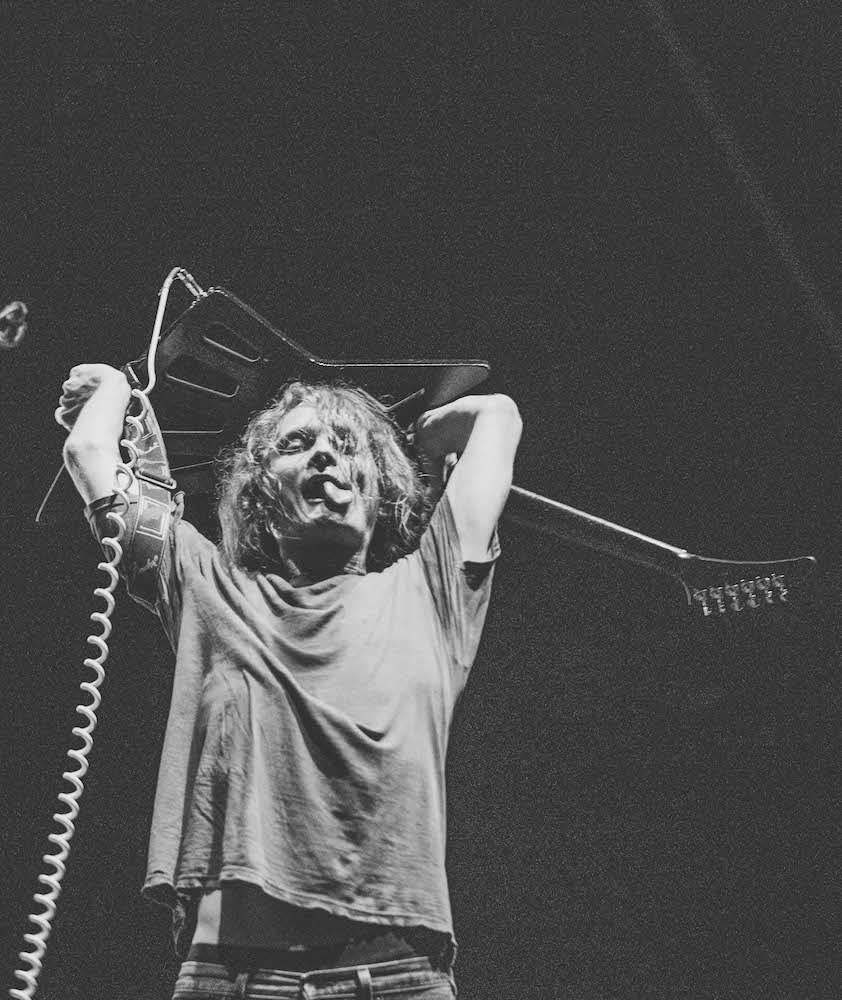
The prolific Melbourne band played their biggest-ever headline show to date at the 10,000-capacity venue in the capital, with the promise of “a new set, new songs and a whole new visual experience” being made by the psych-rock troupe. This was an anomaly. An Australian psychedelic rock band, blessed with the kind of name a 14-year-old comes up with during a particularly boring double maths lesson, sells out the 10,000-capacity Alexandra Palace with little radio support and no hit records. What’s more, their latest of many albums since 2012 (they released five in 2017 alone) is a ferocious thrash metal concept piece about ecological disaster called Infest the Rat’s Nest. No focus group would come up with the King Gizzard approach to musical success.
The heady, inspired, confusing, and addictive path King Gizzard & The Lizard Wizard set out on almost a decade ago has led to this point. Announcing – and then swiftly selling out – a headline date at Alexandra Palace, the Australian group took on one of North London’s most imposing venues. A historic landmark, thousands of fans descended on the people’s palace for the show, an indication of just how big these psychedelic outlaws actually are. Rampaging through their leviathan-like catalogue, King Gizzard & The Lizard Wizard pulled out all the stops for the biggest night of their lives.
Short, punchy, and fun, King Gizzard gives a more matured take on their early surf rock sound. Such a sunny treat on this Christmas Eve. Don’t say King Gizz & The Lizard Wizzard never gave you anything. Just in time for Krimbo, the unstoppably prolific Australian eccentrics have done it again, dropping not one but two new albums on their Bandcamp page.
First and foremost of the two is Teenage Gizzard, a collection of early non-album singles and rarities that date back to 2010 and 2011, even before their debut album. Of course, for those who can’t get enough of KG in performance, there’s also Live in London ’19, the latest in a series of self-explanatory concert recordings they’ve dropped this year. You can check them both out below, or click through if you’d like to buy them. Not that you have to shell out: The band have also started up their own Bootlegger page, allowing anyone to download these discs (and several more) and release them — as long as they share. Here’s how they put it:
“Yo indie labels, bootleggers, fans, weirdos. We’ve got a deal for ya… If anyone wants to release these albums, you’re free to do so. Below you’ll find links to audio master files and cover art. Feel free to get creative with it if you like — it’s yours. Only deal is you’ve gotta send us some of them to sell on Gizzverse.com — whatever you feel is a fair trade is cool with us. Ideas: double LPs, 7”, remix, reimagined cover art, bizarre-looking wax, live show box sets, tapes. Or keep it simple — that’s totally OK. Anyone keen?!”
I’m sure they’ll have no trouble finding takers. As for me, I’ll be spending some quality time with these albums over the next few days — and into the new year. Although I’ve been a fan of KG&LW for years now, I’ve resolved that 2021 is going to be the year I go deep into the their back catalogue and truly embrace my inner lizard. Or wizard. Or whatever. Anyway, enjoy.
Tracks 1-8 recorded some time in 2010 in Angelsea, Victoria, Australia Tracks 9+10 recorded some time in 2011 in Carlton, Victoria, Australia Mixed by Stu Mackenzie
It started with a plea from one friend to another. George Harrison had been close to the legendary Indian classical musician Ravi Shankar since the mid-’60s, when the Beatle first sought an expert to teach him to play the multi-stringed Indian sitar. RaviShankar, older than Harrison by some 22 years and the acknowledged world master of the instrument, was from Bangladesh (previously known as East Pakistan) in the South Asian region of Bengal. At the time, in 1971, Harrison’s website states, “The country was ravaged by floods, famine and civil war, which left 10 million people mostly women and children fleeing their homes.” Feeling distraught and wanting to help, Shankar met with Harrison and asked if he might be able to draw attention to the crisis, and possibly use his fame to do something to raise some funds for aid. “Yes,” Harrison told him, “I think I’ll be able to do something.”
In April of 1971, Harrison went to work recruiting friends for a one-time-only concert; by June he had already received commitments from several of the biggest names on rock. He also arranged for a film and recording to be made of the event, the proceeds of which would go toward the cause. The concert date was set for August 1st, 1971, two shows .The shows were held at 2:30 and 8:00pm(afternoon and evening) to take place at New York’s Madison Square Garden. Not only would The Concert for Bangladesh be Harrison’s first major live appearance since the Beatles quit touring five years earlier, it would go down as one of the greatest evenings of classic rock in history. The event was the first-ever benefit of such a magnitude, and featured a supergroup of performers that included Harrison, fellow ex-Beatle Ringo Starr, Bob Dylan, Eric Clapton, Billy Preston, Leon Russell and the band Badfinger. In addition, Shankar and Ali Akbar Khan – both of whom had ancestral roots in Bangladesh – performed an opening set of Indian classical music. The concerts were attended by a total of 40,000 people, and the initial gate receipts raised close to $250,000 for Bangladesh relief, which was administered by UNICEF. After collecting the musicians easily, Harrison found it extremely difficult to get the recording industry to release the rights for performers to share the stage, and millions of dollars raised from the album and film were tied up in IRS tax escrow accounts for years, but the Concert for Bangladesh is recognised as a highly successful and influential humanitarian aid project.
Shankar’s original hope was to raise $25,000 through a benefit concert of his own, With Harrison’s commitment, and the record and film outlets available to him through the Beatles’ Apple Corps organisation, the idea soon grew to become a star-studded musical event, mixing Western rock with Indian classical music.
According to Chris O’Dell, a music-business administrator and former Apple employee, Harrison got off the phone with Shankar once the concept had been finalised, and started enthusing with his wife, Pattie Boyd, and herself about possible performers. Ringo Starr, Lennon, Eric Clapton, Leon Russell, Jim Keltner, Voormann, Billy Preston and Badfinger were all mentioned during this initial brainstorming. The Concert For Bangladesh happened because of my relationship with Ravi … I said, “If you want me to be involved, I think I’d better be really involved,” so I started recruiting all these people. O’Dell set about contacting local musicians from the Harrisons’ rented house in Nichols Canyon, as Harrison took the long-distance calls, hoping more than anything to secure Bob Dylan’s participation
Almost all of Harrison’s first-choice names signed on immediately, while a day spent boating with Memphis musician Don Nix resulted in the latter agreeing to organise a group of backing singers. The Sunday, was the only day that Madison Square Garden was available at such short notice. By the first week of July Harrison was in a Los Angeles studio recording his purpose-written song, “Bangla Desh”, with co-producer Phil Spector. The song’s opening verse documents Shankar’s plea to Harrison for assistance, and the lyrics “My friend came to me with sadness in his eyes / Told me that he wanted help before his country dies”
Harrison then met with Apple signed band Badfinger in London to explain that he would have to abandon work on “Straight Up” , before flying to New York on 13 July to see Lennon. During the middle of July also, once back in Los Angeles, Harrison produced Shankar’s Bangladesh benefit record, an EP titled Joi Bangla. As with Harrison’s “Bangla Desh”, all profits from this recording would go to the newly established George Harrison–Ravi Shankar Special Emergency Relief Fund, to be distributed by UNICEF.
Also around the middle of July, the upcoming concert by “George Harrison and Friends” was announced via a small ad buried in the back pages of the New York Times”, Tickets sold out in no time, leading to the announcement of a second show. Towards the end of the month, when all parties were due to meet in New York for rehearsals, Harrison had the commitment of a backing band comprising: Preston, on keyboards; the four members of Badfinger, on acoustic rhythm guitars and tambourine; Voormann and Keltner, on bass and drums, respectively; and saxophonist Jim Horn’s so-called “Hollywood Horns”, which included Chuck Findley, Jackie Kelso and Lou McCreary. Of the established stars, Leon Russell had committed also, but on the proviso that he be supported by members of his tour band. Eric Clapton insisted that he too would be there, even if O’Dell and other insiders, knowing of the guitarist’s incapacity due to his severe heroin addiction, were surprised that Harrison had considered him for the occasion. Among Harrison’s former bandmates, John Lennon initially agreed to take part in the concert without his wife and musical partner Yoko Ono, as Harrison had apparently stipulated. Lennon then allegedly had an argument with Ono as a result of this agreement and left New York in a rage two days before the concerts The line up was staggering: First, there was Ringo Starr. As if half of the Beatles wasn’t enough of an enticement to fans,
As well as the songs he would go on to perform Harrison’s list included his own compositions “All Things Must Pass” with Leon Russell, apparently “Art of Dying” and the just-recorded B-side “Deep Blue” Eric Clapton’s song “Let It Rain” appeared also, while the suggestions for Dylan’s set were “If Not for You”, “Watching the River Flow” (his recent, Leon Russell-produced single) and “Blowin’ in the Wind”. Only Harrison, Voormann, the six-piece horn section, and Badfinger’s Pete Ham, Joey Molland, Tom Evans and Mike Gibbins were at Nola Studios on that first day of rehearsals, and subsequent rehearsals were similarly carried out in “dribs and drabs”, as Harrison put it.
Only the final run-through, on the night before the concert, resembled a complete band rehearsal. On Tuesday, 27th July, Harrison and Shankar, accompanied by a pipe-smoking Allen Klein, held a press conference to promote the two shows notoriously performance-shy, Harrison said “Just thinking about it makes me shake. The “Bangla Desh” charity single was issued in America with a UK release following two days later. Ringo Starr arrived on the Thursday, and by Friday, 30th July, Russell was in town, interrupting his US tour. Leon Russell’s band members Claudia Linnear and Don Preston were added to Don Nix’s choir of backing singers. Billy Preston would switch to lead guitar for Russell’s solo spot during the shows, just as bassist Carl Radle would replace Voormann temporarily. At this point, Clapton’s participation was gravely in doubt, and Harrison had drafted in Jesse Ed Davis as a probable replacement. The ex-Taj Mahal guitarist received last-minute coaching from Voormann, who was more than familiar with Harrison’s songs, as well as those by Billy Preston and Starr.
The final rehearsal, the first for some of the participants, was combined with the concert soundcheck, at Madison Square Garden, late on 31 July. Both Dylan and Clapton finally appeared at the soundcheck that night.Even then, Clapton was in the early stages of heroin withdrawal – only a cameraman supplying him with some methadone would result in the English guitarist taking the stage the following day, after his young girlfriend had been unsuccessful in purchasing uncut heroin for him on the street. To Harrison’s frustration, Dylan was having severe doubts about performing in such a big-event atmosphere and still would not commit to playing. “Look, it’s not my scene, either,” Harrison countered. “At least you’ve played on your own in front of a crowd before. I’ve never done that.” Stephen Stills having proceeded to sell out Madison Square Garden two days before the concert on 30th July, in support of his album, “Stephen Stills 2”, allowed Harrison to use his stage, sound, lighting system and production manager but was upset when Harrison “neglected to invite him to perform, mention his name, or say thank you”. Stills then spent the show drunk in Ringo Starr’s dressing room, “barking at everyone”.
The shows began with sets by Shankar and his musicians, followed by Harrison and his entourage, performing material both from his emerging solo career. Harrison began the concert with “Wah-Wah”, followed by his Beatles hit song’ “Something” and the gospel-rocker “Awaiting on You All”. Harrison then handed the spotlight over to Preston, who performed his only sizeable hit “That’s the Way God Planned It”, followed by Ringo Starr, whose song “It Don’t Come Easy” had recently established the drummer as a solo artist. Next up was Harrison’s “Beware of Darkness”, with guest vocals on the third verse by Russell, who covered the song on his concurrent album, Leon Russell and the Shelter People. After pausing to introduce the band, Harrison followed this with one of the best-received moments in both the shows – a charging version of the White Album track “While My Guitar Gently Weeps”, featuring him and Clapton “duelling” on lead guitar during the long instrumental playout.
Both the band introduction and “While My Guitar Gently Weeps” are among the few selections from the afternoon show that were included on the album and in the film. Another one was Leon Russell’s medley of the Rolling Stones’ “Jumpin’ Jack Flash” and the Coasters’ “Young Blood”, which was also a highlight of Russell’s live shows at the time. With Don Preston crossing the stage to play lead guitar with Harrison, there were now temporarily four electric guitarists in the line-up. Don Preston, Harrison and Claudia Linnear supplied supporting vocals behind Russell. In an effective change of pace, Harrison picked up his acoustic guitar, now alone on the stage save for Pete Ham on a second acoustic, and Don Nix’s gospel choir, off to stage-left. The ensuing “Here Comes the Sun” – the first live performance of the song, as for Harrison’s other Beatle compositions played that day was also warmly received. At this point, Harrison switched back to his white Fender Stratocaster electric guitar he looked down at the setlist taped to the body of the guitar and saw the word “Bob” followed by a question mark. “And I looked around,” Harrison recalled of Bob Dylan’s entrance, “and he was so nervous – he had his guitar on and his shades. It was only at that moment that I knew for sure he was going to do it.” Among the audience, there was “total astonishment” at this new arrival. As Harrison had envisaged, Dylan’s mini-set was the crowning glory of the Concert for Bangladesh for many observers. Backed by just Harrison, Russell (now playing Voormann’s Fender Precision bass) and Starr on tambourine, Dylan played five of his decade-defining songs from the 1960s.
The moment that put the Concert for Bangladesh over the top as one for the ages was when Bob Dylan walked out onstage. Like Harrison, he had not performed in public much recently, since a 1966 motorcycle accident that caused him to reassess his life and career. Dylan, who was reportedly nervous about playing to such a large audience, arrived onstage for the first show accompanied by Harrison, Russell (on bass) and Starr (playing tambourine) and performed five of his greatest compositions: “A Hard Rain’s A-Gonna Fall,” “Blowin’ in the Wind,” “It Takes a Lot to Laugh, It Takes a Train to Cry,” “Love Minus Zero/No Limit” and “Just Like a Woman,” before Harrison and the band closed out the show. The evening show followed a similar trajectory, with both Harrison and Dylan making a handful of changes to their set lists: Dylan, notably, added “Mr. Tambourine Man” in place of “Love Minus Zero.”
Harrison and the band then returned to perform a final segment, consisting of his recent international number one hit, “My Sweet Lord”, followed by the song of the moment – “Bangla Desh”.
The Concert for Bangladesh recording, featuring highlights from the two shows, was released on December 20th, 1971, also winning the Grammy for Album of the Year. The film, Following the Bangladesh concerts, some controversy ensued over the allocation of the funds but an estimated $12 million ultimately found its way to aid in the relief efforts over the next decade and a half. And in the world of rock music, the 1971 Concert for Bangladesh is viewed as a landmark event, the first true large-scale benefit concert of its type; it would serve as the model for Live Aid and is seen as the prototype for many other such charitable events even today.
As of August 2020, neither the album nor DVD was in print. Perhaps for its 50th anniversary in 2021we get an updated version along with a full set of the songs performed each night.







 The Fat Angel Sings