The Reverberation Appreciation Society is proud to launch a brand new live series, Live at Leviation. Recorded over the history of the world renowned event, professionally mixed and mastered, this series captures key moments in modern rock and roll history, and live music in Austin, Texas. The artists and sets showcased here are the apex of modern psychedelia, performing for a crowd of their peers and fans who gather at Levitation annually from all over the world.
The first LP in this series features Japanese psych heavyweights Kikagaku Moyo. This particular record is as strong as it is meaningful in the band’s story. It showcases one of the bands very first US show in 2014 on the A-side and their triumphant return in 2019 on the B- side with them firing on all cylinders amid a sold out US tour.
Kikagaku Moyo have come a long way –both literally and metaphorically– since their humble beginnings busking on the streets of Tokyo back in 2012. A tight-knit group of five friends who bonded over the desire to play freely, and explore music associated with space and psychedelica, their initial ambitions were modest semi-regular slots in the cramped clubs of the city’s insular music scene. Yet the band’s progressive, folk-influenced take on psychedelica marked them out from their peers and re-started Japan’s psych rock scene, and soon brought them international acclaim. Fast forward a few years, and you find the band crushing headline sets at festivals, embarking on sprawling international tours, and a dedicated fanbase for their music and record label Guruguru Brain – all while steadfastly maintaining their creative freedom and DIY allure.
Kikagaku Moyo are the real deal: masterful musicians, a powerful creative force, and one of key bands in the psychedelic rock movement and we are thrilled to have them kick off the “Live at Levitation” series with this incredible record.
Best known over the past 35 years or so as one of the champions of pervasive power pop, a sound and style heavily invested with a mix of melody and reverence for classic rock tradition, Matthew Sweet embraces edgier intents on “Catspaw”, his 15th album overall.
Mostly a solo affair, sans the famous collaborators he’s worked with in the past, it’s a lean, mean and gritty affair, one that bows to Sweet’s desire to establish himself as a lead guitarist fully capable of stepping to the instrumental fore. Although it doesn’t necessarily indicate some sort of insurgent attitude, songs such as “Coming Home,” “Blown Away” and “Challenge the Gods” do find him in darker domains, an arena mostly devoid of the lush arrangements that have marked Sweet’s more prominent efforts to date. There are exceptions—the billowy “Drifting,” the psychedelic strains of “Stars Explode” and “Parade of Lights,” and the Laurel Canyon like lilt that wafts through “Hold On Tight” in particular—but overall it’s a more pronounced approach that dominates the proceedings.
Sweet claims that the tone was dictated by his attempts to come to grips with the inevitably of aging and the belated onslaught of maturity. “I’m trying to get my head around getting older,” he remarks in the press release that accompanied the album. “I want to let go, I want to tell the ugly truth … I want to do all kinds of different things in my head and they really popped out in these songs.”
Sweet also reveals the fact that the title was borne from his struggle to reconcile himself with his own mortality infused with some obscure trivia gleaned from his childhood. “I really connected to the idea of the certain and deadly inevitable—the pounce. Don’t ever forget life is totally cruel and the catspaw is already coming down on you.”
Despite the fact that Catspaw was recorded entirely on his own, save drumming from longtime pal Ric Menck of Velvet Crush, and put together in his home studio prior to the pandemic, the album still manages to retain an emphatic edge while eschewing any hint of sadness or sobriety. It seems to be the next natural step in a career that’s always been capped by one accomplishment after another and brought him considerable regard in the process.
“What if the best of me isn’t good enough,” Sweet asks himself on the track fittingly titled “Best Of Me.” “What if the best of me isn’t me at all?” Judging from the results realized herein, Sweet’s clearly got no reason to worry.
Lande Hekt wouldn’t call herself a role model. That would be weird. But she is someone whose words have become important to a good number of people. Across two albums and a slew of short-form releases with Muncie Girls, she has earned a rep as one of the most interesting, emotionally engaging writers in UK punk.
Her first solo full length, which follows up last year’s “Gigantic Disappointment” EP, relies on the trust found in that relationship between artist and listener. “Going to Hell” details Hekt’s experience of coming out as gay, and ranges from the all-consuming uncertainty of the opener “Whiskey” to golden hue of “Winter Coat”. All the while she attempts to foster a feeling of community for anyone who sees themself reflected back by the songs.
“That was in my head not just when I was writing, but when I was trying to push the theme on the record,” Hekt says. “I didn’t have anywhere near enough queer role models in bands that I listened to, and it had a negative impact in terms of my identity. Trying to put more queer music into the world is important to me, because you never know who might hear it. They don’t have to be young, it could be anyone who’s struggling with coming out or anything like that.”
She adds: “Things have begun to change in the past few years, which has also probably been important for me, to feel comfortable in talking about it in a scene that’s more welcoming. Ten years ago, it would have been a massive thing and would have alienated you as a band. Now, you can exist within multiple different scenes while also being gay, and not be singled out as ‘just a gay band’. I think it has changed, but I was definitely damaged by growing up in a heteronormative scene.”
“Whiskey” is an important moment. Its place at the top of the order isn’t an accident, and it lays the table both thematically and musically, finding Hekt stuck between stations in a personal sense while calling on the indie-rock-literate palette that she utilises throughout. “Is it meeting someone who’s not into bands? Is it weird that they still understand?” she sings during the chorus.
“I wanted to set the scene with that song because it is the truest one on there in terms of the theme of coming out as gay, and the one that grapples with the subject,” Hekt says. “With the last Muncie Girls album I put the song that scared me the most at the beginning. I think it’s a good rule of thumb. If you’re going to do something, commit to it. If I’d have been half-heartedly like, ‘This record’s kinda about coming out as gay but it’s kinda not…’ Then people would be like, ‘Okay…’ It makes more sense to put it at the top as something to be proud of.”
Going to Hell was recorded pre-lockdown in the Adelaide Hills with the Hard Aches’ Ben David following a tour of Australia. It is a solo record in every sense, with Hekt playing almost every note. “It’s Ben’s studio, so we weren’t restricted to times of the day and stuff like that,” she says. “We were able to get a little bit more down than maybe I would have recording in a commercial studio.
“We tracked a guide guitar and vocals and then I played drums along to that, tracked bass over it, then guitar, then vocals. It was pretty intense but also really rewarding because it’s 100 per cent creative control, and fucking around was really fun. It was a super immersive experience and I think we both just got a little bit creative with plugins and effects that we maybe wouldn’t normally have used.”
Chiefly, Hekt and David sought out a sound that felt honest. The record is a treasure trove of nods to her influences – from the Sundays’ gauzy guitar tones to the ringing jangle-pop riffs that light up “December” and “Stranded” – but it’s not artificial or forced. Gear-wise they wanted to maintain a level of unfussiness, generally pairing David’s road-worn Telecaster with a Twin Reverb, and tried to pull out atmospheric threads that had already been woven into the songs.
“We kept it super simple,” Hekt says. “One combo at a time, not going through three amps at the same time. We wanted a true sound for the guitars, with those obvious effects on top. It wasn’t a gear heavy record. We weren’t spending ages working through different heads.” She adds: “When I demo I tend to use a lot of reverb and delay. We did have a conscious decision of using a lot of slapback on the vocals, and we didn’t want any dry guitars on there.”
The Jenga-tower layering of Going to Hell is similarly drawn from Hekt’s increasing interest in intersecting guitar parts. Nominally the bassist in Muncie Girls, she has in recent years begun to play second guitar live to bring out that element of their sound. Here, those melodic feints and counter-punches are pushed front and centre as her vocals cut through the hustle and bustle.
“With Muncie Girls I write the songs on an acoustic and demo a second guitar in,” she says. “We then develop them into the parts they’ll become. I want to eventually play these songs with a full band, having two guitarists. I do like layering. As Muncie Girls have gone along we’ve written more prominent second guitar parts, so that’s in my mind as a typical four piece rock band setup where you can play around with differing melodies. It becomes more of a textural thing, and that’s probably built into me now through Muncie Girls.”
Going to Hell achieves its goals because of Hekt’s honesty and her way with a crunchy indie-punk hook. It just works, and in that balance it has the capacity to reach those who might need to hear it. “It does help to have people making music that’s relatable,” she observes.
Lande Hekt’s “Going to Hell” is out on 22nd January through Get Better Records.
Since their foundation in 2014, this malevolent rogues gallery of luminaries of the UK underground have consistently proven to be capable of projecting vibrations that transcend and usurp any idea of the sum of their component parts. It is true that they’ve clocked up notable experience sparking tinnitus with everyone from Mugstar and Bonnacons Of Doom (bassist Jason Stoll) to Dethscalator (vocalist Dan Chandler and drummer Stuart Bell) and from Earth (guitarist Jodie Cox, who also introduced keyboard player Ollie Knowles to the melee) to a dizzying variety of endeavours from the paint-stripping skronk of Dead Neanderthals to the righteous ire of Idles (all via saxophonist Colin Webster). Yet Sex Swing represents less a group of disparate musicians pooling their resources, and more a peculiar spark of collective chemistry, with all forces gravitating towards the pursuit of the same dissolute and mysterious goal.
There are no flashy guitar moments on this album. Instead, “Type II” is an argument for the guitar as a buttress. From the drop-tuned chugs of Skimmington Ride to the feedback that catapults slow-build squall-stomp closer “Garden of Eden – 2000 AD” to its conclusion, every sound emitted by Jodie Cox’s Fender Squier Vintage Modified Baritone Jazzmaster strengthens the band’s bilious psych-noise screed, forming the critical bed for the screeching sax, monotone vocals and more.
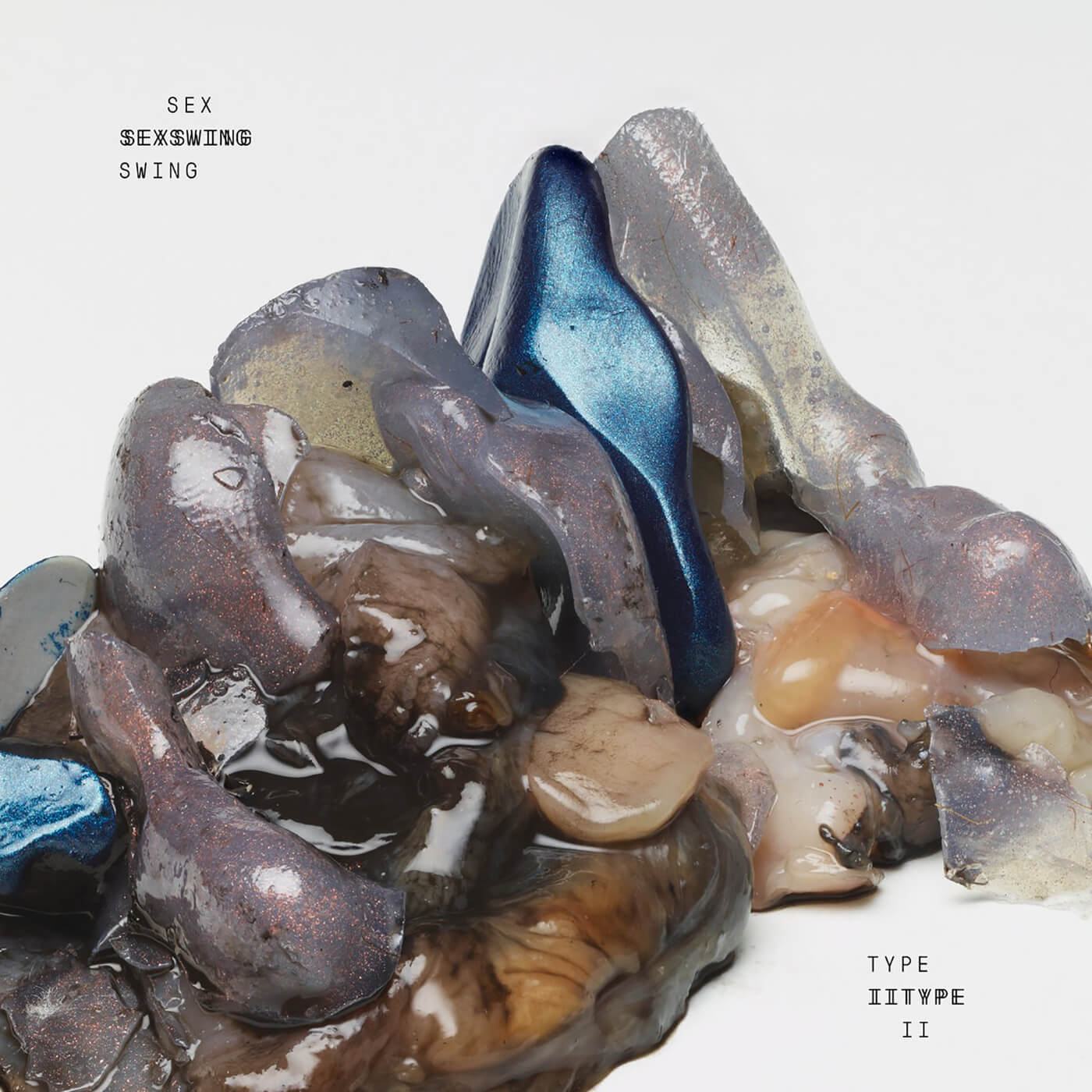
With songs that melt into the best kind of textural melange, Sex Swing seem uniquely equipped to dig their fingers into the fabric of time and stretch it all out of shape. Perfect listening, then, for a punishing year that’s felt as much like a whistle-stop tour of Hell as it has an eternity in Limbo. Type II is that goal reached in effortless style and amplified to intimidating aural vistas. This mighty monument of swagger and malice also sees fit to add a certain amount of glitter to the trademark grit this time around. Just as the artwork from long-term collaborator Alex Bunn boasts a luminous sheen absent from the unsettling abjection of the sleeve of their 2016 debut, so the rolling grooves and mantric hypnosis here boast a new-found structure and a feline sleekness fresh and unusual for this pugilistic outfit. Nonetheless, this remains a band fundamentally obsessed with the expression of decadence and wrongdoing through the mediums of repetition and overloaded frequencies. Type II is more than the mere machinations of a rock band – it’s a howl of malfunction rendered terrifyingly visceral. It’s the lightning flash and unearthly roar of the primeval battle between Godzilla and Mechagodzilla that provokes awe and disquiet in the realm of fantasy, It’s the haunted clangour of the faullty air conditioning unit that lurks in the anonymous office building yet lends it eerie ambience. It’s man vs machine where discord becomes harmony, and it’s a fearsomely invigorating spectacle to behold.
Type II is more than the mere machinations of a rock band – it’s a howl of malfunction rendered terrifyingly visceral. It’s the lightning flash and unearthly roar of the primeval battle between Godzilla and Mechagodzilla that provokes awe and disquiet in the realm of fantasy, It’s the haunted clangour of the faullty air conditioning unit that lurks in the anonymous office building yet lends it eerie ambience. It’s man vs machine where discord becomes harmony, and it’s a fearsomely invigorating spectacle to behold.
“Type II”Rocket Recordings Released on: 2020-05-15
Of all the new music I heard during the height of the initial lockdown. ‘Ultra Mono’ was an album that I was already extremely excited to hear; and the stream of songs released during Lockdown only served to raise that excitement to a fever pitch.
Thankfully IDLES didn’t disappoint and when the album arrived it was a pure masterpiece. It shows a natural progression on the bands first two records and grows the bands sound. It still captures what made us all fall in love with the band but by incorporating new elements into the bands sound the album shows that IDLES are no one trick pony.
Above all other releases this year and those that feature in this list, this was the album that we needed this year. In a year where we have all been knocked down one way or another, IDLES and ‘Ultra Mono’ has been a call to arms, to pick ourselves up, dust ourselves down and keep going.”
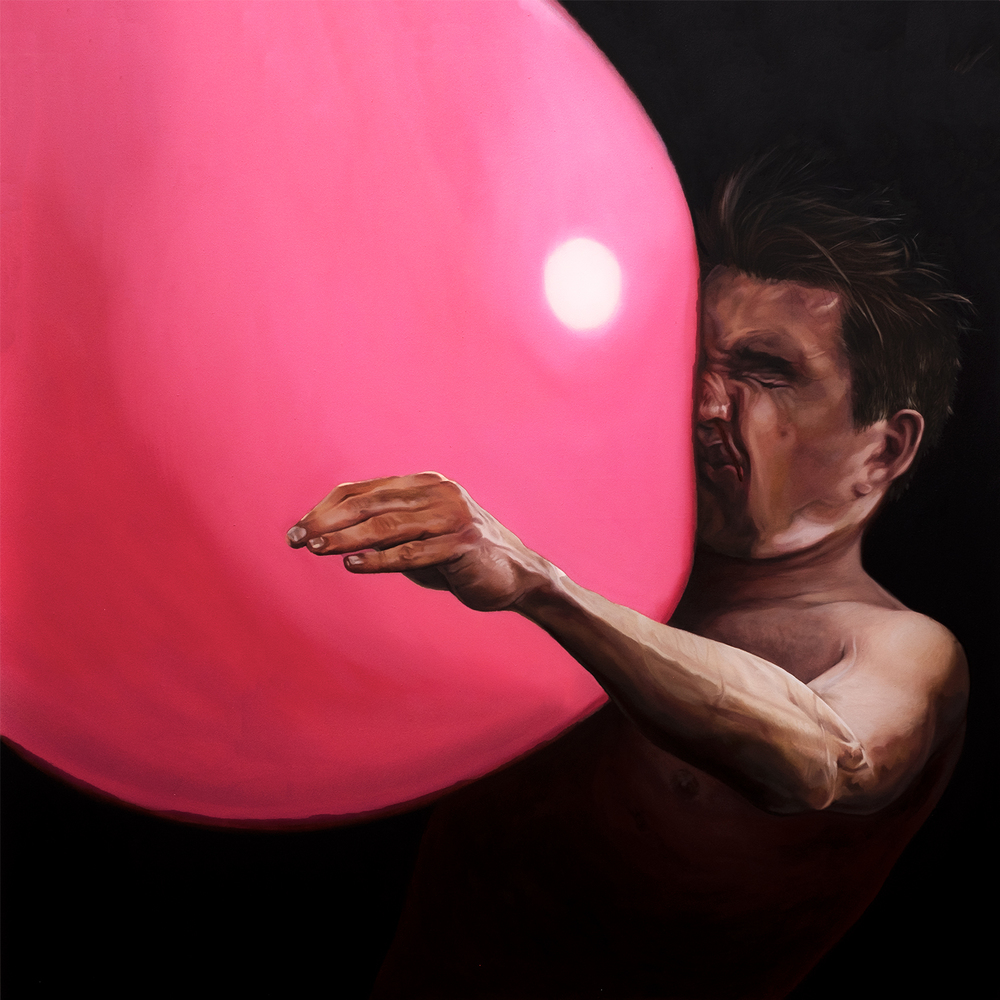
IDLES third LP, Ultra Mono, was released earlier this year to critical acclaim. The video for “Kill Them With Kindness” was directed and designed by James Carbutt and animated by Pip Williamson, inspired by the working men’s clubs of Barnsley. Brutal guitar work flips between Bowen and Kiernan on a Travis Bean and Esquire respectively, revealing again why they’re the two most important players in the UK today.
Another single from the Bristolian band’s acclaimed third LP on Partisan Records, it begins with a monstrous bass riff that twists around the snare drum, before bellowing into the chorus with pulsating, glistening guitars and the odd bit of ring-modulator thrown in for good measure.
The Bristol, U.K. punk outfit are releasing their third studio album Ultra Mono this last year. IDLES recorded Ultra Mono in Paris, working with producers Nick Launay (Nick Cave, Yeah Yeah Yeahs, Arcade Fire), Adam “Atom” Greenspan (Anna Calvi, Cut Copy) and Kenny Beats (FKA Twigs, DeBaby, Vince Staples). Per a press release, “‘Ultra Mono’ was sonically constructed to capture the feeling of a hip-hop record.” The album also features guest vocals from Jehnny Beth (Savages), and contributions from Warren Ellis (Nick Cave and the Bad Seeds), David Yow and Jamie Cullum.
In 2020 there were certainties: third IDLES album, third time among the best fifty of the year. On Ultra Mono we hear a sharper and smoother IDLES than before. A band that takes steps to keep developing its sound, which takes a hip-hop producer under its arm, once worked its crown with the cracks and moments later comes across songs like “Grounds” or “Reigns”. The British are going to be wonderfully retamful about this drive for innovation and the ability to remain fully IDLES. (Post)punk has its heyday again, and part of the answer to the question shines on the chest of the Bristol fivesome. Ultra Mono also includes a lot of discs that live on a swirling, roaring mass, while a band has the mob on a raise.
Chicago-based singer-songwriter Gia Margaret released an ambient album, Mia Gargaret, last year, and she’s now followed it with her first new single of 2021, a studio version of a song she’s been known to perform live. “I just felt like sharing a song,” she writes. “I’ve been missing the spontaneity of releasing music on a whim, I suppose. During these slow winter months and after such a slow (and rough) year for everyone– I thought it would give me (and maybe you) something nice to start 2021 with. It is my offering. It also feels like a misfit (production wise) in a body of newer songs and especially with the direction I’m moving into. That’s not to say there might not be another version on a record at some point. I just decided this deserves it’s own celebration.”
I just felt like sharing a song. I’ve been missing the spontaneity of releasing music on a whim. During these slow winter months and after such a slow (and rough) year for everyone– I thought it would give me (and maybe you) something nice to start 2021 with. It is my offering.
Released January 12th, 2021 Produced by Gia Margaret
Laura Stevenson‘s second album with The Cans as her backing band, the modern classic “Sit Resist”, turns 10 this year, and we’ve very excited to be teaming up with her to help celebrate that anniversary with a livestream performance of the album in full. “Sit Resist (At Home)” airs on Saturday, February 13 at 8 PM ET (5 PM PT), and tickets, including merch bundles, are on sale now.
“We had a handful of full-band, full album “Sit Resist” shows planned around the release of the reissue before the pandemic put an end to that,” Laura says. “This is probably the closest we can get to actually pulling it off. This will be the first time I’ve ever played some of these songs for an audience. It feels like we took a lot of pre-pandemic life for granted, one of those things being the ability to freely gather together and experience all that music does for communal connection. Livestreams will never be the same as that experience, but I’m hoping this will fill a couple of the cracks in the meantime.
The thirteen song album has been remastered at the hallowed Abbey Road Studios in London from the original 1/4” analog master tapes, and the vinyl processed with a new half speed lacquer cut to ensure the highest quality audio possible. The bonus LP is a collection of outtakes of nearly every album track, including never before heard pre-production demo recordings, alternate mixes and arrangements, live material, an Archers of Loaf cover, as well as a newly recorded version of the album track “Caretaker” which was recorded in 2019 on the literal last night in the house Stevenson grew up in, ten years after the song was originally written there.
The album features liner note essays written by musicians Julien Baker and Lucy Dacus who drew early inspiration for their own music and song writing from the album. Also contributing liner notes are Pitchfork, NPR and Stereogum writer Nina Corcoran, as well as long time friend and collaborator Jeff Rosenstock who produced and played guitar on some of the bonus demo material contained in the collection.
The packaging also features many never before seen studio photos and tour photography from the era in which the album was written, produced and released, and outtakes from the photo session at which the album’s iconic cover artwork was shot. The limited run double-LP Remastered Deluxe Edition set of “Sit Resist” is now available for pre-order via Don Giovanni Records, and will be released on September 4th, 2020. This is a one-time edition, and the limited collection will not be reissued in this current state after the initial pressing sells out.
The Band:
Laura Stevenson – vocals, acoustic and electric guitars, piano, organ Mike Campbell – bass guitar Alex Billig – accordion, trumpet Peter Naddeo – electric guitar, glockenspiel Chris Parker – drums, percussion
Philadelphia punks Mannequin Pussy’s made their best album yet with 2019’s Patience. They’ve hinted that their fourth is done now, too, tweeting that the new songs include “1 classic MP song. 1 pop song. 1 sad bitch bedroom song. 1 happy slut bad-bitch song. 1 Bear song. These songs make up our collective feelings over this stupid fucking year.” Producer Will Yip calls them “bonkers,” which has us all the more excited.
The cover art of Mannequin Pussy’s third album, “Patience”, is an apt illustration of what you’re about to hear. An old-school globe is aflame, setting the scene for the Philly punk band’s strongest effort to date—as well as one of the best (and most cathartic) punk albums of the year. The artwork springs to life especially on one of the record’s most delicate and simultaneously powerful tracks, “High Horse.” Vocalist/guitarist Marisa Dabice reaches into a crescendo while she belts, “Your world’s on fire, as I watch up from my high horse / Your world’s on fire, and I walk away.” The climactic moment in which Dabice exits an abusive relationship epitomizes the immense strength fueling Patience, and acts as a prelude of sorts to the message that supplies the project’s lifeblood: You are enough. “Who You Are” echoes that same sentiment, exploring how to quiet your inner critic (and how to say “screw you” to the systems that put this critic in your head in the first place). Unlearning harmful thought patterns is a challenge, but can ultimately set you free. Patienceis all about chasing that freedom—and more importantly, being patient with yourself in the process.
“High Horse” by Mannequin Pussy from the album ‘Patience,’ available now
The first album in five years from Teenage Fanclub is also their first without bassist and vocalist Gerard Love. In his place, the group recruited Euros Childs of the Welsh band Gorky’s ZygoticMynci. “The whole process of making this album was very invigorating,” guitarist and vocalist Norman Blake said in a press release. After a 2018 vinyl reissue series put many of their iconic albums back in print, “Endless Arcade” looks to be another welcome reintroduction to Scotland’s power-pop giants. Losing a songwriter as good as Gerard Love, who bowed out of Teenage Fanclub in 2018, would be a blow to any band, but luckily TFC still have two other great singer/songwriters in Norman Blake and Raymond McGinley and now count former Belle & Sebastian’s David MacGowan as a member. Despite those major lineup shifts, TFC’s jangly, harmonious sound is likely to remain un-phased.
Even if we weren’t living through extraordinarily troubling times, there is nothing quite like a Teenage Fanclub album to assuage the mind, body and soul, and to reaffirm that all is not lost in this world.
Endless Arcade follows the band’s ninth album Here, released in 2016. It’s quintessential TFC: melodies are equal parts heart warming and heart aching; guitars chime and distort; keyboard lines mesh and spiral; harmony-coated choruses burst out like sun on a stormy day.
In the 1990s, the band crafted a magnetically heavy yet harmony-rich sound on classic albums such as Bandwagonesque and Grand Prix. This century, albums such as Shadows and Here have documented a more relaxed, less ‘Teenage’ Fanclub, reflecting the band’s stage in life and state of mind, which Endless Arcade slots perfectly alongside. The album walks a beautifully poised line between melancholic and uplifting, infused with simple truths. The importance of home, community and hope is entwined with more bittersweet, sometimes darker thoughts – insecurity, anxiety, loss.
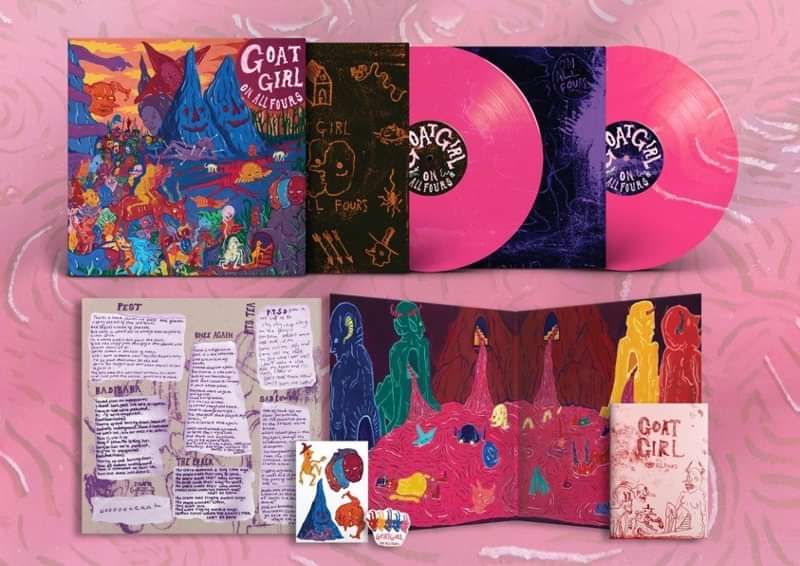
Nearly three years after their self-titled debut, Goat Girl return with their sophomore record, “On All Fours”. In the time between albums, the London group have matured in their approach to music making; for On All Fours, the band collectively collaborated on song writing, often switching instruments and exploring new sonic territory. Lead singles “Sad Cowboy” and “The Crack” are exciting new examples of Goat Girl’s growth.
Goat Girl’s new album On All Fours was produced by Dan Carey (Kae Tempest, Black Midi and Franz Ferdinand) in South London in early 2020. This new record sees the band veer away from the confrontational lyricism of their debut and indicates Goat Girl’s maturing perspectives in discussing the world’s injustices and social prejudices, using the music to explore global, humanitarian, environmental and mindful well being. Goat Girl’s frequent use of sci-fi synthesisers, off-beat chord progressions, analogue drum machines, diverse vocal styles and distinct, gritty guitars fuse a musical language that expresses both former characteristics and newer developments of the band’s sound and vision On All Fours.
For their follow-up to their very good 2018 debut LP, UK group Goat Girl once again worked with producer Dan Carey. Where their first was a rough-and-ragged, guitar-centric record, though, On All Fours adds synthesizers to the mix which, on the singles shared so far, brings bounce to Goat Girl’s swaggering sound.







 The Fat Angel Sings