Gillian Welch – Boots No. 1: The Official Revival Bootleg 2xCD (Acony) Boots No. 1: The Official Revival Bootleg is a companion to Welch’s Grammy-nominated debut, Revival, and features 21 outtakes, alternate versions, and demos from the making of Revival, including eight previously unheard songs. “‘Mostly I hear experimentation, trial and error.’ Gillian Welch is recalling her and partner Dave Rawlings 1996 Americana landmark debut, Revival. Her modesty is unwarranted. This is a revealing 21-track collection of outtakes, alternate versions, mixes and demos, some equal, if not superior, to the versions that made the album. These dark, mostly stripped-back tracks, including eight songs previously unreleased, expand our understanding of that signature recording, not least the road to her true voice. The gossamer ‘Paper Wings (Alternate Mix)’ floats in pedal steel heaven, while the home demo of ‘Tear My Stillhouse Down’ crackles with self-loathing, anger and guilt. ‘Red Clay Halo,’ later to appear on Time (The Revelator), also didn’t make it. It was in good company; ‘Dry Town,’ cut from Johnny Cash’s cloth, was another. Warts and all reissues can test the most loyal, but these gems, albeit flawed, simply fascinate.’”
Jonathan Rado, co-creator of Foxygen, plays with dusty toys and makes music errday. He bangs on items. He won’t stop banging on items. During a short weekend in October of 2011, Jonathan Rado covered “McCartney”, the 1970 solo album by PaulMcCartney (of the hit rock band, The Beatles) in it’s entirety. In the spirit of the original album, there wasn’t much thought put into anything – most everything is first take, from memory – no song took longer than 3 hours to record. The only missing track is “Teddy Boy”, which somehow got deleted from my computer. Also, man, my vocals on “Maybe I’m Amazed” just do NOT cut it. All songs written by Paul McCartney
recorded and performed by Jonathan Rado in 2011
cover photo by Jonathan Rado (hot sauce & sour skittles/kitchen floor)
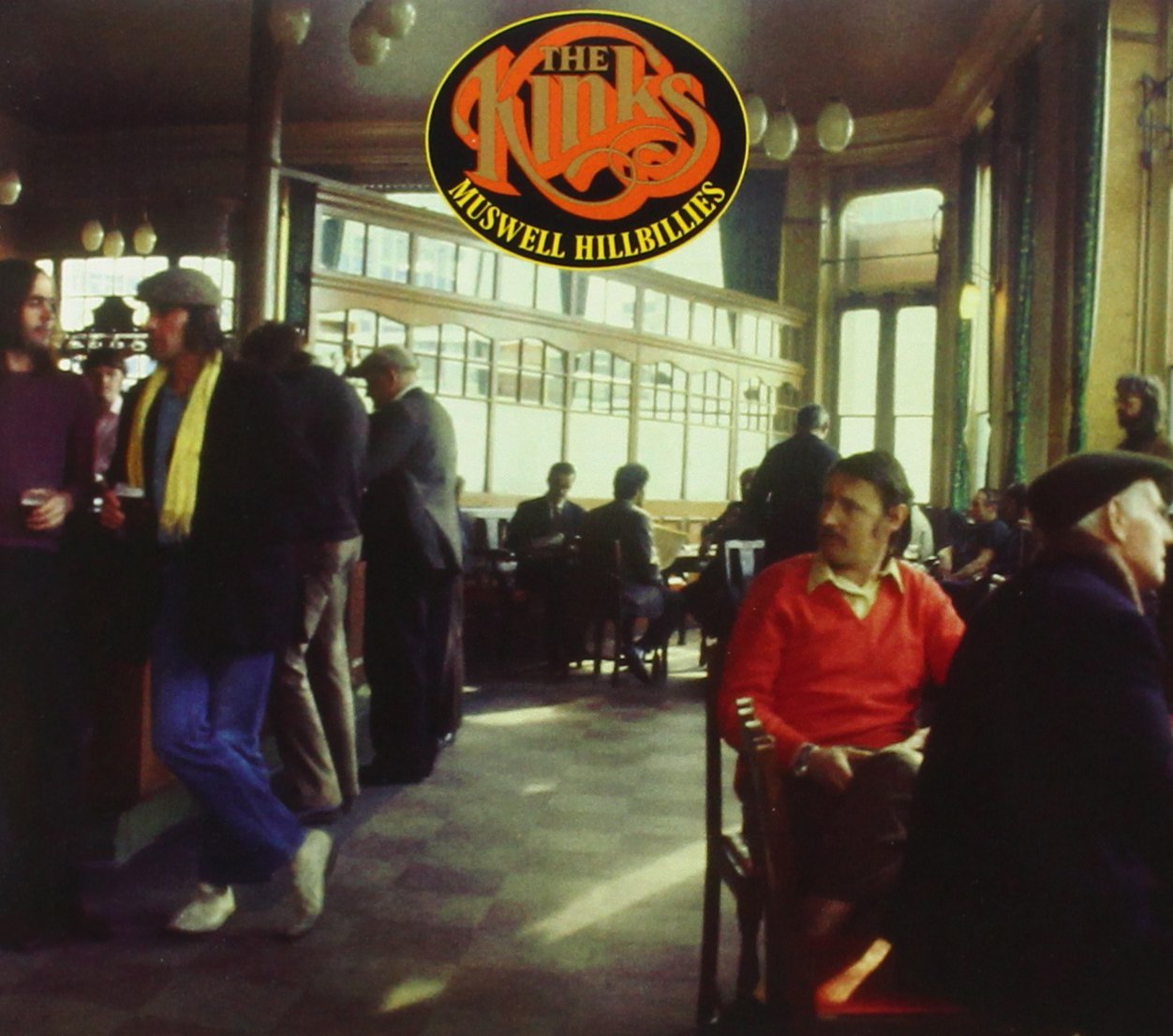
The Kinks had a rocky romance with the U.S. After the band’s initial burst of fame in the mid-’60s, they were banned from touring in the States for four years, due to “rowdy” performances. In the ensuing years, the group’s popularity dwindled across the U.S. Audiences struggled to connect with the band’s often specifically English subject matter, and the Kinks couldn’t help matters by promoting their music in concert.
The situation turned after the ban ended in 1969, and the Kinks toured and scored their first U.S. hit in years with “Lola” in 1970. Although they soon got dumped from Reprise Records, they were rescued by RCA, who gave the Kinks a big contract and a $1 million advance.
Things were looking up for the Kinks, although frontman Ray Davies couldn’t say the same about Britain. He was dismayed at his country’s political status and bothered by the sense of history that was being lost as new subdivisions were destroying old neighborhoods. Davies witnessed this trend in the northern London suburbs, near MuswellHill, where he and his family, including brother and Kinks guitarist Dave Davies, had grown up.
“It’s just very disturbing to see this happen,” Ray told Circus Magazine in 1972. “They’re knocking down all the places in Holloway and Islington and moving all the people off to housing projects in new towns.”
The songwriter decided to let his anger and sadness fuel the Kinks’ first RCA album, Muswell Hillbillies. As the title suggests, RayDavies conceived the record as a mix of British social commentary and rustic American music styles, including country and bluegrass. He perceived a connection between the music of the downtrodden in the U.S. and the marginalized working class in the U.K. “Muswell Hillbillies was about real people, real characters in the Davies family,” Dave remembered to Express in 2014. “Ray and I have always been great fans of the likes of Hank Williams and American country music, so [the album] gave us an opportunity to marry up the [idea] of Cockney families moving out to the suburbs and relating it to country music.”
Acoustic instruments, slide guitar, country beats and outdated equipment became the hallmarks of the Kinks’ new album. Lead single “20th Century Man” began with strummed acoustic guitar before turning into a country rock song in which the nostalgic Ray wondered about his place in modern life. “Here Come the People in Grey” matched a bucolic boogie-woogie with a story about government overreach. The song had its roots in the Davies brothers’ grandmother’s living situation.
“My gran used to live in Islington in this really nice old house, and they moved her to a block of flats, and she hasn’t got a bath now. She’s got a shower because there isn’t room for a bath,” Ray said in 1972. “And like she’s 90 years old, she can’t even get out of the chair let alone stand in the shower. … It’s just a lack of consideration for people. The government people think they are taking them into a wonderful new world but it’s just destroying people.”
Other family and neighborhood friends made appearances in other songs, from Uncle Son (who died from tuberculosis after doing outside labor for the government) to Rosie Rooke (a neighborhood fixture who symbolized a form of excitement for the young musicians). Davies found a way to tie Britain and America, thematically, on the sparse “Oklahoma U.S.A.” On the accordion-drenched tune, he sings of a poor English woman who finds joy in Hollywood escapism and the musical Oklahoma!
On the album’s closing title track, Davies sings of the American music and iconography that inspired him and so many of his fellow British rockers. Over glistening guitar, he declares: “My heart lies in old West Virginia / Never seen New Orleans, Oklahoma, Tennessee / Still I dream of the Black Hills that I ain’t never seen.” While many of Davies’ contemporaries got to see the U.S. on repeated tours, Davies felt he was kept at arm’s length from a country that interested him so much.
“I think a part of me always felt like I should have been brought up in Appalachia,” he admitted to The Guardian in 2013. “People associate me with north London, but I always felt a bit surprised to have been born here somehow. We had this strange thing that because we were banned, there was literally no way of us engaging with America. … I took the ban very personally.” The Muswell Hillbilies album was released on November. 24th, 1971. Although critics reacted favorably to the album, it wasn’t a big hit on either side of the Atlantic (especially in contrast to Lola Versus Powerman and theMoneygoround, Part One). Over the decades, it has become a well-respected entry in the Kinks’ chronology, with some even terming it the band’s last great album. When doing press for a deluxe re-release of the LP in 2014, both Davies brothers highlighted the album as one of their favourites, largely because of how it altered the Kinks’ musical perspective. “Muswell Hillbillies, because of its transformation of the group, was a fine record,” Ray said.
A very special 10th anniversary edition of Sufjan Stevens’ Illinois.
In 2005 Sufjan Stevens released Illinois, his fourth album and the second in his 50-state project. Sufjan fans with long memories might recall a minor hiccup in our release of Illinois as it related to the inclusion of a certain Metropolis-born man of steel.
While we do love balloons, we’ve always missed the imminent presence Big Blue brought to the album’s cover art, short-lived though it was. But things are very different in 2015 than they were in 2005, and different times call for different heroes.
So today, exactly ten years after we released the double LP of Illinois, we’re proud to announce a special 10th anniversary edition of the LP that includes Chicago-born Blue Marvel on the cover.
The double LP will include an “Antimatter Blue” and “Cape White” vinyl colors. The audio for the special edition comes from a 2014 remastered version of Illinois. We commissioned children’s book artist and the original Illinois cover artist Divya Srinivasan to portray Blue Marvel in the style of the original art. We’re pressing 10,000 double LPs of this edition. And we might include an extra surprise so stay tuned.
Big thanks to everyone at Marvel for giving us permission to feature Blue Marvel. Blue Marvel, who made his first appearance in the Marvel Universe in November 2008 in Adam: Legend of of the Blue Marvel #1, is a rising star in the Marvel universe. Here is Blue Marvel’s official biography:
In the 1960s Adam Brashear was a young man who served his country as a U.S. Marine. When he discovered his super-powers, he fashioned a secret identity with which to protect his country; the Blue Marvel! He served as a hero for years, and was one of the most popular heroes of his time. Yet Adam had a secret, he was an African-American, a fact not lost on the government. As a precaution against so much power in the hands of a black man, they took steps to control him, even going so far as to plant a Spy for him to date. His career as the Blue Marvel ended after he faced the Anti-Man, with his ethnicity revealed, Adam was pressured by the government to retire.
Chris Shaw smokes the microphone while Ty Segall and Charles Moothart trade lizardian licks and skin hits. Guest GØGGS include Cory Hanson, Mikal Cronin and Denée Petracek. Ten tracks of misanthropic noise to bring home to mom’s house on fire. Boots to your face after the high speed chase, Then! A death trip down memory lane. The lead actor dies first and the shotgun shooter flashes chipped teeth.
Created in Los Angeles in the middle of the summer of 2015: three years of planning, thirty days of writing, one week of ripping. A severed finger on the button, the player ends the game. Final notice has been served.
Working in the sweetly swinging tradition of Serge Gainsbourg and the yé-yé sound of the ’60s, the Limiñanas have a sound that blends sunny psychedelia with vintage pop. Based out of Perpignan, France, the group is composed of drummer and sometime vocalist Marie Limiñana and bassist, organist, and jack-of-all-trades LionelLimiñana, as well as a host of guest vocalists including MU. With its combination of fuzzy organ, half-spoken/half-sung vocals, and vintage production, the band captures the sexy, ultra-hip sound of classic French pop. After releasing a series of singles, the duo released its self-titled debut in 2010 through the Chicago label Trouble in Mind. The band continued to crank out singles, and a second album, Crystal Anis, followed in the summer of 2012. After taking some time to revamp the Limiñanas’ sound to introduce more elements of French and Italian soundtrack music, the duo returned quickly with its third album for Trouble in Mind. Costa Blanca was issued in late 2013. The band are now back with new relase “Malamore”.
“Sun Structures” delivers strong melody after strong melody, with not a single parody to be found. The band boast an unusual gift, and that’s the ability to create the essence of the mid-to-late ’60′s psychedelia, without ripping anybody off in the process. No clichés, just strong material. The sound may be familiar, but the tunes are all theirs. The band performed a superb set of songs at Reading Festival during the summer.
these classic qualities are all over just about every song here, particularly “Keep In The Dark”. And so SunStructures is the perfect album, with reference points aplenty,
The first half of “Denial” the third single from Mannequin Pussy’s sophomore album, “Romantic” is designed to sound like someone having a panic attack. Marisa Dabice is trapped inside her own head, unable to escape a spiraling depressive cycle:
“At night sometimes my thoughts collide/ My body shakes/ I feel so separated from what I thought I’d be and what I am.”
But something miraculous happens midway through the song: She manages to pull herself out of the hole she’s dug, and the rest of the band responds in kind. The tension slacks; Dabice launches into an affirmative pep talk: “Pick yourself up, baby/ Everything’s gonna be fine/ But if not, so what?/ You’ll get it the next time.”
It’s a pointed moment on an album that embraces wild and erratic mood swings. hardcore anthemics and sickly sweet punk-pop riffs from Mannequin Pussy.
Originally begun as a duo between childhood friends, Marisa Dabice and Thanasi Paul, Mannequin Pussy expanded to a three-piece for their debut album, GP. Following a move to Philadelphia, the band has once again grown in numbers and strength. With the addition of Kaleen Reading on drums and Colins Regisford on bass, Mannequin Pussy are now a quartet for their sophomore full-length, Romantic. Once again a Mannequin Pussy full-length is a perfect example of “all killer, no filler” as Romantic clocks in at less than 20 minutes. And much like GP, Romantic shifts seamlessly back and forth between pop and punk rock. But, the band has refined their songwriting with Romantic. The pop hooks are bigger and sharper. The punk rock numbers are filled with even more fury. Romantic is the sound of a band hitting its stride.
Charlie Hilton, known up until now for her work in the band Blouse, has now forged a new identity with her debut solo album, ‘Palana’.
It should come as no surprise that many of the songs on ‘Palana’ are concerned with shifting characters, forms and ideas. The album’s title itself is a nod to Hilton’s given Sanskrit name, an identity she shed completely after high school in favour of the androgynous ‘Charlie’ and Palana’s overarching theme can be summed up by a quote from Hermen Hesse’s Steppenwolf, a phrase Hilton cites as a personal mantra: “Man is not by any means of fixed and enduring form… he is much more an experiment and a transition”
Enlisting Unknown Mortal Orchestra’s Jacob Portrait as producer, Hilton freely experimented with diverse sounds and moods – some minimal and some cacophonous – out of the confines of a band structure. ‘Funny Anyway’ is truly stark, featuring only string accompaniments, with Hilton assuming a role akin to a confessional French chanteuse, while ‘Let’s Go To A Party’ is Hilton’s cheeky take on an icy dance track with thick, bouncing synths and a chorus that echoes “I’m only happy when I’m dancing.” Alternatively, tracks like ‘Pony’ harken back to the psychedelic strengths of Blouse, saluting bands like Broadcast and United States Of America and then there’s ‘100 Million’, the sole track produced by Woods’ Jarvis Taveniere that rounds out the album in a soft, acoustic and light-hearted way with labelmate Mac DeMarco lending his talents on percussion and back-up vocals.
This wide range of moods on ‘Palana’ recall several of Hilton’s key influences – the solemn beauty of Nico, the whimsical nature of Marc Bolan and the naïveté of Jonathan Richman – but the album is undeniably the work of one artist, perhaps best summed up by the artist herself: “The music on this record is diverse, but so is the inside of a person. I feel like I’m many people.”
All the best music is made by fanatics. The kind of people who are immersed in its wonder, obsessed by the never ending panoply of electric noise.Whyte Horses are an enigmatic group from Manchester who make guitars chime like lysergic bells and sing songs so full of wonder that they make your heart ache. They shape-shift from Turkish psyche to Brazilian trip music, from acid house to electronica to punk rock to guitar classic in a heartbeat. It really shouldn’t work, but it’s synthesized that it absolutely does. There is a hypnotic beauty to their music and a poetic perfection to their muse. The band is the brainchild of Dom Thomas, a music fanatic and chronologist who scours the planet for obscure and rare vinyl genius. This obsession is in their musical DNA and Whyte Horses are the sound of people who, on the quest for the perfect record, decided to make one themselves.
Whyte Horses are a Psychedelic Pop group from Manchester music luminary Dom Thomas for his work with Andy Votel at Twisted Nerve and also his extraordinary home-made psychedelic compilations he‘d bring into the store. In both guises he excelled in the mysterious, exotic, and occasionally impenetrable. This was far-out stuff. Until now! Suddenly there is a pop group and they’re called Whyte Horses. Reconvening to a dilapidated cottage in rural Italy, with only an acoustic guitar, female buddy and some battered analogue recording gear, Dom set about creating what would become the psychedelic dream pop diamond we’re celebrating today