Earlier this year, the self-titled 1967 debut album by The Doors arrived in a 50th anniversary box set presenting the original album on CD in both mono and stereo plus the mono version on vinyl. Much as The Doors followed that debut months later with Strange Days, Rhino is following up the reissue of The Doors with a 50th anniversary presentation of that sophomore album, due on November 17th. Strange Days: 50th Anniversary Edition will be released in two configurations: a 2-CD set with the mono and stereo versions of the album, each on its own CD; and a 1-LP vinyl reissue of the original mono album only. Digital streaming and download versions will also be released.
Strange Days, originally issued on Elektra in September 1967, reached No. 3 on the American chart, and yielded two hit singles with “People Are Strange” and “Love Me Two Times” . Strange Days arrived in stores a little more than eight months after the Doors’ self-titled debut in January 1967, and was a more experimental record – due in part to a bigger budget allotted to the band for its second record.
Recorded like The Doors debut album at Hollywood’s Sunset Sound, the LP was the band’s first to be recorded on eight tracks, allowing for a more expansive and experimental sound than its predecessor. Its songs were a mix of both current tunes and older ones tested onstage; the band performed “Strange Days” during its 1966 residency at the London Fog in L.A., and “My Eyes Have Seen You” dates back to 1965. “Moonlight Drive” was a similarly early composition, and one of the first songs Jim Morrison, Ray Manzarek, Robby Krieger, and John Densmore ever rehearsed together.
The Strange Days: 50th Anniversary Edition has been produced by the album’s original engineer BruceBotnick and restores the original stereo mix to CD for the first time in over a decade, fully remastering it for the first time in 30 years. The second disc features the album’s original mono mix, which has been remastered for this set and is making its CD debut. No additional audio material has been included. Liner notes have been provided by David Fricke, and his notes are accompanied in the booklet by rare and previously unseen photographs.
Strange Days: 50th Anniversary Edition will be available from Rhino Records on November 17th
Lagniappe (la·gniappe) noun ˈlan-ˌyap,’ – 1. An extra or unexpected gift or benefit. 2. Something given or obtained as a gratuity or bonus.
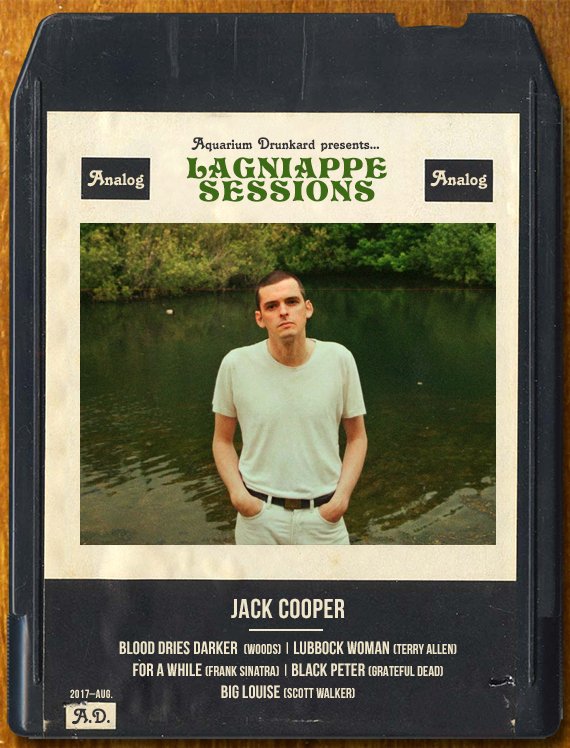
Earlier this year Ultimate Painting’s Jack Cooper slid us an early version of his new solo album, “Sandgrown”. At nine tracks we were immediately drawn to its sparse, tranquil, yet personal offerings inspired by his hometown of Blackpool off the coast of England. The effort finds Cooper waxing nostalgic about his time growing up on the Fylde Coast and the cast of characters that come with living and working in a seasonal resort town. Often compared to the Velvets, Sandgrown finds Cooper acknowledging other influences including Terry Allen and The Grateful Dead, mixing them with the experimental textures of John Cale and Robert Wyatt.
Woods have a special place in my heart because my wife and I are both big fans and we always listen to them together. I first saw them in 2008 in Manchester and it’s been a pleasure seeing them so many times since then. This is my favourite song of theirs and although they never really play it, Jarvis dedicated it to my wife and I last time they played London. It’s a pretty perfect song.
Terry Allen’s Lubbock (On Everything) was a big influence in this solo album of mine. The framework of writing about a town or place opens up a world of possibilities. I’ve been writing about Blackpool since I lived there but the idea to do something centered on that was really inspired by this record and Watertown by Frank Sinatra. The words and the delivery is all about Terry, so it felt weird singing them. I scrapped the idea 4 or 5 times, before thinking ‘fuck it’… it’s a great song.
Frank Sinatra’s Watertown is just the most melancholic, downbeat, comforting record I’ve ever heard. It’s his best album and his finest acting performance. Again…the delivery and words are all about him but I gave it a good shot. My friend Phil Anderson recorded some piano for me…it’s blown out and weird.
I’m not too sure why I chose this apart from being a huge fan of the Grateful Dead. Robert Hunter was on fire around this time…such rich, interesting imagery and narratives. I really can’t think of a better lyricist, and around this time in particular.
Most of these songs I’ll class as misses, in that they’re all so hard to do justice too. The vocalists are way too singular and this one in particular I’ve included just for the hell of it. The phrasing and way he sings is so incredibly complicated. I couldn’t even begin to get right. I’ve listened back to all of these at some point and become to self conscious about even submitting them (laughs). I guess there’s something liberating about taking a shot at something and just going with it.
According to Mick Jagger, “The title came from looking at the stage. Because it was going to be the name of the tour as well as the record—it all had to fit together. We were looking at the stage one day and trying to find where we were with it. What does this design say to us? I came up with the ‘Bridges’ idea and a friend of mine came up with the Babylon thing. The bridge to the B-stage worked perfectly most nights, except when it was too cold or too hot, and then it had to be sort of manually got together. It was always my worry that it wasn’t gonna actually open.”
The Bridges To Babylon tour was announced in a press conference held underneath the Brooklyn Bridge in New York City and began on 9th September 1997 with a warm up show in Toronto, Canada, followed by another at The Double Door In Chicago. It officially began on 23rd September at Chicago’s Soldier Field followed by 55 more shows in North America, nine shows in South America, six shows in Japan and thirty-seven shows in Europe.
The production was designed by Mark Fisher, Charlie Watts, Mick Jagger and Patrick Woodroffe and opened with a circular central screen exploding with fireworks, from which guitarist Keith Richards emerged playing the riff to “(I Can’t Get No) Satisfaction”.
This was the first tour on which the B-stage featured at almost every gig; the stage design included a 46 m (150 ft) long telescoping cantilever bridge that extended from the main stage to a ‘B’ stage in the centre of the stadiums. The only issue according to Keith was the fact that out door shows had the unpredictability of the weather to contend with.
“There’s another guy that joins the band on outdoor stages: God. Either he’s benign or he can come at you with wind from the wrong direction and the sound is swept out of the park. The weather normally comes good around show time… but not always.’ Keith
Keith also pointed out that, “The bigger shows are harder to play, even though that’s what we do most of the time, because we are so locked into lighting systems and computers: the more constructed you have to be, because of the size of the operation. When we play on the B-stage or at a club venue, for us it’s just like coming back home—sweating it up a bit.”
All in all this was another massive step forward in terms of the number of people who came watched The Stones perform: 4.8 million at 108 shows in 25 countries.
It concluded on 19th September 1998 in Istanbul, Turkey. Five shows were cancelled (in Marseilles, Paris, Lyon, Bilbao and Gijón), and five more were postponed (in Italy, Ireland and Great Britain).
As the ’90s wore on, Jagger became concerned with keeping the Rolling Stones fresh. That led directly to some of the dated experimentation on Bridges to Babylon, released on September. 23rd, 1997.
“There is a great danger when you’ve done all these albums … that you think you know how to make a record,” Jagger said in 1997. “Someone writes a song and there is something in the song that you recognize: ‘Oh, I know what that is. I’ll get my slide guitar.’ I don’t want to do that first thing that comes to mind.”
Over-worried about sounding too much like themselves after succumbing to a kind of easy classicism on 1994’s Voodoo Lounge, the Rolling Stones ended up going too far the other way. That meant bringing in then-hip producers John King and Mike Simpson. Known professionally as the Dust Brothers, they’d most recently been working with Beck.
“Anybody Seen My Baby,” the lead-off single, was doomed to parody by their decision to include a sample of Biz Markie‘s 1986 track “One Two.” Deep cuts like “Might as Well Get Juiced” suffered too, as its generically electronic backing track felt somehow both relentless and largely without detail. Hiding somewhere within this tune is something that could have harkened back to the edgy smack-laced danger of 1972’s Exile on Main St. The loop-driven “Saint of Me,” written in tribute to their late long-time sideman Billy Preston, suffers a similar fate. It’s a pretty good Stones song lost in a maze of studio tricks.
Jagger even brought in the sleek R&B producer Babyface to work on “Already Over Me” at one point, before discarding the tapes. “It’s full of fance – that’s funk and dance put together,” guitarist Ron Wood enthused in a 1997 . Fans were less enthusiastic, as the album became the Rolling Stones’ first ever – including 1986’s lightly regarded Dirty Work – to finish outside the U.K. Top 5. Bridges to Babylon ended up selling a million copies, but that was far less than the multi-platinum sales of their two most recent studio projects.
You could hardly blame Keith Richards. Favoring an abandoned back-to-basics approach, he ended up contributing some of his strongest material, and simply stayed well away from the more modernized stuff. Waddy Wachtel, the ace Los Angeles session guitarist, sat in on “Anybody Seen My Baby,” which was rumored to have been about actress Mary Badham of To Kill a Mockingbird fame. Richards doesn’t even appear on “Saint of Me.”
He claimed there were no hard feelings, despite early reports of tensions in the studio. “You always have to deal with other people’s preconceptions of what their version of the Stones is – and we can’t be everything to everybody,” said Richards “All we can do is be true to ourselves as much as possible, and say, ‘This is us now, take it or leave it.’”
Richards collaborated exclusively with stalwart Stones producer Don Was on the reggae-inflected “You Don’t Have to Mean It,” the soul-drenched “Thief in the Night” and his devastatingly sad album-closing “How Can I Stop.” All of them would have sounded more at home on one of Richard’s then-recent solo projects, For his part, Richards argued that while Bridges to Babylon may not have always worked, it had at least been interesting.
For Portland, Oregon songwriter Anna Tivel, the open road is more than a way to bring her songs to new places, it’s also a near-endless source of stories. On her new album, “Small Believer” (out September, 29th on Fluff & Gravy) Tivel taps into the stories she hears every night, after every show. “When you’re touring,” Tivel explains, “you’re naked onstage each time. You’re doing this vulnerable thing in front of strangers and it encourages people to open up themselves.” You’ll see it after one of Tivel’s shows, a young woman who steels up the courage to go up and speak to her. Something in a song has touched this person and her story comes tumbling out, tears streaming down her face. It’s powerful to watch, and a testament to the intimate connection between the songwriter and the audience. For Tivel, herself a naturally soft-spoken introvert, perhaps people see in her the struggle they see in themselves to be heard in such a noisy world.
The songs on Small Believer were written while Tivel was touring, but also in-between shifts at the odd waitressing job, or driving Meals on Wheels in her spare time. She has an extraordinarily keen eye for recasting the images she sees into song, so that a homeless man drawing comfort each day while sitting and watching a building go up, brick by brick, becomes the song “Riverside Hotel.” A chance conversation with a neighbour, also a waitress, who makes an empty promise becomes “Last Cigarette.” Each image or moment that burned itself into Tivel’s memories become a launching pad for a larger story that she spins into song. And each song of Tivel’s is full of blazing moments that go on to implant themselves into her audience, touching each person. It’s a turning cycle, a spinning wheel of time, movement, and stories that define Tivel’s passage.
To make Small Believer, Anna Tivel drew on her close community of friends and collaborators in Portland, starting with Austin Nevins (Josh Ritter, Della Mae), who produced the album. Nevins shared a deep love for the kind of quiet stories Tivel loves to tell. Nevins brought together Portland collaborators to make the understated accompaniment that pervades the album: slow-driving fiddles, accordions, electric guitars moving beneath and supporting Tivel’s soft words. Released on Fluff & Gravy Records, label-head John Shepski has long championed Anna’s music along with other great, unheralded Northwest songwriters across genres.
Even in Americana as a genre today, people tend to forget that the best songwriters are great storytellers, and the best storytellers source their material from what they observe around themselves. The best songs don’t need to be complex or virtuosic, they just need to mean something to someone. That’s how they last.
Small Believer is out September 29th via Fluff & Gravy
Appropriately enough, The Clientele return to the fold with a brand-new album on the first day of autumn. Music for the Age of Miracles marks the band’s first new album in seven years.
The Clientele have always provided a serene sense of atmosphere in their music, with Alasdair MacLean’s vocals rarely having the tendency to ascend beyond a lush accompaniment through gorgeous arrangements fitted with strings and guitars at the forefront. For me at least, they’ve always exuded the sound of autumn. Having not released a full-length since 2009’s Bonfires on the Heath, it was worth wondering if the band would maintain the consistency of prior releases. Fortunately, Music for the Age of Miraclesfinds the band without hesitation, their hiatus ultimately resulting in my favorite album from the London-based act yet. Anthony Harmer contributes his skill of numerous non-Western stringed instruments (like santur and saz), working alongside MacLean to result in 12 strong tracks.
The combination of these string instruments and MacLean’s tendency for fluttering, serene guitar arpeggios results in a dreamy listening experience throughout. In essence, this very much sounds like classic The Clientele, though with more effective songwriting and instrumentation than ever their norm. The standouts are numerous. “Falling Asleep” chronicles the ascent of MacLean’s vocals, amidst prancing guitars throughout and riveting strings during the chorus. “Everything You See Tonight Is Different From Itself”, the following effort, injects brass into the fold over trickling guitars with precision, while “Everyone You Meet” serves as a great example of the band’s overall warmness. Music for the Age of Miraclesseems to almost have a healing-like tendency, ideal for turning listeners in need of a stress ball into those content to stretch out and enjoy the beauty, ideally on an autumn day
This time around, Anthony Harmer joins the line-up of Alasdair MacLean (vocals, guitar), James Hornsey (bass), and Mark Keen (drums, piano, percussion), contributing string and brass arrangements as well as guitars, vocals, keyboards, saz, and Santoor.
Nearly four decades’ worth of singles — both A-sides and their accompanying B-sides — by the assorted lineups of Mark E. Smith’s pioneering post-punk outfit The Fall will be collected on a new 7-disc, 117-track box set from Cherry Red Records this November.
The collection, christened The Singles 1978-2016, is due to be released November. 24th in both a full 7-disc set and a slimmed-down 3-disc set that just presents the A-sides, without the four CDs worth of B-sides. Both versions of the forthcoming box set can be pre-ordered via the label’s website.
According to Cherry Red, this collection — remastered by Fall engineer Andy Pearce — is the first to bring together TheFall output released across a swath of different labels, including Step Forward, Rough Trade, Kamera, Beggars Banquet, Cog Sinister, Permanent, Artful, Action and Cherry Red itself.
The collection spans music released on The Fall’s 1978 debut EP Bingo-Master’s Break-Out! through 2016’s Wise Ol’ Man EP, and countless singles, and their B-sides, in between (though not anything from New Facts Emerge, the band’s 32nd studio album, which was released this past July).
The box set includes a full illustrated discography from Fall expert Conway Paton.
“Läther” released OnThisDay in 1996. The recordings for the album were originally delivered to Warner Bros. in 1977 as a quadruple box set, but Warner Bros. refused to release it in this format. Contractual obligations stipulated that Zappa deliver four albums for release on DiscReet Records, which eventually resulted in much of the material on Läther being released on four separate albums: Zappa in New York (1977), Studio Tan (1978), Sleep Dirt (1979), and Orchestral Favorites (1979), only the first of which was produced with Zappa’s oversight.
However, bootlegs of the original recording had existed for years before the album’s official release as a result of Frank Zappa broadcasting it over the radio in 1977 and encouraging listeners to make tape recordings of it. The album was reissued released posthumously as a triple album on Rykodisc in 1996. in 2012 through Universal with cover art Frank Zappa originally considered for the album.
This was Official Release number 65.
Gail Zappa has confirmed that the 2-track masters for the planned original album were located while producing the 1996 version. While the official CD version of Läther released is reportedly identical to the test-pressings for the original quadruple album, four bonus tracks were added to the 1996 release and the title of the song, “One More Time for the World” was changed to “The Ocean is the Ultimate Solution”, the title under which the same song appears on the album Sleep Dirt. The album does not include “Baby Snakes”, a song which was originally planned for the album. A version of the song served as the title of the film from the same era.
The album pretty much stopped me in my tracks when i first heard it. So delicate! So beautiful! Find a quiet space and play the single follow my voice. After spending years on the road performing as part of a fiercely independent DIY music community, Julie Byrne stayed put in New York City and coalesced the thoughts and experiences of her past few transient trips around the sun into this unnervingly beautiful album. Not Even Happiness is a stunning combination of strong lyricism and technical skill. Byrne fingerpicks a guitar she inherited from her father and pours every ounce of herself into these compositions, laying her innermost feelings completely bare in the process.
The album has had huge support from radio already with RRR and FBI making it album of the week and Double J adding the first single. Pitchfork recently made it Best New Music! “Here is something special” ***** The Times
“Byrne paints sublime, awestruck moments when simple things become overwhelming.” Pitchfork, Best New Music
“there’s so much to love about Not Even Happiness: the lightness of the finger-picked acoustic guitar patterns, the flute and string interludes, the plaintive timbre in Byrne’s voice recalling fellow outsider folk figures Anne Briggs and Karen Dalton.” **** MOJO
“the voice is a balm” **** The Observer
“with Not Even Happiness she’s spreading her wings musically” Album of the Week, The Line Of Best Fit
“otherworldy and other-timely… for all its dreaminess, it never seems fey or contrived… stunning.” The Guardian “one of the albums of the year” NME
A trans-American folk singer (and former park ranger) travels far and wide, only to return to the comforts of her childhood home to record a stunning, stripped-down sophomore effort.
Given Julie Byrne’s extensive record of following wherever the wind takes her, it’s tempting to read Not Even Happiness as an acoustic travelogue of the United States, or rather, her United States. It helps that the album invokes an intoxicating sequence of visual imagery that spans the continent from the Redwood Forest to the Gulf Stream waters, Byrne’s voice splashing watercolors across Big Sky country in the touring ballad “Natural Blue” before literally dissolving into the ocean on “Sea as It Glides”. But just as often this record turns inward, probing the depths of a twentysomething soul as it transitions from wary to wistful to weary. Each of the nine songs on Not Even Happiness is its own vast landscape, lurching and zig-zagging far more often than Byrne’s steady, delicate finger picking might suggest. Whether those landscapes turn inward or explode outward depends, one imagines, on what the listener brings to the table
In 2006, Matthew Sweet and Susanna Hoffs, recording as Sid and Susie, released “Under the Covers, Vol. 1,” a collection of performances of their favorite songs from the nineteen-sixties that included heavy-rotation classics such as the Beatles’ “And Your Bird Can Sing” and the Beach Boys’ “The Warmth of the Sun” alongside less familiar relics like the Marmalade’s “I See the Rain” and the Left Banke’s “She May Call You Up Tonight.” Three years later, Sweet and Hoffs returned to take a crack at the seventies with a double disc that ranged from power pop (the Raspberries’ “Go All the Way”) to proto-punk (Television’s “Marquee Moon”). Trading lead vocals, accompanied by meticulous recreations of the original music—the effect was like an unimaginably skilled karaoke party.
And now, like slightly slow clockwork, the pair has arrived where they were always destined to go: the nineteen-eighties. It’s the decade, of course, in which Hoffs rose to stardom with the Bangles (they released their first album in 1984 but dominated airwaves in 1986, with “Different Light”) and Sweet began to take steps toward his own power-pop reign (he released “Inside” in 1986 and “Earth” in 1989 before breaking big with 1991’s “Girlfriend”).
This installment of “Under the Covers,” like the ones that came before it, has relatively modest aims. It’s not attempting to reinterpret the songs in a manner that makes listeners forget the original versions. It’s not trying to show off instrumental chops or vocal pyrotechnics. It’s only trying to point out some stars in the sky by which Hoffs and Sweet navigated their journey to becoming singers and songwriters. Those looking for sharp spikes of energy or bracingly innovative arrangements won’t find them.
The set opens with R.E.M.’s “Standing Still.” The “Under the Covers” players—anchored by the drummer RicMenck and the guitarist Dennis Taylor, both of whom play with Sweet’s band—do a fine job of capturing the swampy sense of the unknown central to any remaking of early R.E.M., while Sweet, singing lead, emphasizes the lack of understanding central to the band’s lyrical mystery.
later in the set, when Hoffs sings lead on a cover of the Go-Go’s “Our Lips Are Sealed,” at once the most sensible and the most audacious choice in the bunch. The Go-Go’s, of course, dominated the early part of the decade with their first two albums, “Beauty and the Beat” and “Vacation,” and in the process launched a thousand high-energy all-female rock-and-roll groups, the Bangles among them. Here, the liner notes are short and to the point: “This Bangle loves to Go-Go! Susie was awed pre-Bangles. Sid was awed aged 15. He may or may not have had their bubble bath poster in his room.”
Even when there aren’t direct lines of inspiration, Hoffs and Sweet do right by their source material. Their cover of “Girls Talk” (already sort of a cover, as most people know the Dave Edmunds version rather than the Elvis Costello original) navigates the intricate wordplay and rockabilly beat. And Hoffs’s plaintive reading of Kirsty MacColl’s “They Don’t Know” (also re-covered—the original came out in 1979, but it was made famous again by Tracey Ullman in 1983) is not only the strongest performance here but one of the strongest in the entire series. Yet, not every track succeeds. The version of the Smiths’ “How Soon Is Now” has great instrumental backing, but it suffers, like every Smiths cover, from an absence of Morrissey. And the cover of Roxy Music’s “More Than This,” which reverses gender by letting Hoffs sing Bryan Ferry’s lead part, retains the beauty of the original but not its hypnotic power.
Part of the credit for the album’s success should go to the nineteen-eighties. While the guitar-heavy, lightly psychedelic rock and roll that both artists favor was born in the sixties and mixed into a broader stew in the seventies, the eighties represents a pinnacle for a certain type of pop music. R.E.M. helped spearhead the birth of college radio (also represented here by the dB’s “Big Brown Eyes” and the Bongos’ “The Bulrushes”). The Go-Go’s helped grow MTV into the single biggest force in American music (the duo covers Tom Petty’s “FreeFallin’,” one of the dominant videos of the late eighties). The eighties had good arena rock, which may seem like an oxymoron. In its attempt to take a measure of the sprawling seventies, Vol. 2 had sixteen songs, and another dozen found their way out via bonus tracks and online exclusives. Here, the main album has only fourteen selections, and the diversity of styles can sometimes make the album sound scattershot. XTC’s “Towers of London,” jittery and brainy, sits right next to Echo and the Bunnymen’s majestic, cinematic “The Killing Moon.” If you approach the album as a radio station, it’s not necessarily a problem. If you approach it as a musical biography or autobiography,
UNDER THE COVERS VOLUME 1
Record Store Day 2016 Release. Now available separately on different coloured vinyl, on these three 2 LP sets Matthew Sweet and Susanna Hoffs deliver perfect cover versions of their favourite songs from the 60s, the 70s and the 80s. 2 LP blue vinyl.
UNDER THE COVERS VOLUME 2
Record Store Day 2016 Release. Now available separately on different coloured vinyl, on these three 2 LP sets Matthew Sweet and Susanna Hoffs deliver perfect cover versions of their favourite songs from the 60s, the 70s and the 80s. 2 LP yellow vinyl.
UNDER THE COVERS VOLUME 3
Record Store Day 2016 Release. Now available separately on different coloured vinyl, on these three 2 LP sets Matthew Sweet and Susanna Hoffs deliver perfect cover versions of their favourite songs from the 60s, the 70s and the 80s. 2 LP purple vinyl.
The Replacements were always going to be a risk for any label to sign in the mid eighties. The band’s reputation for sloppy live shows, drunken interviews and overall contempt for anything resembling self promotion was already legendary. Not that any of this ever worried the band, when Sire eventually signed the Mat’s in 1986 they seemed more concerned with keeping up with their local rivals Husker Du (who had just signed to Warners) than proving any doubters wrong.
Paul Westerberg always seemed to understand that for the kind of band he was going to run, danger was a part of deal. Indeed, the Replacements seemed to revel in it. One of their very first songs was a tribute to Westerberg’s great hero and soon-to-be inevitable heroin casualty Johnny Thunders. On “Johnny’s Gonna Die,” Westerberg sings with an offhand casualness: “Johnny always takes more then he needs / knows a couple chords / knows a couple leads / and Johnny’s gonna die.” The sentiment is decidedly not, “Hey, we should probably do something before Thunders finally kicks it!” It’s more like he’s noting the weather outside, an absolutely prosaic dispatch. Westerberg even ends the song with a sort of cheerful refrain of “bye, bye” — it was 10 years before Thunders would finally leave the building, but the Replacements had already skipped ahead to the eulogy.
For all of the tremendous hilarity surrounding the band’s legendary antics, the Replacements’ story is far more tragedy then comedy. The band wasn’t a suicide pact, but they were a sort of four-man Russian Roulette game. Excess bordered on mandatory. A much-repeated (and unconfirmed) story tells of Westerberg confronting the deeply troubled and dependent founding lead guitarist Bob Stinson before a show when Stinson had just finished 30 days in a detox clinic. Westerberg brings him a bottle of champagne and tells him: “Either take a drink, motherfucker, or get off my stage.” It doesn’t matter so much if this is true or not, simply because it is plausible. Being wasted was Bob Stinson’s brief in the Replacements — he really wasn’t good enough a technical player to keep around sober and levelheaded. The fact that he was eventually fired for being overly erratic is an unamusing irony.
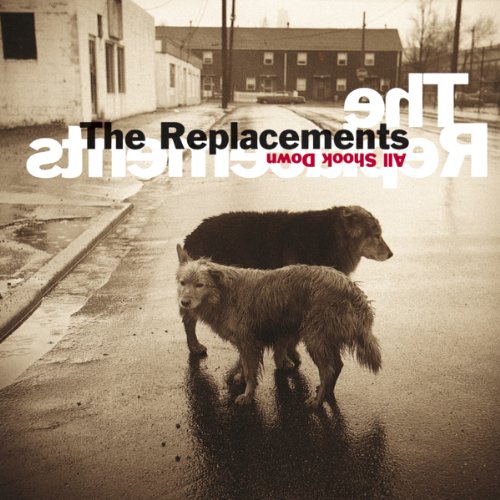
‘All Shook Down’ (1990)
The band’s final LP gets punished for what it’s not – a real Replacements record. Paul Westerberg began ‘All Shook Down’ as a solo effort and only shifted to include his bandmates during sessions. On its own merits, and stripped of ‘Don’t Tell a Soul’’s misguided bombast, the album is pleasant. It is fine. The steady “Merry-Go-Round” has a nice hook and Paul’s sleeve-hearted storytelling is solid – even if, as he looks back, Westerberg takes his band’s legacy more seriously than the boys did in the moment). But middling tempos and hushed shuffles make ‘All Shook Down’ the audio equivalent of beige. Stuck between being a Replacements record and a solo debut, the album doesn’t satisfy in either way. Westerberg’s pen is typically astute and nimble here, noting the soon-to-be-disastrous marriage depicted in “Nobody” and the fractious future of an unsettled newborn in “Sadly Beautiful.” It’s an album reckoning with the consequences of all that has come before. On the final track the band would ever release, “The Last,” Westerberg ruefully acknowledges: “It’s too late to run like hell.”