By the mid-’70s, Lou Reed had been through a lifetime of rock ‘n’ roll experiences in just a little more than a decade. From early-’60s session work to the Velvet Underground to the unexpected chart success in the early ’70s with the solo hit “Walk On the Wild Side,” Reed was never one to stay in limbo. He followed his hit Transformer album with the dark and haunting Berlin, the live album Rock and Roll Animal and the back-to-basics Sally Can’t Dance.
His next move remains one of the most famous middle fingers in the history of music: the 1975 release of Metal Machine Music, a double album of guitar feedback and other noise effects. Was it a joke, a bold artistic statement, a contractual obligation or all of these? In early 1976, Reed told an interviewer, “I committed a number of blasphemous acts that I can back myself up on, only in saying that it got me the chance to make Metal Machine Music, and it gave me the power to make Coney Island Baby my way, from top to bottom.
That’s why I did Metal Machine Music. It was supposed to clear the air. Most people, even if you are into electronic music, aren’t going to listen to that.”
Reed was back on a more conventional path with Coney Island Baby in early 1976, and by October, he returned with the self-produced Rock and Roll Heart, his seventh solo album. It’s another of Reed’s more conventional records, opening with the soul-injected “I Believe in Love,” which surges along with R&B horns. Its refrain of “Good time music, good time rock ‘n’ roll” is a 180-degree turn from the barrage of noise found on Metal Machine Music. Reed sticks to traditional music here: “Banging on My Drum” is a straightforward rocker, “Follow the Leader” is funky and “You Wear It So Well” is a soulful ballad. On “Ladies Pay,” he even sounds like he’s imitating Patti Smith imitating Lou Reed.
There’s much use of horns on Rock and Roll Heart, bearing the influence of early rock ‘n’ roll and jazz that often hangs out in Reed’s work. The closing “Temporary Thing,” one of the album’s best tracks, creates a tension that never breaks over five intense minutes as it borrows from the Velvets, jazz and soul music.
Like many of Reed’s albums from the late ’70s and early ’80s, “Rock and Roll Heart” doesn’t get much love these days. But give it a chance. It’s a fresh and intriguing listen, hardly the throwaway its critics claim.
We’re thrilled announce three unforgettable nights of music, dance and merriment in San Francisco at The Independent to ring in 2018. We’re calling it ….
A NEW YEAR’S TRIPTYCH
DEC 29 – intimate, acoustic sets (w/ music from Bedouine + dance from The Seaweed Sisters)
DEC 30 – we go ELECTRIC (w/ music from Veers + dance from The Seaweed Sisters)
DEC 31 – an epic New Year’s celebration (w/ a dj, surprise guests + an open bar!)
Many surprises will unfold and each night will be one-of-a-kind!
Jess and Holly continue to tour with Roger Waters in his band throughout October across Canada. The show is spectacular, and if there’s a tour date near you, we highly recommend it.
This past year has brought on a new wave of feminism, and with it, the most strikingly feminine album I have heard. At 27 years of age, by U.K. singer-songwriter Laura Marling who has crafted a collection of intimate, emotionally rich songs that seek to explore the female gaze turned on itself. Semper Femina which is Latin for “always woman”..
This is Marling’s conscious edit of a cautionary phrase from Virgil’s Aeneid: Varium et mutabile semper femina. (“Woman is ever a fickle and changeable thing.”) In fact, it is precisely the mutability and complexity of women, in our relationships to each other and to the world around us, that Marling celebrates within these nine vignettes. From the darkly sensual album opener, “Soothing,” which banishes with love an unwelcome lover, to the coda, “Nothing Not Nearly,” which concludes “nothing matters more than love,” she gets to the heart of the beautifully multifaceted nature of women — and, indeed, of LauraMarling herself. Personally, I am deeply grateful to her for the gift of this panoramic view of ourselves: We need soothing. We can take away your pain. We need beauty. We cry sometimes. We sing. We put up a fight. We need to be free. We love you. We are the muse, but also the artist. We were wild once, and must remember. Semper Femina.
The characters in Marling’s songs feel like real people—often restless, frequently viewed from afar and almost uniformly mysterious in their motivations. Despite all her growth over the past decade—which has included adding a soulful bounce to her occasionally brittle hooks and orchestral heft to her simpler arrangements—Marling remains at heart a folksinger who uses the foundational elements of songcraft to express abiding truths. And like any great folk singer, she has created an album of songs whose sounds and sentiments are much weightier than they might appear.
Sharon Van Etten has announced that her 2009 debut album, Because I Was in Love, has been remixed and remastered for a deluxe edition that will be out November 17th via Vinyl Me Please and Sharon’s online shop. The new edition of the skeletal, intimate album has been retitled (it was)Because I Was in Love and features new artwork, liner notes and two bonus tracks. You can listen to the newly-remastered version of the record’s opening track, “I Wish I Knew,” and check out the new artwork and tracklist, below.
In a statement, Van Etten spoke about the new reissue:
It was an innocent and beautiful record, which some of my newer fans may not even know about. This seemed like the perfect time to remix and remaster it, and give it a new life.
Sharon Van Etten will play David Lynch’s Festival of Disruption in L.A. this month, and has been featured on several other artists’ work as of late, teaming with Michael Cera for “Best I Can,”, as well as duetting with Lee Ranaldo on “Last Looks” from his new solo record Electric Trim,
“I Wish I Knew” is from the forthcoming album ‘(it was) because i was in love’ – a remastered reissue of Sharon’s 2009 debut album. comes out on 17th November
In A tribute To Tom Petty here is Sharon Van Etten and Shearwater covering the classic “Stop Draggin’ My Heart Around” Original Song: Stevie Nicks, Tom Petty & The Heartbreakers. A.V. Club – Undercover 2012
“Plum” is Wand’s fourth record. Yet it functionally serves as a new debut. Their first three albums saw the group, then a four-piece helmed by guitarist/vocalist/main songwriter Cory Hanson, producing wild and ecstatic, fuzzed-out psychedelic garage rock in the vein of Ty Segall and associated California bands. Wand erred to the more playful and gleeful end where Segall would lean into ecstasy and abandon,
For Plum, however, Wand sees the addition of a full-time keyboardist and a much more democratic approach to songwriting and development. This new palette brings with it a shift in arrangement and a fairly big shift in sound. The instruments are thinner now, the guitars less bustling with fuzz and distortion, the drums less rumbling and redlined.
Everything has more space now, in an uncomfortably produced sense, allowing the songs to develop almost like the way The Beatles, Kinks, early Radiohead or ’90s-era Britpop bands did. Wand reveals here a similar sense of dreamlike melodies, something that was hidden behind the walls of distortion. To their credit, it spares them one of the most damning-with-faint-praise comments made of music in the garage mold that they worked in before, being that the aesthetic covered up typically bad songwriting. If nothing else, this record shows that Wand know the mechanics of songs, can construct memorable, deft and complex melodies, and can ornament and arrange those structures well.
There is the issue of cohesion, though. When these songs get cooking, they develop in similar directions: spare, thin guitar lines playing in counterpoint to one another, trapped somewhere between the King Crimson-isms of Slint and the psych-folk of the Byrds; drums and bass locked in simple motorik rhythm; keys bridging the gap between pure ornamentation and the central melodies. And, it must be said, when these tunes get cooking, it’s compelling stuff. The launching points span from Beatles-replay indie rock cliches to smart minimal post-punk to heady psychedelia, with little emotional logic to link the songs. Listen to “Charles de Gaulle” through to “White Cat” and try to find a common emotional thread. It isn’t there.
Which proves as frustrating as it does because when on tracks like “High Rise” (far too short at a scant two minutes for as fulfulling a riff it is!) and album standout “Blue Cloud,” Wand shows that this new configuration and songwriting approach can produce some exceptional song structures and incredible playing to complement them. This promising messiness is what makes Plum feel so much like a second debut rather than a fourth album, per se; given the fact that they took on a new second guitarist and added a whole new member in their keyboard player, not to mention totally shifting how they write and develop songs.
Plum ultimately is a record of a band finding their feet again. The bad news is it doesn’t come together and leave a fully satisfying record in their wake. The good news, however, is that they give themselves plenty of fertile ground here. “Blue Cloud,” as stated before, is easily the most successful song on the album. Record closer “Driving” is a Neil Young-style massive emotional closer, something I never would have imagined this band capable of before.
It was only a matter of time before Chelsea Wolfe up and recorded a metal album. “Hiss Spun” is, more or less, that album. Produced by Kurt Ballou of Converge and featuring guests such as Sumac’s Aaron Turner and Queens of the Stone Age’s Troy Van Leeuwen, it’s a set of loud, blistering, powerful dirges and rippers that end up being some of the most immediate tracks in Wolfe’s repertoire. Wolfe exorcises some hard-rocking demons in “Vex” and “Hiss Spun,” while retaining some industrial darkwave eeriness in “Offering,” though it’s an album short on songs that aren’t standouts. It’s a weird irony that her most explicitly metal album to date is also her catchiest, but why question synchronicity when it comes out sounding this great.
Atlanta trio Omni seemed to naturally materialize via 2016’s year-end lists and retrospectives after the release of their increasingly inescapable debut “Deluxe”. The record flew largely under the radar due to criminally minimal press coverage during album rollout, but by the time December approached, Deluxe was causing critics and fans to perform a collective double take—and for good reason. Omni’s nuanced and relaxed approach to their post-punk ventures is a refreshing take on the genre; their music never reeks of pretension or severity in comparison to their contemporaries.
Multi-Task, is their latest release, It unquestionably puts the emphasis on what the band does best. Omni find a balance between hazy production and jagged syncopation, carving a pop niche out of spindly guitar hooks and sharp melodies. While Deluxe may have been last year’s hidden gem, Multi-Task confirms Omni’s longevity.
Led by Philip Frobos and ex-Deerhunter affiliate Frankie Broyles, the group pairs comparable musicians in collaborative circumstances that, just kind of happened.
Both members also craft lean homespun punk outside their work with Omni; Frobos works with Atlanta art punks Carnivores while Broyles’ lo-fi solo excursions lay the foundation of Omni’s sound. On Multi-Task, they begin to push the boundaries set by Deluxe, while maintaining its assured composure and distinct style. Upon first listen, it’s easy to pinpoint the direct influence of bands like Television, Wire and Ought, all are touchstones for the feel of Omni’s previous material.
The album kicks off with lead singles “Southbound Station” and “Equestrian,” providing a two-part intro to Omni’s M.O. Each track organizes the band’s wiry hooks of nimble basslines and jittery guitars through detailed arrangement and airtight technique. Perhaps the catchiest moment on Multi-Task can be found next within the first 20 seconds of “Choke,” an instant standout and personal favorite. The song’s capering rhythms and inescapable melodies set a qualitative tone for the rest of the album, thoughtfully executed through distinct variance between later tracks. There are brilliant little epilogues tacked on to the end of “Type” and “Calling Out,” the latter of which is most effective in applying this technique. At its two-minute eight-second mark, the track beelines toward an urgent and furious bass-driven finale.
Within just 30 minutes, Multi-Task manages to pack 11 superb, sub-three-minute ditties, each thriving on pure musical instinct. The album simultaneously shows Omni’s logical progression and refined experimentation, pushing the band’s already novel concepts into a deeper and more engaging territory. They combine the past and present, emulating Devo’s fidgety agitation on “Tuxedo Blues,” and plucking straight from the Parquet Courts playbook on “First Degree” and “Date Night.” Through an unspoken calm, Omni keep their cool. Looking back at the tracklisting, it’s equally as difficult to find a favorite as it is to find a least favorite, especially since there aren’t really any bad songs on the album. Front-to-back, Multi-Task is a first-rate take on post punk, maintaining cohesion and song strength throughout.
Initially following its release, the album received little attention in the United States. But Following a U/K tour, it climbed up the UK album chart and the single “Anything That’s Rock ‘n’ Roll” became a hit in the UK. After nearly a year and many positive reviews, the album reached the U.S. charts, and eventually went Gold.
It’s a great American rock album with beautifully constructed songs and a passionate vocal from Tom Petty.
It runs in at a little over 1/2 an hour so it is slightly short by today’s standards but the music there in is wonderful.
Before I mention the songs individually , I should say that there isn’t the searing guitar overload of a live performance, in that the solos are short and not as stand-out in the mix.
Live, there was more emphasis on soloing but the songs are rock ‘n’ roll works of art and this is an album that you can’t tire of. Luna, is a beautiful ballad, is my favourite song of the album and I would say that it is a unique song , part blues, part lullaby , with a beautiful organ melody that you’ll never forget.
huge anthemic track American Girl is a joy and the guitar solo at the end is a piece of magic, The Wild One Forever and Mystery Man are beautiful , gentle songs with melodies to die for.
Throw in Fooled Again, Breakdown and Strangered in the Night et.al. and you have one of the best albums ever made. Wonderful stuff !.
The singles “Breakdown” and “American Girl” became an FM radio tracks that can still be heard today.
The album was recorded and mixed at the Shelter Studio, Hollywood, California.
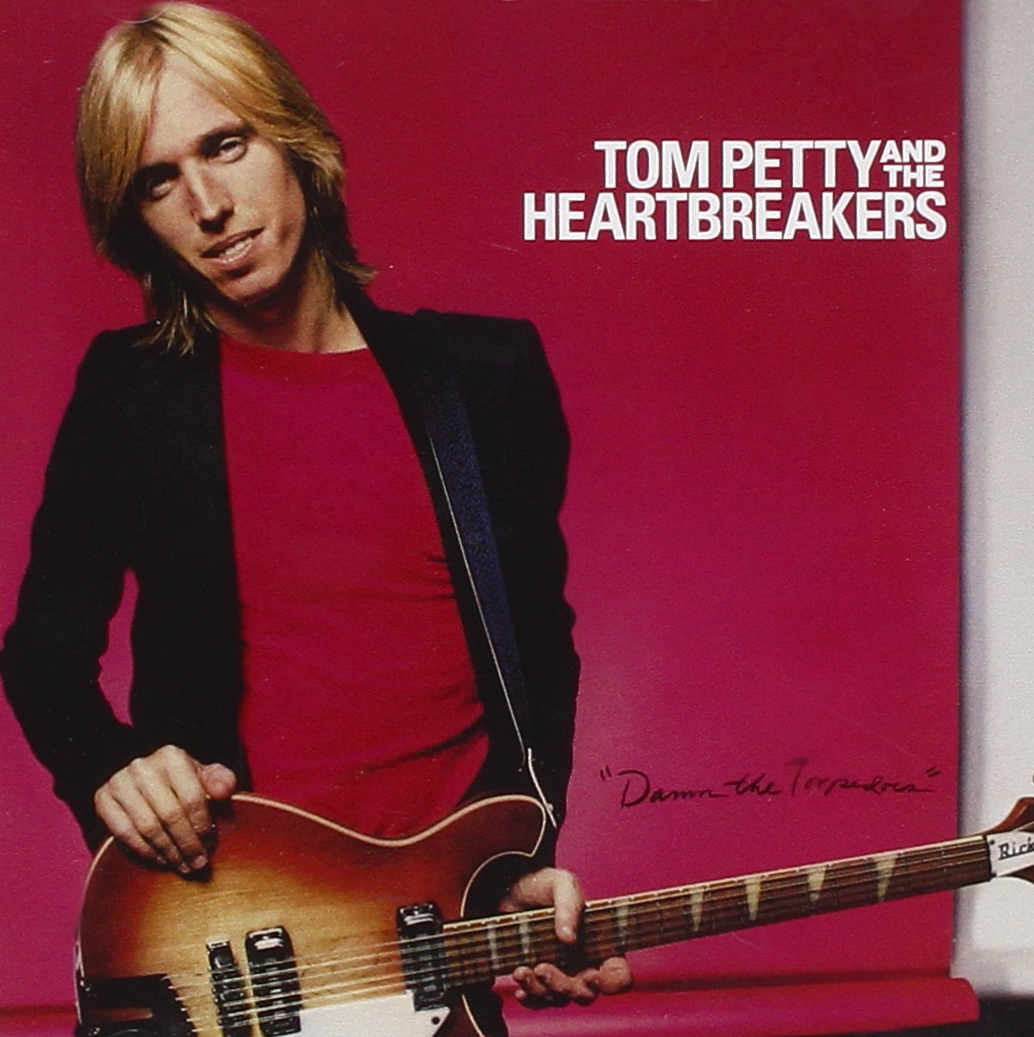
Petty’s breakthrough album plays like his most genuine slice of rock ‘n’ roll – probably because his two earlier albums didn’t do much, and that hunger drips through nearly every single groove. ‘Damn the Torpedoes’ heads straight into a world where Byrds-ian folk-rock collides with heartland-sized riffs. Tom Petty and the Heartbreakers never hit the brakes.
Not long after You’re Gonna Get It, Tom Petty & the Heartbreakers’ label, Shelter Records, was sold to MCA Records. Petty struggled to free himself from the major label, eventually sending himself into bankruptcy. He settled with MCA and set to work on his third album, digging out some old Mudcrutch numbers and quickly writing new songs. Amazingly, through all the frustration and anguish, Petty & the Heartbreakers delivered their breakthrough and arguably their masterpiece with the album Damn the Torpedoes.
Musically, it follows through on the promise of their first two albums, offering a tough, streamlined fusion of the Stones and Byrds that, thanks to Jimmy Iovine’s clean production, sounded utterly modern yet timeless. It helped that the Heartbreakers had turned into a tighter, muscular outfit, reminiscent of, well, the Stones in their prime — all of the parts combine into a powerful, distinctive sound capable of all sorts of subtle variations. Their musical suppleness helps bring out the soul in Petty’s impressive set of songs. He had written a few classics before like “American Girl,”“Listen to Her Heart” — but here his songwriting truly blossoms. Most of the songs have a deep melancholy undercurrent — the tough “Here Comes My Girl” and “Even the Losers” have tender hearts; the infectious “Don’t Do Me Like That” masks a painful relationship; “Refugee” is a scornful, blistering rocker; “Louisiana Rain” is a tear-jerking ballad. Yet there are purpose and passion behind the performances that makes Damn the Torpedoes an invigorating listen all the same. Few mainstream rock albums of the late ’70s and early ’80s were quite as strong as this, and it still stands as one of the great records of the album rock era.
In a career that would come to be defined by near-constant change Van Morrison‘s fifth studio album found him in the midst of personal as well as creative upheaval. released in the October of 1971. Recorded Spring-Summer, 1971 at Wally Heider Studios and Columbia Studios in San Francisco.
Already over the course of his relatively young career, Morrison had led a nomadic lifestyle, moving from Ireland to Boston and then to upstate New York, where he settled in Woodstock while writing the material for the classic albums “Moondance” and “His Band And The Street Choir” LPs. Fruitful as those environments clearly were from a songwriting standpoint, by the spring of 1971, he was on the move again this time across the country, to the sunnier climes of northern California.
There were a number of reasons for Morrison’s latest migration. His wife at the time, Janet “Planet” RigsbeeMorrison, was from the area, and was eager for more familiar areas a desire compounded by the changes Woodstock had seen in the wake of the historic rock festival held in the area. Complaining it “was getting to be such a heavy number,” Morrison said later, “When I first went, people were moving there to get away from the scene — and then Woodstock itself started being the scene.”
Morrison was also at something of an artistic crossroads. After exploring Northern soul to critical acclaim with his more recent efforts, he contemplated cutting a country album for his fifth LP. Although he gave up on that idea after making the move to the West Coast, he faced an even bigger decision: what to do about putting together a new group of musicians now that he’d put thousands of miles between himself and his regular crew.
With saxophonist Jack Schroer and his wife Ellen who contributed backing vocals the lone holdouts from Morrison’s previous band, he set about assembling a new musical corps, ultimately enlisting a crowd of players that included familiar faces (percussionists Connie Kay and Gary Mallaber had contributed to previous LPs) as well as a generous helping of fresh blood. Among the new additions were a trio of Bay Area musicians who’d later become very familiar to rock fans: producer Ted Templeman, notching his second co-production credit after working on the Doobie Brothers’ self-titled debut earlier in the year; guitarist Ronnie Montrose, who’d soon embark on his own distinguished recording career; and guitarist John McFee, a highly regarded session player who’d join the Doobies toward the end of the decade. The vocals on the album were always live after rehearsing each song five or six times, according to saxophonist and flautist “Boots” Houston, who further commented that when Morrison and the band went into the studio: “we would then just play a whole set straight through without repeating anything. We would have played maybe twenty songs and Van would go back and cut out the songs he didn’t want.
If his personnel were new, Morrison’s material was of a slightly older vintage. After abandoning the idea of a country album, he relied mostly on previously written material during the sessions for the new LP, penning one new track — the Side One closer “You’re My Woman” — along the way. Further cementing the reputation he’d already acquired for mercurial behavior, Morrison subjected Templeman to a trial by fire, leading a hard charge through the songs and essentially demanding everyone else keep up. The end result, somewhat ironically, amounted to one of his more peaceful, contended-sounding records.
Tupelo Honey proved an immediate hit for Morrison upon its arrival in October of 1971. Peaking at No. 27 in the U.S. — a new high for him — it also included one of his biggest hit singles, the album opener “Wild Night.” For mainstream listeners eager to hear more of the bucolic side of his musical personality, Tupelo Honey offered a bounty of mellow riches, reflecting the sun-dappled domestic bliss pictured on the album cover. Of course, as he was later eager to point out, none of it was necessarily reflective of his reality.
“The picture was taken at a stable and I didn’t live there,” said Morrison “We just went there and took the picture and split. A lot of people seem to think album covers are your life or something.”
In fact, although it ended up garnering him additional riches and critical acclaim, Morrison was never shy about expressing his emotional distance from the album. As stubbornly as he insisted on making music his way and following his own occasionally inscrutable creative path, he wasn’t immune to contractual obligations or commercial pressures, and he’d later acknowledge that the decisions leading to these particular sessions weren’t ones he stood behind.
“I wasn’t very happy with “Tupelo Honey,”Morrison amitted afterward. “It consisted of songs that were left over from before and that they’d finally gotten around to using. It wasn’t really fresh. It was a whole bunch of songs that had been hanging around for awhile. I was really trying to make a country and western album.”
Tupelo Honey remains one of the more popular gateways to Morrison’s daunting body of work, and if it isn’t necessarily the first record named in discussions of his best albums, it’s usually part of the conversation. Still, for the relentlessly forward-thinking artist who produced it, it represents a misguided detour he’d rather not revisit — and as fans would soon discover, he was interested in exploring musical vistas well beyond this period’s sound.
“I never really listen to Tupelo Honey much,” commented Morrison. “I just don’t connect up with it. I’ve got a bad taste in my mouth for both the Street Choir and Tupelo Honey albums.”