We are pleased to announce that ‘Loose Canon – Live In Europe 2016-2017′ will be available internationally on CD, digital download and to stream from Friday 16th February!. Following the success of their ‘Foreverland’ album and tour, The Divine Comedy release a 17 track live album. Recorded at various dates over the band’s 16/17 European tour, the album contains both standout tracks from ‘Foreverland’, classic songs from Neil Hannon’s extensive catalogue and hits such as ‘National Express’ and ‘Something For the Weekend’. This is a fabulous memento of the ‘Foreverland’ tour for longstanding Divine Comedy fans and newcomers alike. The ‘Foreverland’ tour was attended by over 100,000 people in the UK and Europe. Some quotes from live reviews include: “The Divine Comedy remain a life-affirming joy”. “He makes you laugh, but what lifts the comedy towards the divine is the fact that he also makes you think.” . “Bittersweet ambiguity, where irony meets sincerity and levity shades into melancholy”
Loose Canon was recorded during the band’s 2016/2017 ‘Foreverland’ tour and originally sold through our Merch stand and online store. The good news is that we’ve widened our distribution to all good record emporiums, so if you missed out on adding this collection of electrifying performances to your collection – grab one while you can! This CD is a limited run and will not be reissued.
Here is the track listing to whet your aural appetite –
1. How Can You Leave Me On My Own
2. Napoleon Complex
3. Catherine The Great
4. Bad Ambassador
5. To The Rescue
6. The Complete Banker
7. Bang Goes The Knighthood
8. Generation Sex
9. Our Mutual Friend
10. Funny Peculiar
11. A Lady Of A Certain Age
12. At The Indie Disco
13. I Like
14. National Express
15. Assume The Perpendicular
16. A Drinking Song
17. Tonight We FlyWith digital downloads, streaming and CDs there is more than one way to experience The Divine Comedy on stage! Have a night in and let us provide the soundtrack.
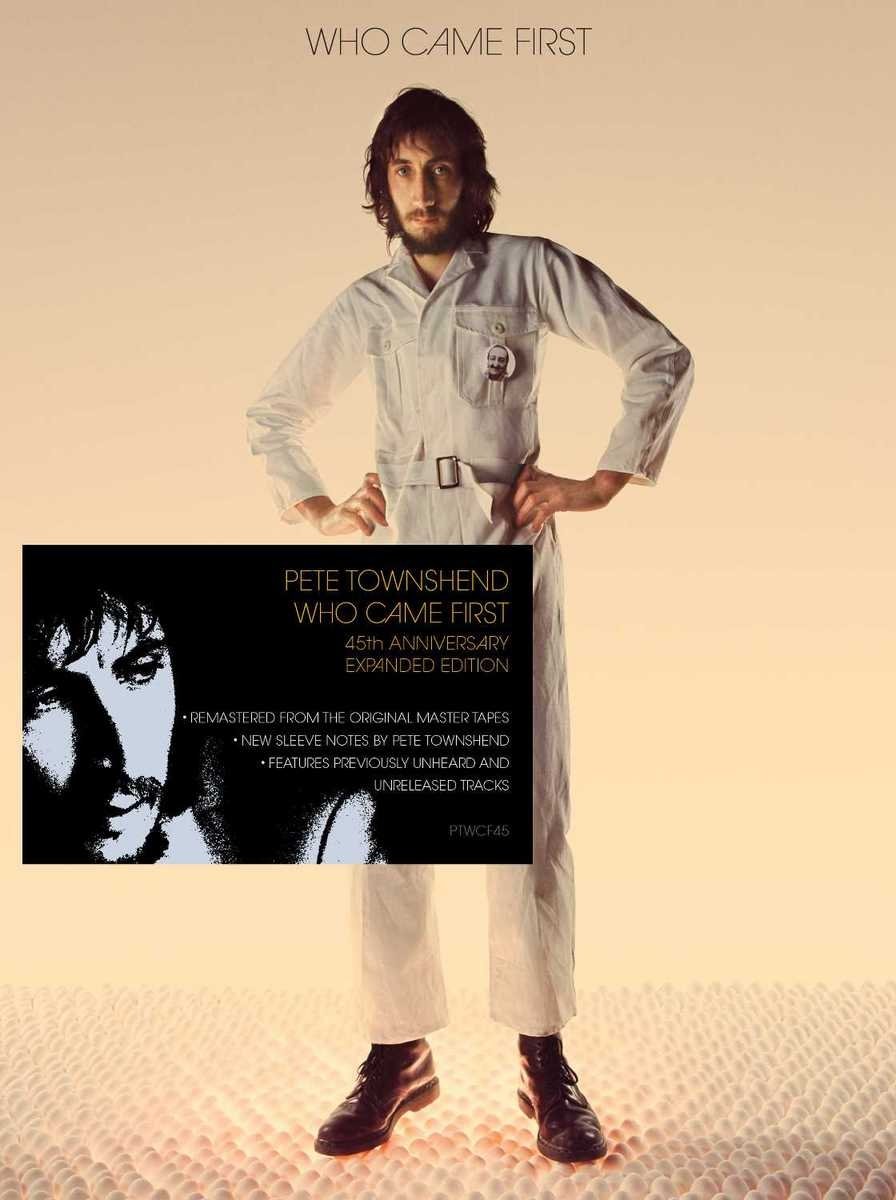
Pete Townshend’s first solo album will mark its 45th anniversary by returning to stores with a second disc of bonus material that includes previously unreleased tracks. the pending plans to reissue Townshend’s “Who CameFirst” LP. Originally released in October 1972, the album marked the Who guitarist and songwriter’s official solo debut, and collected an assortment of recordings that included demos for the band’s aborted Lifehouse project.
According to the label, the 45th anniversary Who Came First reissue, which is scheduled for an April 13th arrival, will add “eight previously unreleased tracks, new edits, alternative versions and live performances,” as well as restored and expanded packaging that includes new liner notes from Townshend, the poster included in the original release and a 24-page booklet containing rare photos from the period that produced the album.
The track listing hasn’t been made available for this edition, but as fans are likely well aware, this isn’t the first time Who Came First has been given the reissue treatment. Rykodisc brought the album to CD with bonus tracks in the early ’90s, and it was subsequently expanded further in 2006, after Universal took over the catalog. Between those two editions, nine extra cuts have already been added to the original track listing, so if nothing else, it should be interesting to see what else has been unearthed for this latest expansion.
This 1972 album gets off to a cracking start with a superb song which fans of The Who will know well – Pure and Easy . While I really like The Who’s dynamic version I prefer this because it sounds more personal, more precise, more…at peace with itself. Yes. For this is indeed a great album and something of a personal and spiritual odyssey for Townshend. The Who’s main composer is in reflective mood here, heavily influenced by the spiritual leader Meher Baba. If you are expecting trademark power chords you’ve come to the wrong album, this is a quiet set of songs compared to his band at their exuberant best. It is something of a tour de force as Townshend sings and plays all the instruments, recording his songs in his home studio. No surprise then that acoustic guitar is very much in evidence and some songs have an almost folky/country feel – one thing that is unmistakeable is the catchy tunes and singalong hooks that Pete seems to produce with ease. If you want an insight into the creative processes and intuitive craft of a classic songwriter this intimate album is probably a good place to start. Townsend’s voice gives more sensitive treatment of his own lyrics compared to Daltrey’s mighty lungs.
It would seem churlish to go through the album track by track, this is one collection which is meant to be heard as a whole and very much proves that the sum is greater etc. Special mentions though for the beautiful Evolution and Heartache, the addictive Sheraton Gibson and a song which again would be recorded by The Who, Let’s See Action. The bonus tracks on this deluxe edition are all worthwhile although none are essential.
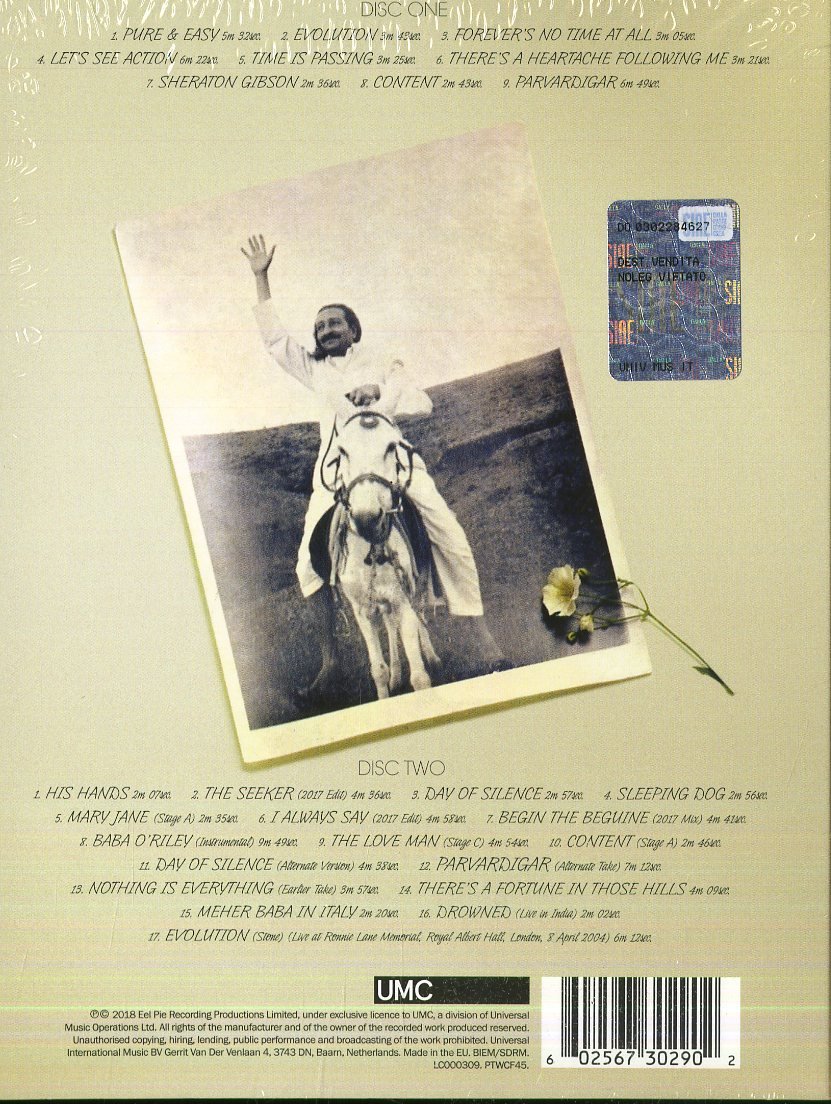
The instrumental His Hands starts like the quiet beginning of Pinball Wizard but you’ll wait in vain for those power chords. Another version of a Who song “The Seeker” seems appropriate in some ways but is also ill at ease in the company of the other songs. The Who version you will remember is a classic song of despair and fruitless searching. Somehow, in context, the lyrics “I won’t get to get what I’m after till the day I die” take on a different meaning. Among the other songs, Mary Jane is perhaps not just about a girl (!)and is a wry song (of the same ilk as Pictures Of Lily, Dogs or Tattoo but not as good) and Begin The Beguine is not a cover you would expect from this guitarist. Sleeping Dog is a touching love song to Baba, while The Love Man could conceivably have made a good Who album track, I Always Say is a McCartneyish blues number and the piano is very much to the fore in instrumental Lantern Cabin.
Meanwhile, his contributions to the new Who Came First booklet notwithstanding, Townshend is in the midst of a quiet spell. As he announced late last year, he’s enjoying a yearlong sabbatical following his marriage to longtime partner Rachel Fuller.
A ’60s-era rock star finding spirituality in an Indian mystic and adopting the teaching philosophy of said mystic is almost a stereotype. However, Townshend has never wavered in his admiration of Meher Baba (The Baba in ‘Baba O’Riley’). While Townshend’s drug use was at odds with Baba’s views, he never tossed out his beliefs throughout the decades. Indeed, his more overtly religious songs were usually tempered with narratives that involved child abuse and salvation (‘Tommy’), Mod culture (‘Quadrophenia’), or an early version of the Internet as connecting people to more authentic experiences (‘Lifehouse’ and ‘Psychoderelict’). However, one song members of the Who were most likely never exposed to during band meetings was ‘Parvardigar’ — a prayer Baba asked his devotees to say every day. Townshend set the prayer to music, and the result is this rather heartfelt and beautiful song.
Blushing are a band formed of two husband and wife pairs, although it didn’t start out that way. Back in 2015, singer and guitarist Michelle Soto plucked up the courage to share some songs she had been working on with friend Christina Carmona. From that friendship, a creative partnership was born, Christina adding her classically trained vocals and bass-playing to the mix, shifting Michelle’s rough sketches into fully formed compositions. Recruiting their spouses, they set about recording the songs that would become their debut EP, Tether.
After the EP’s release, and with growing acclaim, the band went back into the studio as quickly as possible and recorded their latest offering, Weak. The record showcases a sound Blush are making entirely their own; shimmering guitars, rolling bass-lines, heavy drum hits and a vocal set to draw a raft of Cocteau Twins comparisons. From the gloomy Hidden Places to the triumphantly loud Bound, Weak is a record that wears its melancholy with pride.
No Joy / Sonic Boom is Jasamine White-Gluz and Pete Kember.
You know Jasamine from her eight-years (and counting) stint as a founding member and principal songwriter of Canadian shoegaze/noise-pop band No Joy. And Pete Kember is Sonic Boom, of Spacemen 3, Spectrum, and E.A.R.
While neither can accurately recollect how they met, the pair first touched on the idea of working together in an exchange of emails during the fall of 2015. No Joy had just finished touring on the back of LPMore Faithful(their third full-length on the Mexican Summer imprint, and their heaviest to date), and Jasamine was eager to walk a new path. “No Joy functioned as a four-piece ‘rock band’ for so long,” she says. “I wanted to pursue something solo where I collaborated with someone else who could help me approach my songs from a completely different angle. Pete is a legend and someone I’ve admired for a long time. Being able to work with him on this was incredible.”
What started as a sonic exploration between two friends—passing songs back and forth intercontinentally, with Jasamine writing and producing songs in Montreal and Pete writing, arranging, and producing in Portugal—soon grew into a project of substance, the result being four glistening tracks that dance along the lines of electronica, trip-hop and experimental noise.
“I wrote some songs that were intended for a full band and handed them off to Pete, who helped transform them. I barely knew how to use MIDI so I was just throwing him these experiments I was working on and he fine-tuned my ideas. There are barely any guitars on this album, because I was focused on trying to find new ways to create sounds.”
The EP begins with the 11+ minute epic “Obsession,” a disco-y dream trance jam that ebbs and flows, before “Slorb” slinks in, casting its seductive spell. “Triangle Probably” rings triumphant, an industrial beat thumping below, the track interwoven with Jasamine’s silvery vocals. “Teenage Panic” begins in celebration, brimming with hope and excitement, and then—a full stop—before striking back in the form of a droning loop that gathers more and more layers as it spins out into the infinite void.
No Joy / Sonic Boom is an experiment in testing boundaries and stepping out of comfort zones gone cosmically right.
Official music video for “Obsession (Radio Edit)” new song from No Joy / Sonic Boom EP. Out on Joyful Noise Recordings 30th march 2018.
Limited to 300 hand-numbered copies pressed on baby pink inside bottle green vinyl. Instant download of “Obsession” with purchase,
Olden Yolk’s debut ruminates on questions surrounding love, self-doubt, and locating autonomy amidst burgeoning unrest. Wrought with hazy melancholy and halcyon joy, Butler and Shaffer’s lilting vocals play off one another through a devotional dialogue, taking form in haunting choral melodies and candid rock n’ roll. These songs are ecstatic odes to the life of the city; to the subway platforms, kiosks, and monuments which enliven and encompass our collectivity, elevating into an urban-psychedelia.
On the album, Butler and Shaffer are joined by drummer Dan Drohan (Tei Shi, Uni Ika Ai) and guitarist JesseDeFrancesco who round out the studio sessions and live-band. Drohan’s deep passion for jazz, hip-hop, and experimental percussion come to fore while Defrancesco’s minimal yet powerful guitar ambiences are heard swelling in the peripheries of each song. The album was recorded at Gary’s Electric in NYC by Jarvis Taveniere (Woods) with co-production, electronics, and mixing by Jon Nellen (Ginla, Terrible Records). Other guests, such as multi-instrumentalist John Andrews (Woods, Quilt, The Yawns) and violinist Jake Falby (Mutual Benefit, Julie Byrne), add to the mercurial nature of the record, creating a landscape tinged with beatific songwriting and transgressive underpinnings.
From their eponymous debut album, out February 23rd, 2018 via Trouble In Mind Records
from the band: “Vital Sign” represents two sides of a coin. It references feelings of isolation and paranoia felt during periods of illness and confinement, as well as the emergence from such an experience, in recognition of the trials that bind us (“it could have been you too”). The song begins with a reflective moment which quickly reaches a breaking point, accentuated by screeching strings and bellowing background vocals.
Olden Yolk is a New York-based group whose penchant for dystopian folk, abstract poeticism, and motorik rhythms have enveloped them in a sound uniquely of-the-moment yet simultaneously time-tested. The project is led by songwriters, vocalists, and multi-instrumentalists Shane Butler and Caity Shaffer, whose interlaced vocals are found guiding each composition on their enlivening self-titled debut. The project was initially conceived in 2012 by Butler as an outlet for one-off songs and visual art while touring and releasing albums with the band Quilt (Mexican Summer). Following the release of a split-record with Weyes Blood in 2014, Olden Yolk became a collaborative entity.
On the album, Butler and Shaffer are joined by drummer Dan Drohan (Tei Shi, Uni Ika Ai) and guitarist JesseDeFrancesco who round out the studio sessions and live-band. Drohan’s deep passion for jazz, hip-hop, and experimental percussion come to fore while Defrancesco’s minimal yet powerful guitar ambiences are heard swelling in the peripheries of each song. The album was recorded at Gary’s Electric in NYC by Jarvis Taveniere (Woods) with co-production, electronics, and mixing by Jon Nellen (Ginla, Terrible Records). Other guests, such as multi-instrumentalist John Andrews (Woods, Quilt, The Yawns) and violinist Jake Falby (Mutual Benefit, Julie Byrne), add to the mercurial nature of the record, creating a landscape tinged with beatific songwriting and transgressive underpinnings.
From debut album out February 24th, 2018 on Trouble In Mind Records
If, like us, you have a thing for dystopian folk, abstract poeticism and motorik rhythms then Olden Yolk can happily tick those boxes for you. This has echoes of the Arthur Lee’s Love .
The New York-based group led by songwriters, vocalists, and multi-instrumentalists Shane Butler (of Quilt) and Caity Shaffer, are set to release their self-titled debut album on23rd February via Trouble In Mind.
We previously shared tracks Takes One To Know One and Vital Sign, and now we have latest single, Cut To The Quick, which the band describe as being, “about reclaiming oneself when the pressures of the outside world seem to close in around you. The video was largely shot in NYC and Austin, TX; two places that have been homes to us at one time or another. It plays with abstraction, memory, and the simple acts we go through on a daily basis to construct some semblance of identity.”
From debut album out February 23rd, 2018 on Trouble In Mind Records
Featuring members of Braid, Their / Coaster and Stay Ahead of The Weather This is the third EP from LiftedBells, but rest assured, they won’t be releasing new music in bite-sized formats forever. “The EP will hopefully be a fresh introduction to the band and what we’re up to,” Nanna says. “We’re already over halfway done with a full length and are looking forward to getting out on the road. It’s going to be a fun, wild ride.”
Katie Toupin, formerly of the band Houndmouth, is set to release her debut EP on March 2nd. it was sad news when she parted way with Houndmouth as I thought they had something special going there a terrific live band. But based on this first track, it looks like Toupin has got a lot more to show us. Here’s how the EP came to be.
After years on the road with Houndmouth and a brief hiatus while getting settled in Los Angeles, Katie returned to writing. The resultant material became the EP Moroccan Ballroom, a totally authentic expression of Katie. The Moroccan Ballroom EP was recorded entirely live (with no overdubs or edits) in a single day at Village Studios — it was meant to be a simple shoot for some of her newly-written songs, but Katie was so enamored with the outcome that she wanted to give them a proper release.
“Danger” was filmed during the live recording of “Moroccan Ballroom” on 12/11/17 Katie Toupin’s debut EP “Moroccan Ballroom”
In 1975, the album Born to Run catapulted Bruce Springsteen from a regional critical favorite to a worldwide megastar.
But after Born to Run‘s release, a legal battle with his former manager, Mike Appel, kept Springsteen from making a follow-up album for nearly two years. Springsteen spent his time touring extensively across the U.S. with the E Street Band. When he returned to the studio, in 1977, he brought with him dozens of songs that he had written during his exile.
Those studio sessions produced Springsteen’s fourth album, 1978’s Darkness on the Edge of Town. It was musically very different from Born to Run — and drew thematically from the punk-rock movement, the Vietnam War and Springsteen’s own reflections about wanting to stay connected to his roots.
But many of the songs Springsteen wrote for that album were never released.
“Darkness on the Edge of Town came out of a huge body of work that had tons of very happy songs,” Springsteen told actor Ed Norton at the Toronto International Film Festival in September. “It was all music that we recorded, we wrote and made a very distinct decision to not use.”
Twenty-one songs Springsteen originally recorded for Darkness on the Edge of Townare now being released for the first time as part of a collection called The Promise. Here, we feature some of Springsteen’s conversation with Norton at the Toronto International Film Festival, where the two men talked about the making of Darkness,as well as a new documentary about the album, titled The Promise: The Making of ‘Darkness on the Edge of Town.’
Many of the songs cut from Darkness on the Edge of Town are being released in the box set The Promise, which comes out tomorrow. The box set also includes a remastered version of Darkness, 2 CDs of songs that were recorded but not used for the album, along with the documentary, The Promise, and DVDs of other live performances.
Bruce Springsteen performs shortly after he recordedDarkness on the Edge of Town.
Jim Pozarik/AP Photo
Interview Highlights
On Darkness In Music
“Some of the greatest blues music is some of the darkest music you’ve ever heard. And I had maps. Obviously, Dylan had come when I was 15, and obviously I listened to his music first, and his music contained a lot — I used to say when I heard ‘Highway 61,’ I was hearing the first true picture of how I felt and how my country felt. And that was exhilarating. Because I think 1960s small-town America was very Lynchian. Everything was there, but underneath, everything was rumbling. … I think what Dylan did, was he took all that dark stuff that was rumbling underneath, and I think he pushed it to the surface with irony and humor, but also tremendous courage to go places where people hadn’t gone previously. So when I heard that, I knew I liked that, and I was very ambitious, also.
On The Timing Of Darkness’ Release
“I think Darkness came out of a place where I was afraid of losing myself. I had the first taste of success [with Born to Run], so you realize it’s possible for your talent to be co-opted and for your identity to be moved and shifted in ways that you may not have been prepared for. I was the only person I’d ever met who had a record contract. None of the E Street Band, as far as I know, had been on an airplane until Columbia sent us to Los Angeles. … It was a smaller, smaller world. And we were provincial guys with no money. So there was this whole little street life in Asbury Park, and New York was a million miles away. Localism, as a movement, hadn’t occurred yet in music. So there was nobody saying, ‘I need to see what those bands in New Jersey are doing.’ It was a very different time. But the good part about it was you were very, very connected to place and you had a real sense of place. And it was unique, the place where you lived and where you grew up.”
On Where The Tracks On Darkness Originated
“No one knows anyone else who has any money. They only know you. And at the time, even though we’re making a lot of records, we’re not making much money, because we didn’t know how to make records, or because I signed a lot of bad deals and it all went away. My desire to not get disconnected from my parents and their history and a lot of the people I cared about; I said, ‘These things aren’t being written about that much. I’m not sure. And those were the topics I decided to take on for that particular record, not so much out of any social consciousness, but as a way of survival of my own inner life and soul.”
On Musical Influences
“I don’t know if I know anyone, with the exception of the early inventors of rock music [who wasn’t influenced by something]. And even then, the kind of study that had to go on — like the gospel background in Jerry Lee Lewis’ piano playing, and it’s completely informed with church and honky-tonk — and you have to study that stuff. I don’t mean study in the sense of literal schooling, but you’re drawn to things that make you seek out what they’re about. That’s studying. And whether you’re drawn to gospel music or church music or honky-tonk music, it informs your character and it informs your talent.”
On Great New Music
“If you’re good, you’re always looking over your shoulder. I mean, that’s the life — that’s the gun-slinging life. It’s like, ‘Yes, you are very fast, my friend, but there’s some kid in his garage tonight, and just about 10 minutes from now…’ You can’t make any mistake about it. The record and documentary show that [that album] was carved meticulously and consciously out of a big chunk of stone over a long period of time, with a huge amount of ego and ambition and hunger, hopefully for the right things.”
2 VERSIONS WERE RECORDED OF THIS AMAZING SONG. Recorded at The Record Plant on October 14, 1977. V1b includes a horn section (Cruz-Manion-Pender-Rosenberg-Spengler) that was recorded in 1998 (not 1977) and then added to create the end product on Tracks. However this E Street Band base recording (i.e., without the 1998 horns) was used as the base recording for Southside’s original 1978 album track, with Southside merely replacing Bruce’s vocal with his own and adding in his own horn players at the time.
DARKNESS DOSSIER DAY 3: THE OUTTAKES
According to comments by Darkness sessions recording engineer Jimmy Iovine about 30 songs were recorded to a completed state and available for inclusion on the Darkness album. There were an unknown number of additional songs not fully completed. What “not fully completed” means is uncertain. At this stage 32 songs have been officially released (the ten on the original album, four on Tracks and 18 on The Promise) but several of these have modern vocal takes, and their 1978 state remains unknown. There is also an unknown amount of not fully finished recordings. The list below contains 54 songs from the period that likely encompass all or nearly all of the 30 songs Jimmy Iovine was alluding to, as well as most of the ones never completed.
The audio from the Darkness sessions that has surfaced unofficially over the years has been of rather disappointing quality. During the late 1970s and 1980s most of it was of very weak quality. However over the past 20 years lower generation audio specimens have emerged and the CD-era boots of this audio have been a noticeable improvement over their vinyl era counterparts. Yet in many cases it has become apparent that there were flaws in the way the original source individuals taped these studio sessions. There certainly appears to have been some hidden “fly-on-the-wall” type tapings. The other problem is that much of the leaked audio is of early studio workouts of these songs, rather than later, fully realized renditions. Most of the leaked studio material emanates from the June-October 1977 period, so the later November 77-January 78 sessions may include several other songs that remain undocumented, even after the release of The Promise.
The 2010 release of The Promise is somewhat of a double-edged sword. We now have a slightly better understanding of the Darkness sessions, as well as access to several tracks that were previously unknown to us such as “Save My Love” and “Breakaway”. However, the wonderful notebook facsimile included in the box set lists titles of many songs (see Part Four below) that are totally new to us. It is unknown how many of these songs actually exist; many may not be songs at all – just titles. Jimmy Iovine mentions in the making of documentary that Springsteen wrote seventy songs for potential use on “Album IV”. It remains a possibility that even the seventy songs mentioned by Iovine is a conservative estimate of Springsteen’s true output at this time. A case of three steps forward, two steps back?
GOTTA GET THAT FEELING. 3 TAKES.
V1 recorded at Atlantic Studios in August 1977. V2 is more fully realized. Up-tempo, pop-flavored. The officially released V3 contains a modern vocal take, replacing the unfinished vocal found on the ‘Deep Down In the Vaults’ recording. V1 and V2 were bootlegged under the title “Get That Feeling”. Takes recorded at either Atlantic or Record Plant on August 11-12 and 30, 1977.
OUTSIDE LOOKING IN. 2 VERSION
V1 recorded at Atlantic Studios on June 1, 1977. This is a very rough early take with an uneven mix and some seriously off-key harmony vocals by Van Zandt. V2 was recorded September 27, 1977 at The Record Plant, officially released (unmolested) on The Promise in 2010.
come on let´s go tonight. 2 version
V1 is a rough workout, probably from either July 2 or 13 at Atlantic Studios, with the melody complete but with embryonic, alternative lyrics. V2 is the final released take, titled “Come On (Let’s Go Tonight)”. Also recorded at either Atlantic or Record Plant on August 23-24 and 30, and at The Record Plant on September 8, November 2, 7-8 and December 9 and 29, 1977. The early, work-in-progress title was “Let’s Go Tonight”. Aspects of the music and lyrics can also be found in “Factory”. Bruce would return to the song in April 1981 during a break in The River Tour, recording a solo acoustic demo. Soon after, he borrowed the first two lines of Chuck Berry’s “Bye Bye Johnny”, combined it with “Come On (Let’s Go Tonight)”, and created “Johnny Bye-Bye”. The composition was premiered live in May 1981 and recorded in the studio in 1982 and 1983.
V1 apparently dates from August 1977 at Atlantic Studios, although studio logs indicate takes were only recorded on June 30, 1977. V2 likely dates from around the same time and is more developed but still features some bluffed lyrics. The logs say a song called “New Spanish” was recorded two weeks later on July 13; one assumes that is “Spanish Eyes”. The officially released V3 has a modern vocal, and potentially some modern band elements. A great song that shares several lyrics with “I’m On Fire”.
Recorded at The Record Plant, perhaps on September 27, 1977. The circulating audio is marred by the vocal being buried in the mix. The very strange working title for this was “Say Sons”. Short rocker.
BECAUSE THE NIGHT. 4 TAKES
Note: V1 is from Atlantic Studios in June 1977 with the lyrics not finished. V2 (recorded a month or so later) is less embryonic but still with some bluffed lyrics. It was soon after (late September 1977) that fellow NJ poet/rocker Patti Smith, who was also recording at The Record Plant, became aware of the tune via Jimmy Iovine (who was engineering both artists). The not-quite-finished song was handed to Smith, who fine-tuned the lyrics and released the song in March 1978, three months before the Darkness album was issued – and it was a worldwide hit. V3 was recorded September 27, 1977 at The Record Plant. This take was broadcast on Sirius / E Street Radio, is more realised but still not the finished item. The officially released V4 uses Smith’s lyrics and is a modern vocal take.
The 9 versions recorded provide a good insight into how Springsteen develops some songs through the course of numerous sessions, with all three being distinctive songs.
Candy’s Boy: V1 is a summer 1976 band rehearsal in Bruce’s house in Holmdel, NJ and is included on the Thrill Hill Vault DVD/Blu-ray on The Promise: The Darkness On The Edge Of Town Story box set. V2 and V3 are from Atlantic Studios in June and August 1977 respectively and contain the familiar lyrics but utilize a different melody. V4 is longer, and includes an extra instrumental section. The officially released V5 (from June 1977) bears a strong resemblance to V3. Logs show takes of “Candy’s Boy” were recorded on June 3, 6 and 27, August 24 and September 2, 1977). Early alternative title was “(I Will Forever Be) Candy’s Boy”. Included on an October 1977 album cover mock-up.
The Fast Song: V6 is the familiar “Candy’s Room” melody, with no lyrics. V7 and V8 feature nondescript, bluffed lyrics (all three from August 1977 at Atlantic). Takes of “The Fast Song” were recorded June 6, 9-10, 13-14, 20 and 24, 1977 at Atlantic, with further work undertaken on August 24 and September 1-2. Lyrics found at the beginning of “The Fast Song”, “I wish God’s angels would tear this town down / and blow it into the sea”, are also found in some performances of the “Backstreets” interlude from 1977’s Lawsuit Tour (most famously on March 25 in Boston), as well as some early versions of “Something In The Night”, e.g. February 13, 1977 in Toronto. Original or alternative title of “The Fast Song” may have been “God’s Angels”, one of the song titles found in The Promise book.
V1 is from September 1977 at The Record Plant and is a rough workout with lyrics very bluffed. V2 is more developed, with nearly finished lyrics and is likely to date from shortly after. V2 also contains phrases also found in “Frankie”, “Prove It All Night”, and “Badlands”, most notably “For the ones who once had a notion, it ain’t no sin to be glad you’re alive”. Takes recorded on September 26-28 and November 4 + 7, 1977. Mixed in November 1997 for the Tracks project, but not used. Also known in collector circles as “All Night Long”. The audio quality on Scorpio’s ‘Loose Ends’ is the best.
V2 officially released on The Promise, recorded October 14, 1977 at The Record Plant. Bruce’s working title was “Taxi Driver”. Also known as “Taxi Cab” and “City At Night”. Shares a line with 1988’s “All That Heaven Will Allow”.
Recorded at The Record Plant on October 14, 1977. This is fully finished take but the circulating audio is slightly marred by the vocal being buried in the mix. The working titles were “Bo Diddley Rocker” or “Bodo Rocker
At least four takes recorded at The Record Plant on September 12, 1977 and played once on the Darkness Tour on December 28, 1978 in Pittsburgh, PA. Re-recorded for The River. A song titled “Rocker” was registered with the US Copyright Office in January 2011 but information on the copyright claim suggests this is actually “Ramrod”. It was registered because a short audio snippet was included in The Promise: The Making Of Darkness On The Edge Of Town, the documentary included on the box set.
An unknown composition before the official release of The Promise. Features Jon Landau on drums, Bob Chirmside (Bruce’s road manager between ’75 and ’81) on bass and a modern horn section of Barry Danielian (trumpet), Stan Harrison (tenor sax), Dan Levine (trombone), Ed Manion (baritone sax) and Curt Ramm (trumpet). Early working title may be “Jon’s Jam”, as found in the studio logs. A lone take was recorded June 14, 1977 at Atlantic Studios. The connection is Jon Landau, who provides the drums.
someday we´ll be together. 2 version
V1 recorded at The Record Plant in September 1977. This is only the backing track – Bruce’s vocal is missing (assuming there was one). Takes recorded at The Record Plant on September 26 and 29-30, 1977. Bootlegged with the title “Someday Tonight”. V3 is officially released on “The Promise” with a probably completely modern vocal take. The track features backing vocals by the Alliance Singers (Tiffeny Andrews, Corinda Crawford, Michelle Moore, and Antoinette Savage), who contributed choir vocals on The Rising album, in addition to Patti Scialfa and Soozie Tyrell.
one way street. 2 version
V1 Recorded at Atlantic Studios on June 17, 1977. This is a complete take but it’s clearly not a final take. V2 officially released on The Promise with what appears to be a modern vocal. It is also likely that the horns were re-recorded as well. Original alternative title may have been “Dead End”.
Talk to me.
Note: Takes recorded at Atlantic Studios on July 8 and 13, either Atlantic or Record Plant on August 5, 9, 24, 26 and 30, and at the Record Plant on October 14, 1977. V1 (missing Bruce’s vocal) is from Atlantic Studios in August 1977. V2 is the officially released take from The Promise, and features some original Jukes/Miami Horns members: Rick Gazda on trumpet, Stan Harrison on tenor sax, Ed Manion on baritone sax, Bob Muckin on trumpet, and Richie “La Bamba” Rosenberg on trombone. It is uncertain whether the horns are contemporary to the original recording, or a modern addition. The latter seems more likely. Bruce donated this composition (and “Hearts Of Stone”) to Southside Johnny in spring 1978 for use on his upcoming third album. According to Max Weinberg, as with “Hearts Of Stone”, the Darkness session E Street Band backing track was utilized for Southside Johnny’s album.
V1 recorded at Atlantic Studios June 1977. V2 fades in, repeats the last verse and is likely to emanate from the same time period. Takes were recorded June 24 and 27, and July 1, 1977. Premiered live during the Darkness Tour with a spoken introduction: “This was a song that we recorded live in the studio about two years ago, the beginning of the summer and it was originally gonna be on Darkness, but it was too weird so we left it off”. Re-recorded for The River album.
Recorded at Atlantic Studios, probably very early in the sessions, perhaps June 1977. The audio take is very unfinished, with bluffed lyrics. No complete take is circulating from the Darkness sessions, although this song (like several others from these sessions) was re-recorded in 1979-80 during sessions for The River and that version has been issued on Tracks.
A Darkness On The Edge Of Town outtake recorded in Oct-Dec 1977 at The Record Plant, New York City, NY. Its working title was CRAZY ROCKER, but it’s also known among collectors under the title IT’S ALRIGHT. The only circulating recording of this song is of a nearly finished take but the audio quality is not great. It’s messy and full of indecipherable, bluffed lyrics and yelled out key changes. It can be found on Deep Down In The Vaults (E Street Records), The Genuine Tracks (Scorpio), and The Definitive Remastered Darkness Outtakes (The Godfather Records) bootlegs. This is an early (but entertaining) take with bluffed lyrics and called out key changes. “Crazy Rocker” was a working title, and it has also been known under the title “It’s Alright”. Does not specifically appear in the studio logs, but it may be “New Rocker”, recorded at either Atlantic or The Record Plant on August 9, 1977.
Three slightly different mixes of the same performance. Takes recorded at either Atlantic or Record Plant on August 5 and 15, and at The Record Plant on September 12 and December 10-12, 1977. V1c is slightly faster, and officially released on The Promise, albeit as a hidden bonus track. Considered and rejected for Darkness On The Edge Of Town, Tracks and The Essential.
It is uncertain from which period of the Darkness sessions these two versions emanate from – probably from The Record Plant. V2 (which is in very weak sound quality) is sometimes listed under the alternate title of “I Wanna Be Wild” but these are clearly the same song with just alternate work-in-progress lyrics. A take of this song with the title “I Want To Be Wild” was recorded at the Record Plant on November 11, 1977. “Don’t Say No” was registered with the US Copyright Office in November 2010, suggesting that it may have been a candidate for inclusion on The Promise.
Studio logs indicate that Springsteen worked on this song at only two sessions, June 16 at Atlantic and August 24, 1977 at The Record Plant. V1 is definitely from that June session, V2 is probably also from June (an image of a tape inlay dated June 17 found in the Darkness box set book lists two takes), but could be from the August session. If V2 is from June, then the August 24 take does not currently circulate amongst collectors. V2 has a different opening and is shorter, lacking Clarence’s saxophone solo. Note that although some bootleg CDs (such as Godfather’s ‘The Unbroken Promise’) include two versions of the eight minute “Drive All Night”, it appears that they are actually the same recording. Listed on some early vinyl boots by the title “Sad Eyes”. Bruce re-recorded the vocal track during The River sessions, but apparently used the Darkness session backing music for the officially released version found on The River.
V1 dates from June 3, 1977, V2 from just over a month later, July 12, 1977. Both recorded at Atlantic. Bruce re-recorded the song five years later during the Born In The USA sessions and that later version (on Tracks) is far superior to either of these renditions.
Recorded at The Record Plant on October 27, 1977. This is a completed take and one of the few that has surfaced from the sessions with the vocals mixed correctly. Also known as “New BoDo Rocker” in the studio logs. Bruce incorporated elements of the song into the middle of “She’s The One” during the latter stages of the Darkness tour.
Recorded at Atlantic Studios on June 1, 1977. Takes also recorded on July 1 (also at Atlantic), as well as September 12 at The Record Plant. This is complete but clearly not a final take. Bruce re-recorded it during the River sessions and it’s that version which is found on Tracks.
Recorded at The Record Plant, probably September 26-27, 1977. The sound quality of this particular piece of audio is weak. Also recorded at either Atlantic or Record Plant on August 15. Further work undertaken at The Record Plant on November 4 + 11 and December 9. Short-listed for inclusion on Darkness On The Edge Of Town, included as it was on an October 1977 album cover mock-up. Bruce re-recorded this for release on The River.
The only circulating audio is apparently from Atlantic Studios in June 1977, although the only appearance in the logs is October 14 at The Record Plant. An embryonic take with very unfinished lyrics and a lovely melody. Bruce’s work-in-progress title was “The Ballad”.
Unknown composition until officially released on The Promise. Recorded at Atlantic Studios on June 1, 1977, but modern vocals have been added, along with some modern band elements. Features a modern horn section of Barry Danielian (trumpet), Stan Harrison (tenor sax), Dan Levine (trombone), Ed Manion (baritone sax) and Curt Ramm (trumpet) and backing vocals by the Alliance Singers (Tiffeny Andrews, Corinda Crawford, Michelle Moore, and Antoinette Savage), who contributed choir vocals on The Rising album, in addition to Patti Scialfa and Soozie Tyrell.
The promise: Considered for the album, but ultimately rejected due to the personal lyrics. “It was a song about defeat, and it was self-referential, which made me uncomfortable,” said Springsteen in 2010. “I didn’t want it to overtake the album, which, in the end, was not my personal story. I wanted ‘Darkness’ to be completely independent of that. So I left it off. But I remember saying to myself, ‘This is something I can sing later.’ The distance really helps it now.” Premiered live on August 3, 1976 at Red Bank’s Monmouth Arts Center in a solo piano arrangement. It would be performed that way throughout 1976 and 1977, however all circulating studio takes are with the band. V1 is from June or July 1977 (takes were recorded June 30 and July 1, 7-8 and 13, 1977). V2 is from August 1977 (takes recorded August 24 and 30 at Atlantic Studios). Both V1 and V2 feature slightly different lyrics. V3 is probably from The Record Plant in the September-October 1977 period (perhaps the September 28, 1977 performance recorded in the studio logs) and is the completed recording that Bruce rejected for Tracks. He instead opted to record a new version (issued on 18 Tracks) that pales in comparison to the stunning V3. V4 (also recorded August 1977) is the official release included on The Promise CD, featuring a string arrangement by Ken Asher. Interestingly, V4 lacks the “…dead ends in the two-bit bars” and “…backseat of a borrowed car” lyrics from the final verse, both of which are present in all other circulating studio takes. V5 is a studio rehearsal recorded at The Record Plant in (probably early) January 1978 and is included on the Thrill Hill Vault DVD/Blu-ray on The Promise: The Darkness On The Edge Of Town Story box set. V6 was recorded after this rehearsal, on January 12, 1978, and remains in the vaults.