Archive for the ‘CLASSIC ALBUMS’ Category

For their sixth album,”Marauder“, Interpol come out swinging. English-American singer and bassist Paul Banks, lead guitarist Daniel Kessler and drummer Sam Fogarino have been playing together now for 21-years, about the age they each were when the band formed back in 1997. The recording for this record began in 2016 with a 15th anniversary tour of the band’s first and classic album Turn On The Bright Lights sandwiched in between the recording session. The band took on famed producer Dave Fridmann, known for his band Mercury Rev but also for producing music by Flaming Lips, Weezer, Sleater-Kinney and many more, just to give an idea of his visceral aesthetic.

For a sense of Marauder, Paul Banks here dives into detail and unveils some of the thoughts that went into this record.

1. “If You Really Love Nothing”

One of the swing jams. Sam is rocking a shuffle and the rhythmic poise is uncommon for us.

The song has some of my favorite lyrics: “If you really love nothing, everybody’s made up, everybody’s losing.” It’s a similar sentiment as expressed by “Stella.” “The building fronts are just fronts.” Both songs, I suppose, center around a narrator who is perplexed by a woman with unwieldy psychological pathologies involving paranoia and dissociation. This song, like “Stella,” suggests the narrator gives up on this woman ultimately. The choruses feature the best guitar interplay on the record.

2. “The Rover”

“The Rover” was one of the first songs we got cooking. Daniel introduced the riff and the rest came very quickly — bass, drums and vocals.

I wanted to keep the bass and guitar simple in the verses. I felt that the counterpoint of a drone against Daniel’s poppy, sharp progression would provide a bottled-up energy that we release when the chorus arrives and the bass and guitars diverge.

The lyrics are about a seductive, charismatic cult leader who has no trouble amassing young followers. His message is one of inclusion, obedience, hedonism, and salvation. The end is nigh, so come and see me.

3. “Complications”

Another swinger. Sam really stretching out and having fun. One of my favorite songs. I feel that the “The Rover” and “Complications” exist in the same world — in the same movie. If “The Rover” were walking through the desert on an acid trip, then “Complications” is the song playing in the jukebox of the dive bar where he winds up — the come-down at sundown.

4. “Flight of Fancy”

This song has a very strange chord progression from Daniel. I think in my mind it begins on the 5th chord of the melody and then plays out like: 5, 1, 2, 3, 4. But if you ask Daniel, the order of the chords is as you hear them: 1, 2, 3, 4, 5. Basically I think he’s starting his melody in the “wrong” place. And he thinks I’m nuts. We are probably both right.

But that difference of orientation lent itself to a fun and fluid arrangement between bass and two guitars. I think it would be difficult for someone else to learn the song because it doesn’t really seem to follow any rules. To play it correctly, I first had to memorize my bass pattern before I could feel it.

Lyrically the song begins as a lover’s lament — much like “NYSMAW” — the idea is, why can’t I know you?

Then the chorus opens into a defiant assertion. A claiming of agency. My thoughts are my own. And I am my thoughts. It suggests in the feel and tone (and in my mind) that one day we will not just be defending our right to privacy and free-speech. But we may some day find ourselves defending our freedom of thought. It’s another song, like “Surveillance,” that thematically is akin to an episode of Black Mirror. I just like the idea of reclaiming the right to free thought.

5. “Stay In Touch”

Our gothic jam. Daniel loved the simple ominous descending bassline and never let me change it. 🙂 His riff has always struck us — it has a beautiful hollow, woody timber — hooky but vague. Moody and distant, but sticky and inviting. Producer Dave Fridmann loved it immediately for how it invited his ear. It’s amorphous. We slaved to make it hold together as a song while maintaining the nebulous quality of Daniel’s languid shifts. The third verse features a cool Eastern or African sounding guitar part from Daniel. Very sparse but filled with kinetic energy. It inspired my second best riff on the record, lovingly referred to as “Cuban Bill Gates.”

Sam brought the flavor on this one.

6. “Mountain Child”

In my mind the narrator is perhaps the same character from the “Rover” — a dusty man. Here, he’s in love with a girl who is in love with nature. She is a social outcast by choice. She prefers the wild. But the narrator can see her — knows the ilk of her spirit and chooses to follow her.

In the third verse he is bitten by a venomous snake. And as the song proceeds, his consciousness breaks down as the toxin invades his senses. He becomes nonsensical, fevered: “My mountain child is strange and I’m a kind of hero. We used to rule back then. What did we used to rule back then?” [These] are his last thoughts before he perishes.

The outro features my fourth favorite riff, but it’s really just an inversion of what Daniel is playing.

7. “NYSMAW”

Just an easy breezy pop rocker. Dancing, punchy energy. Daniel coordinated the snare accents to emphasize his stabbing, off-kilter guitar hits. Lyrically the song is about wanting to understand more of one’s partner. It’s the frustration that we cannot know all and the frustration that she in fact may know all of me.

8. “Surveillance”

Sam and Daniel often championed this song’s disco beat and high-energy propulsion. Harmonically it’s a strange journey. Daniel’s chord pattern begins as a four-chord pattern, then he adds a chord to his sequence, making it five-chords. Then he adds a sixth chord. It’s like a round that acquires a new facet with each pass. It gives an illusion that there is no clear anchor to the verses, but there is always the four-chord nested pattern. [It] never rests.

Sam brings a special energy on this track. Signature Sam dance style. The bass and drum interplay here was something we worked on diligently. If it came out correctly we should be flamming. This song features my third best guitar riff, nicknamed “Bill Gates.”

(It appears in the outro.)

9. “Number 10”

This song was destined to be a B-side. I had written a fun surfy baseline that jived well with the drums but I was never super stoked on the song. In the studio we just recorded it because we had some time. But there was no second guitar and no vocals.

When we tracked it, it came out really explosive and fun. The additional guitars and vocals were written in a few hours over two afternoons. No fuss no muss.

The lyrics are about an office drama. The narrator is tired of his supervisor, Ella breathing down his neck. She’s a tough boss. But there is also a love there, a secret attraction. A mutual secret attraction. But alas, business is business and their desire is never sated. I think that feeling of frustration and desire suits the temperment of the music. The flighty intensity. Pent up lust.

I love this song. It’s the loosest, most spontaneous and unpolished track on the record, and I’m proud of its garage feel and grit.

10. “Party’s Over”

Popping pills and masturbating to Instagram. (Fiction!) Also an anarchist call to arms.

11. “Probably Matters”

It’s like an impressionist/surrealist film about a defunct relationship — the remorse, guilt, and shame that can nag us through the haze of afterthought.

Interpol’s new album Marauder out on Matador Records on August 24th.

The Ohio folk-rock band Saintseneca has carved out a nifty discography using unexpected tools in inventive ways. There’s the exotic instrumentation, sure stuff like the balalaika and the bouzouki, to go with more familiar sounds – but the group also has a real gift for matching fatalistic, ruminative rambles to arrangements that sparkle and surprise. In the brightly infectious “Moon Barks at the Dog,” one of many highlights from their new album “Pillar of Na”, Zac Little suggests an M.O. for Saintseneca that fits into just six words: “Weep with me in 4/4 time.”

The Columbus, Ohio group’s latest single, “Beast in the Garden,” uses Adam and Eve’s exile from Eden as a nostalgic discussion point, stopping short of any sermonizing or guilt-tripping. Its intricate finger-plucking bursts joyously into a mix of jubilant horns, anxious violins, and sprawling Zither-based instrumentation. Little’s voice rings with urgency as he sings, “Beast in the garden/Be still guarding the gate,” referencing the couple‘s inability to return to paradise.

Four albums into its career, Saintseneca continues to poke at its sound’s margins, as the new record’s nearly nine-minute title track incorporates fluttering acoustic instruments, a crowd-pleasing folk-rock jam, a stormy crescendo, a verse about Dolly Parton’s “I Will Always Love You,” a chant of “We all must get stoned” and an a cappella coda that revisits “Circle Hymn,” the track that opens the album.

But Pillar of Na’s artier reaches also liven up more broadly accessible jams like “Frostbiter,” which marries oblique musings on death, dashed hopes and survival to choruses sweet enough to swoon to.

Band Members
Zac Little, Caeleigh Featherstone, Steve Ciolek, Jon Meador, Matthew O’Conke

Image may contain: fruit, text and food

Image may contain: 3 people

Brisbane nervy pop champs The Goon Sax have just released We Can’t Win, a heart-wrenchingly beautiful new song from their second album We’re Not Talking, which comes out September 14th.

As soon as the album comes out, they take off on their biggest international tour yet, taking in UK, Europe and the US from September through November. Taken from the fothcoming album, We’re Not Talking (out Sep 14 on LP, CD and digital) via Wichita Recordings and Chapter Music (Aus/NZ).

We’re also going to be doing another tour. we’ll be doing shows in Europe and America after that. Here’s those dates:

Mon 17 September – Hug & Pint, Glasgow UK
Tue 18 September – Headrow House, Leeds UK
Thu 20 September – Hare & Hounds, Birmingham UK

Band Members
James Harrison, Louis Forster, Riley Jones

Some musical partnerships are so strong, intuitive and natural that they almost can’t be separated due to the natural magnetism present in the relationship. One such tight knit songwriting family are Tunng, and their new album Songs You Make At Night reunites founding members Sam Genders and Mike Lindsay (fresh from his LUMP side project with Laura Marling) and the rest of the Tunng gang for the first time since 2007’s Good Arrows.

“We really wanted to do a Tunng record going back to the original line up,” Lindsay says. “there was a real magic in the early records that we all wanted to capture again in this one.”

Since forming in 2003 and over the course of five albums, Tunng are a group that have explored the boundaries between acoustic and electronic music, becoming synonymous with the folktronica genre before moving into territory that managed to both evade that label and continue to redefine it. Songs You Make At Night finds a group of people reconnecting with a previous collective state to bring out something new and forward-looking. “We’re all so different but each bring something essential, something Tunng to the party. Be that to the studio, to the stage, to the van, or to the pub. I think that the new songs Mike and Sam have crafted between them have brought out the best in all of us.” confirms singer Becky Jacobs.

Songs You Make At Night is also Tunng’s most electronic-leaning to date. Take lead single ABOP which brings the Moog right to your face, with a heavily swung frazzled 808 pigeon beat that builds into a magical folk pop feast.

http://

Songs You Make At Night’s tone, theme, lyrics, mood and characters exist in a fluctuating state between night and day (“I got very much into the idea of a dark underwater world suffused with pockets of light and beauty and some of the songs grew out of that.” says Sam Genders), the conscious and unconscious. Crepuscular in its nature, Lindsay explains the all-encompassing title. “I think it’s also important to stress the songs you make at night not, we make at night. Then the word “songs” can mean a multitude of things. It can mean songs, or dreams, pillow talk or actions and decisions, moves, and can be very personal… the thoughts that keep you awake at night.”

released August 24th, 2018

The shifting dimensions of Masana Temples, fourth album from psychedelic explorers Kikagaku Moyo,are informed by various experiences the band had with traveling through life together, ranging from the months spent on tour to making a pilgrimage to Lisbon to record the album with jazz musician Bruno Pernadas. The band sought out Pernadas both out of admiration for his music and in an intentional move to work with a producer who came from a wildly different background. With Masana Temples, the band wanted to challenge their own concepts of what psychedelic music could be. Elements of both the attentive folk and wild-eyed rocking sides of the band are still intact throughout, but they’re sharper and more defined.
More than the literal interpretation of being on a journey, the album’s always changing sonic panorama reflects the spiritual connection of the band moving through this all together. Life for a traveling band is a series of constant metamorphoses, with languages, cultures, climates and vibes changing with each new town. The only constant for Kikagaku Moyo throughout their travels were the five band members always together moving through it all, but each of them taking everything in from very different perspectives. Inspecting the harmonies and disparities between these perspectives, the group reflects the emotional impact of their nomadic paths. The music is the product of time spent in motion and all of the bending mindsets that come with it.
releases October 5th, 2018

The news that John Lennon‘s 1971 album Imagine is to be reissued as a six-disc super deluxe edition box set, with outtakes, sessions, quad mix, demos etc., is exciting for a number of reasons.

First off, it’s one of only a handful of albums from ex-Beatles that truly approach ‘classic’ status. Lennon’s own John Lennon/Plastic Ono Band is another and Paul McCartney’s Band on the Run and the RAM albums could also probably be included.

Secondly, it sounds as if Imagine is getting a proper, almost forensic, examination. McCartney has reissued both albums mentioned above (Band on the Run twice) but he’s very stingy with bonus material (no ‘sessions’) and hasn’t bothered at all with surround sound, since the start of his long-running ‘archive collection’ campaign in 2010.

Being so close to the break-up of The Beatles and with Lennon and McCartney still exchanging jibes at each other through their music (‘Too Many People’/’How Do You Sleep?’) and beyond (early editions ofImagineincluded a postcard featuring Lennon holding a pig, mocking the cover of the RAM cover) John’s second solo studio album still feels part of the tail end of a Beatles narrative, rather than the start of his solo career.

Imagine, set to be released on October 5th. The new John Lennon Imagine box set will include 140 tracks spread over four CDs and two Blu-rays including rare outtake recordings, previously unreleased demos, isolated recording track elements, and much more. In addition to the deluxe box set’s audio element, Imagine — The Ultimate Collection will include a lengthy book about the making of the album.

The deluxe box set, whose creation was overseen by Lennon’s widow and musical collaborator, Yoko Ono, aims to paint the complete picture of John’s creative process on the monumental LP. As engineer Paul Hicks explains in the accompanying book,

When John Lennon headed into the studio in 1971 to make his solo classic Imagine, wth Yoko Ono and Phil Spector, he had a lot to prove. He wanted to shake off the shadow of the Beatles, yet also build on the band’s legacy. He was itching to leave his ex-bandmates in the dust — Imagine has his notorious attack on Paul McCartney, “How Do You Sleep?” But he also wanted to come to terms with his past and embrace his future with Yoko. He wanted both raging protest songs and tender love ballads. He wanted it all. As he explained at the time, “I was still full of wanting my own space after being in the room with four guys, and always having to share everything, share shirts, share the same dry cleaner, the same everything.”

A previously unheard “raw studio mix” of John Lennon recording ‘How Do You Sleep?’ has been released. Stripped to the raw recording, with no effects like reverb or echo, it brings the listener into the studio during the recording of a classic Imagine track.

The “raw studio mix” captures all the intimacy of the recording session at Tittenhurt Park in Ascot, England. Present at the session were George Harrison, playing electric slide on Lennon’s pale blue Fender Strat; Rod Lynton with Ted Turner from Wishbone Ash, on twelve string acoustic guitars; Lennon and Harrison’s old friend Klaus Voormann on his hand-painted Fender Precision bass; Alan White on drums; John Tout, from Renaissance, on the Steinway upright piano; and Nicky Hopkins improvising on the red-top Wurlitzer Electric Piano, literally days before he leaves for Nellcôte to play on Exile On Main St with The Rolling Stones. Listening to the outtake is like being in the room as the track is captured.

Yoko was very keen that these Ultimate Mixes should achieve three things – to be totally faithful and respectful to the originals, be generally sonically clearer overall and should increase the clarity of John’s vocals. It’s about John’ she said. And she was right. His voice brings the biggest emotional impact to the album.

Here’s our pick of the eight most revelatory moments on Imagine: The Ultimate Collection.

“Imagine” (The Evolution Mix)
John’s most famous solo song expands on “Evolution Mix,” from the raw piano demo he taped in his bedroom to a polished studio confection. One fantastic version has John Tout’s vibes, John Barham’s harmonium and Nicky Hopkins’ electric piano for a droning feel. John marveled that such a politically outspoken song became a hit. As John says here, “The idea came like a child’s song, you know, and I wanted to keep it that way so a child could understand it. I sort of think of it as ‘Working Class Hero,’ only in child language … It’s the same story in a way, but it’s just sort of say it with, you know, powder paints.”

“Gimme Some Truth” (Take 4)
A gentle folk-rock approach, with John’s chiming guitar. At the end, John says defiantly, “This is the truth.” Phil Spector sneers dismissively: “It’s gettin’ there.” John replies, “Oh — wasn’t that it?”

“Jealous Guy” (Take 9)
A powerful version with acoustic guitar from Joey Molland and Tom Evans of Badfinger. Basing it on the White Album outtake “Child of Nature,” written in India with the Maharishi, John saw “Jealous Guy” as his anti-sentimental love song. “I think, ‘Get away from this romantic knight on horseback galloping in,’” John says in his commentary. “The parents, they were fed this guff about the knight in shining armor. And what happened was they got Sid and his braces and it wasn’t the same. He didn’t get Veronica Lake, he got Maggie and her hair curlers. That’s just as beautiful to me — that is love, too.”

“It’s So Hard” (Take 6)
An early bash with a raw guitar solo from John — “well, that was not bad” he admits at the end. The complete studio jam has soul legend King Curtis on sax — one of the Beatles’ Fifties rock & roll heroes — just before his tragic death. King Curtis was murdered on the streets of New York, a month after playing his sax solo. Aretha Franklin and Stevie Wonder sang at his funeral.

“Oh Yoko!” (Bahamas, 1969)
This may be most emotionally affecting moment in this collection. John and Yoko were in the Bahamas, en route to Montreal to stage their famous Bed-In for Peace. He busks the brand-new song for his friend and publicist Derek Taylor, just strumming his acoustic guitar with Yoko improvising harmonies. John toys with the song as he goes along, adding a bridge (“I want youuuu, baby!”) and lines that got cut, including “In the middle of the sea,” a touching in-joke given the ocean-child double meaning of Yoko Ono’s name. Halfway through the song, he explodes into a shout from his idol Little Richard: “A wop bop a loo bop, a lop bam boom!”

“How Do You Sleep?” (Takes 5 & 6)
A looser, funkier slink through John’s attack on his longtime songwriter partner, although John admits it’s more a song about conflicts within himself. “If I can’t have a fight with my best friend I don’t know who I can have a fight with.”

“I Don’t Wanna Be a Soldier Mama I Don’t Wanna Die” (Take 11)
A reggae jam, with Bobby Keys honkin’ on sax while Jim Keltner and Klaus Voorman sink into the groove. In one take, John apologizes in formal tones: “I’m sorry, gentlemen. I’m incapable of following my own head.”

“Oh My Love” (Take 6)
A stripped-down early version of the album’s most intimate love ballad, co-written with Yoko, featuring George Harrison on guitar. John’s voice cracks as he gets to the line “I see the clouds.” It’s a moment that sums up the songwriting collaboration between John and Yoko at full blast — and the joy of John discovering his own strength as a solo artist. Imagine remains as fresh and timely as it was in 1971 — all over this box set, you can hear why.

John Lennon

Back in 1971, Jim Keltner closed his eyes as he laid down the drums to John Lennon’s bittersweet ballad “Jealous Guy.” He knew he shouldn’t do it blind — the song was just so mesmerizing. He almost forgot that he was collaborating with the former Beatle.

“But when I opened my eyes and saw John singing on the microphone…” he trails off, recalling the moment . “That’s something I’ll never forget. It still gives me that same feeling today.” Beatles fans may know these songs by heart, but over the course of six discs, this box set dives deep into Lennon’s No. 1 solo album and brings listeners right into the studio. Throughout it all, however, one element stands the test of time and studio trickery: Lennon’s voice.

It all started at Ascot Studios, the London recording space built by Lennon and Yoko Ono on the grounds near their country home, Tittenhurst Park. Finally freed from public pressure, bureaucracy and bad vibes, the newly emancipated Beatle could work on his own terms.

Ono sees the studio as a mini-rebellion against the trappings of a mainstream pop band — and for a holistic “us.” “Both of us understood that it was very important to be honest and open,” she remembers. “Not for other people, but for ourselves.”

John Lennon photographed circa 1970.

Lennon’s first solo album,John Lennon/Plastic Ono Band, was tortured, didactic and consumed with grief. With its follow-up, Imagine, he was ready to deliver similar messages in a more accessible package. The result was Lennon’s most commercially successful album, hung on its startling title track, which became a modern standard by earnestly depicting a world without hierarchy or dogma.

And its satellite songs were nearly as good: the elegant ballad “How?”, the apologetic “Jealous Guy,” and the bile-filled indictment of manipulative political figures “Gimme Some Truth.”

But even as those songs have saturated the public consciousness over nearly five decades, it turns out there were still ways to flatter the sound. Specifically, Lennon was notoriously insecure about his vocal ability, leading to lots of double-tracking and tape delay on the 1971 mixes.

And Phil Spector’s production, while forward-thinking, sometimes bore his mark a little too much; “I Don’t Wanna Be A Soldier Mama,” in particular, swims in reverb and buries its powerful live-in-the-studio performance between Lennon, Keltner and bassist Klaus Voormann.

Engineers Paul Hicks and Rob Stevens took a unique, double-faced perspective to The Ultimate Collection. Hicks, a long-time Beatle comrade who worked on projects like Cirque du Soleil’s Love show, the remix album Let It Be… Naked and the Beatles’ 2009 remaster campaign, handled Disc 1’s Ultimate Mixes. He simply shone the original 1971 mix to a 2018 clarity without making it overly slick or modernized.

Stevens, who co-produced 1998’s The John Lennon Anthology with Ono, took Disc 3, called Raw Studio Mixes, which feature no strings, overdubs or decoration: simply the barest, driest version of the music, as if the listener was sitting in with the band. According to Stevens, the only way to access this ultra-pure version of Imagine was to drop his own ego.

“Let’s bring up these faders, let’s forget who it is, let’s forget it’s a legend,” he remembers of the process behind Raw Studio Mixes. “Otherwise, you’re listening through a filter of ‘This is freaking John from the Beatles. This is John who sang ‘No one, I think, is in my tree,’ and made me sit there with my jaw dropped.’”

While Hicks’ presentation of Imagine is simmering and subtle, recommended for acolytes of the original mix, it’s by design that Stevens would go deepest into what actually happened in the room. Lennon’s living bandmates on Imagine — Keltner, Voormann and drummer Alan White — all hear John’s sweet-and-sour voice, accompanied by guitar or piano, as all you need from the man.

“It was always a mistake,” says Voormann, now one of John’s oldest friends and collaborators in the visual and musical realms. “He hated his voice. He told me he didn’t like his voice. But you can get much more into John’s feelings when you don’t have those effects.”

Keltner, who drummed on “Jealous Guy” and “I Don’t Wanna Be a Soldier,” agrees that less is more with Lennon: “He had one of the greatest voices ever. But he was a searcher. He loved to have things not how they were.” Voormann, who’s perhaps known Lennon the longest of the Imagine crew, agrees. “You can get much more into John’s feelings when you don’t have those effects.”

Despite being apprehensive about his voice, Lennon was, by all accounts, more relaxed than ever at Ascot. Alan White, who drums on most of Imagine, recalls a “homey” atmosphere where all involved shared meals around a big wooden table. “It was informal,” White says, “But there was a sense of the meaningfulness of the songs. John would give us the lyrics beforehand to make sure we knew what they meant and what we were saying to the world.”

The Ultimate Collection is not the first re-release of Imagine, but it is by far the most extensive, spanning four CDs and two Blu-Ray discs in a visually arresting, Ono-curated package. “This is it for Imagine, as far as I can… imagine,” Hicks says with a chuckle. “There’s nothing else. We’ve gone through all the tapes.”

Stevens also sees this box set as the logical finish line for an album that has continued to ensnare new fans over the last several decades. “The reason the word ‘ultimate’ was used was because that was the intention,” he says. “If you wanted to put out an Imagine that was more comprehensive and artistic than this one, good luck.”

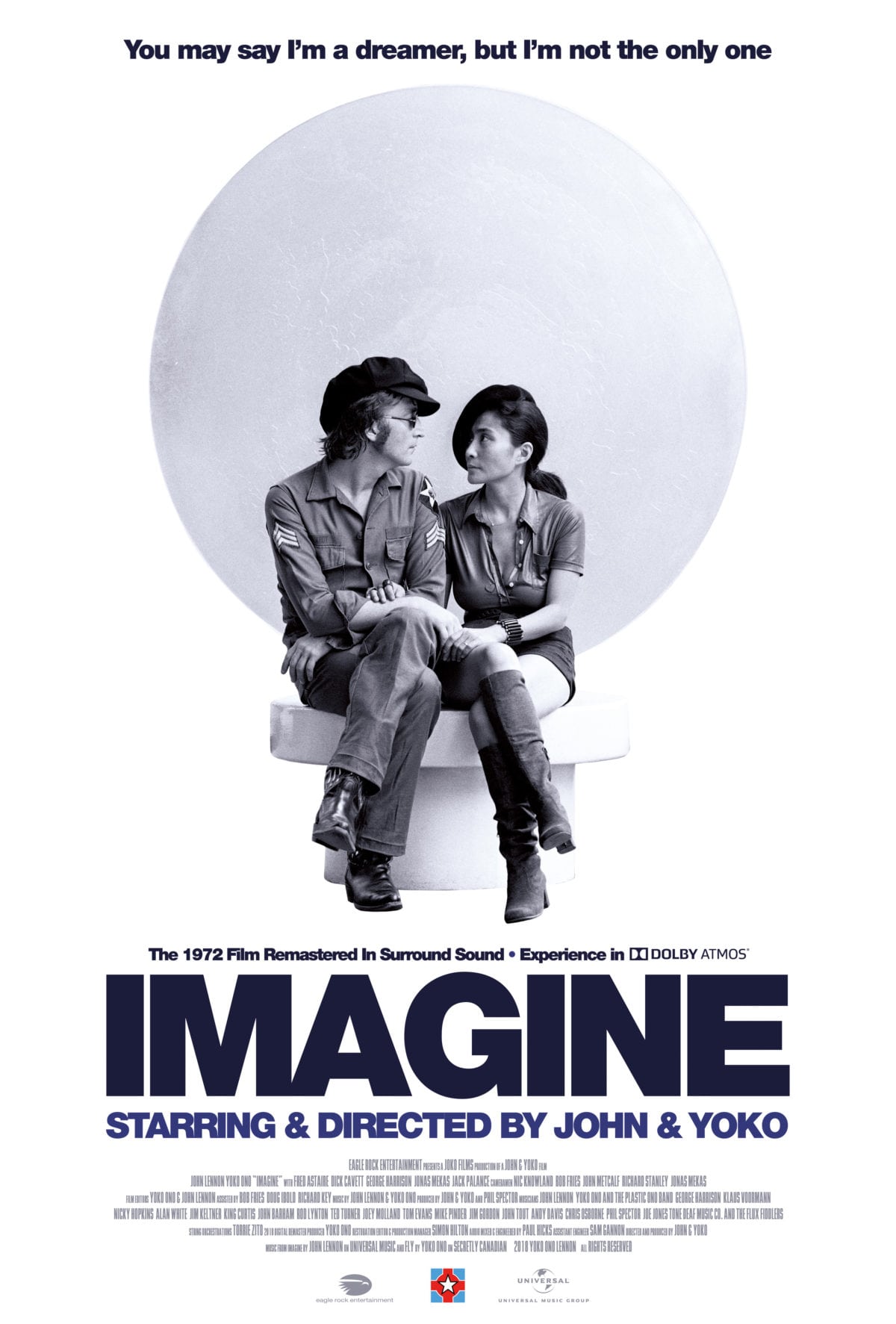
In addition to the announcement of the box set, John Lennon’s camp is revisiting the video components of the album’s initial release. The Imagine film and its companion documentary, Gimme Some Truth, were re-mastered frame-by-frame from the original film negative and completely remixed from the ground up from the original audio multi-tracks in stunning Dolby Atmos and 7.1 Surround Sound, this collage of colour, sound, dream and reality and star John Lennon and Yoko Ono with George Harrison, Fred Astaire, Jack Nicholson, Andy Warhol, Dick Cavett, and many more.

The ground-breaking music film directed by John and Yoko is coming to cinemas on September 17th

Image may contain: one or more people, people sitting, table and indoor

Earlier this month, Interpol hosted a press conference in Mexico City to announce their new album Marauder. The band answered questions and smiled for photos, and the press conference was pretty par for the course. Well, that is, until a man interrupted the panel to massage frontman Paul Banks’s head, without a single word of explanation.

Turns out, Interpol don’t need to beef up their security after all: The stunt was for their music video for “The Rover,” the first single off their new record. The mystery man in question is actor Ebon Moss-Bachrach (Girls, The Punisher) playing the song’s title character, a cult guru in the making.

The music video introduces us to The Rover on the brink of a breakdown inside a van carrying the band. After throwing himself out of a moving vehicle, he acquires his first followers and romps his way across the city to reunite with Interpol at the press conference.

“It’s the origin story of the character described in the song, the birth of a cult leader,” says Banks. “When we meet him, he is partly unhinged. He’s a man on the verge, an artist subjected to great pressures, and beset with existential frustrations. A distracted hipster who enjoys psychedelics, let’s say.”

Director Gerardo Naranjo (Narcos, The Walking Dead) filmed the Rover’s trippy adventures on-location in Mexico City for four days straight, resulting in a music video that blurs the line between reality and fantasy.

‘If You Really Love Nothing’ is the latest single from Interpol’s new album Marauder out on Matador Records due out in August

Marauder isn’t due out until August. 24th, on Matador Records

Verasola maintour2018 damonduke0 %281%29

A family of spiritualists, writers and performers generations deep; a home haunted by legends of literature and music; personal upheaval and a sense of being unseated in time: these are the origins of singer, songwriter and multi-instrumentalist Vera Sola.

With an ethereal voice providing the foundation for a haunting body of song, her timeless sound and enthralling stage presence began as a child. She played classical piano, later guitar and bass, learning more by instinct than instruction. An obsessive reader and writer, she’d forever written poetry and been fascinated by wordplay, falling in love at a young age with Russian literature and the work of Dylan Thomas, James Joyce and William Faulkner. All this, along with a career as a stage and voice actor —combined with years of touring in Elvis Perkins’ band — would serve as a launching point for Vera Sola.

But it wasn’t until early 2017, when she booked time at Native Sound Studio in St. Louis, that she began to experiment with the idea of recording her own material. She hadn’t even shared her music with her closest friends and family, let alone recorded anything of her own.

Even then, despite a lineage and lifetime of public performance, she felt a barrier blocking off her voice. Writing and playing came easily, but singing her own songs presented a different challenge. One she couldn’t explain and couldn’t quite shake.

That would all change. Just before she was to travel to St. Louis, a series of life-altering events marked a radical shift that reframed her relationship to her music. With everything she’d known to be true now unravelled, along with it vanished the fear that had prevented her from translating the sound in her blood into song.

Entering the studio, she abandoned plans to bring in other musicians. She decided instead to make the album entirely alone, picking up instruments she had never played before, drawing from them the internal music that had for so long gone unexpressed. She recorded using anything at hand. Bones and breaking glass, chains and filing
cabinets, hammers and two-by-fours. Countless moving parts meticulously layered and arranged. And that old fear now cast off brought new abilities, a change in her voice, including an otherworldly vibrato. She’d become a vessel, capable of channeling at once her innermost self and yet something entirely beyond her.

What emerged from the sessions was her debut album, Shades, a collection of ten finely-honed and immaculately-rendered ballads. Poems and stories delivered in a mannered but casually dismissive style–-full of sorrow, yet arch and wry. Songs of the present that conjure the past. Accounts of women and their ghosts: echoes of
memories that just won’t quit; of relationships over or current but fleeting; of the extinction of species; the violent capture of a feminine landscape and the spirits that stick around long after; messengers from the other side.

London Sessions (feat. J. Spaceman)

It should come as no surprise to fans of the Chilean trio Föllakzoid that upon meeting the legendary Jason Pierce a.k.a. J. Spaceman (Spacemen 3, Spiritualized), they discovered they were kindred spirits. Föllakzoid and Spaceman’s projects share a restless drive to explore the outer limits of music, as well as an uncanny ability to lock into a groove until it infiltrates the deepest recesses of the listener’s psyche. When Föllakzoid met Spaceman backstage at a Wooden Shjips gig at London’s Electric Ballroom several years ago, they instantly became friends. For London Sessions, the Chileans and Spaceman joined forces for new, live-to-tape renditions of ‘Electric’ and ‘Earth,’ two highlights from Föllakzoid’s III. The recordings were made in a private studio in London while Föllakzoid was on tour in Europe in June 2016, and Spaceman’s contributions breathe new life into the songs.

“Jason added a very different harmonic atmosphere to the songs,” guitarist Domingo Garcia-Huidobro explained. “It somehow rearticulated the space and metric that already existed in a way the band never could.”

http://

This is a reintepretation of the two first tracks from III and they are completely different. The focus goes more on the rythmic section, which changes the entire perspective while keeping the spirit.

TRACK LISTING

1. Electric (11:37)
2. Earth (11:21)


Image may contain: 1 person, sitting and stripes

Leeds duo Menace Beach have released the latest track from their upcoming third album, ‘Black Rainbow Sound’, out August 31st.

The fizzy ‘Satellite’ was inspired by Liza Violet’s dog.”I wrote the words to ‘Satellite’ after I came back to Leeds and saw how crazily nuanced and weird the bond between Liza and her dog had become,” says Ryan Needham.

“It got me thinking about clairvoyance in human relationships and how developed and extrasensory they would become if we constantly studied each other as much as that little guy watches Liza, or even if we just paid a little more attention to each other.”

Taken from Menace Beach’s new album ‘Black Rainbow Sound’,