In March 2020, the music world mourned the loss of Psychic Ills founder, frontman, and songwriter Tres Warren. At the time of his death, Warren was overflowing with creativity, actively writing new songs, and excited about the next phase of the band. He was preparing to go into the studio alongside longtime collaborator Elizabeth Hart and their bandmates to record the sixth PsychicIlls full-length, which was supposed to be out this fall. While those songs were tragically not recorded, the band did record a pair of covers for a new 7″. “Never Learn Not to Love” and “Cease to Exist” are the first new Psychic Ills songs to be released since 2016’s Inner Journey Out, and while they no longer precede a new album as originally intended, they stand as a celebration of Tres Warren’s beautiful musical spirit.
Originally appearing on The Beach Boys’ 1969 album 20/20, credited to Dennis Wilson and with changes to the arrangement and lyrics, Never Learn Not To Love was written as Cease To Exist by a then unknown songwriter named Charles Manson. His version would eventually appear on his album Lie: The Love and Terror Cult, released in 1970, by which time he was already incarcerated for the events that he is most commonly known for today.
How a version of that song came to find its way onto The Beach Boys album is the stuff of legend, and Charles Manson’s disappointment with the lyrical and structural changes is well documented. The Beach Boys simultaneous adherence to and departure from the original has long been a point of fascination for people, but Psychic Ills frontman, Tres Warren, says it’s something less tangible that has kept him coming back to both songs through the years. “The soulfulness is what has always spoken to me in those songs. I gravitate towards that(soul) in music, and both of these songs have it in spades. I almost shed a tear every time I hear Dennis Wilson sing.”
Psychic Ills’ version of “Never Learn Not To Love” echoes the arrangement and feel of The Beach Boys recording, but the female gospel backing singers make it more reminiscent of a Phil Spector production than that of Brian Wilson. “We wanted to honor the originals, but we didn’t want to cover them note for note.” Warren says, adding “We wanted to bring them to where we are.” Which seems like an apt statement as Never Learn Not To Love is a dense electrified rock and roll song reminiscent of recent Psychic Ills songs like it.
On the flip side of the record, “Cease To Exist” couldn’t be sonically more different. Where Never Learn Not To Love has a fullness from an instrumentation and sound quality standpoint, Cease To Exist thrives off the intimacy of the performance and transparency of the documentation, bringing the singing and playing into full focus, in a similar manner to the Manson original. There’s no question that this was recorded in very few takes, and that by-the-seat-of-the-pants feeling is further reinforced by the unedited studio talkback left in at the beginning. “Ivi is it rolling?” Warren asks engineer Iván Díaz Mathé as he begins the song, the band naturally falling in behind him reminiscent of jazz players adhering to both their own cosmic cues and those of the collective whole.
“Never Learn Not To Love/Cease To Exist” is an interesting experiment, successful in both concept and execution, and a typically non-traditional way to announce that Psychic Ills, have a new record coming soon. They continue to be a journeyman band, in an era where few exist, and a band you can count on to continue to expand on what they do as they have with every record, but never at the expense of what makes them Psychic Ills…their feel. They’re still weary and wanting, still searching for something.
One of the world’s most commercially successful and acclaimed artist/bands in the history of popular music, Steve Miller was a mainstay of the San Francisco music scene that upended American culture in the late ‘60s. The Steve Miller Band released two LPs on Capitol Records in 1968: Children of the Future, and Sailor, which included “Living In The USA,” which became a staple on the new rock radio format. Next came Brave New World, the band’s third album including the hit “Space Cowboy,” and “My Dark Hour,” which Miller recorded in London with fellow label-mate, Paul McCartney, who is credited as Paul Ramon.
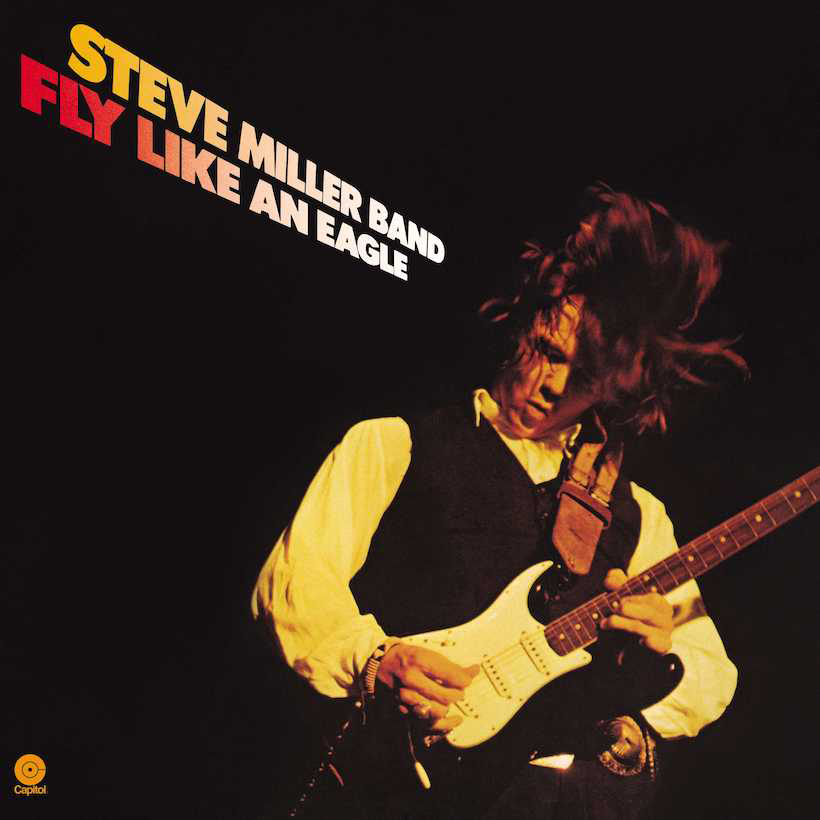
After the band’s next few albums, Your Saving Grace (1969), Rock Love (1971), Recall The Beginning (1972), and Number 5 (1970), Miller made some changes to the band, went to Los Angeles and produced his own record in 19 days. That album was The Joker. The title track became a Number One worldwide smash hit. Miller had crafted a brand of pure pop that was polished, exciting and irresistible that dominated radio in a way that few artists have ever managed. His next two albums, Fly Like an Eagle (1976) and Book of Dreams (1977), both went multiplatinum, and the hits they generated are among the most recognizable songs in pop music history. Hit followed hit in what seemed like an endless flow: “Take The Money And Run,” “Rock’n Me,”“Fly Like An Eagle,” “Jet Airliner,” “Jungle Love,” and “Swingtown,” to name a few. In 1978, Capitol released Greatest Hits 1974–78, which has sold more than 17 million copies worldwide. Miller’s had a worldwide hit with “Abracadabra,” the title track of his 1982 album and in 1986, a #1 Billboard Rock Album Track with “I Want To Make The World Turn Around.” To this day, his songs are instantly recognizable when they come on the radio. Their hooks are the very definition of indelible.
Steve Miller’s Ultimate Hits offering was the initial project that marked the start of a new Steve Miller Band licensing deal with Capitol Records/UMe and this continues with the Vinyl Box Set Volume 1 (1968-1976), a set that brings together the group’s first nine studio albums in a 9LP vinyl box.
It has been fifty years since the first two Capitol Records albums (Children of the Future and Sailor) were issued in 1968 and this new set features newly remastered audio (by Steve Miller and Kent Hertz)
As well as those two records, this new set features 1969’s Brave New World (which features Space Cowboy and the Macca-assisted My Dark Hour), Your Saving Grace(1969), Number 5 (1970), Rock Love (1971), Recall The Beginning… (1972), and The Joker (1973). The latter’s success paved the way for 1976’s Fly Like An Eagle and Book of Dreams from ’77.
Vinyl Box Set Volume 1 (1968-1976) will be released on May 2018. The albums are also available individually (not everything is listed, yet) and there are some limited coloured vinyl pressings available at certain retailers (the box is only black vinyl).
When Steve Miller signed a licensing deal with Capitol last year, it was stated that Capitol would have unlimited access to Miller’s personal archive of audio, video & memorabilia, and the contract seemed to get off to a good start with the 2-CD set “Ultimate Hits”, whose previously unreleased live and studio tracks seemed to be a preview of further archival projects
Some people call him the Space Cowboy. Some call him the Gangster of Love.
CHILDREN OF THE FUTURE
In February 1968, while in England, the band recorded their debut album, Children of the Future, at Olympic studios with Glyn Johns as engineer/producer. At this point the Steve Millerband is a democracy of sorts with Jim Peterman’s atmospheric keyboards underpinning Tim Davis’s drums and vocals and Lonnie Turner’s super funky bass guitar. The SMB took a psych rock blueprint and ran riot on the title track, ‘The Beauty of Time is That’s Snowing (Psychedelic B.B.)’ and the trippy ‘In My First Mind’. However their R&B roots also shine through on Scaggs’ moody ballad ‘Baby’s Calling’ Me Home’ and Buster Brown’s rolling ‘Fanny Mae’. As debuts go this is immaculate and fully deserves reappraisal. It’s a five star wonder.
Fans of “Jet Airliner,” “Take the Money and Run,” and “Fly Like an Eagle” wouldn’t recognize this incarnation of the Steve Miller Band. Five years before “The Joker” topped the charts and the group became one of the Seventies’ biggest hits machines, the Steve Miller Band was just another psychedelic band in San Francisco during the Summer of Love. On their debut album, Miller featured guitarist Boz Scaggs and keyboardist Jim Peterman. By 1969, those two were out of the group and Steve Miller Band adopted a much more pop-rock sound. Children of the Future showcased how infectious psychedelic rock could be in the hands of a real songwriter.
Steve Miller Band has, for a number of different reasons, done a superb job on their first album. It ranks with Moby Grape’s first album in terms of economy and with Sgt. Pepper in terms of taste… One would not characterize the record as being “far out” or revolutionary, but rather as being excellent. many of the songs had been written earlier when Miller was working as a janitor at a Texas music studio. “Baby’s Callin’ Me Home” was written by band member Boz Scaggs who later rose to considerable global fame in his own right.
SAILOR
The second album Sailor appeared in October 1968 successes included the single “Living in the USA.” may be even better. It’s certainly a regular entry in most discerning critics Best 100 Albums of all time lists. Sticking with Johns but moving to Burbank to record Miller now brings in a battery of synth effects on ‘Song for Our Ancestors’ – whale noises from the deep included – and also introduces one of his soon to become familiar alter egos in the shape of the irresistible ‘Gangster of Love’. The album is notable for other items like ‘Living in the USA’, which would eventually become a hit in its own right and Scaggs’ rock soul brother vocals on ‘Overdrive’ and ‘Dime-a-Dance Romance’. The albums Brave New World and Your Saving Grace did the trick again in 1969 while Number 5 (1970) took a side trip to Nashville to team the band with country luminaries Charlie McCoy and Buddy Spicher.
The band’s first album, Children of the Future, was somewhat disjointed. While it features some good tracks, it wasn’t until their second album, Sailor, that everything started to come together. “Quicksilver Girl” is a beautiful song with some haunting vocals and dreamlike guitars that weave in and out of each other in fine acidic fashion without ever being swallowed up by gimmicks of the era. Miller seems pretty conscious about keeping his feet on, or at least near, the ground.
Even though it never became a hit single, “Living in the U.S.A.” was all over FM radio back in the day and served as many fans’ introduction to Miller. It’s one of the many great tracks on the band’s 1968 sophomore album, Sailor, and features Miller on lead vocals with harmonies by band member Boz Scaggs, who would go on to bigger things as a solo artist around the same Miller finally broke through in the mainstream in the mid ’70s.
BRAVE NEW WORLD
Brave New World is the third album by Steve Miller Band, released in 1969. It is the band’s first album following the departure of founding members Boz Scaggs and Jim Peterman, with Ben Sidran replacing Peterman on keyboards.
featured the songs “Space Cowboy” and “My Dark Hour”. A certain “Paul Ramon” (alias Paul McCartney) played drums, bass and sang backing vocals. “Space Cowboy” uses the same primary guitar riff as the Beatles‘ song “Lady Madonna,” owing perhaps to McCartney’s involvement
By the time of their third album, 1969’s Brave New World, Miller and band were sharpening their focus and style. That’s no more evident than it is on “Space Cowboy,” one of the LP’s key tracks. Even though it wasn’t released as a single, it became a favorite on underground and FM radio. The song, co-written by Miller and keyboardist BenSidran, features distinct harmonies that would become a Miller trademark. He would later reference the song on his 1973 hit “The Joker.”
The title cut from 1969’s Brave New World is a psychedelic-shaded tour de force. “We’re traveling fast from our dream of the past to the brave new world where nothing will last that comes from the past,” Miller sings in the song’s opening verse. It features a fairly straightforward blues groove, but it’s vividly painted in technicolor. If you’re not familiar with Miller’s work before the familiar chart hits, this is a good place to start.
YOUR SAVING GRACE
Your Saving Grace is a much more earthy collection of tunes when compared to the band’s previous three long-players. While there are distinct psychedelic remnants of the Boz Scaggs (guitar/vocals) and Jim Peterman (keyboards) era, the addition of keyboardists Ben Sidran and Nicky Hopkins — which began on the Steve Miller Band’s previous effort, Brave New World — adds a jazzier facet to this second incarnation of the group. Harking back to the band’s blues roots, Your Saving Grace includes a couple of distinct blues originals — such as the up-tempo and gospel-doused “Don’t Let Nobody Turn You Around” and a somewhat uninspired arrangement of “Motherless Children,” which sounds more synchronous with the Sailor or Brave New World albums. The funky “Little Girl,” the elegantly pensive “Baby’s House,” and the title track — which is oddly programmed as the LP’s final cut — are among the highlights of this disc. Once again, the production is handled by Glyn Johns, whose contributions here are more subdued, yet no less noticeable. This is especially true of Miller’s crystalline slide guitar licks on Lonnie Turner‘s cryptically titled “The Last Wombat in Mecca.” The same upfront clean sound holds true on the laid-back and bluesy “Feel So Glad” — which is punctuated by some inspired and unmistakable ivory tickling by studio wunderkind Nicky Hopkins. Although the album is not as thoroughly solid as earlier efforts, Your Saving Grace and the follow-up, Number 5, are definite bridges between the early trippy montages prevalent on Children of the Future and the direction that Millerwould take on his much more successful mid-’70s discs.
NUMBER 5:
Number 5 is one of the Steve Miller Band’s strongest albums; “Jackson-Kent Blues” is the LP’s centerpiece. Clocking in at more than seven minutes, the song not only allows Miller and band to stretch out, but also to comment on the world around him. The lyrics deal with shootings of students at Kent State University and Jackson State College, which occurred within days of each other. Likewise, the song gives Miller an opportunity to sail away on lead guitar. Released at the end of 1970, it would be the last of Miller’s batch of classic early albums.
The Steve Miller Band released their first five albums over a two-and-a-half year span. That’s a heavy workload, especially when you mix in concerts and such. But the hectic schedule did little to hinder Miller’s creativity on Number 5. “Going to the Country” remains one of the highlights of the LP and features killer guitar work by Miller and ace harmonica playing by session pro Charlie McCoy, While nobody could ever mistake the Steve Miller Band for a country outfit, there was definitely a nod to Nashville that was evident on the band’s 1970 set Number 5. Lending their instrumental talents to the session were Music City stalwarts Charlie McCoy and Buddy Spicher. Also appearing on the same album was Bobby Thompson on the banjo. Though a departure, the sound of this track isn’t too removed from such sounds of the era as Pocoor theByrds. If you haven’t heard this Steve Miller Band song, check it out.
This is the last Steve Miller Band album to feature original drummer Tim Davis.
ROCK LOVE
In 1971, Miller broke his neck in a car accident. Capitol Records released the album Rock Love, featuring unreleased live performances and studio material. This is one of two Steve Miller Band albums not to be released on CD, the other being Recall the Beginning…A Journey from Eden. In 1972, the double album compilation Anthology was released around this time, containing 16 songs from the band’s first five albums.
Rock Love was the sixth album by The Steve Miller Band, released in 1971. All of Miller’s previous backing band had left following the recording of the previous album, save bassist Bobby Winkelman. They were replaced by members of Winkelman’s previous group, the psychedelic rock band Frumious Bandersnatch for this record, including Ross Valory (a future member of Journey) on bass, and Jack King on drums. Bobby Winkelman was in the band (having moved back to rhythm guitar) during the live recordings on the album’s first side, but is not credited on the album cover. David Denny, who later joined the band in 1976, is a guest guitarist.
The album consists of three blues-rock tracks recorded live, including lengthy jam-style “Love Shock” which lasts nearly 12 minutes and includes an extensive drum solo, and four studio tracks. The first song starts with the words “I’m going to play you some blues ‘cos I know you like that”, but some critics disagreed, criticising the album’s songs as “generic white-boy blueisms”.
RECALL THE BEGINNING…A JOURNEY FROM EDEN
If the former combines slick live electric blues with fiery poppy moments in the brilliantly speedy title cut and the lurching ‘Let Me Serve You’, the latter is an extended amalgamation of Miller soul, enigmatic lyrics, thoughtful arrangements and the best melodic breakdowns known to West Coast music. The evolution of the album on side two is assisted by Jim Keltner’s drumming and regular cohort Ben Sidran’s ability to fuse his keyboards to Miller’s languid singing and immaculate guitar prowess. Completely recommended.
THE JOKER
In 1973, Miller finally broke through in a big way. Steve Miller went to Los Angeles and produced his own record in 19 days. That album was The Joker. The title track became a Number One worldwide smash hit. Miller had crafted a brand of pure pop that was polished, exciting and irresistible that dominated radio, The title track became a huge single and was certified platinum, reaching over one million sales.
The style and personnel of the band had changed radically for The Joker , concentrating on straightforward rock and leaving the psychedelic side of the band behind. The live ‘Come On in My Kitchen’ and ‘Something to Believe In’ still sound like vintage Miller Band.
On his eighth album, The Joker, he would steer his band’s sound into a more focused pop-rock direction with few ties to his blues roots. The payoff was huge, giving Miller his first No.1 hit with the title track. The song’s lazy groove and distinctive wordplay — especially the “pompatus of love” line — caught listeners’ ears and have lived a long life in the lexicon of pop culture ever since.
So it’s hard to say if Miller really invented the word — one story has him misinterpreting the lyrics from a 1954 song by the Medallions or if it somehow drifted down to his ears from some long-lost snippet of obscure conversation by someone with the world’s weirdest vocabulary.
Kind of a lot of work to put into understanding a song about weed and chicks, but hey, that’s rock ‘n’ roll. Plus, “the splendor of love” sounds downright boring.
After a string of blues-influenced albums, 1973’s ‘The Joker’ took the band’s music and Miller’s songwriting in a more pop and rock direction, resulting in the biggest hits of his career. That rise to superstardom began with ‘The Joker,’ and it’s hard not to see why. With a guitar riff that’s as catchy as it is simple and the kind of lyrics that are instantly quotable, ‘The Joker’ is almost so stupid it’s brilliant, or maybe so brilliant it’s dumb.
Maybe what’s most compelling about ‘The Joker’ is the fact that even though the lyrics seem to make absolutely no sense, if you just listen hard a few more times, you’ll somehow unlock the secrets of Maurice, the space cowboy, and the pompetus of love.
FLY LIKE AN EAGLE
Nineteen-seventy-six was a key year for Miller. A month before the release of his breakout Fly Like an Eagle LP, “Take the Money and Run” landed as its first single. Miller attempted to borrow a page from American history with a ’70s take on Bonnie and Clyde, but with the lead characters in this 1974 single being named Billy Joe and Bobby Sue. FM radio wore out the album’s title track, but it was “Take the Money and Run” that caught fire in the Top 40, where it stalled just shy of the Top 10 that spring. It remains one of Miller’s all time best and biggest hits.
it was Three years later, the band returned with the album Fly Like an Eagle, Lonnie Turner retained from the previous album and got to work on more than two-dozen tracks in San Francisco in 1965, they divvied up the songs; half went to Fly Like An Eaglewhile most of the remaining tracks ended up on their follow-up album, 1977’s Book of Dreams. Three singles were released from the album: “Take the Money and Run” , “Fly Like an Eagle” and their second No. 1 success in America, “Rock’n Me”. Miller credits the guitar introduction to “Rock’n Me” as a tribute to the Free song, “All Right Now”.
At that time the band included drummer Gary Mallaber and Turner on bass, but the albums also featured contributions by harmonica player James Cotton, session guitarist Les Dudek and the Doobie Brothers’ John McFee. Eagle was singles-centric. Composed of a seemingly endless series of hit singles of differing styles, the album is a musical anthology of sorts, representing all of the music Steve Miller had ever known. From the blues to hippie-rock, country and R&B it could almost pass for a greatest hits album.
With a titular track that’s recognized at first rift, Fly Like An Eagle stands the test of time as the epitome of 70s classic rock. After its release in May 1976, the album blazed its way and introduced Steve Miller Band’s special brand of synth-driven spacey blues-rock that would spawn a string of hits and dominate the FM radio dial.
when it comes to an infectious melodies and radio-ready singles, ‘Take the Money and Run’ and the slick guitar boogie of ‘Rock ‘n’ Me’ take the cake. With its cinematic storyline and everyone’s favourite rhythmic device, energetic handclaps, ‘Take the Money and Run’ kept the album on the charts for nearly two years.
Even though the Steve Miller Band had dropped the “Blues” from their moniker, it didn’t mean they fully left it behind. Some of the songs that skate close to the band’s blues roots are ‘Sweet Maree’, thanks to harmonica stylings of Muddy Waters player James Cotton and ‘Mercury’ which traverses its way around the blues scale.
From slow dance numbers like the Sam Cooke cover, ‘Send Me’ to sitars on ‘Wild Mountain Honey’, the album is anything but predictable and even dabbles in bluegrass on ‘Dance, Dance, Dance’. Often overshadowed by the other hits on the album, ‘Serenade’ is a fan favourite and really is the underdog of the album. With its driving beat and dynamic key shifts . A fabulous set it’s even more vital as a remastered 30th Anniversary Edition with unreleased demos, a documentary and live DVD all in 5.1 Surround Sound.
It took the band eight years and nine albums before they finally hit the big leagues and reached a whole new level of fame.
Steve Miller had experimented with different genres throughout his career, but it wasn’t until he drew upon all of his past influences that his sound would coalesce into something greater. Steeped in the blues from his Chicago days, Steve Miller Band was always a blues band at heart that experimented with hippy psychedelia.
Steve Miller’s ’61 LP Special,
given to him by Leslie West, later painted by surfboard artist Bob Cantrell. Played in the 70s
Copperhead was a band organized by guitarist John Cipollina after he left Quicksilver Messenger Service in 1970. Cipollina, who had been a member of Quicksilver since its formation and whose lead guitar playing was its signature sound, had grown increasingly dissatisfied after the return of band founder Dino Valenti from a prison term, when the group grew larger and he found he had less space to play. He had also grown increasingly interested in playing sessions, which the band discouraged. The early days of Copperhead were casual, with the group consisting of a loose aggregation of people playing gigs with Cipollina. Eventually it coalesced into a quartet consisting of Cipolliana on lead guitar; Gary Philippet on vocals, second guitar, and organ; Jim McPherson on vocals, bass, and piano; and David Weber on drums. The group was initially signed to the Just Sunshine label run by Michael Lang, one of the organizers of Woodstock.
Cipollina had a unique guitar sound, mixing solid state and valve amplifiers as early as 1965. He is considered one of the fathers of the San Francisco psychedelic rock sound.
But in 1972 it was signed to a major-label record deal by Clive Davis at Columbia and recorded its debut album, Copperhead, released in the spring of 1973. Unfortunately, Davis was fired from Columbia shortly after the album’s release, an action that doomed any developing band that had been signed under his aegis. The album went nowhere, and when Columbia refused to release their second album, Copperhead folded. Cipollina went on to play in many different bands before dying in 1989.
Cipollina formed the band Copperhead with early Quicksilver member Jim Murray (musician) (who was soon to leave for Maui, Hawaii), former Stained Glass member Jim McPherson, drummer David Weber, Gary Phillipet (AKA Gary Phillips (keyboardist), later a member of Bay Area bands Earthquake and The Greg Kihn Band), and Pete Sears. Sears was shortly thereafter replaced by current Bonnie Raitt bassist James “Hutch” Hutchinson who played on the Copperhead LP and stayed with the band for its duration. Sears went on to play with the original Jefferson Starship and later Hot Tuna. During the 80s Cipollina performed with a number of configurations, including Fish & Chips, with Barry Melton, Thunder and Lightning, with Nick Gravenites, the Dinosaurs, and Problem Child. He was a founding member of Zero and its rhythm guitarist until his death. Most often these bands played club gigs, mostly in the San Francisco Bay Area, where Cipollina remained well-known to aficionados as among the great psychedelic guitarists. His style influenced many upcoming younger players, including Trey Anastasio of Phish.
Released just over 45 years ago, The Who “By Numbers” has some of Pete Townshend’s most personal and saddest lyrics and is hence a passionate and emotional album with the help of Roger John and Keith. Their last classic album? maybe.
After releasing two of the greatest rock concept albums of all time in Tommy and Quadrophenia,the Who had nowhere to go but down, at least in terms of overweening ambition, anyway. The result released in 1975 The Who by Numbers, proved a critical and commercial triumph in the face of personal adversity.
At the time, the band were battling demons on two fronts. On one hand, they felt somewhat boxed in after setting the template for rock concept records. As singer Roger Daltrey complained, fans and critics expected the band’s albums to come with a certain amount of heft, to the point that they sometimes weren’t willing to give non-concept efforts their proper due. Grumbling that “nobody wanted to listen to what [else] we were doing” after Tommy came out, Daltrey argued “Who’s Next” holds up much better, but nobody wanted to take it seriously because it was just nine songs.
Further complicating things was the band members’ increasingly critical view of where the Who stood — or should stand in a turbulent musical landscape that had grown to encompass styles that seemed to exist in contrast to the growing complexity and maturity of the band’s own work. For guitarist Pete Townshend, who wrote the bulk of the material, the question proved particularly vexing.
“Before the emergence of punk, the Who were the only band who actually sat round a table to decide ‘Should we go on or not?’ Would we be doing music a favour if we just f—ing stopped? We actually considered that,” Townshend told NME Magazine.
“Around the time of The Who by Numbers we used to have really quite heavy conversations about where music was going to go – particularly in this country – and whether we should be involved in it, and the problem with [drummer Keith Moon] living in America and living that Hollywood lifestyle and whether we should try and force him to come back to England … all those kind of things. Whether our music should change, whether we should let the Who tradition just bash on until it got really boring, whether we should try and force change by starting labels and working with other bands.”
As Who fans are well aware, the band opted to forge ahead with their seventh studio album, The Who by Numbers, which arrived in stores on October. 3rd, 1975 . It was nearly two years after Quadrophenia, and a relative eternity during the speedier release cycle that was the norm at the time. Realizing their rather chaotic state would make recording more of a slog than normal, they enlisted producer Glyn Johns to help wrangle the sessions into shape, and as the weeks dragged into months, Johns earned every penny of his paycheck even though the album’s aesthetics were less intricate and synthesizer-driven than the recordings that had preceded it.
“Glyn worked harder on The Who by Numbers than I’ve ever seen him. He had to, not because the tracks were weak or the music poor but because the group was so useless,” Townshend’s quoted as saying in Alan G. Parker and Steve Grantley’s The Who by Numbers. “We played cricket between takes or went to the pub. I personally had never done that before. I felt detached from my own songs, from the whole record. Recording the album seemed to take me nowhere. Roger was angry with the world at the time. Keith seemed as impetuous as ever, on the wagon one minute, off the next. [Bassist John Entwistle] was obviously gathering strength throughout the whole period; the great thing about it was he seemed to know we were going to need him more than ever before in the coming year.”
The end result, unsurprisingly, was a collection of moody, introspective, and fairly dark songs; although tracks like the opening cut “Slip Kid” and double entendre-laden “Squeeze Box” went down easy enough, The Who by Numbers is more strongly defined by self-critical Townshend compositions like “However Much I Booze” and “Dreaming from the Waist”; even the lighter-sounding “Blue, Red and Grey,” which found Townshend strumming a ukulele on top of a brass section overdubbed by Entwistle, was later described by Townshend in a Numbers reissue’s liner notes as “me wanting to kill myself.”
Between the subject matter and the rumors of band strife that pervaded the music press at the time, the popular opinion was that The Who by Numbers offered a sort of grim personal manifesto from Townshend as he approached middle age and although he’s more or less confirmed that point of view a number of times over the years, he’s also cautioned that listeners shouldn’t try to read too much into the songs, insisting what he was really trying to do was put himself in his audience’s shoes.
“There are a couple of really politically incorrect lines on Quadrophenia, but I thought I could get away with it because I was writing for a character. But on By Numbers, everybody took everything really literally. I don’t know. It’s interesting,” Townshend . “I certainly didn’t feel a lack of friendship and I certainly didn’t feel suicidal. I think I may have been a bit angry occasionally. I think I need to go to the great journalistic psychiatrist and have it explained to me, why I was wrong and they were right.”
Perhaps more importantly, according to Townshend, Daltrey was actually more responsible for the overall theme of the album. “The songs are about being older, feeling lost, losing your way,” Townshend has said. “Changing fashions, being sentimental, looking at the sunrise. What’s that got to do with being a young man? You don’t start looking at the sunrise until you’re dying. But,” he added, “Roger picked those songs from my demos.”
The end result, pointed out Townshend, was an album of songs in which one artist interpreted the words of another which were themselves interpretations of Townshend’s efforts to put music to what his audience was going through. “Roger’s an actor,” he argued. “I don’t think he realized that what he was doing all the time with my work was interpreting, acting and I couldn’t do that. I couldn’t be an actor and he could.”
Daltrey, for his part, still believes the album is more autobiographical than Townshend would perhaps like to admit. “Who by Numbers is very dark because Pete was going through some terrible agonies, but I didn’t realize this at the time,” he told Uncut. “We thought, if he wants space, we’ll give him some space – when what we should have done was been there saying, ‘You all right, Pete?’ But that’s just the way he was and still is. There’s a side to him that is like a stone wall and what he really wants you to do is knock down the f—ing wall and come through it, which takes a lot of effort all the time. I understand it now but I didn’t understand it then. So it led to this brooding, deep, introspective album. He was boozing a lot and I think he was having problems with his marriage, trying to balance that family life with rock’n’roll, ’cause they don’t balance. But I love that album.”
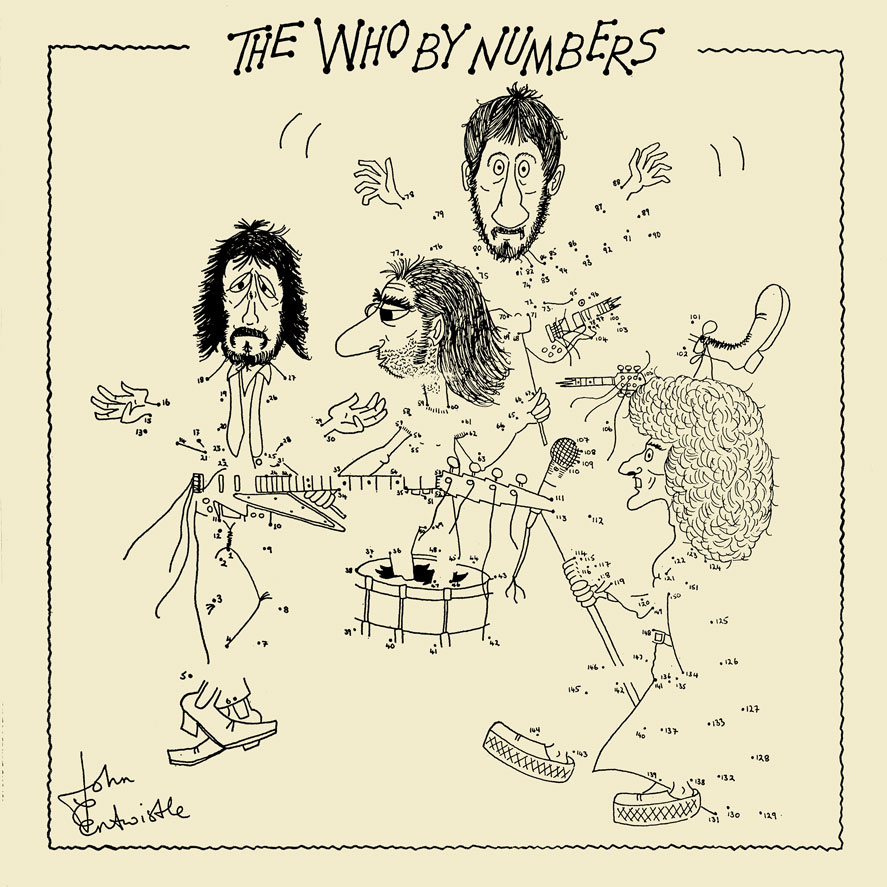
However you take the songs’ meaning, “The Who by Numbers” proved yet another hit for the Who, with “Squeeze Box” entering heavy rotation on both sides of the Atlantic while the album hit the Top 10 in the U.S. and U.K. on its way to RIAA certification for half a million in sales. And while Townshend may have sweated the songwriting during this period, other members of the band seemed perfectly content — including Entwistle, whose hand-drawn album art reflected the record’s scaled-down sensibilities.
“Squeeze Box” is a slang term for an accordion, but it is also slang for the vagina. The band just wanted to see if they could get away with singing about the joys of explicit sex.
In the liner notes to Pete Townshend’s compilation album Scoop, he wrote that he recorded the song for fun one day when he had bought himself an accordion. The accordion gave the song a polka-esque rhythm and the lyrics were “intended as a poorly aimed dirty joke.” Townshend had no thought of it ever becoming a hit.
The song is about an accordion (sort of), but there is hardly any of the instrument in the song. You can hear some in the section about 90 seconds in that goes, “squeeze me, come on and squeeze me,” but the subsequent instrumental section is mostly banjo. Pete Townshend played both instruments.
“The best we’ve done since the last one,” chuckled Entwistle when asked for his thoughts on The Who by Numbers in a 1976 interview with Sounds. “I like the cover. That’s pretty good.”
LIMITED EDITION 50th ANNIVERSARY HALF-SPEED-MASTERED VINYL RELEASED FOR RECORD STORE DAY 2020
In June, 2020 one of the greatest solo debuts in rock history, Paul McCartney’s McCartney, will receive a special 50th anniversary release in a limited edition half-speed mastered vinyl pressing for Record Store Day.
Originally released in April 1970, one month before The Beatles’ swansong ‘Let It Be’, McCartney saw Paul getting back to basics. Writing every song and playing every instrument (with backing vocals from Linda McCartney), the eponymous album represented a creative rebirth, bursting with new ideas, experiments, playfulness and freedom. Sonically, McCartney’s bare-bones home recording aesthetic imbued the album with an authentic lo-fi spirit, a much sought after sound that continues to retain a contemporary edge 50 years on. In contrast to the professional difficulties that came with the demise of the world’s most iconic band,
Paul was personally enjoying the contentment of family life as a newly married father. In a Q&A released at the time, Paul described the theme and feel of the album as, “Home, family, love.” This is obvious from the opening notes of Lovely Linda throughout the album, with tracks like ‘Every Night’ and ‘Man We Was Lonely’ musing on how much Paul’s life had improved—and nowhere more poignantly than on the tour de force ‘Maybe I’m Amazed’. Paul’s timeless tribute to Linda would be recognized as one of contemporary music’s great love songs, and remains a staple of Paul’s live set to this day, never failing to inspire tears of joy with its refrain of “Maybe I’m a man in the middle of something that he doesn’t really understand. Maybe I’m a man. Maybe you’re the only woman who can ever help me. Baby won’t you help me understand”.
Linda’s presence is also felt in the album’s iconic artwork: the front cover’s bowl of cherries photographed by her on holiday in Antigua, and the back cover’s portrait of Paul with daughter Mary as a baby, photographed on the family’s farm in Scotland where some of the album was also written. 50 years and counting, McCartney offers an incredible insight into the mind of one of the world’s greatest ever songwriters. The homespun spirit of the album and Paul’s taste for experimentation capture a unique moment in time: The very first steps of an unparalleled solo career that has seen Paul McCartney release decades worth of critically acclaimed commercial blockbuster albums including RAM, Band on the Run, Venus and Mars, Tug of War, Pipes of Peace, Flowers in the Dirt, Flaming Pie, Memory Almost Full, and most recently 2018’s-charting Egypt Station.
The 50th anniversary Record Store Day limited edition of McCartney was pressed from a master cut by Miles Showell at half speed using the original 1970 master tapes at Abbey Road Studios. It was made as a vinyl specific transfer in high resolution and without digital peak limiting for the best possible reproduction.
McCartney Tracklisting:
Side one:
The Lovely Linda
That Would Be Something
Valentine Day
Every Night
Hot as Sun/Glasses
Junk
Man We Was Lonely
Side two:
Oo You
Momma Miss America
Teddy Boy
Singalong Junk
Maybe I’m Amazed
Kreen-Akrore
We couldn’t be more proud to share Deeper‘s sophomore album “Auto-Pain” out today on Fire Talk. Truly love these boys and hope you’ll take some time today to check out the record. The press has been all over it, if you want to dig in more read this excellent feature via Stereogum .
Auto-Pain represents the constant wave of depression felt by many in everyday life. Stemmed from Aldous Huxley’s ‘Brave New World’, Auto-Pain is a concept meant to be an inverse to soma, a pill in the book which makes everything numb. The idea of auto-pain is to epitomize the desire to return to a connection with thoughts and clarity, which comes at the expense of feeling everything simultaneously. The album artwork features the now-demolished Prentice Women’s Hospital in Chicago capturing the band’s rounded-off brutalism, and the album title appears in Urdu, a nod to drummer Shiraz Bhatti’s Pakistani heritage. The record was recorded and mixed by Chicago scene luminary Dave Vetraino (Lala Lala, Dehd) and mastered at Chicago Mastering by Greg Obis (Ne-Hi, Melkbelly).
A portion of the proceeds from Auto-Pain will be donated to Hope For The Day an organization that actively works to break the silence surrounding mental health
From Deeper’s Sophomore album “Auto-Pain” out March 27th on Fire Talk Records.
Montreal trio Braids are releasing a new album, “Shadow Offering”, on April 24th via Secret City, but this week they pushed it back to June 19 due to COVID-19. On Thursday they also shared another new song from it, the nine-minute “Snow Angel,” via a Kevan Funk-directed video for the intense track. It’s an epic song that takes on social and political issues that are all the more relevant in this current crisis. “Should I even have a child at all?/This world is full up,” questions singer Raphaelle Standell-Preston in the lyrics. “I want to be a mother/But I shouldn’t bring in another.” It takes on global warming and the role all of us play in destroying the planet. If you want to get lost in the madness of the current moment, this is the song to turn to.
Standell-Preston had this to say about the song in a press release: “‘Snow Angel’ was written in the immediate wake of the 2016 US election, as our collective conscience took a sharp inhale. It’s a diary entry of sorts—a snapshot of the mind grappling with our era’s endless barrage of content and destruction, continents away and close to home. *This* moment, with our world in the midst of a pandemic, is admittedly a new context. But I can’t help but sense the song speaks to feelings many of us are experiencing—uncertainty, angst, and a desperate desire to make sense of it all.
“For me, it was deeply therapeutic to write and sing this song; saying things out loud can help us to not feel so alone, can help validate our natural fears about the future of our world, and can bring to light some of the hard questions that many of us are asking ourselves. I believe that art can change our relationship to fear. We hope this song can offer you a moment of catharsis and relief, in the same way writing and performing it has for us.”
Shadow Offering includes “Eclipse (Ashley),” a new song Braids shared last December. When the album was announced the band shared another song from it, “Young Buck,” via a video for the track. Shadow Offering was produced by former Death Cab for Cutie guitarist/producer Chris Walla.
Summing up the album, Standell-Preston had this to say in a previous press release: “There’s more hopefulness in this record than anything else I’ve written. I think the songs are more human, more tangible, more honest.”
This is among my favourite song of 2020 here. “Snow Angel” by Braids is an outstanding masterpiece, not just due to the fact that it’s over nine minutes long (which marks a new record in my personal ‘song of the year’ history). The Canadian indie art rock band has been on my radar for a few years now but never fully clicked with me. But this song – wow. It already got this great driving notion at the beginning and leading lady Raphaelle Standell-Preston really carries the song. But about four minutes into the track she ignites a spoken-word-reflection on her life on this planet and it when I first heard that part I think I heavily teared up because that moment sums up all the feelings many people in my generation have these days on our planet, the corrupt political system, environmental apocalypse, depression, capitalism, media consumption, ultimately resulting in Standell-Preston asking whether she should actually bring a child into this world. You really feel the desperation in those moments before the track is off to a furious finale, only to break down again. This is triumphant musical story telling, a song that needs a moment but one that perfectly captures the overall feeling of 2020.
When it was released in spring 1974, not even the record company knew that King Crimson’s ‘Starless & Bible Black’ album was essentially a live recording. Such secrecy by the band might have resulted from knowing that record labels paid a reduced royalty rate on live albums. The truth only emerged several years after Crimson had split up.
Bassist/vocalist John Wetton was proud of the results: “For me, it shows us moving into another dimension as far as being a band is concerned. We’d found our feet; we’d been on the road for the best part of a year. We knew what we wanted to do & we were getting creative. Not only is the album chronologically the bridge between Larks’ Tongues In Aspic, & Red, but it’s also a bridge in many more ways..
in 1973 King Crimson weren’t simply touring in order to pursue rutting opportunities. There was the not inconsiderable matter of recording a follow-up to Larks’ Tongues In Aspic. The album had sold well but the band were less than happy with the results of the time they had spent during January and February in Piccadilly’s Command Studios. “Collapse Studios more like – that’s what we used to call it,” shudders Wetton.
Despite the classic nature of the material and many inventive moments peppered throughout LTIA, the Crimson camp felt that whatever magic had touched them as they played in concert during the winter of ’72, the recording of the album in the New Year had quite simply failed to capture any of that power or intensity which had moved not only the band themselves, but also many commentators and fans. Putting a brave face on their combined disappointment, by the time the album hit the shops, the quartet were already on their way around the UK, Europe and, in mid-April, the USA. The Crimson that returned to the UK in July ’73 was not only tired after notching up over 60 gigs, but also in dire need of new material to refresh the setlist and prepare for a new album.
Reconvening after a three-week holiday, spirits and tempers were frayed, rather than rested. What had been a break for some turned out to be a busman’s holiday for RobertFripp, who emerged from his Dorset cottage with Fracture, The Night Watch and Lament. As the group worked on the new tunes, bad tempers flashed. According to Bill Bruford, Crimson’s writing processes were exercises in “excruciating, teeth-pullingly difficult music making. The tunes Robert has written all the way through, such as Fracture, these are good, and had there been greater output from Robert, we’d have got on quicker and faster. Robert’s always done this. He’s started off these bands with one-and-a-half tunes that point the general direction, and Fracture would have been one of them.”
“I was never given the time to write,” counters Fripp. “The band had a three-and-a-half-week holiday. I had three days. I recall on another occasion saying to the band that I needed time to write, rather than just continuing to rehearse. Bill, in a schoolmasterly and rather grudging fashion, would only agree if I really would do the writing, as opposed to what he implied was goofing off.” The gnawing antipathy that became a defining characteristic of Fripp and Bruford’s subsequent professional relationship first surfaced in these rehearsal sessions, sewing the seeds of the band’s demise a year later.
Putting their differences aside, Crimson took to the road with their newly composed repertoire and their near-telepathic ability to create complex and nuanced improvisations off the top of their heads. When they played at Amsterdam’s Concertgebouw, a mobile recording studio captured the band in full aleatoric flight.
Few bands of the era offered as much variety in material from night to night. King Crimson’s propensity for improvisation & fondness for playing its newest material – often unreleased on record at the time of the concerts – is legendary. Fewer bands still, whether by accident or design, recorded so many of their live shows.
Back in the UK in January 1974, and with three new tracks in the can at George Martin’s AIR Studios, the band sifted through the many live multi-tracks from the tour, choosing the best improvisations and scrupulously editing the tapes to remove any hint of audience noise or applause. It was impossible to tell what had been improvised in concert and what had been recorded in the studio.
The only songs recorded entirely in the studio were the first two tracks, “The Great Deceiver” and “Lament”. “We’ll Let You Know” was an entirely improvised piece recorded in Glasgow. “The Mincer” was another improvised piece, originally recorded in concert in Zürich but overdubbed with Wetton’s vocals in the studio ,The track was the edited-out middle section of a longer improvisation, the other parts released on The Great Deceiver as “The Law of Maximum Distress”. “Trio”, “Starless and Bible Black” and “Fracture” (the last of which Robert Fripp has cited as one of the most difficult guitar pieces he has ever played were recorded live at the Concertgebouw in Amsterdam. Also recorded at the Concertgebouw was the introduction to “The Night Watch” (the band’s Mellotron broke down at the start of the next section, meaning that the remainder of the song needed to be recorded in the studio and dubbed in later). In all cases, live applause was removed from the recordings wherever possible (although the remains of it can be heard by an attentive listener). The complete Amsterdam Concertgebouw concert was eventually released by the band in 1997 as The Night Watch.
“Trio” was notable for being a quartet piece with only three active players – John Wetton on bass guitar, David Cross on viola and Robert Fripp on “flute” Mellotron. Bruford spent the entire piece with his drumsticks crossed over his chest, waiting for the right moment to join in but eventually realized that the improvised piece was progressing better without him. His decision not to add any percussion was seen by the rest of the band as a crucial choice, and he received co-writing credit for the piece.
When it was released in that spring, not even the record company knew that “Starless And Bible Black” was essentially a live recording. Such secrecy by the band might have resulted from knowing that record labels paid a reduced royalty rate on live albums. The truth only emerged several years after Crimson had split up.
Starless and Bible Black offers an in depth overview of one of the era’s most significant bands in its most celebrated live line-up. John Wetton is proud of the results: “For me, it shows us moving into another dimension as far as being a band is concerned. We’d found our feet; we’d been on the road for the best part of a year. We knew what we wanted to do and we were getting creative. Not only is the album chronologically the bridge between LTIA and Red, but it’s also a bridge in many more ways. We were getting more experimental, trying different recording techniques, really screwing with the system, removing applause from live tracks so they sound like studio tracks – the exact opposite of what people do today where they add applause to a studio track and pretend it’s live. We’d removed the audience because that was the only way we could get the atmosphere we were after. Before Red, we could never recreate that kind of power in the studio – it just wouldn’t happen. You’re in a sterile environment, whereas on stage you’d got all that air and people and you’d got energy.” The bassist looks back on the period in which the album was made with real affection
Autumn 1973: As King Crimson’s second lengthy US tour of that year was coming to a close, a short series of UK concerts for the end of October, followed by a more extensive European tour in November was already planned. Three of these concerts Glasgow, Zurich & Amsterdam were recorded as full multi-track recordings, with material from the Amsterdam show being used as core material for the January 1974 recording of “Starless & Bible Black”. From mid-March to the start of April, the band was on the road in Europe again, promoting the album with their final European concerts of the decade, prior to undertaking a further US tour. A number of these concerts were recorded on stereo reel to reel machines, fed directly from the signal as sent to the PA system on the night of the performance. These soundboards are often referred to as “The Blue Tapes”, named after the outer colour of the original tape boxes & are especially valued for both the quality of recording & performance.
This boxed set presents eighteen CDs of live concert performances, seven of them mixed from the 1973 multi-track tapes and a further eleven presenting the complete run of “The Blue Tapes” for the first time. CDs of the ORTF Paris TV performance & the 2011 stereo mix of Starless & Bible Black also feature. Two DVD-A discs & two Blu-Ray discs contain concert & studio recordings in stereo, quadraphonic & full 5.1 surround sound – all presented in high-resolution audio.
19 CDs of live performance material.
7 CDs taken from multi-track tape including 4CDs of material from the Glasgow & Zurich shows, freshly assembled & mastered in Hi-Res from the original Great Deceiver mixes by David Singleton at DGM Soundworld in 2014, the Amsterdam show The Nightwatch mixed by Steven Wilson & a previously unheard preparatory of material from the same show prepared by George Chkiantz (engineer of all live KC shows of the era & the Red album).
11 CDs drawn from high quality stereo reel to reel soundboard tapes. 8 making their first appearance on CD with the remaining three re-mastered or drawn from new tape sources.
1 CD presenting the performance from the ORTF Paris TV broadcast
CD 20 features the 2011 stereo mix of Starless & Bible Black by Steven Wilson & Robert Fripp
DVD-A 1 features the Starless & Bible Black album in 5.1 Surround, with new & original stereo album mixes in High Resolution Stereo plus bonus audio material.
DVD-A 2 features material from Mainz (mixed by David Singleton), Amsterdam (mixed by Steven Wilson) & a later show from Pittsburgh (mixed by George Chkiantz) in quadraphonic audio & High-Resolution Stereo.
Both DVD-A discs are region 0 playable in all areas & compatible with all DVD players & DVD Rom players
Blu-Ray Disc 1 features full lossless audio 24/192 transfers of material from the Glasgow & Zurich shows, freshly assembled & mastered from the original Great Deceiver mixes by David Singleton at DGM Soundworld in 2014 in LPCM stereo.
Blu-Ray Disc 1 also features the Amsterdam show The Nightwatch, mixed by Steven Wilson & the George Chkiantz preparatory mix stereo in 24/96 High-resolution stereo & a 24/96 transfer of the original David Singleton/Robert Fripp mix of The Nightwatch.
Blu-Ray Disc 2 features Starless & Bible Black in 5.1 Surround (DTS-HD MAS & LPCM 24/96) alongside new & original stereo masters of the album, a needledrop of an original vinyl pressing + audio extras.
Blu-Ray Disc 2 also features the Quad mixes of material from the Mainz, Amsterdam & Pittsburgh concerts.
Blu-Ray Disc 2 also features the ORTF Paris TV footage in a new hi-res transfer from the original source files.
Discs packaged in 8 individual 3 disc digi-packs within an album sized box
3 additional bonus CDs of audio restored soundboard/bootlegs & audio curios are also included.
1 further concert (bootleg quality audio) is also available via included download ticket.
Album sized booklet with rare/unseen photos, new sleeve notes by Sid Smith, technical notes on the recordings by David Singleton, eye-witness accounts from fans who attended the gigs + memorabilia including an album print, poster, replica concert ticket, press release with folder, photos & more besides.
King Crimson
Robert Fripp – guitar, Mellotron, devices, Hohner pianet, production
John Wetton – bass, vocals, production
Bill Bruford – drums, percussion, production
David Cross – violin, viola, Mellotron, Hohner pianet, production
Paul Banks of Interpol has formed a new band, Muzz, that also features Matt Barrick (The Walkmen) and Josh Kaufman (Bonny Light Horseman). On Tuesday they shared a new song, “Broken Tambourine,” via a video for the track. The single is out now via Matador Records. Interpol have such a specific sound that it’s also nice to hear Banks branch out with his solo and side projects.
Earlier this month, we were introduced to a new indie supergroup called Muzz when a song called “Bad Feeling” quietly appeared online. Matt Barrick (the former Walkmen drummer who also plays in Fleet Foxes’ touring band), Josh Kaufman, the multi-instrumentalist who’s played with everyone from the National to Hiss Golden Messenger to his current project Bonny Light Horseman. The members all go way back — Banks and Barrick have known each other since they were teens, and also played together with Banks’ RZA collab Banks & Steelz — and they finally got together and formed a band themselves.
The song Broken Tambourine – in a nutshell – is about sadness and joy, and the uneven distribution of those elements. When I started thinking about imagery to accompany the song, a lone and lonely moon man came to my mind. I wanted to show his trials and tribulations, his aloneness and his wonder. And I felt that would nicely amplify the thinking behind the lyrics.
I contacted my friend and sometime collaborator Griffin Frazen to help me bring the idea to life. His vision and style are immaculate and we jived immediately. It was a blast refining the ideas and the world of the moon man in collaboration with Griffin.
Previously Muzz shared their first song, “Bad Feeling.” It was a little more lush and chill than the post-punk assault of Interpol . Not much more is known about the band, such as whether or not the singles are taken from a forthcoming EP or album. Banks and Kaufman have known each other since they were teenagers and both have also worked with Barrick before. Muzz’s earliest recordings date back to 2015.
With “Bad Feeling” being billed as something of a soft opening, today we’re getting the real introduction to Muzz by way of the new single called “Broken Tambourine.” It’s also their first single to officially come out via Matador. “Bad Feeling” was already a promising preview of this new band, and “Broken Tambourine” is probably even better.
“Broken Tambourine” begins with a sombre piano introduction courtesy of Kaufman, before building into a brooding thing of hushed, meditative grandeur. Banks intones over piano and clarinet, while Barrick’s percussion rumbles in the distance. You can certainly hear a bit of each of their projects colliding here; in a way, it kind of feels like Banks’ response to a sound we might normally associate with the National.
Multi-Grammy Award winner Lucinda Williams addresses a subject that affects millions with the release of her emotional new song, “Big Black Train”. The track appears on her highly anticipated new album Good Souls Better Angels, out April 24th via Highway 20/Thirty Tigers.
The song’s title works as a metaphor for depression, and Williams compassionately articulates some of the fears and feelings that engulf those who are affected by it. Through lyrics such as, I can hear it comin’ from miles away, Last time through it took me far away, Didn’t know if I was ever comin’ back and the solemn plea, I don’t wanna get on board, Williams masterfully connects the emotional weight of the condition to the overwhelming power of the “Big Black Train”. “Good Souls Better Angels” finds the acclaimed singer/songwriter zeroing in on some of the human and socio-political issues of our day with bold, forthright commentary and an urgency like never before. Just listen to the unabashed “Man Without A Soul” or the empowering “You Can’t Rule Me” to get a sense of where Williams stands at this stage of her celebrated four-decade career. She remains as vital a musical force as ever.
Lucinda Williams’ new album Good Souls Better Angels comes out next month, and she’s shared another new single from it, the lovely, torchy “Big Black Train,” whose title she says is a metaphor for depression. Lucinda Williams will release her new LP Good Souls Better Angels on April 24th.
Highway 20 Records marketed and distributed by Thirty Tigers.