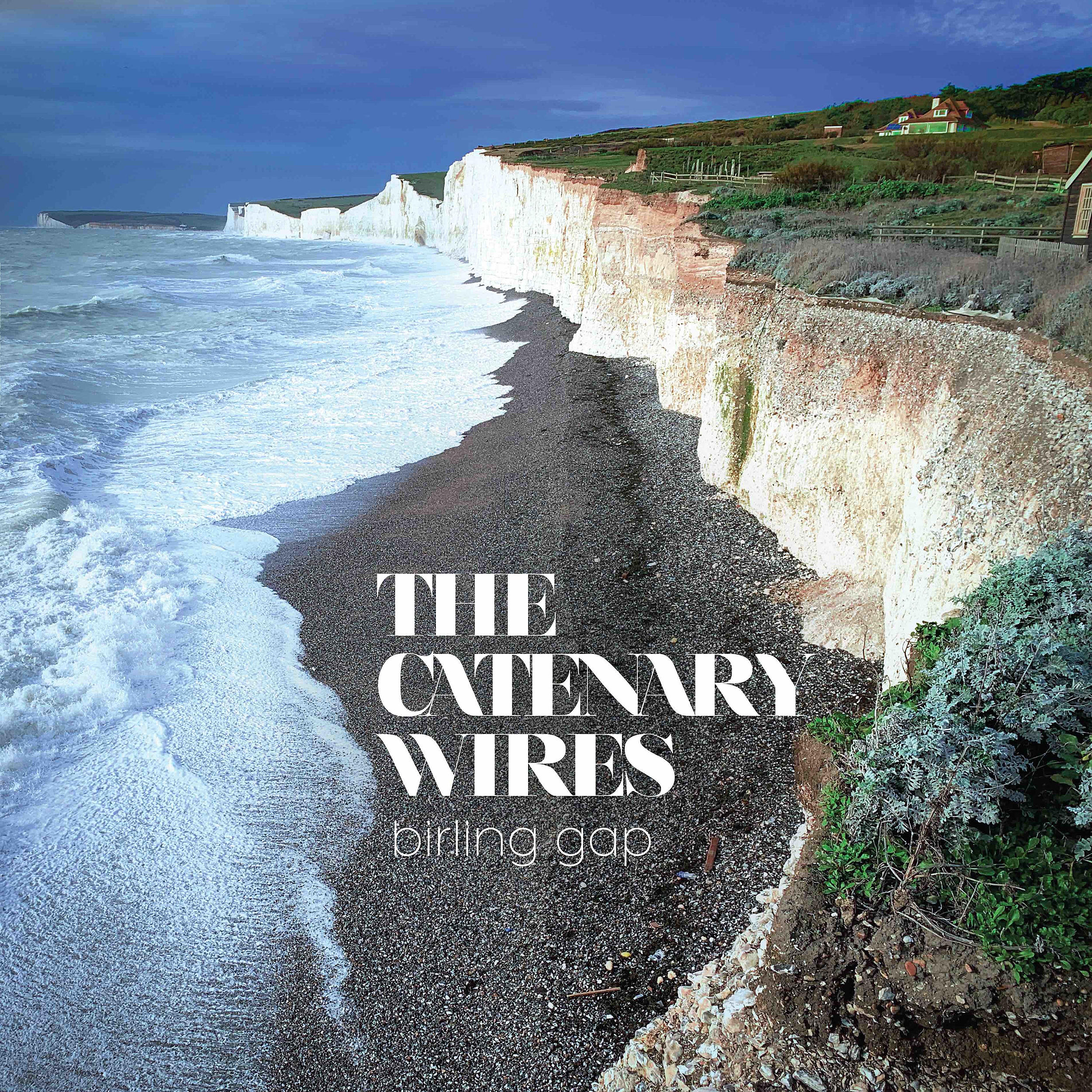
Amelia Fletcher and Rob Pursey have been in so many great bands over the last 40 years, most notably Talulah Gosh and Heavenly, but also Tender Trap, Marine Research and, since 2014, The Catenary Wires. The names and other band members change over the years but the general vibe does not — indie pop that veers towards, but not too far into, twee territory with heartfelt, bookish but unpretentious lyrics. Amelia and Rob are set to release “Birling Gap”, the third Catenary Wires album, on June 18th via Shelflife and Skep Wax Records.
Previous Catenary Wires albums have been very gently, just Amelia and Rob and some lightly strummed acoustic guitars, but they’re now a five-piece, and Birling Gap looks to be a much more fleshed-out record. We’ve already heard a taste of what’s to come with “Mirrorball,” an unabashedly romantic and danceable tribute to never giving up on love and ’80s discos. They’ve now released a second single, “The Overview Effect,” a tender, dreamy number about getting older and accepting it. “Can’t things stay the same?” Rob and Amelia sing to each other, stars in their eyes, already knowing the answer.
New Orleans’ Joystick have spent the last decade honing their craft and emerging as one of the best modern ska-punk bands around, and their fourth record “I Can’t Take It Anymore” is their most mature, refined record yet. “Everybody started getting married and having kids and kind of like settling down — we definitely became less of a party band,” lead vocalist Duck told us in a recent interview. Duck also got sober four years ago and he’s now working as a volunteer to help other alcoholics and addicts, and those experiences informed the personal, honest tone of his lyrics on this record.
The music sounds more “mature” too, but in Joystick’s case, growing up doesn’t mean slowing down. It’s still an urgent, fun, fast-paced record that toes the line between ska-punk and ska-core and sounds as hungry as Joystick did on their debut. It also has a subtle approach to musical diversity; it’s a straight-up, ’90s-style ska-punk record, but it also weaves in aspects of traditional ’60s ska, shouty ’80s hardcore, and plenty of the in-between.
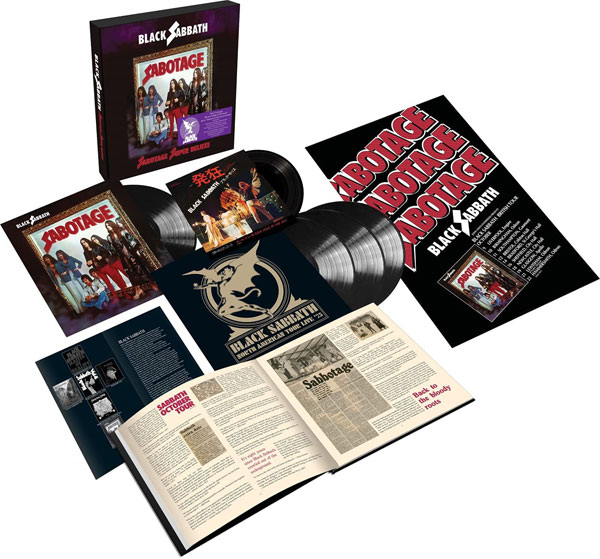
Black Sabbath created “Sabotage” with their backs to the wall, yet it was a masterpiece, fearlessly experimental and adding added yet another dimension to their music. The 1975 Black Sabbath album, “Sabotage”, will be re-issued as vinyl and CD super deluxe edition box sets, in June. The band’s sixth studio album was recorded amidst legal wranglings with their former manager – which is how the title came about.
The both box sets feature a newly remastered version of the album paired with a complete live show recorded during the 1975 tour. 13 of the 16 live tracks included are previously unreleased. The four-CD box set features the studio album and live concert across three CDs with a fourth disc effectively a CD single. It features the single edit for ‘Am I Going Insane (Radio)’ and ‘Hole In The Sky’.
The vinyl box set features the same content across four vinyl records and those two extra tracks feature on a bonus seven-inch single, with artwork replicating the rare Japanese version of the single. All this music is accompanied by sleeve notes in a 60-page book (CD version – the vinyl is a 40-pager) that tell the story of the album through quotes from band members and the music media along with rare photos and press clippings from the era.
Also included in both packages is a 1975 Madison Square Garden replica concert book and Sabotage 1975 tour poster. . The first five records are all classics; “Sabotage“, from 1975, just misses that designation, but this four-disc expansion gives the LP its long-neglected due. In addition to a remastered version of the album, the Super Deluxe Edition includes live tracks pulled from the 1975 North American tour and a radio edit of one of the album’s singles. It took five years and a new singer before Black Sabbath sounded this relevant again.
Flyte are Winchester’s own indie-rock success story. Formed in 2013, the now-trio (Will Taylor, Jon Supran and Nick Hill) have gone from strength to strength with each remarkable release and their sophomore effort corroborates this. At face value, ‘This Is Really Going To Hurt’ is a quintessential breakup album. Ever-present in life and literature, heartbreak is an inevitable theme eventually approached by artists of all areas. While Flyte have previously gained traction through works taking a more vicarious approach, this album is a deeply personal exploration of heartbreak. Vocalist Will Taylor journeyed through the end of an eight-year relationship with all the turmoil you’d expect, but here has managed to carefully document the feelings involved in a delicate and dignified way. His mindful nature and a drive to share his cathartic writing allow this record to exude a matchless sensitivity in its lyricism.
‘Easy Tiger’ is both the opener of the album and a perfect example of such sensitivity. Bearing the album’s title dominantly in its lyrics, this track is the preparatory build to the rest of the album. The soft guitar melodies bring an air of comfort to the foreboding descent into a thoroughly varied and emotional collection of music. ‘Losing You’ swoops in next with a potent, raw form of storytelling. Encapsulating the nostalgia of new romance versus its demise; it’s simple but flawlessly compelling.
‘I’ve Got a Girl’ is a punchy gem which alongside being a fun listen, serves to gently accelerate the pace of the record (written following the departure of former-member Sam Berridge). Launching straight into its dramatic lyricism, no time is wasted in portraying the hurt and subtle distress that runs throughout. This track has an undeniable appeal with its moody composition; dramatic keys and thundery bass giving it an edge akin to early 2000s alt-rock, while slick production cements its modern feel. Flyte crafted the album with the skilled hands of producers Justin Raisen and Andrew Sarlo, and mixing engineer Ali Chant. A mellow, steady, building instrumental meets an initially minimal vocal decorated with Flyte’s classic creative harmony in ‘Under The Skin’. Taylor’s voice builds to hold subtle anguish as we reach the busy, almost chaotic climax of the track. This is met cohesively with thumping guitar, crashing percussion and whirring synths.
We’ve been fortunate enough to feast our ears on half of the tracks from ‘This Is Really Going To Hurt’ as singles already, but the as-yet-unheard tracks bring yet more depth to the album. The first of which is the simply exquisite ‘Everyone’s a Winner’ . Despite its subject matter, the record is never accusatory; just attentively observational and introspective to a refreshing degree. Littered with choral-like harmonies, ‘Trying To Break Your Heart’ feels as though it’s been freshly plucked from a coming-of-age movie where a sense of melancholy is drenched in summery, jolly instrumentation.
As the band told us in an interview back in the summer of 2020, “every song has a very distinct personality” which stands true as the smooth, shoegaze dream, ‘Love Is An Accident’ begins. We’re then launched into the rockier ‘There’s a Woman’. Here we find classic, janky guitar and darker tonality, intermitted with calmer moments that tease at a lingering sense of romance. The end of the song is heavy with brass and synth, and the continued harmonies we’ve come to expect and love from Flyte over the years.
‘Mistress America’ features echoey vocals set among sentimental acoustic guitar in a lively track. It has a definite sense of being hopeful and joyfully romantic, with a relevant mid-American feel. This begins to round ‘This Is Really Going To Hurt’ off quite nicely, though the real treat waiting at the album’s close is ‘Never Get To Heaven’. Sleepy, hazy and comforting, it conclusively signals the end of an arduous period of time experienced by Taylor.
With their second album, a new vulnerability in the band’s work is clear. While a breakup record, delving deeper unveils a tapestry of raw emotion, polished instrumentation and lyrical complexity. It almost feels invasive to listen to Taylor’s plight in this way, especially as we’re used to Flyte’s relatively impersonal previous works. Here, the lyricism is beautifully and brutally self-aware. To tackle personal experiences and adjust to working as a trio were Flyte’s latest challenges, and each member played their part to meet them with grace; creating some gorgeous music on the way.
“No Joy has revisited and reinvented some of her favourite tracks from her 2020 album Motherhood for the new EP Can My Daughter See Me From Heaven? It sees principal songwriter Jasamine White-Gluz mining and exploring fresh avenues, bringing you an orchestral interpretation of choice tracks. Once again pulling sonically from every corner she’s mastered before — including nu metal, trip hop, and shoegaze — the five-song EP shows White-Gluz settling into a strange and confident harmony.
Highlighting the urgency of Motherhood while continuing to find formidable shapes of reinvention, the EP defies expectation and genre, cementing No Joy as something rare: A band without a category.”
“Can My Daughter See Me From Heaven?” the new album feat. orchestral reimaginings of your fave songs from Motherhood (and one Deftones cover!) First single “Kidder (from Heaven)” is out now, video directed by 7 year old Sloan. Recorded entirely in remote, these songs feature harp by Nailah Hunter, Cello by Ouri, French Horn/Opera and Backing Vocals by Brandi Sidoryk, drums by Sarah Thawer and tons of guitars by none other than Tara McLeod.
Produced by moi & Tara, Mixed by Jorge Elbrecht and mastered by Heba Kadry.Available on Digital, Blue Glitter Cassette, and Limited ‘Mood Ring Coffin’ Cassette – these are limited to just 100 hand-numbered copies that I’m hand painting my gddamn self!!!This was a challenging, experimental journey that sounds like nothing I’ve ever done before and I’m so proud of it.
Jasamine White-Gluz (vocals, producer) Tara Mcleod (co-producer/guitar) Ouri (cello) Nailah Hunter (harp) Sarah Thawson (drums) Brandi Sidoryk (french horn, opera and backup vocals)
“Kidder – From Heaven” by No Joy off the EP ‘Can My Daughter See Me From Heaven’ out 5/19/2021 on Joyful Noise Recordings worldwide, out on Hand Drawn Dracula in Canada.
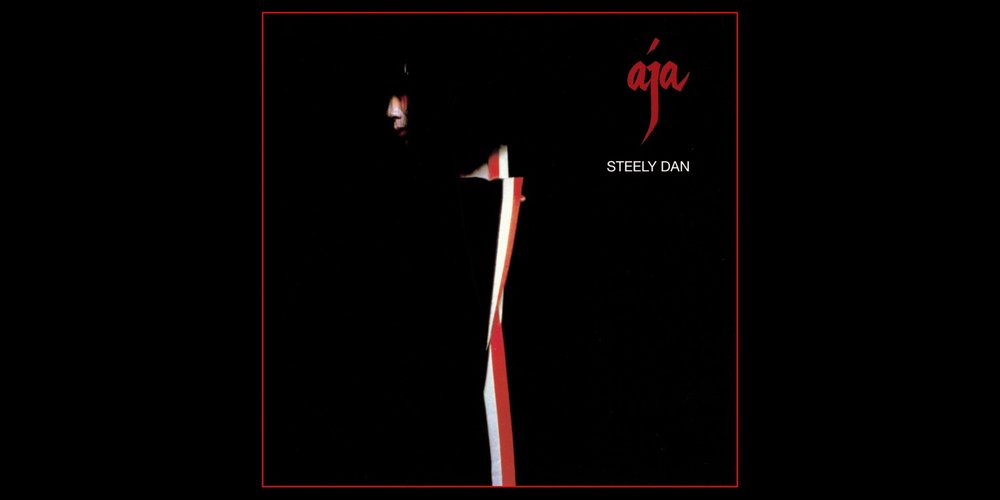
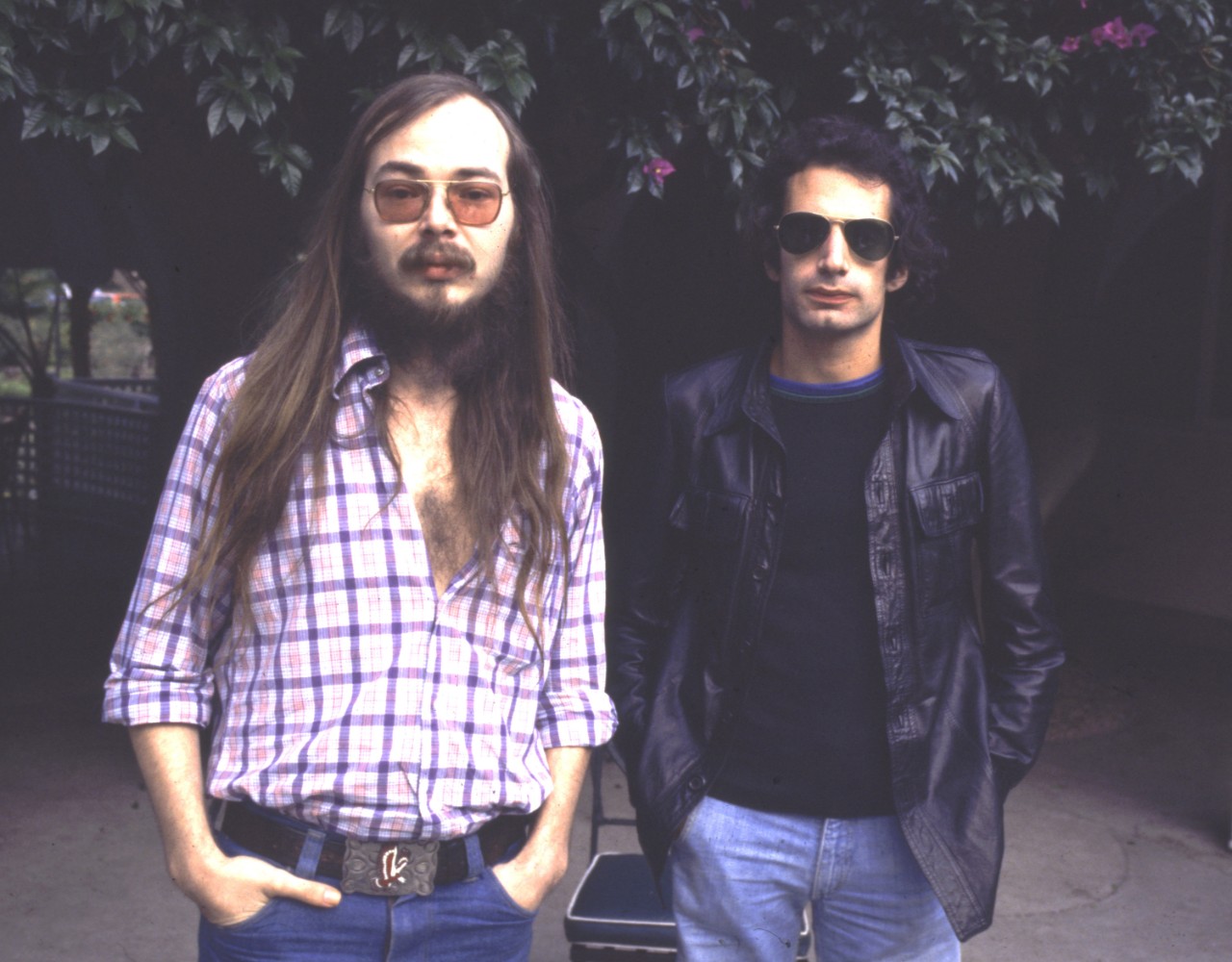
Steely Dan’s records were pristine to the point where you could eat off their glistening surfaces. They were never as sharp or as focused as they are on ‘Aja,’ their 1977 hit that balances cool jazz with timeless pop appeal. Band leaders Donald Fagen and Walter Becker have been criticized for their coldness. But on ‘Aja,’ they reveal a warm, beating heart beneath that steely exterior.
One of the many signature qualities of this album is that it is impeccably produced, a fact that has garnered both praise and condemnation. Admittedly, I’ve always found it silly to criticize a band for being too proficient at their job. Becker, Fagen and crew ease you into Aja with “Black Cow,” a song about a man who grows fed up with his lover’s pill addiction and continuous infidelity. You have to appreciate that the beauty of Steely Dan’s music is found in its sonic flawlessness enveloping sharp and intelligent lyrics.
Ian Dury once said of this album, “Well, Aja’s got a sound that lifts your heart up… and it’s the most consistent up-full, heart-warming…even though, it is a classic L.A. kinda sound. You wouldn’t think it was recorded anywhere else in the world.
The title track is the antithesis of what should be on a rock album. Then again, is this a rock album? The nearly eight-minute opus has been described by Donald Fagen as being about “tranquility that can come of a quiet relationship with a beautiful woman.”
These people are too fancy, they’re too sophisticated,” William S. Burroughs said of Steely Dan in 1977. “They’re doing too many things at once in a song.” Burroughs, who had no personal connection to the band, had been asked to comment on Aja, Steely Dan’s new record, because co-founder Walter Becker and Donald Fagen had named themselves after “Steely Dan III from Yokohama,” the surreal dildo featured in Burroughs’ most notorious novel Naked Lunch. His comment embodied a common-man criticism made about Steely Dan by their detractors: The unit, who stated their claim in the pop sphere with clean, blues-steeped singles like 1972’s “Reelin’ in the Years” and “Do It Again,” had gradually but consistently ceased to resemble a meat-and-potatoes rock band, instead spiraling off into groovier, jazz-inspired pop experimentalism.
‘Aja’ (1977): “Aja”
The eight-minute title song to Steely Dan’s best-selling album brilliantly combines jazz and rock. But even the fiery interplay between drummer Steve Gadd and saxophonist Wayne Shorter was more the product of studio wizardry than in-studio camaraderie. Gadd recorded his titanic drum fills live — and, he’s said, in one surprising take no less — with the rest of the legendarily picky members of Steely Dan. Shorter was brought in later and taped his answering solo over their already completed parts. At this point, that had become the norm, rather than the exception. Aja ended up taking a year and half to record, with studio expenses piling up into the hundreds of thousands of dollars. “We overdubbed a lot of the overdubs over,” Becker joked with Cameron Crowe in 1977, and he wasn’t really kidding. Still, the extended sessions allowed Fagen and Becker to explore entirely new corners of the their self-taught musical minds. The result is a moment like “I run to you” on “Aja,” where the song seems to come totally unmoored.
The effect heightened as Fagen and Becker systematically fired all of their band’s other members, and replaced them with industry-standard jazz, soul, and blues musicians. They stopped touring; the songs’ narratives and jokes became more acidic and obscure. Rolling Stone’s review of 1976’s sprawling, sinister The Royal Scam summarized the feelings of the band’s skeptics and newfound admirers alike, that they would “eventually produce the Finnegan’s Wake of rock.” On the day Aja came out, Walter Becker told Cameron Crowe that he was empathetic toward the concerns, but also uninterested in compromise: “These days most pop critics, you know, are mainly interested in the amount of energy that is…obvious on the record. People who are mainly Rolling Stones fans and people who like punk rock, stuff like that… a lot of them aren’t interested at all in what we have to do.”
Instead of the Rolling Stones or punk rock, Aja was deliberately intellectualist pop music that appealed easily to music-school types and jazz fans–chops-y rock music that helped “legitimize” the genre. Becker and Fagen’s songs, charted out across six or seven sheets normally, prized and necessitated technical musicianship. They used horns as expressive, exalted instruments in rock songs, not just padding or blunt, skronking deus ex machinas. But the record’s appeal extended well beyond the ranks of any subgenre of snobs. Standard-issue rock listeners, after all, indulged in elaborate, preciously-conceived, and strange things in the 1970s, a decade which yielded four Top 10 albums for Emerson, Lake, and Palmer.
Years later, Aja is still Steely Dan’s commercial triumph. It was their only record to sell over a million copies, spawned three Top 40 singles—”Peg” hit No. 11—and stayed on the charts for well over a year, peaking at No. 3. In 1977, the music industry was at the apex of LP sales and mammoth recording budgets. In the year-and-a-half Fagen and Becker spent making Aja, the Dan would push their studio expenses into the hundreds of thousands, all while not playing live. On its 20th anniversary, Becker would chalk Aja’s success over past Steely Dan ventures up to the right-place-right-time factor: “That was a particular time when people were just selling lots of records.” They assumed, he said, that “‘we’re gonna sell three times as many records as we would have two years before.’”
To just chalk it up to a general market uptick, though, would be to sell the unique, subversive appeal of the re-minted Dan of Aja way short. Today, Aja still stands as the crucial microcosm of Becker and Fagen’s artistry, and as one of the most inventive blockbuster rock albums of its decade.
‘Peg’
“Peg,” which is the most well-known track on the album, is in a class by itself. It’s also the song that took forever to complete. The band went through seven studio guitarists to find the right sound on the guitar solo before settling on Jay Graydon’s version. Detractors will point to this fact as not letting a moment happen organically, but I would argue that it made a good song great. Having Fagen’s lead vocal mix with Michael McDonald singing background made it even better. “Peg” is the middle point of Aja and ensures that the album has already exceeded expectations before you even listen to the latter half. The interesting thing about this song is that Becker did not play bass on it. Those duties were handed to veteran session player Chuck Rainey.
‘Home at Last’
From: ‘Aja’ (1977)Donald Fagen once called this Steely Dan drinking song a “blues for Odysseus.” As such, it’s only appropriate that the hero in ‘Home at Last’ would be served “smooth retsina,” a Greek resinated wine, during his stay in paradise. Contrary to the track’s title, he can’t stay – “it’s just the calm before the storm.” Maybe he can take a bottle to go.
‘Black Cow’
From: ‘Aja’ (1977)Could it be that there’s a drink referenced in a Steely Dan song that doesn’t contain alcohol? Nothing’s for certain, but ‘Black Cow’’s titular beverage could be a simple coke float or a more adult version of the beverage. I guess it depends on what one finds most comforting during a break-up: “It’s over now / drink your big black cow / and get out of here.”
‘Deacon Blues’
This ‘Aja’ classic romances the idea of being a jazz musician toiling in obscurity – something that might have seemed appealing as Becker and Fagen became more famous throughout the ’70s. ‘Deacon Blues’ concocts the appropriate cocktail for this: get a cool name, learn to play an instrument, refuse to compromise, “Drink Scotch whisky all night long and die behind the wheel.” Wow. Sounds great, doesn’t it? (Kids, really, don’t try this at home.)“They got a name for the winners in the world / I want a name when I lose / They call Alabama the Crimson Tide / Call me Deacon Blues.” There are song lyrics that make you scream, “Damn, I wish I wrote that.” A prime example are the lyrics to “Deacon Blues,” one of those songs that’s easily quotable and just stays with you forever. The name “Deacon” was influenced by Hall of Fame football player Deacon Jones. Fagen and Becker’s ode to underdogs clocks in at 7:36, but feels like a four-minute song that you wished lasted longer. Fagen’s inspiration came from his thought that “if a college football team like the University of Alabama could have a grandiose name like the ‘Crimson Tide,’ the nerds and losers should be entitled to a grandiose name as well.” It may the coolest nod to geeks that I know of.
During the making of Aja, the Dan were well-settled into retirement from live performance. Fans had gotten used to the band’s new, faceless new image. Over the months they spent fashioning the album, a suite of 7 songs about lust, wanderlust, delusions, and the destructive effects of American Dream, Donald Fagen and Walter Becker methodically reimagined the sound of their studio-assembled ensemble. It was not a dramatic repositioning. Steely Dan had been mostly made up of session musicians since 1974’s Katy Lied, and their songs had already featured plenty of weird chords and prodigious horn solos. But there was nothing like a big, rollicking rock’n’roll single on Aja: no “Kid Charlemagne,” no “My Old School,” and certainly no fucking “Reelin’ in the Years.” Guitars provided auxiliary punctuation and effects-less solos rather than the brunt of the song; a stew of acoustic piano and electric keyboards, reminiscent of Miles Davis’ In a Silent Way, were at the warm center of the mix. Aja’s sound was a direct offshoot from jazz and fusion, steeped in its harmonic language, as well as that of turn-of-the-century modernist classical music (Debussy and Stravinsky, especially).
The particular musical syntax on Aja was in many ways uniquely Dan’s, however, the misbegotten result of Becker and Fagen’s own self-taught musical education. Their chordal sense was central to the issue: The complex changes left the average rock listeners’ ear out in the cold, pointing toward whole new keys for choruses and away from easy resolution. Moments like “I run to you” on Aja’s title track leave one totally adrift for clues as to where the song will move; elsewhere, there are deceptive instrumental flourishes, like the mystical Rhodes-and-guitar fanfare that introduces “Deacon Blues.” Fagen and Becker voiced chords so unusually that theory-heads refer to a specific “Steely Dan chord” (or “mu major chord”): a substitution for the typical primary (or tonic) chord featuring an added 9th rubbing up against the major 3rd. Harmonies like these pop up everywhere on Aja, imbuing its songs with sophisticated, decidedly un-rock’n’roll atmosphere.
But Becker and Fagen also borrowed plenty from contemporary pop music, despite their general dismissiveness of it. Plenty of why Aja was so successful–and spawned actual hit singles–came from its emulation of the backbone of American R&B and soul of the time. They hired players that had defined the sound of records by James Brown, Aretha Franklin, and Quincy Jones, as well as virtuoso jazz soloists (Larry Carlton, Victor Feldman, saxophone luminary and Miles/Weather Report alum Wayne Shorter). The most time-consuming sessions would be devoted to the lock-groove-based tunes, the ones that wouldn’t be too out-of-place next to disco on a playlist: “Peg,” the warped blues of “Josie,” the lascivious “I Got the News.” Fagen and Becker’s obsession with precision backbeats would become a more empirically insane compulsion during the more troubled sessions for 1980’s Gaucho, with some interference from a custom-designed drum machine called “Wendel.”
Decades later, Becker admitted just how much of this had to do with disco. “They had all these records that were just whack-whack, so perfect, the beat never fluctuated, and we didn’t see why we couldn’t have that too, except playing this incredibly complicated music, and the drummer would go and play a great fill or something and come exactly back at the perfect beat at the same tempo, you know?” he told GQ UK in 2014. “It seemed like a good idea.”
Much gets made of how obsessively Fagen and Becker would plot parts for musicians, but many of Aja’s best and most famous were defined by their players’ independent innovations. As bass player Chuck Rainey recalled in the Steely Dan biography Reelin’ in the Years, Fagen and Becker had specifically told him not to slap his bass during the sessions for “Peg.” Rainey responded by turning his back to the control room and slapping away. Fagen and Becker liked the sound, despite their prejudices, and Rainey went on to slap again on “Josie.”
Then there was Bernard Purdie, one of soul music’s most inimitable drum stylists, whotold the story of taking control of the direction of the recording of “Home at Last” himself in the Classic Albums episode on Aja. “They already told me that they didn’t want a shuffle. They didn’t want the Motown, they didn’t want the Chicago,” Purdie explained. “But they weren’t sure how and what they wanted, but they did want halftime. And I said ‘Fine, let me do the Purdie Shuffle.’” It was precisely what Fagen and Becker hadn’t asked for, until they heard it. Purdie would go on to use the same beat on one of the Dan’s greatest singles, Gaucho’s “Babylon Sisters.”
Meanwhile, drum prodigy Steve Gadd foiled the duo’s plans for the day by running down the intricate title track of Aja in just one take. For the most muso-focused listener, his epic, virtuosic solo in the instrumental middle of the song is the beating heart of the album, layered over with chunky horn charts from arranger Tom Scott and alien synthesizer atmosphere (an anomaly for a Becker/Fagen recording at the time.)
Like their hero Duke Ellington, Fagen and Becker needed the identity of individual soloists to create their finished canvas, but within quite specific and refined structural limits. The duo was not as good with people as Ellington, but they didn’t have to be. From the safety of the studio booth, they could just say “try it again” as much as they needed, and scrap the solos they didn’t like after the fact. According to Reelin’ in the Years, the band’s career-long producer Gary Katz would break the disappointment to the players by talking to them about baseball, before dropping the news that their solo—which the person had spent hours trying to hammer out—would not make the record. When it came to the prospect planning a live tour behind Aja, they got as far as rehearsals, but ultimately backed down.
“We had 4,000 dollars worth of musicians in the room, guys who wouldn’t go out on the road for Miles Davis, literally, and they were committed to doing this,” Fagen explained. “And we both left the room together and said, ‘What do you say, you wanna can it?’ And we both said ‘Yeah’ without thinking twice.”
Once you get to “Home at Last” and “Josie,” you realize that something truly special happened during the recording of Aja. A rock band named Steely Dan made a jazz album that masqueraded as a rock album, and the results are glorious. A smartly crafted, well-produced album does not equate to selling out or being soft. Their sound may not be for everybody, but it works for me.
Aja, despite its detractors, is one hell of an album that demands not just one play, but multiple spins. Aja makes you think. It compels you to listen again and again, as you continually uncover new elements and flourishes you hadn’t heard before. Great albums make you want to come back for more. And Aja is a great album.
Aja was one of the only records Becker and Fagen ever made that they would speak about with real pride. (Less than a year after Gaucho’s release, they would characterize it as a “sideways” move; Fagen admitted, “It’s possible that we took a few steps backward with this album.”) Today, Aja remains the extreme of their modernistic progress, a place they could not effectively move forward from or visit again, except when running down its songs on reunion tours two decades later.
One of Southern rock’s best-kept secrets during its golden age in the 1970s, Cowboy were formed by songwriters Tommy Talton and Scott Boyer in Jacksonville, Florida. They released four albums on the Capricorn Records label in the 1970s: Reach for the Sky (1970), 5’ll Getcha Ten (1971), Boyer and Talton (1974), and Cowboy (1977). Steve Leggett of Allmusic considered Cowboy “one of Capricorn Records‘ and Southern rock’s best-kept secrets during the genre’s golden age in the 1970s.
Led by Scott Boyer and Tommy Talton, the Jacksonville band Cowboy was discovered by none other than Duane Allman, who, as legend has it, banged on their door at 7 am one day and asked to hear some songs. He then recommended them to Capricorn label owner Phil Walden, who sent Allman Brothers producer Johnny Sandlin to check them out; Sandlin ended up producing several Cowboy albums for Capricorn. Boyer died on February 13th, 2018. His musical partner Talton said, “No one could write a more beautiful ballad than Scott Boyer. I love him and I miss him more than anything that can be said.
Reach for the Sky
Boyer and Talton Are Still Active Led by Scott Boyer and Tommy Talton, the Jacksonville band Cowboy was discovered by none other than Duane Allman, who, as legend has it, banged on their door at 7 am one day and asked to hear some songs. Sandlin endedup producing several Cowboy albums for Capricorn, of which this 1970 release was the first. Reach for the Sky features some great songs from Boyer and Talton, and has a loose, informal feel with acoustic guitars and harmonies a-plenty; over the years it’s become quite the cult item, with copies of its long, long out-of-print CD release trading hands for well over $100.
Our Real Gone reissue features notes by Scott Schinder, the original gatefold artwork (with lyrics) and photos. Fine, soulful Southern rock, long overdue for rediscovery!
5’ll Getcha Ten
The Allman Brothers connection on this album is even more explicit than it was on their debut album (Reach for the Sky,also reissued by Real Gone Music); Allman plays guitar on “Lookin’ for You” and dobro on “Please Be with Me,” while Allman Brothers keyboardist Chuck Leavell appears on half of the album tracks. But what makes 5’ll Getcha Ten special—and indeed what makes it many Cowboy fans’ favourite record—is the songwriting.
“Please Be with Me” was covered by Eric Clapton on his classic 461 Ocean Boulevard release, and throughout the album a gentle undercurrent of spirituality courses through these beautifully played and sung songs, particularly on “What I Want Is You,” “Innocence Song” and the title tune. Scott Schinder’s notes contain revealing quotes from Tommy Talton; we’ve also added some great period photos and provided a pristine remastering job by Maria Triana at Battery Studios in New York.
Boyer & Talton
Having released the first two records to great acclaim, and with the recent passing of producer Johnny Sandlin and the even more recent passing of Scott Boyer himself, it seemed like a good time to circle back to the last two Cowboy records for Capricorn, which, like our first two reissues, feature liner notes by Scott Schinder featuring great quotes from Tommy Talton and pictures from Tommy’s private archive. As the title indicates, this 1974 album—produced, like the first two, by Capricorn mainstay Johnny Sandlin—found the group down to its creative core of Scott Boyer and Tommy Talton. But their new back-up band wasn’t half bad: Capricorn regular Bill Stewart on drums, future Charlie Daniels Band bassist Charlie Hayward, Allman Brothers Band members Chuck Leavell and Jaimoe on keyboards and percussion, respectively, and saxophonists Randall Bramblett and David Brown, the latter a former member of Boyer’s old Florida combo the 31st of February, which also included Duane and Gregg Allman as well as future Allmans drummer Butch Trucks (plus a cameo from Toy Caldwell of The Marshall Tucker Band)! Most of this same aggregation backed Gregg Allman on the solo album “Laid Back”, and indeed went on tour with him, which we’ve documented with the two bonus tracks that featured Cowboy from The Gregg Allman on Tour album, “Time Will Take Us” and “Where Can You Go?”
As for Boyer & Talton, it remains one of Tommy Talton’s favourite Cowboy albums (and one of their fans’ favourites, too), though he modestly points to a Boyer song, “Everyone Has a Chance to Feel,” as a particular standout. But you won’t go wrong with any track on this album…masterful, melodic American music. CD debut, remastered by Mike Milchner at SonicVision!
Cowboy
Having released the first two Cowboy albums to great acclaim, and with the recent passing of Scott Boyer himself, it seemed like a good time to circle back to the last Cowboy records for Capricorn, which, like our first two reissues, feature liner notes by Scott Schinder featuring great quotes from Tommy Talton.
Talton and Scott Boyer just kept cranking out one great tune after another on their 1977 self-titled album, their last for Capricorn and the last made under their name until 2011. In the producer’s chair this time was Capricorn house engineer Sam Whiteside, while the band featured Arch Pearson on bass, Chip Condon on keyboards, and Chip Miller on drums. The band’s sound shifted to a more pop-savvy, country-rock sound, but Boyer and Talton’s wry, thoughtful song writing continued to ring true, and such numbers as “Takin’ It All the Way,” “Pat’s Song,” “Everybody Knows Your Name” and the Latin-tinged “Straight into Love” demonstrated that the new Cowboy line-up was adept at navigating the novel stylistic wrinkles. Shortly thereafter, the band folded, fittingly, at just about the same time the Capricorn label did, but Cowboy remains a worthy last hurrah.
The music of Sharon Van Etten offers this strangely familiar ethic and aesthetic. She is Patti Smith finishing a pint of Pilsner as the pool cue cracks in the back of the dive bar.
Van Etten’s newest release, “Epic Ten”, is unlike any other. In one sense, it’s a reissue of her 2010 sophomore record, Epic. But it’s also much more. The reissue includes covers of each song from the original release from such heavyweights as IDLES, Lucinda Williams, Courtney Barnett, and Fiona Apple. In this way, “Epic Ten” is two albums at once in a compact 14 tracks, ranging in creative impact from Van Etten’s ghostly harmonies to IDLES’ industrial wallop.
The record begins with the acoustic-propelled “A Crime.” The lyrics, saturated with anger and remorse, are also breathy, dreamy. But through the sonic lens of Aaron Dessner and Bon Iver’s Big Red Machine, the song is more electric, like a Radiohead song played through a spotty AM radio connection in a beautiful contrast. “Peace Signs” harkens to ’90s rock ‘n’ roll, part Smashing Pumpkins, part Melissa Etheridge. All the while the kick drum bangs. When IDLES take hold on the record’s flip side, that kick portends guttural screams, an explosion.
On “Save Yourself,” Van Etten sings over slide guitars. There’s a new eeriness to her voice now—she’s the last person in the Dust Bowl, and she has one last song to sing. Lucinda Williams understands this mood, she was once that person, too. And her rendition is elongated, patient, dark. By “Dsharpg,” Van Etten has become the breeze through cracked slats in the attic. She is the sound of one’s own personal church. Shamir laser focuses this vibe and offers a neon blue candle to pray to on his cover.
Mid-album track “Don’t Do It” is reflective. It’s a gritty electric guitar with an angel moaning in the distance. Van Etten is low-eyed, fed up at the heft while also acknowledging there are better days ahead. It’s bad, but not all bad. When sung by Courtney Barnett and Vagabon, the song is up front, close, in your ear. It’s as if Barnett doesn’t feel the song itself is enough at this point.
On the album’s penultimate track, “One Day,” Van Etten seems to be remembering the important days now in her rearview mirror. It’s a song she might sing in the tour van, the rest of the band strumming guitars, playing tambourines as the highway stretches past. St. Panther takes the song in the direction of bedroom pop, made with a laptop and the buzz from caffeine at three in the morning.
“Love More” has a solid perspective—it’s the song of someone who’s accepted adulthood and the very personal ups and downs that inevitably come along with that. Friends leave, loved ones pass, but the strength to sing can still grow stronger. Though life is dangerous and dramatic, there is hope, if only borne from your own voice. Perhaps no one knows that better than Fiona Apple. For the one who told us to “fetch the bolt cutters,” fame has been painful. Growth out of that is the only medicine, escape.
Sharon Van Etten’s “Epic Ten” anniversary reissue arrives on digital platforms tomorrow, and now she’s shared the final advance single: a cover of “Love More” by recent Grammy winner Fiona Apple.
The double-disc “Epic”reissue has already spawned several thrilling updates to old songs: Big Red Machine’s “A Crime”, IDLES’ “Peace Signs”, Shamir’s “Dsharpg”, and Courtney Barnett and Vagabon’s “Don’t Do It”. “Love More” is the closing track to both Epicand Epic Ten, and Fiona Apple puts her mark on the song right from the beginning with newly-added claps and hand drums. Where the original derived its atmospheric power from pulsing synths and the sparing use of percussion, Apple’s take comes with gentle pianos and insistent heartbeat drums.
In a statement, Van Etten wrote about the darkness that inspired “Love More”, and how Apple’s version reframes the song with “the hope it deserves.” She said,
“The emotional rawness and visceral angst and honesty of Fiona Apple’s music was first met by my teenage years, sharing a bedroom with my little sister — who so patiently studied for school as I tried to write, sing, and play guitar in a way I wasn’t ready for yet. Fiona made me want to be a better player. She made me want to have something to say. Although music has always been an important outlet for me, I knew I hadn’t lived like she had. Having no concept of age, I heard her voice as experienced and wise and someone that I wanted to be or to know. I carried her with me. “The closest we came to meeting was when we played SXSW at Stubbs back to back in 2012 and I teenagerly posed in front of her road case. I dared not overstep the line of comfort at a festival… but her set was incredible. New, and true to herself and vulnerable… “Love More is the most revealing song about one of the hardest times in my life, and the mark of change. When I admitted I needed help. When I leaned on others and acknowledged my weaknesses, when I was accepted at my lowest of lows, with support, and was able to move on. I was in a dark place when I wrote this song, I was in a safer space when I was able to record it, and now that Fiona’s version will exist in this universe, it helps me feel even farther away from the darkness I had to experience in order to write this song. She brings it life and light. She has given me her hand after all these years… and it is with pure joy to finally share this song in a brand new light by someone I always wished I could be. “Thank you, Fiona. I admire you so much and now I wish for everyone to hear this song with the hope it deserves. It is so nice to meet you. Xoxo”
In total, Van Etten’s reissue of Epic Ten is a success. She’s achieved the relighting of her past release while doing so with a fresh torch. With hope, the album will burn long and in many hearts.
You can listen to “Love More” below. Epic Tenmakes its digital debut tomorrow, April 16th, with physical versions arriving June 11th via Ba Da Bing Records. Besides that, Van Etten will stream an Epic Tendocumentary and full-album concert on April 16th and 17th, with a portion of proceeds benefiting the Los Angeles venue Zebulon.
Acclaimed singer, composer and producer Lydia Ainsworth will share her upcoming fourth album “Sparkles & Debris” on May 21st via Zombie Cat Records. The record follows 2019’s Phantom Forest and blends live drums, guitars and bass with Ainsworth’s signature vast electronic landscapes.
“Longing seems to be a major theme running through my songs on this album,” says Ainsworth. “Whether that is longing in love, longing to be free from oppression, or longing for the muse of inspiration to make an appearance. I have included some spells and charms in there as well that have proven effective, if any of my listeners want to use them for help with their own desires.”
Written and produced by Ainsworth in Toronto, New York and Los Angeles over many years, “Sparkles & Debris” reflects her usual composer’s mindset and instinct for idiosyncratic melodies and structures. The album also marks a departure from the more solitary creative process that her previous releases were born from. Ainsworth recorded all her vocals at her engineer/mixer Dajaun Martineau’s studio in Toronto. Mark Kelso provided live drums and Neil Chapman and John Findlay added electric guitar and bass in the city’s Desert Fish and Noble St. studios. These live elements blend with Ainsworth’s own samples, programming and voice to create the record’s sonic tapestry.
Lydia Ainsworth is an internationally acclaimed singer, composer and producer whose 2015 debut album Right from Real was nominated for a Juno Award for best electronic album and shortlisted for the Polaris Prize. In 2017 her second LP, Darling of the Afterglow, brought with it headlining tours of North America, Europe and Japan as well as support tours with Perfume Genius. In 2019 she released Phantom Forest, and that same year, “Earth Song,” her collaboration with Kyle Dixon and Michael Stein, appeared in the last episode of Season 3 of Stranger Things. Her original scores for film and commercials have screened at festivals such as Sundance, Cannes and Hot Docs.
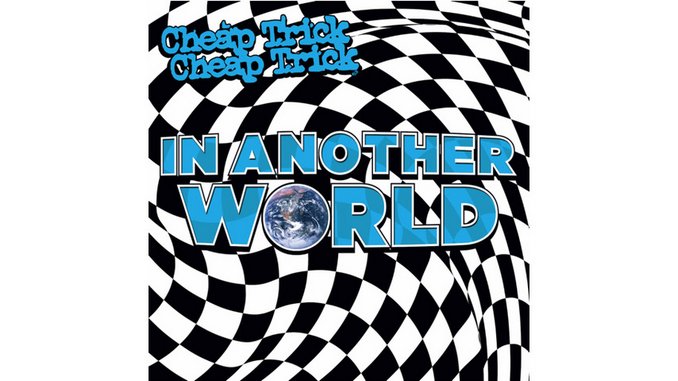
Just this week, two days before the release of Cheap Trick’s 20th studio album In Another World, comedian and SNL star Pete Dadvison and Jimmy Fallon attempted to play the band’s biggest hit “I Want You to Want Me” using a guitarrón and melodica while members of The Roots tried (unsuccessfully) to guess what song it was. Of course, the Beastie Boys had already turned Cheap Trick into something of a meme 30 years ago when they opened their album Check Your Head with a snippet of Cheap Trick vocalist Robin Zander’s famous stage banter from the 1978 live album At Budokan, to date the band’s biggest seller.
Judging from the way Cheap Trick playfully reference their own legacy on “In Another World”, they don’t seem to mind very much. On “Quit Waking Me Up,” for example, the band folds Beatles and Brian Wilson influences back into its own classic tune “Surrender,” as Robin Zander drags-out the word “souuuuuund” in the chorus to a chord progression that must surely have been designed, almost like a wink, to get you to think about the past. Likewise, on “The Party,” the band rolls the familiar grooves from both its own ‘70s-era track “Gonna Raise Hell” and Zeppelin’s “Trampled Under Foot” into one. And a cover of John Lennon’s “Gimme Some Truth” points back to guitarist Rick Nielsen and original Cheap Trick drummer Bun E. Carlos’ session work on Lennon’s Double Fantasy.
Back in the ‘90s, when hip figures like Steve Albini, Billy Corgan and Stone Temple Pilots gave Cheap Trick their blessing, the band played along. After all, why wouldn’t they be grateful for the endorsements? In a USA Today interview that ran the day before the release date, Nielsen remarked that “We’re a lot of people’s fifth-favourite band. They say, ‘I’ve got Zeppelin, Ozzy Osbourne, the Beatles … ’ But I don’t mind being fifth.” The self-effacing attitude looks good on paper, but it’s unfair: The reason why the band can get away with copping its own licks at this point is that it isn’t content to just self-cannibalize.
For one, other than a passing (if carefully placed) nod to “Surrender,” “Quit Waking Me Up” bears no other resemblance to the older song. Similarly, “The Party” quickly veers away from the familiar into all-new hooks that sound fresh when paired against older, tried-and-tested ideas. As for the hooks, it’s hard to remember a time when Cheap Trick sounded this abundant with catchy parts that move you to sing along. Just as importantly, the band breathes life into every note on In Another World with a verve that’s nothing less than shocking at this point in its career.
After coming out of the gate with their fiery, Jack Douglas-produced self-titled debut album in 1977, Cheap Trick spent the rest of the ‘70s putting out records—In Color, Heaven Tonight and Dream Police—that presented the band (not necessarily by its own choice) as purveyors of radio-friendly power-pop. Nielsen has remarked over the years that the band’s label at the time, Epic, essentially forced them to accept mixes of those albums that weren’t as raw as he would have liked. And while Zander’s airy, heartthrob vocal style certainly fits the “power-pop” bill (especially on the new material), Cheap Trick were way heavier than those classic albums indicate.
Zander’s rhythm guitar, along with Nielsen’s explosive playing and bassist Tom Petersson’s 12-string bass work, created a dense—at times, even harsh—wall of sound. Petersson, the musician who first proposed the invention of the 12-string bass, has always been crucial to the band’s lush tone, at least when they’ve managed to achieve it. Cheap Trick got even softer and more pop-oriented in the ‘80s, and they’ve in a sense been chasing their own past glories ever since. They’ve often arrived at intriguing results, but if we’re being honest, it’s been at least three decades since anyone expected any new twists from Cheap Trick.
Which is what makes the new album’s blend of old and new flavours such a left-field triumph. In the past, when the band tried jangle-lite arrangements and keyboard strings like what we hear on the new song “Another World,” the menu consisted mostly of air-fluffed power-ballad soufflé. Today, those same types of moves at least contain organic traces. “Another World” is basically, a modern-day power ballad, but you can hear the flesh and bone that went into it. To be clear, it’s pretty apparent at this point that Cheap Trick aren’t going to come close to recapturing the thrilling roar of their stage sound circa 1978, but they don’t have to. In fact, if the new material is any indication, the band sounds liberated, loose and more alive than it has in years for not pressing too hard.
Album opener “The Summer Looks Good on You,” for example, marries the dissonant chord voicings of the gloomy debut album track “The Ballad of TV Violence” with an infectious Beach Boys-style harmony that resounds with hope and possibility. Undoubtedly, the song was custom-crafted for driving with the windows down and letting the wind blow your troubles away. For the time being, that’s more than enough. Cheap Trick and others from their graduating class may be perfectly content to carry on as walking memes, but In Another World reminds us that this veteran rock act still has lifeblood coursing through its veins.









 The Fat Angel Sings