When TheWytches hit the road in 2017 they were self-admittedly touring with “absolutely nothing to promote”. Having amicably parted ways with their label Heavenly Recordings following the release of 2016 album “All Your Happy Life”, the band were left with no long-term plan. As such, the departure of drummer Gianni Honey last year came during a hiatus for the band. Frontman Kristian Bell was left needing conviction “to even do another album”.
It was illustrator Sam Gull – a long-time collaborator of the band, and personal friend of Kristian – who gave The Wytches the push they needed to get the wheels turning again. “In many ways,” Kristian says, “he was kind of the one who told us to just do the album”. With their new-found drive to create, the band recruited drummer Demelza Mather (formerly of Projector) – who they met when she was working behind the desk at a rehearsal studio – to replace Gianni late last year. “She smashed it completely. She was the first person we auditioned, and we knew straight away”. With a new line-up, the band set out writing material to match. Their upcoming third album “Three Mile Ditch” was mercifully finished “a few months before the pandemic”, but with the uncertainty of Covid and subsequent factory delays, the album ended up being pushed back twice. In hindsight, Kristian feels this was a positive move. “When there aren’t any gigs and the album is released with nothing else going on, it puts more focus on the music itself”. Like the rest of us, The Wytches have truly been starved of live music. They played just three shows with the new line-up before the pandemic led to mass cancellations, including “loads of cool stuff” the band had pencilled in. With that in mind, you can only begin to imagine the release that was provided by two socially distanced performances in Walthamstow mid-October.
“It was a lot of people’s first gig for a long time and that made it really special”, Kristian said. Of course though, the nature of a socially distanced show meant the usual vibe of “getting into it based on how much the audience is into it” was flattened. “All I could really go off was some guy tapping his foot on the front seat”.
Three Mile Ditch is the first album The Wytches have released themselves via their own label Cable Code Records. Without the influence of an external label, the creative juices flowed: “the DIY approach made us more passionate to put the hours into the finished product”. It’s been a long break between albums. And why? Simply, The Wytches “didn’t think we would have been able to fill that four year gap with material.” Personally, Kristian “struggled to write music for a long time” and despite the band “continuing to be solid and writing new material” through that period, the break could have actually been a good thing. In Three Mile Ditch, there’s a “freshness and excitement”.
Self-releasing has also seen the band strip back their team and “start being a bit more prepared and thinking more efficiently”. This extends to time spent in the studio: as younger people during the making of their previous albums: “we took studio time for granted…with the first album we were touring the songs for a long time before we got signed” but with the second album “we were on a label and had time in the studio and maybe weren’t so prepared. It didn’t feel as solid before we went in”.
Now, the approach in the studio has changed again. 2014’s Annabel Dream Reader engineer Luke Oldfield continues to be a mainstay, although this time they recorded in Luke’s own space, Tilehouse Studios. In the sessions for Three Mile Ditch, overdubs and additional pieces were planned out in advance of recording; less concern was given to writing something that could be emulated live. Kristian used to be “really bothered if things weren’t as organic and raw as they could be” but with these sessions, his main concern was, simply, “making the album as good as possible”.
With the band’s hiatus and subsequent album delays, Three Mile Ditch has felt like a long time coming – not just for The Wytches, but for their dedicated fanbase too. “One thing I really noticed is we still have such a lovely fanbase: I honestly didn’t think anyone would be that bothered anymore. I think it’s really surreal how much they’re still into it and how fans that were there from the start are still here” Kristian wonders.
There’s a sense of excitement for the future of the band in a post-Covid world. “Music lovers must feel a bit deprived” Kristian muses, “when people do come back round there will be a wave of energy for live music again”. Despite the uncertainty surrounding the industry at the moment, Kristian has faith in The Wytches’ fans: “if we have to tour the album a year after it comes out then we’re quite confident there’ll still be interest there. The fans are just so good”.
Three Mile Ditch will be released 13th November via Cable Code Records.
In light of its 6th birthday, and being out of stock for some while now, I’m happy to announce a remaster and repress of my first album “Listen to Formation, Look for the Signs”. Recorded in Lyttelton in 2014. I self-released this album in late 2014 with help from a humble crowdfunding campaign. It was then re-released in March 2015 on an Australian label called Spunk Records. I owe gratitude to Aaron Curnow for believing in me back then. And also, to Matthew Crawley.
Listen to formation, look for the signs was recorded in July 2014 at the Sitting Room in Lyttelton, New Zealand. Players on this record were Richie Pickard, Sam Taylor, Joe McCallum and Anita Clark.
“When I hear a young artist making an album as soulful and rich and self-possessed as ‘Listen To Formation, Look For The Signs’, I feel so thrilled not only for the existence of that record but for all the music they will make over all the years to come”. The Guardian (UK)
Through these strange and uncertain times it is sometimes a little hard to see any light at the end of the tunnel but this is where The Moons have stepped in. This long player is an album full of colour and raw song writing recorded live in the legendary Studio 2 at Abbey Road Studios. With cinematic string arrangements and masterclass song writing from the pen of singer/songwriter Andy Crofts this album will be your happy escape.
“Most of this album had been unintentionally sat in my pocket for quite some time. Songs that I had written and forgotten about or had just lost their way and left unfinished. So that is why I wanted the album to simply be named Pocket Melodies. I had this inner feeling to pull them all together and it turned out my favourite Moons record.” Andy Crofts
Pocket Melodies takes you on a journey of glorious melodies leading you through love, romance, nostalgia, regret and unity.
Congratulations to the PaulWeller band members of The Moons on the release of their new album, ‘Pocket Melodies’ out today. Featuring a Weller/ Crofts composition called ‘Tunnel of Time’ recorded at Abbey Rd.
“I wanted to be true to myself with this record. My best strength is writing melodic pop songs so I just let it all flow as I wanted this album to be soaked in colour and completely natural. There’s no pretence, it’s just straight up pop songs. I have always worn my heart on my sleeve when it comes to my feelings and I think you can hear this in the lyrics this time.” Andy Crofts
The album features singles Riding Man and Today which received high praise and championed on BBC London and Radio X and a collaboration with Paul Weller on the song Tunnel Of Time.
“I wrote all of the songs on the album except Tunnel Of Time which is a collaboration between myself and Paul Weller. He once approached me with a little idea and we slowly worked at it in dressing rooms etc until I took it away and put it all together. Its a nice little song and i’m glad it found a home with The Moons.” Andy Crofts
Taken from the forthcoming album ‘Pocket Melodies’ out 23/10/20
Compared to the manic and raw original from the Pixies, Beacon takes its time to build upon the lyrics on their rendition of “Wave of Mutilation.” It’s a stripped-back approach that focuses on soothing piano balladry, eliciting feelings of placidness and occasional dips into the eerie territory. The original increases pulses and provides a constant stream of aggression, so Beacon going in the complete opposite direction was an interesting take, but one that inexplicably works in their favour. The vocals are charged yet subdued, wrapping itself around listeners with a tight grip, but one would be hard-pressed to want it to release. Both provide emotive experiences that can satisfy varying moods, and it’s because of this that Beacon should be lauded, taking something old and turning it into a wholly new creation. A wholly new experience, one that will sure to leave listeners in awe.
Band Members:
Thomas Mullarney III, Jacob Gossett
Gravity Pairs out now on Ghostly International on November 2nd, 2018:
Caroline Polachek shared “The Gate [Extended Mix]” to mark the one-year anniversary of her debut solo album “Pang”. Released via Perpetual Novice, the new 10-minute version was mixed by Polachek and features contributions from Oneohtrix Point Never and Danny L Harle.
According to a press release, Polachek mixed the new track, which has “textural contributions” from Oneohtrix Point Never and Danny L Harle. “The Gate (Extended Mix)” also arrives with a music video by Ezra Miller.“In the original version of the song, the closing lyric (‘Finally, there’s a way/To be both free and safe’) are the words I’m waiting to hear, but never do,” Caroline Polachek said in a press release. “The extended version of the song then is a sort of parallel universe or alternate ending, where those words not only arrive, but ring true.”
This setlist carefully balances the then-new material from “A Momentary Lapse Of Reason” and Pink Floyd classics, including songs from “The Dark Side Of The Moon” (Time, On The Run, The Great Gig In The Sky and Us And Them), the anthemic title track of “Wish You Were Here”, “The Wall’s” Comfortably Numb and a cathartic Run Like Hell. Pink Floyds “Delicate Sound of Thunder” still stands as a record of the creative power of David Gilmour, Nick Mason and Richard Wright at their incendiary best.
3-LP 180-gram vinyl set includes 9 songs not included on the 1988 release of the album. Pink Floyd “Delicate Sound Of Thunder”: Restored, Re-Edited, Remixed.
Pink Floyd‘s Delicate Sound of Thunder live album and concert film were restored, remixed and re-edited for last year’s mammothLater Years box set, but this November will be made available separately, across all major physical formats. The sound on this 1988 release has been completely remixed from the original multi-track tapes by longtime Pink Floyd engineer Andy Jackson with Pink Floyd’s David Gilmour, assisted by Damon Iddins. The new 2CD and 3LP vinyl sets feature this remixed audio and offer more tracks than before: the vinyl triple-disc package offers nine more tracks than the original, while the new double-CD package features eight songs not on the 1988 2CD set. The concert film was restored and re-edited from the original 35mm film and enhanced with 5.1 surround sound and this is available as standalone Blu-ray and DVD packages.
Pink Floyd’s supporting musicians for this tour were as follows: Jon Carin (Keyboards, Vocals), Tim Renwick (Guitars, Vocals), Guy Pratt (Bass, Vocals), Gary Wallis (Percussion), Scott Page (Saxophones, Guitar), Margret Taylor (Backing Vocals), Rachel Fury (Backing Vocals) and Durga McBroom (Backing Vocals).
These new editions of Delicate Sound of Thunder will be released on 20th November 2020.
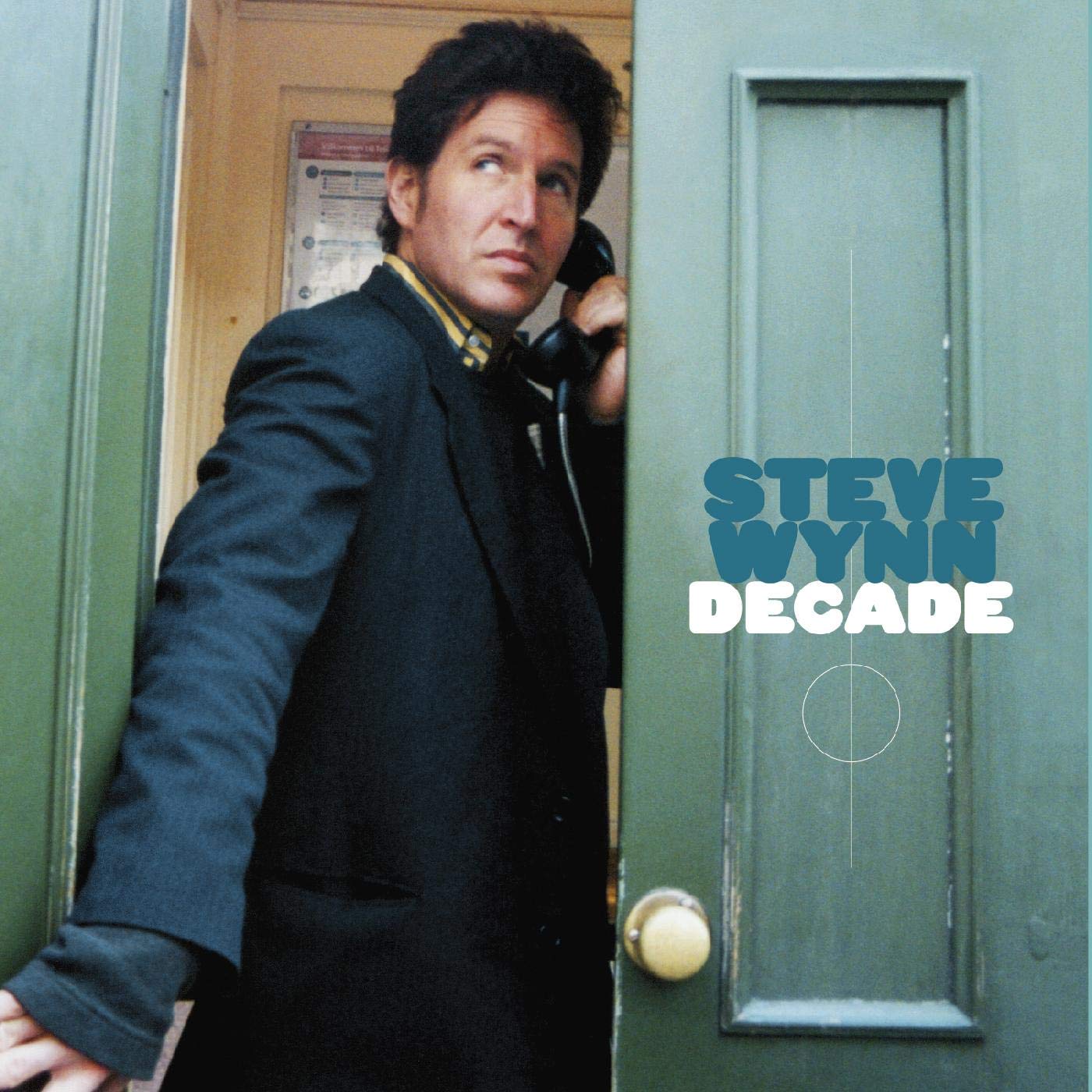
Steve Wynn is well known as a vocalist, songwriter, and multi-instrumentalist, beginning as part of the renowned Paisley Underground outfit The Dream Syndicate. After the group folded, Wynn began a solo career that garnered critical acclaim and accolades from his legion of fans. Now, his solo career is celebrated in a new, 11-CD box set from Real Gone Music called Decade. The expansive 166-track set chronicles Wynn’s career with deluxe versions of the albums he released from 1995 to 2005, many of which have been long out of print. From the U.S. albums “Melting In The Dark, Sweetness and Light, My Midnight, Here Come The Miracles, Static Transmission, and …Tick…Tick…Tick”, to the rarities collections like the German compilation The Emusic Singles Collection and the European set Pick of the Litter– not to mention the 57 unreleased tracks within – the Decade Box Set promises to be the definitive word on Steve Wynn’s solo output. It’s all been compiled and sequenced by Wynn himself, alongside archivist and box set producer Pat Thomas.
Steve Wynn first gained fame as lead singer and songwriter for The Dream Syndicate. But his post-Dream Syndicate solo career is the equal of any indie-rock singer-songwriter you’d care to name. Now, Real Gone Music and Steve Wynn have joined forces to release “Decade” (yup, the Neil Young reference is deliberate), an 11-CD set that chronicles, with lavish deluxe editions, the guitar-driven albums Wynn recorded between 1995 and 2005, most of which have been long out-of-print. The statistics on this box set are mind-blowing: 166 tracks, 57 of them totally unreleased, plus 31 other rarities! That’s right’over half of this 11-CD set consists of either hitherto unknown recordings or tracks that have been almost impossible to find!.
So, Real Gone Music has just issued (is issuing? I’m not sure about the timeline) “Decade”, an 11-CD box set of music recorded by Steve Wynn—he of Dream Syndicate, Miracle Three, Gutterball, Baseball Project, and other fames—between 1995 and 2005, and the first album in the set is Melting in the Dark, which Steve recorded with Boston band Come back in 1995. If you’ve never heard “Melting in the Dark“, I recommend you order the box set right now so you can enjoy the fruits of our labours (plus Steve’s albums Sweetness and Light, Here Come the Miracles, and more!). We basically rehearsed and recorded all of “Meltingin the Dark” in two three- or four-day sessions, and there are a lot of great songs and performances therein
New York City’s layers of continuous noise – vibrating, reverberating, buzzing & blazing – have set the backdrop to a rising four-piece that NME already calls “one of New York’s most exciting new bands.” Just like the city, The Muckers are equal parts vital and timeless, resolute and vibrant. Frontman Emir Mohseni moved to New York all the way from his native Iran to pursue a career in music. The move, profiled across acclaimed publications, from Rolling Stone to Billboard, only marked the beginning of the band’s story. Upon landing in this new environment, Mohseni met the three guys that would become his closest friends, and build with him the enlivening sound and enrapturing live show that The Muckers have garnered early praises for: Anthony Azarmgin at the bass, Chris Cawley on rhythm guitar, and John Zimmerman behind the drums.
“Endeavor” is a fitting title for the band’s debut. Their journey is nothing short of an odyssey: first, as an immigrant taking refuge in New York City to have the right to perform rock music, then as a band caught in the global pandemic who’s had to let go of their greatest strength: thriving on any stage – from performing with Pond in a 800-cap room to making the crowds dance and sweat in the divey bars of Brooklyn.
“My days are numbered / I’m running out of time / I’ve been waiting for too long / Don’t wanna lose it again” Mohseni sings on “Suspended” in an almost prophetic moment. He has battled for years for the right to perform his music live, and just as his dream felt in reach, all the venues of the world shut down at once. But in the face of adversity, The Muckers have never let up their ambition. Listen and you’ll hear why – their music is a thrill worth fighting for.
The Muckers -Recorded Live – Paste Studio NYC – New York, NY The record is out February 26th, 2021.
1. Suspended for a Long Time 1:11 2. Memories 7:53 3. This Town Will Drag Us Down 16:18 4. It’s Better Without You 23:11
Everyone recalls the first time seeing It’s A Beautiful Day, on the OGWT with their soaring, unforgettable track “White Bird,” they were an anomaly among bands of the San Francisco psychedelic scene of the late 1960s. With David LaFlamme’s violin as lead instrument, and the keyboards of Linda LaFlamme (now Neska) as the solid foundation, they stood out. Their debut album on Columbia Records is now a bona fide classic. But then, things went South for the band and for Neska personally.
In early 1968, the band It’s a Beautiful Day were in Seattle, remembers original keyboardist Linda LaFlamme, “in a band house that was very old, freezing cold. There was no food, there was no money, nothing. I was seven months pregnant. The first week that we were up there, I had the electric piano out. I was sitting on the bed, and just started playing some chords. And David [LaFlamme] turned around and said, ‘Do that again.’ ‘White Bird’ was developed through us just working together for about two hours.
“The song kept shifting. There came to be a middle part, and whatever I would lead with chords, David would take it, so that the words on that song were mostly David, I think. The chording was me; the melody was both of us. The song kept evolving, but that was the birth of ‘White Bird”.’ When we finished after two hours, David and I looked at each other, and we knew we had a beautiful song.”
Within a few months of teetering on the edge of poverty and starvation, It’s a Beautiful Day would be one of the hottest emerging bands on the exploding San Francisco psychedelic scene. When it was finally released as part of their debut LP around spring 1969, “White Bird” became the band’s signature tune—the one by which they’re by far most remembered. Of all the groups from the era who are mostly known for just one track that wasn’t a hit single, It’s a Beautiful Day might be the most celebrated such act, and “White Bird” one of the most fondly regarded such tunes.
Yet there was more to It’s a Beautiful Day than “White Bird.” Their combination of bittersweet male-female vocal harmonies, David LaFlamme’s violin, and Linda LaFlamme’s haunting, jazz-classical-flavored electric keyboards both fit in snugly with the San Francisco Sound and distinguished them from the many other Bay Area groups trying to make a mark in the late ‘60s. Linda, however, wouldn’t be around to enjoy most of their notoriety as their fame spread beyond Northern California. Not long after their first and best album was completed, she was out of the group, as her marriage and musical partnership with David LaFlamme ended.
Of all the ‘60s San Francisco bands to gain national success, It’s a Beautiful Day is one of the most sketchily documented. In part that’s because, as I’m surprised to hear her tell me when we talk a couple years ago, “You’re the first person that’s ever asked about my input, what happened in the group. How all the music happened. They usually ask David, and it’s not been as accurate as I remember it.”
Besides playing organ, electric piano, harpsichord, and celeste, Linda—who now goes by the name Neska—shared songwriting credits with David for three songs on their self-titled debut. Her contributions have been overlooked, in part because she’s sometimes confused with a different Linda LaFlamme. After their marriage finished, David LaFlamme wedded a different woman named Linda, who became part of It’s a Beautiful Day. Neska was the Linda LaFlamme who played with them for the first couple years, not the one who began singing with a different line-up in the late 1990s. When finally approached for her memories of It’s a Beautiful Day’s early days, she had a lot to divulge.
Like many San Francisco psychedelic bands, It’s a Beautiful Day’s core founders weren’t from a rock background. Unlike many of those other core founders, they weren’t from the folk world, either. Neither Neska nor David LaFlamme were in rock bands when they met in 1963, marrying the following year. “I moved out to San Francisco, where a friend introduced me to David, who came over,” she explains. “When he walked in, I was totally flabbergasted by his wonderfully good looks. He brought a piece of music, and I had a piano in the studio apartment. He said, ‘Can you play this so I can sing it?’ It was ‘Laura,’ the name of his grandmother.
“So I sat down and played, and he sang, and that was it. I was in love. I don’t know what David was, but I thought he was in love,” she laughs. So David started singing with me playing, just a few gigs. He met this man who decided he would have a fabulous career doing promotional shows—they wanted entertainment for the executives. So they hired David to sing, and a band would play.
As the San Francisco psychedelic scene took off, the LaFlammes’ music took a turn for the more radical. “He met a group of guys – one was an oboe player, one was a cellist. Standup bass [by Jaime Leopold, who’d go on to play with Dan Hicks and His Hot Licks]. One was a drummer, Terry Wilson [later in the Charlatans]. David on violin, and on guitar was Bobby Beausoleil.” That’s the same Bobby Beausoleil who’d kill Gary Hinman in 1969 as part of the Charles Manson Family murders; back then, he was one of many struggling San Francisco teenage rock musicians.
Rock was in there, but all of those musicians, except for Terry Wilson as I remember, were classically trained. So it was a very unique sound. Also with Bobby Beausoleil, there was the rock influence. But it was classical rock, almost, I guess I would call it. Except they were really leaning toward the heavy rhythms.”
One of the pieces on that 2006 archival LP Light Shows for the Blind, “Bombay Calling,” was developed (with much alteration) into a track on It’s a Beautiful Day’s debut album. Beausoleil and David had such egos that when they would go onstage at small clubs, it was truly who could outdo the other.” As for what Bobby Beausoleil was like back then, Neska simply comments, “He lived with us for six months, and I thank god still today that we got out of that alive.”
David playing the electric violin was such a unique instrument that Matthew heard about us.” That was Matthew Katz, who’d managed Jefferson Airplane in their early days, later managing Moby Grape . Katz would have a rocky relationship with It’s a Beautiful Day, but played a vital role in launching the band. Matthew said, ‘I already have the name of the band. One of my hobbies is naming bands and writing them on paper.’ He pulled his middle desk drawer, and took out sheets of paper on which he had written names of bands that he thought were terrific. He said, ‘I was thinking the name It’s a Beautiful Day for you.’ We said, ‘Sure.’ I wasn’t in love with the name, because it was during the Vietnam War, and I wasn’t thinking that it was such a beautiful day. Matthew said, ‘let’s audition some musicians,’ and we did. We wound up with [bassist] Mitchell Holman and the drummer, Val Fuentes. And Matthew had this young girl singer, Pattie Santos, who had a phenomenal voice. When went up to Seattle, we lived in a band house that was very old, freezing cold. We had, I think, three rooms. David and I slept in one room, Mitchell and Val were in one room, and I think Pattie had her own room. There was another band in the house, and there might have been another two people in the house. It was filled. It was freezing.”
Both LaFlammes brought elements into It’s a Beautiful Day’s sound that were highly exotic for the time. Electric violin had been used in rock before their first LP, most notably on “Celeste” on Donovan’s classic 1966 Sunshine Superman album; guitarist Simon Nicol occasionally played the instrument in Fairport Convention’s early days. The Velvet Underground’s John Cale used viola to good effect in some of the group’s early songs, and the psychedelic-era Animals made violin a big part of some of their late-‘60s arrangements. Yet no full-time violin player had taken such a key role in a rock group prior to David LaFlamme .
“It took the place of the guitar in our group,” says Neska. “It was the lead instrument.” Getting it heard in a rock group made some modifications necessary.
“When it first started, David was using his regular violin. Who knew about pickups for the violin? So [Rodney] Albin”—brother of Big Brother & the Holding Company bassist Peter Albin—“made this violin for David, which was a beautiful piece of art, I must say. It also weighed like 50 pounds,” she laughs. “It was a solid body. David finally said, ‘I can’t play this anymore. We have to do something.’ That was when pickups were coming out, and David put a pickup on his violin. The melancholy folk-rock and male-female vocal harmonies so typical of the early San Francisco Sound both made the experimentation accessible and placed the band squarely in the zeitgeist of the city’s psychedelic scene. Never was this more memorable than in the lilting “White Bird” which was at once mournful and uplifting.
“So I would get on the bus in the morning and go to my work at the doctor’s office, which was how ‘Hot Summer Day’ [one of the songs on the debut LP on which the LaFlammes shared the song-writing credits] came about. I was riding the 22 Fillmore [bus in San Francisco], looking out the window, and the words just went through my head. I got to the doctor’s office, phoned David, and said, ‘Write this down.’ He came up with the middle section. Then he would come in and we would mess around with the chords. He would come in with a melody.”
The third song with LaFlamme co-writes on the first LP, “Girl With No Eyes,” also “came lyrically to me. It also came musically to me the first part, ‘cause I could hear it in my head. Then David took that and he expanded it.
She also remembers making contributions to other songs that formed both the bulk of their early repertoire and the backbone of the It’s a Beautiful Day debut album. Like “Wasted Union Blues,” which was “all David, except when I came in, he said, “What can you do for the beginning of this? I came in with the piano lead-in, and that got the beat of the music going. But those lyrics were David’s. ‘Bulgaria,’ that was just David and I playing like we used to at three in the morning, and that just came about.”
But while Katz had done his part to get the band going, It’s a Beautiful Day wouldn’t work with him for long.
We got gigs at the Avalon and he went to Bill Graham, and Graham said he would pay for our union fees, and we would just work ‘em off. But he would get those done right away so we could start working the ballrooms. Neska wasn’t just busy with It’s a Beautiful Day and changing management in early 1968. Her daughter Kira was born in March, though she and the group kept gigging before and after the birth. “We played the Matrix”—one of San Francisco’s most crucial rock clubs since Jefferson Airplane started playing there in summer 1965— “when I was about eight months pregnant, with Jefferson Airplane.
After It’s a Beautiful Day started to raise their profile with some shows at the Avalon in late March and early April, they made their first known recordings. Four demos were cut at the AvalonBallroom itself three of them (“Girl with No Eyes,” “Bulgaria,” and “Wasted Union Blues”) of songs that were redone for the debut album. The fourth, the rather atypically good-time country-shaded “Countryside,” wouldn’t make it onto their studio LPs, though a live version appears on the 2013 CD Live at Fillmore ’68. Oddly, “White Bird” wasn’t demoed at this session, though an unofficially circulated version identified as an April 1968 Avalon concert recording has. Taken at a markedly slower, more stately pace than the arrangement used on the debut LP, it was even at this early stage the obvious highlight of the band’s set.
Neska made a remarkably quick transition to playing electric keyboards in a psychedelic band. Her forceful, ingenious work comes through more strongly on 1968 live recordings than it would on the LP, particularly on the Live at the Fillmore ’68 CD and a half-dozen Fillmore shows from May and June that can now be heard (for a fee) at wolfgangs.com. Her deft use of eerie, mysterious embellishments with shades of jazz and classical isn’t all that dissimilar from what Ray Manzarek was doing in the Doors, though imbued with her own sense of restrained grace. She could also pump with a furious groove, as heard on some of the more extended breaks the band would take in a live setting.
“Most keyboard players back then, as I’m recalling, [would] mostly fill in chords until they would solo,” says Neska. “David made sure there was always space for everybody to get some kind of solo.” She was able to generate an especially rich sound by using both a Wurlitzer electric piano and a Hammond organ onstage, often playing them at the same time. “The electric piano would sit on top of the Hammond organ,” she notes.
We were living on Potrero Hill,” she elaborates, the group even sharing a basement rehearsal space across the street for a time with another promising unsigned band, Santana. “The drummer would take his [instruments] over to the club earlier in the day. Everybody else would bring their instruments and their speaker. We’d wait for the bus on the corner. We’d get on with our instruments, and I remember everybody was just looking, like, ‘Okay.’ It was nearly impossible to even find space for that and the other band instruments once they got onboard.
Adds Neska, “The organ was a Hammond B-3. It had that mid-range speaker. Al Kooper came to me once and said, ‘I’ll pay anything you want for that speaker.’ And I said, ‘It’s not for sale, Al.’ It was such an old speaker; there wasn’t a mid-range speaker for organs. So it was like a gem. I was very honoured that Al Kooper would think that my organ speaker was really cool.
As the live tapes reveal, by spring 1968, It’s a Beautiful Day were playing sets almost identical to the track list of their first LP, along with a few songs (“Countryside,” the uncharacteristically bluesy “Changes”) that wouldn’t make that cut. (As “Changes” included a lyric that used the phrase “fucked-up,” it might have had a hard time gaining official release anyway, at least in uncensored form.) The length of these would get pared down considerably in the studio.
“David is an incredible arranger,” she feels. “David had a real fabulous knack for arrangements. He knew how to put them together. We really were attuned to listening to each other. [Guitarist] Hal [Wagenet], particularly. I don’t know that Val and Mitchell had that same perception in listening. “Hal brought a sensitivity. Hal really worked on his guitar parts. He wasn’t one of these people that would improvise on parts that he was playing with other musicians. He would improvise on his solos, and even then, worked very hard to make sure it’s what he wanted. So Hal brought his own unique sound. Brilliant guitarist, very conscientious guitarist. He had a beautiful touch.
“And Pattie was just so sensitive a singer. She had this wonderful voice that she and David could really work their harmonies. She had a great ear for harmony, and for playing the tambourine and all of those rhythm instruments. she was great onstage. She was a very wholesome kind of performer. Even at this early stage, there was one song that stood out above all their others. “We would play ‘White Bird’ and yeah, that was the song,” though “Time Is” also got a big response. “I think it’s because it was so different from what was being played out there. It was a much more gentle song. It didn’t have a huge rock beat. That violin was different, and Pattie and David’s harmonies were different. I don’t know what people thought ‘White Bird,’ the phrase itself, meant. I got told, ‘oh, White Bird means cocaine,’ and all of these interpretations of what White Bird meant.
For “Time Is,” Neska continues, David “had read an anonymous poem in a magazine, and he just loved those words. And brought the words and said, “What can you do with this?’ I said, ‘There’s a classical piece written by Samuel Barber that is perfect for this.’ So I played the first part of Samuel Barber’s “Four Excursions.” I just played the first line…it set the rhythm of the song. David came in, and just started singing, and that song was born. With a strong original repertoire and a fast-building reputation in San Francisco now that they’d played numerous shows at the Fillmore and Avalon, record labels started to express interest. “Two people were very interested in the group – Lou Adler, and Columbia. Columbia had transformed a bus into a recording studio. They drove it up to the Fillmore, recorded us and whatever groups were at the Fillmore that night, and then sent us a letter that they were very interested.
So we drove down to Los Angeles, playing a gig at Whisky A Go Go. We got to Lou Adler’s, “We walked into Lou’s house, and I still to this day have not experienced that kind of stopping at the door, gasping for air at the beautifulness of this house. The wood was sent over from Spain. You walked over this little bridge, then around the swimming pool, and then came to this very open-spaced living room. All wood. And sitting there is John Phillips. He left, we talked to Lou Adler, and it was a wonderful experience. I’m sorry we chose Columbia. myself. at the time, Columbia was the bigger company.
“We then went to play our gig at Whisky A Go Go. Clive Davis came in wearing a turtleneck and a string of beads, or two string[s] of beads. After our gig, he and David split off and did some talking. They talked about contracts etc. Then David brought the information back to us. It was a session between Clive Davis and David. We made the decision to go with Columbia because they were the bigger company.”
Back in 1968, “where we got into sticky wicket was since Matthew owned the name, they immediately told Columbia, as they would have told Lou Adler, you cannot use the name. We had a decision to make – whether we were going to change our name to something like Beautiful Daze. But we had already built up a following, in San Francisco at least, that knew us by the name It’s a Beautiful Day. Maybe we thought Columbia was going to back us all the way, which is what they did. But Matthew was absolutely certain that [we weren’t] going to be It’s a Beautiful Day. So that started a lot of terrible stuff right off the bat. Financially, it started a war.
The It’s a Beautiful Day Album By the time they did manage to get into Columbia’s Los Angeles studio, there were some differences between the band as they sounded on those spring 1968 tapes and as they’d sound on the It’s a Beautiful Day LP. Neska was able to use a wider range of keyboards. The songs—always longer in concert, and sometimes a lot longer—were shortened and tightened up. The studio had “a great piano. What was really fabulous was being able to play that concert grand piano, particularly on ‘Wasted Union Blues.’ I’m a very heavy left-handed player, so I love bass lines, and being able to do it on that piano, that was heaven. A lot of times, I would play the electric piano and the organ at the same time, so that there was a left hand on the organ, and there was a right hand on the electric piano. Because I didn’t want to put the electric piano on top of the concert grand piano,” she laughs, “I think I had it to my right, and I had the organ to my left.
Although Neska was pleased with the album and feels “it represented us very well, I will say, it was a very hard time for me. Because David had fallen in love, and had just left Kira and I. So between my crying of tears and going into the studio to record, listening to the album just was like knives being stuck in my body. The sound was fulfilling; the sound was very good. But I couldn’t truly realize that until there was seven years of pain that stopped being painful. And I got cheated out of a lot of money.
Released around spring 1969, It’s a Beautiful Day finally made their music available to the world beyond the West Coast, making #47 in the Billboard Top Hundred. An edited version of “White Bird,” oddly, did not chart as a single, though it made #5 on San Francisco station KFRC. The long version quickly became a staple on FM stations across the nation, and remained one for several years. It’s still the song for which It’s a Beautiful Day are known.
Fred Webb replaced Neska on keyboards for their next album, “Marrying Maiden”, which would be their sole Top Forty LP, though the debut remains by far the most popular item in their discography.
As Dave Mason reflects in a statement, “I’ve played these songs for the better part of 50 years because I love them. I re-recorded the whole album because I still feel inspired by the music. This makes “Alone Together Again” a true labour of love. Some things I know for sure; music is relationship and love is best when shared. That is the whole conceptual play of Alone Together.” Here, he performs the album in its original sequence with members of his touring band and special guests such as Jonathan McEuen, Gretchen Rhodes, and Doobie Brothers multi-instrumentalist John McFee.
Now, unlike some re-recordings, the reimagined versions aren’t a ploy to land a sync deal or to bury the classics we’ve come to love. Rather, these talented artists are drawing on a fifty-year vantage point with new experiences and perspectives to inform their compelling interpretations. Both Yusuf (Cat Stevens) and Mason seek to build on their legacies with new performances that complement the original albums rather than replace them. Arriving as they do at a time when we’re truly alone together again, living in a wild world that’s tackling many of the same questions from 50 years ago, the words remain pertinent to our current times, while the performances remain spirited.
“Alone Together” was my first solo album. Like all firsts, they are special. The original tapes that burned in the 2008 Universal fires was heart-breaking. But it occurs to me, the Music never dies.
I’ve played these songs for the better part of 50 years because I love them. I re-recorded the whole album because I still feel inspired by the music.
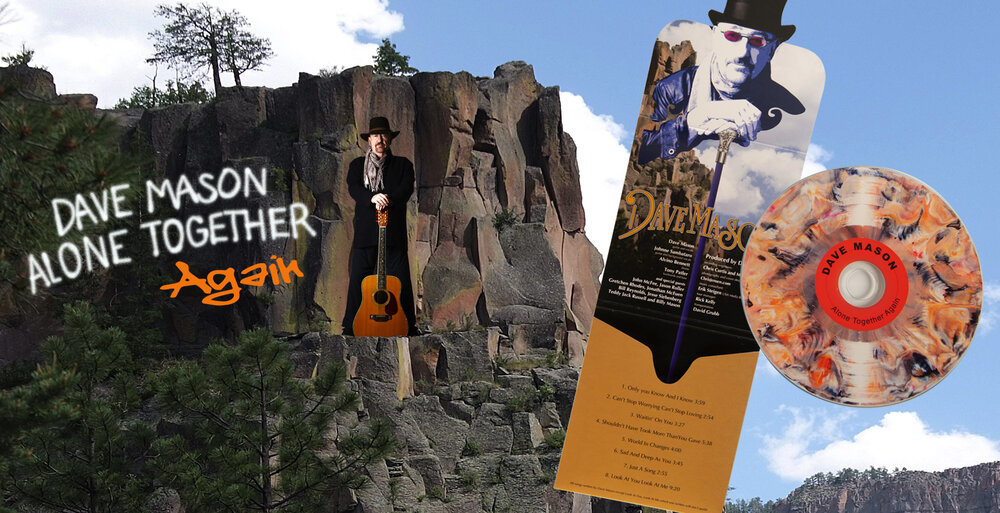
We allowed ourselves to have some fun with the presentation of this CD, which is marbled and multicoloured, just like the original vinyl. And true to the original album, it’s a three part fold out. We tried to find the exact spot in Joshua Tree to reshoot the photo, but, well, it has been over fifty years ago and we couldn’t be sure. But we think we recaptured the spirit, nonetheless.
I hope you’ll enjoy listening to Alone Together Again as much as I had in making it. And I hope you’ll feel the love when you have it in your hands, and when the music hits your heart.
Alone Together included a tri-fold die-cut design and what might be the first example of marbled colour vinyl on a mass scale. Thankfully, these visual elements remain in their reimagined versions. The tillerman in the new edition has returned from a space expedition while the children enjoy music through headphones and gaming on a cell phone. – Dave Mason
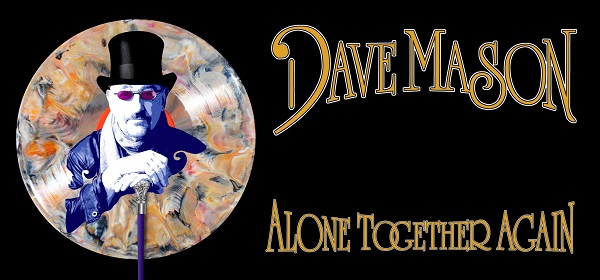
Wait! There’s More! You’ll hear great music, but you’ll also have something awesome to look at. Encased in a tri-fold jacket, complete with die cut image of Dave Mason in a top hat and collaged behind a rocky outcrop. The interior pocket holds your marbled CD, an homage to the legendary original record. Alone Together Again will bring you joy both for the ears and the eyes.
Featured on this CD is the Dave Mason Band: Johnne Sambataro on guitar, Alvino Bennett on drums, Anthony Patler on bass & keyboards, and special musical guests John McFee, Jason Roller, Jonathan McEuen, Gretchen Rhodes, Bill Reynolds, Jesse Siebenberg, Teddy Jack Russell and Billy Mason.




 The Fat Angel Sings