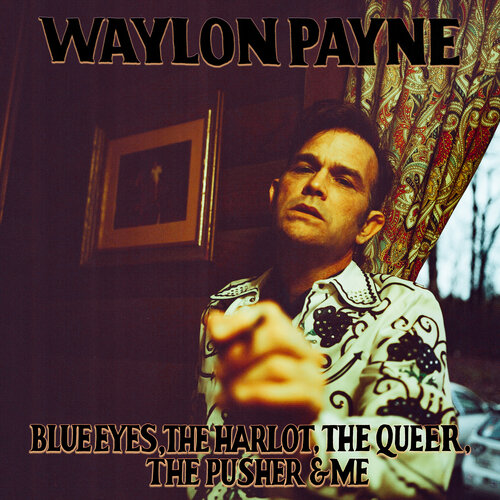
The second album from Waylon Payne is a defiant account of addiction, trauma, and recovery. It’s the first effort in 13 years from Payne, a Nashville-based country songwriter, and it tells the story of his past decade overcoming drug abuse, homelessness, and the loss of his parents in four breath taking acts. He confronts his demons on the gorgeous “Dangerous Criminal,” and comes out on the other side on the rollicking “Back From the Grave,” which was co-written by country heavyweights Brandy Clark and Clint Lagerberg. It’s a masterpiece of humanist storytelling and there’s something close to closure on the closing act highlight “Santa Ana Winds.”
In interviews this year, Waylon Payne spoke of the songs on his second album, Blue Eyes, The Harlot, The Queer, The Pusher & Me, as though they were works of unfiltered emotional purging. In fact, his intimate sharing about the warping of pivotal relationships in his life abounds in a thoroughly earthy kind of profundity. From his gusts of ruefulness during “High Horse” — about his father’s death preventing a reckoning — to his elegant pining during the orchestrated pop tune “Old Blue Eyes” — for a companion he lost to shared addiction — and his terse but deeply felt desperation during the churning country-blues of “All the Trouble,” his range as a personalized storyteller is riveting.
From the album ‘Blue Eyes, The Harlot, The Queer, The Pusher & Me’
When the Covid-19 pandemic hit the U.S., Chastity Belt’s Annie Truscott descended into a state of mourning. Her plan had been to join her partner, Jay Som’s Melina Duterte, as violinist on tour, a privilege rarely afforded since both maintain busy road schedules, and for Truscott, the prospect of spending most of the year in a van wasn’t met with exhaustion so much as exhilaration. At long last, she’d be making a living playing music, no side hustle needed. The cancellation of the tour represented a side lined dream.
Routine was born of this disappointment. Like the phoenix rising from the ashes, Truscott and Duterte’s collaborative project offers a glimpse of the creative possibilities that can emerge from a state of defeat. Written and recorded over the course of a month in Joshua Tree, Routine’s lush debut EP And Other Things finds the couple trying on new roles. Truscott, who plays bass in Chastity Belt, wrote the bulk of the material and sings on the EP, while Duterte, normally a band leader, used the project as an opportunity to, in her words, “Take the backseat,” as accompanist, producer, and engineer.
Duterte describes the making of the EP as “seamless.” In the mornings, Truscott sat outside of the cabin in the not-yet-blazing sun and worked out chord progressions on guitar while Duterte slept in. Staring out at the horizon, Truscott could see a smattering of houses and the sharp outline of a mountain range, but overall the property felt remote, far removed from home in Los Angeles. On long walks Truscott admired the recently bloomed spring flowers and pondered the legacy of friendships and experiences that made her. “I spend a lot of my time thinking about the people who’ve impacted my life,” she says. “Routine gave me an opportunity to explore those relationships through music.”
It was on one of these walks that Truscott began writing Cady Road, a contemplative, country-tinged pop song that urges listeners to sit in the discomfort of the present moment. “Relax / It’s fine / You don’t have to know this time,” Truscott sings on the chorus, reflecting on the un-suredness that gripped her in those early days of the pandemic. Duterte joins in harmony, giving a song about being alone with your thoughts a collaborative dimension. “In Annie’s songs I hear a yearning for something just out of reach, something unachievable,” Duterte says. “She’s such a great singer, so it felt good to just layer instruments to make her vision for it feel fully fleshed out.” That impulse is heard vividly on Cady Road, where an abundant arrangement accompanies Truscott, replete with the spry notes of a banjolele.
A true collaboration requires trust, intimacy, and patience, three elements that cohered almost mystically in the process of making this EP. “Melina is the most calming presence. She’s so good at sitting with silences in a conversation and just observing,” Truscott says. The quality not only makes Duterte a good partner, but also a good bandmate and producer. Calm and Collected is a tribute to that enviable ability to maintain serenity amidst the chaos of experience. Though it was written in Joshua Tree, Duterte and Truscott recorded it in the attic of their home in LA, where Duterte set up a studio in the free time afforded by the pandemic. The song is the quietest of the collection, a gentle ode underscored by atmospheric swaths of synth that swaddle the listener.
“I think of And Other Things as a series of vignettes,” Truscott says. “We aren’t telling one story here, we’re telling a series of short stories that people can hopefully relate to.” Asked how it feels to offer the EP up to the world during a time of major uncertainty in the music industry, Truscott offers only one word: “Cathartic.”
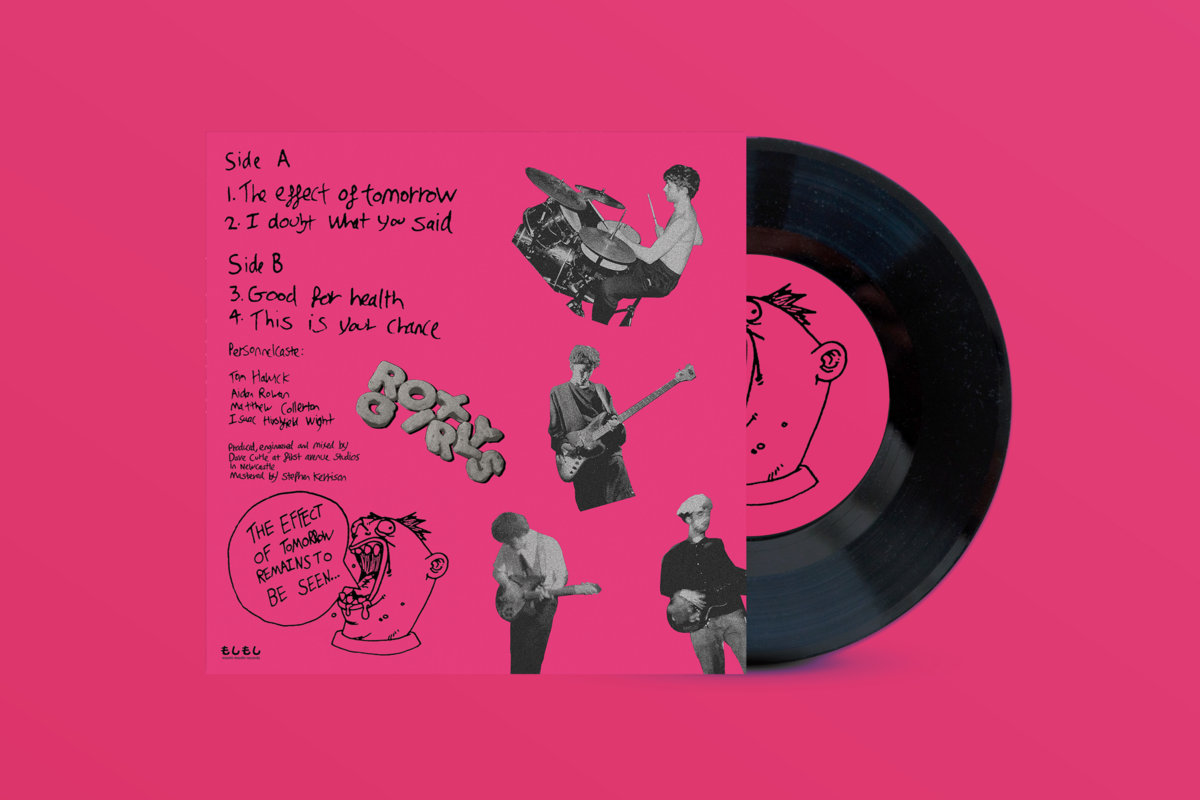
Like all involved in the arts and culture sector, Roxy Girls haven’t been able to pursue their passion for performing live since March. During the slight reprieve between lockdowns, however, the four-piece were able to reunite to record a new EP. The four-track record has been released as a limited edition vinyl, with 75% of profits going towards Sunderland Foodbanks, who’ve provided a lifeline service to the city’s most vulnerable during the pandemic. Made up of Tom Hawick on lead vocals and guitar; Isaac Hirshfield-Wight on guitar and vocals; Matthew Collerton on bass and Aidan Rowan on drums, the band had already built up a firm following in their native Sunderland and were gaining real momentum, with their first headline UK tour booked, before lockdown hit.
Tom, who founded the band with Isaac after the pair met as teenagers at the city’s Pop Recs culture hub, said: “We had the opportunity to finally get together in August and it was very much needed. We’ve all been doing our own musical endeavours in lockdown, but that was the first time we could actually get together. As performers, our entire life has been turned on its head and it’s been really difficult.
Recorded over two much needed days at First Avenue Studios, Newcastle Upon Tyne. The Effect of Tomorrow was only meant to have 100 vinyls pressed, but after all 100 were pre-ordered, subscription service Flying Vinyl donated a further 100 to the cause, with around 90 of those left. Discordant mackems in every which way.
Tom lives with Isaac and the pair already have a backlog of songs written during lockdown, which they’re hoping to be able to perform with the rest of the band for audiences next year.
The singer said: “Having such a backlog of songs is one positive to come out of this and puts us in a really good position for when we’re coming into our first album. We’re confident we’ll be doing gigs again next year and we’re already getting offers in for next summer. Rather than rescheduled dates, they’re new offers, which is great.”
*The Effect of Tomorrow limited edition pink vinyl is £6.99 and is available from theRoxy Girls Bandcamp page.
Released November 23rd, 2020
Written and produced by The Roxy Girls
The Roxy Girls are,
Tom Hawick – Guitar and Vocals Isaac Hirshfield-Wight – Guitar and Vocals Aidan Rowan – Drums and Percussion Matthew Collerton – Bass and Turner Rollies
Sufjan Stevens is a singer-songwriter living in New York City, It was only a matter of time before the musical trickster in Sufjan Stevens returned after the stripped-down, soul-baring Carrie & Lowell. But while it may be overstuffed with ideas, The Ascension is far from the old precious orchestral ornamentation of Illinois. Stevens creates massive, complex soundscapes from electronic scraps of sound here—call it his digital orchestra. He isn’t interested in being clever (with the possible exception of the on-the-nose, Rx name-dropping “Ativan”), instead letting these sprawling tracks reflect simple emotions (the detachment of “Video Game,” the morose come-ons of “Sugar”) or pointed political commentary (the epic “America”). As usual, Christianity is never far from his mind (the title track is a kind of personal hymn), but Stevens isn’t trying to proselytize—he wants to take us deeper than ever into his own spiritual journey.
All songs performed, recorded, engineered, arranged, mixed and produced by Sufjan Stevens, with additional contributions (*) recorded and engineered by James McAlister and Casey Foubert at their respective home studios.
Honey Harper—born William Fussell—grew up by a swamp in Georgia, and his father was an Elvis impersonator, which gave him a childhood rich with strange memories that shaped his gentle, romantic country songs. Harper describes them as “celestial cosmic country music” or “glam country,” in the vein of Gram Parsons or a lamé-wrapped Townes Van Zandt. His debut full-length, Starmaker, isn’t made for tailgating or cranking from an F150; it’s for psilocybic camping trips in Joshua Tree, stargazing, and reflecting on bygone days. Twirling, misty tracks like “Suzuki Dreams” and “Strawberry Lite” sound like they’re messages from long ago, just now reaching us after a long journey through time and space.
Honey Harper’s Starmaker, co-written with the singer’s wife, Alana Pagnutti, plays off the pun in its title to explore the risks inherent in having ambitions of stardom, speaking to the desperation of reaching for but not quite grasping something greater. Harper luxuriates in his songs’ heartfelt solemnity, letting their lush arrangements and lavish harmonies swirl like galaxies. The contrast between Harper’s twangy, processed vocals, acoustic guitar, and synthetic warbles on the opening track, “Green Shadows,” epitomizes his distinctive style of chamber-pop-inflected country, conjuring the image of a pickup truck taking off into space. From the plaintive orchestrations on “Suzuki Dreams” to a crying flute on “Vaguely Satisfied,” every dazzling element of Starmaker coalesces, and every moment is filled with awe.
From Honey Harper’s debut album “Starmaker”, out now!
Once upon a time, Phil Elverum sang about swimming to the bottom of the ocean and finding beauty there. On “Microphones In 2020”, he plunged deep into his own personal history and discovered something arguably more profound. Eschewing nostalgia and solipsism as much as possible, the Mount Eerie mastermind revived his long-dormant Microphones moniker to scour that era of his life for wisdom. He came away with epiphanies about meaning, impermanence, and “the true state of all things,” wrapped up in a staggering 43-minute recording that defies categorization.
After more than a decade releasing music as Mount Eerie, Phil Elverum dusted off his moniker as the Microphones to release a single-song LP tracking a lifelong tension between his art and his enduring sense of smallness. The album or, as Elverum describes it, “This spooling-out, repetitive decades-long song string/This river coursing through my life,” is a droning dirge that expands the affecting tableaux of A Crow Looked at Me and Now Only into a nearly cradle-to-grave chronicle informed by years of travel and experiences of loss. The effect is hypnotic, as cascades of distortion nearly swallow Elverum’s voice, reminding us that he is not only an auteur of empathy, but also a humble messenger of mortality.
The last recording released under the Microphones’ name was 2003’s Mount Eerie, a precursor to Phil Elverum’s creative shift. The notion that the Microphones disbanded is something of a misconception, because even though he collaborated with other musicians on the project throughout the years, the Microphones name is really synonymous with Elverum himself. Since assuming the Mount Eerie persona, he’s proven incredibly prolific, releasing 10 studio albums under his new name between 2005 and 2019. Elverum slipped back into the Microphones for a performance last summer, and when the stirrings around this choice picked up, he began toying with “what it even means to step back into an old mode.”
The result is Microphones in 2020, the sprawling, one-track album lasting nearly 45 minutes. Microphones in 2020 contains some of the year’s best, most reflective and probing lyrics. Elverum’s mastery of language is impressive thanks to his ability to capture an intangible, fleeting feeling without coming across as pretentious or out of reach. It’s honestly worth sitting down and reading the lyrics along with the song, consuming the words as poetry. His descriptions of nature are some of the most soul-stirring moments of the album, which isn’t surprising considering his lifelong sense of unity with the flora and fauna around him. “I started making my own embarrassing early tries at this / thing that sings at night above the house, branches in the wind bending / wordlessly, I wanted to capture it on tape,” he says of his early musical intentions.
For a while, I thought that Phil Elverum had said everything he could say as Mount Eerie. The two records on which he mourned the death of his wife, Geneviève Castrée—A Crow Looked at Me and Now Only—felt like the end of a story, just as his marriage to actress Michelle Williams and concurrent move to New York City seemed to mark the beginning of a new one. But within a year, Elverum separated from Williams and returned to Anacortes, and though he didn’t retire Mount Eerie, he did something even more unexpected: He resurrected The Microphones, recording his first album (OK, an album-length song) under the moniker in 17 years. It’s one of Elverum’s most unguarded works, under any name.
To listen to Microphones in 2020 is to follow Elverum as he revisits his own mythology—making tapes as a teenager, stargazing and feeling his size after recording The Glow, Pt. 2, setting fire to the Microphones name and watching Mount Eerie rise from the ashes—and asks himself: What led me to become what I am? Does anything mean anything? His thoughts wander to the time he saw Crouching Tiger, Hidden Dragon in Aberdeen or ran into Will Oldham on tour in Italy, as if trying to rediscover the significance that these memories once held. But in the song’s final minutes, Elverum finds himself back at the same inconclusive conclusion he’s come to multiple times before, in his life and in the song itself: “There’s no end.” The song is over, but his search for meaning is not.
Now eight albums into their career, the Hold Steady are well known for their elaborate storytelling and explosive, communal rock music. According to frontman Craig Finn, their eighth studio album should satisfy everyone’s expectations: “Open Door Policy” was very much approached as an album vs. a collection of individual songs,” he said in a press release, “and it feels like our most musically expansive record.” Produced by Josh Kaufman, the album was completed before the pandemic began, and Finn notes that it touches on themes including “power, wealth, mental health, technology, capitalism, consumerism, and survival.
“Open Door Policy” is our 8th studio album and will be released on February 19th, 2021 via our own label, Positive Jams, in association with Thirty Tigers.
We recorded “Open Door Policy” in two different sessions in the back half of 2019. Once again we teamed with producer Josh Kaufman and engineer Dan Goodwin, this time at the Clubhouse studio in upstate NY. Our intention was to create an album that worked as a grand piece, rather than a collection of songs. 2019 was an active year for The Hold Steady – our writing was consistent, and new songs were coming in pretty regularly. The recording process was creative, open and fun.
We were pretty much done with the record by the time we played a few of the new songs in London the first week of March 2020, as the unease of the pandemic was setting in. Not long after we got back from London, NYC shut down and we began to see our 2020 shows postponed. Over the next months, it became obvious that timing this album’s release to specific weekend celebrations wouldn’t be a possibility in the near future. But we were still excited to share it.
The songs on “Open Door Policy” are about power, wealth, & mental health. They’re about technology, occupation, consumerism, freedom, fandom and escape. And although the album was written and recorded in 2019, the themes of this record seem to be underscored and highlighted by this year of virus and quarantine.
Thanks for listening. Thanks for understanding. We’re really glad that you’re here.
Ratboys have been quietly churning out folk-rock masterpieces over the last few years, but Printer’s Devil turns up the volume. Sharper, louder, and bolder than 2017’s GN, the album retains the band’s distinctive sensitivity to the world around them, telling empathetic stories with deft nuance and a lot of heart. “Looking toward the sky for something bona fide, I’m listening for it all,” JuliaSteiner sings on the standout “Listening,” and that’s a good summation of the band’s approach. Printer’s Devil is full of characters fleshed out with the kind of detail that can only come from a writer who’s really paying attention—like the anxious, out-of-place extraterrestrial on the rousing opener “Alien with a Sleepmask On” or the memory of a loving babysitter on the ‘90s rock-indebted “Anj.”
Upheaval and change are themes spread throughout the songs on “Printer’s Devil”, the latest Ratboys LP, It came out February 28th, 2020 via Topshelf Records. But all the while, singer-songwriter Julia Steiner embraces moments of uncertainty as a necessary part of growing. Steiner recalls a David Byrne lyric, “I’m lost, but I’m not afraid” as inspiration for the transformative outlook, considering the line a personal mantra while writing Ratboys’ third full-length record. “There’s definitely a lot of uncertainty about what’s next, but I like to think that, in the midst of creating a lot of vulnerability for ourselves, we’re confident and becoming more self-assured.”
Steiner wrote the record with guitarist Dave Sagan while she was experiencing a dramatic shift in her own foundations, demoing out songs in her Louisville, Kentucky childhood home, which had just been sold and emptied out. “Demoing there was almost too intense,” Steiner says. “I kept writing in my journal that it feels like we shouldn’t be there. I don’t know if that feeling made its way directly into the lyrics, but to me the songs will always be connected to that sense of home and time passing.”
With years of touring under their belts, Steiner and Sagan have welcomed a newly consistent four-piece line-up, after years of shuffling through drummers. The band’s comfortable core — which sees Steiner and Sagan backed by drummer Marcus Nuccio and bassist Sean Neumann — is tangible across Printer’s Devil. What started as an acoustic duo has finally transformed into a full-scale indie-rock band with a clear identity. The rhythm section brings the band not only consistency, but a jolt in line with Steiner and Sagan’s growing sonic aspirations: Printer’s Devil was recorded live at Decade Music Studios in Chicago and was produced by the band and engineer Erik Rasmussen. Big-chorus power pop songs like “Alien with a Sleep Mask On” and “Anj” sound massive and larger than life, while the band’s dynamics beautifully thread together intimate folk songs like “A Vision” and devastating alt-country tracks like “Listening,” showcasing a rare range that invites listeners to imagine the band blowing out a 2,000-cap room or playing quietly next to you in the living room.
Building off their previous albums—AOID (2015) and GN (2017), which feature bright, youthful Americana narratives centered around soft vocal cadences and fluid, melodic lead guitars—Ratboys captures the bombastic, electrified fun of their live show in a bottle on Printer’s Devil and showcases their growing chemistry as a tight-knit group. Through all the change that fuelled the record, Ratboys’ latest album Printer’s Devil finds a band that’s truly grown into itself and is just getting started.
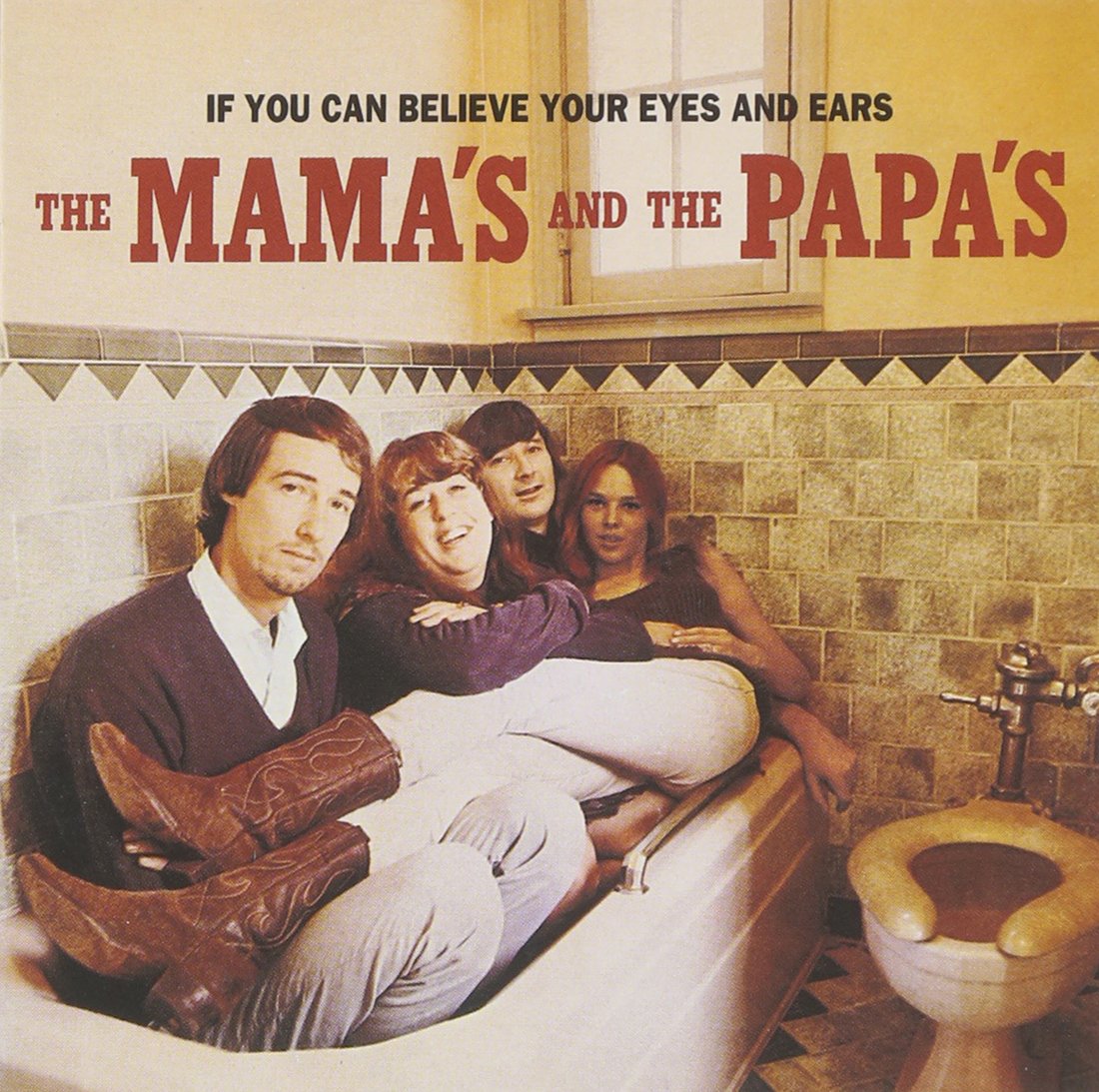
The Mamas & the Papas’ debut album, “If You Can Believe Your Eyes and Ears“, is being reissued on vinyl in all of its porcelain greatness, with the original cover photo, which was censored at the time for showing a toilet. The 12-song 1966 LP, a pop-rock favourite, showcases the impeccable harmonies of Cass Elliot, Denny Doherty, John Phillips and Michelle Phillips. The reissue arrives January 29th, 2021, via Geffen/UMe.
“If You Can Believe Your Eyes and Ears”reached No#1 on the Billboard album chart within months of release and spent more than 100 weeks there. The Lou Adler-produced gem opens with the “Monday, Monday” and includes “California Dreamin’,” which reached No#4.
The Mamas & the Papas signed in 1965 and disbanded shortly after their performance at the 1967 Monterey Pop Festival, where “Monday, Monday” was first performed live. In between, the foursome embarked on what has become a storied career during their brief time together. Contributing to their status as pop culture icons were memorable performances on The Ed Sullivan Show, including the John Phillips penned “Monday, Monday,” their interpretation of Lennon & McCartney’s “I Call Your Name” and “California Dreamin’,” co-written by John and Michelle Phillips.
From the reissue announcement: The album features a mix of originals and covers that captivated fans and critics alike. First released on February 28, 1966, If You Can Believe Your Eyes And Ears opens with the chart-topping ode to the first day of the work week, followed by the upbeat, bass-heavy rocker “Straight Shooter.” On “Got A Feelin’,” co-written by Denny Doherty and John Phillips, a ticking clock underscores the melancholy vibe that someone is cheating; the aptly titled “Go Where You Wanna Go” (given the LP’s controversial cover), “Somebody Groovy” and “Hey Girl” round out the original compositions with the musical and lyrical flair that defined their style.
The Mamas & the Papas also brought their easy-listening harmonies to Leiber & Stoller’s “Spanish Harlem” and Bobby Freeman’s “Do You Wanna Dance,” while gently rocking to the Turtles’ “You Baby.”Cass Elliot’s rollicking cover of Billy Page’s “The ‘In’ Crowd” closes the album.
In the decade-plus I’ve known Maxwell Stern, he’s never been one to stop. And I’ll go out on a limb and say that anyone else who has come to know Max—maybe from one of his several bands (Signals Midwest, Meridian, Timeshares), or perhaps sweating it out in the pit at a show at some point in time, or maybe from a ska message board in the early 2000s—would say the same thing. Max has this undeniable urge to create. It’s like an impulse, really; an uncontrollable desire to try and make sense of the thoughts and emotions and anxieties about the world that swirl around our heads at any given point in time—and funnel it all into a song. Maybe it’s a song that people can relate to. Hopefully it’s one that they can sing along to.
For Max, Impossible Sum—his first proper solo record—is an honest-to-God effort to wrangle heartfelt and sometimes confusing feelings of adjustment, displacement, and settling into song. These songs have the kind of heart-on-the-sleeve vulnerability that fans of his other bands have come to admire, but presented in a completely unfiltered fashion, existing exactly as they need to be. ” Max tells me. “So I really tried hard to throw that kind of thinking out for the sake of making something different.”
Independent venues have given me everything – jobs, friends, inspiration and a means of self-discovery. I don’t know who I’d be without places like The Grog Shop, Johnny Brenda’s, Boot & Saddle, O’Briens, Great Scott, and the Beat Kitchen. I became a better version of myself in these rooms, as have countless others. The National Independent Venue Association (NIVA) is an organization working to secure financial support for independent venues across America. These establishments are not just places of employment – they’re tourism destinations, revenue generators and so much more.
Independent venues were the first to close as COVID overtook the American ecosystem, and they will be the last to reopen, and when they do they will require help and solutions unique to the live music industry that we all love so dearly. Tying Airplanes to the Ground · Maxwell Stern · Ratboys









 The Fat Angel Sings