Posts Tagged ‘The New York Dolls’

Left us on this day (April 23rd) in 1991: American rock’n’roll/punk rock guitarist, singer & songwriter Johnny Thunders (believed to be drug-related causes, age 38), who came to prominence as a founding guitar player of influential, proto-punk band, The New York Dolls (1971-75); born John Anthony Genzale, Jr., he renamed himself after a comic book of the same name; the Dolls released the seminal albums ‘New York Dolls’ (1973) & ‘Too Much Too Soon’ (1974); Johnny left & formed The Heartbreakers in 1975, recording on & off until 1984 (including the essential 1977 album ‘L.A.M.F.’); he also recorded solo, including the 1978 considered classic LP ‘So Alone’, featuring a rock & punk celebrity cast & arguably his greatest composition, “You Can’t Put Your Arms Around A Memory”; he also formed Gang of War with MC5’s Wayne Kramer for one album in 1990; his final recording was a version of “Born To Lose”, with German punk rock band Die Toten Hosen less than two days before his passing in New Orleans; in 1999, veteran documentary filmmaker Lech Kowalski released ‘Born To Lose: The Last Rock ‘N’ Roll Movie’; Danny Garcia’s featured documentary, ‘Looking for Johnny’, was released in 2014…

My admiration of Johnny Thunders stems from my huge love of his tenure with the New York Dolls and The Heartbreakers. I’ve just started listening to his solo catalogue again. And I started off with what are identified as his three true studio albums, “So Alone”, “Que Sera Sera”, and “Copy Cats”. Does anyone recommend listening to specific other releases of his that are floating around out there? There are so many titles live albums, compilations, bootlegs, Love to get your recommendations please.

“DTK live at the Speakeasy” often included in some LAMF reissues. “Live at the Village Gate” is good. If you can get your hands on one, “LAMF Heartbreakers definitive edition” box CD set. It includes 4 CD’s (and badges!), LAMF lost ’77 mixes, LAMF the restored Track LP, LAMF demo sessions ’76, ’77, LAMF alternative mixes (21 in total for that disc), deluxe booklet by Nina Antonia including a comprehensive interview with Walter Lure. You should still be able to find one on EBay probably. “Belfast nights” has pretty good sound quality. “The Yonkers demos” often included in some comps. “Madrid memory”, “The Heartbreakers live at Max’s” great sound quality. Walter Lure’s Waldos have a couple CD’s “Rent Party” and the still pretty new “Wacka Lacka Loom Bop A Loom Bam Boo” on Cleopatra Records.

‘Johnny Thunder lives on water, feeds on lightning.
Johnny Thunder don’t need no one, don’t want money.
And all the people of the town, They can’t get through to Johnny, they will never, ever break him down.
Johnny Thunder speaks for no one, goes on fighting.
And sweet Helena in bed prays for Johnny.’
“Johnny Thunder”—R. Davies

In the late summer of 1980, the remains of what was Giant Sandworms went in an exhaustive road trip to find our place in NYC’s post-punk rock whirlpool of unsigned bands. We were unprepared for this mythic belly flop into the catacombs of both the Lower East Side and the herculean task of day-to-day advancement of spinning our wheels just to play CBGB for 16 people, 15 of them being our friends.

New York City was a harsh, smelly, tinderbox of sorts. The Hell’s Angels block on First Avenue and Third Street held an obit on the west side of the street, sprayed on the brick wall in memory of Big Vinny “When in doubt, knock ’em out.” .The building was like any other building in 1981, serving as Alphabet City’s 24/7 narcotics market and shooting galleries. It wasn’t always a pleasant interaction and even Johnny Thunders was just another mark.

Back then, everybody had a story about Johnny Thunders, everybody. Way back in the early ’70s, rock had become listless. With a few exceptions, groups made the same record again and again, then a live album, with audience applause engineered to sound like panzer divisions. But the onset of change would begin in small camps, garages, and basements, by like-minded kids that didn’t fit. New York City had become dangerous, abandoned and for the taking. Beneath the Brill building, Warhol’s Factory, Manny’s Music (“try it, you buy it”), record companies furnished with mahogany and leather and maybe a faint trace of Birdland and, more recently, The Fillmore, offered up stagnation. The industry and its product were stamped in Billboard Magazine, in self-congratulatory pages, while raw, young talent went unfostered. It became near impossible to break into the machinations of this music machine.

In 1973, one band The New York Dolls almost got through. They were representing their city with driving blues rock, and hard-luck tales of youth punching back at the disorder of war, technology, urban renewal and the luckless stars of a time where nothing was forbidden. It was unapologetic, dirty, loud, and fast. The cover of their debut album found the quintet in full drag and unwashed long hair with more swagger than the Rolling Stones could muster on their best night.

Todd Rundgren produced it and it sounded as they did—no whiteout on this term paper. David Johansen was a lead singer with the goods. Lead guitarist, Johnny Thunders’ sound was driven, mangy, loud, and original. “Trash,” “Vietnamese Baby,” and “Subway Train” were unforgettable titles. There would’ve been no Sex Pistols without them and that’s just for starters. It was pure from-the-streets commentary on the times.

CREEM magazine awarded the Dolls the No. 1 best new band and No. 1 worst band in their yearly poll in 1973. Love ’em or hate ’em, they made a huge impression. The record peaked at paltry No. 119 on the Billboard album chart , and they toured in the U.S. supporting Mott The Hoople and went back to London for a short tour as well. They could inspire from an audience a chorus of boos, or offer truly compelling performances that left people gasping, saying it was the best rock show of their lives.

The band was schizophrenic and the media found them authentic if nothing else. Bowie had referenced Billy Murcia in song (“Time” from Aladin Sane), the original Dolls drummer who OD’d in a London bathtub in ’72 just before the band signed to Mercury. By ’74 the quintet made Too Much Too Soon with Shangri-Las’ producer Shadow Morton. It held “Babylon,” “Human Being,” and Thunders’ first lead vocal on “Chatterbox.” It was camp but cool, choosing mostly great covers like Philadelphia’s “Gamble and Huff” and Sonny Boy Williamson’s “Don’t Start Me Talking.” Record sales were even worse than the first outing, and the tours were hampered by bassist Arthur ‘Killer’ Kane’s alcoholism and the heroin habits of Thunders’ and drummer Jerry Nolan. Infighting and a lack of new material found them waning, they dropped by Mercury.

In ’75, Thunders and Nolan quit the band. But along with the MC5, The Stooges, and The Dictators, the Dolls were the American precursor to a punk-rock movement that found its place in every city young, reckless, and hungry.

Johnny Thunders forms The Heartbreakers, Thunders might have been without a band or a steady gig for a week before he formed The Heartbreakers, which, for a downtown minute, included Richard Hell. But the group would be ex-Doll Jerry Nolan, guitarist Walter Lure, and Billy Rath on bass. They worked and developed a devil-may-care harder rock sound and, planned or not, they were synonymous with heroin. You wouldn’t find The Heartbreakers pictured with Nancy Reagan’s “Just Say No to Drugs” slogan above their heads. What I did see on every other pole and telephone booth after moving to New York City with a post-Heartbreakers pic of Johnny sideways in a hat, syringe sticking out of the brim, pimping his next show, trading street cred for self-parody by 1982.

The Heartbreakers played around New York and then overseas as be part of the historic Sex Pistols’ Anarchy Tour. Four dates in and things imploded. London was not used to a group like this, unafraid to play a guitar solo, yanks dressed big-city junkie cool with enough ego and stage presence to be long remembered. They stayed and recorded the record L.A.M.F. , a very good journal of a rock & roll band with antisocial bravado and American conceit and big dirt-sugar pop hooks. But the record was muddy and poorly mixed and has by now a remixed version or two, but you don’t get them when you need them and Nolan left the band because of it.

They became an apparition of sorts, who would through the years get back together for a payday, but in their time, they were the house band at Max’s Kansas City and took on all contenders. (Their swagger-y ’79 live album, Live at Max’s Kansas City, smokes).

Thunders stayed in London and the next year put out his debut record “So Alone”, one of ’78’s best by anyone. He had Paul Cook and Steve Jones hot to play from The Pistols’ demise and Thin Lizzy’s Phil Lynott on bass, some Peter Perrett (Only Ones) on guitar, and it opens on a cover of The Chantays’ “Pipeline” and it don’t quit. The ultimate in blood-on-the-page ballads is “You Can’t Put Your Arms Around a Memory” and covers Otis Blackwell II’s “Daddy Rolling Stone” with Thunders on the first verse, Lynott emotive second, and Steve Marriott, the white blues-boogie screamer, who turns the final verse into sulfur, striking fire, holding nothing back.

The studio is said to have been an all-day and all-night den of vice and electricity, where all involved saw a success in its making and a fortune cookie that read “Your Time is Nigh.” So Alone was helmed by a young (pre-U2) Steve Lillywhite. It earned some good press on both continents, sold better than expected and is a rock ‘n’ roller’s album. Johnny’s vocals were as good as they got and his playing was tough, sincere and even tender. It has aged well. But and he never hit that high again. In fact, all three of the voices heard in “Daddy Rolling Stone,” would be dead within a decade.

After returning to the States, Thunders became more difficult, more undisciplined, and toured to survive and make his bones with mostly sub-par bands, or worse. Thunders and Wayne Kramer were in that storied, short-lived combo Gang War. The few songs I’d heard were reggae influenced, but with no real direction. The band was more like a ghetto timeshare for two very talented men. It was a project that brought no record deal and no new respect for the future rock ‘n’ roll legends. Lots of time-wasting though.

Fighting with his band, fighting with his roadies, and with the audience. Trolling the faces to call down: “hey douchebag, pussy, come suck me off!” as if he was waiting on something or someone to take the weight off, to just be John again, or someone else completely. The shows might have been sloppy the first week, but you end up floating downstream letting a last power chord float when he didn’t know the bridge or when the band did one out of thin air he didn’t know. Thunders would look back, frown, turn up a notch before doing standards like “Can’t Kick,” “Chinese Rocks” or a cover he still found a friend in.

May be an image of 4 people, people standing, people playing musical instruments and guitar

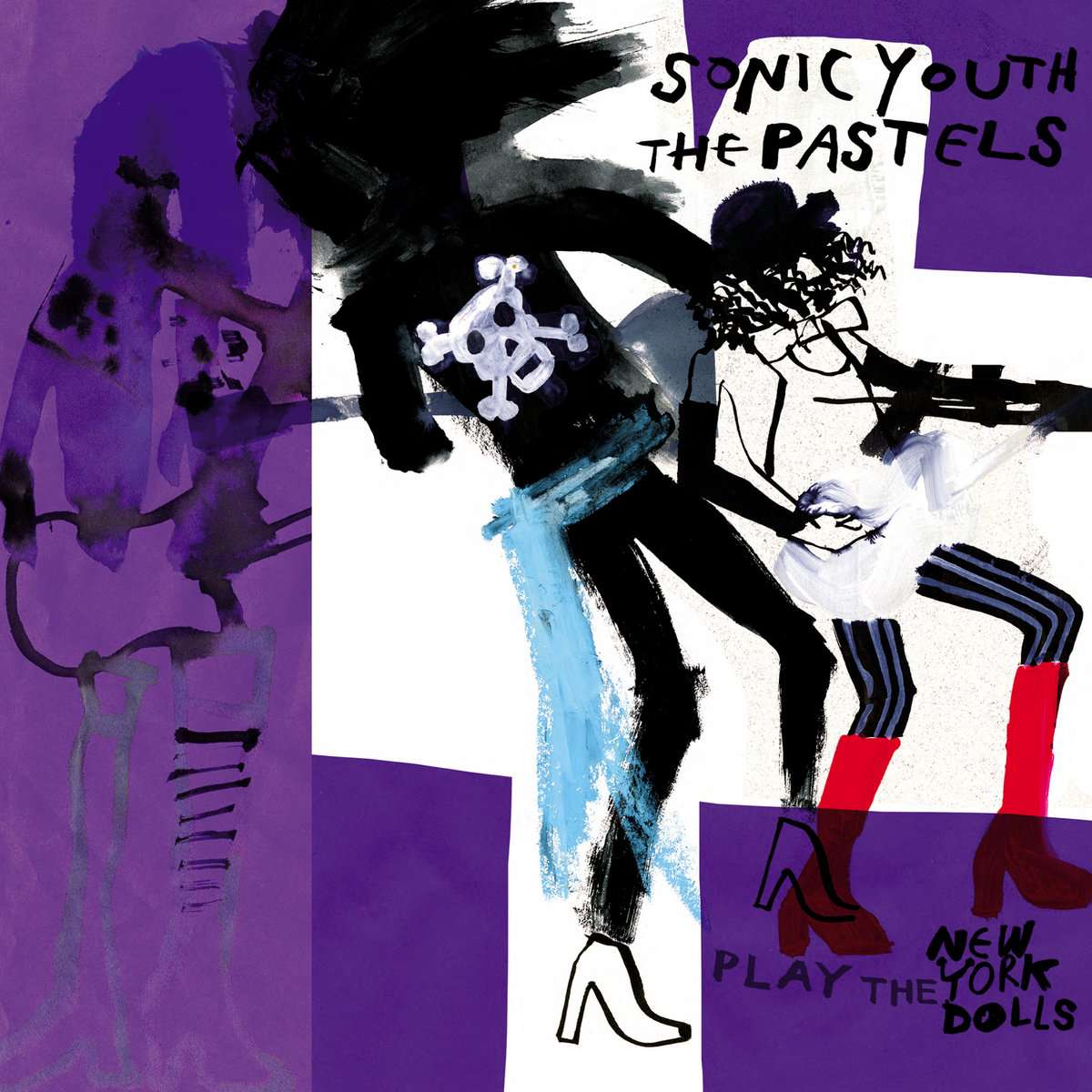
Sonic Youth have a new split-7″ with Glaswegian indie legends The Pastels featuring previously released covers of New York Dolls‘ songs. The Pastels’ cover of “Lonely Planet Boy” dates from 1987 and was originally appeared on their Comin’ Through EP, and Sonic Youth’s cover of “Personality Crisis” was originally released as a 7″ via Sassy Magazine in 1990, and later appeared on the 1993 Whores Moaning EP and the deluxe edition of “Dirty“.

The cover art for this split-7″ was designed by Annabel Wright and it’s due out November 5th via Glass Modern. Preorder yours from the North American or European store, and you can listen to both covers below.

The music we love passes from one generation to the next and the New York Dolls will always be a group to celebrate. Both Sonic Youth and The Pastels are not only fans but covered two of their most iconic songs a few years apart, in 1987 (The Pastels Lonely Planet Boy) and 1992 (Sonic Youth – Personality Crisis). Glass Modern is really thrilled to bring these two fantastic versions together in a limited edition split 7” single with Annabel Wright cover art. New York Dolls forever.

An early touchstone for The Pastels was New York Dolls amazing Old Grey Whistle Test appearance which Brian had on Beta tape along with other select choices which he liked to share as the mood took him. A few years later, in 1987, we decided to cover their broken ballad, “Lonely Planet Boy” on our Comin’ Through 12”. This of course came out on Glass Records. Glass is happily now back in business as Glass Modern and when the owner, Dave Barker, suggested we might release it as part of a New York Dolls tribute we were into the idea – particularly as he wanted to pair it with Sonic Youth’s “Personality Crisis” which we love. Unfortunately the master tape was missing, although we had the multi-track which we worked on with Paul Savage at Chem 19, going for something very close to the original. This is now coming out on November 5th as a 7” on purple vinyl with a fab Annabel Wright cover and is available on presale from Monorail Music and other reliable sources.

Glass Modern is a new imprint of Glass Records, for new recordings and a choice selection of Ltd Edition reissues on CD, Vinyl & downloads.

Supergroup Halloween Jack Premier TRASH as Tribute to Sylvain Sylvain

Supergroup “Halloween Jack” is set to release “Trash”, a cover song video by The New York Dolls as a tribute/ token of love to the glam/punk band’s Sylvain Sylvain who died last month after losing his battle with cancer. 

The New York Dolls, known for their glam rock androgyny and their signature attire including women’s makeup and frenzied, bizarre fashions, revitalized the New York City underground music scene in the 70s foreshadowing punk by half a decade. The Dolls were an anomaly, considered to be one of the most influential bands on the planet with their unpolished, chaotic music expression that combined British invasion-influenced rhythm and blues with the guitar distortion and booming backbeat of proto-punk bands such as Iggy and the Stooges. 

Halloween Jack combines the talent of Stephen Perkins, drummer of Jane’s Addiction, Gilby Clarke, former guitarist of Guns N’ Roses, Dan Shulman former bassist of Garbage, Eric Dover guitarist from Jellyfish, and guest guitarist Steve Stevens of Billy Idol, a huge fan of the Dolls. Halloween Jack’s “Trash” video is filled with a texture and colour completely reminiscent of the orgasmic, sophisticated anarchy that captured the essence of the kaleidoscopic vibrancy transmitted by the original New York Dolls. Halloween Jack wished to celebrate the memory of Sylvain using the video as a token of love to the fallen Icon.

Sylvain Mizrahi, best recognized by his stage name Sylvain Sylvain, was the guitarist for The New York Dolls. One of the key architects of rock music, Sylvain was the driving force behind the band and the soul of the clothes, style and thrilling guitar combinations that would be such a profound influence on punk rock. As a precursor to the dolls, he created the band Actress from a bunch of guys that hung around his clothing store that would later give birth to the Sex Pistols. In 2019, Sylvain announced that he had cancer and he died in his home on January 13th, 2021.

Image may contain: 1 person, playing a musical instrument, on stage and night

Sylvain Sylvain, best known as the guitarist of the New York Dolls, died Wednesday (13th January) after a long battle with cancer. He was 69 years of age. Bored of their heroes’ increasing indulgences, The Dolls’ mission was simple: to restore rock’n’roll to its rightful place as a flamboyant, dangerous cultural force. And, while David and Johnny would become the figureheads of the band, Sylvain Sylvain was its beating heart and chief strategist.

The news was announced today on Sylvain’s Facebook page. Lenny Kaye, a guitarist in the Patti Smith Group, penned a lengthy tribute to the proto-punk and glam rock pioneer. “Sylvain battled cancer for the past two and a half years,” Kaye wrote. “Though he fought it valiantly, yesterday he passed away from this disease. While we grieve his loss, we know that he is finally at peace and out of pain.

“Please crank up his music, light a candle, say a prayer and let’s send this beautiful doll on his way.” In April 2019, the guitarist revealed that he had been diagnosed with cancer, and set up a GoFundMe page to raise funds for treatment. It is unclear what form of cancer he had.

Sylvain was born Sylvain Mizrahi in Cairo, Egypt in 1951. Not long after his birth, his family fled the country to escape anti-Semitism, eventually settling in New York after a period in Paris.

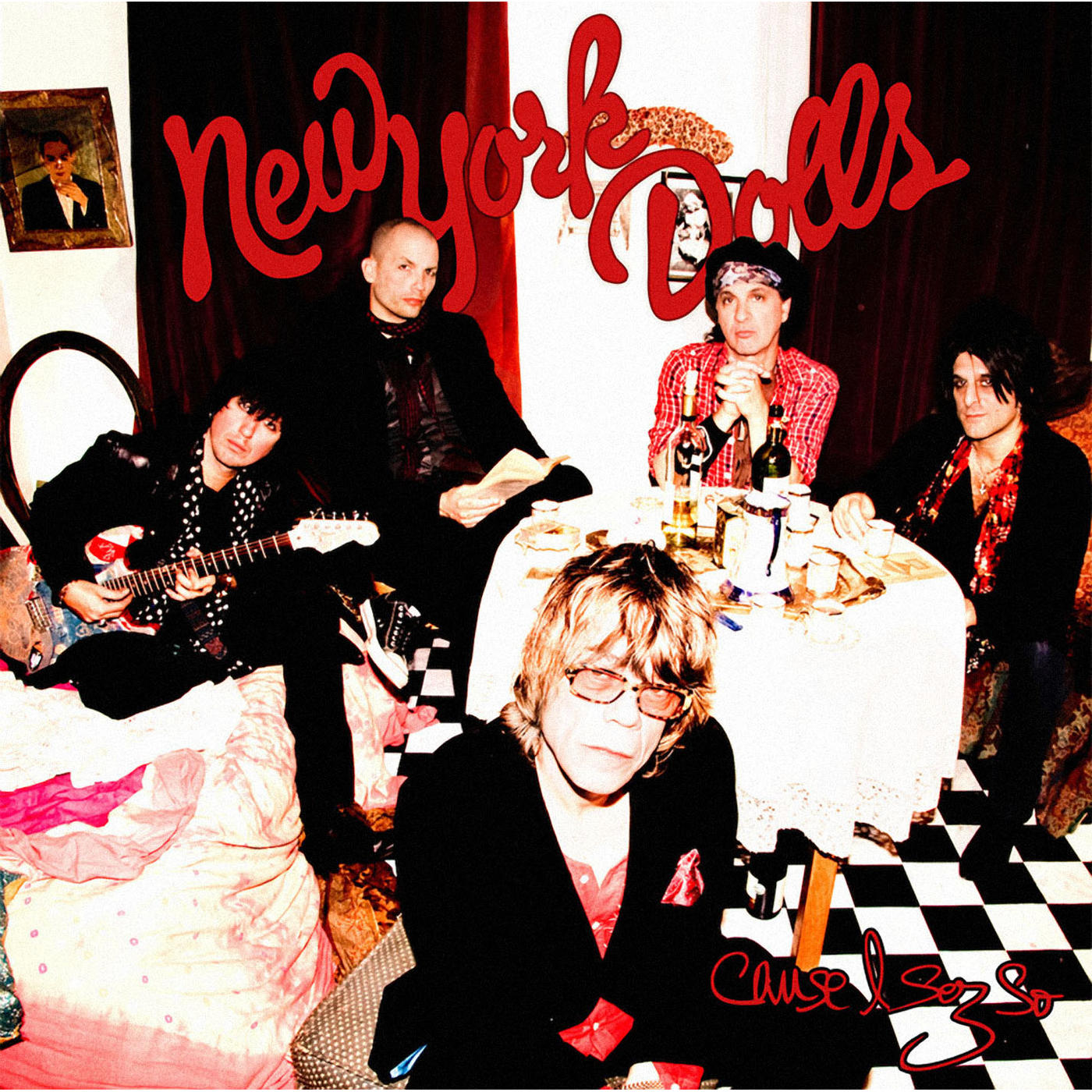
In 1972, Sylvain befriended New York Dolls drummer Billy Murcia and joined the band, serving as rhythm guitarist until the iconic outfit’s dissolution in 1977. He would also be part of the Dolls’ reunion in the mid-noughties, releasing a trio of records: One Day It Will Please Us To Remember Even This (2006), Cause I Sez So (2009) and Dancing Backward In High Heels (2011).

To call the New York Dolls different is something of an understatement. Formed in 1971, the five-piece of David Johansen (vocals), Johnny Thunders (guitar), Arthur ​Killer’ Kane (bass), Billy Murcia (drums) and Sylvain slunk out of the Bronx, seemingly having raided their girlfriends’ wardrobes for their clothes and having rifled through their make-up bag for their rouge. Following the band’s split, Sylvain would embark on several other musical projects – working on David Johansen’s solo albums (for which he wrote a number of songs) and a record of his own, as well as playing with several other musicians. He would, however, always remain a Doll.

Fiercely proud of the band’s music and legacy, he was a key instigator in the New York Dolls’ reformation in 2004. He was equally disappointed to find that David – who’d subsequently enjoyed a parallel career using the pseudonym Buster Pointdexter and as an actor – was going through the motions. Despite the fact that the re-constituted Dolls released three new studio albums, Sylvain remained angry with David when the latter refused to commemorate the 40th anniversary of the band’s debut in 2013.

It’s sad nobody’s doing anything about it. It would’ve helped if everyone had gotten into it, including our frontman, but nobody got into it,” he said at the time.

Two years later Sylvain would leave his adopted hometown of New York for Nashville. He presaged his departure with a tune about that very subject – 2012’s Leaving New York, a track full of the man’s typically romantic spirit.

Sylvain was also a prolific solo musician. He released his debut solo record, Sylvain Sylvain, in 1979, and continued playing in bands such as The Criminals and The Batusis well into the 2010s.

Image may contain: 1 person, sitting, text that says 'ARTHUR KANE 1949 2004 JOHNNY THUNDERS 1952 1991 JERRY NOLAN 946 1992 SYLVAIN SYLVAIN 1951 -2021 Peryorhodz mercury'

Johnny Thunders & Wayne KramerJohnny Thunders & Wayne KramerJohnny Thunders & Wayne KramerFreudlp076

The New York Dolls & MC5 guitarists collaboration! with Wayne Kramer, It’s the first time on vinyl; in a limited edition in dark red & dark yellow coloured vinyl, on 2xLP with five bonus ‘Live at Max’s’ tracks only previously available on bootleg. Johnny Thunders & Wayne Kramer’s ‘Gang War’ In 1979, Johnny Thunders, renowned band Heartbreakers and New York Dolls guitarist, teamed up with Wayne Kramer, also legendary guitarist of Detroit’s seminal MC5, to form ‘Gang War’, an alliance that lasted the best part of a year. Although Gang War released no records and without a label – at the time they were an underground act; in retrospect the collaboration is looked on as a ‘rock fantasy’ supergroup.

https://www.youtube.com/watch?v=_Q2PWcA8t4I

These live recordings bear testimony to this unique partnership between two celebrated rock guitar icons. Gang War came about shortly after Johnny released his ‘So Alone’ album, and Wayne was not long out of jail after serving two years of a sentence of four years for a coke bust. Arriving in Detroit with the Heartbreakers, Johnny met his teenage idol Wayne who jammed with them at the gig. Johnny stayed on, moving his family to Michigan and pledging his future to Gang War. They toured regularly and recorded a couple of demos with a view to getting a deal, but although there was great interest, after eight or nine months they split. On these recordings, both contribute lead vocals and guitars on Thunders and the Dolls tracks such as London Boys, Endless Party and M.I.A.; songs familiar from Kramer and MC5 such as Ramblin’ Rose and Hey Thanks, and fascinating cover versions such as These Boots Are Made For Walking and The Harder They Come.

https://www.youtube.com/watch?v=Q79IQuw-0zg

Together with the between-track repartee they also demonstrate the difference between the two – as Wayne Kramer has said: “Music is important to me and I value the honour, the opportunity, to be an important musician. Johnny, on the other hand didn’t consider himself a musician. He considered himself an entertainer.”

Cause I Sez So

American standard-bearers for glam rock and important precursors to punk rock, The New York Dolls reunited (at the personal request of longtime fan Morrissey) nearly three decades after their early-1970s heyday. Original Dolls David Johansen and Syl Sylvain still have all the sass and swagger of their prime on “Cause I Sez So”. Todd Rundgren had helmed the band’s debut and returns in the same capacity for this 2009 Atco album, helping the quintet push its sonic envelope a bit beyond the Stonesy racket of yore.

The reconstituted New York Dolls stack up awfully well against the original Seventies band, whose glam rock inspired thousands of acts. This Todd Rundgren-produced follow-up to the Dolls‘ fine 2006 comeback features new moves like reggae and Latin-tinged balladry. But the selling points are its Stones-y propulsion and the nuanced vigor of David Johansen. The singer delivers singalong choruses in his New Yawk bark, sweetly praises a lover who “treats [him] like a maharajah” and, on the funked-out “Let’s Get Radiant,” delivers the perfect middle-aged-rocker line: “If we don’t come back, call us on the Ouija board.”

A reggae-tinged reworking of their ’70s classic “Trash” may be the most striking example of this, but the beautiful pop melody of “Lonely So Long” and the propulsive R&B of “Nobody Got No Bizness” show the Dolls can wear any style and make it look great.

So give “Cause I Sez So” another spin in memory of the band’s drummer Jerry Nolan, who passed away on this day in 1992.

“Personality Crisis: Live Recordings & Studio Demos 1972-1975”. A trio of pre-Mercury demo sessions – arguably as close as the Dolls ever got to nailing their sound in the cold austerity of the recording studio – are joined by a collection of incendiary live shows (including two American radio broadcasts)

Formed in 1971 in New York City, and originally classified as hard rock, the New York Dolls became one of the creators of punk rock before there was even a term for it. With a line-up of vocalist David Johansen, guitarist Johnny Thunders, bassist Arthur Kane, guitarist Sylvain Sylvain and drummer Billy Murcia, the New York Dolls sported an androgynous wardrobe of high heels, eccentric hats, make-up and satin onstage, and in the words of the Encyclopedia of Popular Music were “one of the most influential rock bands of the last 20 years”, boasting such high profile fans as Morrissey, the Sex Pistols, The Ramones, Kiss, Guns N’ Roses and The Damned.

It is commonly perceived that the essence of the New York Dolls was never satisfactorily captured by their two albums for the Mercury label, both of which many believe suffered from unsympathetic production. Fortunately for us all, the band’s untutored rawness, unencumbered strength of purpose and unique vision is better served by the recordings that are gathered together for the first time on Personality Crisis: Live Recordings & Studio Demos 1972-1975. A trio of pre-Mercury demo sessions – arguably as close as the Dolls ever got to nailing their sound in the cold austerity of the recording studio – are joined by a collection of incendiary live shows (including two American radio broadcasts) that, despite the variable sound quality, capture their unfettered outrageousness and life-affirming vitality. This package serves, then, as an alternative view of one of the few genuinely essential rock’n’roll bands to emerge from the early Seventies wastelands.

Includes early versions of acknowledged New York Dolls’ classics: ‘Jet Boy’, ‘Trash’, ‘Personality Crisis’, ‘Puss ‘n’ Boots’, ‘Stranded In The Jungle’, ‘Babylon’, ‘Who Are The Mystery Girls’, ‘Bad Girl’ and ‘Pills’.

Come in a beautifully designed clamshell box set containing its own booklet with full sleeve notes, plus individual card wallets for each of the discs. All material contained within this package has been specially remastered for this release.This package serves, then, as an alternative view of one of the few genuinely essential rock’n’roll bands to emerge from the early Seventies wastelands.

Released April 27th, 2018 via Cherry Red Records.

HBO’s Vinyl began its first episode at a New York Dolls show where they blew the roof off the Mercer Arts Center. In reality, the band had an alibi. The New York Dolls didn’t always get away with things so easily.

Vinyl season 1 is set in New York City in 1973. Rock music was in the middle off an identity crisis and it gave bands like the Dolls a personality crisis. Rock was getting bloated and rollers thought it was getting a little pretentious.
The New York Dolls – David Johansen, Johnny Thunders, Sylvain Sylvain, Billy Murcia, and Arthur Kane Jr. – kept the erection but deflated the egos. The Dolls “single handedly lowered the standards of an entire industry.” They came on like a prima ballerina on a spring afternoon wearing a rag-tag concoction of Thrift Store and Salvation Army toss offs.

The band had a glammed up look and pared down sound. They were funny. They were rude. They covered classic rock and roll hits like “Stranded in the Jungle” by The Cadets under a red communist flag.

The New York Dolls won Best New Band and Worst New Band in Creem Magazine’s Readers Poll in 1973. Music aficionados complained that the New York Dolls couldn’t play. So what? Whoever said Bob Dylan could sing? Robert Christgau called them “the best hard-rock band since the Rolling Stones.”

The New York Dolls predated punk and glam metal. They influenced rock groups like the Sex Pistols, Kiss, the Ramones, Guns N’ Roses, and the Damned. When the Dolls started, Patti Smith did poetry readings before their shows. Richard Hell and Tom Verlaine caught the Dolls right before they formed the Neon Boys, which became Television.

The New York Dolls can be traced to the 1967 band The Pox, which included Sylvain Sylvain and Billy Murcia, who were friends since a schoolyard fight at Van Wyck Junior High in Jamaica, Queens. Sylvain crossed the Suez Canal from Cairo to be a New York Doll and the first words of English he learned were “fuck you.” Murcia came from Bogota, Colombia, not Jersey, and the two were finally able to finish sentences, according to the book Too Much Too Soon: The New York Dolls. They met Johnny Genzale at New Town High. The Italian bassist was thunder on a basketball court or a baseball diamond, but wound up being just a Jaywalker. Arthur Kane came down from the Bronx with a thick Irish accent.

The Pox were recorded by Harry Lookofsky, the same guy who produced “Walk Away Rene.” When the Pox broke up, the two friends got into fashion, opening Truth and Soul. Sylvain also worked at men’s boutique, A Different Drummer that was across the street a doll repair shop called the New York Doll Hospital. They also sold “keef,” which was really good hash. By the early seventies they were playing with Rick Rivets. Thunder rechristened himself after the hero of DC Comics’ All-Star Western after he turned down the Volume. Thunders played lead guitar and sang for the band, called Actress during practice but named Dawn of the Dolls on an October 1971 rehearsal tape release.

David Johansen was living on East 6th Street when he got the call because he looked like a cross between Mick Jagger and French actress Simone Signoret. Johansen started singing in the late 1960s in the local Staten Island band the Vagabond Missionaries before hitting Café Wha with Fast Freddie and The Electric Japs. He was a stud on Main Street and maybe some other porn movies. David Jo looked 16 and bored shitless. Rick Rivets was replaced by Sylvain Sylvain and the bottom was held together by bass guitarist Arthur “Killer” Kane and drummer Billy Murcia.

https://www.youtube.com/watch?v=Ctg5FCS1wCM

The Bowery butterflies wore Spandex and platform boots at their debut first performance at homeless shelter The Endicott Hotel on Christmas Eve 1971. They caught the eye of Andy Warhol who helped them get a gig on Broadway, lower Broadway. Ex-Paramount Records exec Marty Thau saw a sign outside the Mercer Center advertising: “NEW YORK DOLLS: 2 SETS $3.” For six bucks he and his wife caught “five guys dressed as women in horrible makeup and jewelry” and became the band’s manager, arranging a residency at the Center.

Bands did New York City residencies at theaters in the early seventies. Frank Zappa and the Mothers of Invention played Wednesday afternoons at the Garrick Theater on Bleecker St. The Fugs played seven nights a week at the Players Theater on MacDougal Street. The Velvet Underground played around the block twice a night, five days a week at Max’s Kansas City. The New York Dolls had a regular Tuesday-night gig in the Oscar Wilde Room of the Mercer Arts Center.

The New York Dolls were plastic dolls with a fresh coat of paint and a Vietnamese baby on their mind. Who was gonna sit through the madness and still act quaint? They mixed drag queens with glam rock to lead an assault on what was happening on the radio. “Is it a crime for you to fall in love with Frankenstein?” asked David Johansen, who would go on to become Buster Poindexter before learning intricate blues guitar and go back to being David Jo. Johansen only wore a dress one time onstage at Club 82, though he rocked the Capri pant.

Mercer Arts Center kicked The New York Dolls out in 1972 because they wanted neither rock nor roll in the theaters. The center came crawling back after they saw the diminished bar tabs. The Center’s Blue Room theater also hosted the Modern Lovers and Suicide. Rod Stewart invited the Dolls to open for him at a London concert. The Mercer Arts Center was buried in the Grand Hotel collapse just after five p.m. on Friday August 9, 1973.

Well if you don’t like it, go ahead, find yourself a saint. Billy Murcia would be dead of “misadventure” before the New York Dolls even signed a record contract. While on a brief tour of England in 1972, Murcia passed out from an accidental overdose at a party. He was put in a bathtub and force-fed coffee to bring him around but wound up choking on it, dying of asphyxiation. Murcia was found dead on the morning of November 6th, 1972, at the age of 21, David Bowie, who proclaimed The New York Dolls as a major influence, immortalized Murcia when he sang “Billy Dolls and other friends of mine” in the song “Time” which opened side two of his 1973 album Aladdin Sane.

The Dolls were signed by Mercury Records’ A&R man Paul Nelson. Their debut album was produced by Todd Rundgren. Stereo Review magazine said they sounded like lawnmowers. How she ever gonna love you when she can’t parlez vous your Francais? They topped from the bottom in Creem magazine and lit out for Europe, where Bob Harris called them “mock rock” on the BBC’s Old Grey Whistle Test.

The New York Dolls’ second album, Too Much Too Soon, was produced by George “Shadow” Morton. He made his bones recording morbid motorcycle death hits like “Leader of the Pack” and “Out on the Street” for girl groups like the Shangri-Las and helping Janis Ian bridge the racial divide in “Society’s Child.” There’s gonna be a showdown don’t you worry. Mercury let them go shortly after the album also failed to do much on the charts.

https://www.youtube.com/watch?v=dG_vvq2ip6Y

Future Sex Pistols manager Malcolm McLaren managed to split the band up by 1975. He put the band in front of a communist flag for a 5-concert-five-borough tour of New York. Television opened for them. Their last show in New York State was at The Shoram, in Quogue, New York. Thunders and Nolan left while on tour in Florida in 1975. Blackie Lawless sat in on guitar for the rest of the Florida tour. The New York Dolls played at the Beacon Theater on New Year’s Eve, 1975 and a follow-up show at Max’s Kansas City. The group played its final shows in 1977.

Sylvain formed The Criminals. Johansen got funky, but chic and by the late 1980s he rechristened himself Buster Poindexter for Saturday Night Live, kept it through Sunday morning, made some movies, had some laughs. Thunders and Nolan formed The Heartbreakers with bassist Richard Hell.

A rock n roll nurse went into my head. In 1991, Johnny Thunders died in New Orleans. It was originally believed he overdosed on heroin and methadone but it later came out that he had t-cell leukemia. Nolan died in 1992 following a stroke brought about by bacterial meningitis.

Early New York Dolls demo tapes were released on cassette as Lipstick Killers on ROIR Records in 1981. Sylvain formed The Criminals, cut a solo album for RCA and drove a cab. He recorded the album Sleep Baby Doll for Fishhead Records in the early 1990s.

The Smiths’ Morrissey reunited Johansen, Sylvain and Kane for the Meltdown Festival in London in 2004. Morrissey’s Attack label released a live album. A film called New York Doll came out and it looked like the Dolls would be back. But Arthur Kane died of leukemia on July 13, 2004.

All dressed up, I got nowhere to go. In November 2006, the Dolls headlined “Little Steven’s Underground Garage Presents the Rolling Rock and Roll Show” about 20 times and the former new Dead End Kids played in Australia and New Zealand. On September 22, 2007, the Dolls were dropped by Roadrunner Records

The current lineup is David Johansen on vocals and harmonica; Sylvain Sylvain on guitar, bass and piano; Brian Delaney on drums, and Claton Pitcher on guitar and vocals.

A lot of the information for this article was unabashedly retrieved from the book Too Much Too Soon: The New York Dolls by Nina Antonia.