Appropriately enough, The Clientele return to the fold with a brand-new album on the first day of autumn. Music for the Age of Miracles marks the band’s first new album in seven years.
The Clientele have always provided a serene sense of atmosphere in their music, with Alasdair MacLean’s vocals rarely having the tendency to ascend beyond a lush accompaniment through gorgeous arrangements fitted with strings and guitars at the forefront. For me at least, they’ve always exuded the sound of autumn. Having not released a full-length since 2009’s Bonfires on the Heath, it was worth wondering if the band would maintain the consistency of prior releases. Fortunately, Music for the Age of Miraclesfinds the band without hesitation, their hiatus ultimately resulting in my favorite album from the London-based act yet. Anthony Harmer contributes his skill of numerous non-Western stringed instruments (like santur and saz), working alongside MacLean to result in 12 strong tracks.
The combination of these string instruments and MacLean’s tendency for fluttering, serene guitar arpeggios results in a dreamy listening experience throughout. In essence, this very much sounds like classic The Clientele, though with more effective songwriting and instrumentation than ever their norm. The standouts are numerous. “Falling Asleep” chronicles the ascent of MacLean’s vocals, amidst prancing guitars throughout and riveting strings during the chorus. “Everything You See Tonight Is Different From Itself”, the following effort, injects brass into the fold over trickling guitars with precision, while “Everyone You Meet” serves as a great example of the band’s overall warmness. Music for the Age of Miraclesseems to almost have a healing-like tendency, ideal for turning listeners in need of a stress ball into those content to stretch out and enjoy the beauty, ideally on an autumn day
This time around, Anthony Harmer joins the line-up of Alasdair MacLean (vocals, guitar), James Hornsey (bass), and Mark Keen (drums, piano, percussion), contributing string and brass arrangements as well as guitars, vocals, keyboards, saz, and Santoor.
“Ease My Mind”is the fifth full-length album from Swedish pop masters Shout Out Louds, and their first since 2013’s Optica.
“Ease My Mind” celebrates music as a means of escape, a need to take a break from feeling petrified with fear,” Shout Out Louds’ Adam Olenius and Bebban Stenborg write. “The world is a different place now than it was in the beginning of the 2000s. We didn’t grow up very aware of political messages in music and probably didn’t feel much of an urgent need to understand the world around us, in that sense. However, that has changed over the years. The world has seemed extremely dystopic and frail for quite a while now, and having children and getting older forces you to open your eyes to issues more devastating than heartbreak and feeling lost. But in our music, we still allow ourselves to address things the way we always have: through emotions rather than analysis. Ease My Mind is a lot about that for us.”
Bob Mould took a different path after the dissolution of post-punk legends Hüsker Dü, memorably releasing an acoustic-based solo debut in 1989’s Workbook followed by a return to volume with Black Sheets of Rain a year later. Then Nirvana arrived. He said he knew, right then, that guitar records were back. “Copper Blue” is the debut studio album by American alternative rock band Sugar. It was voted 1992 Album of the Year
All of the songs were written by guitarist/vocalist Bob Mould, who also co-produced with Lou Giordano. The song “The Slim” is about losing someone to AIDS. Musically, the band continues the thick punk guitar of Mould’s previous band, Hüsker Dü, while slowing the tempo and emphasizing melody even more.
Bob Mould quickly formed Sugar with bassist David Barbe and drummer Malcolm Travis, releasing CopperBlue on September. 4th, 1992. Several tracks were recorded for this album, but were not included. Mould decided to release them separately as an EP entitled “Beaster”.
“Music is such a circular thing. When Nevermind came out, that album changed the way people listen to music,” Mould told NPR in 2014. “A lot of the songs that I had been writing in 1991 led up to my next group, Sugar — and had it not been for Nevermind, I don’t know if Sugar’s Copper Blue would have stood a chance in ’92. But people were now receptive to this sound.”
Constructed in the same power trio image as Hüsker Dü, Sugar instead leaned more toward power pop – extending Mould’s underground legend into a new arena and into a new generation. What it wasn’t, Mould insisted at the time, was “alternative.”
This sunburst of hooky joy, however, followed a very dark period. Mould was coming off a failed personal relationship, and a failed professional one. A recent separation from his manager revealed that he’d signed away Mould’s publishing rights without permission. A split with Virgin Records followed, leaving Mould to toil through a rigorous – but financially necessary – nine-month solo tour in 1991.
As he averaged some 300 miles of driving a day, Mould had plenty of time to jump start his creative impulses. Something he once called a “lonely and inspiring” experience led to “plenty of time for reflection,” and then to these new songs.
Then came an appearance at an outdoor festival in Germany before some 7,000 people – all of whom, it seemed, where there to see Nirvana. On the verge of releasing their breakthrough Nevermind, Mould admitted that Nirvana “customarily trashed the joint.” Mould had the bad luck to follow them onstage.
“Pounding away on a 12-string acoustic by myself at an outdoor festival in the middle of the afternoon was no easy feat,” Mould said in 2011. “Nirvana destroys the stage, then it’s me carrying on like Richie Havens at Woodstock.”
Change was in the air, and Mould was deeply aware of it. You could, of course, draw a straight line from HüskerDü to Nirvana. The time for a return to the outsized energy, the riffy focus and even the format of Mould’s critically acclaimed but always commercially overlooked first band seemed to have finally arrived.
“The success of Nevermind re-tempered the ears of the listeners throughout the world,” Mould told NPR. “It was a heavy, punky record, but there was something about it that was so accessible that it opened up all these pathways for other musicians — myself included — to have our music heard.”
Sugar’s songs, once envisioned as solo performances, took on new life with the arrival of Barbe and Travis, and they immediately started feeling like a real band, Mould said. Sugar selected their name in the most off-the-cuff manner possible, while sitting inside a Waffle House at Athens, Ga. where they band spent some time working out their emerging sound in R.E.M.‘s practice space. “We got a big pot of coffee and banged out about 24 songs,” Travis said in 1992.
Mould was right; their timing was perfect. “Helpless” hit No. 5 on the modern rock charts; “A Good Idea” – which Mould has said was “an unconscious homage” to the Pixies’ “Debaser” – became a fan favorite, too. Free of so many lingering worries, tracks like “Hoover Dam” (a triumph of jangly optimism) simply came tumbling out.
“It was this dream song that just turned up as I was waking up one morning,” Mould said of “Hoover Dam” in a 2014 interview with Team Rock. “It came to me fully formed, and then it’s just all the baubles that make it that crazy baroque band thing. All that was pretty much in my head too, but you have to sit down and make these baubles shine. That’s the production stuff.”
Copper Blue did even better in the punk-loving U.K., reaching the Top 10. NME named it Album of the Year, even as “If I Can’t Change Your Mind” reached the Top 30 there. “What a fun ride that was. That was like 0 to 100 in about eight seconds,” Mould told Moehlis, adding that he was grateful that “I had 13 years of experience under my belt before the rocket got strapped to my ass.”
After all, pressure like that often leads rock stars down rocky paths, since “everybody wants everything all the time.” Instead, Mould got to enjoy the ride. “At this point in my life,” he said in his autobiography See a Little Light, “I was euphoric.”
Of course, plenty of people began to frame Sugar as a call back to his time with Hüsker Dü. There were, on the surface at least, some obvious similarities. For Mould, however, this represented a brand new start, and a most welcome one, even if he was returning to a tried-and-true trio set up.
“It’s a pretty comfortable spot for me,” Mould said in a 2014 interview. “It’s odd to say ‘comfortable,’ because it’s really a lot of work for me but musically it’s the best way, when I have two other people that I need to connect with. There’s a real clarity and a purpose to it because everybody knows how much they have to lift at all times. I like that interaction. It feels like jazz.
Their sets, like Bob Mould himself, focused on the here and now. “Hüsker Dü broke up,” he told the Los Angeles Times. “We had eight good years, and one bad one. Sugar doesn’t do any oldies.”
In July 24, 2012, the album was reissued by Merge Records as a 3-disc set containing the full album accompanied by B-sides (disc 1), the Beaster EP (disc 2), and a 1992 live performance at the Cabaret Metro (disc 3) Band members
Bob Mould – guitars, vocals, keyboards, percussion
Hallelujah Anyhow is the latest studio album from Hiss Golden Messenger, due out September 22nd worldwide on Merge Records. Its ten new songs, penned by HGM principal M.C. Taylor, were recorded with Brad Cook, Phil Cook, Chris Boerner, Josh Kaufman, Darren Jessee, Michael Lewis, and Scott Hirsch. Alexandra Sauser-Monnig, Tift Merritt, Skylar Gudasz, Tamisha Waden, Mac McCaughan, and John Paul White provided vocal harmonies. All pre-orders in the Merge Records store will receive a signed poster, while supplies last.Hiss Golden Messenger have announced a fall headlining tour following summer festivals and three shows supporting Mumford & Sons.He has commented, I’m from nowhere. That’s the way I feel about it now, right at this moment. Music took me and made me and gave me a purpose and I built my world with it, and now my geography is a musical one, forever. And when I break, when I think about running as far as I can, I remember that there is nothing that does me like music, and I might as well be a poor man in a world of my own devising. Hallelujah Anyhow.Rhythm? I learned it over twenty years in the back of rented vans, in attics and back rooms—hard places to get to, harder places to get out of. And now rhythm is my clock and I live by it. We all do. But it’ll kill you if you’re not careful. It might kill you even if you are. Hallelujah anyhow.https://www.youtube.com/watch?v=zNweFE3_HcE
I see the dark clouds. I was designed to see them. They’re the same clouds of fear and destruction that have darkened the world since Revelations, just different actors. But this music is for hope. That’s the only thing I want to say about it. Love is the only way out. I’ve never been afraid of the darkness; it’s just a different kind of light. And if some days that belief comes harder than others, hallelujah anyhow.
It didn’t happen overnight, but it still came about pretty quickly. After making only one album Funeral in 2004 and doing a whole bunch of touring, Arcade Fire had become one of the most acclaimed bands in the world, anointed as the new flag waving of U2 , Coldplay and David Byrne . Now all the Canadian collective had to do was make a follow up record.
Neon Bible is the second studio album by the Canadian rock band ,released on March 5th, 2007 on MergeRecords. Originally announced on December 16th, 2006 through the band’s website, the majority of the album was recorded at a church the band had bought and renovated in Farnham Quebec. The album is the first to feature drummer Jeremy Gara, and the first to include violinist Sarah Neufeld among the band’s core line-up.
In the process of making the sophomore release Neon Bible, the members of Arcade Fire turned their gaze from the inward grief of Funeral to more worldly matters – religion, violence, television, war, power, greed and fear, personified as “a great black wave in the middle of the sea.” Oceans play a major role in the imagery of the album’s songs.
“If you’ve ever been in a boat when the weather is bad… all of sudden you feel out of control,” frontman and primary songwriter Win Butler said . “Those are the few times when I’m really aware of how out of control of the situation I am. And definitely, if you’ve ever been in the ocean and had a huge wave move over you, you become very aware that you’re not in control.” Butler was able to gain perspective on the “ocean” that is the U.S. via his status as an American expat. On Neon Bible, his birth country became reflected in, to borrow the title of the album’s lead-off track, a “Black Mirror.”
“It was the first time in my life that I felt like I was visiting my own country as some sort of outsider,” Butler said about the effect of touring the U.S. “I had lived in Montreal for a few years at that point, but I didn’t realize that I had really made it my home until that trip.”
He began to look at the U.S. as an alien culture where, Butler said, “Christianity and consumerism are completely compatible, which I think is the great insanity of our times.” Religion became a through line for many of the compositions, reflected in the thoughts of a suicide bomber (“Keep the Car Running”), the aspirations of the father of a reality star (“(Antichrist Television Blues)”) and the devotion of a person “singing hallelujah with the fear in your heart” (“Intervention”). Although the American criticisms of “Windowsill” aren’t explicitly God-obsessed, Butler connects the tune to religion as well.
“In theology there is this idea that it is easier to say what God isn’t than what God is, and in a way that song is my trying to say everything about my country that is not what makes it great or beautiful,” the singer said. “In a way it makes what is great and beautiful and worth fighting to preserve more clear.”
It’s no wonder that most of the album was recorded in a church – a former one, at least, that the members of Arcade Fire purchased in 2005. The bandmates turned the Petite Eglise church in Farnham, Quebec, into a studio over the course of 2006, recording “Neon Bible” as they went. While the building’s past use might have rubbed off on the lyrical content, the big, central space also allowed the seven-member band to have enough real estate to record live all at once.
The big spaces and big themes seemed to demand big sounds. Neon Bible reveled in expansive arrangements and instrumentation. A film orchestra and military men’s choir were recorded in Budapest to add epic heft to “No Cars Go” (a holdover from Arcade Fire’s debut EP). A gargantuan pipe organ led “Intervention.” Butler’s wife (band multi-instrumentalist and vocalist Regine Chassagne) played the enormous instrument on the album’s fourth track, nailing the performance in just one take.
“Normally you think of organ with just a couple of stops open, said ” Butler “It’s like a flute – gentle. But with all the stops pulled it’s got this really aggressive sound. I knew that for ‘Intervention’ it was really going to be about the organ.”
Upon Neon Bible’s release on March 5th, 2007, fans and critics were divided over the new, more substantial Arcade Fire sound. While many praised the ambitious arrangements, pointing to the influence of maybe Springsteen , others felt that the album’s sound could become overblown, pointing to the influence of Bruce Springsteen. In spite of – or because of – this, the album became one of the most-praised releases of the year, included on a bevy of best-of lists at the end of 2007.
Neon Bible also pushed Arcade Fire further into the mainstream. Soon after the album’s release, the band played the TV show “Saturday Night Live” and scored their first No. 1 album in Canada, while hitting No. 2 in both the U.S. and the U.K. “It’s pretty wild,” Butler said “It’s pretty amazing for a band like us to be in that position. It’s funny in kind of a satisfying way.”
Katie Crutchfield is nervous. It’s a few weeks before the release of her new album, “Out in the Storm”, and the 28-year-old singer-songwriter — known for her deeply personal, candid work — is only beginning to come to terms with the fact that she’ll soon be sharing with the world the most unflinching and detailed record she’s ever made. As she puts it in the lead track, “Never Been Wrong,” “Everyone will hear me complain/Everyone will pity my pain.”
Over the past decade or so Crutchfield has played in a variety of upstart DIY bands that blend folkie intimacy with cascading electric guitars, often sharing the stage with her twin sister, Allison. Out in the Storm is her fourth release as Waxahatchee, and her second for the indie mainstay Merge Records. She’s long been celebrated for the emotional directness of her songwriting, which places a magnifying glass on her own flawed tendencies and relatable shortcomings. But Crutchfield has never put out a record quite so raw as her latest, which chronicles the dissolution of her long-term relationship in painful detail.
“I can’t believe people are going to hear this,” says Crutchfield, calling from her home in Philadelphia. “Every day I wake up, as we get closer and closer to putting the record out, and I’m like, ‘This is the best thing I’ve done.’ And then the next day, I’m like, ‘I can’t put this record out.’ ”
Waxahatchee’s music organizes conflicting emotions into something resembling clear-minded self-awareness. The first Waxahatchee album, 2012’s American Weekend, was a stark collection of acoustic songs that Crutchfield recorded in her family’s home in Alabama. “I don’t care if I’m too young to be unhappy,” she sang on “Grass Stain,” after promising to drink her way to happiness. She explored the self-destructive tendencies of twentysomethings stuck in slow-motion memories, establishing herself as indie rock’s sharpest self-scrutinizer in the process.
The pain of Out in the Storm feels as fresh as a newly skinned knee, but it took some time for Crutchfield to write songs she felt comfortable sharing with others. “I really tried to not write when I was in the middle of all this craziness at the end of that relationship, because when I did try to write while stuff was still going on, I was in such a state. I hadn’t fully processed a lot of things,” she says. The first songs Crutchfield came up with sounded like they were written by an “angsty fifteen-year-old girl.” They were “too earnest,” she says, “to the point where I felt uncomfortable putting them out in the world.”
In fact, there are still moments on the finished album (“Brass Beam,” parts of “No Question”) that give Crutchfield concern “It’s just like, oof, there it is,” she says. That unadulterated openness is what resonates profoundly with an internet-raised generation eager to admit to “feeling all the feels,” and a growing fanbase that includes admirers like Sleater-Kinney, Lena Dunham, and Kurt Vile.
For Out in the Storm, her first full-length recorded with an outsider producer, Crutchfield reached out to JohnAgnello, who’s worked with artists like Dinosaur Jr. and Sonic Youth. “There’s a real backstory to these lyrics, and that might be why this record has such an edge to it,” says Agnello. “Katie was really motivated to go in a certain direction, and the talent and energy from her and her band was just incredible.”.
“All the things I learned from the American Weekend era have been thoroughly applied to my life now,” she says. “This record’s more about gracefully ending a relationship.” On “Sparks Fly,” Crutchfield needs only three words to sum up both the premise and the promise of her new LP: “A disaster, dignified.”
John Darnielle was a goth kid. Maybe not as regards Siouxsie Sioux levels of cool-goth, but enough to wear a little black eyeliner and sport a gloomy undertaker look. “A bad undertaker, I guess, because a good undertaker doesn’t remind you of death,” he tells laughing.
For Goths, Darnielle and The Mountain Goats don’t so much mine the bleakly romantic sounds of say a Sisters Of Mercy or The Birthday Party, but explore what it means to grow old in goth and, by extension, grow old in any youthful outcast culture.
Joined by members of the Nashville Symphony Chorus, album opener “Rain In Soho” is a pounding barnburner chorale that has more in common with the over-the-top theatrics of ’70s arena-rock than the soul-tinged soft-rock that unexpectedly permeates Goths. When Darnielle sings, “No one knows where the lone wolf sleeps / No one sees the hidden treasure in the castle keep,” the choir responds with a sassy “No, no, no, no,“ like a ’60s girl group. “Rain In Soho” paints a bleak-but-loving picture of a nightclub London goths called home in the ’80s and that goths worldwide sought out in reports from friends and magazines. “You could meet someone who’s lost like you,” Darnielle sings. “Revel in the darkness like a pair of open graves / Fumble through the fog for a season or two.”
Goths wrestles with impermanence and the past with a mixture of humor and empathy for which Darnielle has become known. It’s a different sort of record for The Mountain Goats and is quickly becoming a new favorite of mine.
From the album Goths, out May 19th, 2017 on Merge Records.
New release day to Coco Hames The Tennessee songwriter’s fabulous self-titled debut is available on CD and limited-edition green vinyl now from Merge Records , In glowing four-star review from various bloggers, “There’s not a single song here that won’t have you reaching for the repeat button at some point,” and we couldn’t agree more.
To mark the occasion, Coco recently shared a new video for “I Don’t Wanna Go” Shot in the California desert last month, it features many of the musicians who recorded the album with her: bassist Jack Lawrence (The Raconteurs, The Dead Weather, The Greenhornes), drummer Julian Dorio (The Whigs), and guitarist AdamMeisterhans (The Weight).
From the album Coco Hames, out March 31st, 2017 on Merge Records.
Allison Crutchfield of Swearin’and Waxahatchee is preparing the release of her debut solo album, “Tourist In this Town”. We’ve already heard the track “Dean’s Room,” and now Crutchfield has a new video for “I Don’t Ever Wanna Leave California.” Directed by Crutchfield and Catherine Elicson, the song features Crutchfield waxing nostalgic about the promise of California in front of a facsimile of beachside paradise: a plastic photo backdrop and a palm tree party decoration.
Allison Crutchfield invites you to join in her wintry dreams of west coast sunshine and square footage with a brand-new video for ” I Don’t Ever Wanna Leave California” the second single from her debut full-length album “Tourist In This Town”. The song’s charming melody and harmonies unite with biting lyrics like “we’re pretty far away from Philadelphia and/ that’s fine cuz I’m really starting to hate you and anyways I am looking to move/ I keep confusing love and nostalgia/ I don’t ever wanna leave California” that highlight the journalistic themes of Crutchfield’s new record.
“Tourist in This Town” will be in stores on January 27th.
Allison Crutchfield is a Philadelphia-based indie rock/punk singer/songwriter. You probably know her twin sister Katie as the frontwoman of the amazing band Waxahatchee. The recent Waxahatchee record Ivy Tripp was among my favourite albums of 2015. You might also remember that the Alabama native twin sisters were in a band called P.S. Eliot. Both Crutchfield girls played on the Waxahatchee tour of the UK promoting the Ivy Tripp album.
You may also remember that Allison was the front of a band called Swearin. She’s stepped away from that band, at least for a moment. She’s now on Merge Records (same as her sister), and she’s set to release her solo debut early next year. It’s a little punky, a little poppy, and even a little gothy. And it has enormous hooks. After the drum-heavy, fuzzy intro, the particular way the keyboards mix with the guitars and bass . The chorus is big and bright with vocals way up front.
I don’t know how the rest of the album sounds, but this is big and fun. Allison says that she went through a lot of life changes in the last two years. She says that big changes will often trigger a panic button, but that in the end, most people will emerge triumphant on the other side. That, apparently, is what her record is about.
Personnel:
Allison Crutchfield: synthesizer, piano, guitars, vocals
Sam Cook-Parrott: bass, additional guitars on tracks 2, 3, 4, and 6, additional vocals on track 8
Joey Doubek: drums, percussion
Katie Crutchfield: additional vocals on (prologue) and tracks 2, 6, and 10
Jeff Zeigler: modular synth, drum machine programming
Tourist in This Town will come out on January 27th, 2017 via Merge Records. In case you’re wondering, Katie did some vocals on three songs from this album, .


![Copper Blue [Clean]](https://images-eu.ssl-images-amazon.com/images/I/51WDKeg3joL._SS500.jpg)

 It didn’t happen overnight, but it still came about pretty quickly. After making only one album Funeral in 2004 and doing a whole bunch of touring, Arcade Fire had become one of the most acclaimed bands in the world, anointed as the new flag waving of U2 , Coldplay and David Byrne . Now all the Canadian collective had to do was make a follow up record.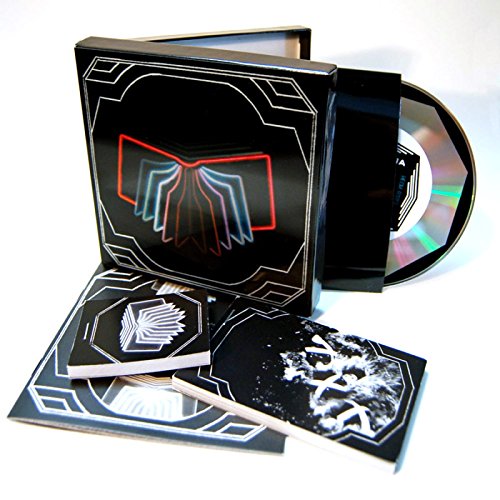


 The Fat Angel Sings