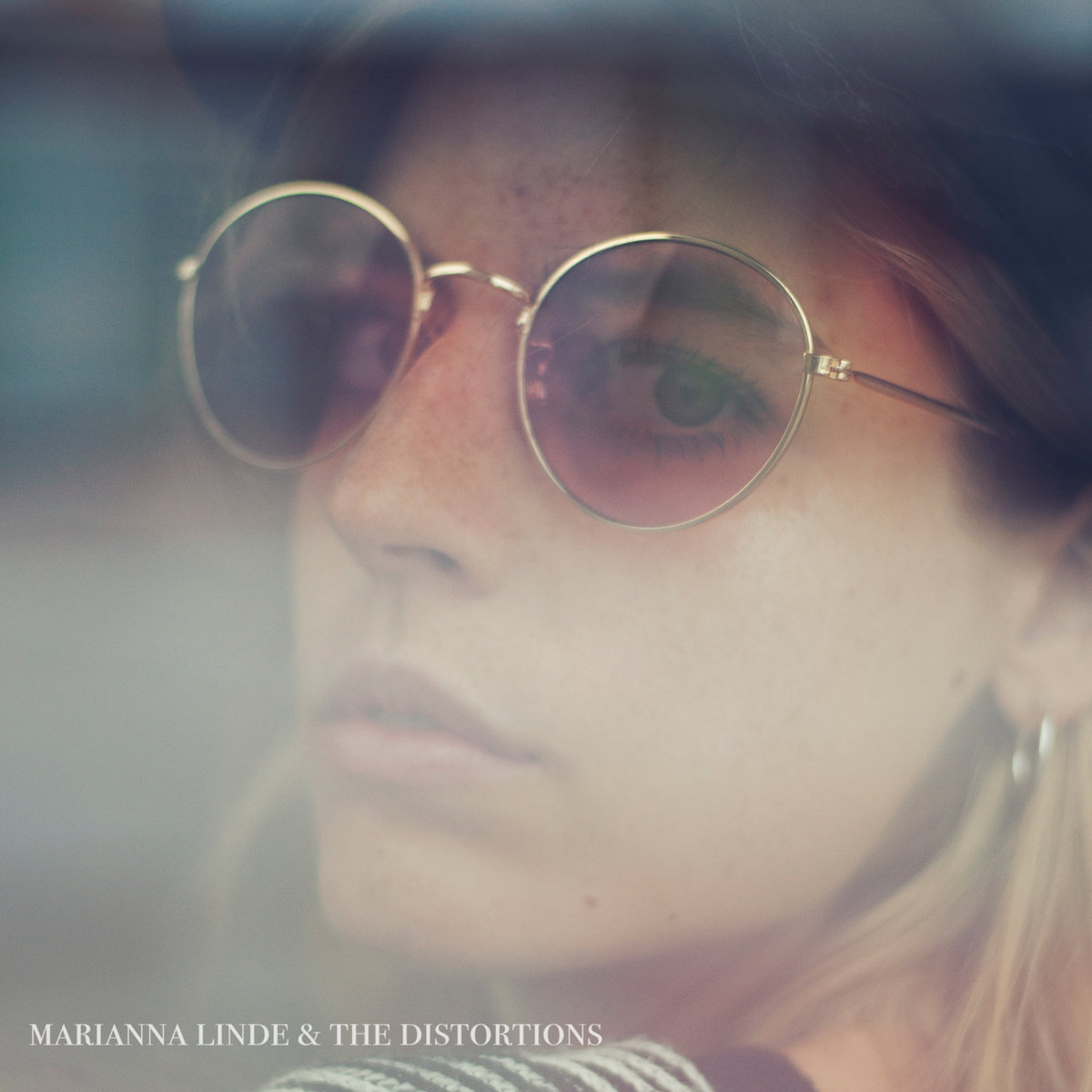
This album was recorded May 1st-4th 2017 at Uniform Recording by Jeff Zeigler. It was mastered by Carl Saff. Jeff Bolt played drums. Sam Cook-Parrott sang and played guitar. Jon Rybicki played bass. Cynthia Schemmer played guitar and sang. All words written by Sam Cook-Parrott except “Sycamore” which is a song by the band Martha. Front cover art by Jason Roy. Back cover photo by Catherine Elicson. Layout by Mikey Cantor. Thank you from the bottom of our hearts to Jeff, Carl, Jason, Catherine, Marco, Mikey, Eloy, all our housemates for putting up with loud practices, everyone who ever booked us a show, everyone who has supported our music.
The album Honeymoon by Lana Del Rey swims, lounges and mugs for the camera in the impressionistic video for her Honeymoon tune “Music to Watch Boys To.” Although the clip features a few scenes that live up to the song’s male-objectifying title, the most curious vignette finds the singer reclining in a beach chair as gramophone horns spin around her and the silhouette of one of her boys plays basketball. Then, after a shot of them playing hoops, the camera gives her a close-up for her line about “singing soft-grunge.” Honeymoon is Lana Del Rey’s best yet album.
For her third long player ,the lyrical clichés that bogged her down before are still present, but far less frequently. In fact, those that remain often add charm to the Lana Del Rey experience. She’s finding her voice and owning a persona that’s unlike any of her pop peers. We’re ready to forgive her for whatever she was singing about Florida kilos — here are Honeymoon’s top 10 moments of Lana being Lana.
“All I wanna do is get high by the beach.” – “High By the Beach”
“Club queen on the downtown scene / prowling around at midnight” – “Art Deco”
Get ready to hit the club with Lana, and maybe Azealia Banks, the rumored subject of this song. When you open a song with this couplet you know you’re getting peak LDR; in this case, focused on fervor for 1920s American culture.
“Ground control to Major Tom / Can you hear me all night long?” – “Terrence Loves You”
Sometimes Lana’s lyrics really make the grade.
“Now you’re just another one of my problems / Because you got out of hand / We won’t survive, we’re sinking into the sand” – “High by the Beach”
There’s more to this song than the bowl-passing mantra of its chorus. In the second verse, Lana gets the upper hand on a lover who’s not worth it while alluding to the beach theme.
“Don’t you know, no one alive can always be an angel?” – “Don’t Let Me Be Misunderstood”
Lana didn’t write this one, of course, but she couldn’t have chosen a more lyrically appropriate song to take on.
“Come to California / Be a freak like me, too” – “Freak”
A lust for California has been in American pop music almost as long as there’s been American pop music. You know Lana’s Americana joy ride is going to stop there, and she doesn’t care if you think it’s cliché or not.
“When I’m down on my knees, you’re how I pray” – “Religion”
She’s made a lover her national anthem before, and now she’s calling one her religion. You better believe she’s going to juxtapose church with getting dirty.
“Calling out my name in the summer rain, ciao amore / Salvatore can wait / Now it’s time to eat soft ice cream”
– “Salvatore”
Lana is putting love on hold for the munchies. “Now it’s time to eat soft ice cream”: coming to a meme near you in fall 2015.
“Beatboxing and rapping in the summer rain / Like a boss, he sang jazz and blues.” – “Salvatore”
“Carry me home, got my blue nail polish on / It’s my favorite color and my favorite tone of song.” – “The Blackest Day”
When the singer premiered the tune, which she co-wrote with “Summertime Sadness” collaborator Rick Boyles, on Zane Lowe’s Beats 1 show earlier this month, she called it one of her favorites on the LP. In an interview with Los Angeles Times, she spoke on the song’s evocative nature. “The title lends itself to a visual of shadows of men passing by, this girl’s eyes, her face,” Del Rey said. “I can definitely see things.”
Del Rey put out Honeymoon earlier this month and, prior to its release, recently premiered another song, “Salvatore,” via BBC 1. “[It’s] the most different from all the other tracks on the record,” she said at the time. “It has a little bit of an old world Italian feel, it’s kind of a weirder song, but I love the chorus.”
Del Rey has compared the album as a whole to her first two releases, Born to Die and Paradise. “It’s growing into something I really like,” she said of Honeymoon in an interview with Billboard in January. “I’m kind of enjoying sinking into this more noirish feel for this one. It’s been good.”
If you’ve ever called up one of those numbers you see in a movie or on an album sleeve, the likelihood is you will be put through to an automated line or the number won’t exist. The chances of you speaking to anyone actually interesting are very, very slim.
Lana Del Rey’s doing things a little different. On her latest release,Honeymoon, she included a phone number on the cover: 1-800-268-7886. Surprisingly, if you call the number, it goes straight to Lana .
By their very nature, King Gizzard have always appeared to value loose spontaneity over the close approach of the craftsman. Since emerging from Melbourne in 2010, this seven-headed psych-rock monster have released seven diverse albums, each capturing quick-fire bursts of inspiration, and thrilling in their imperfections and impulsiveness.
On I’m In Your Mind Fuzz, their garage-punk breakthrough from late 2014, they managed to create half a concept album about mind control, before losing concentration and filling Side Two with slower, disjointed songs recorded at a different studio. As their notoriety grew, their restless, relentless muse last year spawned two albums exploring different tangents of their scattershot sound – Quarters was a laidback, semi-improvised effort with four tracks each lasting exactly 10 minutes and 10 seconds (it bizarrely bagged a Best Jazz Album nomination at the ARIAs), while autumn’s Papier Mâché Dream Balloon consisted of uncustomary pastoral, acoustic rambles.
Yet we now learn that these two albums were merely stopgaps, recorded while singer and guitarist Stu Mackenzie and his six cohorts secretly toiled on a project that would finish what they attempted with I’m In Your Mind Fuzz – a bona fide concept album, unified in sound and vision. While the last decade has undoubtedly been a fertile time for the kind of underground rock that takes inspiration from garage, punk, prog and psychedelia, Ty Segall, Thee Oh Sees and their ilk have so far attempted little on this scale.
Although it was tracked in four days at the all-analogue Daptone House Of Soul in Brooklyn, New York, Nonagon Infinity was meticulously planned beforehand, then the subsequent recordings were subjected to endless tinkering back in Australia. The need for this work becomes clear when the album is heard – each song on Nonagon segues into the next, while the end of the final track, “Road Train”, can even be looped straight back to careen headlong, Möbius strip-style, into the opening song, “Robot Stop”, their beats matched and primed. What’s more, various melodies, riffs and refrains pop up repeatedly throughout the album, making it more akin to a 41-minute suite than nine separate songs.
On first listen, Nonagon is a hard-driving, exhausting beast; powered by two drummers, “Road Train” edges into Motörhead hard-rock, while “Big Fig Wasp” continues King Gizzard’s adoration for Thee Oh Sees, mixing a motorik beat with Mackenzie’s echoed whoops and demonic guitars (chief Oh See John Dwyer fittingly released I’m In Your Mind Fuzz on his Castle Face label in the US). The seven-minute “Evil Death Roll” harks back to the manic momentum of Hawkwind’s Space Ritual version of “Master Of The Universe”, with distorted organ and super-wah’d guitars adding to the onslaught. There are few simple thrills here, as beats are dropped and riffs gallop along in unwieldy time signatures – “Gamma Knife” might be the most driving song ever conceived in 6/8, while “Nonagon infinity opens the door” is an earworm in 7/8 time. Though Mackenzie barks out vague orders on “Robot Stop” – “Loosen up/Time to jump/Fuck shit up/Don’t forget about it” – his lyrics are often unintelligible through the fuzz, with Hammer horror images of “corpses”, “pitchforks” and a “final hearing” breaking through the haze.
With repeated listens, however, what first seems like an oppressively flat landscape – giant steppes, perhaps – gradually reveals relief, and a lot more nuance that rewards repeated immersion. Subtler elements begin to peek out from the hard-driving tempos: the electric saz solo on “Robot Stop”; the synth storm swelling up in “Big Fig Wasp” that seems to mimic said insect’s mighty buzzing; the middle of “Invisible Face” that echoes the cool-jazz labyrinths of Quarters opener “The River”; the sections on “Wah Wah” that nod to the acoustic reveries of Papier Mâché…. The entirety of the punning “Mr Beat” is five minutes of relative respite, its clowning keyboards and falsetto reminiscent of Unknown Mortal Orchestra. Elsewhere, fidelities shift between (and even within) songs, with Mackenzie deliberately moving microphones around between takes to get more sonic variation.
As King Gizzard’s frontman tells Uncut, making Nonagon Infinity was a gruelling experience compared to the relatively breezy gestation of their previous work, and yet this prolonged concentration has resulted in by far KingGizzard’s most cohesive record to date – a hyper-detailed punk opera that few of their peers have matched for intensity, ambition or sheer derangement. It’s no accident that the end of the album links up to the start: those who listen may find it difficult to get off this particular Möbius strip.
2LP plus 24 page book + DL Card. Emerging after The Lemonheads disbanded Evan Dando returned to music first with a solo tour and ‘Live At The Brattle Theatre’ then came his debut solo album ‘Baby I’m Bored’. During his hiatus he sobered up, got married and went straight. Taking four years to produce, his live shows funded the album’s recording sessions. Mature and autobiographical, ‘Baby I’m Bored’ is a stellar record that stripped Dando of his grunge label.
At the time of recording, he was without the band which saw him lean more towards an achingly melodic alt-country rock sound. Self-deprecating, these are songs of decline and coming back from that. The record includes “Hard Drive” and “All My Life” two tracks penned by Ben Lee and features contributions from producer/composer Jon Brion, producer Bryce Goggin, Tom Morgan, Giant Sand’s Howe Gelb, Calexico’s John Convertino and Joey Burns, ex-Spacehog frontman Royston Langdon, Come’s Chris Brokaw and Arthur Johnson.
This limited edition special Record Store Day 2LP ‘bookback’ reissue includes a disc of unheard unreleased tracks, singles, b-sides and rarities. “Dando has a flair for bruised melancholy that stands comparison with Gram Parsons and Alex Chilton.” Q Magazine / “A beautiful album of tender reflections on life, love and drug-induced folly set in soulful, countrytinged guitar pop.” The Independent
Disc 1 A1 Repeat A2 My Idea A3 Rancho Santa Fe A4 Waking Up A5 Hard Drive A6 Shots Is Fired B1 It Looks Like You B2 The Same Thing You Thought Hard About Is The Same Part I Can Live Without B3 Why Do You Do This To Yourself? B4 All My Life B5 Stop My Head B6 In The Grass All Wine Colored Disc 2 C1 Shots Is Fired (Alternative Version) C2 I Wanna Be Your Mamma Again (Cover – B-Side from ‘Stop My Head’ Single) C3 Tongue Tied (B-Side from ‘Stop My Head’ Single) C4 Whoops C5 Sucker Punch C6 The Same Thing You Thought Hard About Is The Same Part I Can Live Without (Alternative Version) D1 Au Bord De La Seine (B-Side From ‘Stop My Head’) D2 Rancho Santa Fe (Alternative Version) D3 A Walk In The Woods With Lionel Richie D4 Rudy With A Flashlight (Evan Dando) D5 Hannah & Gabi (Live Version – BSide to ‘It Looks Like You’ Single) D6 The Same Thing You Thought Hard About Is The Same Part I Can Live Without (Live Version – B-Side to ‘It Looks Like You’ Single)”
Amazon is hoping to soundtrack your late-summer road trips with their new Open Road playlist, which features 30 contemporary artists covering various car- and traveling-themed anthems. Artists include Hamilton Leithauser, White Reaper, and the blissed-out Bloomington, Indiana trio Hoops, who offer a dazed, hypnagogic rendition of Prefab Sprout’s “Cars & Girls.” “We chose to do ‘Cars And Girls’ because Prefab Sprout is one of our favorite bands in the whole wide world,” the band explain. “It’s not necessarily our favorite Prefab’s song but it was a whole lotta fun to cover.”
The accompanying music video from Weird Life Films is also a whole lotta fun, hitting that sweet spot between goofy sincerity and winking homage. “After losing a location last minute we ended up barreling over the skyway into Indiana to find an abandoned-ish highway hot under the sun near some oil fields,” says Weird Life Films. “There we took over the concrete strip after letting the oil field security know we weren’t terrorists. Before lastly hitting back to Chicago & wrapping up the foggy shoot as the rain storm hit.
Harkening back to their 1997 release of three consecutive EPs (‘Dog On Wheels’, ‘Lazy Line Painter Jane’, and ‘3.. 6.. 9 Seconds Of Light’), Belle and Sebastian will release three new EPs under the umbrella title ‘How To Solve Our Human Problems’, with the first EP coming out on December 8th, the second on January 19th, and the third on February 16th (vinyl and digital only). The EP trilogy will culminate with a compilation CD and a limited vinyl box set containing all three EPs, with the option of a box just for EP3 for those who have already purchased 1 and 2.
Belle and Sebastian has revealed a new song titled “I’ll Be Your Pilot”, which can be found on EP2. The single takes as its subject Stuart Murdoch’s young son: “Having your first kid is a huge event, so I wrapped a lot of things I felt about Denny into the song. Being a dad made me feel a little like the pilot in The Little Prince, hence all the references to the Sahara!”
Just as those three early EPs are a crucial part of the Belle and Sebastian canon, these three new releases aren’t merely a detour between albums, but as definitive releases in their own right. ‘How To Solve Our Human Problems’ is both an era of its own, and part of a long, rich history. ‘How To Solve Our Human Problems’ is, if you like, Belle and Sebastian Redux.
When Belle and Sebastian felt new music percolating, they decided to break from the working methods of the recent years and instead stay at home, record the tracks as and when, often producing themselves, working with friends and collaborators to see what emerged. Working in Glasgow gave them the freedom to work without the constraints that making an album can impose: they could take their time honing and experimenting.
One thing that has defined Belle and Sebastian has been their relationship with fans, and that’s apparent in the new EPs. For the three sleeves, the group issued a call to fans to come to be photographed by Murdoch at a studio in Belsize Park in North London. Fifty were selected, and all those photographed were also recorded answering the question: “How do you solve your human problems?”
There’s something extraordinary about the story of how Anna Burch came to sign for PolyvinylRecords. The Detroit songwriter was spotted by fellow Michigan native, and Polyvinyl artist, Fred Thomas, who sent it straight to his label boss with a simple note, “This is not a drill. You need to hear this.” Listening to Anna’s new single, 2 Cool 2 Care. Anna Burch is the newest addition to the Polyvinyl label. She released a self-directed video and is hitting the road. Anna used to be in a band that was a favorite of Ours, Frontier Ruckus. Now she’s taking her lovely vocals on her own.
2 Cool 2 Care is the first track to be lifted from Anna’s as yet untitled debut record out next year, an album she recorded with Angel Olsen producer Collin Dupuis. The track is a simple, but arresting piece of lo-fi atmospherics, Anna’s warm, laid back vocals, accompanied by a Frankie Cosmos-like guitar line and the simplest of ticking drum beats, an example of the whole far outweighing it’s parts. Lyrically, it seems to tackle the self-destructive tendency to over-analyse and pressurise relationships, as Anna sings, “you scare me when you’re indifferent, I like you best when you’re a mess”. Sure, we’re suckers for a hazy slice of sun-drenched melancholy, but Anna Burch might just be doing it better than any act we’ve heard this year.
Anna Burch’s debut album will be out next year via Polyviynl Records.
“Plus ça change, plus c’est la même chose,” sayeth the French. Just more than a year ago, Heaters shepherded the release of “Baptistina” into the world, which itself followed their debut album, “Holy Water Pool,” by less than a year. Now, the Michigan-made music machine is set to lay claim to a new parcel of mountainous terrain, in the form of their latest release on Beyond Beyond Is Beyond, entitled “Matterhorn.”
It’s a relentless pace, made all the more impressive not by the infrequency with which its met by Heaters peers, but rather by the lasting quality of each release. In this way, “Matterhorn” is more of the same—thirty-eight minutes of propulsive, precisely sculpted sonic signatures. In other crucial ways, however, “Matterhorn” represents massive change for Heaters: first, in the form of a largely revamped line-up, and second, in the form of an album whose wave crests above even the band’s previous high-water marks of consistency.
Short of attending group therapy together, it’s difficult to ascertain exactly what contributions these new sparks have contributed to Heaters overall sound, just as it’s impossible to dismiss how utterly ignited by change “Matterhorn” sounds as a result. If “Baptistina” showed a picture of a band attaining greater control
Joey Santiago, lead guitarist for alt-rock band the Pixies, was never into playing fast. He says it’s just too much work.
“There were enough people doing it,” Santiago says of the guitar shredders. “I wasn’t going to join that bandwagon at all. I couldn’t remember anything about it other than, ‘Wow, that’s fast!’ Really, that’s all you’re going to say about it. Yeah, it’s fast. But if you listen to the phrasing of George Harrison and other guitar players like that, it’s like, ‘That’s more my speed right there.’ I mean, I try to have a slower hand than [Eric] Clapton. I have a syrup hand. Maple, not corn syrup.”
Since Pixies formed just over three decades ago, Santiago’s angular, minimalist approach to the guitar has been an integral part of the outfit’s idiosyncratic sonic palate. Rather than cramming notes into the songs, Santiago leaves space between the notes, letting his riffs ring and breathe. He says it’s about being patient and not being in such a rush.
“That’s hard for me to do because I’m so manic,” Santiago says. “It’s like, ‘Okay, fucking slow down, goddamnit.’ And when you finally find that out, it’s hard. It’s hard to remember to do that. It works. You don’t have to talk all the time. It’s having a conversation.”
While Santiago has no problem conversing musically, he admits that outside the band, he’s still the worst communicator. “I just am,” he says. “I try not to be such a social misfit. When [people] meet me for the first time, they just go, ‘What the fuck is up with him?’”
That even goes back to his days as a high school quarterback in his home town of Longmeadow, Massachusetts. “I just didn’t talk at all,” he says. “The coach would try to have me talk to him, and it was like, ‘No, please. I already know what to do.’”
Santiago might not be the best communicator, but the same could have been said for the rest the band members earlier in their career. Santiago, frontman Black Francis (born Charles Thompson), drummer David Lovering and bassist Kim Deal released five studio albums from the time the band formed in 1986 through its breakup in 1993. Eleven years later, the band reunited, and some of the reunion tour was captured in the 2006 documentary loudQUIETloud, where Deal’s sister Kelley said, “You guys are the worst communicators ever.”
But since Kim Deal left the Pixies in 2013, during the recording of Indie Cindy, there’s been a different chemistry in the band with the arrival of bassist Paz Lenchantin, who came on board in 2014 as a touring member.
“She’s just brought in a new kind of energy,” Santiago says. “She’s just a very, very positive person. She belonged right away.”
Following Deal’s departure, he says, the musicians didn’t know if they were going to keep going as a band.
“It’s just a miracle that we did just keep going,” Santiago says. “This is what we know how to do best. We don’t know any…I don’t know what else to do. It’s what I’ve wanted to do since I was, I don’t know, eleven or something. It’s happened. Nothing is going to get in the way of it. Nothing. I’ve paid the dues. We were getting paid by pizzas and beer and gas money. We drove ourselves. And it’s like there’s no fucking way I’m going to… and then we went from tour buses to nice hotels. It’s like, nah, I don’t want to do anything else. Let’s just try to keep this going.”
They kept forging on, indeed. WhileIndie Cindy, the band’s first album of new material in two decades, was not one of the act’s stronger releases, they more than made up for it on last year’s Head Carrier, which includes tunes like “Bel Esprit,” “Might as Well be Gone,” “Classic Masher” and “Oona” that evoke classic Pixies songs.
“We’re so unique that why fight it?” Santiago says. “I’ve been trying to fight it for a while. When I give up, that’s when it comes naturally. When I just go, ‘Okay, you know what? You’re not that bad. Just do what you know how to do best and just go along with it.’”
While preparing to record Head Carrier, Santiago says, the process mirrored the making of the 1989 masterpiece Doolittle. All four bandmembers sat in a room and hashed out the songs and picked the ones to demo. They took the demoed songs to producer Tom Dalgety, whom the band met in 2015, and he chose the songs that he thought would be good for the album.
Santiago says the new material fits flawlessly into the band’s live sets. ‘It’s part of the language,” he says. “It’s seamless. It’s just totally seamless. You know, we notice some of the kiddos out there singing along with it. It’s nice.”
On the current tour, the band has been drawing from some ninety songs that it’s rehearsed.
“It’s just the way it is,” he says. “I think at this point, a set list would just confuse us. Looking down and, ‘That’s next.’ How do you even know what’s next? You can’t even tell if it’s going to be appropriate for the next song. You don’t even know what our mood’s going to be like at the end of two minutes.”
The band debuted their first release under the name Sasha Shevchuk in 2015 and now their back with a neo-Psychedelic banger that’s more focused than ever. Marianna’s voice is so powerful and with it being caressed by shimmering delays this album’s sound provokes the darker side of the Lofi Psychedelic genre, jointing hands with the likes of The Black Ryder, BJM and Tess parks but with distinct/unique tonality.