Parquet Courts have announced that they will release their fifth album ‘Wide Awake!’ – produced by Danger Mouse due on 18th May, and the band will be heading out on a worldwide tour in support.
On working with producer Danger Mouse, A. Savage explains: “The ethos behind every Parquet Courts record is that there needs to be change for the better, and the best way to tackle that is to step out of one’s comfort zone. I personally liked the fact that I was writing a record that indebted to punk and funk, and Brian’s a pop producer who’s made some very polished records. I liked that it didn’t make sense.”
For both Savage and co-frontman Austin Brown, this record represents the duality of coping and confrontation. “In such a hateful era of culture, we stand in opposition to that — and to the nihilism used to cope with that — with ideas of passion and love,” says Brown. He goes onto say that he found himself “writing songs I’ve been wanting to write but never had the courage” on this record.
A deluxe vinyl includes a 16-page double booklet of art and illustration by the band’s Grammy-nominated artist A. Savage – available exclusively from the Rough Trade Records webstore and all other indie relatailers. Here’s a sneak peek: get a load of “Almost Had To Start A Fight / In And Out Of Patience” – the first (double shot!) track to be unleashed from the album:
On their first LP, 2015’s brilliant Metalmania, New Zealand’s Salad Boys built hooky, radiant songs from silvery strands of guitar, recalling the same effortless gift for melody as fellow countrymen The Bats as well as Reckoning-era R.E.M. Every song on the album felt wide-eyed and optimistic, frontman Joe Sampson’s voice front and center in the mix, the guitars ringing brightly behind him. The mood is decidedly grimmer on “This isGlue”which, like its predecessor, was recorded and mixed in Sampson’s home studio. Those claustrophobic environs suit Glue’s paranoid mood. Opener “Blown Up” rides a tense, krautrock rhythm, and Sampson’s voice is hushed and distant. When the guitars finally enter, one minute into the song, they arrive in great, furious slashes, a far cry from Metalmania’s church-bell pealing.
The result is a record that is marvelously tense and coiled; “Psych Slasher” is aptly named, a big, roaring garage rock song that wouldn’t be out of place in the Goner catalogue. “Choking Sick” heaves and stutters, Sampson repeating the same two-note vocal melody over and over as the drums kick and clatter behind him. “Under the Bed” is draped in funereal synths; “Scenic Route to Nowhere” is a three-minute festival of scuzz and rattle. “Hatred,” with its open arpeggios, is the closest in tone to Metalmania, but Sampson sighs out his vocals, undercutting the spiraling guitars with a twinge of melancholy. The album’s title is appropriate—every song feels caked in gluey layers of distortion, but instead of capsizing the record, the bleariness instead makes the record feel drifting and dreamlike. If Metalmania was a crisp, hi-res photo of a mountain range on a sunny day, Glue is that same photo during a rainstorm, with the focus off.
The Pretty Things started as blues-rock band in the early 1960s, and they’re often described as being “meaner, louder, uglier and with longer hair” than the Rolling Stones. (Pretty Things guitarist Dick Taylor originally played bass in the fledgling Stones). Their gritty, primitive R&B sound was heavily influenced by Bo Diddley’s beat.
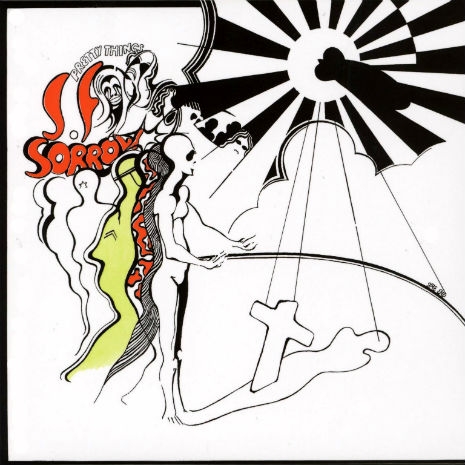
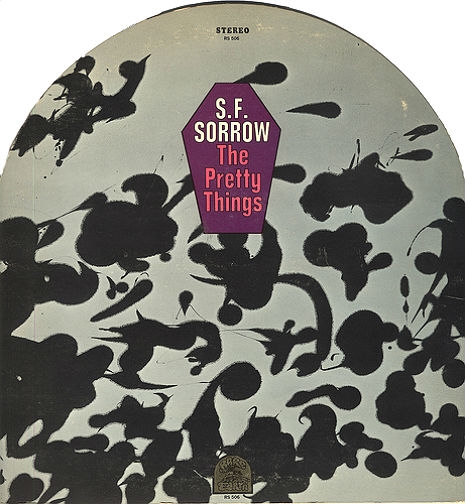
With their fourth album, “S.F. Sorrow”, the Pretty Things decided to shake it up a bit and create a psychedelic rock opera that some regard as a “lost”—or at least unfairly underappreciated, A mini masterpiece . It’s held in the same high regard as another “lost” 60s classic, Odessey and Oracle by the Zombies. In fact, S.F. Sorrow was the actually the very first rock opera, not Tommy. Although Pete Townshend has pointedly denied that S.F. Sorrow was an influence on Tommy, this seems unlikely at best: They were both of the same London scene.
Possibily the first rock opera. As good a document of what a band infatuated with the blues could do within the burgeoning psychedelic scene. The cradle-to-grave story of S.F. Sorrow. Classic songs include “I See You,” “Baron Saturday,” “Old Man Going” and “Defecting Grey.” (Note: latter releases include the five-minute version of the latter and is not to be missed for its sheer ferocity.) To quote Richie Unterberger: “And it does show a pathway between blues and psychedelia that the Rolling Stones, somewhere between ‘Satanic Majesties,’ ‘We Love You,’ ‘Child of the Moon,’ and ‘Beggars Banquet,’ missed entirely.” This British group the Pretty Things, was released in December 1968, is generally considered to be among the first creatively successful rock concept albums, in that each song is part of an overarching unified concept – the life story of the main character, Sebastian Sorrow.
S.F. Sorrow was recorded between December 1967 and September 1968 at Abbey Road Studios. The sound incorporates the sitar, Mellotron, flute, dulcimer and several tripped out sound effects. At the same time as the sessions for S.F. Sorrow, at Abbey Road their album’s producer, Norman Smith was also working with Pink Floyd on their A Saucerful Of Secrets album and The Beatles were recording their White Album there as well. (S.F. Sorrow came out the same week as the White Album and the Rolling StonesBeggars Banquet. What a week for music.)
The Pretty Things S.F. Sorrow The title comes from the sad-sack protagonist who wanders through life unhappy before going nuts from regret. The opera’s libretto came in the form of liner notes that told the story of one SebastianF. Sorrow, an ordinary fellow who works at the “Misery Factory” and is drafted into World War I. His life descends into meaninglessness after he witnesses a hot-air balloon carrying his fiance crash and burn. Along the way he has an encounter with a mysterious whip-cracking character called “Baron Saturday” who is based on the voodoo deity Baron Samedi. The opera ends on a sad note as the desolate Sorrow realizes that he can trust no one and that he will die alone.
It’s a landmark because it ranks as the first rock opera. Rumor has it Pete Townshend started wringing his hands and concocting “Pinball Wizard” after hearing this.
Olden Yolk is a New York-based group whose penchant for dystopian folk, abstract poeticism, and motorik rhythms have enveloped them in a sound uniquely of-the-moment yet simultaneously time-tested. The project is currently led by songwriters, vocalists, and multi- instrumentalists Shane Butler and Caity Shaffer, whose interlaced vocals are found guiding each composition on their enlivening self-titled debut. The project was initially conceived in 2012 by Butler as an outlet for one-off songs and visual art while touring and releasing albums with the band Quilt (Mexican Summer). Following the release of a split-record with Weyes Blood in 2014, Olden Yolk became a collaborative entity.
Olden Yolk’s debut ruminates on questions surrounding love, self-doubt, and locating autonomy amidst burgeoning unrest. Wrought with hazy melancholy and halcyon joy, Butler and Shaffer’s lilting vocals play off one another through a devotional dialogue, taking form in haunting choral melodies and candid rock n’ roll. These songs are ecstatic odes to the life of the city; to the subway platforms, kiosks, and monuments which enliven and encompass our collectivity, elevating into an urban-psychedelia.
On the album, Butler and Shaffer are joined by drummerDan Drohan (Tei Shi, Uni Ika Ai) and guitarist JesseDeFrancesco who round out the studio sessions and live-band. Drohan’s deep passion for jazz, hip-hop, and experimental percussion come to fore while Defrancesco’s minimal yet powerful guitar ambiences are heard swelling in the peripheries of each song. The album was recorded at Gary’s Electric in NYC by Jarvis Taveniere (Woods) with co-production, electronics, and mixing by Jon Nellen (Ginla, Terrible Records). Other guests, such as multi-instrumentalist John Andrews (Woods, Quilt, The Yawns) and violinist Jake Falby (Mutual Benefit, Julie Byrne), add to the mercurial nature of the record, creating a landscape tinged with beatific songwriting and transgressive underpinnings.
All songs written & recorded by Olden Yolk (ASCAP) Olden Yolk is:
Shane Butler:
vocals, acoustic guitar, electric guitar, fx, keys, bass, production
Caity Shaffer:
vocals, piano, keys, bass, percussion
Dan Drohan:
drums, percussion
Jesse Defrancesco:
electric guitar, keys
Last week something beautiful came to fruition. Following a certain kind of bromance, the two bands connected after Smash Mouth proclaimed their love for Car Seat Headrest on twitter. The bands were then later egged on to collaborate. And they did.
Last week, Car Seat Headrest and Smash Mouth premiered their respective covers of each other’s work on SiriusXMU. Smash Mouth did a rendition of the “Teens of Style” track ‘Something Soon,’ while Car Seat Headrest took on Smash Mouth’s ‘Fallen Horses’ from the album 1999’s “Astro Lounge”.
Now CSH have shared their version for you all to enjoy in your own time. The brilliant version is what covers should be, an interpretation of a classic track by a different artist and Toledo and Co. really make the song their own.
Last year we heard from Melbourne punks Cable Ties l and thier track the feisty ‘Say What You Want’.
The three are equally on fire with latest single ‘Tell Them Where To Go’, digitally released via Poison City Records on February 2nd (with a limited edition two-song 7” ).
The four minutes of rock ‘n’ roll swagger with a punk sneer and typical Cable Ties toughness was inspired by spending time volunteering and playing at Girls Rock! camps in Melbourne and Canberra – a week long camp dedicated to helping young women, trans and non binary folk play music, form bands and build confidence.
Lead singer Jenny McKechnie says of the track: “It’s about ignoring everyone who tells you that you can’t play music because you don’t fit Western society’s expectations of who can be a ‘rockstar’ – an attractive white, straight, cisgendered man. It’s about finding new heroes who reflect your life experiences and learning how to tell your own story through rock!”
Cable Ties last released their self-titled debut album in May 2017 via Poison City Records. Poison City is an independent record label, distributor and skateboard/ music store based in Melbourne, Australia.
“Unhalfbricking” was the third album by the British folk rock band Fairport Convention and their second album released in 1969. It is seen as a transitional album in their history and marked a further musical move away from American influences towards more traditional English folk songs that had begun on their previous album, What We Did on Our Holidays and reached its peak on the follow-up, Liege & Lief, released later the same year. 1969 was a roller-coaster year for Fairport Convention. In January of that year they released their second album What We Did On Our Holidays, the first with singer Sandy Denny. In May they hit rock bottom with a tragedy that killed two people including one of its members. Miraculously they recovered and released the album that defines the Britishfolk rock revival of that period, the iconic Liege and Lief. By December Sandy Denny and bass player Ashley Hutchings had left the band to form Fotheringay and Steeleye Span and the classic FairportConvention lineup was no more. And that was not all, for these events book-ended one more album that the band managed to record and release during that prolific period, One of the classic records from that era, “Unhalfbricking”.
The band was going through a Bob Dylan phase at the time, resulting with three covers of his songs on the album. Dylan’s version of Million Dollar Bash, later to appear at the Basement Tapes album but at that point not yet released, came to the band through producer Joe Boyd’s song publishing company which had access to Dylan’s new recorded materials. The great mandolin accompaniment is courtesy of Dave Swarbrick, who made a number of excellent recordings with Martin Carthy between 1965 and 1968, and was called by Joe Boyd to guest on a number of songs on Unhalfbricking. Another Dylan cover was for a relatively unknown song, If You Gotta Go, GoNow. Dylan recorded it in 1965 for his Bringing It All Back Home album but decided not to include it in the album, instead releasing it as a single in the Netherlands in 1967. Manfred Mann covered the song soon after Dylan recorded it in 1965. Fairport Convention gave it an interesting twist by singing it in French, translated to Si Tu Dois Partir.
“Fairport Convention was playing a gig at the Middle Earth and thought it would be amusing to do Dylan’s song in French Cajun style, so the band called for volunteers from the audience to help with the translation. RichardThompson: “About three people turned up, so it was really written by committee, and consequently ended up not very Cajun, French or Dylan.” The studio version is a better attempt at the Cajun style, featuring Dave Swarbrick on fiddle, Richard Thompson on accordion and Trevor Lucas, who later formed Fotheringay with Denny, on triangle. The band was quite inventive when it came to producing interesting sounds in the studio. Joe Boyd, from his book White Bicycles: Making Music in the 1960s: “Martin created the Cajun washboard sound for “Si TuDois Partir” by stacking some plastic Eames chairs and running his drumsticks along them. The percussion break was supposed to feature an empty milk bottle lying on the topmost chair, but when the time came it fell and smashed on the floor. I signaled frantically to keep playing. The crash of broken glass was absolutely in time and worked perfectly, a good omen for the session.” The song was released as a single, reaching #21 in the UK singles chart, and got the band its only appearance at Top of the Pops on August 14, 1969.
Of the three Dylan covers Percy’s Song, recorded by Dylan in 1963 for his third album The Times They Are a-Changin‘. The song did not make it into the album and was released some twenty years later on the Biograph collection. The song lyrics are a futile plea to a judge to reconsider a harsh sentence given to a driver in a fatal car accident. Sandy sings a beautiful harmony with Ian Matthews who left the group after their previous album had been the band’s male vocalist Matthews left during the recordings for Unhalfbricking to make his own album Matthews’ Southern Comfort, after recording just one track, “Percy’s Song”, and her interpretation is the best I know for this lesser known Dylan tune. Guitar player Simon Nicol said this of Denny’s vocal on the song: “It needs a voice like Sandy’s to get the shades of emotion across, from moodiness to compassion to outright fury. There’s not many singers can do that.”
One song on Unhalfbricking points to the direction that the band will take on their next album. A Sailor’s Life is a traditional song brought to the band by Sandy Denny. The song, indexed as Roud 237 in the English Folk Dance and Song Society, was previously covered by Judy Collins on her album A Maid of Constant Sorrow in 1961 and by Martin Carthy on his second album from 1966. Fairport Convention’s version is a milestone in British folk rock, maybe the first time a serious rock interpretation was given to an old ballad. Sheila Chandra, who was inspired by Sandy Denny’s delivery of the song and later covered it herself, found similarities to Indian music in Fairport Convention’s version: “The track is actually a microcosm of 2,000 years of Indian music – it goes from Vedic chanting on two or three notes right through to full improvisations on a fixed note scale. All in one take. The band have realized that all folk music is based upon a drone, and shares a common root. For instance, the way the violin comes in with an insistent repeat of the drone note is reminiscent of the Indian wind instrument the Shenai, and its distant relative the shawm in Irish music. It all connects.” That violin is played by Dave Swarbrick, his finest contribution to the album.
Fairport Convention’s version of this poignant traditional song marks a pivotal point in the development of folk-rock, representing as it does a brilliant fusion of a traditional form with all the dynamic, exploratory approach of modern rock playing. The song had been a part of Sandy Denny’s repertoire when she joined Fairport. As a traditional song it had been known in many forms. A Sailor’s Life starts as a plaintive lament on the fickleness of sailors and the agonised waiting endured by their sweethearts until their return. The terrible irony of her rather bitter condemnation of the sailor’s life as ‘merry’ is brought home by the subsequent tragedy. The singer extols her beloved’s virtues before she sets off to find him. She hails a passing ship and is told that he is feared drowned. Beside herself with grief and despair, she runs her boat against a rock. This could be seen as a metaphor for another tragedy as she takes her own life. The song then echoes the stormy course of the bereaved woman’s grief, as it takes off into a passage of terrific ensemble playing, all instruments interweaving, building to an overwhelming intensity, before settling to a sombre resolution. There are echoes of everything from dirges to hornpipes in an extraordinary composition. The Unhalfbricking album, from which A Sailor’s Life comes, foreshadowed the more overtly folk-rock album Liege & Lief, often considered a classic of its kind. The title Unhalfbricking was taken from a word Sandy Denny came up with in the word game Ghost. The track A Sailor’s Life was done in one take.
John Wood, who was the principal sound engineer in the studio, recalls the recording of the song: “Richard and Sandy came in and said “we really think we can only do this once”. They already got Dave Swarbrick in to play on it. We put Sandy in a vocal booth (she had an awful cold that day too) and everybody else in a big semicircle. When you want to cut that sort of track, its not easy for people to work if its all sectioned off, so it was very open and that was it, one take, done. No overdubs.” Dave Swarbrick was given no specific instructions as to what to play on the song other than to just come in when the singing stops. He had fond memories from the session as well: “Sandy had a great band to soar over and a great bunch of musicians who were sympathetic. Richard and Sandy worked closely together. Richard was awesome, of course. That should be his middle name. But the band was cohesive and so special, the chemistry worked and the line-up was sensational.”
I have two favorite songs on this album, and one of them is Sandy Denny’s Who Knows Where the Time Goes?.Denny wrote the song early in her career with the original title The Ballad Of Time. She was not yet 20 years of age when she wrote the mature lyrics about the passage of time. She sang it during her short stint with the Strawbs in 1967, accompanied by Dave Cousins on guitar. Judy Collins gave the song an interpretation in 1968 on her album of the same name and as a B-side on her single Both Sides Now.
The song became one of Denny’s most enduring and beloved songs, and in 2007 it was voted by BBC Radio 2 listeners as their favorite folk rock track of all time. It was the last song to be recorded for “Unhalfbricking”, and the last drummer Martin Lamble will ever record with the band.
The album was recorded in the early months of 1969 at Sound Techniques and Olympic Studios in London. Sound Techniques was a go-to studio for many great psychedelic, rock and folk British acts of the time, including Nick Drake (Five Leaves Left, Bryter Layter), Incredible String Band (The 5000 Spirits Or The Layers Of The Onion), Jethro Tull (This Was), John Martyn (Solid Air), Pentangle (Cruel Sister), Pink Floyd (Arnold Layne), Steeleye Span (Parcel Of Rogues) and Fairport alumni Richard Thompson and Sandy Denny. JohnWood assembled a roster of first-class musicians who acted as the house band for a great variety of recording sessions. Not surprisingly, many of them were associated with Fairport Convention, including Dave Mattacks and Gerry Conway on drums, Danny Thompson, Dave Pegg and Pat Donaldson on bass, Richard Thompson, Jerry Donahue and Simon Nicol on guitars.
“Unhalfbricking” was released in July of 1969, several weeks after the fatal accident on the M1 that killed drummer Martin Lamble and Jeannie Franklin (“Genie the Tailor”, who designed clothes for west-coast pop and rock elites), Richard Thompson’s recent girlfriend. The event questioned the band’s resiliency, and was followed by an amazing period of recovery that gave birth to Liege and Lief. Franklin was immortalized a month later when Jack Bruce dedicated his debut solo album Songs for a Tailor to her, and Elton John’s Tiny Dancer is likely about her as well with the telling lyrics “Blue Jean Baby, L. A. lady/Seamstress for the band”.
“Unhalfbricking” climbed to a respectable #12 in the UK album chart, its name penned by Sandy Denny who came up with the made-up word in a game of Ghost the band was playing while traveling in their beat up van to shows. Uncharacteristic for its time, the front cover features a single photograph with no indication of the band or album name. Two people, Sandy Denny’s parents, are standing in front of their house on Arthur Road, Wimbledon in the autumn of 1968. In the background we can see the band lounging in the front yard. Even more uncool is the back cover with a picture of the band engaged in the domestic task of having a meal. The whole package smells of looking back at days of yore, keeping a distance from current trends.
A&M Records, who distributed the band’s albums in the US, found the album cover’s concept abnormal and instead decided in a curious creative burst that the average American consumer’s palate might appreciate a photo of three dancing circus elephants with a girl dancing (balancing?) on top. Underestimating the American record buyer’s tolerance to the unknown, the band and album titles were slapped on the US album cover.
The B-side on the single Si Tu Dois Partir went unnoticed at the time but over the years became one of RichardThompson’s favorite performance songs. It is also my favorite tune on the album, achingly sang by Sandy Denny. It is one of the first in Thompson’s career-long strike of beautiful melancholic songs, the album opener Genesis Hall. Thompson on the topic of the song: “Genesis Hall was the name of a building in London that was occupied by squatters. The police went in and were far too brutal in evicting the people. My father was a policeman at the time, and although he was not involved in this operation, I could see the situation from both the squatters’ and police’s points of view. This was conflicting for me, and I tried to express that.”
The August 1969 issue of the underground newspaper International Times mentions an incident that took place in the Drury Lane Bell Hotel involving police and squatters. It happened in March of that year, when FairportConvention was in the process of recording Unhalfbricking: Thompson covers the song from time to time on his live shows, giving it a fantastic acoustic version. A great example is from the first episode of the BBC Songwriter’s Circle series from 2010.
Several reasons why this song moves me: The lyrics, again so mature for a 20 year old who has not written too many songs up to that point. The sad yet somewhat detached mood in which Sandy Denny sings them. The part where the whole band is soaring with her when they sing “Oh, oh, helpless and slow”. The dual guitar work by RichardThompson and Simon Nicol. Martin Lamble’s drumming, sadly not discussed too often, demonstrating his ability to play very interesting patterns behind the melody as if he was playing a melodic instrument himself. Only a month after the band finished recording the album Lamble died in that car crash. The band went through a rough period of mourning and healing and came out on the other end with the album that defines British folk rock. Check out Richard Thompson’s biography, written by Patrick Humphries. A great resource for Thompson’s fans and an interesting chronicle of Fairport Convention during the time Thompson was with the band.
Ashley Hutchings said in relation to the album cover photograph:
My memory of it is bound up with the terrible car crash. On the back cover we’re all eating around a table. The shirt and the leather waistcoat I’m wearing are what I had on when the crash happened. I can clearly remember them being bloodstained. You don’t forget things like that.
Martin Lamble, a talented musician, died in 1969 in a crash while returning from a gig, aged 19. Dave Swarbrick, a highly influential fiddle player, has had health problems but joined Fairport on stage for a number in August 2010. Simon Nicol has been the band’s lead singer and guitarist since 1975. Ashley Hutchings, an outstanding bassist, has been a major force in music and helps make folk accessible to younger listeners. Richard Thompson has composed many acclaimed songs and tours regularly. He appears in many polls for the greatest guitarists of all time. Sandy Denny composed many great and enduring songs. One of the greatest of English folk artists, she died 21 April 1978, aged 31, following a fall.
Despite the pluralized nom de guerre, illuminati hotties is the creative outlet of Sarah Tudzin – a producer and engineer hailing from the sprawl of Los Angeles. illuminati hotties has been lighting up stages across SoCal since Fall 2016 with playfully interweaving guitar lines, relentless rhythmic momentum, and strikingly self-aware vocals. At first listen, illuminati hotties is a sun-drenched, irreverent volley with the onset of adulthood, but as the listener dives deeper, they will find an earnest consideration of musical phrasing and deliberately crafted wordplay regarding the complexity of love, loss, and skateboarding. Lauded as local “tenderpunk pioneers,” illuminati hotties has perfected the blend of sweetness and ferocity, of celebration and despondency, in their debut album, Kiss Yr Frenemies.
Many of you have been waiting a long time for this, especially since we took a year off in 2017! So, we’re very proud to reveal our 2018 line-up. Malian music legends Amadou & Mariam, electronic party pioneers Basement Jaxx, acclaimed cinematic pop duo Goldfrapp and legendary punk band The Stranglers (Official) headline the weekend – arguably our biggest line-up of artists yet, perfect for our fifth anniversary!
Don’t forget to check our the rest of the festival programme beyond the music – the weekend is absolutely jam-packed. Thanks to partnerships with the Royal Shakespeare Company, the National Space Centre and the Glee Club Birmingham, we offer a whole host of theatre, science and comedy workshops and shows.
We are so happy to be bringing Lunar back in 2018 after a break this year – so much so that we thought 3 days just wasn’t long enough! If you agree with us, and want to come for the ultimate Lunar experience, you can now get an Early Settlers Ticket so you can come and enjoy the festival on Thursday 26th July as well!
Wilderness Festival has unveiled the first acts set for the 2018 edition of the Festival.
Taking place at Cornbury Park in Oxfordshire from August 2nd – 5th, the eighth edition will continue to champion its genre crossover with an eclectic mix of arts and music across the weekend.
From workshops and theatre to cabaret and politics, the family friendly festival is known for its multi-arts elements.
This year’s Wilderness headliners have been announced as Chic Ft Nile Rodgers alongside Bastille.
Joining the above on the line-up on the main stage are acts including Palace, Billy Lockett, Dan Owen and Stereo Honey.
The main stage will also be host to ‘An Afternoon with BBC Introducing’ with hotly tipped artists take to the stage, you may even spot a future headliner!